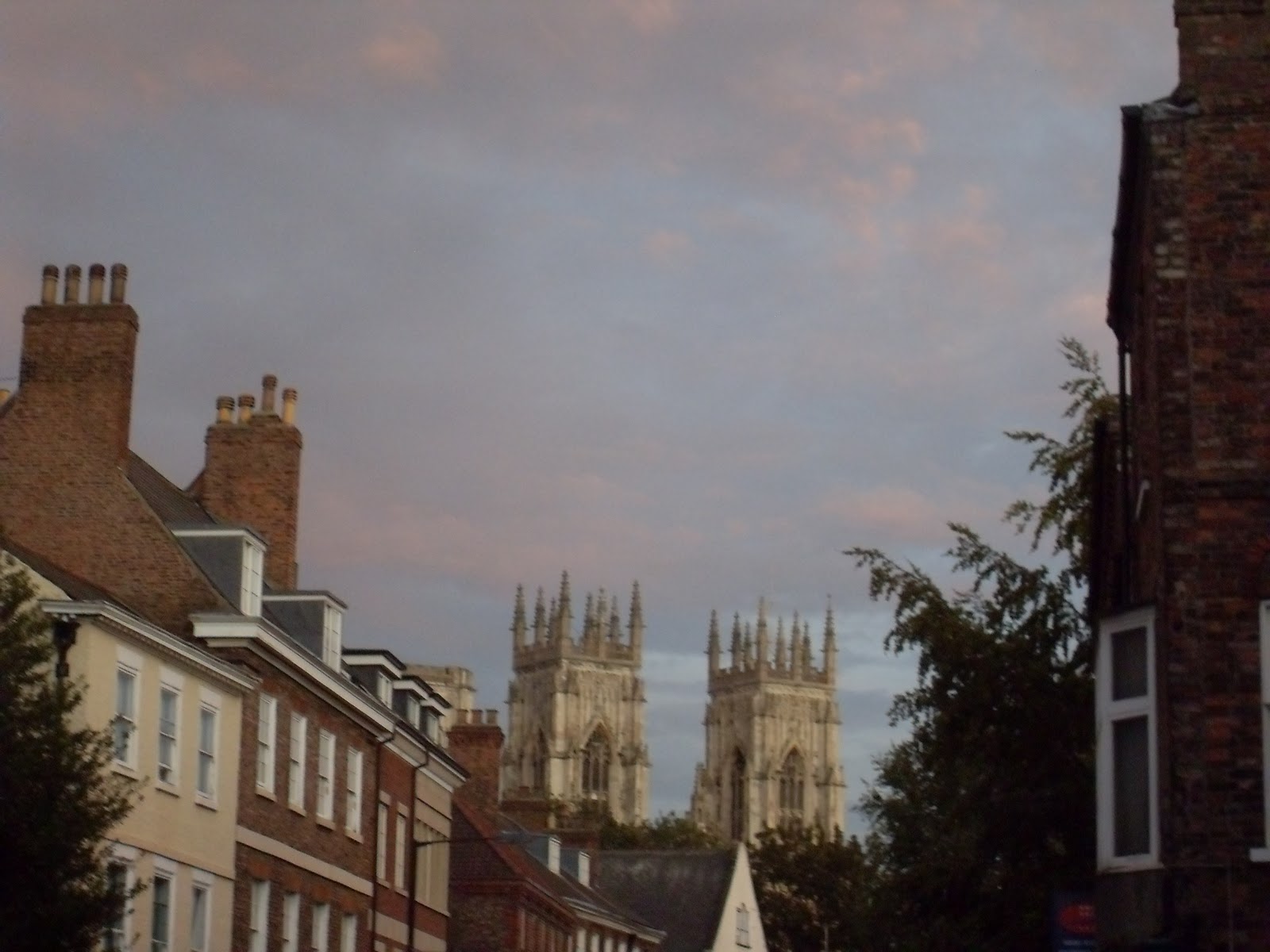
And was the holy Lamb of God,
On Englands pleasant pastures seen!
- And did those feet, William Blake
Viser innlegg med etiketten Nugae. Vis alle innlegg

tirsdag 30. januar 2018

Working with liturgical manuscripts, part 6 - Penmanship practice from pages past


As mentioned in previous blogposts, I'm currently engaged in a projects researching manuscript fragments in bindings from a book collection formerly at Herlufsholm School at Næstved, and purchased by the university library of University of Southern Denmark in 1968. In these relics there are many little details that provide interesting and curious glimpses of the past lives who have at various points been engaged with these books, either with the manuscripts before they were cut up for binding, or with the books in their manuscript bindings. One such case is Jacob, presumably a young boy who studied at Herlufsholm School (founded in 1565 and treated more extensively here), who seems to have practiced his penmanship, and his Latin, in a scrap of residual vellum on the inside of the covers of one of these books.


Inside of the back cover
Syddansk Universitetsbibliotek RARA Musik L 43

The book in question is a booklet of musical notation and lyrics by various composers, and its estimated date of print is sometime in the 1580s. It is one of several collections of songs that were kept at the school. We do not, to my knowledge, know how these books were used in the the study of music, whether they were handed out to students or not, but it is clear that young Jacob did have this book in his possession for long enough - and sufficiently out of sight - for him to practice writing his name, first in Latin and then in Danish, both of which were presumably taught at Herlufsholm.

Of Jacob nothing more is known to me at least, although I am sure his name can be located in school registers, and possibly also in other books throughout the collection, serving as evidence for his efforts to write his own name correctly in two languages.


mandag 22. mai 2017

The tooth of time - a little nugget from Ribe


As mentioned in the previous blogpost, the beginning of last week was spent in the southwestern Danish town of Ribe, an important medieval bishopric and now a quaint, lovely, old-fashioned, seemingly timelocked settlement near the Jutland coast. There are several gems to be found around the town, some of which are big and striking like the medieval cathedral, some of which are small and easy to overlook like the many beautifully and creatively painted doors.

One such little gem is a bronze sculpture situated outside Ribe Viking Museum. The sculpture was created by the Danish artist John Olesen (b. 1938) in 1995, and now welcomes visitors who seek to get closer to ages past by exploring the many treasures of the museum. The idea of "the tooth of time", which is "tidens tand" in Danish and "tidens tann/tidas tann" in Norwegian (Bokmål and Nynorsk respectively), is a Scandinavian expression to denote the passing of time left visibly on objects. We say that something has been marked by the tooth of time, an image of quiet nibbling that I find very pleasing and immensely poetic. A very fitting concept to be reminded of before stepping into a museum to behold items that have been gnawed away by the tooth of time.


fredag 20. april 2012

Life's Little Oddities, part IV - The Rockery


You could have got off with Shepherd Book at the Bathgate Abbey. Could've been meditating on the wonders of your rock garden by now.
- Capt. Malcolm Reynolds, Firefly S01E09

This month and the next my life is dominated by my MA thesis hurrying inexorably to its allotted end. One of the many consequences thereof will be that I no longer have that much time to dedicate on this blog, and my blogposts will be shorter, briefer and - much likely - more self-absorbed than usual. The subject of the first in what will probably be a long line of such posts is a minute feature in one of York's greatest attraction, the Yorkshire Museum and Gardens.


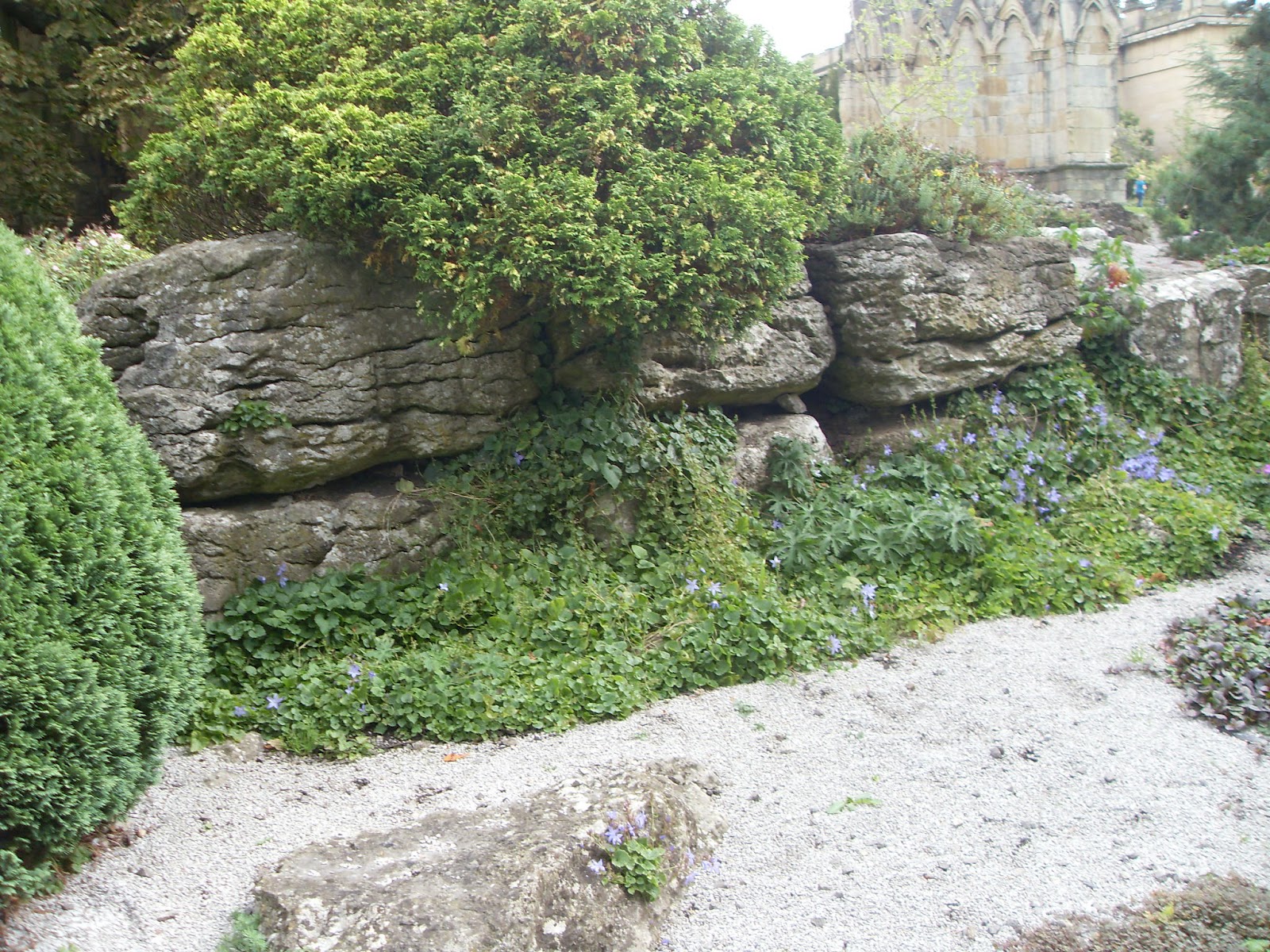
I was walking through the garden one day as I was wont to do when going between the city and Constantine House, when suddenly I noticed a sign telling me that what I had thought was rocks casually clumped together, actually was a deliberately designed rockery, a stone garden with alpine plants.


This stone garden was put together in 1980 by students of Askham Bryan College in commemoration of the Backhouse family nursery, an interesting feature of the city's commercial and scientific history that was operative between 1815 and 1955.


A nursery is a place for cultivation of plants, a business that stayed very lucrative throughout the 18th and most of the 19th century. The reason for this was that the gentry and the parvenus were putting up gardens and collecting curiosity cabinets, either for the purpose of displaying their wealth, acquiring knowledge or a blend of both, and this created a demand for plants to put there, preferably exotic and rare plants.

 
The Backhouse family nursery, first known as James Backhouse and Son of York, was established by James Backhouse III (1794-1869) and his brother Thomas (1792-1845). The brothers were of a wealthy Quaker family and this allowed them to buy the nursery of John and George Telford (or Tilford) situated on the grounds of an old Dominican friary at Tanner Row.


Since the wealthy of the north often were dependent on London nurseries to provide them with fine plants the Backhouse brothers' local supply must have made them ideally situated for competition with the southern businesses. When the railway station was built in 1841 transport became easier, faster and safer for the plants and seends. This was also a time when several new scientific societies, botanic and public gardens were founded and the upper classes, who made good money on the trade with the colonies, could afford to pursue their horticultural interests. In the decade leading up to the arrival of the railway in York, James Backhouse III had been away in Australia, engaged in mission activities, and he had collected and shipped home a number of seeds and plants. This may also have helped the business significantly.


From the 1860s and up to the 1890s the Backhouse nursery was at its summit, admired for its underground fernery (allegedly more impressive than that of Kew Gardens), its expensive rockery and its forty greenhouses. Because of the Agricultural Depression of the 1880s, the Land Tax of 1910, World War I and the establishment of competing nurserymen the business declined badly. In 1921 the nursery was forced to sell much of its land and in 1955 the firm closed down. What was left of the company's land was bought by York City Corporation and converted into a public park.

 
Today the only visible testament to this enterprise that I know of is this arrangement of rocks in the Yorkshire Museum Gardens. When I first became aware of these stones I had no idea that they would direct me to an interesting part of the city's modern history that so far was unknown to me. This is one of the beautiful things about the City of York: almost whenever you start looking for its history it will be there and it will surprise you.


Thence forward by that painfull way they pas,
Forth to an hill, that was both steepe and hy;
On top whereof a sacred chappell was,
And eke a litle Hermitage thereby
- The Faerie Queene, Edmund Spenser

lørdag 7. januar 2012

Days we have held

And the sometimes-abandoned gods confuse
With immortal essences men's brief lives
- After Cumae, Geoffrey Hill

Days I have held,
days I have lost,

days that outgrow, like daughters,
my harbouring arms.
- Midsummer, Tobago, Derek Walcott

I know I'll never be able to be free
from these memories
- Only for a while, Toploader


Today, at 16.00 GMT it will be one year since my arrival in York, the end of a prolonged journey thoroughly chronicled in the very first blogpost on this site. I still remember my student days in York very fondly and likewise the many friends I acquired during my stay, friends whose company I miss, whom I'm looking forward to meet again when occasion arises, and whom I reunited with briefly in September to my great delight.

An evening not long ago I was listening to Toploader's Only for a while, a band and a song I became acquainted with fairly recently and which - as a consequence of my lately acquired knowledge - I listened to quite a bit at the time when I returned to York in September to visit my friends and former flatmates of Constantine House. It was late, I was drowsy but refused to sleep and as I listened to the song I browsed through some pictures from September and became overwhelmed by an intense nostalgia, longing for the time I spent in the company of good friends in York, reliving the days I have held that are now vanished and never will return. In an attempt to mitigate this melancholic yearning, and to commemorate my anniversary, I have decided to put up a couple of pictures from the days we held for a brief while in September, accompanied by a song that reminds me I will never be free of these memories, fortunately.


The selection below is an incomplete and superficial chronicle of my time at Constantine House and my purpose is to present an overview in tune with the melody and the evanescence of the House as I once knew it. In this array not all of my friends have been included and the reason for this is simply lack of material, partly owing to early departures and hectic days. This blogpost is for all of my friends from York, Constantines or not.

(...) in search of his own shire, unlatch a gate
that opens into Albion
- The Prodigal, Derek Walcott


Three pictures from St. Leonard's Hospital:


The backyard of Constantine House, complete with its own herb garden.


At the Lamb & Lion Inn


York Train Station

 Micklegate Bar

Micklegate


St. Martin cum Gregory, Micklegate


Archway leading to the Exhibition Square

Candles at York Minster

 (...) gonna be prancing
Around in the moonlight
With a cane and a top hat
- Quality Shoe, Mark Knopfler


 The Ouse


Stonegate

 St. William's College

Fossgate


New Year's Greetings for my friends from York

søndag 6. november 2011

Life's Little Oddities, part III - The Almshouses


and have my roof and food by dead men's alms
- In an Almshouse, Augusta Webster


One day I was walking back to my lodgings at Constantine House from a tour along the New Walk. Since I have often neglected the southern part of York I took the opportunity to stay on that side of the river for a while and as I strolled down Skeldergate I noticed a very pretty collection of brick houses and a lovely garden, all embraced by a short wall with a white fence on top of it. It had a charming air of past times about it and I was immediately attracted to it. 


Taking a closer look I learned that it was an almshouse erected in memory of Sir Joseph Terry, an important man in the civic life of York whose offices included Freeman of York, Sheriff of York, Alderman of York, Governor of the York Merchant Adventurers Company and Lord Mayor to mention but a few. In 1887 he received a knighthood from Queen Victoria and the same year he obtained a grant of arms in commemoration of this honour. The almshouses were raised the year after his death. 


I didn't examine the premises as much as I would have liked, partly because I was not hungry enough to order something from the café, partly because I didn't want to conspicuously loiter with a camera where people were eating. Some day, hopefully, I may enjoy a nice cup of tea in the gardens of Joseph Terry's almshouses.

mandag 31. oktober 2011

Life's Little Oddities, part II - Voracious Vagrancy

To whom the Prince, him fayning to embase,
Mylde answer made; he was an errant Knight
- The Faerie Queene, Edmund Spenser


There are several terms that, with variable accuracy, denote a person finding pleasure in sauntering and serendipitious discovery, and I have a particular fondness for these words. One of the first that springs to mind is "flaneur", a word borrowed from the French and, in the course of a linguistic evolution spurred on by Charles Baudelaire, meaning a person who wanders about aimlessly with the purpose of discovering the area he or she saunters. A similar meaning can, I will argue, be given to the word "vagrant", especially in its poetic ornithological meaning, referring to a bird found outside the customary range of its species. In addition we also find "vagabond" and, in almost allegorical rendition, the "knight errant" of so many wonderful Medieval and Medievalesque romances. I will happily adopt all these sobriquets as a way to describe how I have gone about exploring York during my stays there.

In this blogpost I aim to present some of my various findings as I roamed the streets of York in September trying to take note of as many quaint curiosities as I could. There is no unifying theme here except from the difficulty to put them in any other category than "sundries", but as a topic for an anthology I trust this will suffice.


Outside York Castle Museum

And you you're always the same, you persevere
On the same old pleasure ground
- It Never Rains, Dire Straits


Two sights from Micklegate

This pun might actually be better than the punner had intended, since redolence in Medieval hagiography was considered to be a token of sanctity or at least a virtuous life. Exhumated bodies of aspiring saints are often described as smelling of a flowery perfume, while Aldhelm of Malmesbury claims in his book De Virginitate that Ambrose of Milan's doctrine had a "mellifluous sweetness" to it.


A cruciform lantern hook situated, if I remember correctly, at the junction of Finkle Street and Swinegate.

Merchantgate


Two findings from Walmgate

I sort of regret I never had the courage to try this venue.


Skeldergate

  Yes, I am ashamed of my gritty sense of humour displayed here.


Petergate


York was having a Canada day.


St. Mary's

This little fellow was found on the cellar stair of Constantine House, having sought indoor warmth in the approach of winter. It is an English house spider, the largest species of arachnids I've ever come across, and it looked so scared I didn't want to use the flash in case it would find it disturbing.


Goodramgate (presumably)

Yes, this is what matters to a true Yorkshireman. And Yorkshirewomen too. I'm not absolutely certain whether it is meant to be a guide of good beer or a beer guide which is considered good.


Shambles

Mild warning found on the lintel of a shop purveying coat-of-arms customers design themselves.


Next time around I'll be looking for more of these.