And was the holy Lamb of God,
On Englands pleasant pastures seen!
- And did those feet, William Blake
Viser innlegg med etiketten St. Sunniva. Vis alle innlegg

fredag 2. desember 2022

New publication: Helgenkult og institusjonell identitet i mellomalderen - Sunnivakulten i Bergen


A couple of months ago, I was approached by the editors of the in-house journal of the history students at the University of Oslo, Fortid (Past), who asked if I would contribute a text to their upcoming volume. This journal, the only one of its kind among history students in Norway, is an excellent venue for publishing scholarship across the full spectrum of experience that can be found at a department such as ours. I was very happy to be asked, not only because it is always a delight to be approached about publications, but also because it was an excellent opportunity for me to put together some thoughts about a topic that has been on my mind for a while, but that I have not yet had time to develop, namely the cult of Saint Sunniva of Selja and her veneration in Bergen. Thanks to the editors of Fortid, who were wonderfully professional in the process, I was able to piece together a few things that I can build on in my later work. 

The article is in Norwegian, and as of yet there is no digital version to be disseminated, so a brief summary here must suffice. The Norwegian title reads "The cult of saints and institutional identity in the Middle Ages - the cult of Saint Sunniva in Bergen". This topic was chosen because the theme of this issue - number 3, 2022 - was institutions, and I was approached to write something about institutional identity since I have worked a lot on that concept for much of my fledgling academic career. Institutional identity, how it is formed and how it is connected to the cult of saints, was the core of my PhD thesis, and it has proven to be a very fruitful framework for exploring source material pertaining to saints. In this article, I took as my starting point the translation of relics said to belong to Sunniva of Selja, which were brought to Bergen from the island of Selja in 1170. Sunniva was named as the leader of a group of Irish Christians who landed on the Western Norwegian island sometime in the late tenth century, and several texts - which are either lost or survive in late text witnesses - were composed in the wake of her translation. The cult was in place already in the eleventh century, but the figure of Sunniva first appeared in 1170 and became venerated as the patron of Bergen. 

Due to the limited scope of the article, I focussed mainly on outlining the theoretical concept of institutional identity, how it worked in medieval religious institutions, and how we can see such identity-formation in the surviving material for Sunniva. One day I hope to write a more comprehensive and exhaustive article about the Sunniva texts, but for now I have been able to put my thoughts in order and provided a good starting point for future writing.    


søndag 30. januar 2022

A mingled past - or, Adventures in medievalism, part 3


Uses of the Middle Ages in a modern context are a bit like dust bunnies: Once you start looking for them, they are everywhere, sometimes even in rather surprising locations, or in unexpected forms and shapes. One frequently recurring form of medievalism is the use of the Middle Ages as an origin point for modern commercial products, where a modern manufacturer will employ references to the medieval period as a way to sell their merchandise, creating the illusion of a link with ancestral practices. The reference points depend on the culture in which the merchandise is peddled. Knights, monks, saints, Vikings, crusaders, kings, queens, nuns and jesters are some of the typical figure that are employed either separately or together, serving ultimately to persuade the buyer that by choosing this particular product, they will connect to a heritage that extends centuries into the past. Such strategies can yield amusing or funny results, but they can also be quite insidious given the right political context. 


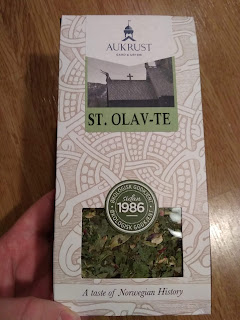
One such example of a product that relies on the buyer's fascination with the Middle Ages is a range of herbal teas that I have encountered both in the fjords back home, as well as in the Museum of Cultural History in Oslo, where the above picture was taken. The herbal teas are named after two of the most important Norwegian saints, SS Sunniva and Olaf. So far I have not been able to find a tea named after the third main Norwegian saint, Hallvard.  


Products that rely so clearly on the medieval past to sell their product often find different ways to do so, but a common strategy is to provide a bit of explanatory text, whereby the link is forged a bit more clearly. In the case of the St. Olav tea, this link is forged by reference to two typical but in a way disparate elements from the Norwegian Middle Ages. The herbs are said to be well-known staples of monastic herb gardens, and the selection includes angelica, which is here claimed to be a Nordic contribution to those herb gardens. This claim is notable since it emphasises Nordic participation in the development of medieval monastic culture, and in a way can be said to present Norway as an active part on the medieval stage. The connection between the tea and medieval monastic practices is also strengthened by the patterns and the logo of the brand, which are taken from the stave church in Lom. Although a stave church was a parish church and not connected to a monastic establishment, the evocation of one religious foundation helps bring the mind towards another type of religious foundation. 

Interestingly, the manufacturer has not only employed the image of the idyllic cloister garden, but also combined this with references to Vikings. In the presentation of the product, the manufacturer states that Vikings used wild-growing herbs, and then going on to provide an estimate of the number of stave churches that were erected after Norway's Christianisation. This joining of two disparate types of imagery - warriors and the institutions they sacked - is at first confusing, but can also be said to make perfect sense from a marketing point of view: All bases are addressed, both those who are drawn to the quiet romanticism of monastic life, and those who aspire to be manly men like the Vikings. The link to the Vikings are also alluded to in the opening text of the content description, where the tea is described as a tea for peaceful times between the battles. Now, the expression "between the battles" is very typical in Norwegian, and simply means between busy periods. In a context that plays on a connection with Vikings, and for a product that is named after a Viking-turned-Christianising-king-turned-saint, the expression does take on a slightly more literal meaning. 

The marketing strategy in this case fascinates me, as it is a typical yet very convoluted and layered employment of Norway's medieval past in order to sell tea, a product that was not known or used in medieval Norway. In this way, there is both an element of achronology - Norway's pre-Christian and Christian past evoked in the same breath - but also of anachronism, since the product that is supposed to embody these links to the past was not used in the past to which it is being connected. I find this interesting because I believe the strategy says a lot about us modern people, not only the manufacturer, but also those who buy the product. And after all, even though I have bought this tea for the sake of a scholarly point, I have spent just as much money on it as someone who buys it in order to be more like a monk, or a Viking, or like Saint Olaf. So it is clear that advertisements work. 


tirsdag 22. juni 2021

Saint Alban in Odense, part 1 - introductory reflections on the Alban liturgy


Today is the feast of Saint Alban, protomartyr of Britain, who was killed some time in the third century, when Britain was still a Roman colony. The earliest surviving textual testimony to his cult is the inclusion of his legend in Bede’s Historia ecclesiastica gentis anglorum, and His cult reached its zenith in the course of the twelfth century with the increasing power and wealth of the Abbey of Saint Alban’s.     

In addition to the importance of Saint Alban in England, his cult was also introduced into Scandinavia through different routes. In Norway, a Benedictine monastery at Selja was dedicated to him around 1100, and his cult became connected with that of Saint Sunniva of Selja, one of the three main Norwegian saints of the Middle Ages. The Breviarium Nidrosiense from 1519 contains three lessons for his feast, which summarised his legend. In Sweden, his feast appears in a number of surviving calendars, several of which were produced in England, and a church was said to have been dedicated to him at Säby by the turn of the eleventh century.  

In Denmark, however, his cult appears to have been particularly important in the diocese of Odense on the island of Fyn, which is the focal point of this blogpost. By 1086, a wooden church had been jointly dedicated to Saint Alban and the Virgin Mary, and it was in this year that King Knud IV, later Saint Knud Rex, was murdered by a mob of insurrectionists on July 10. In the saint-biographies written in the span of 1086-c.1120, the description of his martyrdom commonly includes a mention of the relics of Saint Alban, which were toppled in the tumult when the mob broke into the church. These relics were said to have been brought from England by Knud himself. Several of the priests who served at the Church of Saint Alban’s appear to have been English, possibly brought to Denmark in order to maintain the cult at what was then also the cathedral of the city.          

In the course of Knud IV’s relatively short reign, the foundations for a new church in stone was begun in Odense. This work was left incomplete by the time of his death, but it is likely that it was intended to be dedicated to Saint Alban, as a replacement of the old-fashioned wooden church. (Such replacements were common across all of Denmark in the period.) As it happened, the new stone church, which took over the role as the cathedral of Odense, was consecrated to Saint Knud, as Knud was canonised in 1095 and his relics placed in the crypt of the church. The cult of Saint Alban, however, was still maintained at the old church, which appears to have been replaced by a stone church in the course of the twelfth century, as per the ongoing trend of such replacements. This parish church, in turn, became defunct in the course of the sixteenth century, and was eventually dismantled.        

The Church of Saint Alban appear in various sources from medieval Denmark, but it is difficult to ascertain the extent of his cult and its popularity in Odense. The best testimony to the importance of Saint Alban can be found in Breviarium Othoniense, which was printed in three editions, in 1482, 1497, and 1510. This breviary provides a window into the liturgical practices of the diocese of Odense in the Middle Ages, although it must be examined with methodological caution. In the 1470s, the cathedral church of Odense, which had been a Benedictine community, was reformed to a community of secular clerics, and this entailed a change in the liturgy. While liturgical practice previously had followed the monastic use, it was now changed to the secular use, which is shorter. This means that the liturgical offices as they survive in the printed editions of Breviarium Othoniense are reduced from their former size, and therefore only imperfectly reflect the liturgy of previous centuries. Even so, it is in this breviary that we find a best source for the veneration of Saint Alban in medieval Odense.   
The office for the feast of Saint Alban can be found on folios 369r-371v in the 1482 edition. This abbreviated, secular office contains materials for Vesper, Matins, Lauds and Second Vesper. The lessons are taken from Bede, and it is likely that the chants are similar or identical to those sung at Saint Alban’s, England, although I have not yet been able to track down any source to this. 


Breviarium Othoniense, 1482, f.369r


Breviarium Othoniense, 1482, f.369r


While the office for Saint Alban as it survives in Breviarium Othoniense is an abbreviated version to what was performed in, say, the twelfth century, it nonetheless gives a very good idea of the story and image of the saint which was rehearsed by the clergy of Odense every year on his feast day. This liturgical repertoire is especially interesting when comparing to the Norwegian repertoire as found in the near-contemporaneous Breviarium Nidrosiense, where, as mentioned, only three lessons with corresponding responsories are included. This suggests that Saint Alban did indeed enjoy significant popularity throughout medieval Odense, at least among the clergy. This can also be glimpsed from Breviarium Othoniense, if we compare with the materials that precede the feast of Saint Alban, namely those for the feast of SS Gervasius and Protasius (June 19). Here, only three lessons are included, which suggests, again, that Saint Alban was venerated more than just perfunctorily in medieval Odense.        

Since this is an introductory blogpost to my reflections on the place of Saint Alban in Odense, I will not be going into detail about the liturgy itself, as this is something to which I hope to return in later blogposts. However, I will include two images from the 1482 edition of the breviary. From these images, we get a sense of the celebration itself, as these images show the materials for the first Vesper service, usually celebrated around six in the afternoon. The chants are from the office of Saint Alban, and not from the common of martyrs, a repository of liturgical material that could be performed during the feast of a martyr when materials unique to that martyr were lacking. To put it differently, we therefore know that in Odense, Saint Alban was sufficiently important that chants from his own repository were being sung. We also see a rubric specifying that in Saint Alban’s own church, his own hymn was to be sung, whereas outside of this church, the hymn “Deus tuorum”, which is from the common of one martyr, should be performed instead. This is interesting, as it suggests that the cult of Saint Alban was not of the highest rank, or rather that his veneration was not widespread beyond the Church of Saint Alban’s, even though his importance at his own church in Odense is unquestionable.         

More information remains to be extracted from the office of Saint Alban, and eventually I hope to get around to this. But for the present, I will leave this as an opening into the role of Britain’s protomartyr in the history and cityscape of one of Denmark’s largest cities.


onsdag 27. juli 2016

Churches of Gloppen in Western Norway, part 1 - Vereide


In this blog I have written a lot about my adventures in England, Denmark, Spain and Italy, and I have now come to realize that it is high time I start writing more about the history of my own home region. This home region is Nordfjord in the western Norwegian county of Sogn og Fjordane, and I live in the municipality of Gloppen in the central part of Nordfjord. My home village is Hyen, one of the parishes of Gloppen. This blogpost is, as the title says, the first in a series on the churches of my home region, concentrating primarily on the churches of Gloppen municipality. The blogpost was made possible thanks to my friend Benny Aasen, the verger of this church and others, who gave me a guided tour. He is an avid outdoorsman and a great amateur photographer, and his blog can be found here.

It is fitting to begin with the oldest of these churches, that of Vereide (meaning the isthmus of the ram), which is situated on the northern side of Gloppefjorden. This is the only medieval church in Gloppen which was built in stone, and it is therefore the only one that has survived. Most of the medieval structure is still in use, but in the course of the 19th century the church has been extended in several stages. As can be seen when compared with the penultimate picture in this blogpost, the wooden tower has replaced the medieval porch built in stone, which suggests that in the Middle Ages the church had a belltower outside the church itself. Furthermore, there has been added a choir in stone and later a wooden sacristy.


We do not know the exact age of the Vereide church. A local fiction has given the year of its foundation as 1163, but this was heralded by the celebration of the octocentennial in 1963, and there seems to have been no prior argument about such an early date. The fiction, however, was continued in 2013 when the supposed 850th anniversary was celebrated. This is untenable based on written sources (starting late) and lack of any thorough examination. However, it is possible that the church was built in the late twelfth or in the thirteenth century, as the architecture of the nave is very similar to other Norwegian churches built in this period. The oldest written source, on the otther hand, with reference to a priest at Vereide, in 1303, is Bergens Kalvskinn, a rent-roll or urbarium of the bishopric of Bergen from the fourteenth century (Rinde 2014). In addition to this, there is a handful of references in various surviving medieval letters and wills. The content of these can be found in the form of summaries in the project Regesta Norvegica, a registry in Norwegian of the letters pertaining to Norwegian medieval affairs. In volume 3, entry 538, we read in a letter by Bishop Arne of Bergen that Sigvat, priest at Vereide was given five days to drive away his concubine and cease carnal commerce, or else Sigvat would be suspended from his office and benefice by the authority of that selfsame letter. This letter was dated 16th or 17th October, 1308, and it was written in Gimmestad, a parish at the southern side of Gloppefjorden. Sigvat, or Sigvard, was not alone in this, also four other local priests were mentioned as guilty of the same crime.

A later source, a note in the copybook of the Bishop of Bergen (vol. 4, entry 254), states that Vereide was one of the places where the bishop should reside during his visitation in 1322/1323. I don't know if the note specifically mentions the priest's lodgings as his place of residence, but it does suggest that Vereide parish was of some importance, or at least was well situated as a base from which the bishop could inspect the other local parishes.

In addition to these references, there are three letters of testimony where members of the local elites served as witnesses for financial transactions. These letters are from the turn of the fourteenth century. From these sources we learn that by August 13 1380 the priest at Vereide was one Torbjørn Andresson (vol. 7, entry 885) and that he was still in this office by March 12, 1386  (vol. 7, entry 1288) and July 27 1401 (vol. 8, entry 1019).


Torbjørn Andresson resurfaces in the sources in 1626, when a certain man called Skonvig documented the cemetery. The tombstone of Torbjørn was found by the cross pictured above, although the cross itself is considered to be far older and might have been moved from another location to serve as a grave marker for the priest. The design of the cross is also known from other medieval Norwegian crosses (Rinde 2014: 24).


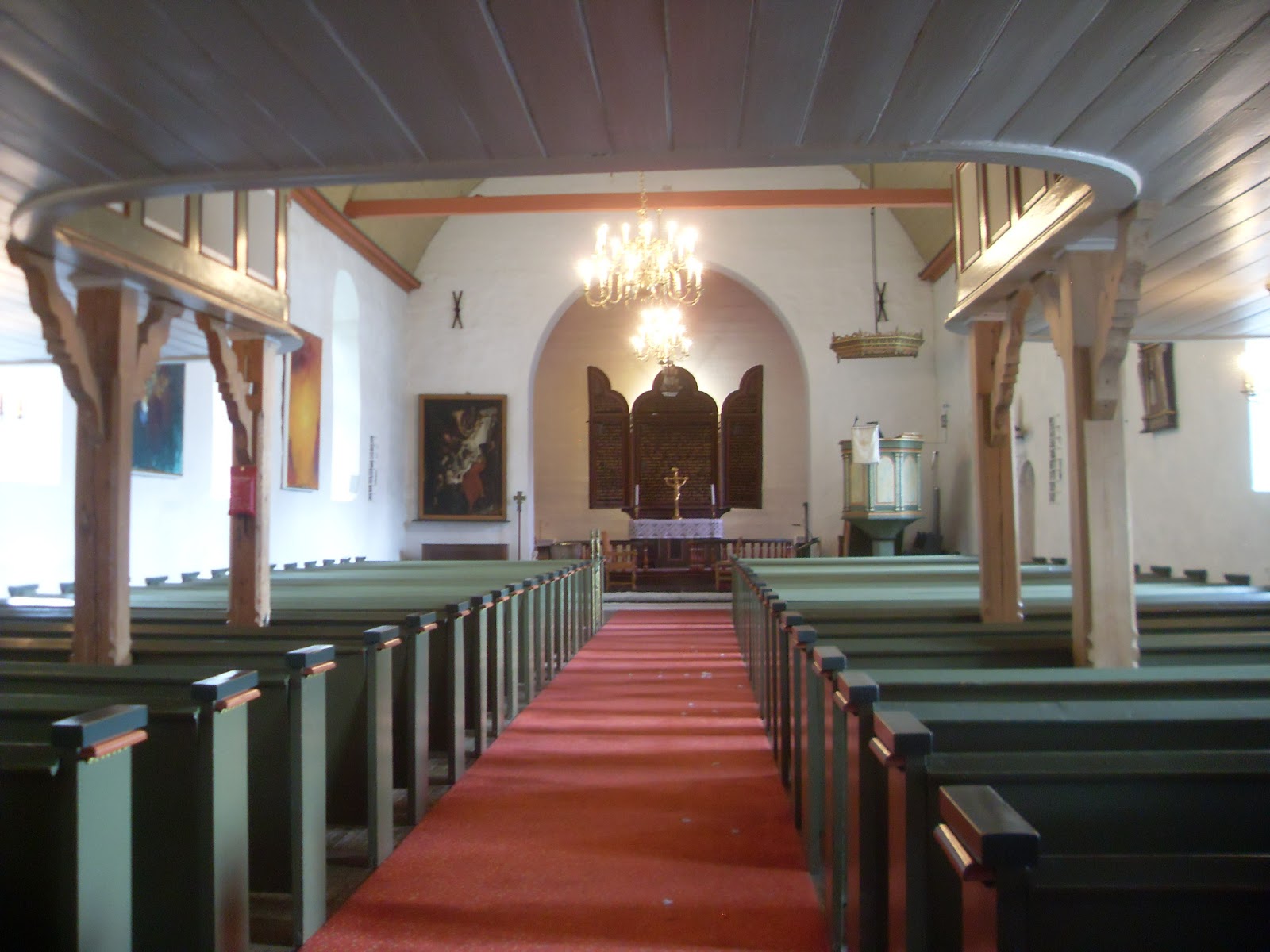
When you enter the church, you do so through the modern porch in the modern tower, and when you open the door to the nave itself you see the altarpiece from 1604, situated in the choir which also is a nineteenth-century addition.


View from the pulpit

Hourglasses to help the priest keep track of the length of his sermon

Throughout Vereide church there are many small treasures from its long history. Many of them have been omitted here for the sake of brevity, but a handful of the can be seen in the picture below. The painting, of which a better picture can be found further below, shows the deposition of Christ. It was painted by the local artist Karl Kristian Uchermann (1855-1940), and is inspired by a painting on the same motif by Peter Paul Rubens, which Uchermann studied in Antwerp. He had been commissioned in 1880 to paint the new altarpiece for Verede Church, and this painting served this function until 1962 (Gundersen 2014C: 136).


Three other items in the above picture are noteworthy. The first is the little processional cross, which appears to be a minitature copy of the old stone cross shown above. This is carried in front of the procession in and out of the church. The second item is the stone on which the staff stands, as this is a piece of a type of conglomerate rock which is typical for Gloppen. The final item is the little statuette, which seems to be depicting Saint Sunniva, who holds in her hands a rock which also seems to serve as a church, presumably a nod to the monastic community which grew up at Selje, the place of her legendary martyrdom. This is a modern figurine, but it is suitable to a parish church within the Bergen diocese, as Sunniva serves as a patron saint for this region.


Vereide church also contains some underground rooms. My friend told me about these and it was indeed that conversation which prompted the tour in the first place. Two of these rooms are no longer possible to reach since they are covered by pews, but one of these rooms is still possible to go down into, and we did.


The room is accessible through a door hidden under the carpet, and it is one of two crypts in the nave. I do not know whether these two crypts go all the way back to the Middle Ages, although it is likely. When the church was renovated early in the 1930s, there were found several wooden caskets - probably early modern - and these were removed to the southern crypt (Eide 2014B: 62). The northern crypt is no longer accessible, as mentioned above. The rooms themselves are old, but the southern crypt has been modernized, the floor has been covered in concrete, the stair is new, and electricity has been put in place.

The southern crypt contains about a handful of adult caskets, and about the same amount of child caskets. Two of these caskets are open and contain mummified corpses. These will be shown below, so if you, dear reader, find that an unpleasant prospect, you are hereby warned. The quality of some of the pictures are not very good thanks to the poor light in the crypt.


As a final note of conclusion, I have added these following pictures. The first is a photograph of a painting from around 1879, which shows the medieval design more clearly. The second picture is an interior from before the addition of the choir.


Vereide church is a beautiful old artefact and a rare medieval survival in the Norwegian fjords. I'm very grateful to my friend for having shown me around, and I was elated to see so many treasures big and small both inside and outside this church.


Bibliography

For some of the details of this blogpost I have relied on chapters from the book Vereide Kyrkje - Kyrkjestad og kyrkjelyd gjennom 850 år, edited by Ove Eide and published in 2014 by John Grieg Forlag. The book is intended as a publication for the 850th anniversary and is a treasure-trove of anecdotes, pictures and useful information. In many respects it is a good book, but it has neither been written nor edited by trained historians and is very much a lay production. This can be seen in the careless perpetuation of some ideas which are not properly grounded in sources, or at least if they are these sources have not always been referred to. For all its shortcomings, however, it is a useful book, and I have relied on the following chapters.

Eide, Ove, "Kyrkje og kyrkjelyd frå 1600-talet til vår tid (56-110)

Rinde, Anders, "Vereidskyrkja i mellomalderen" (10-29)

Gundersen, Olaf Sigurd, ""Nedtakinga av Krossen"" (135-136)


torsdag 31. desember 2015

Narrative and Saints' Lives, part II - Saint-collectives and their figureheads


 In a previous blogpost I wrote down some reflections on the structuring of the narrative in stories about saints. This post was prompted by a reading group I've been arranging at the Centre for Medieval Literature in Odense where I work, in which we've read excerpts from Legenda Aurea by Jacobus de Voragine. The present post follows in the same vein, but while the previous post considered narrative in stories which were very brief, I here wish to consider what happens to the narrative when the story contains a great multitude of characters. The post in centred on the story of Saint Ursula and the eleven thousand virgins of Cologne, parts of which legend we translated in the last reading group session of the semester.

I'm also happy to know that the reading group inspired my colleague Alaistair Matthews to blog about his thoughts on the Ursula legend and medieval German literature, which can be read here.


Ursula shielding the virgins in her cloak
Amiens - BM - ms. 0203, f.045, book of hours, use of Rome, 15th century
Courtesy of enluminures.culture.fr


The Legend of Ursula

The legend of Ursula has been long in the making, and the story has received elaborating impulses at various points over a long stretch of time. The earliest evidence for a veneration of the virgin martyrs of Cologne is found in an inscription in an old basilica which states that a certain Clematius built this chapel in honour of the martyred virgins of the city. The inscription is believed to be from the fourth, or possibly the fifth, century, and is the foundation for the rest of the legend, although it provides neither names, dates or numbers.

The next step in the development of the legend came in the ninth century, when a sermon was written in natali sanctarum Coloniensum virginum, for the birthday of the holy virgins of Cologne. This birthday refers to the day of their death, considered in the theology of sainthood to be the heavenly birthday of the saint, the day when the saint entered, or was reborn in, Heaven. In this sermon we are for the first time given names and numbers, and it is stated that there were several thousand virgins, foremost of whom was the virgin Pinnosa. The high number of virgins is repeated in the martyrology of Wandalbert of Prüm, c.850, where it is said that there were several thousand of these virgins. This source might have been the Sermo in natali, for the martyrology of Usuard, c.875, only gives the names Martha and Saula and adds that there were several others, and this suggests that the high number of the Sermo had not yet become consensus. However, only a few decades after Usuard the number is set at eleven thousand and this became consensus for the centuries to come.

It was during the course of the tenth century that prose narratives emerged in which the basic story was established: The daughter of a Christian English king, Ursula, is asked for her hand in marriage by a pagan prince. Ursula wants to avoid the marriage, so she asks for a delay of three years, and in this time she summons ten fellow virgins and each of these eleven have a retinue of thousand virgins. They set off in a ship and are borne by the winds to Cologne, and from there they undergo circuitous route which takes them via Basel and Rome back to Cologne again where they are martyred by the Huns. This story is probably derived from an old legend, a version of which is also found in Geoffrey of Monmouth's History of the British Kings, where we find Ursula, eleven thousand noble virgins, and their retinue of sixty thousand young women. 


The ships sailing to Cologne
MS Egerton 3028, f.7, Wace, Roman de Brut, 14th century
Courtesy of British Library


By the thirteenth century, in the time when Jacobus was compiling the Legenda Aurea, the legend had become very elaborate. In the version recorded by Jacobus, Ursula demands that her bethroted is baptized, and she wants to bring the non-Christian virgins of her retinue to baptism as well, thus giving Ursula a more active and apostolic role. As in the above-mentioned legend, Ursula demands ten virgins to follow her, and a retinue of thousand virgins for each of the eleven. The virgins are then brought in from all over the world, and a special mention is made of Gerasina of Sicily who joins Ursula - though not herself a virgin - and brings her five children with her. This is a crucial point in the story, that in addition to the eleven thousand virgins there is a multitude of followers of both sexes who, as it is said, joins this new knighthood of Ursula, all bent on martyrdom.

The virgins and their followers then set out on the route described above and when they arrive in Rome they are greeted by Pope Cyriacus who is British and also fictional. Cyriacus joins up with the virgins and they all leave for Cologne, together with a number of other bishops who had held offices in cities as diverse as Ravenna, Lucca and Antioch. In addition, we learn that Ursula's husband-to-be, Ethereus, is also compelled by an angelic message to leave Britain where he has been residing and go to Cologne to meet his martyrdom.

At this stage in the story we are introduced to the first antagonists of the story, two scheming pagan commanders of the Roman army called Maximus and Africanus. They are concerned that this massive array of Christians "would make the Christian religion flourish overmuch", and so they plot to bring about the death of Ursula and her companions. They therefore communicate with their kinsman Julius, who despite his name and familial relations is the chief of the Huns, and he agrees to march on Cologne and slaughter the Christians. When all the groups of people finally converge on Cologne, it is Justus who plays the role as the traditional tempter as we find it in the classical accounts of virgin martyrs. For as the Huns are slaughtering the Christians, Justus becomes so dazzled by Ursula's beauty that he asks her to marry him. She refuses, and Justus shoots and arrow through her.

The last section of the legend as recounted by Jacobus tells of one virgin, Cordula, who had hidden in the ships during the massacre, but gave up herself and was martyred on the next day, leaving her outside the celebration of the martyrs.


Ursula's martyrdom by a Hun's arrow
Mans (Le) - BM - ms. 0688, f.028, book of hours, c.1435-1440
Courtesy of enluminures.culture.fr

Narrative and characters

The account in Legenda Aurea reads more like a chivalric romance rather than a saint's life, and this has been the case since the earliest prose narratives about the virgins of Cologne. The level of elaboration, however, the numerous characters, the profusion of sub-plots and the gathering of people from a wide-ranging geographical spectre, all these are typical of the chivalric romance as this genre came about in the twelfth century, the century which also saw a new surge in the cult of the eleven thousand virgins.

It is interesting to note the strategies employed to make the narrative more accessible to the reader or the listener. The various sub-plots of Gerasina of Sicily, Pope Cyriacus, the Bishop of Greece and his widowed sister, and others, all contribute to make the narrative more episodic. This in turns creates a different curve of suspense than what we find in most other narratives of Legenda Aurea, where the trajectory is more straightforward, more formulaic. Ursula and her companions, however, do not follow the typical trajectory, but rather a trajectory which might be said to bear greater resemblance to that of errant knights in the romances - except that the journey of the virgins are guided by divine power and angelic messages.

Another aspect which emphasises the similarity between chivalric romance and the Ursula story is the wide geographic scope. Ursula's followers come from all over Christendom, from locations which are both exotic and more familiar, at least to the continental audience. Ravenna, Lucca, Sicily, Antioch, Britain, Greece, all these are place-names thrown in seemingly to provide that blend of familiar and exotic which is so typical of the chivalric romance. For example, in Wolfram von Eschenbach's Parzival, written in the early 13th century, we find figures like Morholt of Ireland, Lot the king of Norway, Count Lanzidant of Greenland, Kingrisin king of Ascalon and Ipomidon of Babylon, to mention only a few of the most exotic members of the cast. This wide-reaching geographic blend is a staple of the chivalric romance, and in the abovementioned History of the Kings of Britain by Geoffrey of Monmouth, we read how King Arthur subdued a wide range of kingdoms, as illustrated in the chronicle of Peter Langtoft, seen below.

Arthur standing on the crowns he has conquered
MS Royal 20 A II, f.4, English miscellany, c.1307-c.1327
Courtesy of British Library

It is of course natural that a narrative containing such a multitude of characters is in dire need of figureheads and focal points. This explains for instance the various sub-plots of the story, which I suspect should be seen as a sign of inspiration taken from the numerous chivalric romances written in the twelfth and thirteenth centuries. Through these sub-plots, Ursula maintains her role as the architecture of the grand scheme, but it also allows for some pauses from the main action and the introduction to new characters which adds faces and thus personality to a massive blob of around seventy thousand persons marching on Cologne. However, it is worth noting that Ursula is the only protagonist character who is featured throughout the story. Eutherius, her husband, appears twice but is largely inactive, while Gerasina, Cyriacus and the unfortunate Cordula are given their time in the limelight and then never mentioned again - with the possible exception of Cyriacus who is mentioned leaving Rome, but as he has also been featured in the preceding paragraph it might still be said to be a continuous sub-plot. In this way, we are given a long list of names which allow us to create some mental images of the characters involved, but they are treated very briefly. However, since Ursula is the only properly recurring character, she is the one most easily imprinted on the mind of the audience. In a way, it seems like the secondary character are there to lift up Ursula as the main protagonist, like a choir is meant to bring out the soloist more strongly in a musical performance. In this way, the multitude is given several heads but only one figurehead.

Another explanation for the various characters might be to add some verisimilitude to the story by mentioned geographical localities which exist in the real world and which therefore act as guarantors of the account's veracity. To such a strategy it is of no significance that in the temporal setting of this narrative - which Jacobus argues must be set in the mid-fifth century, there was no queen of Sicily, and there was no pope called Cyriacus.

Regardless the explanation for the multitude of secondary characters, the need for a primary protagonist is evident. We can ask ourselves why Ursula ended up as this figurehead rather than Pinnosa mentioned in Sermo in natali sanctarum Coloniensum virginum, but ultimately it is only to be expected that an unwieldy mass of virgins needed at least one named figurehead so that the faithful can direct their prayers more easily, or so that the story is lifted out of mere myth, which is what happens easily when no names are attached to such a massive body of saints.


Ursula and Gerasina
Châteauroux - BM - ms. 0002, f.376, breviary, use of Paris, c.1414
Courtesy of enluminures.culture.fr


Ursula and the virgins
MS Royal 13 A IX, f.4, Francesco Roseti of Verona, before 1547
Courtesy of British Library

Concluding thoughts

In the medieval calendars and collections of saints' lives we find several feasts which commemorate groups of saints, men and women grouped together because they had shared eminence in their holy works. In the Legenda Aurea alone we find for instance chapters titled "The Seven Brothers", "The Seven Sleepers", "Saint Adrian and His Companions", "Saint Cyriacus and His Companions" (not to be confused with the character in the Ursula legend", "Saint Hippolytus and His Companions", "The Four Crowned Martyrs", and a few more. In most of these stories there are some saints who are more prominent than the others, and the often low number of companions makes it easier to accept these groups, yet even they have their figureheads.

The need for such figureheads can be exemplified not only by the fact that Ursula has become the leader of the group even though hers is not the oldest name featured in the legend. Another instance can be found in a Norwegian legend most likely based on the story of Ursula. This legend is that of Sanctorum in Selio, the holy of Selje. This legend tells of an Irish princess who escaped marriage to a pagan prince by fleeing to Norway. They were brought to the coast of Selje, which is a small portion of the the Western Norwegian coast. When the pagans came after them, Sunniva prayed for deliverance and the holy were buried in an avalanche of rocks. We don't know exactly how old this story is, but we know that the story was known in the mid-eleventh century from references in Adam of Bremen's History of the Diocese of Hamburg. The name of this princess, however, was not given until the twelfth century, when the relics of these men and women were translated to Bergen. She was then called Sunniva, and she is now one of Norway's four saints. That Sunniva emerges as the leader for the group as a late development in the legend is similar to what we see in Ursula, and points to the need for a figurehead in a group of saints as a phenomenon not limited to the legend of the virgins of Cologne.

This need for figureheads is probably not limited only to the medieval cult of saints, especially since there are plenty of postmedieval collectives of saints that are officially recognized. We have for instance the forty martyrs of England and Wales, or the martyrs of Nagasaki in 1622, but I'm not sufficiently familiar with these cases to know whether any figureheads emerged. It will, however, be interesting to see the development of the collective of saints canonized by the Armenian church earlier this year. In commemoration of the genocide of the Armenians in 1915, the Armenian church canonized all 1.5 million victims of the persecution, and the question is whether anyone, and if so who, will emerge as leaders and figureheads of the possibly biggest saint-collective in Christian history.


Ursula and the virgins in the most traditional depiction
Mâcon - BM - ms. 0003, f.003, Jacobus de Voragine, Légende dorée, c.1470
Courtesy of enluminures.culture.fr

Literature


Farmer, David, Oxford Dictionary of Saints, Oxford University Press, 2005

Jacobus de Voragine, The Golden Legend, translated by William Granger Ryan, Princeton University Press, 2012

Wolfram von Eschenbach, Parzival, translated by A. T. Hatto, Penguin Classics, 1980

http://www.newadvent.org/cathen/15225d.htm

http://www.telegraph.co.uk/news/worldnews/europe/armenia/11559613/Armenian-Church-makes-saints-of-1.5-million-genocide-victims.html