And was the holy Lamb of God,
On Englands pleasant pastures seen!
- And did those feet, William Blake
Viser innlegg med etiketten Saint Denis. Vis alle innlegg

lørdag 30. mai 2026

Saint Julian in a fragment - chance survivals, canonicity, and the cult of saints in medieval Scandinavia


Much of my research deals with questions pertaining to the cult of saints in medieval Scandinavia. This is a topic that labours under the double-edged problem of having both very few surviving sources - making it difficult to make strong claims about certain questions - as well as such a wide variety of source types, making it difficult to have the required expertise to use all these sources together. Concerning the cult of saints, we know that there were many more sources used and produced in medieval Scandinavia than those we have access to today. The surviving sources have, therefore, provided a skewed sense of the saints venerated by the medieval Scandinavians, as well as the stories told about those saints. Due to the source situation - combined with the nationalistic tilt embedded into the foundations of medieval studies in each Scandinavian country - we have a tendency to focus on the cult of native saints, especially the royal saints. Aside from the biblical saints and the most famous of the early Christian saints - especially Laurentius, who was patron saint of the Church of Lund, which became a metropolitan see in 1104 - there has been relatively little work done on the veneration of the saints less known in our own time. Judging from surviving materials, we have a pretty good idea of how popular and important these famous saints were. But we cannot really know whether some of the saints that we consider minor today were, in actuality, major saints throughout the Scandinavian Middle Ages, or at least within one time period or within one milieu. 


I was reminded of this issue earlier this spring, when I was at the Danish National Archives in Copenhagen to research some manuscript fragments. In one of the boxes I had ordered was the upper part of a two-columned page from a twelfth- or early-thirteenth-century manuscript, the text of which is the saint-biography of Julian Martyr, also known as Julian of Le Mans. The fragment is well known in medieval studies and I have seen it mentioned and analysed several times. It is most likely produced in Scandinavia, probably in Norway, and it is a important witness to the earliest stages of native Norwegian manuscript production. The content of the fragment, however, has received much less attention than its codicological, palaeographical and iconographical aspects. This text provides a very good starting point for reflecting on the state of our knowledge about the cult of saints in twelfth-century Norway.


Rigsarkivet, Fr. 251

Rigsarkivet, Fr. 251


Saint Julian was a third-century bishop of Le Mans. Since he was martyred during the heroic age of Christianity in what was later to become France, his cult and his figure appear to have been important elements not only of Le Mans' own identity but also the identity of France as a kingdom having received special divine attention. This kingdom-wide identity was also propped up by the cults of Saint Dionysius of Paris, of Saint Remigius and the Holy Ampulla, and eventually also the cult of Saint Louis IX. The early date of Julian's life and martyrdom also meant that he was included in several early martyrologies and calendars, and his cult was disseminated far and wide. 

In Scandinavia, there are few surviving traces of Julian in the sources. For example, the only sources from Sweden, as far as I am aware, are twelve calendars that contain his feast-day, which is celebrated either on January 26 or Janaury 27. Since most calendars used in medieval Sweden have survived only as fragments, however, the actual number of calendars containing his feast-day was significantly higher. In any case, no other sources are known - not sculptures, not altarpieces, not wall-paintings. I know of no sources from medieval Denmark, although I have not yet checked whether his feast is included in the late-medieval printed breviaries. In Breviarium Nidrosiense, the breviary printed in Paris in 1519 and aimed at the entire Norwegian church province, his feast is not included. In other words, Saint Julian of Le Mans appears to have been virtually unimportant in the cult of saints in medieval Scandinavia. 

However, Saint Julian was at least known, if only in the monastic or ecclesiastical community in which the manuscript containing his passion story was used. We do not know what community this was, but it is likely that the manuscript was a collection of saints' lives produced for - and perhaps at - one of the leading religious centres of twelfth- or early-thirteenth-century Norway. My own hunch is that the original manuscript was a typical hagiographical collection that was used during the Matins of the feast-day of the saints included in the collection. Matins was the divine service in the middle of the night, and it was during this service that the saint was venerated with a liturgical office which included both chants and readings from the saint's biography. The original manuscript, therefore, is likely to have contained the legends of several other saints aside from Julian. 

What, then, are we to make of the inclusion of Saint Julian of Le Mans in this hypothetical, now-lost hagiographical collection. Probably not much. Such collections were typically compiled from available materials, and those materials tended to contain those stories and legends that were widely accessible rather than those which were particularly important to a specific diocese or church province. Put differently, the legend of Saint Julian was sufficiently widespread that it was easy to get hold of. Its appearance in Norway reflects Julian's general canonicity as a saint in Latin Christendom by the late twelfth century rather than the importance of his cult among Norwegian Christians. 

On the other hand, the fact that Julian's legend was available in Norway and accessible at one - if not more - major religious centre should be taken seriously. What happens at such an institution when the available hagiographical material is limited? Do those stories that are available become more important than they otherwise would be? Can the cult of Saint Julian have been strengthened at this institution simply because the clerics or monastics who comprised the institution's community were familiar with his legend? Very likely, because cults tended to be shaped by the personal devotion of those who were part of the veneration of saints at religious centres. Surges in a saint's popularity could be shaped by events that were interpreted as intercession from that saint, it could be shaped by dreams of individuals, of the constant, long-term pressure from exposure to the saint's story. We see this happen in the cult of Edward the Confessor, for instance, whose main promoter before the 1160s was the figure of Osbert of Clare who believed himself to have been healed due to the saint-king's intercession. Might not a similar causality - however imagined - also not affect the cult of a well-known but otherwise not particularly important saint-bishop? 

We do not have any evidence to suggest that the knowledge of Julian's legend made an impact on his cult in medieval Norway. And personally, I do not think it did, simply because this possibility hinges on our knowledge of one sole surviving fragment. However, this reflection is not primarily about Julian or his cult, but about how our ideas about canonicity and the cult of sains is shaped by the chance survivals of sources. The fragment containing part of the prologue of Julian's saint-biography proves that he was known somewhere in medieval Norway, and for at least a period, even if that period might only be the generation of clerics or monastics that first made use of this manuscript. 

As scholars we need to be very careful in assuming that the canon of literature that we imagine today based on the survival of sources is necessarily the same as the canon of literature of the Middle Ages. Indeed, we know very well that the so-called bestsellers of medieval Latin Christendom - such as the Imago Mundi of Honorius of Autun, or the Sententiae of Peter the Lombard - receive much less attention from and are much less accessible to modern readers than works such as Beowulf, which only survives in one single manuscript. The modern medieval canon is, in other words, very different from the medieval medieval canon. Similarly, the cult of saints as we understand it today might have been configured somewhat differently in the Middle Ages, with saints now lost to us or ignored by us having much greater prominence than we will ever know. 


Rigsarkivet, Fr. 251

Rigsarkivet, Fr. 251


fredag 22. november 2024

Saint Thomas and apostolic succession in the Antipodes


When researching the history of utopian thought, one of my main points of interest is when I can map the continuity of an idea or a topos across the medieval/early modern periodisation. My interest stems from the artificial nature of periods, and how these chronological divides continue to impede our understanding of the past. The other day, I encountered one such example of continuity that both pleased me and surprised me. 


The example in question comes from the 1616 novel Histoire du grand et admirable royaume d'Antangil incogneu jusques a present à tous historiens et cosmographes (‘History of the great and marvellous kingdom of Antangil, unknown to historians and cosmographers until the present day’). On the title page of the 1616, the work is attributed to a certain I. D. M. G. T, whose identity is, as far as I know, still a mystery to us. The work was part of a growing vogue that followed in the wake of Thomas More’s Utopia, published one hundred years before Antangil, where authors described ideal societies found in faraway locations, which could also be used to satirise or criticise the real-world societies of the author’s own time. While the main form of this vogue – a novel about an invented ideal society – had Thomas More’s work as its starting point, both More and later authors belonged to long strands within the history of ideas, and therefore ensured a great deal of continuity in thought and form from both the medieval and the pre-medieval cultural frameworks.   


At the point of writing this blogpost, I have not read Antangil in its entirety, and I hesitate to say much about its content, as most of my knowledge about the work comes from secondary sources – especially David Fausett’s excellent 1993 monograph Writing the New World. What I can say, however, is that this marvellous kingdom is located south of the tropic of capricorn, and south of Great Java, the latter being a common point of orientation in late-medieval travelogues. The reader is not only provided with coordinates, but also a woodcut map made with incredible detail, where the main villages and rivers are numbered, and these 129 numbers correspond to a list of three columns where the names are provided. The capital of the kingdom, Sangil, is located at the bottom of a long, narrow inlet akin to a fjord.  


The great kingdom of Antangil


Table of the main cities and rivers of Antangil


The capital of Sangil


I hope to delve more deeply into the world of Antangil in the future, but at this point I am most interested in the fifth book, which describes how Christianity was brought to Antangil, and how the kingdom got its first martyr. The events are summarised in the header of chapter 1, which states that the holy gospel was proclaimed the capital of Sangil by Byrachil, who is described as a very sage ‘Braquemane’ who was the disciple of Saint Thomas the Apostle. As I have yet to read how Byrachil met his martyrdom in chapter 16, I can only focus on what the information from chapter 1 tells us, and how this connects to utopian thinking from the Middle Ages. 


Header for chapter 1, book 5


If we start with the description of Byrachil as a ‘Braquemane’, this points us to the tradition of medieval travelogues exemplified in particular by Marco Polo and John Mandeville, two figures whose works remained impactful and widely read well into the seventeenth century. (I say this with full awareness that it was Rustichello of Pisa who gave Marco Polo’s account the shape by which we know it today, and also that John Mandeville might never have existed.) In these accounts, we read about non-Christian sages who are given variations of the name ‘Bragmanni’, which in turn comes from ‘Brahmin’. The descriptions of these sages drew heavily on the so-called Alexander tradition, a long line of fantastical accounts of the exploits of Alexander the Great that comprise the legacy of the Alexander romance by Pseudo-Callisthenes rather than any contemporary accounts from Alexander’s own time. What interests me here, however, is that the figure of the Brahmin was well-established as a marker for the positive ‘other’, and also as a representative of the far east. That the author of Antangil has decided to use such a figure as the apostle of their fictional utopia shows that they were familiar with the traditions of the Middle Ages, and that they expected the medieval traditions to be known to their audience. In short, we see that the idea of the Brahmin was still a figure of contemporary resonance in the early seventeenth century, and that markers of the ideal society established in medieval writing still served that function centuries later.  


Another point of importance is that Byrachil was the disciple of Saint Thomas, the apostle of Christ whom the post-biblical apocryphal literature claimed to have evangelised in India. Thomas’ missionary activities were accepted as historically true in the Middle Ages, and there are to this day those who believe that this account is based on historical reality. As Saint Thomas was the apostle of India, it only makes sense to use his activity as a historical reference point for the introduction of Christianity in the antipodean kingdom of Antangil. A similar idea can be found in Francis Bacon’s New Atlantis (1624/27), where the society in question is converted to Christianity through a letter from Saint Bartholomew (who was also credited with evangelising in India). In terms of continuity of ideas, however, the use of Saint Thomas as a marker of an ideal society located on the far side of the world – albeit vicariously through his disciple – is also seen in medieval literature. In the mid-twelfth century, members of the court of Frederick Barbarossa forged a letter claiming to be from Prester John, a Christian king in the east, who ruled over an ideal kingdom, which became a fixture in Latin medieval thought well into the sixteenth century and beyond. In the letter, the king states that the tomb is Saint Thomas the Apostle is located in his realm, and that he undertakes pilgrimages to this holy site. Moreover, the king’s own palace is modelled on the palace that Saint Thomas built for King Gundoforus of India, which means that the connection to the apostle is both one of architectural emulation and continuous contact by way of his relics. In other words, Saint Thomas, as apostle, saint, and biblical figure, a marker that proves the ideal condition – the utopian quality – of Prester John’s realm. This same function is fulfilled by him – by way of his disciple – in the novel Antangil.         


The Christianisation of the kingdom of Antangil by Byrachil also rhymes with the medieval thoughtworld in another way, namely that apostles of new members in the Christian oikumene had a connection to a biblical figure. Such a connection provides a link to biblical history, and when the figure in question is an apostle, the Christianisation of the new location takes the form of apostolic succession. Such a succession was not always the case in the Christian histories of Latin medieval kingdoms – Latin is here used about the liturgical language, not about the vernacular – and there are plenty of medieval polities where the apostolic mission is not traced all the way back to the Bible. The native France of Antangil’s author, however, had several traditions concerning such biblical connections. In the ninth-century Vita Dionysi by Hilduin, Saint Dionysius – or Saint Denis of Paris – was conflated with two other individuals by the same name, one of whom was Dionysius the Areopagite, who is mentioned in the Acts of the Apostles, which recounts his meeting with the apostle Paul. Through this conflation, the apostle of the Paris region was linked to the apostolic activities of Paul. Similarly, around the year 1000, Ademar of Chabannes, a historian at the abbey of Saint-Martial in Limoges, rewrote his chronicles to claim that Martial was also a first-century figure. It is tempting to see the apostolic succession from Saint Thomas in India to Byrachil in Antangil as a variant of the theme represented by Dionysius and Martial.          


The novel Antangil is very much a work of the seventeenth century, in that it belongs to a contemporary vogue in utopian writing. However, it is also steeped in ideas and traditions that run through the Middle Ages, and which showcase how ideal societies have been imagined or represented in medieval writings. The connection with the Brahmins is a utopian strand where an ideal society is located in the far east. The connection with Saint Thomas is a utopian strand which also places the ideal society in the far east, but which also includes biblical history, and, by extension, the figure of Prester John, the ideal Christian king. The connection with the idea of apostolic succession might be seen as stemming from similar ideas in French medieval hagiography. These medieval strands have remained forceful and important by 1616, and they continued to be so for centuries afterwards. The novel Antangil, therefore, is a good reminder that ideas have a long and often curious life, and that there is more that connects the so-called modern world with the Middle Ages than what separates it.


tirsdag 25. januar 2022

The saint in the pot - Saint Erasmus at Skive


One of my various side-projects these days entails a revisit to the saints of the Church of Our Lady in Skive in Northern Jutland. The church, built around 1200, was decorated with an extensive wall-painting programme of various saints in 1522, and thanks to restoration work in the 1900s, most of these can still be seen today. I have touched upon several of these saints in earlier blogposts (see here, here, here, here, and here). The best treatment of these wall-paintings can be found in a small pamphlet from 1993, Kalkmalerierne i Vor Frue Kirke Skive (The frescoes of the Church of Our Lady, Skive), published by Bodil Glad and Ingvar Glad in 1993. Having read through this excellent resource, I was notified of one particular and in a way delightful detail that I had caught on camera during my visit there in 2019, but which I had subsequently overlooked - no doubt distracted by the host of other details to draw the eye. 

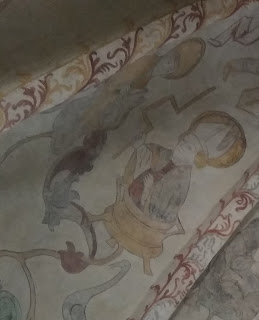
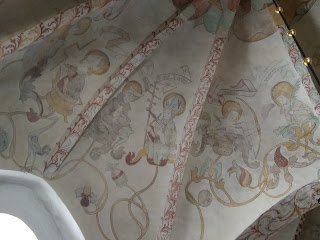
The detail in question concerns the representation of Saint Erasmus, also known as Saint Elmo, whom we find in the second vaulting of the nave next to Saint Denis, or Dionysius if one prefers. Saint Erasmus was, according to legend, the bishop of Formia, who was martyred in a typically gruesome fashion: He had his entrails drawn out with a windlass, and he was himself boiled in a pot. As is typical in medieval Christian art, the martyr Erasmus is depicted holding one of the (often several) instruments of his torture, in this case the windlass. Among the other saints in Skive we see the same pattern, although some have other symbols of their martyrdom than the instruments, such as Erasmus' neighbour Denis, who holds the top of his skull, which his assailants chopped off. 

In the case of Saint Erasmus, however, the artist has decided to present the legend of the saint by more ways than one. Possibly inspired by the vogue of the time which had saints emerge from flower bulbs, the artist has replaced the bulb with the pot from Saint Erasmus' passion, making the saint stand out among his colleagues, as can be seen in the second of the blogpost's two images. The reason for this choice is unknown to us, and can be interpreted in several ways. Was it a humorous choice? Or did it grow - pun intended - out of devotion for the saint, resulting from a wish to make Erasmus more notable, or to have his legend represented in more detail? Did it follow a wider trend of the period, a period in which Erasmus enjoyed widespread popularity as one of the fourteen holy helpers? Ultimately we do not know, but we can still enjoy the result of this decision taken during the work of 1522.

Saint Erasmus in a pot, next to Saint Denis with the top of his skull

Saint Erasmus in immediate context 
(Denis, Erasmus, Peter Martyr, Thomas of Canterbury, Sebastian and Vincent)