And was the holy Lamb of God,
On Englands pleasant pastures seen!
- And did those feet, William Blake

fredag 22. juli 2011

London Letters - Westminster Abbey

 
About midwinter King Edward came to Westminster, and had the minster there consecrated, which he had himself built to the honour of God, and St. Peter, and all God's saints. This church-hallowing was on Childermas-day. He died on the eve of twelfth-day; and he was buried on twelfth day in the same minster.
- From the entry for the year 1065 in the Anglo-Saxon Chronicle

The world-famed Abbey by the westering Thames.
- Westminster Abbey, Matthew Arnold

Here, where England's statesmen lie
- In Westminster Abbey, John Betjeman

Here Edward king,
of Angles lord,
sent his stedfast
soul to Christ.
In the kingdom of God
a holy spirit!
- From the entry for the year 1065 in the Anglo-Saxon Chronicle

For the past year and the one year ahead I have and will be working on my master's thesis, and since I'm writing about an office dedicated to St. Edward the Confessor I felt obliged to render a visit to Westminster Abbey where he lies buried and where he ordered a large stone church in the mid 1060s. When Edward instigated the construction of a stone church in 1065 he placed it where Benedictine monks had established a monastic community in 960, and not in the seventh century as Ailred of Rievaulx claims to be the case. Edward dedicated the church to St. Peter who was his particular saint, and by whom, according to the first biography of Edward, he had been elected as king of the English when already in his mother's womb.

Nave, choir and transept glorified with light
- Westminster Abbey, Matthew Arnold

The construction of the church we see today began in 1245 and was ordered by Henry III who also rests here. Henry was one of the most important devotees of St. Edward and it is therefore no wonder he decided to build this impressive structure to the shrine of his favourite saint. Westminster Abbey, in other words, has always been the main focal point of the cult of Saint Edward - a relationship masterfully outlined by Paul Binski - and the office I'm working on comes from the Westminster missal. It should therefore not come as a surprise that I felt a strong inclination to visit the church and have a look for myself.

Wherefrom now our choir in his honour
Gladly sings hymns
So his pious merits are remebered
By all forever after.
- The Office to Saint Edward (my translation)


I visited Westminster Abbey after a trip to the National Gallery and I looked forward to enter into a world so closely connected to my dissertation. Very soon, however, I was overwhelmed by how densely packed with tourist the church was, and my enthusiasm waned a little. Naturally, as a frequent visitor to York Minster I was not unaccustomed to churches crowded with tourists, but the space of York Minster is - or at least appears - much wider than the nave of Westminster Abbey, partly, I presume due to the slightly darker stone used inside the Abbey. I discovered, to my disappointment, that it is not possible to visit the shrine of St. Edward since it is closed for the public, and I didn't have the courage or wits to ask the staff for special treatment. Consequently the chief purpose for my visit was never carried out, and, as mentioned in the previous blogpost, nor did my second chief purpose come to a glorious end. I was a little let down by this and I didn't manage to enjoy the spectacular architecture and its decorations to the fullest, not even as a tourist.


As I sauntered through the various spaces of the church room I came across many beautiful details, and I did enjoy the combined giftshop and museum very much. There also is a charming little cafeteria next to the atrium where I bought a very tasty stilton cheese pie and consumed it while gazing idly into the green space outside. However, as much as I like to spend time in my own manner and despite there being much to explore in Westminster Abbey, I nonetheless didn't go about it as meticulously or zealously as the venue deserves. This was mainly due to the disappointments I had encountered, and so I achieved satiety much sooner than I had expected. 


Here the bones of birth have cried--
'Though gods they were, as men they died.'
Here are sands, ignoble things,
Dropt from the ruin'd sides of kings;
Here 's a world of pomp and state,
Buried in dust, once dead by fate.
- On the Tombs in Westminster Abbey, Francis Beaumont


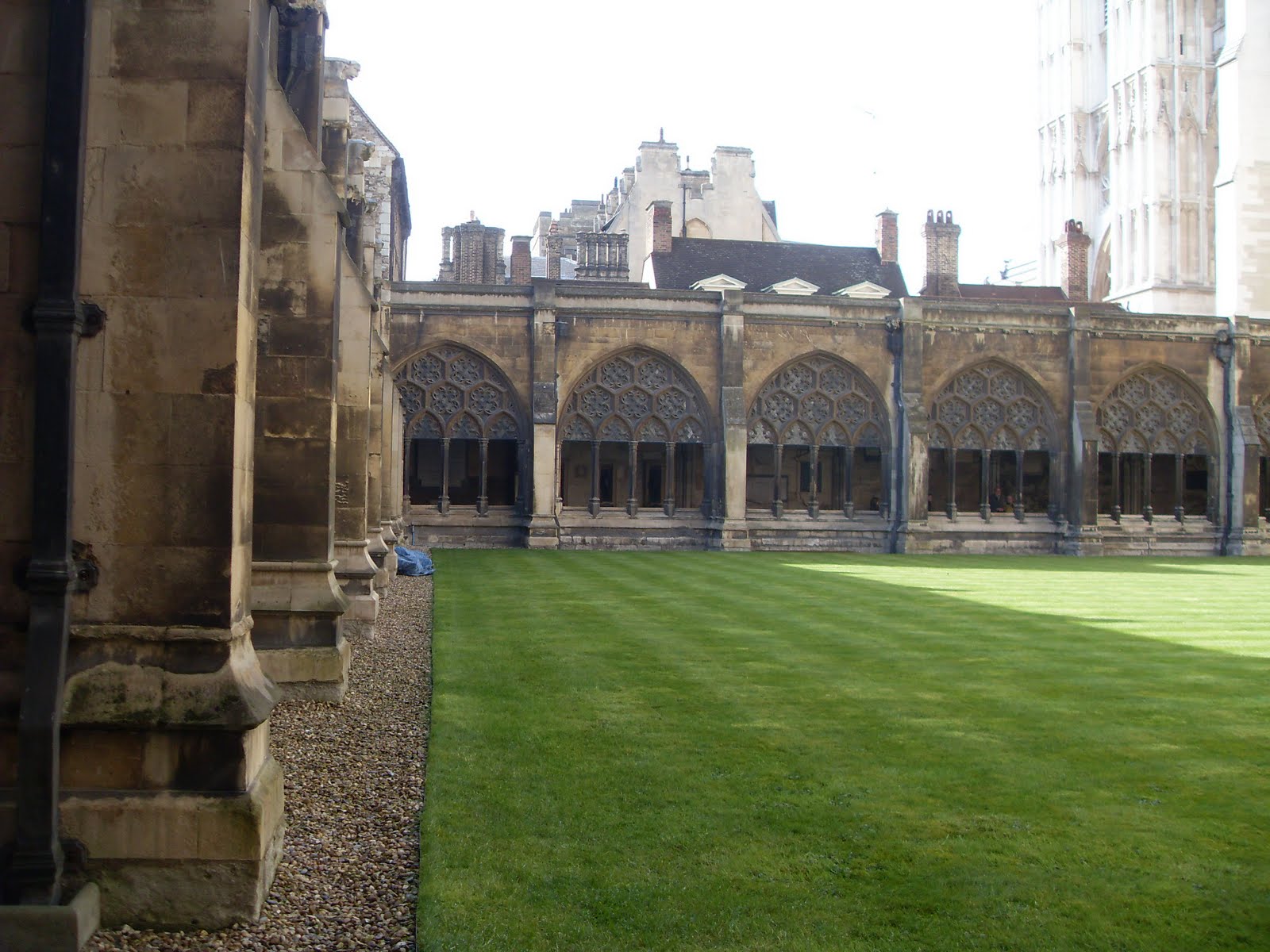
Although Westminster Abbey in many respects is an awe-inspiring church, I didn't manage to summon the same feeling of reverence as I always get when visiting York Minster. This is, of course, partly due to the tourists as explained above, but it is also in part because of the unfortunate condition of the exterior walls. As can be seen in the picture below, there are two colliding types of stone used in the structure, and this gives the venerable Abbey a semblance of having some fascinating skin disease or a leprosy in the making. 


It is evident that I have to return to Westminster Abbey at some point and spend considerably more time there, preferably in the company of friends who can alert me to the things I miss and overlook and with whom I can engage in scholarly discussions. Despite my rather sullen tone in the comments above I was on the whole quite impressed with the Abbey, or at least the distinctly Medieval aspects I encountered. If only I can bribe the staff, I may even pay some respects to the man I write my thesis on. 


mandag 11. juli 2011

London Letters - Elegy for Edmund Spenser

That iolly shepheard, which there piped, was
Poore Colin Clout (who knowes not Colin Clout?)
He pypt apace, whilest they him daunst about.
Pype iolly shepheard, pype thou now apace
Vnto thy loue, that made thee low to lout;
Thy Loue is present there with thee in place,
Thy Loue is there aduaunst to be another Grace.
- The Faerie Queene, Edmund Spenser

How many thousands never heard the name
Of Sidney, or of Spenser, or their books?
- Musophilus, Samuel Daniel

(...) our sage and serious poet Spenser, whom I dare be known to think a better teacher than Scotus or Aquinas
- Areopagitica, John Milton

 
Lo I the man, whose Muse whilome did maske,
As time her taught, in lowly Shepheards weeds,
Am now enforst a far vnfitter taske,
For trumpets sterne to chaunge mine Oaten reeds,
And sing of Knights and Ladies gentle deeds;
Whose prayses hauing slept in silence long,
Me, all too meane, the sacred Muse areeds
To blazon broad emongst her learned throng:
Fierce warres and faithfull loues shall moralize my song.
- The Faerie Queene, Edmund Spenser


I once scornfully remarked that John Keats was essentially an over-emotional fanboy, after having read his sonnet On sitting down to read King Lear once again. Unfortunately this remark has rendered me a hypocrite, for since then it has become obvious to me that I am myself an equally passionate fanboy, although instead of Shakespeare I direct my adoration to Edmund Spenser. For those of you who know me well or have read some of my blogpost this should not come as a great surprise, Spenser being the most frequently quoted poet on this site. However, since I harbour such great admiration for his poetic genious I decided to make a pilgrimage to his grave in Westminster Abbey as a part of my trip to London.


In his bridal song Prothalamion Edmund Spenser refers to London as his "most kindly nurse, / That to me gave this life's first native source", and as events unfolded it was also to become his grave. Spenser died in 1599 having fled his home in Kilcolman, Ireland, after the Tyrone rebellion, penniless according to Ben Jonson, and certainly profoundly shaken emotionally. He was buried next to his own hero Geoffrey Chaucer and his coffin was attended by poets who placed upon it elegies written in his honour. The exact whereabouts of his grave is unknown and when an excavation was carried out in the 19th century to save the elegies, the search was fruitless - something it would have been, presumably, even if they had managed to locate his grave.

Mr. Beeston sayes he [Edmund Spenser] was a little man, wore short haire, little band and little cuffs.
- Brief Lives, John Aubrey

Picture of Spenser's tomb is taken from www.poetsgraves.co.uk.

I had greatly looked forward to this little pilgrimage and to pay the proper respects to my poetic idol, the prince of poets and, in my opinion, the true English bard. However, the pilgrimage was somewhat disappointing, partly due to the fact that Westminster Abbey is littered with tourists (something I do not cope with very well, I confess), partly because there was some restoration work going on in a neighbouring chapel and partly because Poets' Corner, for all its fame, does not exude or elicit reverence since the graves and memorials are all heaped together. Nonetheless I took out an old volume of Spenser's collected poetical works and read to myself the stanzas from Book VI of The Faerie Queene where Spenser's persona Colin Clout breaks his pipe. Thomas Roche, editor of the Penguin edition of The Faerie Queene, considers this to be Edmund Spenser's public, yet highly allegorical, withdrawal from poetry, akin to how critics have perceived Prospero's submerging of his books in Shakespeare's The Tempest.

Originally I had toyed with the idea of following the example of poets past and write my own elegy to the Prince of Poets at his grave. Unfortunately the location and its surroundings do not invite to lofty elegiac thoughts, so I disconnected the creative part of my brain for a while and strolled about in the Abbey more as a tourist than scholar or poet.

Although I failed to compose an elegy in Westminster Abbey, I had written a sonnet in Spenser's honour long prior to my arrival in England. I was hoping, this time, to produce a better poem, a more elegiac poem, but since this did not happen I will now present my work in honour of Britain's greatest poet. The sonnet is written in the Spenserian stanza and was completed almost a month after I had finished reading The Faerie Queene. It may appear strange during the first reading, but this is probably due to my imitation of the Spenserian spelling - an antiquated rendition of his contemporary language, attempting to bring it closer to the Middle English of Chaucer's time, that caused Ben Jonson to say, tongue-in-cheek, that "Spenser writ no language". The sonnet shows first of all poetic immaturity and a Keatsian fanboyism, but I hope there is sufficient intertextuality to find it an amusing read.


In Praise of the Unlearned Weaver

When I behold your craftfull tapestry,
I gin to doubt if fairest Philomel
Could with her work match your sweet industry
Or with her thread a greater story tell;
But pierlesse art is ne'er rewarded well,
And solace oft denied a poet's pains;
Such spiteful fate your labours hard befell.
Your mastry poesie does entertain,
And also seeks the virtues to engrain
Fast to the fabric of the reader's mind;
And those who sought to make your struggles vain
Were to your dext'rous nature deaf and blind.
As shown by your delightful sonnetry
You can both weaver and a shepherd be.
- December 2009 – March 18 2010


Notes


Title: The title and weaving imagery of the poem draws on Spenser's own words in a dedicatory sonnnet to Lord Grey of Wilton, prefaced to The Faerie Queene, in which Spenser claims his rhymes to have been "wrought in an vnlearned Loome". It also points to the Spenserian sonnet structure, which through its rhyme scheme weaves the sonnet together in a way I find very pleasing.

Craftfull: This neologism plays on Spenser's own neologism "tradefull" which he employs in sonnet 15 of Amoretti, his sonnet cycle dedicated to his bride Elizabeth Boyle.The meaning is that Spenser's verse is very well crafted with its frequent puns and neologisms.

Philomel: Philomela is a figure of Greek mythology, a princess of Athens who was raped by her brother-in-law Tereus. To hide his transgression Tereus cut off Philomela's tongue, but she revealed the injury wrought on her by weaving a tapestry depicting the story. After her sister had avenged her, Philomela was turned into a swallow. Her metamorphosis is often confused with that of her sister Procne, who was transformed into a nightingale. I considered it a fitting comparison with Spenser as a weaver, since Philomela is the most famous storyteller of that medium in Western legendary tradition.

But pierlesse art is ne'er rewarded well: Despite being considered the prince of poets in his own age, Spenser has in later times taken a backseat to a number of poets and is no longer as well-known or widely read as might be expected. This fate was already pointed out in Jacobean times by Samuel Daniel, as quoted above, even though The Faerie Queene was printed in a complete edition in 1611.

And also seeks the virtues to engrain: Spenser, an Elizabethan Protestant and fierce anti-Catholic, wrote The Faerie Queene partly as an allegory of chivalry and its Christian values. Each of the books is dedicated to a particular virtue which also is represented by the protagonists. The first book has as its protagonist the Knight of the Red Cross who embodies holiness, although this holiness is achieved or repossessed only after he has purified himself from sins committed throughout the book in a pilgrim's progress of allegorical beauty. It is therefore no wonder to understand John Milton's sentiment with regards to Spenser as a teacher of good morals. Spenser had originally planned to write one book for each of the 12 traditional virtues, as he wrote to Walter Raleigh in a letter from 1589, but sadly this was never to be fulfilled.

And those who sought to make your struggles vain: One reason for Spenser's decline in popularity can be ascribed to literary critics of later ages. Samuel Johnson, for instance, disapproved of his archaic language, and early 20th century critics, like Eliot, if I remember correctly, were rather dismissive of his work.

Sonnetry: This is another neologism, but after coining it I discovered that it had already been coined.

You can both weauer and a shepherd be: Spenser's first poetic publication was The Shepheardes Calender, a series of 12 eclogues in emulation of Vergilius, another hero of Spenser's. In this array of highly experimental poetry Edmund Spenser created the persona Colin Clout for himself, named after a poem by John Skelton. Whereas Vergilius masked himself as Tityrus in his Eclogues, Spenser appears as the dejected shepherd Colin Clout who also, as indicated by the first epigraph, makes an appearance in The Faerie Queene.


Poore Colin Clout (who knowes not Colin Clout?)

The illustration to the first eclogue is taken from www.luminarium.org. Notice the broken bagpipe, an image Spenser would return to in his great epic.

lørdag 9. juli 2011

The Hidden Place

The works of the Lord are great, sought out of all them that have pleasure therein.
- Psalm 111:2

Where is my God ? what hidden place
Conceals Thee still ?
What covert dare eclipse Thy face ?
Is it Thy will ?
- The Search, George Herbert

Pride and ambition here
Only in far-fetch'd metaphors appear;
Here nought but winds can hurtful murmurs scatter,
And nought but Echo flatter.
- The Wish, Abraham Cowley


Some of the most delightful discoveries are those which are the most serendipitous, and when one detaches oneself from the Search for something and rather let things occur, one will occasionally experience such discoveries. I consider these to be the true discoveries, for they are accidental rather than being results of meticulous investigation. My discovery of Holy Trinity Church near Goodramgate was one such serendipity. I had already, I noticed in hindsight, seen the church on postcards and walked past the sign pointing it out many times before I ventured to find it, but these observations made only sense to me after I had discovered the church and could make the necessary connections.

The reason why this became a discovery, the reason why I was allowed to make this discovery, is its location. Holy Trinity Church is situated in a little green area enclosed by buildings, and to get there you have to pass through an archway from the 18th century, an architectural feature that secludes the church very effectively. Given the fact that Goodramgate is one of York's busiest streets I suspect I was more concerned with running errands rather than to explore the street in all its beautiful detail, and so it was that it took me until one of my last weeks in York to break off the beaten path, enter the inviting darkness of the archway and follow its tunnel to the oasis beyond, as if it all was a beautiful metaphor for Eden.


For because His love is free, so are His treasures.
- Thomas Traherne, Centuries of Meditation

It was a beautiful day, somewhat crisp if I recall correctly, and entering this pocket of tranquility after the relative commotion of Goodramgate was a delightful transition. As a Christian and a Medievalist I have a particular soft spot for churches, and the months in England had given me an appreciation for that typical English design which was prevalent in Holy Trinity Church.


The premises were to a certain extent quite modest: a small cemetery adorned by various clusters of daffodils, an unpretentious and - given its location - unostentatious church where small groups of elderly people passed the time in quiet conversation, not unlike the daffodils. Being quite fond of anonymity and the humble, it was something of a pleasure to see this little sphere of calm so undisturbed, even on such a beautiful day.

Because of the house of the Lord our God I will seek thy good.
- Psalm 122:9

Holy Trinity Church as it stands today is chiefly a construction of the 15th century, but various traces range from 12th century foundations to 19th century additions. It is not a functioning parish church, but a building taken care of by the Churches Conservation Fund, a national charity organisation whose work is of utmost importance to the cultural history of Britain, and they have, to my knowledge, done a marvellous job keeping Holy Trinity Church from fading into cruel oblivion.


The floor and the arcades are somewhat uneven, but not as uneven as the pictures suggest; I take the blame for this distorted presentation of reality. 
 

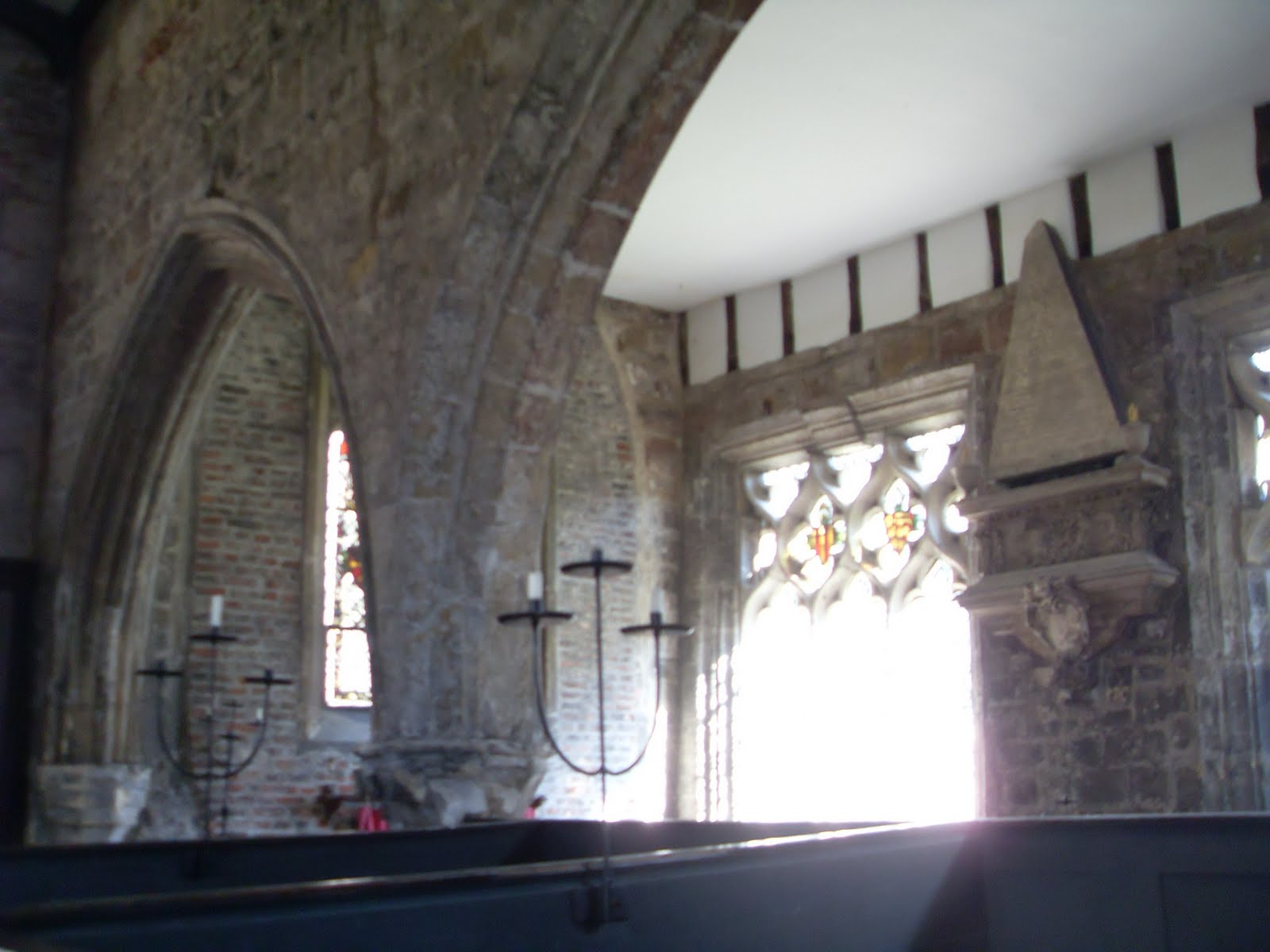
Entering the cool shade of the church room - for which there is no entrance fee - was very delightful, and I was immediately thrilled to have an entirely new church space to explore, and, as in most churches steeped in history, there were many things to come across. Two of its main features of interest can be seen in the pictures above: the beautiful stained glass window, which the rector of the church, the Reverend John Walker, donated in the 1470s, and the boxed pews which are the only of its kind in York.


Compared to other parish churches in York, Holy Trinity Church appeared to me as particularly wide compared to its length, a feature greatly enhanced by the arcades, and considering that the arcades do not separate the quire from the rest of the nave very effectively, the church space appears somewhat less well-structured and ordered than what is the case in similar churches. Rather than creating a focal point at the main altar and illustrating the side naves' relative autonomy, it all floats together. This is of course not void of charm, quite the contrary, and such idiosyncracy is only to be treasured in Medieval works of any kind.

Weightless magnificence upholds the past.
- Who are these coming to the sacrifice?, Geoffrey Hill

To my experience most of the stained glass windows found in Medieval churches in York are restorations, partly due to the relentless effect of time, partly due to iconoclasm following the victory of the Parliament forces in the Siege of York, 1644. Therefore it is all the more awesome to behold true Medieval stained glass, not only Medieval in essence but also in origin.


  A wounded Dragon vnder him did ly
- The Faerie Queene, Edmund Spenser

St. George, patron saint of England, is oddly enough portrayed with a yellow cross on his armour rather than the traditional red. I am sadly no art historian, so I can't elaborate on the subject of this occurrence.


The next day John seeth Jesus coming unto him, and saith, Behold the Lamb of God, which taketh away the sin of the world. This is he of whom I said, After me cometh a man which is preferred before me: for he was before me.
- John, 1:29-30


When the even was come, there came a rich man of Arimathaea, named Joseph, who also himself was Jesus' disciple: He went to Pilate, and begged the body of Jesus. Then Pilate commanded the body to be delivered.
- Matthew, 27:57-58

I'm not sure whether the central window is meant to portray Joseph of Arimathea putting Christ's body to rest, or whether this is a depiction of all God's three aspects put together, a motif found among some Renaissance painters such as Andrea Mantegna. The latter would be more appropriate considering the name of the church, but I'm not sure if that is the case.

Irregardless I find this to be a superbly beautiful window, both because of its realism, but also of the very palpable rendition of Christ's humanity, as can be seen in the very easily-spotted navel.


In the sun lily-and-gold-coloured,
Filtering the cruder light, he has endured,
A feature for our regard; and will keep;
Of worldly purity the stained archetype.
- In Piam Memoriam, Geoffrey Hill

I'm not sure who this saint is meant to be and I ought to be careful with tossing forth suggestions on too weak a ground. Still, I would like to suggest that it might be Joseph of Arimathea who, according to Medieval legend, brought the chalice of Christ to England after the crucifixion, a chalice, as it appears, which contains such a typically English element as a little dragon. The reader should bear in mind, however, that I have no expertise on the subject, and my words should be considered with due scholarly scepticism.


At first I thought the gentleman above to be Moses, but then it occurred to me that Moses did not wade the waters, they were divided for him. I suspect the figure represents St. Christopher who, upon conversion to Christianity, made it his task to ferry wanderers across a river. According to legend he one day carried a child on his shoulders, a child who revealed himself as Christ. To prove this, He asked Christopher to put his staff in the ground and on the following day it had become a palm tree, a miracle that drew many to faith. The name Christopher means Christ-bearer and was originally considered to be understood in a poetic, spiritual way, bearing Christ in your heart. The literal meaning became a feature of his legend in the 12th and 13th centuries, as he had previously been known as a martyr.


Thou hast made me, and shall Thy work decay?
Repair me now, for now mine end doth haste;
I run to death, and Death meets me as fast,
And all my pleasures are like yesterday.
- Holy Sonnet I, John Donne

Beautie in thee takes up her place,
And dates her letters from thy face,
When she doth write.
- The British Church, George Herbert


As alluded to earlier parish churches have one altar at each side of the nave, and in most cases these altars appear quite autonomous. This is, as mentioned, not the case in Holy Trinity Church due to the width of the church room. 


The arcades seem out of proportion to the space they define, almost as if they think themselves worthy of a cathedral rather than a parish church and try to convert into one. This is typical for several features of this church: the feeling that something is slightly awry. Other manifestations of this notion are, as mentioned, the uneven floor and the relatively wide church room.

Truly there are two worlds. One was made by God, the other by men.
- Centuries of Meditation, Thomas Traherne


We have short time to stay, as you,
We have as short a spring;
As quick a growth to meet decay,
As you, or anything.
We die
As your hours do, and dry
Away,
Like to the summer's rain;
Or as the pearls of morning's dew,
Ne'er to be found again.
- To Daffodils, Robert Herrick

onsdag 29. juni 2011

Where a Gate is not a Gate

So many pathes, so many turnings seene,
That which of them to take, in diverse doubt they been.
- The Faerie Queene, Edmund Spenser

In this strange Labyrinth how shall I turne,
Wayes are on all sids while the way I misse
- A Crown of Sonnets Dedicated to Love, Lady Mary Wroth

By the way, you will hear many strange words here. Perhaps the most important thing you should know is that a street is called a gate, while a gate is called a bar.
- Sovereign, C. J. Sansom


One of the reasons York is such a charming place is its infrastructure, a collection of streets, squares, bridges and small alleys called snickelways in a native neologism. As with the city's architecture the intrastructure has such an appeal to me because of its wide variety both when it comes to scenery and York's history which is very palpable wherever you turn. A little too often I was tempted to leave my academic labours behind in my apartment and idly stroll the city like the flaneur extraordinaire I aspired to become, bringing my camera and a book of verses with me as my two most frequent companions.

As C. J. Sansom so aptly puts forth, there are some differences in terminology when discussing the infrastructure of York, a point illustrated by this local slogan: When is a gate not a gate? When it is a street in York. The word "gate", like the word "street", is of Norse origin and means exactly the same as its lingual sibling. . The heavy usage of gate most likely stems from the heavy Nordic influence in the latter part of the Anglo-Saxon era, but why this is so predominant compared to the word "street" is beyond my knowledge. Whether this word is found outside York I can't say for sure. On my first trip to Durham I stumbled across a sign with the name Walkergate on it and immediately believed it to mean "street", ignoring the most likely explanation - as a friend pointed out to me recently - namely that the word simply means gate, or "bar" as the Yorkists put it.

They do of course also use the word "street" in York, just as they use numerous other words designating stretches of infrastructure of varying length, but "gate" is by far the most noticeable. Many of the gates are named after trades which were found in that area, such as coppergate and skeldergate, homes of cupmakers and shieldmakers respectively, while others are named after famous persons either of native origin or who played a significant role in the city's history. Examples of the latter can be found in Marygate and St. Saviourgate, named after the Virgin Mary and Christ respectively, who, although they never set foot in York, were of major importance to the city's history and culture, and they remain so today.

This blogpost is dedicated to various streets of York, some of which are major features of the city, while others are less important but nonetheless enjoyable or interesting. Some streets have been left out due to the rather scanty or lacking availability of photographs owing to my own neglect. One street, Stonegate, is excluded because a blogpost has already been bestowed on it. As for the selection below I trust this will entertain and please in its own right.

Bootham

Bootham is one of the main roads into York, and I walked a stretch of it every day on my way to class or on one of my numerous excursions. Seeing the Minster looming in the distance beyond Bootham Bar was a pleasant sight I never tired of.


This plaque is situated on the wall by White Horse pub which in turn is the neighbour of Jeanette Ray Bookseller, a nice antiquarian bookshop with architecture, gardening and local history as its main themes.


Bootham Bar.

St. Mary's

There is a gentle lady in heaven, who has pity
- Inferno, Dante Alighieri (translated by Charles Sisson)

St. Mary's is a little side road to Bootham where Constantine House, my residence for the stay, is situated.


Marygate Lane


Marygate Lane is a little alley connecting St. Mary's and Marygate, and I was oblivious of this shortcut until a friend revealed it to me. I became very fond of the lane since it cuts through a very nice area, typically British, with brickhouses, hedges and ivy-coated walls.

or the gate in a hedge that opens into England
- The Prodigal, Derek Walcott

Platonic England grasps its tenantry
- Loss and Gain, Geoffrey Hill


 leaves, unraked, tiling the road's margins
- The Prodigal, Derek Walcott


Aldwark and vicinity

Aldwark is an area in the eastern part of York, comprised predominantly of apartments of a fairly recent origin. It is in many ways a rather bland and sterile place and I only walked through it once on my way to Monk Bar, which in hindsight was a ridiculous thing to do considering Monk Bar's location. The only item of interest is St. Anthony's Hall, which by the way now contains the Quilt Gallery, but for reasons I'm not quite comfortable with I only photographed the commemorative plaque rather than the hall itself.


Nothing like good ol' British hospitality.

It's an aardvark! Can't you see that, Your Highness? It's a bloody aardvark!
- Edmund Blackadder 

 
Dundas Street


The name Dundas comes from the Celtic and designates a man who dwells at the south hill or at the hill fort. The reason why I even noticed this name is thanks to Patrick O'Brian's splendid Aubrey and Maturin novel series, where one of Captain Aubrey's closest friends is Heneage Dundas.


Black Horse Passage

Now, as the surging horses of Night grip heaven in darkness,
Down from the skies above slips an apparition
- The Aeneid, Virgilius (translated by Frederick Ahl)


King's Staith


Staith is a Norse word meaning "landing" or "dock".


Swinegate

York has long been famous for its pork, and indeed the scent of fried pork is a fragrance often felt when meandering the city, so it is only natural that there is a Swinegate, which, interestingly enough, also has a gate with swine on it. This part of the city probably belonged to swinekeepers.
 
And the other two little boy pigs, Pigling Bland and Alexander, went to market. We brushed their coats, we curled their tails and washed their little faces, and wished them good bye in the yard.
- The Tale of Pigling Bland, Beatrix Potter

A little snickelway connecting Swinegate with Stonegate, running past, if I remember correctly, Barley Hall Museum.

Davygate


Davygate is one of the busier streets of York, leading to Parliament Street and St. Sampson's Square. A frequent sight was the long queue of people trying to get a table at Betty's Tearoom, to my big surprise. For a city where so many foodstuffs can be found, purchased and devoured, it is fitting that a street should be named after a lardiner, and of course it is only natural considering the lardiner's position and importance in Medieval times.


Sundry details of Davygate.


Fossgate

Foss River.

Stand still, fear not, I'll show you but this book.
- The Honourable Historie of Friar Bacon and Friar Bungay, Robert Greene


Fewster Way

I first thought the word fewster was a variant of the medieval term fewter or fewterer - also surnames, by the way - which refer to greyhoundkeepers, originating from the Latin word vertragus, meaning greyhound. However, after consulting Henry Harrison's Surnames of the United Kingdom I learned that fewster means saddle-tree maker, a trade often mentioned together with saddlers in old plays. Which Fewster this street is named after I don't know.


The Shambles


The Shambles is perhaps the cosiest street of York, having crowbarred itself into the townscape and consisting of a number of delightful shops, such as Chocolate Heaven. There is also the shrine of Margaret Clitherow, a Catholic martyr of the 16th century, which I, in my almost criminal neglect, forgot to visit.


Jubbergate


The word "jubber" is an older word for Jew and this is one of the various mementos of the city's Jewish history. Another memento can be found in the name Jewbury, which designates the Jewish burial ground. The most tragic location in the Jewish history is Clifford's tower, a Medieval castle, where a number of Jews were burned to death in 1190 due to a severe surge of animosity following Richard I's Jewish policy, a policy too light to the tastes of anti-semitic Medieval Christians.


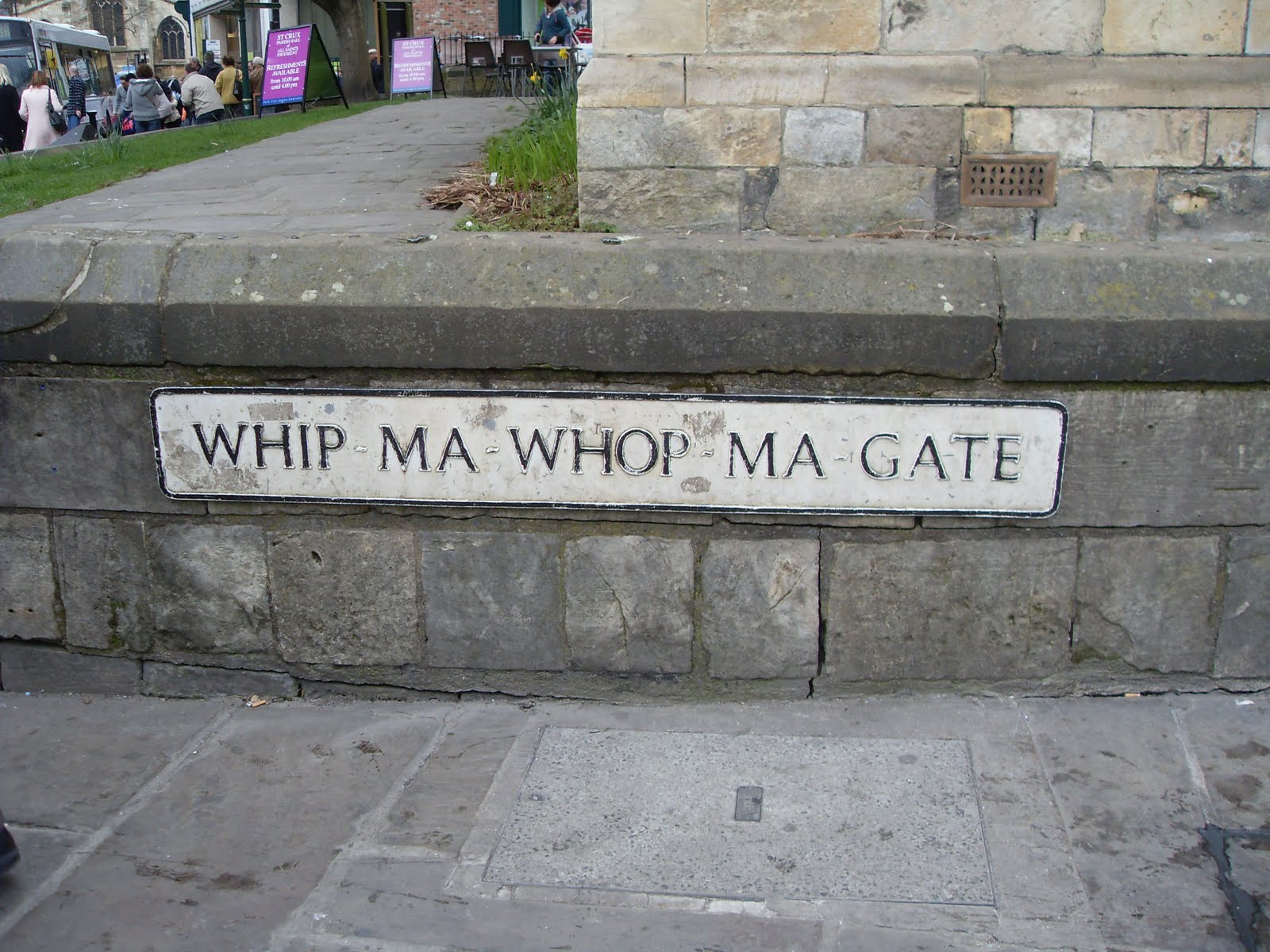
Whip-ma-whop-ma-gate


The shortest street in York is a favourite motif of local postcard designers.


Petergate

Soon after that came east from Denmark two hundred ships; wherein were two captains, Cnute Swainson, and Earl Hacco; but they durst not maintain a fight with king William. They went rather to York, and broke into St. Peter's minster, and took therein much treasure, and so went away.
- Entry for the year 1075, the Anglo-Saxon Chronicle


Beginning at Bootham Bar and divided into Low and High Petergate, this street can offer an array of pubs, bookshops and purveyors of numerous and various goods. Leading to the Minster, it was the natural way for me to walk when on my way to and from Evensong, or whenever I decided to render the cathedral a visit.


Skeldergate

As previously mentioned this was the precinct of the shieldmakers.


York Way


And, as can be seen, there are stretches of road related to York even outside York. This was taken in London and is complete with the compulsory CCTV.