And was the holy Lamb of God,
On Englands pleasant pastures seen!
- And did those feet, William Blake
Viser innlegg med etiketten York. Vis alle innlegg

lørdag 15. februar 2020

For the feast of Saint Sigfrid


Today is the feast of Saint Sigfrid of Växjö in Sweden, the patron saint of the city and of the region of Småland. His legend survives in thirteenth-century sources, and according to this legend he was the archbishop of York in the early eleventh century, who went to Sweden on the invitation of the pagan Swedish king who wanted to learn about Christianity. This king was Olof Skötkonung (d.c.1022), who is the first recorded individual to have claimed rulership over both the Geats and the Swedes, which were the two main political entities of medieval Sweden.Olof Skötkonung (interpreted as tax-king) is a historical figure, but Sigfrid's historicity is highly dubious. We do know that there has never been an archbishop of York by that name, and the English king Mildrith who also appears in the legend is likewise not authentic. 


Växjö Cathedral


The legend of Sigfrid continues with a description of his arrival in Denmark, where he was greeted by King Svend (presumably Svend Forkbeard who died in 1014). The Danish king was himself a Christian, and had Sigfrid escorted safely to the Swedish border. By this point in time, Denmark extended into the region of Skåne, or Scania, which today belongs to Sweden. Consequently, at Sigfrid's time, it was Småland that constituted the border zone between the politically fragmented Sweden and the more centralised Denmark.

In Småland, Sigfrid set up camp by Lake Växjö, a name that I have seen interpreted as veg-sjö, or road-lake, i.e. a lake by the crossroads. If correct, this name points to the existing trade routes through forests and by water that were in place at the time of Sigfrid's alleged arrival. This also makes sense, considering that Christian missionaries - historical or mythical - were not pioneers in unknown lands, but settled where there already existed networks of human contact and infrastructures by which the new faith could be disseminated. Close to Lake Växjö, he established his first church, said to be on the spot where the cathedral stands today. While Sigfrid's church is mythical, it is likely that a wooden church was erected in the early stages of the Christianisation of the area. It is also likely that this wooden church was placed where the cathedral stands today, because when Växjö became a bishopric in 1170, the building of a new stone church was started. This stone church were a replacement for the previous wooden structure, and likely raised on the same foundations - this is a very common pattern in the history of Nordic churches.

In the first stages of Sigfrid's missionary campaign, he was aided by his three nephews that he had brought with him from England. They were named Unaman, Sunaman and Vinaman, and they were in charge of the nascent church while Sigfrid went to visit King Olof to tell him about his progress. While Sigfrid was away, a group of twelve local aristocrats - i.e. rich farmers and chieftains - conspired against the three nephews. These twelve had been selected as honorary members of the church organisation, presumably in imitation of Christ's apostles, and possibly also with a nod to the twelve monks that were chosen by Benedict of Nursia in his establishment of the Benedictine Order. The twelve Swedes, eventually, stole into the sleeping quarters of the nephews and decapitated them. The bodies were buried and the heads thrown into Lake Växjö.

When Sigfrid learned about this, he returned to Växjö and as he was walking by the lake a celestial light shone down on the water, revealing the three heads placed in a small wooden tub. The heads spoke to him, and vowed revenge on later generations. The culpits were later punished by Olof Skötkonung, and Sigfrid continued his work as the first bishop of Sweden. He later died peacefully, and is therefore listed as a confessor in the calendars. 


Since today is the feast of Sigfrid, there was a concert in the cathedral featuring excerpts from the liturgical office, which survives in thirteenth-century sources. The arrangement was organised by Karin S. Lagergren, a friend and colleague at Linnaeus University whose research is the foundation for the musical arrangement, and the recording of a CD of Sigfrid's liturgy. It was a wonderful experience with beautiful music permeating the sacred space of the cathedral and bringing to life the mythical and inauthentic figures, whose story nonetheless is likely based on some collective memory from the time of conversion. This office was likely composed in the bishopric of Växjö - thus pointing to the existence of a scriptorium at the cathedral - and from there it was disseminated throughout the Swedish metropolitan see (which had been established in 1164). The performance, in this way, brought me closer to how the story of Sigfrid, and how the identity of the cathedral, was communicated to the medieval community of clerics from the thirteenth century onwards.


Following the concert, I had a stroll by Lake Växjö, following the shore where Sigfrid mourned his nephews and miraculously found their heads. There was no celestial light today, but it was nonetheless a very atmospheric afternoon, and with my head filled with the watery imagery of the Sigfrid legend, it became somewhat easier to imagine the scenes of the story. It was, in other words, easy to see how the legend and the landscape in combination served to solidify an identity centred on the figure of Sigfrid. We now know that he never existed, but to the Swedes in the twelfth century onwards he was, and he became the representative of their identity both in relation to the local geography and in relation to the Swedish history as a whole.


fredag 27. desember 2019

The chalice of John the Evangelist


Today is the feast of John the Evangelist, and for this occasion I decided to dig deep in my archives in search of a memory from when I was an MA student and spent quite a lot of time in York. I was reminded of the many beautiful pieces of surviving medieval stained glass in the city's many churches, and I had some hazy recollections of John the Evangelist featuring in some of them. In particular, I was convinced that the Church of St Denys on Walmgate had at least one memorable depiction of John, and it turned out that I was right, in a fashion. The images I found were not quite what I had envisioned, but what I found was well worth sharing, especially because one of the images teaches a very good lesson about the importance of iconography. But I'm getting ahead of myself. 


John the Evangelist, holding his attribute, the eagle


The above picture was one I had forgotten, but which shows one of the typical representations of John: A young, beardless man holding the eagle, his attribute which points back to the tetramorph of the vision of Ezekiel. In his other hand he holds what looks like the palm leaf, commonly attributed to martyrs, which is puzzling considering that John was not martyred but rather died of old age. It is possible that it is a lily signifying his virginity, but this is uncertain. The glass is fourteenth century. 


Saint Denys

Saint Denys, tower and repaired Norman doorway


The Church of Saint Denys is a treasure trove of medieval vestiges pointing to its long history. The doorway beside the tower, for instance, points to its early twelfth-century origin, as it is a Romanesque Norman arch with mason work typical of the period. Although the stonework and the gateway itself is, to the best of my judgement, original, its placement is a result of the continuous changes of the medieval church space. The main church building with its central nave and two flanking aisles dates from the fourteenth and fifteenth century, the period when the oldest surviving stained glass windows were constructed. The nave was badly damaged during the English Civil War, presumably in particular during the Siege of York in 1644, and therefore significantly shorter and more quadratic than it was originally. Consequently, while the Norman doorway once was the main entrance into the nave, it presently stands in its rebuilt form as a side entrance. 


Saint Denys, interior


Because the church has undergone many accidents and tumultuous changes in the course of its long history, a lot of what survives today is not in its original place - as demonstrated by the case of the Norman doorway. This is particularly evident in much of the stained glass. Some of the figures remain in their original positions, either by being put back in place or simply by serendipitously surviving the many changes in the subsequent centuries. Much of the medieval glass, however, survives only in fragments. These fragments have been put into whichever empty lead frame that fit them, resulting in an incongruous mix of displaced details that together provide an imperfect but powerful glimpse of the once complete programme of stories, episodes and figures that filtered the light for the churchgoers in the late Middle Ages. To the medievalist, these assemblages of fragments provide a veritable treasure hunt by which a picture, a narrative or a figure might be teased out from the chaos. One of these figures is John the Evangelist. 


In the picture above we see some of the many details that once were part of complete stories in glass. We see trumpeters that might hint at a doomsday window since the gonfanon is decorated by horned devils and ominous black birds that could be owls. We see the crowned head of the crucified Christ that might have been a free-standing crucifix or part of a larger crucifixion scene. And we see a chalice with a serpent. This chalice is the chalice of John the Evangelist, and can be found in a story recounted by Jacobus de Voragine in Legenda Aurea. According to this story, John was given a cup of poisoned wine by a pagan priest, but John drank the wine and survived, thus proving the power of God.

What is particular interesting about this disembodied attribute is exactly that it is recognisable even outside its original context. Once this stained glass fragment flanked a figure of John the Evangelist and reminded the onlookers of the story of the poisoned wine, which the priest might have recounted in sermons on precisely this day, December 27. They would have been reminded of this story whenever they went to church, looked up and saw this chalice and the now-lost figure of the evangelist. And even now, centuries later, with the figure of John irretrievably lost to the accidents of history, this single chalice, displaced from its original context, is still identifiable precisely because the stories survive, and precisely because the stained glass is a reminder of that stories, a shorthand for a larger narrative. In this way, fragments of a now-lost vitreous splendour is sufficient for us to, at least mentally, piece together what was once a familiar sight to the parishioners of Saint Denys, Walmgate, York.


tirsdag 19. juli 2016

Saints, Stained glass, and Serendipity


Created purely from glass the saint stands,
Exposing his gifted quite empty hands
- Geoffrey Hill,
In Piam Memoriam


Towards the end of June I arrived in England for an intense bout of conference activities, starting in York for a few days and then continuing to Leeds. It was a hectic period, but by a stroke of luck it all began just in time for me to catch the last performance of the 2016 York Mystery Plays. From the beginning of the performances on 26 May I had seen several favourable comments and many tantalizing pictures from people who had gone to see the plays. I became very envious, especially since I had seen a performance of the 2012 Mystery Plays, and I knew I was missing out. I was therefore very happy when I had managed to procure a ticket for the very last performance in the evening of 30 June.

This year, the Mystery Plays were performed in York Minster, with a stage arranged like the stairs of a temple, with three broader steps on which the action was performed. The top step was Heaven, while the bottom step served both as the entrance to Hell and the tomb of Christ. It was a masterful performance, and I might write more about it at some later point. In this blogpost, however, my focus is a very serendipitous detail of that evening.


Window from the south side of the cathedral

Since the stage of the mystery plays was arranged like a stair, the seating was arranged like in a stadium, and in order to get a good overview I had bought a seat very high up, which brought me level with the first row of stained glass windows. I had been inside the Minster numerous times since my first visit there in 2009, but I have never been that high up and I might never be again. I knew that this might be a once-in-a-lifetime opportunity, so before the play started I made sure to examine the glass of the south wall as well as I could. Suddenly, however, I realized that I had been more fortunate than I could ever have imagined.


Edmund to the left of me, Edward to the right

As I was standing by the railing, I saw that one of the closest windows contained stained glass depicting two saints with which I have become very familiar over the past few years, namely Edmund Martyr and Edward the Confessor. I knew that the two kings were to be found in the wilderness of stained glass in York Minster. I once wrote a blogpost about the iconography of these saints as found in York, and experts on the subject told me that they were there and provided me with details. But there I was, staring them in the face and for the first time seeing them in real life and with my own eyes. I spent a long time trying to take good pictures of the individual windows, and the best results can be seen below. Regular readers of this blog, or people who know me well enough, will know that I have something of an obsession with these two saints, and this obsession has its root in my academic career. I wrote my MA on the cult and literature of Edward the Confessor, and I'm currently working on a PhD thesis in which an examination of the cult material of Edmund Martyr is one of the three major parts.


Edward the Confessor is easily recognized in this right-hand panel. This is not the only depiction of Edward in York Minster, another stained glass window featuring the saintly king can be found in the chapter house vestibule, dated to the latter two decades of the 13th century. In both depictions, however, Edward is seen with the ring, which is perhaps his most famous attribute and the one which is most often used in representations of him in glass, sculpture, painting or illuminations. The ring is of great importance due to the miracle depicted in the stained glass window above.

The miracle of the ring appears first in Aelred of Rievaulx's Vita Sancti Edwardi, which was finished in 1163, two years after Edward's canonization and in time for his translation on October 13. According to Aelred, Edward had once met a beggar who asked for alms, and when Edward realized he had no money on him, he gave the beggar his ring instead. Later, two English knights in the Holy Land were approached by a man who said he was John the Evangelist, and gave them a ring which he asked them to bring to the king of England. This the knights did, and Edward recognized the ring understood the miracle. The miracle of the ring was so famous that it was included in the chapter on John the Evangelist in Legenda Aurea, but with Edmund Martyr in the place of Edward through some strange confusion.


Edmund Martyr is also found other places in the Minster. He is also found among the seven windows of the chapter house, and on a wooden panel once found in the chapter house ceiling (13th century), but now among the treasures of York Minster displayed in the crypt. Edmund is recognized by the arrow he holds in his hand, and this is his most common attribute. The arrow - or sometimes arrows - are the instruments of his torture. According to the first life of Edmund, Passio Eadmundi, which was written by Abbo of Fleury in the 980s, Edmund was seized by a group of Danish Vikings, tied to a tree like Christ on the cross and then pierced through with arrows like Saint Sebastian. When Edmund still refused to submit to the lordship of the Danish chieftain, he was decapitated and his head carried off, but that is another story.


Having worked this much with these two saints, it was a very pleasing serendipity to find myself on the level with these two otherwise inaccessible depictions, and that on the very last day it was possible for me to do so. Such instances of good luck can sometimes be found in the course of academic work, and they are always very welcome and very pleasing.


Similar blogposts


Edmund likened to a hedgehog

Edward the Confessor in the North of England

The miracle of the ring in Legenda Aurea

Edward the Confessor in Dringhouses, York

The cult of Edward the Confessor


søndag 10. juli 2016

That which is taken from me is not mine - epitaph for Geoffrey Hill


Dawnlight freezes against the east-wire.
The guards cough 'raus! 'raus! We flinch and grin,
Our flesh oozing towards its last outrage.
That which is taken from me is not mine.
- Geoffrey Hill, "I had hope when violence was ceas't", from
King Log (1968)


For years I have been an avid reader, and an avid re-reader, of Geoffrey Hill's poetry. I no longer remember when I became enthralled by his verse, but it must have been about six or seven years ago. At that time I had already studied one of his poems, "September Song", in an English course on poetry and drama, but I do know that it was not this poem which caught my attention. Rather, I discovered his verses while browsing through the Norton Anthology of English Poetry, whose fourth edition contains a selection of some of his greatest works, including excerpts from the sonnet cycle "An Apology on the Revival of Christian Architecture in England" (its title taken from a book by Augustus Welby Pugin from 1895), excerpts from Mercian Hymns, and his homage to Helen Waddell, "Veni Coronaberis". The poetry of these verses spoke to me, with their references, their sure sense of rhythm, with their evocative images and - for some - with their epigraphs, for which I have a big soft spot.

In the following years, I kept reading Hill's poems, and when I studied in York for the spring term of 2011, I bought a copy of edition of Collected poems from 1985 by Penguin Publishing. This volume contains the complete first four collections, in addition to two longer poems published separately in 1983 and 1984. This book became a constant companion on my walks around in York, and I would often read it in the Yorkshire Museum Garden while enjoying the peace and quiet of the surroundings and the sense of history which is so very strong in that particular place. As a consequence, Geoffrey Hill became a travelling companion as I explored the streets and history of York, and his poems became part of my understanding and comprehension of York itself. When I read some of my favourite verses, such as "The Laurel Axe" from "An Apology...", or "The Distant Fury of Battle", I immediately think of York in springtime, in its changing moods. It was also in York, in september 2011, that I bought and read his collection Clavics, which was a pleasant return to form for a poet whose verse - in my opinion - is at its best when rendered in verse.


It is fitting, therefore, that it was in York I learned of Geoffrey Hill's tragic passing. I received the news the day after, while accidentally overhearing someone at the University of York mentioning the fact to a colleague. I was in York to attend a conference organized by my job, the Centre for Medieval Literature, and during lunch I came to learn of the loss of one of the greatest poets of the English language. I still carried with me the volume bought in 2011, and I had read the entire "An Apology for the Revival of Christian Architecture in England" on the day of his passing without knowing he was dead, and somehow it pleased me think of this unwitting homage. The day when I heard that he was dead, however, I again picked up the collection and read the beautiful magic realism of Mercian Hymns.

The poetry of Geoffrey Hill has meant a lot to me in the past few years. They have teased my historical imagination with their evocation of past epochs, they have satisfied my delight in rhymed verse, they have dazzled me with their lyrical and playful use of language and imagery, and they have opened up doors to other books and other literatures for me. To me, when talking about Hill's poetry, it will always be his earliest collections I think of with greatest admiration, when he relied chiefly on rhyme but not strictly so, and when he still wrote sonnets. Among his early poems there are many often overlooked gems, some of which are very short, which evoke in my mind an England which is that England of an ever distant past which is partly the reason for my abiding anglophilia - the dark sides of contemporary English culture and society notwithstanding. In a way, Geoffrey Hill's early poems are windows into a lost world - not a better world, but one which it is delightful to explore through these particular verses.


The front page of the collected poems by Geoffrey Hill
Oxford University Press, 2014
(Photo credits, bookdepository.com


As a conclusion to this very personal epitaph, I will include one poem from King Log, whose opening frequently comes to my mind, and which is one of the most beautiful verses crafted by Geoffrey Hill.

The Imaginative Life

Evasive souls, of whom the wise lose track,
Die in each night, who, with their day-tongues, sift
The waking-taste of manna or of blood:

The raw magi, part-barbarians,
Entranced by demons and desert frost,
By the irregular visions of a god,

Suffragans of the true Seraphs. Lust
Writhes, is dumb savage and in their way
As a virulence natural to the earth.

Renewed glories batten on the poor bones;
Gargantuan mercies whetted by a scent
Of mortal sweat: as though the sleeping flesh

Adored by Furies, stirred, yawned, were driven
In mid-terror to purging and delight.
As though the dead had Finis on their brows.


For similar blogposts:


House of Solitudes

Containing "Veni Coronaberis"

The Herefordshire Carol

Damon's Lament for his Clorinda, Yorkshire 1654

A selection of Geoffrey Hill's early verse


torsdag 24. mars 2016

Saint Wilfrid and the Easter controversy


In the Christian year, the celebration of Easter is the mystical climax and the most important feast of the annual cycle. Since Easter is a movable feast there have been many debates throughout the early Christian centuries about when the feast should be celebrated, and there have been many attempts at calculating a calendar cycle that would accurately predict the time of Easter.

One of the arguably best known examples of this ongoing Easter controversy took place in England at the Synod of Whitby in 664, where representatives of the Celtic and the Roman churches presented their arguments for their respective views. The story is perhaps most famously recorded in Bede's Ecclesiastical History, book III, chapter 25, but it is also expounded in dramatic detail in the Life of Wilfrid written by Eddius Stephanus in 720. Wilfrid (d.709) was a monk from Lindisfarne who studied in Rome and became bishop of York, and he was among the representatives from the Roman church at the Synod in 664. In the account by Eddius Stephanus' it is Wilfrid who single-handedly is responsible for the victory of the Roman party and the introduction of the Roman calculation in all of Britain.

I will not go into great detail here regarding the Synod of Whitby (an introduction can be found here). Suffice it to say that the matter was one of great importance, since there were in Britain at that time two competing Christian traditions. The Celtic church had its origin in the Roman era and had established its own missionary tradition which had founded centres on the Continent, and which had a strong influence in the north of England. The other side is referred to as the Roman side since it had been established by the missionary work from Rome as ordered by Pope Gregory the Great. At Whitby, therefore, not only correct religious observance - itself an important issue - but also ecclesiastical power struggles were at play.

As an overview of this event and as a reminder of the importance of Easter, I will here quote from J. F. Webb's translation of Eddius Stephanus' Life of Wilfrid, published in The Age of Bede, Penguin Classics, 2004: 116-17. The account is found in chapter 10. Eddius' introductory information about Bishop Colman is largely incorrect (see Webb 2004: 116). It is also worth noting that this takes place before Wilfrid ascended to the episcopacy of York.


October, with Wilfrid on the far right
BL MS Royal 17 A XVI, almanac, England, c.1420
Courtesy of British Library


On a certain occasion while Colman was bishop of York and metropolitan archbishop, during the reign of Oswiu and Alhfrith, abbots, priests, and clerics of every rank gathered at Whitby Abbey in the presence of the most holy Abbess Hilda, the two kings and Bishop Colman and Agilberht, to discuss the proper time for celebrating Easter: whether the practice of the British, Scots, and the northern province of keeping it on the Sunday between the fourteenth and twenty-ssecond day of th moon was correct or whether they ought to give way to the Roman plan for fixing it for the Sunday between the fifteenth and twenty-first days of the moon. Bishop Colman, as was proper, was given the first chance to state his case. He spoke with complete confidence, as follows: 'Our fathers and theirs before them, clearly inspired by the Holy Spirit,as was Columba, stipulated that Easter Sunday should be celebrated on the fourteenth day of the moon if that day were a Sunday, following the example of St John the Evangelist "who leaned on the Lord's breast at supper", the disciple whom Jesus loved. He celebrated Easter on the fourteenth day of the moon, as did his disciples and Polycarp and his disciples, and as we do on their authority. Out of respect to our fathers we dare not change, nor do we have the least desire to do so. I have spoken for our party. Now let us hear your side of the question.'

Agilberht, the foreign prelate, and his priest Agatho bade St Wilfrid, priest and abbot, use his winning eloquence to express in his own words the case of the Roman Church and Apostolic See. His speech was, as usual, humble. 

'This question has already been admirably treated by a gathering of our most holy and learned fathers, three hundred and eighteen strong, at Nicaea, a city in Bithynia. Among other things they decided upon a lunar cycle recurring every nineteen years. This cycle gives no room for celebrating Easter on the fourteenth day of the moon. This is the rule followed by the Apostolic See and by nearly the whole world. At the end of the decrees of the fathers of Nicaea come these words: "Let him who condemns any one of these decrees be anathema."'

These are Wilfrid's word on the subject, and the chapter continues with the king asking rhetorically the synod whose authority is the greatest, Columba or Peter the apostle. Since no one can deny the primacy of the prince of apostle, the case is settled and Colman is allowed to resign rather than having to enforce a break with his own tradition.

The Easter controversy was a matter of great contention, and we do well in treating Eddius' report with due skepticism. However, what we know for certain is that the Roman party won, and Wilfrid solidified his reputation as a learned man in these debates.  

As a final note of explanation: Bishop Colman argues that they follow the tradition established by Saint John the Evangelist, and although both this and the Roman use of Saint Peter are questionable in historical weight, this highlights the importance of longevity, tradition and Biblical roots in church ritual. What is of particular interest to a saint-scholar like me is the reference to Polycarp (d.155). He was martyred in Smyrna and was believed to have been the disciple of John the Evangelist, hence his inclusion in Colman's argument of the chain of tradition. Aside from being a valuable insight to the rhetoric of the period, Colman's speech gives us also a glimpse of the standing of Saint Polycarp in seventh-century Britain.

søndag 20. mars 2016

Edward the Confessor in Dringhouses


Ever since writing my MA thesis on Edward the Confessor, I've had a minor obsession with all things related to his posthumous cult. Regular readers of this blog will be aware of this already, as might be attested to by the number of blogposts touching on this particular subject (a list of which will be added after the present post).

It was for this reason that I have been haunted by the idea to pay a visit to the Church of Saint Edward at Dringhouses, a village just outside York. Fortunately, while I was staying in York for two months as part of my PhD programme, I lived just about fifteen minutes away from the church and decided that it was high time I had a look around. Typical of my propensity for procrastination, I left it to the very last day I was in York, but luckily I did manage to get around it.  


The belltower. The spire was replaced in 1970


This part is most likely the vestry, which was added in 1902

The inner doorway

The church of Edward the Confessor was built between 1847 and 1849, and upon its completion it was dedicated to Saint Edward. This was in fact a re-dedication, as the new church replaced a church from 1725 which had been dedicated to Saint Helen, which in turn had replaced a chapel dedicated to the same saint. This chapel is mentioned in chantry certificates as early as in 1546 and 1548. The church was financed by the widow of the late Revd. Edward Trafford Leigh, and in memory of her husband she had it dedicated to his namesake saint. Saint Edward's became a parochial church in 1853 when Dringhouses parish was established from parts of the parishes of Holy Trinity and St Mary Bishophill Senior.

Saint Edward's church was constructed in decorated Gothic by the architects Vickers and Hugill (or Hugall) of Pontefract. This is perhaps especially evident in the windows and the doorways with their pointed arches and the leaf-work masonry on their side columns. Although there are several details of such beautiful handicraft, the exterior of the building is not remarkably opulent. The interior of the church is somewhat more so, owing in particular to the many splendid windows of stained glass.

Nave, towards the choir


The oldest stained glass windows were designed by William Wailes in 1849, and these depict figures and scenes from the Bible. The first two windows below are found on the left-hand side of the nave when facing the choir. The first window depict the prophet Elijah (here Elias) with the scene showing him being fed by ravens in the wilderness (1 Kings 17:4-6), and then Moses with the scene showing the rod with the brass serpent (Numbers 21:4-9). The second window shows Saint Simeon holding the Christ-child with a scene from the presentation of Christ in the temple below (Luke 2:25-32), and then John the Baptist with the scene showing the baptism of Christ in the River Jordan (Mark 1:1-8).


In the choir, the central window shows the crucifixion of Christ with Mary and John the Evangelist at his sides, with scenes from the Passion underneath. In the choir on the left-hand side are Matthew and Marcus, while on the right-hand side are Luke and John. Note especially how carefully John is made to be identical with the depiction in the central east window.  


On the right-hand side of the nave the windows depict scenes from the New Testament. The first shows parables of Christ, including the parable of the sower (Mark 3:4-9), the parable of the lost sheep (Matthew 18:12-17), what seems to be the parable of the talents (Matthew 25:14-30). The lower left panel might depict Christ being rejected by a pharisee. The second window shows Christ blessing the children (Matthew 19:14) with angels underneath.  


While the stained glass windows by Wailes were very beautiful, I was chiefly interested in the sundry depictions of Edward the Confessor himself, in order to see how his iconography had been represented. The first depiction of Saint Edward can be found in a niche above the doorway where a statue shows the Confessor, bearded, wearing a crown and holding a ring and a sceptre with a bird on its top.  


This iconography is typical of the tradition of Saint Edward's cult. His appearance as a bearded monarch is attested already in the first biography, written relatively shortly after Edward's death in 1066, now referred to as Vita Ædwardi Regis. His white, and virginal, beard is made into evidence of holiness in the two twelfth-century hagiographies written about him, the first by Osbert of Clare in 1138 and the second by Aelred of Rievaulx in 1163.

The ring and the bird refer to two of the most iconical legends concerning the Confessor. The story of the ring can first be found in Aelred of Rievaulx's Vita Sancti Eadwardi, where it is told that the Confessor gave his ring to a beggar. This beggar turned out to be Saint John the Evangelist in disguise (the Confessor's particular saint), and Saint John, again in the disguise of a beggar, gave the ring to two English knights in the Holy Land, with the orders to take it to the king and report how they had received it. The ring remains the key iconographical feature of Saint Edward. (More on this here.)

The bird is a later feature, but it may have entered the iconography as early as the 13th century. By the end of the fourteenth century, the coat-of-arms of Edward the Confessor was held to be a golden cross on a blue background with golden birds in the open spaces between the cross arms, and one golden bird underneath the cross. We see this from Richard II's merging of his own coat-of-arms with that of Saint Edward.

In time there emerged a legend saying that Edward had once been disturbed by nightingales during prayer, and when he prayed that they should cease their singing for a while they did so. This legend appears to have an early modern date rather than belonging to the medieval tradition. (More on this here.)


Edward the Confessor is also depicted inside the church. We see him on the right-hand side of the altar, where he is flanking Christ in majesty with Saint Peter standing on the left-hand side. The confessor is here surrounded by four angels, two of which are carrying some of the instruments of Christ's passion. Above Saint Edward's head we find his coat-of-arms.


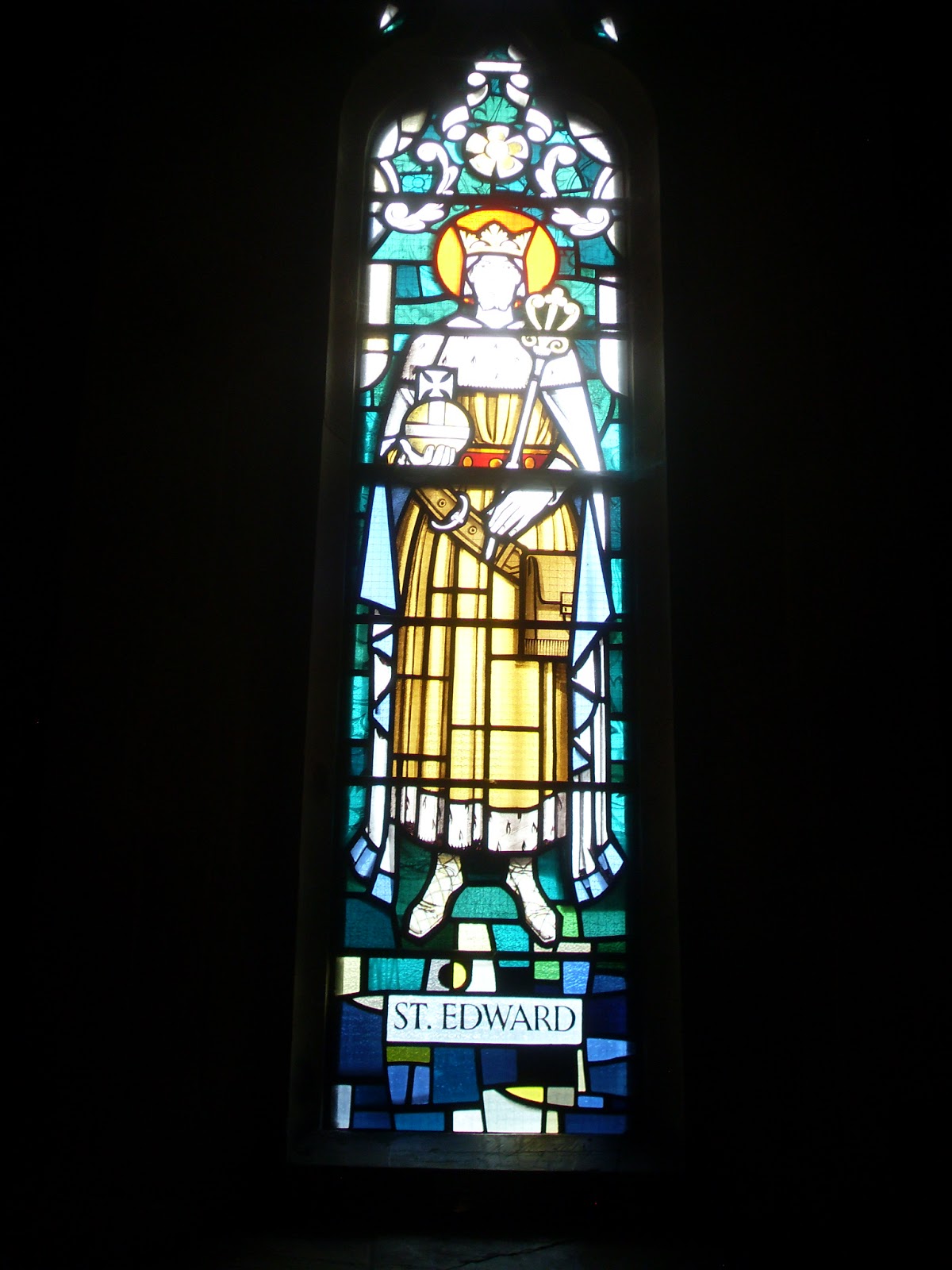
We also find Saint Edward on the left-hand side of the bottom end of the nave (when facing the altar). This is a stained glass window put up in memory of churchwarden G. Raymond Burn who died in 1993. Here the Confessor is shown wearing his regalia, but in a distinctly more royal and notably less legendary form than in the other depictions. 


The dedication of the church has also given name to at least one more place name in Dringhouses, namely St Edward's Close, as depicted below.


Websites: