And was the holy Lamb of God,
On Englands pleasant pastures seen!
- And did those feet, William Blake
Viser innlegg med etiketten Giovanni Boccaccio. Vis alle innlegg

onsdag 15. mai 2019

Whose Utopia is it anyway? – some brief reflections on the inherent vice of the ideal society


Screenshot from the Disney short Plutopia (1951), presumably showing the country's coat of arms


For several years I have been fascinated with the various forms of Utopian societies and how they have been imagined by writers through the centuries. As a general rule, I hold that a Utopian narrative is interesting mainly for what it can reveal about its author, and not so much for what it can offer for the sundry societal ills of our own time. Indeed, the majority of the Utopian societies I have read about are practically dictatorships where one person’s preferences and pet peeves have a disproportionate impact on people of different tastes and views. Such an impact becomes all the more problematic in those cases where the Utopian society in question is described in minute detail, something which inevitably makes the whole narrative a catalogue of the author’s obsessions and blind spots. In most cases, these blind spots highlight that the creators of these Utopian societies predominantly are not women – with some notable exceptions such as Margaret Cavendish – and so there are several problems affecting mainly or only women that are either not dealt with or that are dealt with immensely poorly. For instance, I do not recall having read any Utopian narrative that addresses problems such as domestic violence or rape, or admit to the possibility that such crimes might occur in any given society. This is just one of the elements which show to what extent Utopian narratives are predominantly about the critique and lampooning of a select bundle of issues, and not a literary genre that can provide much practical guidance. It is also one of the elements which suggest that an author of a Utopian narrative very rarely ought to be in a position of power. Quite the opposite, I argue that one way to keep people away from power would be to ask them to describe their own idea of a Utopian society, and then have the atrocious ones disbarred from any future participation in the government.


Title woodcut from a sixteenth-century edition of Thomas More's Utopia
Courtesy of Wikimedia


It is both impractical, unrealistic and, to be frank, completely undesirable to make use of Utopian narratives as wholesale guidebooks to how a society should be organised, above all because of how the faulty ideas of the creators tend to bleed into the very structures and foundations of these imagined perfect societies. As an example, Thomas More’s Utopia (1516) relies on slave labour, and even though these are criminals and soldiers from other countries taken prisoners in war, the very existence of a slave class shows that even the prototype of all later Utopias has something very rotten at its core. Granted, More does say at the end of his book that he does not agree with all aspects of Utopian society, but I find little reason to think that the use of slave labour is one of those aspects.

Another example can be found in Tommaso Campanella’s City of the Sun (1602), where the Utopian state practices extensive eugenics and consequently does not operate with the concept of love and infatuation. It therefore is of little use that both More and Campanella criticise very severe problems of the respective societies in which they themselves lived, because they have allowed other types of problems to be an integral part of their imagined ideal societies. In other words, Utopian narratives can provide excellent vehicles for identifying individual societal problems and even identify the main causes, but because these narratives are the products of individual authors it is no wonder that the Utopias usually fall short of providing any real solutions. Hence the question in the title of this blogpost: Whose Utopia is it anyway?   

Utopias are not always political, however, and often the name Utopia takes on the meaning of a kind of paradisiacal society where it is the sensual rather than the logical which serves as the linchpin. Such imaginary societies predate the publication of More’s Utopia by centuries, and they are an important part of medieval satirical culture. One of the most famous of these societies is the Land of Cockaigne, where everything is made of food and the very raison d’etre appears to be gastronomical excess. Then there is the land of Cornucopia mentioned in Boccaccio’s Decameron (c.1353) (day 8, third story), which can count among its distinctive geological features a mountain made of parmesan cheese. Stories such as these are often interpreted as a kind of earthly counterpart to Paradise, where it is the stomach rather than the soul which is rewarded, but they can also be employed to lampoon the base and myopic desires of those who are more concerned with earthly gain than spiritual gain, and are unable to see beyond the diameter of their own stomachs. An example of this is the island of Narragonia, situated just beyond Spain, which is the destination of the eponymous vessel in Sebastian Brant’s Ship of Fools (1494).


Enter Plutopia
Screenshot from the Disney short Plutopia (1951)


These two different types of societies – the political Utopia and the sensual paradise – are often overlapping or mixed together in modern popular culture, where the name Utopia can easily be used as a shorthand for a paradise not in Heaven. One such case from the twentieth century is the Disney short Plutopia from 1951, as seen in the illustration above, and it was this cartoon that prompted me to reflect on the inherent vice of ideal societies, namely that– with few exceptions such as Potu in Ludvig Holberg’s Niels Klim’s Journey Under Ground (1741) – they rarely benefit every individual and rarely function without the suffering of others. While the cartoon is not, and does not set out to be, a political commentary, it nonetheless serves as an example of this fundamental flaw of Utopias where the well-being of some depends on others paying a significant price for that well-being.  

The cartoon relies on the paradisiacal connotations of Utopia, rather than the social connotations. In other words, the name of More’s ideal society is here used as a shorthand for a land devoid of trouble and problems. This is demonstrated very clearly throughout the cartoon, as Mickey and Pluto travel to Camp Utopia, the sportman’s paradise. Already here we see that this particular kind of paradise necessitates the potential suffering of others – a trait mainly of the political Utopia – while we also see that the focus is on the gastronomical pleasures of the sensual paradise of medieval literature. When Mickey and Pluto arrive, Pluto picks a fight with a cat, but when the cabin rules dictate that Pluto be kept on a leash and given a muzzle, the cat enacts his revenge by eating the dog’s food and sleeping in his place. This leads Pluto to wander off into his dreams, in which he is brought to Plutopia, and although the cartoon does not at all suggest it, I consider this to serve, in effect, as a subversion of the medieval dream vision whereby the heavenly Paradise has been accessed. This, I suspect, is an occupational injury that comes with being a medievalist.


Welcome to Camp Utopia
Screenshot from the Disney short Plutopia (1951)


Plutopia is a dog’s sensual paradise, symbolised by the plethora of fire hydrants and bones, and because it is a paradise serving the needs and desires of dogs, it also contains a cat servant, who in this case happens to be the cat who ate Pluto’s food at Camp Utopia. This feline fellow is excessively servile, and demands to be bitten as punishment for tripping and losing a delicious bowl of cream. Although Pluto at first hesitates, he soon becomes accepting of this punishment, because in return for these bites the cat gives him food in overabundance, feeding him by the bedside in exchange for a painful nibble on the tail. Eventually, Pluto wakes up, Mickey finds the two animals sleeping together on the porch, and so he remarks that this is truly is a Utopia, with a nod to the image of Paradise as a place where the lamb and the lion, sworn enemies, lie down together.


A dog's paradise
Screenshot from the Disney short Plutopia (1951)


We've struck bones!
Screenshot from the Disney short Plutopia (1951)


Screenshot from the Disney short Plutopia (1951)


Screenshot from the Disney short Plutopia (1951)


The royal hall of Plutopia
Screenshot from the Disney short Plutopia (1951)


What fascinates me about this cartoon is precisely how it manages – despite not even trying to do so – to showcase one of the most important faults in any ideal society, the existence of potentially violently exacted hierarchies. The nature of such hierarchies differs from case to case, and the sadistic demarcation line between the classes is rarely, if ever, a feature of Utopian societies – rather, they appear in dystopian fantasies of forgotten and debauched civilisations. However, Pluto’s punishment of the cat for his own gastronomical benefits – which is hardly a punishment since nothing is actually being punished – does serve as a reminder that ideal societies tend to be impossible not only because of how radically they reimagine reality, but also, and primarily, because they are ideal societies to a minority of one, i.e. their creator. This inherent vice is something shared by most Utopias, whether they are imagined as a critical mirror of sixteenth-century England or just the vengeful dreams of a hungry dog.


A second or third breakfast in bed
Screenshot from the Disney short Plutopia (1951)


Pieter Bruegel the Elder, Het Luilekkerland (1567), Alte Pinakothek, München
Courtesy of Wikimedia


søndag 26. juni 2016

Brexit, Featherbeds and the Land of Cockaigne


I try not to be overly political on this blog, and I hesitate to use it as a platform for voicing my opinion on various political issues. This is mostly because my blog is intended to focus on research, academia, engagements with cultures of the past, and also to share the many beautiful and curious things I come across in my professional and also my personal life.

In this particular blogpost, however, I will be talking politics, and I will talk about the recent political farce which is commonly known as Brexit, the campaign that - successfully - urged for the UK to leave the European Union. The results were clear on Friday 24, the morning after the votes for the referendum had been cast, and I and several of my friends grieved tremendously for this result. Many of my friends are academics whose lives depend very much on the financial support from the European Union, and who are now facing a very uncertain future. Furthermore, the centre at which I work - the Centre for Medieval Literature - is a cooperation between the University of Southern Denmark and the University of York, a cooperation that has been possible because of the close ties between Denmark and the UK as members of the Union.

I will not go in great detail about why Brexit is a catastrophic farce. This has been done better elsewhere, such as here, here, here, here, and many other places. What angers me most in all this, is the way in which the British public has been manipulated and how they have been fed promises which leading Brexiteers then the very next day went back on. The result of the referendum came about in part through exploitation of fear and in part by way of promising a future which was claimed to be more financially secure. In a way, the Leave campaign painted a picture of this future in ways similar to what we find in Pieter Brueghel's painting below.

Het Luilekkerland, or the land of lazy-lucious
Pieter Brueghel the Elder, 1567
Courtesy of Wikimedia

In the history of European culture, we find many expressions of a materialistic paradise, an impossible country which satisfies the stomach and which abounds in a never-ceasing supply of food and drink. This place is sometimes known as the Land of Cockaigne, or as Schluraffenland, the land of lazy apes. It is found in Boccaccio's Decameron, day 8, third story, in which the poor painter Calandrino is dazzled by prospects of a materialistic paradise whose wonders include a mountain of parmesan cheese. We might also see a remnant of this, and also a subversion of the topos, in the description of the witch's house in the fairy tale Hansel and Gretel, which like the architecture typical to Cockaigne is edible.

A somewhat similar day-dreaming permeated the Leave campaign. Nigel Farage, Boris Johnson and the rest of the  Brexiteers tapped into a pool of anxieties among the elderly, among the less well-educated and among people living in cities without many prospects for the future. They played on a rising and poorly suppressed xenophobia, they nurtured a Euro-scepticism that sometimes seem to have been turned to hate, and they were very careless about facts. One of the two main promises of the Leave campaign was that immigration would be severely reduced, a promise which pandered to xenophobia and racism, which has now unleashed a load of nasty attacks on British citizens and guest workers, and which was then severely modified by Daniel Hannan the day after the referendum.

Borish Johnson and the non-promise of the 350 million pounds
Copyright Getty Images
Courtesy of The Daily Mail

Nigel Farage goes back on his promise


The second main carrot applied by the Leave campaign was the suggestion, as seen in the picture above, that the membership contingent sent to the EU should rather be spent on the National Health Service. This contingent was presented systematically as numbering 350 million pounds weekly, a number which was from the very start incorrect since it didn't take into account the rebate, i.e. what Britain received back from the EU in subsidies and funding. The anatomy of this scam was wonderfully explained by John Oliver recently. The bottom line is that there never was a 350-million-a-week sum to be had in the first place, and yet this number became the very symbol of what financial glories would await should Britain leave the European Union.

The very morning of the referendum result, Friday 24th of June, Nigel Farage stated in an interview on Good Morning Britain, as seen above, that he could not guarantee that this sum would be spent on the NHS. To add insult to injury, he furthermore stated that it was a mistake to make that promise in the first place - and he said that he himself never did make it - and that it Leave voters should not have voted because of this. As pointed out by Susanna Reid in the interview, this sum might have been a strong motivator for many voters, and she brilliantly showcased just how mendacious the Leave campaign had been.

What is particularly distressing, however, is to see the look on Nigel Farage's face when he defends himself with the claim that there will be "a ten-billion-a-year, a three-hundred-and-fifty-million-a day featherbed" to spend on whatever the country pleased. It actually does seem that Farage believes in this foolish fantasy, and he appears to have glimpsed by this number a short view of this materialist paradise that is the Land of Cockaine.

The ship of fools sails to Narragonia
Woodcut from Das Narrenschyff, Sebastian Brant, 1494
Courtesy of Wikimedia


The fantasies of Nigel Farage and the whole Leave campaign brings to mind another version of the topos of the land of overflowing, namely the motif of the ship of fools. This motif received its name and its most brilliant formulation in Sebastian Brant's satirical book-length poem Das Narrenschyff from 1494. The main conceit of this book is that all the fools of the earth - each type described in detailed in the various episodes of the poem - are embarking on a ship bound for Narragonien, or Narragonia, a kingdom of fools.

This is not to say that all Leave voters are fools. Although I think all of them made the completely wrong choice, I do not intend to insult their intelligence - at least not all of them. However, all, or at least most of the Leave voters were fooled. They were fooled by phantom numbers, by already-broken promises and by fear and greed. They were shown an imaginary featherbed of 350 million pounds a week to secure the health system - a prospect particularly appealing to the older segments of society, the majority of which voted Leave - and this featherbed will turn out to be non-existent.

The Leave campaign was a fraud from the very beginning, a ship of fools that is now driving the UK away from its ties with Europe, and which is making life difficult for millions of Brits and non-British residents in the UK. There are problems with the European Union, certainly, but the answer is not to defraud millions of people for misguided and imaginary gains.


Stultifera Navis, Jakob Locher's translation of Sebastian Brant's Das Narrenschyff,
Strassburg, 1497
Courtesy of Wikimedia


Bibliography

Giovanni Boccaccio, The Decameron, translated by G. H. McWilliam, Penguin Classics, 1971 (reissued in 2003)

Sebastian Brant, The Ship of Fools, translated by Edwin Zeydel, 1964

Umberto Eco, The Book of Legendary Lands, translated by Alastair McEwen, MacLehose Press, 2013


Similar blogposts

On the ship of fools in early modern culture

tirsdag 7. oktober 2014

Boccaccio's Sicily


On the road from the airport to Palermo

The hundred stories that comprise Bocaccio's Decameron take place in a wide variety of geographies, some of which are more frequently employed than others. Florence is featured in 25 stories which makes it the location most often used. This is only natural given the story-tellers have escaped from Florence and are themselves imbrued in the politics of the city (we learn in the seventh story of day 10 that one of the ladies is a ghibelline). Among the other locations most often referred to we find Paris, Genoa, Alexandria in Egypt and, naturally, Naples, where Boccaccio himself spent his youth attached to the court as a poet. Sicily features in eight of the stories, and is also referenced in a ninth, but not in a way that affects the story in any significant way. In these eight stories, Sicily is included in different ways, sometimes merely by an inclusion of a character of Sicilian origin, and other times it serves at the geographical setting. In this paper I argue that these eight stories can be categorised into to two overarching themes which show us how Boccaccio presents Italy to his audience. These themes are perhaps informed by Boccaccio's own experiences, he might have been informed by the prejudices of his time, or he might have been aware of the expectations his - largely Tuscan - audience had of Sicily.

The first grand theme I will present is the capricious nature of Sicilians, whom Boccaccio - drawing perhaps on established cultural stereotypes - seems not to have valued very highly. This theme informs five of the eight stories featuring Sicily, and it meets us already in the first story where Sicily mentioned in the Decameron, namely the fifth story of the second day. The subject for this day is people who meet with unexpected fortunes following a series of hardships and unfortunate events. The story in question is set in Naples and follows the misfortunes of Andreuccio, from his fall into a latrine until the delightful conclusion to his adventurers as a grave-robber. However, the catalyst of these misfortunes is a young Sicilian woman, described as very pretty and willing to be genteel towards anyone who would offer a small montary recompense. She, aided by an elderly Sicilian woman, pretends to be Andreuccio's half-sister in order to rob him for his money.

A very similar expression of the capriciousness of Sicilians can be found in the last story of day eight, a day whose subject is the tricks humans play on each other. The trickster is here another Sicilian woman, described by the narrator as just like the other Sicilian ladies, who can hardly be called friends of virtue. This woman robs a merchant of his wares and casts him into calamity, only to be fooled by him in return.  

From the monastery of St John in the Desert, Palermo

However, the capricious nature of Sicilians is also expressed in other ways than pure con-artistry. On the sixth story of the fifth day - a day whose subject is lovers who undergo hardships before attaining happiness - we are told of a Neapolitan girl who is abducted by a group of Sicilian merchants. Because they cannot decide which of them should have her as mistress, and because they fear the jealousy of each other, they give the girl to King Frederick II. This is more of a romance than a picaresque story, but the catalyst is once more the capriciousness of Sicilians. A similar kind of capriciousness is crucial to one of the most iconic tragedies in the Decameron, namely the fifth story of day four, a day whose subject is unhappiness in love. This is the story of the girl who keeps the head of her lover in a pot of basil, a story set in Messina. Her lover has been brutally murdered by the girl's brothers, and she waters the basil with her tears every day. 

Isabella, or The Pot of Basil
William Holman Hunt after Keats, inspired by Boccaccio
Courtesy of Wikimedia

The fifth story to portray the capricious nature of Sicilians is one which combines the two grand themes concerning Sicily in the Decameron. This is the sixth story of day two and thus follows the story of Andreuccio. The historical background of the story is the end of the Hohenstaufen reign of Sicily by the defeat of King Manfred, the son of Frederick II. The story's protagonist is Beritola, the wife of King Manfred's viceregent in Sicily. Upon learning the news of King Manfred's defeat, Beritola's husband prepares to flee the island because he does not trust the dubious faithfulness of the Sicilians. His fears are well-founded, and this sets off a chain of events cast in the tradition of romance, and the story bears resemblance to such examples of the genre as Apollonius of Tyre and the Middle English romance Octavian. Beritola herself becomes a castaway, and in this way we meet with the second grand theme concerning Sicily in the Decameron. This second grand theme is Sicily as a frontier zone - both culturally and geographically - between Latin Christendom, the Muslim world and the Levant. This theme informs informs four of the eight stories, all of which - like the story of Beritola - are heavily indebted to the romance tradition.

The next story of this kind is told as the fourth story of day four and precedes the tragic tale of the head in the basil pot. We are here told of a Sicilian prince and a Tunisian princess who fall in love with each other through rumour, but without ever having met. This story is a tragedy, and the tragedy is facilitated by the fact that the Sicilian prince, in order to find his beloved, breaks a peace treaty with the kingdom of Tunis which his grandfather the king of Sicily has accepted. In this way, the theme of Sicily as a frontier zone is of crucial importance to the story, because it allows the prince and the princess to learn about each other, fall in love with each other and ultimately it brings about their deaths.

The monastery of St John in the Desert, Palermo

The next story of this kind is told as the fourth story of day four and precedes the tragic tale of the head in the basil pot. We are here told of a Sicilian prince and a Tunisian princess who fall in love with each other through rumour, but without ever having met. This story is a tragedy, and the tragedy is facilitated by the fact that the Sicilian prince, in order to find his beloved, breaks a peace treaty with the kingdom of Tunis which his grandfather the king of Sicily has accepted. In this way, the theme of Sicily as a frontier zone is of crucial importance to the story, because it allows the prince and the princess to learn about each other, fall in love with each other and ultimately it brings about their deaths.

The last story in which Sicily as a frontier zone is of importance, is the seventh story of the fifth day. This story tells about an Armenian boy who impregnates the daughter of his master and is sentenced to hang, only to be recognised by his father and saved. The crucial twist to this story is this topos of the reunion of estranged parent and child - one often employed by Boccaccio - and this twist is facilitated by Sicily's role as a trade centre. The Armenian boy is enslaved by Genoese pirates and sold to master Amerigo, a testament to Sicily's position on the frontier between east and west. 

From the Norman palatine chapel in Palermo

To conclude, although the eight stories in which Sicily is a crucial part are very diverse - containing immense tragedy, fantastic serendipity and human trickery - they nonetheless can be catalogued under these two main themes: the capricious nature of Sicilians and the place of Sicily as a frontier zone. The importance of these themes in the stories I've mentioned, suggest that it is no accident that Boccaccio employs Sicily in these ways. Rather, I suggest that these two themes allow us to understand Sicily's place in Boccaccio's worldview, or at least in the worldview of his Tuscan audience. To Boccaccio, Sicily was an exotic place, a frontierland where cultures met and sometimes clashed, but also a place where pirates docked and a place whose people - be they abducting merchants, homicidal brothers or untrustworthy women - could not be relied upon. These features, or themes, make Sicily a good backdrop for a story, but on the other hand there is little in these stories to recommend Sicily as a place for a holiday.

The Mediterranean seen from Cefalú

fredag 29. november 2013

Santa Verdiana of Castelfiorentino


A few weeks back I published a blogpost on the blessed Fina of San Gimignano, a virgin recluse who eventually was appointed patron saint for her native city, despite not being recognised by the Papal church. In this blogpost I will give a brief introduction to the life and legacy of another saint from the similar category, namely Verdiana of Castelfiorentino.

Verdiana shares a number of traits with the blessed Fina. She was born in 1182 into an aristocratic family, but later forsook her riches and pursued a life of spirituality inspired by the teachings of Francis of Assisi, whom she allegedly once met. This led her on a pilgrimage to Santiago da Compostela, and upon returning home she became a recluse in her native town. Immured in her cell she lived a life of poverty, asceticism, forsaking of the flesh and contemplative devotion towards God. Thus she reportedly lived in Castelfiorentino for thirty-four years until her death in 1242. Towards the end of her life, it is traditionally believed that two snakes entered her cell and began eating her flesh. Being committed to the suffering of the body she allowed them to feed and lived in intense pain for the brief remainder of her life. This episode is often represented in art, as seen above.
Verdiana feeding the snakes, Benozzo Gozzoli, 1492
Courtesy of the this website

After her death, Verdiana became the subject of local devotion, and her first vita was written towards the end of the 13th century by an unknown author. This was a time when Franciscan and Dominican monks condemned this kind of popular, unauthorised devotion, as exemplified by Salimbene da Adam, a Franciscan chronicler. A few decades later, however, the Church was in disarray and mendicant orders sought therefore to employ these local cults to bolster a religiosity in tune with their own spirituality. At the turn of the 13th century, the anonymous vita, known as the Vita Antiquor, the old life, was collected in a hagiographical anthology by a monk called Blasio. This vita was the basis for a later rendition authored by Giacomini, a Dominican bishop, in 1420, a testament to the longevity of Verdiana's cult.

Another testament to the popularity of Verdiana's cult, and that she was famous beyond the reaches of Castelfiorentino, is a reference found in Boccaccio's Decamerone, day V, story x. In this tale, Boccaccio tells of a young woman who wishes to take a lover, and in order to procure one she seeks out the advice of "an acquaintance of an old bawd who to all outward appearances was as innocent as Saint Verdiana feeding the sepents, for she made a point of attending all the religious servics clutching her rosary" (translation by G. H. McWilliam), while in reality being a hypocrite whom Boccaccio effectively makes the young woman's pimp.

The cult of Verdiana also resulted in production of art. In 1490, the painter Benozzo Gozzoli, whose talents were also commissioned by the devotees of Fina of San Gimignano, painted the above fresco of Verdiana, and this was produced on the order of Castelfiorentino's podestà Jacopo di Antonio Peri.

Verdiana and the snakes, anonymous painting from the 15th century
Courtesy of Wikimedia Commons


References


Boccaccio, Giovanni, The Decameron, translated by G. H. McWilliam, Penguin Classics, 1972

Vauchez, André, Sainthood in the Later Middle Ages, 2005

http://brunelleschi.imss.fi.it/benozzogozzoli/works/OtherWorks.html


http://www.museobenozzogozzoli.it/opere/Castelfiorentino.html


http://commons.wikimedia.org/wiki/File:S.Verdiana,_Museo_di_Santa_Verdiana.jpg


mandag 22. juli 2013

Travels in Tuscany, part 2 - Boccaccio's Birthplace


(...) if ever anyone required or appreciated comfort, or indeed derived pleasure therefrom, I was that person.
- The Decameron, preface, Giovanni Boccaccio (translated by G. H. Mcwilliam)


In the previous blogpost I gave a very brief summary of the Conference for Medieval and Renaissance Music held this year in Certaldo, July 4-7. Certaldo claims to be the birthplace of Giovanni Boccaccio (1313-75), and I believe it was for this reason it was chosen as the host of this year's conference, seeing as this year is the 700th anniversary for Boccaccio's birth. In this blogpost, therefore, I aim to show you how great a star Boccaccio truly is in his alleged birthplace.

It is, of course, no wonder that the Certaldese have pressed Giovanni Boccaccio to their collective bosom. He is one of the major literary figures in Italian and also world history, and his most famous work, The Decameron, is one of the most important pieces of secular literature to have come out of the Middle Ages. Despite Boccaccio's great renown, however, there are some important details missing from his biography, and particularly his place of birth has been a matter of some contention. Previously, there circulated a theory that his mother was French and that he himself had been born in Paris. G. H. McWilliam, translator of the Penguin Classics edition of The Decameron, dismisses this idea in the introduction to his 1972 translation.

Paris being discarded, there are currently two major candidates to the title of Boccaccio's birthplace. One is Florence, the other is Certaldo, and although McWilliams favours the former, the latter has spared no enthusiasm in commemmorating their potential native son, as will soon be quite evident. It should also be noted, however, that although Certaldo may not be Boccaccio's birthplace, he did spend his last thirteen years in this city, so their enthusiasm is not completely misplaced should it turn out he was born in Florence.

Regardless of precisely where Boccaccio entered this world, he was born of a well-off family. His father was a Florentine merchant-banker from the Compagnia dei Bardi, and in the mid-1320s Boccaccio was sent to Naples to learn the basics of trade and commerce. His time in Naples, and his mercantile background, can be seen reflected in several of his stories, in particular the fifth story of the second day. Eventually, it became clear that the young Tuscan was not cut out for the banking business, and was turned to the study of canon law. This attempt ended the same way as his banking career, and soon he dedicated himself to literary pursuits. At this time, Naples was a significant intellectual centre thanks to the court of King Robert of Anjou, where Boccaccio gained entrance through his family connections. His time in Naples was, in the words of G. H. McWilliam, "crucial to the development of his artistic sensibility".

In 1341 Boccaccio returned to Florence where, according to his introduction to The Decameron, he witnessed the ravages of the plague. To what degree this is true remains uncertain, and it may very well be that Boccaccio had himself done what his literary figures would later do and fled the town. Later, he was sent on several minor diplomatic missions, representing the commune of Florence, and these missions took him both to the Papal court of Avignon and Naples. He later settled in Certaldo, where he is said to have contracted the plague and died.


Casa Boccaccio, Certaldo Alto

The Certaldese take immense pride in their claim to fame in Italy's literary history, and this is reflectd in the numerous venues named after the great writer. The two most important and significant places of interest for Boccaccio enthusiasts are located in the old city, Certaldo Alto or High Certaldo, overlooking the river valley from its plateau. Here, pilgrims will find the house in which Boccaccio lived, Casa Boccaccio, a favourite motif for the local postcard industry, which is now a museum open to the public, and where the book presentations during the MedRen conference were held. Secondly, there is the Church of Saints James and Philip, located by Via Boccaccio, the main street of the old city, where the writer lies buried not far from the local saint Blessed Giulia. To a medievalist like myself, this is of course the two most tantalising targets for a literary pilgrimage.


Chiesa di Santi Jacopo e Filippo


Me posing with Boccaccio at the Pretorian palace, Certaldo Alto
Image credits: Danette Brink

For those more attentive to their stomachs than their minds, there are alternate venues in which to commemmorate Giovanni Boccaccio, namely restaurants and cafés, such as Bar Boccaccio or Enacoteca Boccaccio.


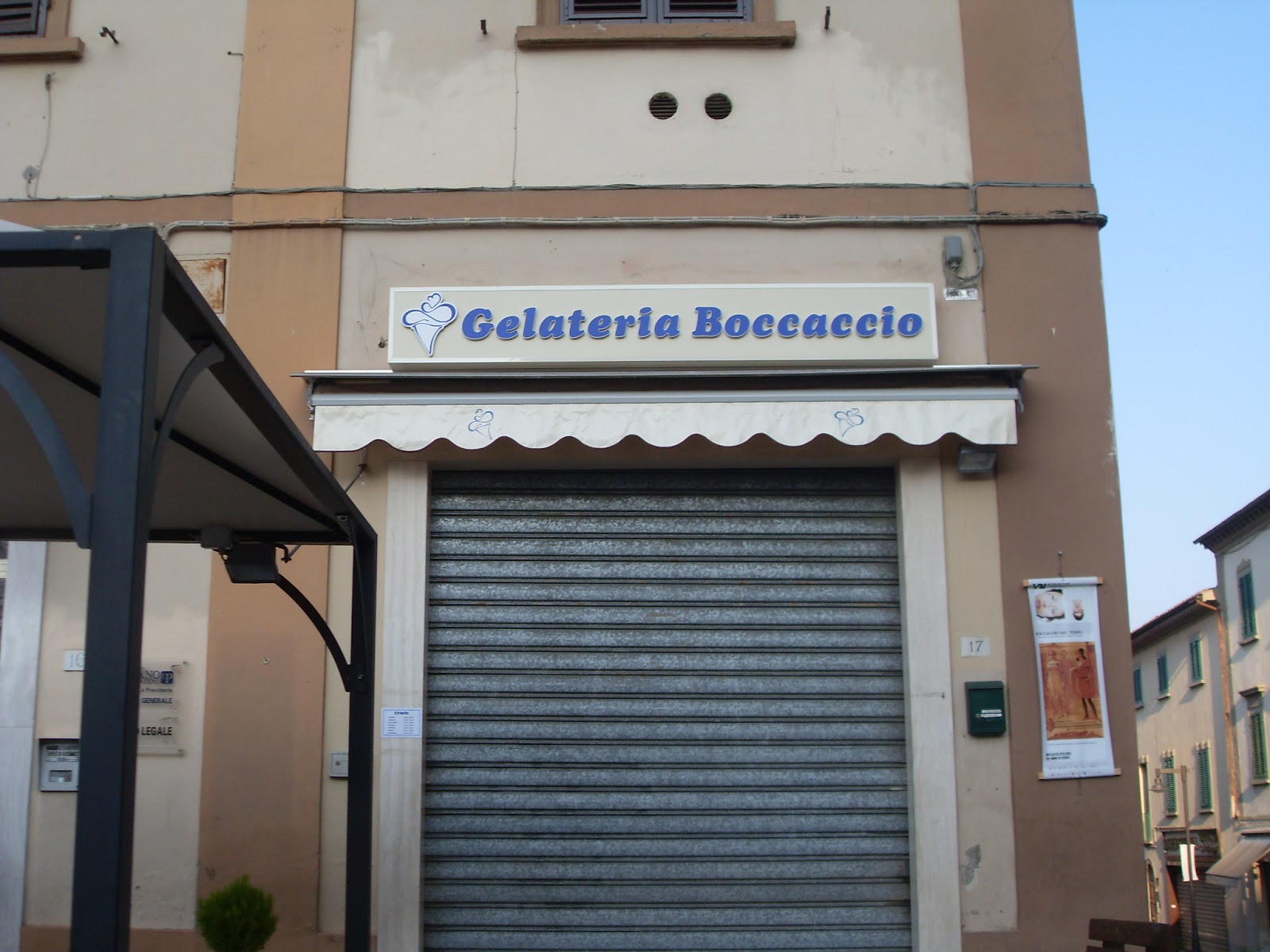
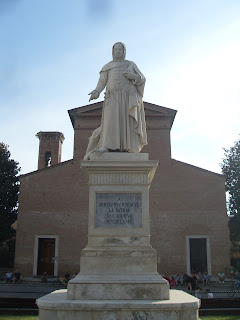
More venues of this kind - heaped under the general umbrella of gusteria, or pleasure - can be found in the new city, Certaldo Basso. Here is a pizzeria and a gelateria named after the author, and also a theatre of some kind, and of course, a white statue right outside the church of St. Thomas the Apostle and close to the cable-car going up to Certaldo Alto.


It was very clear that the city was engaged in the seventh centennial of Boccaccio's birth. Everywhere there were posters advertising a new play based on the ten storytellers of The Decameron, and in a local pastry shop this baked beauty could be found:


And what's more: even in the tiniest minutiae of public life, a nod to the great author could be spotted, such as this environmental advertisement fastened to one of the public litter bins, ostensibly making a pun on the Italian word boccaccia, which means grimace:


All in all, it is very evident that the Certaldese take immense pride in their connection with Giovanni Boccaccio, and that they exploit this aspect of their history to full effect. In some respects there is something charming and lovingly about this embrace, such as the statue in Certaldo Basso and his monument in Chiesa di Sancti Jacopo e Filippo, yet other nods are more clearly designed to draw a crowd rather than being done out of any love for the author. This is of course understandable, but it becomes wearisome in the end, and is a good reason for spending most of the time in Certaldo Alto, where such references are widespread but more natural.


References
All information concerning Boccaccio's life is taken from

Boccaccio, Giovanni, The Decameron, translated by G. H. McWilliam, Penguin Classics, 1972

søndag 14. juli 2013

Travels in Tuscany, part 1 - The Conference in the Citadel


The whole company, ladies and gentlemen alike, were in favour of telling stories.
- The Decameron, Giovanni Boccaccio (translated by G. H. McWilliam)


Every year a large group of musicologists gather for the Conference of Medieval and Renaissance Music, both for the purpose of presenting new finds of their own and to learn of new finds by fellow researchers. This group encompasses both the very seasoned professors and the undergrad neophyte, and the range of subjects being treated is delightfully diverse. This year, for instance, there were papers on topics such as the office for Saint Catherine, the liturgical programme of Reconquista Spain, a song from the Cambridge Songs and late medieval English carols.


Via Boccaccio, from Palazzo Pretorio

The MedRen conference was this year held in the Tuscan town of Certaldo, allegedly the hometown of Giovanni Boccaccio, and my supervisor for my Master's thesis invited me along to participate in a session arranged by one of his colleagues. Naturally, I accepted the offer gladly, and for a few days in the beginning of July I sauntered among musicologists in the medieval old city of Certaldo Alto overlooking the Tuscan denes and hills and soaked up knowledge.

The reason why I - a mere historian - was invited to a conference for musicologists was as follows. For my thesis I had looked at various texts for Edward the Confessor, and in particular a set of liturgical texts contained in a manuscript from the turn of the 14th century which had until then been ignored by scholarship. In the course of my work I managed to date one of these liturgial texts - an hexameter couplet - securely to the timeframe 1161-66, and this was one of the major discoversies of my research. The item in question belonged to the liturgical repertoire of Matins - known as the historia or the part of the liturgy recounting biographical details of the saint - and since the session in Certaldo took the historia as its subject, I was asked to contribute.


The conference lasted four days was comprised of 52 sessions. Each session was about 90 minutes long, and four sessions ran parallel at their alloted hours, with intermingled coffee breaks, lunches, book presentations and concerts. I went to a number of these sessions, but I could only manage two sessions a day since in many cases the papers given dealt with details far too technical for me to grasp or follow at great length. I felt very much like a fish out of water, but then again, that was how evolution started, so I absorbed as much knowledge as I could master and I did indeed learn a great deal. When I was not listening to papers, I walked about the old medieval town in exploration of its museums, churches, streets and gelaterias, or socialised with fellow academics who, like me, had come to present their findings. I met a great number of interesting people, and I almost learned as much from these sociable chats as from the papers themselves, and although I acknowledged the gap between their mastery of the subject and my own feeble clutching at straws, I found it very inspiring to be in the presence of such a great number of brilliant people.


Palazzo Pretorio

The conference headquarter was in the old pretorian palace, the seat of civic power in the Middle Ages, and three of the four parallel sessions were held here. The remaining session took place in the nearby Church of Saints Thomas and Prospero, commonly referred to as the Chiesetta, or the little church, and it was here I presented my paper at about half past nine the fourth day of the conference. I was not particularly nervous about the presentation, partly because I had already aqcuired some conference experience in Oxford in May of this year, and partly because in the preceding three days I had become well acquainted with how these sessions worked.

Unfortunately, this was the last day of the session, so some people were already leaving town, while others were perhaps drawn more to the parallel sessions. Whatever the reasons, the turnout was not great and I would have liked a more numerous audience. Nonetheless, it was a good and attentive crowd - with the exception of two rude cretins who walked out in the middle of my paper (seriously, you don't do that) - and I very much enjoyed presenting my findings.


The Chiesetta, dedicated to Saints Thomas and Prospero

The conference experience was, in sum, a very encouraging experience, and it reinforced my belief in the necessity of interdisciplinarity in medieval studies, for although I am no musicologist I nonetheless found it extremely rewarding to exchange experiences and knowledge with the brilliant minds in the field of musicology, and I do hope that the musicologists, too, will see the benefits in such an exchange - which I'm confident that they will, because they are brilliant.


Coffee break in the courtyard of the pretorian palace