And was the holy Lamb of God,
On Englands pleasant pastures seen!
- And did those feet, William Blake
Viser innlegg med etiketten Jocelin of Brakelond. Vis alle innlegg

onsdag 31. mai 2017

Learning to transcribe - a few personal notes on working with Saint Edmund Martyr


One of the recurring sensations in my time in academia is the feeling that there are things with which you never really finish. Today this feeling was brought on by a revision of a transcription of the office for Saint Edmund which I undertook back in 2015, and which forms one of the main pillars for the research of my doctoral thesis.

The offices for the vigil and feast of Saint Edmund Martyr are contained in a manuscript produced at Bury St Edmunds around 1130, together with the first saint-biography of Edmund, Abbo's Passio Eadmundi, and collections of miracles related to Saint Edmund. This manuscript contains the most complete version of the office for the feast of Saint Edmund that has survived, and also the only version of the office for the vigil. For my chapter on Saint Edmund, I have gone into great detail about the chants and readings for the office for the feast day, but now it was time to turn to the office for the vigil instead and get a better overview of what it contains.

The office for the vigil was performed on the eve before the feast of Edmund (November 20), and contains one nocturn of four lessons with responsories in accordance with the monastic model. The chants and lessons all take their material from the miracle collection written down by Herman the Archdeacon around 1080-90. The selection of miracle stories is not wide, as they all focus on one of the most salient episodes in the history of the cult of Saint Edmund, namely the divine punishment of Svein Estrithsson.

The story which Herman wrote down tells of how the Danish king Svein Estrithsson (d.1074/76) invaded England and demanded tribute from the English. He also demanded tribute from the monks at Bury St Edmunds and sought to despoil the riches that had accumulated at the shrine of Saint Edmund Martyr. The monks turned to Edmund for help, and their heavenly ambassador brought divine wrath down upon the Danish king to such a degree that the king exempted Bury from paying tribute. At the time when Herman composed his collection of miracles this story had not been in circulation for many years, but it tied in with another punitive miracle that had been included in the Passio written by Abbo of Fleury in the 980s and so the punishment of the Danish king became one of the most iconic miracles attributed to the merits of Saint Edmund (but performed by God).


Opening of the office for the vigil of Saint Edmund
MS Pierpont Morgan 736, Bury St. Edmunds, c.1130 (photocopy)

I find the miracle story fascinating, especially in the way it cemented Saint Edmund Martyr's reputation as a guardian of his own shrine and ensured that this reputation would be a recurring feature in later writings at Bury St Edmunds, such as the chronicle of Jocelin of Brakelond from c.1200.

In the coming days I will immerse myself further into the miracles of Saint Edmund, which I left off in 2015 so that I could focus more single-mindedly on the office of the feast itself. To return to this text was a reminder that those things on which you work the most are sometimes the things most likely to stay with you. This feeling of return was perhaps also exacerbated by the fact that back in 2015, the office for the vigil of Saint Edmund was the first text I ever transcribed from a medieval manuscript - or rather, from a printed out photocopied version of the manuscript.

I remember very well the excitement of those summer days in June 2015 where I had a 27-page document to transcribe and make sense of - without any prior experience of transcription. Foolhardy and stupidly optimistic as I sometimes can be, I nonetheless thought that I would be able to do it. And sure enough, I did manage to tackle the text after two intense weeks of work, and I remember feeling overly proud of myself for getting this done.

Today, close to two years later, my experience with transcription is significantly greater, and armed with more experience - and much greater knowledge of the textual corpus in question - I set out to see how much of the transcription work of my 2015 self I had to correct.

It turned out that there was quite a lot to correct, both in terms of things I had misread, things I had failed to understand, things that were close to unintelligible, and also in terms of lack of standardized practices for how to deal with scribal inaccuracies. This was perhaps particularly noticeable in the office for the vigil, since this is the very beginning of the manuscript and the very first text with which I had to try my inexperienced brain.

On the one hand, correcting my mistakes from two years ago gave me a sense of how inexperienced I still am when it comes to manuscript work, even though I have gained a lot more since 2015, and many of the mistakes had the very dirty tinge of the dilettante about them. On the other hand, however, it made me realize just how much I had learned in the two years that had passed, and it also gave me an optimistic sense of all the things I have yet to learn and hopefully will learn as I continue to carve my path through the dense forest that is academia. It is a pleasing thought, and such thoughts are always welcome in the thesis process.



fredag 6. februar 2015

Saint Edmund the Ring-giver – SS Edmund and Edward in the later Middle Ages


I’m currently doing some reading in Legenda Aurea, the Dominican Jacobus de Voragine’s great compendium of saints’ legends and other liturgical feasts, designed to be a reference book for homilists. Jacobus compiled these stories in the 1260s and relied on a wide range of Christian authors, often citing contradicting views on certain matters as a summary of the views held by previous authors. Legenda Aurea is first and foremost a conservative compilation, since it contains only five saints from Jacobus’ own time or the preceding century. Four of these modern saints are connected with the vogue of mendicant sanctity that dominated the religious sentiments of the Latin Mediterranean in the thirteenth century. These are the mendicant founders Francis (d.1226) and Dominic (d.1221), the Dominican friar and martyr Peter of Verona (d.1252) and the Franciscan tertiary Elizabeth of Hungary (d.1231). The last of the modern saints is Thomas Becket (d.1170) whose martyrdom in Canterbury cathedral Jacobus erroneously dates to 1174, the year after his canonization by Pope Alexander III.

This incorrect date suggests that although Jacobus was extremely well-read and could draw references from a long and impressive list of sources, his knowledge of English material was quite sparse. Jacobus’ lack of familiarity with English hagiography becomes all the more apparent when you compare his original work with the adaptations from thirteenth- and fourteenth-century England such as the Gilte Legende, the South English Legendary and the Nova Legenda Anglie. Considering that Jacobus probably envisioned only a relatively local circulation of his work, his lack of English material is neither surprising nor something that merits rebuke, but it does result in the occasional misinformation, such as the year of Becket’s death.

Another piece of information is an interesting anecdote appended to his chapter on St John the Apostle. Jacobus writes (in William Granger Ryan’s American translation):

Saint Edmund [of East Anglia], king of England, never refused anyone who asked a favor in the name of Saint John the Evangelist. Thus it happened one day when the royal chamberlain was absent that a pilgrim importuned the king in the saint’s name for an alms [sic]. The king, having nothing else at hand, gave him the precious ring from his finger. Some time later an English soldier on overseas duty received the ring from the same pilgrim, to be restored to the king with the following message: “He for whose love you gave this ring sends it back to you.” Hence it was obvious that Saint John had appeared to him in the guise of a pilgrim.


'Cy seynt Edward dona un anel a Iohan le ewangelist'
Yates Thompson 13, English book of hours, 2nd quarter of the 14th Century
Courtesy of British Library

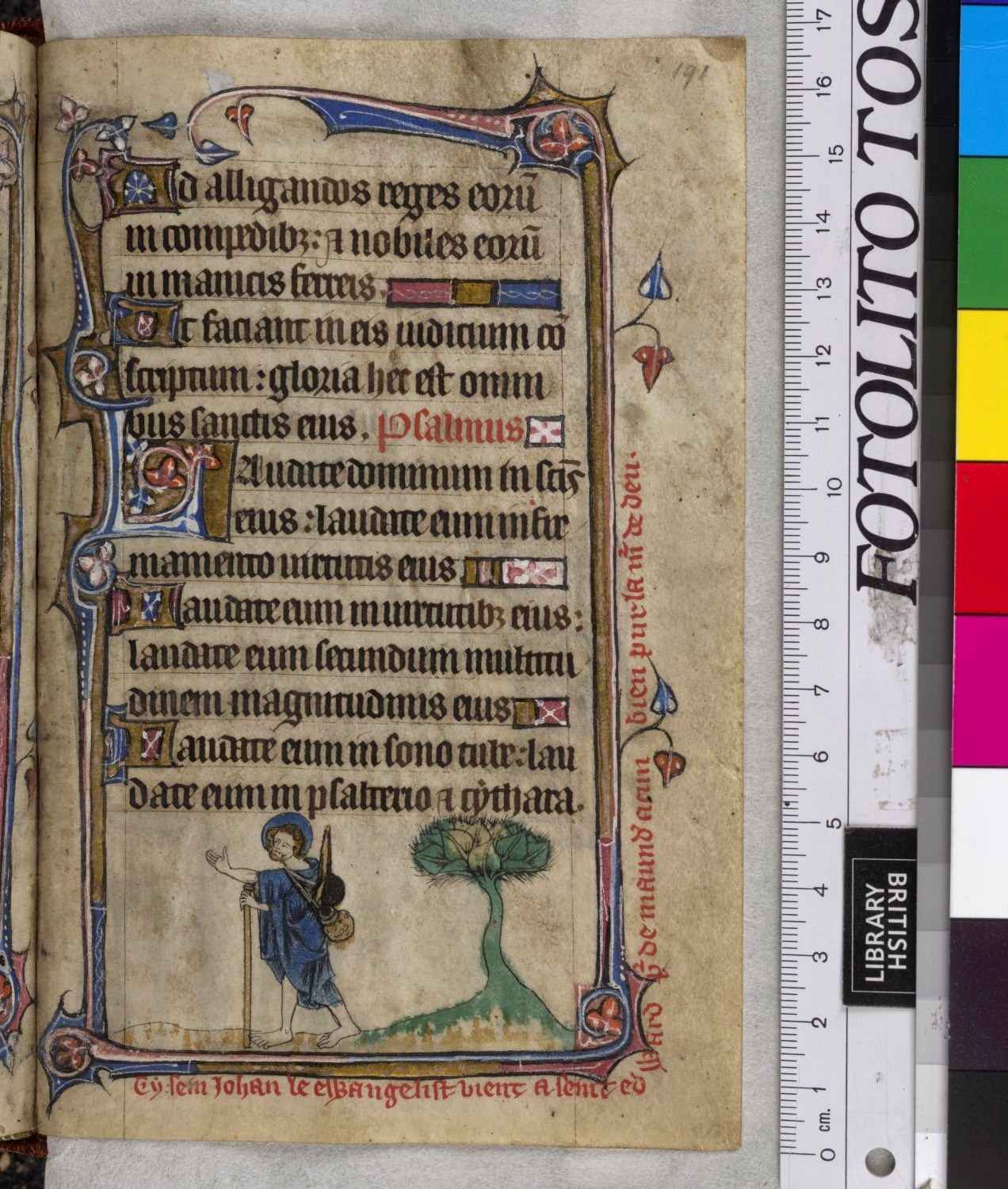
'Cy sein Johan le ewangelist vient a seint edward p[ur] demaund[er] acun bien pur lam[ur] de deu'
Yates Thompson 13, English book of hours, 2nd quarter of the 14th Century
Courtesy of British Library

This anecdote is significant for several reasons. First of all because it shows an interesting confluence of two of high-medieval England’s most important saints: Edmund of East Anglia and Edward the Confessor. The story of the king giving his ring to Saint John in disguise belongs to the legend of Edward the Confessor and is perhaps one of the most famous miracles from his hagiographies. It first appears in Aelred of Rievaulx’s Vita Sancti Edwardi Regis, a work written for the translation of Edward’s body in 1163, and which was commissioned by Lawrence, abbot of Westminster. The ring became Edward’s main attribute and remained so throughout the Middle Ages, as seen below from a calendar page from the early 1400s.

Edward the Confessor holding his ring, oddly placed at March 18
Harley 2332, Almanac with astrological miscellany, England, 15th century (before 1412)
Courtesy of British Library

Jacobus’ attribution of this episode to the legend of St Edmund is also significant because it allows us a glimpse of the close relationship between those cults from the twelfth century onwards. Edmund had been venerated as a saint since the late ninth century, and his cult centre had been at Bury St Edmunds from the start. In the second half of the eleventh century and onwards, the cult of St Edmund experienced an increased literary output of hagiographical and liturgical material. A new, proper, liturgical office was composed between 1065 and 1087, and Herman the Archdeacon wrote De Miracula Sancti Edmundi c.1100. In the literature of Bury’s long twelfth century, King Edward the Confessor – universally respected in English history – was invoked as one of Edmund’s devotees, and as a just king who granted the abbey many valuable charters. The generosity of Edward was a recurring feature, appearing both in Herman’s De Miracula and Jocelin’s late-twelfth-century Chronicle of the Abbey of Bury St Edmunds.

Edward the Confessor was not canonised until 1161 and his cult was a product of Westminster Abbey and the political interests of King Henry II. Edward’s cult had a brief but intense first period of popularity which rapidly diminished at the explosive growth of the cult of Thomas Becket in the 1170s. Becket’s cult did not affect the cult of Edmund in the same way, much thanks to Bury being a thriving literary centre, and brief anecdotes in late-twelfth-century historiographies – such as Benedict of Peterborough’s Gesta Henrici II and Ralph Coggeshall’s Chronicon Anglicanum – suggests that Edmund enjoyed a much wider and more stable veneration than did Edward.

Martyrdom of St Edmund
Yates Thompson 13, English book of hours, 2nd quarter of the 14th Century
Courtesy of British Library

From the thirteenth century onwards, the two royal saints began to appear together in both art and literature. We don’t know which is the earliest example of this. Edward and Edmund – along with two others – are both listed among England’s peaceable kings in the anonymous Anglo-Norman Le Estoire de Seint Aedward le Rei from the 1240s, and in the late 1300s William Langland states in Piers Plowman that Edmund and Edward were both followed by the personification of Charity. To name some of the examples of these two appearing together in art, we have a glass cycle in Amiens from c.1280, and perhaps the most famous instance of them all, the Wilton Diptych where they appear together with John the Baptist as patron for the young Richard II.

The Wilton Diptych
Edmund and Edward both displaying their most well-known attributes
Courtesy of Wikimedia


In all these instances mentioned above the pairing of Edmund of Edward have been done deliberately, while in Jacobus’ Legenda Aurea the two saints have blended together by mistake. The interesting question is whether this mistake was owing to Jacobus’ own faulty memory, having heard the story from one of the many English pilgrims in Italy and then confused the characters, or whether the story was transmitted to Jacobus in the way he recorded it. In any case, the faulty attribution of the miracle of the ring to Edmund of East Anglia, suggests that by the latter half of the thirteenth century, the two royal patrons of England may already have begun to be paired together, not only in art and literature but also in the common imagination.


Literature

Anonymous, Le Estoire de Seint Aedward le Rei, translated by Thelma Fenster and Jocelyn Wogan-Browne, ACMRS Press, 2008

Aelred of Rievaulx, The Life of Saint Edward, King and Confessor, translated by Jane Patricia Freeland and published in Dutton, Marsha (ed.), Aelred of Rievaulx: The Historical Works, Cistercian Publications, 2005

Herman the Archdeacon, The Miracles of St Edmund, translated by Tom Licence, Clarendon Press, 2014

Jacobus de Voragine, Legenda Aurea, translated by William Granger Ryan, Princeton University Press, 2012

Jocelin of Brakelond, Chronicle of the Abbey of Bury St Edmunds, translated by Diana Greenway and Jane Sayers, Oxford World Classics, 2008

Langland, William, The Vision of Piers Plowman, translated by Schmidt, Everyman, 1995


søndag 11. mars 2012

Flores Historiarum, pt. 3 - Jocelin's Chronicle

Such one king Edmond, but was rent for gaine
- The Ruines of Time, Edmund Spenser


Jocelin of Brakelond (fl.1173-c.1215) was a monk at the Abbey of Bury St Edmunds in Suffolk and his chronicle is an interesting work, motley in the best sense of the word and a must-read for any anglophile medievalist. Unlike so many chronicles or gestae of the Middle Ages the scope of Jocelin's opus is unambitious and succinct, focussing primarily on the career of Abbot Samson (1135-1211) rather than attempting a broad historical narrative of either a geographical area, an institution or even a person's life, which were common scopes of Medieval histories. Throughout his chronicle Jocelin describes events and individuals with striking intimacy and a keen alertness to human nature, and as such it can be appreciated as History's own version of Ken Follett's modern classic Pillars of the Earth.

Through Diana Greenway and Jane Sayers' well-wrought translation and explanatory notes the reader is allowed a clear - but limited - view of the complex worlds of Medieval monasticism, jurisprudence and history, following Jocelin's account of the various battles lost and won by Samson in his various struggles with king and fellow ecclesiastics. Since Jocelin wrote for an audience familiar with the various details of Medieval life - details that to us are strange and arcane - the reader him- or herself is introduced to a multitude of quotidien and extraordinary aspects as ingrained in a larger narrative. The consequence is that the reader will eventually become used to these details and absorb them - aided, of course, by the very comprehensive notes - and thus learn them more easily than would otherwise be the case.

The greatest asset of the Chronicle of the Abbey of Bury St Edmunds, however, is Jocelin's frankness when depicting himself and fellow monks, a feature that makes this book all the more accessible even to the modern reader. Eager to see the best in people Jocelin is sometimes forced to admit and portray the darker side of humanity, and even Abbot Samson - the "protagonist" - is allotted a chapter recounting his sundry faults. Perhaps the most poignant example of this can be found when Jocelin describes the state of the abbey in the reign of Samson's predecessor, the old and easily manipulated Abbot Hugh:

This is the hour of darkness. This is the hour in which flatterers prevail and are believed: their might is increased and we can do nothing against it. For the time being we must ignore these things. Let the Lord look down and judge.
- Chronicle of the Abbey of Bury St Edmunds, Jocelin of Brakelond (translated by Diana Greenway and Jane Sayers)

A similar comment can be found concerning the division of the monks during the election of a new abbott in 1182. Jocelin states "Many opposed him [i.e. Samson] in those days, though later they became his flatterers."

The appeal of Jocelin's account lies, as stated, to a great extent in the various details - sometimes of a very intimate and even personal nature - that appear throughout the pages. Sometimes we may even catch a glimpse of various prejudices, either held by Jocelin or the people he describes:

He [i.e. Samson] confirmed only one manor by charter: that was Thorpe, held by an Englishman, a free man, though tied to the soil, of whose loyalty he was confident, because he was a good farmer and could not speak French.

Or better still, we are treated to an anecdote told by Samson about how, when he travelled to Rome and back during the schism of Alexander III and Victor IV, he avoided being mistaken for an Englishman:

But I pretended to be a Scotsman, wearing Scottish dress and behaving like a Scot. To drive off those who jeered at me, I brandished my stick as if it were a type of spear known as a "gaveloc" [javelina], and used threatening language as Scotsmen do.

On other occasions these personal details are of a more sombre nature. Particularly striking is a passage where Samson, obviously weary of the way of the world,

(...) swore that if he could have foreseen the nature and scope of the abbot's duties, rather than be abbot and lord, he would have been master of the aumbry and librarian, which was the office he had wanted above all others.

A similar weariness can be found in Jocelin himself in this very lamentable and poetic passage:

But the good fortune that had smiled on him [i.e. Henry of Essex, constable-turned-monk] in these and similar activities now intervened to bring him unending tribulation, and behind the illusion of a happy beginning worked out a sorrofwul end for him. Fortune has a habit of smiling as a prelude to becoming enraged, of caressing only to deceive, and of praising in order to disparage.

The tale of Henry of Essex also highlights Jocelin's approach to history, namely to provide examples for posterity to emulate or avoid, an approach that informs much of Medieval historiography and hagiography:

It is essential to have an understanding of evil in order to avoid it, and for that reason it is worth recording the actions and aberrations of Henry and Essex, not as a model, but as a cautionary tale. To persuade by example is a helpful and painless way of correcting faults.
Jocelin's alertness to human nature together with a sometimes very terse, almost resigned prose often result in very beautiful passages. One example is a dispute between Samson and his prior:

(...) the abbot said several things that should not have been said, and swore that he would be master as long as he lived. But with the evening approaching, he spoke more mildly with the prior.

Jocelin also shows resignation over monastic politics and after having discussed an election he utters this passage, a particular favourite of mine:

Spare your praises of the new man, because high office changes a man's character, or rather demonstrates its true nature. First take note of which advisers he has, and what they are like and in whom he trusts, because like naturally attracts like.

Jocelin's chronicle reads partly as a contemporary history of Bury St Edmunds, partly as a biography of Abbot Samson and partly as a cautionary tale where Samson's virtues and faults are highlighted for the sake of edification. This is a common and almost ubiquitous feature of Medieval historiography, but rarely is it given such an intimate tinge as that of Jocelin's account.