And was the holy Lamb of God,
On Englands pleasant pastures seen!
- And did those feet, William Blake
Viser innlegg med etiketten Stained Glass. Vis alle innlegg

lørdag 25. juni 2022

Saint Olaf in Tønsberg, part 1 - the dragonslayer


A few days ago, I took a trip to Tønsberg, one of Norway's oldest cities. Located one hour south of Oslo by train, Tønsberg is nestled at the foot of a large crag called Slottsfjellet, Castle Mountain, so named because it was the site of a royal stronghold and, from the late thirteenth century, a castle. Medieval Tønsberg contained several churches, some of which I hope to return to in later blogposts, as their outlines and their placement in the cityscape - nestled at the foot of Slottsfjellet - can still be seen clearly today. 

For this short blogpost, however, I will focus on a feature of modern Tønsberg, but one which invokes the medieval past in a display of medievalism typical of twentieth-century Norway. The feature in question is a stained glass window in Tønsberg cathedral. This church was consecrated in 1858 and replaced the medieval Church of Saint Lawrence which by then was in disrepair. By 1858, the church was simply a parish church, as Tønsberg did not become a diocese until 1948, when it was carved from the diocese of Oslo, to which it had belonged since the late eleventh century. 

As Norwegian Lutheran churches are not dedicated to saints - since saints are not part of Lutheran theology - the common name for the new church was Tønsberg church, and now Tønsberg cathedral. However, the fact that this new church had a medieval predecessor and thus participates in a historical continuum is marked and even celebrated. Outside the cathedral is a model of the Church of Saint Lawrence, and a plaque containing information about this medieval church which colloquially is referred to as "Lavranskirken", Lavrans being the Norwegian name for Lawrence. 

The awareness of the medieval past of the current church is also marked by a series of stained glass windows made in 1939 by the glazier Per Vigeland, nephew of the more famous Gustav Vigeland whose statues are given their own park in Oslo. The nave of the cathedral contains a series of impressive medievalesque windows, each of which contains a religious figure. Most of these figures are apostles and prophets, in keeping with the constrictions of Lutheran iconography, and of course the Virgin Mary. However, some windows also include the saints to whom churches were dedicated in medieval Tønsberg. Aside from Saint Lawrence, the medieval city also included churches dedicated to the Virgin Mary, Michael the Archangel, the apostle Peter, and Olaf. While Mary and Peter could easily fit into the iconographic scheme of the Lutheran parish church, and while Michael at least would be accepted, the choice to also include Lawrence and Olaf in the array of stained glass windows point to a conscious desire to invoke and connect with the medieval past.   


SS Olaf and Thomas in Tønsberg Cathedral 
Made by Per Vigeland in 1939

While there are interesting analyses to be made of all the Tønsberg saints as depicted in glass in the cathedral, I here want to focus on the figure of Saint Olaf. Since he also was a historical king who is given the credit for finalising the conversion of the Norwegians to Christianity - a claim that is rightly challenged in modern scholarship - Olaf is one of those saints who can be found in Lutheran iconography despite the general unbelief in the cult of saints. When Olaf does appear in church art, he is often, as in the case of Tønsberg cathedral, called Saint Olaf, or otherwise Olaf the Holy, which creates a kind of cognitive dissonance that testifies to the importance of Olaf in the historical imagination of the Norwegian Lutheran establishment. To put it differently, the place of Olaf in Norwegian history has ensured him a degree of veneration that circumvents the scepticism towards saintly figures. 

Per Vigeland's depiction of Olaf is interesting not only because of its circumvention of Lutheran standards, but also because of how it connects with and builds on the medieval iconography of Saint Olaf. In the stained glass window, Olaf is seen holding the axe and the royal orb which are typical attributes in medieval renditions. Moreover, he is standing on a dragon, which is a common feature of several paintings and sculptures, although sometimes he stands on a human figure rather than a dragon. In these two aspects, Vigeland's Olaf is very medieval. However, Vigeland has also departed from the medieval models by making Olaf's attention being drawn to the dragon on which he stands. In medieval images, Olaf shows no concern regarding the dragon or the enemy that he has trampled underfoot, but instead the saint stares serenely ahead, his gaze attentive to other matters, such as those who come to venerate him.

In the Tønsberg window cycle, however, Olaf raises the axe as if to strike and pulls the royal orb towards himself as if to keep it out of reach of the enemy, a pose that suggests the dragon is not yet defeated, even though its visible eye is closed. In addition, we see that the dragon is engulfed in flames, which might serve as an allusion to the hellfire to which Saint Michael pushes the satanic dragon in another of Vigeland's window. Olaf is, in other words, depicted as a dragonslayer in a way that builds on, but also breaks with, medieval iconographic tradition. Whereas medieval images showed Olaf having conquered the enemy - be it man or beast, or beast with the head of a man - this modern rendition shows the moment before this victorious pose. 

What we see in Per Vigeland's depiction of Saint Olaf is, in other words, an excellent example of how medieval iconography still impacts modern iconography, and how the figure of Saint Olaf is imagined in a way that has roots stretching all the way back to the Middle Ages. Vigeland's image of the Norwegian saint-king is a clear case of medievalism, where the medieval tradition, the medieval iconography and medieval history is invoked and used as the basis for a modern artistic expression. We can only speculate as to why Vigeland chose to depart from the medieval standard depictions, and it is possible that the answer can be found in Vigeland's contemporary context. But I know too little about Vigeland's view of the world to hazard a speculative analysis here.     


lørdag 10. juli 2021

Saint Knud Rex in glass - a twentieth-century rendition of Knud's murder


Today, July 10, is the feast of the martyrdom of Knud Rex. He reigned as king of Denmark from 1080 to 1086, and was murdered in the now-lost Church of Saint Alban in Odense by an angry mob who rebelled in response to high taxation. Knud was proclaimed a saint at an episcopal synod in Odense in 1095, and he became the patron saint of the city. His cult was aided both by royal patronage - his later successors Erik Ejegod (r.1095-1103) and Niels (r.1104-34) were both his brothers - and also the monastic community at Saint Knud's Church, the cathedral church of Odense. This monastic community was established in the reign of Erik, when the community of secular clerics was reformed to a Benedictine abbey. Several of the clerics, and also the monks, were English, and were experienced in the maintenance of the cult of a saint, and produced materials - including saints' lives and a liturgical office - for the veneration of the martyred king. The detail concerning this development are of great interest to me, and several articles concerning Knud, as well as related topics, can be accessed freely in this book.

In the present blogpost, however, I am not focussing on the medieval reception of his cult, but rather an aspect of his modern veneration, namely a pictorial narrative of his murder as it is presented in a series of stained glass windows from the early twentieth century.


Saint Knud Rex in majesty
Georg Schneider, 1908, Albani kirke, Odense


In the period 1906-08, a new church was built in Odense, the Roman-Catholic church of Saint Alban (Skt. Albani Kirke). The church is built in a distinctly medievalesque style, and the choice of dedicating the church to Saint Alban suggests that those who financed the project sought to establish this building as a modern continuation of the medieval building that had once seen the murder of Odense's patron saint. Moreover, the location of the modern church is roughly - but not exactly - in the area where the eleventh-century wooden structure once stood, which appears to have been rebuilt in stone in the course of the twelfth century. 

The modern Church of Saint Alban in Odense contains a number of medievalisms, and together these comprise a very interesting window into the identity-construction of the congregation in the early twentieth century. It should be noted, of course, that in a modern Catholic context, it is sometimes difficult to assess which aspects of the veneration of saints from the Middle Ages can be considered expressions of medievalisms. This difficulty arises from the fact that in a worldview in which the saints are genuine parts of the cosmology, the representation and invocation of that saint is not necessarily a representation and invocation of the medieval aspect of the saint's story, but rather the universal, timeless aspect of the saint. 

In the case of the Church of Saint Alban in Odense, however, the architecture and much of the art appears to be deliberately drawing on medieval models. It is very likely that the general aesthetic should be seen in light of the Neo-Romantic appreciation of the Middle Ages that materialised throughout Northern Europe towards the end of the nineteenth century. 

Since the Church of Saint Alban is located in Odense, it not only venerates Saint Alban, but also Saint Knud Rex. These two cults have been closely connected in Odense, given that it was Knud who brought relics of Saint Alban to Odense, and it was thanks to these relics that the church could be consecrated to the British protomartyr. That Knud himself died at the altar of that church, whose consecration he had assisted by the gift of relics, strengthened the connection even further. For the commissioners of the modern Church of Saint Alban's to choose Alban's patronage, it would have been implicit that they would also display a strong veneration for the martyred king. 

Images and references to Knud can be found throughout the church space. One of the most significant of these cases is the series of three stained glass window in the Saint Knud' chapel, located on the right-hand side before the altar. These windows were made by Georg Schneider of Regensburg. From left to right they depict Knud receiving the final confession from his brother Benedict right before his death, then the martyred king in Heaven, and on the right the moment of his martyrdom. The images are, in other words to be read in the following order: Left, right, middle. 

The images are interesting in part because they appear to draw on an iconographic tradition that does not go back to the Middle Ages, but rather to antiquarian and neo-Catholic renditions from the Early Modern Period. The exact links to this early modern pictorial lineage, however, is still not sufficiently mapped, and I will not go into details about it here. 

Through the three scenes of the Saint Knud chapel, the story of the martyred king is efficiently narrated in three key points, which are also three of the key points highlighted in the medieval written narratives. This might be deliberate, or it might simply be because when a saint's story needs to be condensed into what Cynthia Hahn calls pictorial hagiography, the scenes chosen for that narrative are selected for practical reasons, namely that those scenes are the most succinct way to present the story. 

While the art of the modern Church of Saint Alban is distinctly modern - even, or perhaps particularly, when it draws on earlier iconographic traditions - it is very clear that a lot of the aesthetic seeks to invoke the Middle Ages. For this reason, I brought a group of students to this church when I was teaching a course on the cult of saints, because the church spaces gives a good impression of how a medieval church might have looked. And in this way, the story of Knud Rex as it appears in glass in the chapel of Saint Knud is the latest expression of a narrative and aesthetic tradition that has its roots in the eleventh century. 


The modern Church of Saint Alban, from 2015


fredag 27. desember 2019

The chalice of John the Evangelist


Today is the feast of John the Evangelist, and for this occasion I decided to dig deep in my archives in search of a memory from when I was an MA student and spent quite a lot of time in York. I was reminded of the many beautiful pieces of surviving medieval stained glass in the city's many churches, and I had some hazy recollections of John the Evangelist featuring in some of them. In particular, I was convinced that the Church of St Denys on Walmgate had at least one memorable depiction of John, and it turned out that I was right, in a fashion. The images I found were not quite what I had envisioned, but what I found was well worth sharing, especially because one of the images teaches a very good lesson about the importance of iconography. But I'm getting ahead of myself. 


John the Evangelist, holding his attribute, the eagle


The above picture was one I had forgotten, but which shows one of the typical representations of John: A young, beardless man holding the eagle, his attribute which points back to the tetramorph of the vision of Ezekiel. In his other hand he holds what looks like the palm leaf, commonly attributed to martyrs, which is puzzling considering that John was not martyred but rather died of old age. It is possible that it is a lily signifying his virginity, but this is uncertain. The glass is fourteenth century. 


Saint Denys

Saint Denys, tower and repaired Norman doorway


The Church of Saint Denys is a treasure trove of medieval vestiges pointing to its long history. The doorway beside the tower, for instance, points to its early twelfth-century origin, as it is a Romanesque Norman arch with mason work typical of the period. Although the stonework and the gateway itself is, to the best of my judgement, original, its placement is a result of the continuous changes of the medieval church space. The main church building with its central nave and two flanking aisles dates from the fourteenth and fifteenth century, the period when the oldest surviving stained glass windows were constructed. The nave was badly damaged during the English Civil War, presumably in particular during the Siege of York in 1644, and therefore significantly shorter and more quadratic than it was originally. Consequently, while the Norman doorway once was the main entrance into the nave, it presently stands in its rebuilt form as a side entrance. 


Saint Denys, interior


Because the church has undergone many accidents and tumultuous changes in the course of its long history, a lot of what survives today is not in its original place - as demonstrated by the case of the Norman doorway. This is particularly evident in much of the stained glass. Some of the figures remain in their original positions, either by being put back in place or simply by serendipitously surviving the many changes in the subsequent centuries. Much of the medieval glass, however, survives only in fragments. These fragments have been put into whichever empty lead frame that fit them, resulting in an incongruous mix of displaced details that together provide an imperfect but powerful glimpse of the once complete programme of stories, episodes and figures that filtered the light for the churchgoers in the late Middle Ages. To the medievalist, these assemblages of fragments provide a veritable treasure hunt by which a picture, a narrative or a figure might be teased out from the chaos. One of these figures is John the Evangelist. 


In the picture above we see some of the many details that once were part of complete stories in glass. We see trumpeters that might hint at a doomsday window since the gonfanon is decorated by horned devils and ominous black birds that could be owls. We see the crowned head of the crucified Christ that might have been a free-standing crucifix or part of a larger crucifixion scene. And we see a chalice with a serpent. This chalice is the chalice of John the Evangelist, and can be found in a story recounted by Jacobus de Voragine in Legenda Aurea. According to this story, John was given a cup of poisoned wine by a pagan priest, but John drank the wine and survived, thus proving the power of God.

What is particular interesting about this disembodied attribute is exactly that it is recognisable even outside its original context. Once this stained glass fragment flanked a figure of John the Evangelist and reminded the onlookers of the story of the poisoned wine, which the priest might have recounted in sermons on precisely this day, December 27. They would have been reminded of this story whenever they went to church, looked up and saw this chalice and the now-lost figure of the evangelist. And even now, centuries later, with the figure of John irretrievably lost to the accidents of history, this single chalice, displaced from its original context, is still identifiable precisely because the stories survive, and precisely because the stained glass is a reminder of that stories, a shorthand for a larger narrative. In this way, fragments of a now-lost vitreous splendour is sufficient for us to, at least mentally, piece together what was once a familiar sight to the parishioners of Saint Denys, Walmgate, York.


tirsdag 19. juli 2016

Saints, Stained glass, and Serendipity


Created purely from glass the saint stands,
Exposing his gifted quite empty hands
- Geoffrey Hill,
In Piam Memoriam


Towards the end of June I arrived in England for an intense bout of conference activities, starting in York for a few days and then continuing to Leeds. It was a hectic period, but by a stroke of luck it all began just in time for me to catch the last performance of the 2016 York Mystery Plays. From the beginning of the performances on 26 May I had seen several favourable comments and many tantalizing pictures from people who had gone to see the plays. I became very envious, especially since I had seen a performance of the 2012 Mystery Plays, and I knew I was missing out. I was therefore very happy when I had managed to procure a ticket for the very last performance in the evening of 30 June.

This year, the Mystery Plays were performed in York Minster, with a stage arranged like the stairs of a temple, with three broader steps on which the action was performed. The top step was Heaven, while the bottom step served both as the entrance to Hell and the tomb of Christ. It was a masterful performance, and I might write more about it at some later point. In this blogpost, however, my focus is a very serendipitous detail of that evening.


Window from the south side of the cathedral

Since the stage of the mystery plays was arranged like a stair, the seating was arranged like in a stadium, and in order to get a good overview I had bought a seat very high up, which brought me level with the first row of stained glass windows. I had been inside the Minster numerous times since my first visit there in 2009, but I have never been that high up and I might never be again. I knew that this might be a once-in-a-lifetime opportunity, so before the play started I made sure to examine the glass of the south wall as well as I could. Suddenly, however, I realized that I had been more fortunate than I could ever have imagined.


Edmund to the left of me, Edward to the right

As I was standing by the railing, I saw that one of the closest windows contained stained glass depicting two saints with which I have become very familiar over the past few years, namely Edmund Martyr and Edward the Confessor. I knew that the two kings were to be found in the wilderness of stained glass in York Minster. I once wrote a blogpost about the iconography of these saints as found in York, and experts on the subject told me that they were there and provided me with details. But there I was, staring them in the face and for the first time seeing them in real life and with my own eyes. I spent a long time trying to take good pictures of the individual windows, and the best results can be seen below. Regular readers of this blog, or people who know me well enough, will know that I have something of an obsession with these two saints, and this obsession has its root in my academic career. I wrote my MA on the cult and literature of Edward the Confessor, and I'm currently working on a PhD thesis in which an examination of the cult material of Edmund Martyr is one of the three major parts.


Edward the Confessor is easily recognized in this right-hand panel. This is not the only depiction of Edward in York Minster, another stained glass window featuring the saintly king can be found in the chapter house vestibule, dated to the latter two decades of the 13th century. In both depictions, however, Edward is seen with the ring, which is perhaps his most famous attribute and the one which is most often used in representations of him in glass, sculpture, painting or illuminations. The ring is of great importance due to the miracle depicted in the stained glass window above.

The miracle of the ring appears first in Aelred of Rievaulx's Vita Sancti Edwardi, which was finished in 1163, two years after Edward's canonization and in time for his translation on October 13. According to Aelred, Edward had once met a beggar who asked for alms, and when Edward realized he had no money on him, he gave the beggar his ring instead. Later, two English knights in the Holy Land were approached by a man who said he was John the Evangelist, and gave them a ring which he asked them to bring to the king of England. This the knights did, and Edward recognized the ring understood the miracle. The miracle of the ring was so famous that it was included in the chapter on John the Evangelist in Legenda Aurea, but with Edmund Martyr in the place of Edward through some strange confusion.


Edmund Martyr is also found other places in the Minster. He is also found among the seven windows of the chapter house, and on a wooden panel once found in the chapter house ceiling (13th century), but now among the treasures of York Minster displayed in the crypt. Edmund is recognized by the arrow he holds in his hand, and this is his most common attribute. The arrow - or sometimes arrows - are the instruments of his torture. According to the first life of Edmund, Passio Eadmundi, which was written by Abbo of Fleury in the 980s, Edmund was seized by a group of Danish Vikings, tied to a tree like Christ on the cross and then pierced through with arrows like Saint Sebastian. When Edmund still refused to submit to the lordship of the Danish chieftain, he was decapitated and his head carried off, but that is another story.


Having worked this much with these two saints, it was a very pleasing serendipity to find myself on the level with these two otherwise inaccessible depictions, and that on the very last day it was possible for me to do so. Such instances of good luck can sometimes be found in the course of academic work, and they are always very welcome and very pleasing.


Similar blogposts


Edmund likened to a hedgehog

Edward the Confessor in the North of England

The miracle of the ring in Legenda Aurea

Edward the Confessor in Dringhouses, York

The cult of Edward the Confessor


søndag 20. mars 2016

Edward the Confessor in Dringhouses


Ever since writing my MA thesis on Edward the Confessor, I've had a minor obsession with all things related to his posthumous cult. Regular readers of this blog will be aware of this already, as might be attested to by the number of blogposts touching on this particular subject (a list of which will be added after the present post).

It was for this reason that I have been haunted by the idea to pay a visit to the Church of Saint Edward at Dringhouses, a village just outside York. Fortunately, while I was staying in York for two months as part of my PhD programme, I lived just about fifteen minutes away from the church and decided that it was high time I had a look around. Typical of my propensity for procrastination, I left it to the very last day I was in York, but luckily I did manage to get around it.  


The belltower. The spire was replaced in 1970


This part is most likely the vestry, which was added in 1902

The inner doorway

The church of Edward the Confessor was built between 1847 and 1849, and upon its completion it was dedicated to Saint Edward. This was in fact a re-dedication, as the new church replaced a church from 1725 which had been dedicated to Saint Helen, which in turn had replaced a chapel dedicated to the same saint. This chapel is mentioned in chantry certificates as early as in 1546 and 1548. The church was financed by the widow of the late Revd. Edward Trafford Leigh, and in memory of her husband she had it dedicated to his namesake saint. Saint Edward's became a parochial church in 1853 when Dringhouses parish was established from parts of the parishes of Holy Trinity and St Mary Bishophill Senior.

Saint Edward's church was constructed in decorated Gothic by the architects Vickers and Hugill (or Hugall) of Pontefract. This is perhaps especially evident in the windows and the doorways with their pointed arches and the leaf-work masonry on their side columns. Although there are several details of such beautiful handicraft, the exterior of the building is not remarkably opulent. The interior of the church is somewhat more so, owing in particular to the many splendid windows of stained glass.

Nave, towards the choir


The oldest stained glass windows were designed by William Wailes in 1849, and these depict figures and scenes from the Bible. The first two windows below are found on the left-hand side of the nave when facing the choir. The first window depict the prophet Elijah (here Elias) with the scene showing him being fed by ravens in the wilderness (1 Kings 17:4-6), and then Moses with the scene showing the rod with the brass serpent (Numbers 21:4-9). The second window shows Saint Simeon holding the Christ-child with a scene from the presentation of Christ in the temple below (Luke 2:25-32), and then John the Baptist with the scene showing the baptism of Christ in the River Jordan (Mark 1:1-8).


In the choir, the central window shows the crucifixion of Christ with Mary and John the Evangelist at his sides, with scenes from the Passion underneath. In the choir on the left-hand side are Matthew and Marcus, while on the right-hand side are Luke and John. Note especially how carefully John is made to be identical with the depiction in the central east window.  


On the right-hand side of the nave the windows depict scenes from the New Testament. The first shows parables of Christ, including the parable of the sower (Mark 3:4-9), the parable of the lost sheep (Matthew 18:12-17), what seems to be the parable of the talents (Matthew 25:14-30). The lower left panel might depict Christ being rejected by a pharisee. The second window shows Christ blessing the children (Matthew 19:14) with angels underneath.  


While the stained glass windows by Wailes were very beautiful, I was chiefly interested in the sundry depictions of Edward the Confessor himself, in order to see how his iconography had been represented. The first depiction of Saint Edward can be found in a niche above the doorway where a statue shows the Confessor, bearded, wearing a crown and holding a ring and a sceptre with a bird on its top.  


This iconography is typical of the tradition of Saint Edward's cult. His appearance as a bearded monarch is attested already in the first biography, written relatively shortly after Edward's death in 1066, now referred to as Vita Ædwardi Regis. His white, and virginal, beard is made into evidence of holiness in the two twelfth-century hagiographies written about him, the first by Osbert of Clare in 1138 and the second by Aelred of Rievaulx in 1163.

The ring and the bird refer to two of the most iconical legends concerning the Confessor. The story of the ring can first be found in Aelred of Rievaulx's Vita Sancti Eadwardi, where it is told that the Confessor gave his ring to a beggar. This beggar turned out to be Saint John the Evangelist in disguise (the Confessor's particular saint), and Saint John, again in the disguise of a beggar, gave the ring to two English knights in the Holy Land, with the orders to take it to the king and report how they had received it. The ring remains the key iconographical feature of Saint Edward. (More on this here.)

The bird is a later feature, but it may have entered the iconography as early as the 13th century. By the end of the fourteenth century, the coat-of-arms of Edward the Confessor was held to be a golden cross on a blue background with golden birds in the open spaces between the cross arms, and one golden bird underneath the cross. We see this from Richard II's merging of his own coat-of-arms with that of Saint Edward.

In time there emerged a legend saying that Edward had once been disturbed by nightingales during prayer, and when he prayed that they should cease their singing for a while they did so. This legend appears to have an early modern date rather than belonging to the medieval tradition. (More on this here.)


Edward the Confessor is also depicted inside the church. We see him on the right-hand side of the altar, where he is flanking Christ in majesty with Saint Peter standing on the left-hand side. The confessor is here surrounded by four angels, two of which are carrying some of the instruments of Christ's passion. Above Saint Edward's head we find his coat-of-arms.


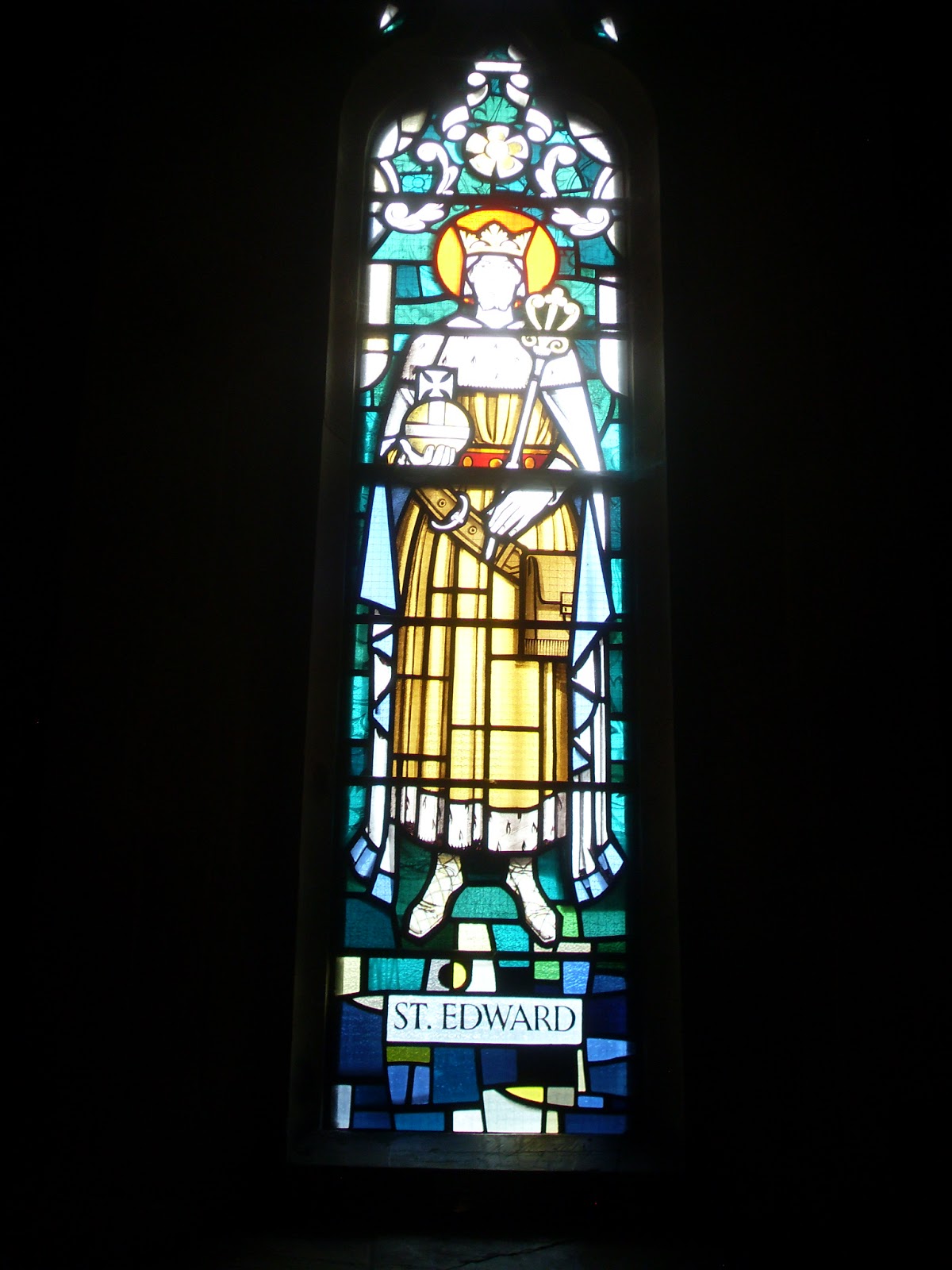
We also find Saint Edward on the left-hand side of the bottom end of the nave (when facing the altar). This is a stained glass window put up in memory of churchwarden G. Raymond Burn who died in 1993. Here the Confessor is shown wearing his regalia, but in a distinctly more royal and notably less legendary form than in the other depictions. 


The dedication of the church has also given name to at least one more place name in Dringhouses, namely St Edward's Close, as depicted below.


Websites:


fredag 12. desember 2014

The Psalter of Quendrada - a miracle of St Kenelm


Kenelm holding a virginal lily
From the Digby Chantry, St Augustine's Church Ramsgate, John Hardman Powell, mid-19th century
Courtesy of this website


The elusively historical Kenelm of Mercia was the head of the Mercian kingdom for some time at the turn of the 8th century, at least according to his legend. Little is known about his life, and what appears in later texts is the stuff of saint-biographical legend, cultivated especially at Winchcombe Abbey, which was the centre of his cult. From documents and charters we know that a royal person by this name existed in this period, but little can be suggested beyond this. The first tokens of a liturgical cult can be found almost two centuries after his death, a time when many royal figures were the subject of new cults, such as Ethelreda, Edward Martyr and Sexburga, to mention only a few.

This flourishing of English royal saints has been treated in great detail by Susan J. Ridyard in her Royal Saints of Anglo-Saxon England, where she distinguishes between king-saints and royal women who became saints by virtue of their monastic pursuits. Ridyard's study was published in 1988, and was a counterargument against the beliefs that royal women in the convent abandoned their roles as royal patrons (hagiography shows this not to be the case), and that these saints were cultivated to protect weak royal houses. In fact, the royal houses benefitting from these cults were all very strong at this time.

Kenelm's role as a saint, therefore, fits into a larger historical canvas, and like the other royal saints boosted by the Benedictine reform movement, his cult enjoyed a perhaps surprising longevity, as can be seen by his inclusion in the 13th-century South English Legendary, and even in Chaucer's Canterbury Tales. Traditions belonging to the cult of Kenelm have endured for a long time, as suggested by a certain piece of folklore expounded by Eleanor Parker in this blogpost I have given some details about his cult and iconography in an earlier blogpost, so I will avoid undue repetition. In this blogpost, however, I will present a miracle of Kenelm which is reported by Gerald of Wales in his Journey through Wales, a work completed at the turn of the 1180s. This miracle is one among many reported by Gerald in chapter 2 of Book 1. The text quoted is taken from Lewis Thorpe's translation published in Penguin Classics (reprinted in 1984).


Kenelm's dream by H. A. Payne
From The Artistic Crafts Series of Technical Handbooks edited by W. R. Lethaby, plate 71
Courtesy of Project Gutenberg


Before presenting the miracle, however, a brief summary of Kenelm's legend might be appropriate. Kenelm was a child-king of Mercia c.800, and he had a wicked sister Cwenthryth, or Quendrada, who plotted against him. She ordered a huntsman to slay him during the child-king's hunt, and although forewarned by a vision given to his nurse, the boy accepted his death with the stoicism so typical of martyrs. After he had died, his body was discovered by the aid of a cow who began to feed at its burial-place, while the pope had been alerted of Kenelm's death by a dove. Kenelm's body was exhumed and taken back to the royal palace, and upon seeing his brother return, Quendrada's eyes fell out of her head and onto the psalter she was reading (backwards, because she was so very evil). The miracle reported by Gerald concerns this psalter:


In our days another great miracle has caused quite a stir. This had to do with the psalter of Quendrada, the sister of Saint Kenelm, at whose instigation he was murdered. In Winchcombe, on the vigil of Saint Kenelm, when, at the invitation of the monks, a great crowd of women from the neighbourhood had congregated for the celebrations, as their custom was, the assistant cellarer had intercourse with on of them inside the precincts of the monastery. The next day he had the audacity to carry this psalter in the procession of the relics of the saints. When the solemn procession was over, he made his way back to the choir. The psalter stuck to his hands and he could not put it down. He was greatly astonished and confounded by what had happened. Then he remembered the crime which he had committed the previous eveing. He confessed his sin and did penance. His repentance was sincere enough, and he was helped by the prayers of his fellow-monks. In the end, by divine intervention, he was able to free himself from the psalter and so was liberated. The book in question is held in great veneration in the monastery, for, when the dead body of Kenelm carried out and the crowd shouted: 'He is God's martyr! There is no doubt about it! He is the martyr of God!' Quendrada, who was guilty of her brother's murder and had it very much on her conscience, replied: 'He is indeed God's martyr, as truly as my eyes are resting on this psalter!' By chance she was reading the psalter at the moment. Thereupon, by divine intervention, her two eys were torn from her head and fell plop on the open book, where you can still see the marks of her blood to this day.
- Thorpe 1984: 85-86


Carving of St Kenelm at the gateway to Romsley Church
Photograph by Pollyanna Jones


There are several interesting iconographical details to pick up on in this anecdote. First, it should be mentioned that although a seemingly novel grisly detail, the loss of eyes is also found in the legend of St Alban, protomartyr of Britain together with his companion Amphibalus. Like the wicked Quendrada, Alban's murderer lost his eyes after killing him, as depicted in gory detail by Matthew Paris in the St Alban's Psalter (as seen below). On the obverse side of the coin we find a story - mentioned by Benedicta Ward in her book on medieval miracles - in the legends of St Cuthbert (if I remember correctly) where a man who had lost his eyesight and was healed by the saint, told a miraculous tale of how birds had carried his eyes away, but that they were returned after he had prayed for healing.


The prototype of British eye-losses: St Alban's beheader
Royal 2 B VI, English psalter, c.1246-c.1260

Another interesting feature is the immediate recognition by the populace of Kenelm's status as martyr. Although we have no information about the death of the historical Kenelm and how his subjects reacted, Gerald's description - perhaps drawn from William of Malmesbury's record, or the anonymous 11th-century vita - invokes a trait typical of Northern European royal cults, namely the immediate canonisation by the vox populi following the trauma of the death of a leader-figure. André Vauchez, in his study of saints' cults, has marked this as an aspect common to several English leaders in the Middle Ages, for instance Simon Montfort and Edward II.

A final aspect I want to draw your attention to in this case, is the punitive nature of Kenelm's miracle. By way of an overly adhesive psalter, Kenelm makes the assistant cellarer's guilt obvious to everyone and forces him thus to repent his crime. Punitive miracles could take many forms, either in a mundane manner or more severely through disfigurement, disablement or death. The assistant cellarer might be grateful that his punishment was not more severe than this.


Kenelm guarding his well-head
From the chapel at the Well-Head of St Kenelm's Well, by J. D. Wyatt, 1887
Courtesy of this website


Literature


Gerald of Wales, The Journey Through Wales, (trl. by Lewis Thorpe), Penguin Classics, 1984

Love, Rosalind, Three Anglo-Saxon Saints' Lives, Clarendon Press, 1996

Ridyard, Susan J., Royal Saints of Anglo-Saxon England, Cambridge University Press, 1988

Vauchez, André, Sainthood in the Later Middle Ages, (trl. by Jean Birrell), 2005

Ward, Benedicta, Miracles and the medieval mind, 1982