And was the holy Lamb of God,
On Englands pleasant pastures seen!
- And did those feet, William Blake
Viser innlegg med etiketten Bury St Edmunds. Vis alle innlegg

søndag 19. november 2023

Saint Edmund in late-medieval Denmark - a hint from the Odense Breviary


Today, November 20, is the feast of Saint Edmund Martyr, a ninth-century king of East Anglia who, according to legend, was killed by invading Danes. His death is commonly dated to 869/70, following the so-called Anglo-Saxon Chronicle. The cult of Saint Edmund – on which I have written several times before – grew significantly in the eleventh century, in large part due to royal protection and munificence, and also due to the abbacy of Baldwin (r. 1065-97). Most likely, it was also during the eleventh century that the cult was actively exported abroad. Herman the Archdeacon’s collection of miracles pertaining to Edmund, written in the 1090s, records how relics were brought to Lucca by Baldwin himself. It is also possible that the veneration of Edmund at the Abbey of Saint-Denis outside Paris was initiated by Baldwin, although the earliest surviving traces of the cult there seems to be from the twelfth century.       

Edmund was also brought to Scandinavia. As of yet, we do not know when the cult arrived there, and where it arrived first. Perhaps the most likely candidate would be Denmark, seeing that Bury St Edmunds was reformed into a monastic house during the reign of Knud II of Denmark, Norway and England. Such a thought is tantalizing, and Knud’s attention to the cult of Edmund appears to be unquestionable, even if we apply the necessary filter of scepticism when reading Herman the Archdeacon’s account of this relationship between king and abbey. However, while Knud’s respect for English saints is demonstrable, this respect and attention, perhaps even veneration, occurs in the context of a foreign king seeking legitimacy in a new kingdom. Consequently, there is little reason to think that Knud II brought Edmund to Denmark, although we should not omit the possibility that someone – perhaps a cleric at Bury – sought to disseminate the cult overseas as well. The main counterargument to a dissemination that early is that there was little cult material with which to spread the knowledge of Edmund. Knud II’s English reign (1014-35) was the abbey’s infancy, and despite the king’s patronage we do not know of any large-scale text production taking place at Bury, or any other kind of production pertaining to the material dimension of a saint’s cult, until Baldwin’s abbacy.           
 
What we do know, however, is that in the course of the twelfth century, we find several references to the cult of Saint Edmund in Scandinavia. He appears in several calendars, there are two Norwegian churches dedicated to him, and liturgical fragments show that his feast was being celebrated, although it was not universally important in either of the three Scandinavian church provinces. In Denmark the death of Edmund is a historical reference point in the Chronicon Roschildense from c.1138, and in Iceland – to step outside of the strictly Scandinavian remit – the same is the case for Ari Frodi’s Íslendingabók from c.1130. Due to the general loss of sources – both textual and pictorial – from twelfth-century Scandinavia, we will never have a complete picture of the extent of Edmund’s cult there, but the sources that do remain suggest a wide dissemination which entered into Scandinavia at different times and by different routes.

One question, however, is how the cult of Edmund fared after the twelfth century. From 1200 onwards, we have more surviving source material – although only a small percentage of what was produced – but we have few clues as to the development or spread of the cult of Edmund. Yet there is one late clue – from 1497 – which might shed some light on the late medieval fate of Edmund’s cult in Scandinavia.

The clue in question is a rubric on folio 435r from the 1497 edition of the Breviarium Othoniense. This was the second edition of the printed breviary, the first being in 1482 and which I have not yet checked for the issue at hand. The rubric opens the office for the feast of Saint Elizabeth of Hungary (d.1231, can. 1235), which is on November 19. In this rubric, it is stated that the Second Vesper of Elizabeth’s feast is not to be celebrated, as this is the feast of Saint Edmund. Instead, psalms are to be sung in Edmund’s honour, although it is worth mentioning that the breviary does not contain any texts for Edmund’s feast. What follows the office for Saint Elizabeth is the feast of the dedication of a church.    


Breviarium Othoniense, 1497, f.435r


The note in the rubric, and the absence of any further indications about Edmund’s feast, suggest that Edmund’s importance in the diocese of Odense had dwindled significantly by the later medieval period, and these two elements also suggest how it happened. Elizabeth of Hungary was one of the most universally famous new saints in from the thirteenth century onwards – universally within Latin Christendom that is. Her widespread popularity was due to three main factors. First of all, her canonized status in a period when the papal church was actively asserting its power through its claim to monopoly over canonization. Secondly, the Franciscan order’s network and influence. Thirdly, her inclusion in Jacobus de Voragine’s collection of saints’ legends, Legenda Aurea. Which factor had the greatest impact in Denmark is difficult to assess, although my preliminary guess would be the Franciscan influence.

Due to Elizabeth’s importance, she appears to have eclipsed that of Edmund. Granted, that the rubric does acknowledge Edmund’s feast suggests that he was not entirely superseded, but that the celebration of his feast is marked as being ferial psalms – i.e., an everyday office rather than an office of a Sunday – points to Edmund being kept more for tradition than devotion.     

We – or at least I – do not know when Saint Elizabeth came to replace Saint Edmund. The difficulty of using the Odense breviary is that the monastic community that comprised the cathedral chapter in Odense from c.1100 onwards was reformed into a secular house in the mid-fifteenth century. Indeed, it was most likely this reform which prompted the printing of the Odense breviary in 1482, since the liturgy needed to be adapted to the secular use. Consequently, we cannot know whether rubrics such as this one was copied from an older, monastic breviary, or whether Saint Elizabeth’s replacement of Edmund was part of the reform. The question is complicated by the Franciscans’ strong position in Odense, which has made it entirely plausible that the feast of Saint Elizabeth might have been introduced as early as the thirteenth century.

Ultimately, we cannot say for certain when this replacement took place, but we do see that it took place, and through the replacement we can see how a Danish bishopric responded to changes in ongoing trends within the cult of saints. From this little rubric, we might, therefore, get a better sense of what happened to Edmund’s cult in Denmark.


søndag 20. november 2022

Saint Edmund the protector - an example from medieval Norway


Today, November 20, is the feast of Saint Edmund Martyr, who was killed by Danish raiders in 869/70. His cult became one of the largest cults of a native saint in medieval England, and in the eleventh and twelfth century it was also notable in the Nordic sphere. Since I wrote about the cult of Edmund for my PhD, and how the formulation of his characteristics changed over time, I take the opportunity of today’s feast to connect one of the main iconographic features of Saint Edmund with a reference found in a Norwegian twelfth-century source. If my interpretation of the evidence holds, it suggests that the image of Saint Edmund as it was reformulated at Bury St Edmunds in the late eleventh century was also sufficiently well known in twelfth-century Norway to be a point of reference. 


Towards Hovedøya


The iconographic feature in question is Edmund’s efficiency as a protector and guardian of his territory, who could resort to violent means to carry out his protective role. While the clearest formulation of Edmund the protector first came about in the late eleventh century, the first vita of Edmund, Passio Sancti Eadmundi written by Abbo of Fleury around 985, includes a miracle story that might provide the basis for the later reformulation. This miracle story tells of how a group of thieves broke into Edmund’s resting place at Bury in order to steal the valuables housed there. As the thieves went to their business, they eventually discovered that they were unable to move, and so were discovered the next day by the clergy who served at the shrine. The thieves were subsequently executed by hanging on the orders of the bishop. Abbo remarks that the death of the thieves was an unnecessary tragedy, and the violent aspect of Edmund had apparently not become part of his image at that point. What is important, however, is that it was through Edmund’s merits that God prevented the thieves from moving, and Edmund was then able to protect his property.  

In the late eleventh century, during the abbacy of Baldwin (r.1065-97), Herman the Archdeacon compiled a collection of miracles which also served as a history of the abbey, and especially the period preceding the reform of the church into a monastic house in 1020. Herman recorded a story of how King Svein Forkbeard, the leader of Danish raiders who demanded heavy tribute from the church at Bury, was killed in his bed by Saint Edmund. The killing of the Danish king convinced the raiders to relinquish their demands. With this story, recorded close to sixty years after it supposedly happened, the image of Edmund as a protector had taken a new form. Or, perhaps more accurately, this aspect of Edmund had now been committed to writing and could therefore have a much more tangible impact on the later cult. This impact is notable, both for its early implementation and its longevity. For example, when an office for the vigil of Saint Edmund was added to the already-existing office for the feast-day itself, the story recounted in the four lessons for Matins was that of Edmund’s killing of Svein. The materials for the office were taken from Herman’s account, and although the earliest source of this office dates from the 1120s, it is likely that the office was composed already in the eleventh century. The longevity of Edmund’s reputation as a protector is evident from the wide range of church art that depicts his killing of Svein, but this development is another story, one that is addressed in the two best studies of the cult of Edmund to date, namely Rebecca Pinner’s The Cult of St. Edmund in medieval East Anglia (2015) and Francis Young’s Edmund – in search of England’s lost king (2018).


Towards the abbey church at Hovedøya


In twelfth-century Norway, the cult of Edmund was known, although to what extent is still an unanswered question. The knowledge of Edmund’s cult was due to the close contacts between the Norwegian church and the English church, a contact that had played a signification role in the conversion period of the early eleventh century, and which continued to have an impact on the cult of saints in Norway throughout the twelfth century. One example of this impact is the Cistercian abbey of Hovedøya – Head Island – outside Oslo, which was dedicated to SS Mary and Edmund. The abbey was established in 1147, and became a significant landowner in the Oslo region. It is in relation to this abbey we find our source to the knowledge of Edmund’s role as protector in medieval Norway.         

The source in question is the Registry of Akershus from 1622, an inventory of the records and charters kept at Akershus fortress (see Regesta Norvegica vol. 1, no. 157). One of the records is a letter of donation to the abbey at Hovedøya from the period 1170-78, signed by King Magnus Erlingsson, Archbishop Eystein Erlendsson, Bishop Helge I of Oslo, Earl Erling (the king’s father) and Orm Ivarsson, all of whom were powerful men of the Norwegian kingdom. The letter states that the manor of Frogn, situated north of Oslo, had been given to the abbey of Hovedøya. Moreover, the letter includes the warning that whomever would infringe on the rights and the ownership of the abbey should beware the anger of God and Saint Edmund.

What makes this letter notable is the warning, and the reference to the anger of the saint. To this date, I have not come across a similar formulation in the Norwegian medieval material, and although this does not preclude that it is a common detail of such letters of donations, it is remarkable for how it fits with the image of Saint Edmund that was well established and common by the end of the twelfth century. Granted, that saints could punish those who offended them or who sought to encroach on their territory or their domain is a feature of the cult of saints that was established very early in its history. Punitive miracles are attested early in the literature pertaining to saints. Moreover their role as protectors is often formulated as battle-helpers who provide victory against the enemies of the saint’s clients, and this variant goes back to at least the early fifth century. In Norway, the protective saint was also known in the figure of Saint Olaf, whose role as battle-helper was recorded in the 1150s, and whose punitive miracles were recorded in the 1180s at the latest. There is, therefore, no guarantee that the threat of a saint’s anger in the donation letter should be linked to the image of Edmund the protector as formulated at Bury St Edmunds in the late eleventh century.


The interior of the Church of SS Mary and Edmund, Hovedøya


However, the anger mentioned in the letter is precisely the anger of Saint Edmund. Considering that the Cistercians at Hovedøya were familiar with the legend of their patron saint, and considering that Archbishop Eystein also is likely to have known about it, it would make sense to see this threat as an expression of the knowledge of Edmund’s violent guardianship whenever his territory was threatened or challenged. We do not know of any manuscripts containing the legend of Saint Edmund from twelfth-century Norway, but that absence of evidence is almost to be expected considering that the vast majority of Latin texts produced and/or kept in medieval Norway have been lost. There is, however, one important survival that suggests that Edmund’s role as guardian was known to the Norwegian clergy, at least at the diocesan churches. The survival in question is a fragment from an antiphoner written in Bergen in the first quarter of the thirteenth century. This antiphoner, whose fragments have been digitally collected by scholars at the University of Bergen led by Åslaug Ommundsen, contains an excerpt from the office of Saint Edmund, an excerpt that earned this antiphoner its current name, namely “the Saint Edmund antiphoner”. Pleasingly, at least from the perspective of my argument here, the fragment (NRA Lat. fragm. 1018) contains one of the antiphons for Lauds which recounts the episode of the thieves who broke into Edmund’s shrine. While this miracle antedates the violent version of Edmund’s protective qualities, it is nonetheless a concrete piece of evidence that points to the knowledge of Edmund and his characteristics in medieval Norway. The threat of Edmund’s anger in the donation letter should, therefore, be seen as a manifestation of the idea of Edmund as a violent protector, and that this idea was sufficiently familiar in late twelfth-century Norway to be used in such an official document as a letter of donation.    

fredag 20. november 2020

Songs for Saint Edmund - liturgy and identity at Bury St Edmunds


Today is the feast of Saint Edmund Martyr, the king of East Anglia who was killed by Danish Vikings in 869, and who became one of the most important native saints of medieval England. This year's feast is, moreover, a special occasion, as it is the millennial anniversary of the founding of the monastic community at Edmund's shrine in the town that came to be Bury St Edmunds, and which is referred to in Edmund's saint-biography by Abbo of Fleury from c.987 as Bedricurtis, or Bedricsworth. The shrine of Edmund had been established shortly after his death, although the actual historical circumstances were in all likelihood very different from how they are depicted in Abbo's Passio Eadmundi. What we do know, however, is that Edmund's shrine was the centre of a local cult for most of the tenth century, but one that attracted the veneration of several magnates and bishops and was a significant feature in the religious life of East Anglia. Based on the miracle stories included in Passio Eadmundi, this shrine was maintained by priests and recluse women, and it had amassed a trove of wealth that was sufficiently large to attract the attention of a group of thieves. So while it was not a monastic community, it certainly had both monastic elements and a great status - which is probably why the shrine was selected to be reformed as a Benedictine abbey. 

The reformation of the community took place under the auspices of King Knud I of England, Denmark and Norway. Knud was an active patron of religious houses in England, and Bury St Edmunds was one of several to which he turned his attention. However, the Danish background of the king must have been particularly poignant aspect of Knud's patronage of Bury, as his father, Svend Forkbeard, had died only six years prior during his invasion of Denmark, and according to the local legends it was Saint Edmund himself who had killed the Danish king for having exacted a heavy tribute from Edmund's shrine. This episode became one of the most iconic scenes to be depicted in pictorial renditions of Edmund's legend. 

In its first few decades, the change to a monastic community at Bury is likely to have been important, but not necessarily dramatic beyond the introduction of a monastic liturgical use, which was more elaborate than the one that was performed previously - although we do not know anything about the details of that liturgy. In the second half of the eleventh century, however, Bury became a major cult centre that established connections with other religious houses on the continent, and that actively promoted and disseminated Edmund's cult beyond its own territory. The man in charge of this dissemination programme was Abbot Baldwin, a former monk at Saint-Denis who had been the physician of Edward the Confessor, and who was appointed by the king to the abbacy. During Baldwin's reign, Bury was the location of a significant textual production, which included the copying of books as well as the composition of new material. Arguably, the most important of the new productions was the liturgical office, because it was through this medium that the abbey formulated its own relationship to its patron saints, and formulated its own identity through its presentation of the life and history of that patron. This identity - this blend of history and iconography - was taught to the monks of Bury through the annual celebrations of Edmund's feast day, November 20, and through this communal, immersive performance the community reminded itself of its role in the holy scheme of God, of the merits of its patron, and of the place of Bury St Edmunds in the fabric of Creation. This kind of identity-construction and identity-perpetuation was a key element of liturgy, and one of the reasons why a new monastic office was composed under the auspices of Abbot Baldwin. It is perfectly possible that another monastic office existed prior to Baldwin's abbacy, but I for my part find it unlikely. 

The office for Saint Edmund is of great interest to us, not only because of its key position in the cult of Edmund and the life and identity of the abbey, but because it has come down to us in one of the oldest surviving sources from Bury: A manuscript dated to around 1070, København Kongelige Bibliotek GKS 1588, in which an almost-complete version of the office can be found, along with the earliest known copy of Passio Eadmundi. For the millenary of the abbey of Bury St Edmunds, I here present a little selection of the content of this office. The translations are based transcriptions and translations from my PhD thesis. A modern arrangement of the office of Saint Edmund can be found here.  


København Kongelige Bibliotek GKS 1588, f.28r


The first song of the office as it has come down to us from MS GKS 1588 is the Magnificat antiphon, performed in conjunction with a psalm during the hour of Vesper. In this chant, Bury's identity vis-à-vis its wider geography, as the chant asks the church of the entire English people - i.e. not only the local branch of East Anglia - to celebrate Saint Edmund. This imparts the idea that Edmund is of so great a standing in the senate of God - a typical metaphor for Heaven - that he can intercede for all the English people, not just those of his own community at Bury. 


Exulta sancta ecclesia totias gentis anglice ecce in manibus est laudatio eadmundi regis inclyti et martyris inuictissimi qui triumphato mundi principe celos ascendit uictoriosissime sancta pater eadmundo tuis supplicibus intende

Rejoice, holy church of the entire English people, behold in [whose] hands is Edmund praised, the illustrious king and invincible martyr, who triumphing over the prince of the world ascended victoriously in heaven. Holy father Edmund, hold out your prayers


København Kongelige Bibliotek GKS 1588, f.28v


The next chant I want to emphasise is third antiphon of Matins. The hour of Matins was the climax of the liturgical celebration of the feast day. This was the longest of the eight services of the daily round, and it was here that the community shared in the story of their patron to chants and readings. The chants of the office were chanted by all the monks, and chants are thus an immensely powerful vehicle of identity construction since the singing makes each individual monk of the community take part in the perpetuation of the institution's collective memory.

This antiphon, Legem dedit, is of particular interest because it adds a new element to the iconography of Saint Edmund. It introduces the idea that the Danish chieftain, Hingwar, threatened Edmund with exile lest he submit to him. The invocation of exile is not mentioned in Passio Eadmundi, but it is a signficant addition in the liturgy, because even though the legend does include an exile for Edmund, the mere threat invokes the image of the exile, and the archetype of exiles for all saints was Christ, who had gone into exile as a child to escape the slaughter by Herod. Since the efficaciousness of saints was often measured in the extent to which they imitated Christ, an added element of this imitation, the threat of exile, served to impress upon the community at Bury how Christlike was their patron.  

Legem dedit rex crudelis hinguuar / ut eadmundus exilio relegarent / aut capite potius detruncarent / si eum suis legibus inclinare aut subdere non possent

The cruel king Hingwar gave the condition / so that Edmund would be banished into exile / or else decapitated, if he could not / bend to his laws and place himself under them


København Kongelige Bibliotek GKS 1588, f.29r


The final example for this millenary blogpost is the first responsory of the office, also performed during Matins. A responsory is a chant sung after a lesson, and it is comprised of three parts: The main part which is the responsum (literally, the response, as it responds to the lesson), then comes the verse, v, and then finally the repetenda, r, which repeats the last line of the responsum for emphasis.

The first responsory comes after the first lesson, in which we learn about Edmund's characteristics and his merits as a king and saint. The responsory emphasises that Edmund was pre-destined to become a saint, and that his entire life was planned by God so that Edmund would join him in Heaven as one of his soldiers in the fight against the devil. This pre-ordained destiny was typical of all saints and not unique to Edmund, but it was nonetheless an important trait, and by repeating this aspect of Edmund twice in the same chant, the community at Bury were reminded, and reminded themselves, that their patron was one of the elect of God, and could therefore aid them in their needs. Such a comfort, the idea of a patron who was especially beloved by God, should be understood as a crucial aspect of a cult centre's identity construction.


Sancte indolis puer eadmundus ex antiquorum personis regum natiuitatis sumpsit exordium quem sue milicie informauit rex celestis ut sibi coheredem transferet in celis.
[v] Cuius infantium illustrauit spiritus sancti gratia quoniam complacuit sibi in illo anima domini iesu

[r] ut sibi


With inborn holiness, the boy Edmund, born from old royal lineage, was taken from the beginning, whom the heavenly king shaped [into] his soldier so that as His coinheritor He could transfer him to heaven.
[v] Whose childhood shone with the gifts of the Holy Spirit, since it was acceptable to him in this soul
[r] so that


The examples I have pointed to here are only three of many. The office is of course a unit in the sense that it conveys a unified legend in a short space of time, but it is also comprised of episodes in which particular aspects of the saint, the saint's qualities and the institution's identity are given particular attention. The full scope of the programme of identity construction begun under Abbot Baldwin requires an immersion in the entire office, not just its texts but its texts performed with music, but even by these few examples we manage to see some of the key aspects of this identity-construction. 


onsdag 20. november 2019

Saint Edmund's sketchy wolf - a doodle in a twelfth-century English manuscript


Today is the feast of Saint Edmund Martyr (d.869/70), one of the saints about whom I have done the most research as a professional academic, and about whom I have written several blogposts already. (See for instance here, here, here, here, and here.) In this blogpost, I wish to present to you an encounter I had while researching the cult of Edmund for my PhD, namely a little doodle of an animal head in the margin of a twelfth-century manuscript.


Edmund's wolf?


The manuscript in question is the sumptuous Pierpont Morgan MS 736, currently held in New York but originally produced at the abbey of Bury St Edmunds in the period 1125-30. Among other things, the manuscript contains materials for the liturgical celebration for Edmund's feast, and for my thesis I was researching how this liturgical material presented the martyred king. Since the liturgical office of the manuscript is not edited I was dependent on the manuscript itself, and fortunately I was sent a file of a black and white scan of the relevant section of the manuscript from the librarians at Pierpont Morgan, a kindness that spared me much time and money. (You can get a high-quality scan of a manuscript page for 100 dollars.) This is also why the above picture is the way it is, it's a photograph of a scan.

In the summer of 2015, I taught myself how to transcribe twelfth-century script by using the scans of this manuscript, an exhilarating two-week endeavour that I have written about here. It was a very exciting exercise, especially because the script is relatively easy to read and the manuscript is clearly a product intended to be of the highest quality, something to which the spectacular illuminations readily attest. But precisely because of this high-class nature of the manuscript, it was all the more surprising and delightful to encounter this doodle of an animal head in the margin.

To this day, I am still not certain how to understand this doodle, and to my knowledge there have been offered no suggestions from the Pierpont Morgan library as to what it may mean. It is not included in their selection of publicly available images from the manuscript, and I have not seen it mentioned anywhere in the academic literature. I will therefore attempt an interpretation here.


The wolf guarding Edmund's head
Pierpont Morgan MS 736, f.16r


The wolf itself is an element from the legend as it was written down by Abbo of Fleury in Passio Sancti Eadmundi in the late 980s. When Edmund has been killed by decapitation, the Danes take the head with them into the woods and discard it there in order to prevent the locals from venerating the dead king. One local, however, observes what goes on, so when the Danes have left the area the locals all go into the woods in search of  Edmund's head. They find it when the head itself start calling out "her, her, her", i.e. "here, here, here", and when the locals approach the head they find that it is guarded by a wolf. Abbo of Fleury compares this wolf to the lions who did not touch Daniel in the den. The wolf then follows the people back to Beodricsworth, the later Bury St Edmunds, and when he sees that the head is cared for properly he disappears. This wolf has become one of the main signifiers of the legend of Edmund in later medieval art.

The animal head doodled in the margin of Pierpont Morgan MS 736 is placed right next to the opening of the eighth lesson of the liturgical office. This lesson is itself opened by a beautiful and rich illuminated initial, an S that contains a griffin and a lion. The lesson begins with the details of Edmund's death on twelfth kalends of December, i.e. November 20, and continues on the next folio with a description of how the text is brought into the woods. The wolf itself does not appear until lesson 9, four folios later, an appearance that itself is heralded by an initial that depicts the wolf guarding the severed head.

But I consider it nonetheless to be possible that the animal head on folio 187 might be intended to signify the wolf of the legend. Granted, it appears a bit early in the story, and, granted, it is not of a clearly lupine shape. Yet it invokes the image of a monk at Bury, at any point between around 1130 and the abbey's dissolution, who perhaps excitedly, perhaps in boredom, remembers the wolf as his reading eyes arrive at the lesson beginning with the aftermath of Edmund's decapitation. He knows the story from before, he has heard it read aloud on previous feast days, he has himself most likely sung this story by way of the liturgical chants also included in the manuscript, chants like the responsory immediately preceding the lesson in question. And this rememberance seems to have spurred him on to make this doodle. 

We will never know who the monk was who made this doodle. We will never be able to say with certainty whether it is indeed a representation of the wolf, or whether it is an image more or less divorced from the story unfolding on the vellum. But it does remind us that this manuscript, sumptuous though it be, was a manuscript in use. It was read, and readers engaged with it in different ways, one of which being this little drawing that remains a delightful and perpetual mystery.


tirsdag 19. november 2019

The vigil of Saint Edmund Martyr


Preuenientes festum ueneremur eadmundum et in eo adoremus regem regum

The feast of Edmund is arriving, let us venerate and in him we adore the king of kings
- Invitatory antiphon from the office of the vigil of Edmund Martyr (my translation)


Today is the vigil of the feast of Edmund Martyr, one of the most popular native saints of medieval England, and one of the saints about whom I wrote my PhD thesis. Due to my abiding interest in Edmund and his cult, I have written about him several times on this blog, and accordingly I will not go into great detail about his story, at least not the entire story. (For older blogposts about Edmund, see here, here, here, and here.) But since I have not yet written in detail about his vigil, I will say a little bit about it here. 


The vigilant Edmund Martyr


The vigil of a feast is the day before the feast itself, and serves as a precursor or a preparation for the main celebration of the saint. As Edmund's feast falls on November 20, the vigil is celebrated the day before. However, it is important to keep in mind that due to the daily cycle of liturgical services, it is easy to get confused about when a celebration actually begins. Any feast in the liturgical calendar begins with the hour of Vesper, which corresponds roughly with our six in the afternoon, though seasonal differences apply. This is the first of three big services in which the saint of the day is commemorated through chants and readings. In the case of Edmund, the most important celebration of his feast was held at his shrine at Bury St Edmunds, and the chants and readings were performed by the monks of the abbey.

As stated, there are three big services in the course of the daily liturgical round: Vesper (ca 18.00), Matins (ca 03.00) and Lauds (ca 06.00). The most important of these is Matins, during which the main part of the liturgical office is performed, and when most of the texts are read. However, since the feast begins with Vesper and Vesper is in the afternoon, this means that the office for the main feast of Edmund begins around six in the afternoon on November 19. This means, in turn, that the office for the vigil of Edmund begins around six in the afternoon on November 18, and the apex of the vigil is at around three in the morning of November 19.

The vigil is, as mentioned, a precursor to the main feast. This means that only the most important feast days were celebrated with their own office for the vigil, as well as for the main feast. For minor feast days, a brief acknowledgement of the vigil was sufficient. But Edmund's feast day was widely celebrated throughout England, and at Bury St Edmunds this was one of the most important liturgical days of the year, outranked only by the feasts commemorating the main events of the life of Christ, such as Resurrection Sunday. Consequently, we do possess a manuscript evidence to the office of the vigil as it was celebrated by the monks at Bury, and it contains the chants and the readings that were performed at Vesper, Matins and Lauds of the vigil. This is a significant testament to the importance of Edmund.


Edmund crowned as martyr in Heaven


The office for the vigil of Saint Edmund is transmitted in a lavish manuscript from Bury that was produced in the period 1125-30. The manuscript, Pierpont Morgan MS 736, contains not only the office for the vigil and for the main feast, but also Passio Sancti Eadmundi by Abbo of Fleury (the first vita of the martyr) and a collection of miracle stories associated with Edmund.

A liturgical office for a major feast day at a monastic community is an expansive affair. The service of Matins, for instance, consists of the performance of twelve psalms, each with their own antiphon recounting something from the saint's story, the reading of twelve lessons taken from the saint's life, each lesson being followed by its own chant recounting key elements of the lesson, and several other shorter liturgical pieces.

The liturgical office for the vigil of Saint Edmund, however, is not as grand. For the service of Vesper (which, as stated, begins at around six on November 18), only one chant was performed instead of the six of the main feast. For the service of Matins, the monks at Bury would sing one antiphon at the beginning (the one quoted above), then three more antiphons, and four lessons with one responsory each. Lauds consisted of four antiphons instead of the five of the main feast.

The office for the vigil that we find in Pierpont Morgan MS 736 serves, as stated, as a preparation for the main feast. Consequently, the chants and readings of this office do not recount episodes of Edmund's vita, i.e. how we was martyred. This is a story for the main feast. Instead, the monks would gather in the abbey church and listen to the readings, and themselves perform the chants, in which were told some of the miracles that God had performed in order to prove the holiness of Saint Edmund. These stories were taken from the collection of miracles gathered in the 1090s by the monk Hermannus.

For the vigil, two miracle stories were selected. One recounted how the Danish king Svend Forkbeard had oppressed the abbey with taxation and had been punished by death by Edmund himself. The other recounted how the faithful monk Aelwine had freighted Edmund's shrine on a cart to protect it from the ravages of the Danes. One day they came to a river whose bridge looked a bit too narrow for the cart, but Aelwine drove on, trusting in the aid of Saint Edmund, and the cart crossed the river with one wheel driving on the bridge, the other driving on the river itself.


The miraculous crossing of the river


These stories were important to the community of monks at Bury St Edmunds. Not only did the stories educate the monks about their patron saint whose body lay in the shrine in that selfsame church. But the stories also educated the monks about their own institution, their own abbey, about its history and about how it was protected from oppressors by the patronage of Saint Edmund and by God. Listening to these stories, and performing these stories through chants, on a set day of the year, in the very abbey featured in the stories, instilled into the monks at Bury a sense of their own institutional identity, and this was passed down from generation to generation. In this way, we see how liturgy served a didactic purpose, and at Bury St Edmunds, this didacticism was centred on the figure of Edmund himself.

As a sort of conclusion to this blogpost, and for the occasion of the vigil, I also present to you the two chants of Lauds in which the story of the river-crossing is narrated. The transcription of the Latin and the translation of the text is my own, and can be found in the appendices of my PhD thesis. 


Antiphon 4:

Dum peruenit sanctus et auriga eius ad aque transitum fit ibi dubium quomodo sancti gleba transierit in hreda [rheda] sed facit uirtus diuina pro sancto laudabilia

While the saint and his charioteer [4 Kings 2:12] arrived at the water-crossing, this [charioteer] became doubtful as to in what way he could cross on that turf in the wagon, but it is done by praiseworthy divine power for the saint.

Antiphon 5:

O sanctissimi meritum eadmundi per quem benedicitur filius dei cuius rote uehiculi dantes certa uestigii super flumen cucurrit dextra eque super pontem sinistra more petri calcantis equor nutu domini benedictus deus per omnia.

O merit of most holy Edmund, by whom the son of God is praised. Whose wheels produced sure tracks, the right moving over the river, just as the left did over the bridge, in the manner of Peter treading the level sea on God’s command. God is praised by all.


fredag 29. mars 2019

Article - Strategies for constructing institutional identity


Yesterday I received the happy news my article "Strategies for constructing an institutional identity: three case studies from the liturgical office of Saint Edmund Martyr" has been published by the Open Library of the Humanities, Cambridge, in the special essay collection Authors, Narratives, and Audiences in Medieval Saints’ Lives edited by Katharine Handel. The article is open access and is available for download here. The abstract of the article is as follows.

The following article explores some of the ways in which the leaders of a medieval ecclesiastical institution, in this case Bury St Edmund, could construct that institution’s own identity by textual production that was centred on the figure of their patron saint, Edmund Martyr. This textual production, and the formulation of Saint Edmund, underwent a continuous development from 1065 onwards, which can be most clearly seen in the composition of the liturgical office for Edmund’s feast day. By an examination of three examples taken from this office, I aim to demonstrate some of the ways in which the figure of Edmund was altered, how the narrative of his passion story was developed and what audiences these changes were aimed at. The purpose of the article is to emphasise the function of the office as a vehicle for the construction of institutional identity in the Middle Ages.

onsdag 14. juni 2017

The typology of decapitation - the case of Edmund Martyr and John the Baptist


When working on the cult and literature of saints, one of the most noteworthy aspects one comes across is the many ways in which one holy person is typologically connected with other holy men and women of Christian and biblical history. This means a saint is understood as the antitype, i.e. as a kind of later reconfiguration, of an earlier type, hence typology. All saints are expected to be an antitype to Christ, but one saint can be typologically connected to a number of saints, either by shared features, belonging to the same category of saints, by intertextuality, or by other means. Mapping these connections is sometimes the most fun part of working with saints.

These days I am returning to Edmund Martyr, the king of East Anglia who in 869 was killed by Danish Vikings and who was venerated as a saint from at least the late ninth century. The first biography of Saint Edmund was written by Abbo of Fleury c.985, and this was the foundation for the later texts that were produced at Bury St Edmunds, the centre of his cult.


Edmund tortured by Vikings
BL MS Harley 2278, John Lydgate's life of Edmund and Fremund, England, between 1434 and 1439
(Courtesy of British Library)


In Abbo of Fleury's Passio Eadmundi, we are told how Edmund was tied to a tree and pierced by arrows while the Danish chieftain Hingwar (usually identified as Ivar Boneless) tried to make him subdue to Danish overlordship. When Edmund refused, his head was chopped off and thrown into the bushes lest a veneration of the deceased monarch should emerge. The head was later found, guarded by a wolf, and when it had been interred in a simple wooden chapel, the head and body miraculously merged into an intact unit.
 

The finding of Edmund's head
BL MS Harley 2278, John Lydgate's life of Edmund and Fremund, between 1434-39
(Courtesy of British Library) 


 Passio Eadmundi was the fundamental text for the later composition of a liturgical office at Bury St Edmunds. This office is today recorded almost completely in Pierpont Morgan MS 736, which was written and put together c.1130. The office for Edmund's feast day - November 20 - consists of a collection of chants and readings to be performed at the hour of Matins on the night of his dies natalis, his heavenly birthday and his death-day on earth. This office forms the centrepiece of my chapter on Saint Edmund for my doctoral thesis.

One night I was playing with one of my most important research tools, the CANTUS database in which liturgical chants from the Middle Ages are catalogued. While doing so, I serendipitously discovered that one of the chants for Saint Edmund - the seventh antiphon, i.e. a chant sung before the seventh of the psalms during the night office - shared some features with an antiphon for the feast of the beheading of John the Baptist.


Decollation of John the Baptist
Amiens - BM - ms. 0195, f.133v, pontifical of Corbie, thirteenth century, Northern France
(Courtesy of enluminures.culture.fr)

According to Matthew 14, Mark 6, and Luke 9, John the Baptist was beheaded on the orders of King Herod Antipas. The reason for the beheading was that Herod's wife Herodias hated John the Baptist and told her daughter Salome that should Herod ask what she wanted as a gift, Salome would request the head of John the Baptist on a silver platter. Salome then danced for the king, and Herod was overcome with delight and told his step-daughter to ask for anything she wanted as a reward for her dance. Salome then heeded her mother's words, and John the Baptist was duly beheaded.

The death of Saint John the Baptist is marked with its own feast in the Catholic liturgical calendar, and it is celebrated on August 29. Unlike most other saints, however, the death-day of John the Baptist is not his principal feast, which is his nativity on June 24. Nor is the day marking the day of his beheading, but instead it marks the finding of his head. This is why the day is known as the feast of the decollation, rather than the dies natalis.


Even the marginal hybrids turn their face away in sorrow 
Limoges - BM - ms. 0002, f.182v, gradual, Fontevrault, c.1250-c.1260
(Courtesy of enluminures.culture.fr)

Since both John the Baptist and Edmund Martyr were beheaded, it is no wonder that the venerators of Saint Edmund should think that the two saints were typologically connected, especially the hagiographers and liturgists at Bury whose job it was to emphasize such connections through musical borrowings, textual allusions, and iconographic similarities. To illustrate how this was done, I will here present you the antiphon of Edmund and that of the feast of the decollation to illustrate how this typological connection was made through liturgical borrowings.

The antiphon for Saint Edmund:

Misso spiculatore de crevit tyrannus
dei adletam eadmundus dum capite
detruncari sicque ymnum deo personuit
et animam celo gaudens intulit.

(The thrown stabs increased by the tyrant, the athlete of God, Edmund, when his head was cut off, and thus resounded with hymns for God and brought the soul rejoicing to Heaven)

The antiphon for the decollation of John the Baptist:

Misso Herodes spiculatore praecepit
amputare caput Joannis in carcere
quo audito discipuli ejus venerunt et
tulerunt corpus ejus et posuerunt
illud in monumento
(The thrown stabs ordered by Herod amputated the head of John while in prison. When his disciples heard this, they came and interred his body and placed it in a monument.)


Praecepit amputare caput Joannis in carcere
Cambrai - BM - ms. 0189, f.161v, Evangeliar, Use of Cambrai, c.1266, Cambrai
(Courtesy of enluminures.culture.fr)


As can be seen from the words put in bold, it is likely that the antiphon for the feast of the decollation served as the foundation for the antiphon of Edmund Martyr. This relationship is also strengthened by some of the words that are not identical but nonetheless carry the same meaning. While the Edmund antiphon uses "detruncari" and the decollation antiphon uses "amputare", it is nonetheless clear that they signify the same form of execution. Similarly, while the primary antagonist in the antiphon for the decollation is identified as Herod, the antagonist of the Emund antiphon is not named but instead referred to as "tyrannus", a term which in medieval liturgical chants is sometimes used about Herod (such as this hymn verse for the feast of the Holy Innocents).

These two antiphons, therefore, provide a good example of how the typological connection of two saints could be emphasized through liturgy. By borrowing key words and phrases from an antiphon for the decollation, the liturgists pointed to the fact that Edmund and John the Baptist both were beheaded, and that they therefore had a relationship in the collegium of saints. Such connections were important to bring out because that way the typological roster of Saint Edmund - i.e. the list of his features shared with other saints - could be mapped out more completely, and thus Saint Edmund's role in the history of Creation could be understood more clearly. This in turn would mean that he could be addressed more accurately, more flatteringly, which might bring about his help more effectively.

Although such a connection might seem arcane to us who do not perform medieval liturgy, we must remember that the monks at Bury St Edmunds would sing both these antiphons. And even though the antiphons were sung at different times in the year, they would nonetheless be performed by the same monks year after year, and thus be remembered. In this way, the monks who venerated Saint Edmund would be reminded that their patron also shared features with the forerunner of Jesus Christ.


onsdag 31. mai 2017

Learning to transcribe - a few personal notes on working with Saint Edmund Martyr


One of the recurring sensations in my time in academia is the feeling that there are things with which you never really finish. Today this feeling was brought on by a revision of a transcription of the office for Saint Edmund which I undertook back in 2015, and which forms one of the main pillars for the research of my doctoral thesis.

The offices for the vigil and feast of Saint Edmund Martyr are contained in a manuscript produced at Bury St Edmunds around 1130, together with the first saint-biography of Edmund, Abbo's Passio Eadmundi, and collections of miracles related to Saint Edmund. This manuscript contains the most complete version of the office for the feast of Saint Edmund that has survived, and also the only version of the office for the vigil. For my chapter on Saint Edmund, I have gone into great detail about the chants and readings for the office for the feast day, but now it was time to turn to the office for the vigil instead and get a better overview of what it contains.

The office for the vigil was performed on the eve before the feast of Edmund (November 20), and contains one nocturn of four lessons with responsories in accordance with the monastic model. The chants and lessons all take their material from the miracle collection written down by Herman the Archdeacon around 1080-90. The selection of miracle stories is not wide, as they all focus on one of the most salient episodes in the history of the cult of Saint Edmund, namely the divine punishment of Svein Estrithsson.

The story which Herman wrote down tells of how the Danish king Svein Estrithsson (d.1074/76) invaded England and demanded tribute from the English. He also demanded tribute from the monks at Bury St Edmunds and sought to despoil the riches that had accumulated at the shrine of Saint Edmund Martyr. The monks turned to Edmund for help, and their heavenly ambassador brought divine wrath down upon the Danish king to such a degree that the king exempted Bury from paying tribute. At the time when Herman composed his collection of miracles this story had not been in circulation for many years, but it tied in with another punitive miracle that had been included in the Passio written by Abbo of Fleury in the 980s and so the punishment of the Danish king became one of the most iconic miracles attributed to the merits of Saint Edmund (but performed by God).


Opening of the office for the vigil of Saint Edmund
MS Pierpont Morgan 736, Bury St. Edmunds, c.1130 (photocopy)

I find the miracle story fascinating, especially in the way it cemented Saint Edmund Martyr's reputation as a guardian of his own shrine and ensured that this reputation would be a recurring feature in later writings at Bury St Edmunds, such as the chronicle of Jocelin of Brakelond from c.1200.

In the coming days I will immerse myself further into the miracles of Saint Edmund, which I left off in 2015 so that I could focus more single-mindedly on the office of the feast itself. To return to this text was a reminder that those things on which you work the most are sometimes the things most likely to stay with you. This feeling of return was perhaps also exacerbated by the fact that back in 2015, the office for the vigil of Saint Edmund was the first text I ever transcribed from a medieval manuscript - or rather, from a printed out photocopied version of the manuscript.

I remember very well the excitement of those summer days in June 2015 where I had a 27-page document to transcribe and make sense of - without any prior experience of transcription. Foolhardy and stupidly optimistic as I sometimes can be, I nonetheless thought that I would be able to do it. And sure enough, I did manage to tackle the text after two intense weeks of work, and I remember feeling overly proud of myself for getting this done.

Today, close to two years later, my experience with transcription is significantly greater, and armed with more experience - and much greater knowledge of the textual corpus in question - I set out to see how much of the transcription work of my 2015 self I had to correct.

It turned out that there was quite a lot to correct, both in terms of things I had misread, things I had failed to understand, things that were close to unintelligible, and also in terms of lack of standardized practices for how to deal with scribal inaccuracies. This was perhaps particularly noticeable in the office for the vigil, since this is the very beginning of the manuscript and the very first text with which I had to try my inexperienced brain.

On the one hand, correcting my mistakes from two years ago gave me a sense of how inexperienced I still am when it comes to manuscript work, even though I have gained a lot more since 2015, and many of the mistakes had the very dirty tinge of the dilettante about them. On the other hand, however, it made me realize just how much I had learned in the two years that had passed, and it also gave me an optimistic sense of all the things I have yet to learn and hopefully will learn as I continue to carve my path through the dense forest that is academia. It is a pleasing thought, and such thoughts are always welcome in the thesis process.


fredag 6. februar 2015

Saint Edmund the Ring-giver – SS Edmund and Edward in the later Middle Ages


I’m currently doing some reading in Legenda Aurea, the Dominican Jacobus de Voragine’s great compendium of saints’ legends and other liturgical feasts, designed to be a reference book for homilists. Jacobus compiled these stories in the 1260s and relied on a wide range of Christian authors, often citing contradicting views on certain matters as a summary of the views held by previous authors. Legenda Aurea is first and foremost a conservative compilation, since it contains only five saints from Jacobus’ own time or the preceding century. Four of these modern saints are connected with the vogue of mendicant sanctity that dominated the religious sentiments of the Latin Mediterranean in the thirteenth century. These are the mendicant founders Francis (d.1226) and Dominic (d.1221), the Dominican friar and martyr Peter of Verona (d.1252) and the Franciscan tertiary Elizabeth of Hungary (d.1231). The last of the modern saints is Thomas Becket (d.1170) whose martyrdom in Canterbury cathedral Jacobus erroneously dates to 1174, the year after his canonization by Pope Alexander III.

This incorrect date suggests that although Jacobus was extremely well-read and could draw references from a long and impressive list of sources, his knowledge of English material was quite sparse. Jacobus’ lack of familiarity with English hagiography becomes all the more apparent when you compare his original work with the adaptations from thirteenth- and fourteenth-century England such as the Gilte Legende, the South English Legendary and the Nova Legenda Anglie. Considering that Jacobus probably envisioned only a relatively local circulation of his work, his lack of English material is neither surprising nor something that merits rebuke, but it does result in the occasional misinformation, such as the year of Becket’s death.

Another piece of information is an interesting anecdote appended to his chapter on St John the Apostle. Jacobus writes (in William Granger Ryan’s American translation):

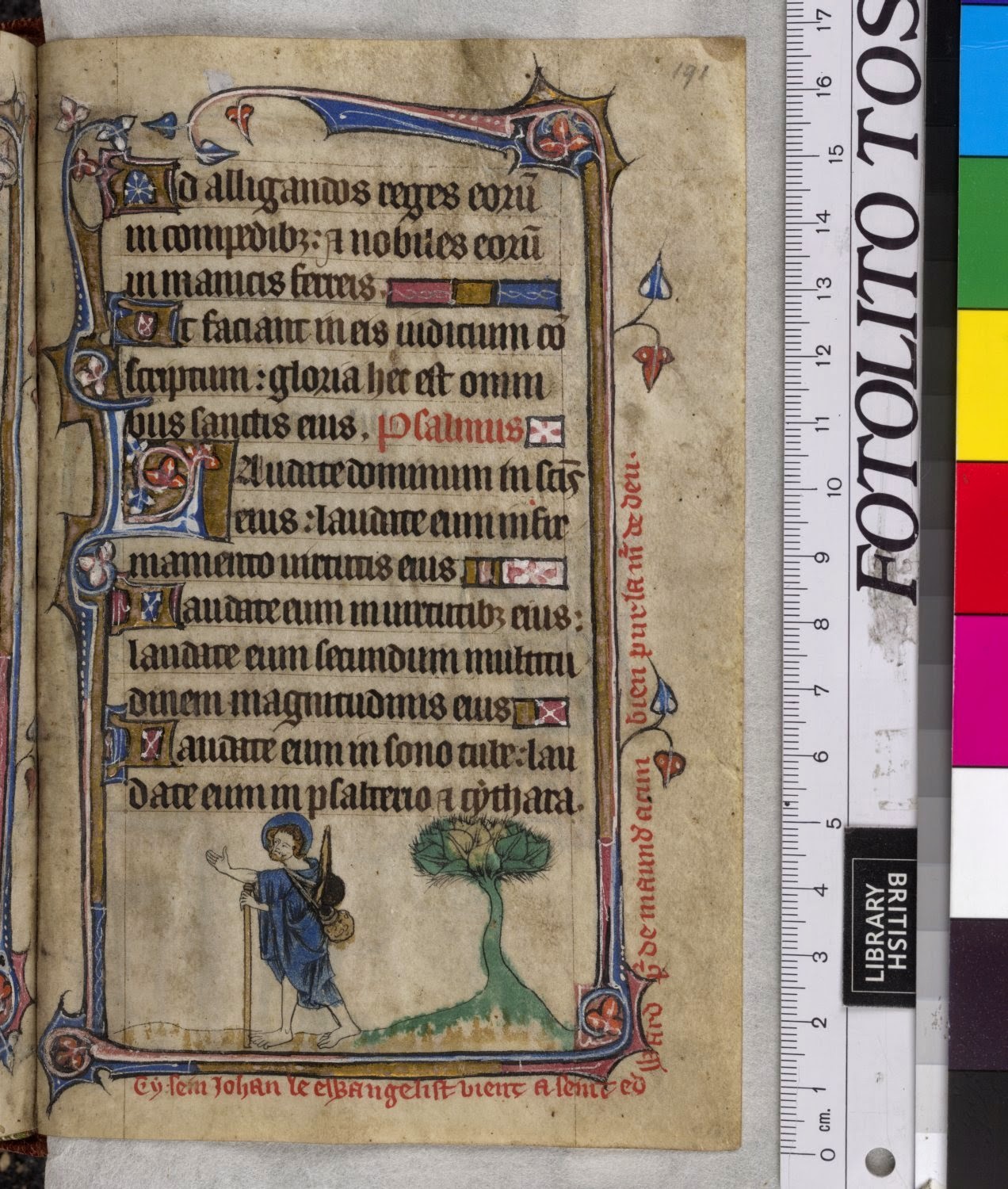
Saint Edmund [of East Anglia], king of England, never refused anyone who asked a favor in the name of Saint John the Evangelist. Thus it happened one day when the royal chamberlain was absent that a pilgrim importuned the king in the saint’s name for an alms [sic]. The king, having nothing else at hand, gave him the precious ring from his finger. Some time later an English soldier on overseas duty received the ring from the same pilgrim, to be restored to the king with the following message: “He for whose love you gave this ring sends it back to you.” Hence it was obvious that Saint John had appeared to him in the guise of a pilgrim.


'Cy seynt Edward dona un anel a Iohan le ewangelist'
Yates Thompson 13, English book of hours, 2nd quarter of the 14th Century
Courtesy of British Library

'Cy sein Johan le ewangelist vient a seint edward p[ur] demaund[er] acun bien pur lam[ur] de deu'
Yates Thompson 13, English book of hours, 2nd quarter of the 14th Century
Courtesy of British Library

This anecdote is significant for several reasons. First of all because it shows an interesting confluence of two of high-medieval England’s most important saints: Edmund of East Anglia and Edward the Confessor. The story of the king giving his ring to Saint John in disguise belongs to the legend of Edward the Confessor and is perhaps one of the most famous miracles from his hagiographies. It first appears in Aelred of Rievaulx’s Vita Sancti Edwardi Regis, a work written for the translation of Edward’s body in 1163, and which was commissioned by Lawrence, abbot of Westminster. The ring became Edward’s main attribute and remained so throughout the Middle Ages, as seen below from a calendar page from the early 1400s.

Edward the Confessor holding his ring, oddly placed at March 18
Harley 2332, Almanac with astrological miscellany, England, 15th century (before 1412)
Courtesy of British Library

Jacobus’ attribution of this episode to the legend of St Edmund is also significant because it allows us a glimpse of the close relationship between those cults from the twelfth century onwards. Edmund had been venerated as a saint since the late ninth century, and his cult centre had been at Bury St Edmunds from the start. In the second half of the eleventh century and onwards, the cult of St Edmund experienced an increased literary output of hagiographical and liturgical material. A new, proper, liturgical office was composed between 1065 and 1087, and Herman the Archdeacon wrote De Miracula Sancti Edmundi c.1100. In the literature of Bury’s long twelfth century, King Edward the Confessor – universally respected in English history – was invoked as one of Edmund’s devotees, and as a just king who granted the abbey many valuable charters. The generosity of Edward was a recurring feature, appearing both in Herman’s De Miracula and Jocelin’s late-twelfth-century Chronicle of the Abbey of Bury St Edmunds.

Edward the Confessor was not canonised until 1161 and his cult was a product of Westminster Abbey and the political interests of King Henry II. Edward’s cult had a brief but intense first period of popularity which rapidly diminished at the explosive growth of the cult of Thomas Becket in the 1170s. Becket’s cult did not affect the cult of Edmund in the same way, much thanks to Bury being a thriving literary centre, and brief anecdotes in late-twelfth-century historiographies – such as Benedict of Peterborough’s Gesta Henrici II and Ralph Coggeshall’s Chronicon Anglicanum – suggests that Edmund enjoyed a much wider and more stable veneration than did Edward.

Martyrdom of St Edmund
Yates Thompson 13, English book of hours, 2nd quarter of the 14th Century
Courtesy of British Library

From the thirteenth century onwards, the two royal saints began to appear together in both art and literature. We don’t know which is the earliest example of this. Edward and Edmund – along with two others – are both listed among England’s peaceable kings in the anonymous Anglo-Norman Le Estoire de Seint Aedward le Rei from the 1240s, and in the late 1300s William Langland states in Piers Plowman that Edmund and Edward were both followed by the personification of Charity. To name some of the examples of these two appearing together in art, we have a glass cycle in Amiens from c.1280, and perhaps the most famous instance of them all, the Wilton Diptych where they appear together with John the Baptist as patron for the young Richard II.

The Wilton Diptych
Edmund and Edward both displaying their most well-known attributes
Courtesy of Wikimedia


In all these instances mentioned above the pairing of Edmund of Edward have been done deliberately, while in Jacobus’ Legenda Aurea the two saints have blended together by mistake. The interesting question is whether this mistake was owing to Jacobus’ own faulty memory, having heard the story from one of the many English pilgrims in Italy and then confused the characters, or whether the story was transmitted to Jacobus in the way he recorded it. In any case, the faulty attribution of the miracle of the ring to Edmund of East Anglia, suggests that by the latter half of the thirteenth century, the two royal patrons of England may already have begun to be paired together, not only in art and literature but also in the common imagination.


Literature

Anonymous, Le Estoire de Seint Aedward le Rei, translated by Thelma Fenster and Jocelyn Wogan-Browne, ACMRS Press, 2008

Aelred of Rievaulx, The Life of Saint Edward, King and Confessor, translated by Jane Patricia Freeland and published in Dutton, Marsha (ed.), Aelred of Rievaulx: The Historical Works, Cistercian Publications, 2005

Herman the Archdeacon, The Miracles of St Edmund, translated by Tom Licence, Clarendon Press, 2014

Jacobus de Voragine, Legenda Aurea, translated by William Granger Ryan, Princeton University Press, 2012

Jocelin of Brakelond, Chronicle of the Abbey of Bury St Edmunds, translated by Diana Greenway and Jane Sayers, Oxford World Classics, 2008

Langland, William, The Vision of Piers Plowman, translated by Schmidt, Everyman, 1995