And was the holy Lamb of God,
On Englands pleasant pastures seen!
- And did those feet, William Blake
Viser innlegg med etiketten Folklore. Vis alle innlegg

mandag 31. oktober 2016

Death and the fiddle - Böcklin, Tartini and a Norwegian traditional


I entertain a deep fascination with the many different ways in which humans meditate on their own relationship to death and mortality, and how they reflect on their own transience in the face of that immense entity of deafening permanence and stability: death. Because even within religious traditions where death is itself transitory, such as Christianity, there has long been a conscience that death marks something definite and, even if it should prove to be only a transition, that death is an endpoint that no one escapes.

The engagement with transient man versus the permanent erasure of death has been the subject of many great cultural expressions. Medieval imagery abounds with meditations on death, resulting in such gloriously morbid concepts and the dance macabre, or the transi tombs which display both the intact body and the rotting corpse in stone for all to see. These are of course connected to the idea of memento mori, that constant reminder of mortality that permeates so much of Christian culture. The memento mori furthermore highlights the anxiety about memory and death, which is a cornerstone in the logic behind impressive funerary monuments. One of the most beautiful meditations on the memorial aspect can be found in Sir Thomas Browne's Urne Buriall from 1658.

One of my favourite modern expressions of the relationship between death and man is the painting shown below, the self portrait with death playing the fiddle in the background by the Swiss painter Arnold Böcklin. I particularly like the way Böcklin has rendered his own face, caught in the realization that Death is standing behind him, playing one-knows-not-what tune, possibly as a reminder of the painter's own mortality.


Self portrait with death as a fiddler
Arnold Böcklin (1827-1901), 1872, Alte Nationalgalerie, Berlin
(Courtesy of Wikiart)


Böcklin's choice of giving Death the fiddle as an interesting one, and although I do not know what thought lies behind that choice, it is worth noting that the fiddle have at times been regarded as an instrument proper of the Devil. One of the most famous stories which connect the fiddle and the Devil is that of the Devil's Trill Sonata by Guiseppe Tartini (1692-1770). The story, given to us by Tartini himself, tells us that the composer had a dream in which the Devil was playing the fiddle, and upon waking Tartini tried to reproduce the music, which he stated "was but a shadow of what he had witnessed in the dream", to quote Britannica.


Guiseppe Tartini, The Devil's Trill Sonata (Violin Sonata in G minor)


Another musical piece which connects the Devil and the fiddle is the Norwegian traditional known as Fanitullen (the Devil's song, "Fan" or "Fanden" meaning "The Devil" in Norwegian and Danish). The piece is known from the nineteenth century, and was the subject of several reworkings. The story behind the song was written down, and edited, by Jørgen Moe (1813-82), a Norwegian priest and collector of fairy tales. According to the legend, the song had been played by the Devil at a wedding in Hallingdal in Norway. The song was played during a fistfight at the wedding, and the Devil played while he sat on a barrel of beer.

Fanitullen, Norwegian traditional
Performed by Christian Borlaug


As a final installment in this series of death and music, I also want to point to the song Self Portrait by Rainbow from their debut album in 1975. Here there is no fiddle, but the theme of personal damnation and its title brings us back to the opening of the blogpost which began with the self portrait with Death as a fiddler.

Self Portrait, Rainbow
From the album Ritchie Blackmore's Rainbow (1975)


Similar blogposts


Dance Macabre

Three Meditations on Mortality

Et in Arcadia ego

The Vanity topos

mandag 20. juni 2016

Blind Heretics Under Ground - Excerpts from the cultural history of the mole


I cannot choose: sometime he angers me
With telling of  the moldwarp and the ant
- William Shakespeare,
Henry IV, part 1, Act 3, Scene 1

Outside my office windows, the moles are waging war against the campus caretakers. It all started a few weeks ago, and when I got to the office in the morning I noticed that five-six mounds of modest size had appeared in the course of the night. I assumed right away that these were erected by moles, although it might well be gophers - they mostly work at night and I have not yet seen one. The mounds were levelled in a few days by one of the caretakers, but the very next day five-six more mounds had appeared, and these are the ones that can be seen on a picture far below in this blogpost. The second series of mounds were later levelled too, but they were replaced shortly thereafter by a total of about ten mounds, plus some smaller ones which I only noticed today closer to the office wall. All of these third-series mounds were levelled today, but only a few hours after that I noticed that a small mound had actually appeared in the same spot as a cluster of two-three mounds, and I wonder how many will be erected in the course of the night.  This ongoing conflict prompted me to write this blogpost.


De talpa - chapter heading for the mole
Valenciennes - BM - ms. 0320, f.080, Thomas Cantimpré, De Natura Rerum, c.1290
Courtesy of enluminures.culture.fr


In the Middle Ages, the learned world did in general not take kindly to the moles. Like all animals included in medieval bestiaries, the mole was endowed with a spiritual, allegorical meaning which made it serve as a model for mankind - in this case a model to be shunned, as we shall see.

Two of the oldest descriptions of the mole, one of which would influence descriptions in bestiaries centuries later, can be found in book twelve of Isidore of Seville's Etymologies. One description can be found in chapter 2, paragraph 39, where Isidore says that "The mole (furo) is named from 'dark' (furvus), whence also comes the word 'thief' (fur), for it digs dark and hidden tunnels and tosses out the prey that it finds" (Barney et.al. 2006: 254). There is good reason to be somewhat skeptical about Isidore's etymological connection here.

In the next chapter of book 12, or more precisely in chapter 3, paragraph 5, there is another description of the mole, and - as we can see from the chapter heading of Thomas Cantimpré's De Natura Rerum above - this was the descriptions transmitted by later commentators. Here, Isidore writes that "The mole (talpa) is so called because it is condemned to perpetual blindness in the dark (tenebrae), for, having no eyes, it always digs the dirt, and tosses out the soil, and devours the roots beneath vegetables" (Barney et.al. 2006: 254). I do not know how come there are two description translated as belonging to the same animal, but it might be that Isidore are describing both the gopher and the mole in this part of the book.


Mouse stealing the host, and an innocent mole
MS Royal 12 C XIX, bestiary, England, 1st quarter of the 13th century
Courtesy of the British Library


Commentators after Isidore also added an allegorical explanation, In one English thirteenth-century bestiary, MS. Bodley 764, for instance, the natural description of the mole follows the standard set by Isidore, and then finishes with the following exposition (translated by Richard Barber):

The mole, condemned to perpetual blindness, is the image of pagan idols, blind deaf and dumb; or even their worshippers, wandering in the eternal darkness of ignorance and folly. Isaiah writes of them: 'In that day a man shall cast his idols ... to the moles and to the bats' [2:20], that is, the blind shall worship the blind. The mole is also the symbol of heretics or false Christians who, like the eyeless mole which digs in the earth, heaping up the soil and eating the roots beneath the crops, lack the light of true knowledge and devote themselves to earthly deeds. They serve the desires of the flesh zealously, and succumb to the lure of pleasure, while they try in every way possible to gnaw at the roots of all that is good.

The Vulgate does indeed speak of bats and moles as symbols of the wasteland, and the imagery is a typical biblical topos where one or two types of wild animals become a synechdoche for the antithesis of civilization. With the desolate imagery of Isaiah in mind, it is easy to see how the mole came to have such an unfavourable standing in the reading of the book of the universe, and how the mole came to be a counter-example to proper Christians.


Mole and company

MS Royal 13 B VIII, Gerald of Wales, Topographia Hiberniae, England, c.1196-c.1223
Courtesy of British Library

On the next stop in this itinerary of cultural history, we come to early modern Norway, where the mole seems to have held a very different position in the popular imagination than that offered by the exegetical parts of medieval bestiaries. In Norwegian, the mole is called "muldvarp", a name that is etymologically linked to the moldwarp of Shakespeare's time, and which comes from German "Maulwürfe", or mold-thrower (werfen = to throw).

In the popular Norwegian imagination, the mole was seen as a bringer of fortune - much to the misfortune of the animal itself, if we are to believe a collection of magic formulas and remedies gathered by Dr. A. Christian Bang in Norske Hexeformularer og Magiske Opskrifter (Norwegian witch formulas and magical remedies). There are two remedies by which moles are believed to improve a person's luck at cards, and both of them have dire consequences for the mole.

According to one of these remedies, recorded about 1770, (Bang 1901-02: 222-23) one must take a living mole and kill it by striking a big pen-knife to its neck. Once this is done, the mole must be placed in a clean pot or other type of clean vessel, and the body of the dead animal must then be burned to powder. No liquid is to be added. This powder is then to be sprinkled into the right shoe of the player, and this will ensure his fortunes at the table. The remedy concludes with the words "one dare not doubt upon this", which suggests that the rhetoric of conviction has not changed all that much these past centuries.

Another remedy, recorded in 1790, is perhaps even more cruel to the poor animals. Again, the mole in question must be alive when it is caught, and the person wishing for luck in games must then bite off the right foot and then release the animal. The foot of the mole is then to be kept in a piece of paper, and it must not touch the earth lest its luck-bringing power goes away. Nor must it be revealed to any other person, presumably for the same reason. To such an extent must the mole-foot be kept a secret talisman, that if the player is in a game which requires a partner, then the mole-foot must be given to the partner's pocket without the knowledge of the partner.

Fortunately, moles are quite rare in Norway and not easy to come by.


Towers of the mole empire
SDU Campus, Odense


In modern popular culture, the moles have largely been depicted in more favourable terms. In fact, modern literature and film is rife with friendly and more or less anthropomorphic moles. For instance, we have the Mole, the protagonist in Zdenek Miler animated children's tv-show from Cold War Czechoslovakia. In British literature we have the kind Mole of Kenneth Grahame's Wind in the Willows, or the companion of Badger in Colin Dann's The Animals of Farthing Wood, not to mention the moles of Brian Jacques' Redwall novels, who all speak in a dialect very similar to that of the West Country. Indeed, there is even a series of fantasy novels centered entirely on the moles, namely William Horwood's Duncton Woods.

As a final installment in this eclectic mix of cultural history, I also want to mention one piece of popular culture which appears to have had some resonance, namely the 1956 science fiction movie The Mole People, where a people of humanoid mole men are enslaved in a subterranean kingdom ruled by albino descendants of the old Sumerians.

Courtesy of Wikimedia


Bibliography

A. Christian Bang, Norske Hexeformularer og Magiske Opskrifter,  A. W. Bröggers Bogtrykkeri, Kristiania, 1901-1902

Richard Barber (editor and translator), Bestiary, The Folio Society, 1992 (this is an abridgement)

Isidore of Seville, Etymologies, edited and translated by Stephen A. Barney, W. J. Lewis, J. A. Beach, Oliver Berghof, Cambridge University Press, 2006

T. H. White (editor and translator), The Book of Beasts, Dover Publications, 1984


Similar blogposts

Christ the unicorn

Excerpts from the cultural history of whales

Beavers in medieval Norway

The miracle of the fox


torsdag 12. mars 2015

Edward the Confessor and the Nightingales


 The nightingales in Haveringatte-Bower
Sang out their loves so loud, that Edward’s prayers
Were deafen’d and he pray’d them dumb
- Alfred Lord Tennyson, Harold, Act I, Scene II


Edward the Confessor occupies a big place in English history and folklore, both because of his office as king of England and because of his role as one of England’s royal saints. As a consequence, there are several legends about him that have been in circulation throughout the centuries. One story claims that he aided Harold Godwinsson in the Battle of Stamford, while another, and one of the most widely famous of these legends, states that he gave his ring to a beggar who turned out to be John the Evangelist . We will return to this latter legend later on, but the main focus of this blogpost is another and much more recent story.


Wooden statue of Edward the Confessor, uncertain date but possibly Victorian
Note the bird on the sceptre - possibly a nightingale

In his play Harold, Alfred Lord Tennyson presents a dramatised account of the Norman Conquest centred around the figure of Harold Godwinsson. In Act I, Harold meets with his sister Edith, Edward the Confessor’s wife, and as Harold enters the stage he recounts the brief anecdote quoted above. The story goes that Edward, who was more of a monk than a king according to the very first biography of him, Vita Ædwardi (c.1070), spent his night in prayer and meditation. One night he was at Havering, the nightingales sang so loudly that they disturbed his prayers and so he prayed that they would be quiet. Since Edward had God’s attention, the nightingales turned silent.

We don’t know how old this legend is, but evidence suggests that it is not very old as far as legends go, and the earliest recorded instance is said to date from the seventeenth century, according to AHistory of the County of Wessex. There is no trace of it in the Latin vitae of Edward that were written during the Middle Ages, and nor can it be found in the historiographical or vernacular material – at least to my knowledge.  The earliest account seems to stem from the early modern period. Historian Deb Martin notes that a local legend – recorded by Essex historian Philip Morant in 1768 – claimed that after this incident, the nightingales never dared to sing in Havering again. By the 19th century, this legend seems to have passed into historiographical tradition, as we see in David Hughson’s London from 1809. Here, Hughson notes that Havering Bower “was the seat of some of the Saxon kings; particularly of Edward the Confessor, who took great delight in it, as being woody, solitary, and fit for devotion” (Hughson 1809, vol. VI: 195). He then goes on to quote the legend, and repeats the story recorded by Montagu that since then the nightingales had stopped singing in that place.

The story of Edward and the nightingales is a curious one, and even though we can’t say for certain when the nightingales at Havering entered the legendary of the Confessor, we can see in this story the conflation of two motifs from medieval folklore.

The first motif is that of animals being silenced by a saint. Many saints are said to have had command over animals, and this motif is found already in Athanasius’ Life of Antony in which we read how Antony of Egypt ordered animals to stay out of his vegetable garden. This was the foundation for the later version of Antony’s life in which it was said that he had a pet-pig, who became his primary iconographical attribute. A later example of this motif can be found in the legend of St Francis of Assisi, who was said to not only command birds but even locusts. In Legenda Aurea, Jacobus de Voragine records the following incident (translated by William Granger-Ryan): “He preached to the birds and they listened to him; he taught them and they did not fly away without his permission. When swallows were chattering when he was preaching, he bade them be silent and they obeyed” (Jacobus de Voragine 2012: 611). Whether there is a connection between this story and that of St Edward and the nightingales is beyond conjecture, but it is nonetheless interesting to see this motif recur in two such different settings.

Antony and his pet-pigs
MS Royal 2 A XVIII, early-fifteenth-century prayerbook
Courtesy of British Library

The second motif at play comes singularly from the legendary of Edward the Confessor, namely his connection to Havering. In 1809, Hughson stated that Havering had been a royal residence and that Edward had spent time there. Whether the Confessor ever did spend much time at Havering can not be ascertained, even though Hughson quotes the Domesday Book as marking Havering as a feudum of the king. The earliest known record of Edward staying at Havering comes from John Hardyng’s chronicle of 1437, where he states that Havering was the setting for the legend of St Edward’s ring. Hardyng’s treatment of the episode goes as follows:

In his forest, as he pursued a dere,
In Essex, a palmer with hym met,
Askyng hym good, whome gladly he dyd here,
He claue his ryng and in sonder it bette,
The halfe of whiche he gaue without lette
To the palmer that went awaye anone,
That other good to geue [hym] there had [he] none

But after that full longe and many [a] daye,
Two pylgrames came vnto that noble kynge,
And sayde, saint Iohn thappostell in pore araye
Vs prayed, and bad straytly aboue all thing,
To you present and take this halfe golde rynge,
Which ye gaue hym of almesse and charyte,
And bade vs say that right sone ye should him se:

Whiche ryng he set together there anone,
And that ylke place he called ay after Hauerynge,
And that same place where they it braste alone
He called by after that ryme Claueryng,
In Essex be bothe fayre standynge,
Where that he made two churches of saint Iohn
Theuangelyst, and halowed were anon
- The Chronicle of Iohn Hardyng, edited by Henry Ellis, printed in London, 1812: 232


Edward holding his ring
Statue of uncertain date, St Albans
Couresy of this website

Hardyng’s account is interesting in many ways. First of all, he introduces the novel idea that Edward broke the ring in two rather than giving it unbroken to the beggar (which is how it happens in Aelred of Rievaulx’s Vita Sancti Ædwardi (1163), the earliest source to mention this). Secondly, Hardyng states that Edward was hunting when he first met the Evangelist. This is significant in that it is a feature absent from the Latin hagiographical tradition, but it is included in William of Malmesbury’s Gesta Regum Anglorum, in which a hunting episode becomes an illustration of the king’s calm temper (William of Malmesbury 1998: 348-49).

In the chronicle of John Hardyng, no reference is made to nightingales, only his connection to Havering. We don’t know when the nightingales first enter the stage, or what was the origin of the legend. One likely source, however, is the Confessor’s coat of arms, which was a golden gross on a blue background surrounded by five gold martlets.

The supposed coat-of-arms of Edward the Confessor
Courtesy of Wikimedia


This coat of arms did not exist in the time of the Confessor, but was believed to have been his coat of arms in the fourteenth century. Therefore, when Richard II merged his own coat of arms with that believed to be the Confessor’s, the result was as follows.

Richard II's coat-of-arms, 1395-99
Courtesy of Wikimedia


The trajectory from Hardyng’s chronicle to the legend recorded by Montague, Hughson and Tennyson can not be recovered, but in the medieval texts and iconography we have seen here we might perceive at least the origin of this charming story.


For more on Edward the Confessor see these blogposts:

Overview of his cult

Edward in stained glass at Ickford

The celebration of his feast day


Bibliography


Primary Sources

Aelred of Rievaulx, The Life of Saint Edward, King and Confessor, translated by Jane Patricia Freeland, printed in Dutton, Marsha (ed.), Aelred of Rievaulx: The Historical Works, Cistercian Publications, 2005: 123-244

Evagrius, Life of Antony by Athanasius, translated by Carolinne White, printed in White, Carolinne (ed.), Early Christian Lives, Penguin Classics, 1998: 1-70

Hughson, David, London, Stratford, 1809

Jacobus de Voragine, The Golden Legend, translated by William Granger Ryan, Princeton University Press, 2012

John Hardyng, The Chronicle of Iohn Hardyng, edited by Henry Ellis, London, 1812

Tennyson, Alfred Lord, Harold

William of Malmesbury, Gesta Regum Anglorum, translated by R. A. B. Mynors, Clarendon Press, 1998


Secondary sources

Baker, Arthur, A Tennyson Dictionary, Haskell House Publishers, 1916

'Parishes: Havering-atte-Bower', in A History of the County of Essex: Volume 7, ed. W R Powell (London, 1978), pp. 9-17 http://www.british-history.ac.uk/vch/essex/vol7/pp9-17 [accessed 9 March 2015].

Websites

http://www.romfordrecorder.co.uk/news/heritage/havering_once_home_to_the_nightingale_but_where_are_they_now_1_1701752

: http://www.stedwardsromford.org/history/edward_the_confessor.html

mandag 29. desember 2014

Gerald of Wales and the Irish saints


 This seems to me a thing to be noticed that just as the men of this country are during this mortal life more prone to anger and revenge than any other race, so in eternal death the saints of this land that have been elevated by their merits are more vindictive than the saints of any other region.
- Gerald of Wales, The Topography of Ireland (transl. by John O'Meara)


A priest accosted by a werewolf
MS Royal 13 B VIII, Gerald's Topographia, England, c.1196-c.1223
Courtesy of British Library

In this blogpost I'm looking at Gerald of Wales' presentation of some Irish saints in his famous work Topographica Hiberniae which was composed in the latter half of the 1180s. The book is in part a recollection of things Gerald heard or witnessed during his trips to Ireland in the period 1183-85. On his second visit he was a part of King Henry II's retinue and was the tutor of his son John. When Gerald returned to Ireland in 1185, he was part of John's retinue. Gerald was also related to members of the Anglo-Norman invasion force, and was therefore doubly invested in the Anglo-Norman campaign to subdue Ireland.


It is in this context Gerald's comments on Ireland and its people must be understood, and in this blogpost I wish to see how Gerald's treatment of Ireland's saints can be explained by context of invasion and subjugation (I hesitate to use the term "colonial context").

The fish with three gold teeth
MS Royal 13 B VIII, Gerald's Topographia, England, c.1196-c.1223
Courtesy of British Library

Gerald's views on the Irish saints as expressed in the epigraph are found as the last chapter of part two of his Topographia hiberniae. In this chapter, Gerald records the wonders, the miracles and the holy men and women of Ireland. The chapter begins with natural wonders, such as a fish with three gold teeth, or the wonderful well of Munster whose water turned things put into it grey. After these natural wonders, Gerald moves on to wonders pertaining to men and beasts, and he records a boy of Wicklow who was a man in most physiognomical respects, but whose nose, eyes, hands and feet resembled those of an ox. This deformed boy was regularly given food at the court of Maurice fitzGerald, one of Gerald's relatives and one of the leaders of the Anglo-Norman invasion of Ireland.

The werewolves of St Natalis
MS Royal 13 B VIII, Gerald's Topographia, England, c.1196-c.1223
Courtesy of British Library


Saint Natalis and the Werewolves

As for the Irish saints, their vindictive nature becomes apparent already in the first story in Gerald's catalogue of animal wonders. The story tells of a priest who was travelling through a wood together with a young boy, and after they had lit up a fire for the night a wolf came up to them and started speaking. In order to calm them down, the wolf spoke about God - and said reasonable and Catholic things, Gerald notes - and then he explained what he wanted:

We are natives of Ossory. From there every seven years, because of the imprecation of a certain saint, namely the abbot Natalis, two persons, a man and a woman, are compelled to go into exile not only from their territory but also from their bodily shape. They put off the form of man compltely and put on the form of wolf. When the seven years are up, and if they have survived, two others take their place in the same way, and the first pair return to their former country and nature.
- Topography of Ireland, chapter 52 (translated by John O'Meara)


The wolf then goes on to explain that his "companion in this pilgrimage" is close to death, and he asks the priest to give her the solace of divine mercy at her life's end. The priest agrees and after some exhortation also gives the dying woman the last rites, including the communion. This story bears some echoes of an old Celtic tale where two brothers are punished by being sent into the woods as a he-wolf and a she-wolf. They later return in their human shape and with the children they have incestuously reared while bearing the shape of wolf. This is not to say that Gerald knew this story, or that it had any impact on the anecdote related above, but it suggests a deep-rooted belief in lycanthropy in Irish folklore. More interesting for my purpose here, is the detail that the fate of these wolves was ordained by St Natalis as a punishment, perhaps a particularly Irish punishment at that, which presents us right away with the vindictive nature of the Irish saints.
St Kevin and the blackbird
MS Royal 13 B VIII, Gerald's Topographia, England, c.1196-c.1223
Courtesy of British Library

The Curse of Saint Kevin

Another example of this vindictiveness is related in chapter 61, which tells about St Kevin, "a great confessor of the faith". Kevin is perhaps most famous for his patience exhibited when, during the saint's prayer, a blackbird started building a nest in his outstretched hand, which was the subject of a poem by Seamus Heaney. In kindness to the bird, Kevin did not move until the birds were hatched, and Gerald notes that because of this, the blackbird features in the iconographical representations of the saint. However, Gerald also tells us about Kevin's vengefulness to birds. We are told that on his feast days, the ravens of Glendalough are "prevented by a curse of Saint Kevin" from being on the ground and from eating, so the birds fly about the village and make "a great noise". The reason for this curse, Gerald speculates, might be that the ravens had caused one of Kevin's students to spill some milk.  

The teal of St Colman
MS Royal 13 B VIII, Gerald's Topographia, England, c.1196-c.1223
Courtesy of British Library

The Teal of Saint Colman

The next chapter records a story in which saintly vindictiveness is protecting rather than harming birds. Here Gerald tells of some teal inhabiting a lake in Leinster, who have resided there since the time of St Colman (it is not specified when that time was). These birds are tame enough to take food from people's hands, but

[w]henever any injury or molestation happens to the church, the clergy, or themselves, they go off to a lake at some distance, and do not return to their former abode until due satisfaction has been made. In the meantime during their absence the waters of the lake, which before were limpid and clear, become brackish and dirty, and cannot be use either for man or beast.
- Topography of Ireland, chapter 62 (translated by John O'Meara)

Gerald further records that once a teal was accidentally brought back from the lake with some cooking water, but although the water was cooking for a long time, the bird - thanks, no doubt, to the miraculous protection of St Colman - remained unhurt. Similarly, Gerald tells of a story happening "in our own times" when the Anglo-Norman invader Robert fitzStephen travelled through the area in the company of King Dermot of Leinster. An archer, ostensibly belonging to the retinue of King Dermot, shot one of the teal and tried to cook it for his king. When he showed King Dermot the miserable result of hours and hours of cooking, the king understood that this was a bird protected by Colman, and exclaimed "Alas form me! That this misfortune should ever have happened in my house". The archer perished miserably a short while after.

The anecdote is relatively sparing in contextual detail, but it is tempting to see King Dermot's fear of St Colman's vengeance in the light of his apparent alliance with the Anglo-Normans, dreading perhaps that his seemingly secure standing would change in the vicissitudes of occupation. Or perhaps this anecdote can be seen as Gerald's warning to the Anglo-Norman barons and their soldiers, that although the subjugation of Ireland is right - since they presented as a nation of bestial and uncivilised men - they should not suffer needless injuries, and nor should their churches be plundered. This should be seen in light of part three of the book, where Gerald gives praise to the Irish clergy, both monks and priests, although he reproves them for lack of discipline.
Minor incidents and lack of vermin

After the anecdote about the teal of St Colman, Gerald soon comes to some minor examples of the powers of Irish sanctity. The first of these is treated in chapter 64, where we are told of a village in Connacht which was "celebrated for a church of Saint Nannan". Once this village was badly infested with fleas, but St Nannan had them miraculously brought to a meadow close by, where the fleas were confined and made it inaccessible to men and beasts alike.

A similar story follows in chapter 65, where we learn of the district of Ferneginan. Here lived Bishop Yvor, who was so plagued by rats eating his books that he cursed them, and the result was that they all were expelled from Ferneginan, and from that day on, it was impossible for rats to live in that district. If rats were to be brought in, they would die. This particular anecdote becomes even more interesting because of its similarities to the supposition noted by Gerald in chapters 21 and 22 that poisonous reptiles are not found in Ireland. This is an old story, and the legend states that it was St Patrick who drove the snakes and other reptiles from the island. Gerald records this belief as a "pleasant conjecture that Saint Patrick and other saints of the land purged the island of all harmful animals", but goes on to suggest that Ireland must have been without these creatures from the beginning of the island's existence.
 
However, this does not explain why reptiles brought into the island perish upon entering the the land, and in chapter 23 Gerald suggests that this has to do with qualities in the Irish soil rather than saintly protection. What is significant about this, is that in chapter 48 Gerald tells how the jurisdiction of the island of Man was granted to Britain rather than Ireland, because poisonous reptiles could live there. And already in chapter 25 Gerald has recorded the discovery of a live frog near Waterford - significantly where the Anglo-Norman invaders entered Ireland in 1174 - which was taken as a sign by King Duvendalus "of the coming of the English, and the imminent conquest and defeat of his people". Ireland allows for heretofore alien reptiles and prepares itself to allow the Anglo-Norman conquest. But the saints are not in the picture, they are not relinquishing patronage nor endorsing the invaders, it is the soil itself that changes - although presumably through divine machinations. Gerald does not pit Irish saints against English saints, but relies instead on what we might call scientific rumination to explain the relationship of reptiles to Ireland.  

The book-eating rats of Ferneginan
MS Royal 13 B VIII, Gerald's Topographia, England, c.1196-c.1223
Courtesy of British Library

Miracles of St Brigid

The next saint to be treated in Gerald's catalogue of wonders is "the glorious Brigid". Some miracles pertaining to St Brigid's fire are mentioned, and a longer account is given of a falcon in Kildare who was believed to have lived there since the time of Brigid (i.e. several generations). This bird is used by Gerald as an example "of honour to churchmen", because during its mating season it flew away from the hallowed precincts of the church where it resided and fornicated elsewhere. The bird "was killed by a rustic" at the time when John, son of King Henry, departed from Ireland the first time.

For my purpose here, however, the significant aspect of St Brigid's powers is her protection of a hedge which surrounds the perpetual fire which is kept burning by her devotees. Since only women are allowed to perform the office as fire-keepers, a man who crosses the hedge "does not escape the divine vengeance". The curse of St Brigid also prevents goats to "have young here".

St Brigid's hedge is described in chapter 69, and Gerald returns to it in chapter 77 where we learn of an archer belonging to the retinue of the Anglo-Norman earl Richard. The archer crossed the hedge and blew upon the saint's fire and immediately went mad. The chapter concludes with an anecdote about a man who had only gotten his shin across the hedge before he was pulled back, and consequently lost his leg. This kind of violent territorial protection is not a feature unique to the Irish saints. Several instances are found in hagiographical texts from all over the Latin West, perhaps most famously St Edmund's killing of Sweyn Forkbeard at Bury St Edmunds. However, when seen in the context of Anglo-Norman invasion and settlement, this anecdote seems to reinforce Gerald's preoccupation with the importance of respecting the Irish places of religion. It seems as if common decency can't prevent the invaders from violating the churches, perhaps a fear of the vengeance of saints might be of help.


Protection of the Land

Keeping in this vein, in the following chapters we find several anecdotes rehearsing the dangers of encroaching upon land belonging to the Irish saints. Chapter 78 contains an anecdote about a soldier who had unlawfully expropriated land belonging to St Finbar in Cork. The bishop of the place, in sadness and anger, asked God (rather Finbar himself) not to allow this land to bear fruit. God listened to the bishop and performed the requested miracle "through the merits of the holy man" (although we are left uncertain as to whether this is Finbar the saint or the bishop of Cork).

The next chapter records how two Anglo-Normans were punished for their lack of piety. The first was Philip of Worcester who forced tribute from the clergy of Armagh, the seat of St Patrick, during Lent. On his departure from Armagh, Philip "was stricken with an illness and scarcely survived". Then we are told of Hugh Tyrrell who stole a cooking-pot from the clergy of Armagh, and the night after he had returned to his lodgings in Louth a fire broke out that burned down a great part of the settlement, killing two horses that had carried the pot away from Armagh. Tyrrell himself was later cast into a civil strife between Anglo-Norman factions. Although it is not elaborated upon, the two aforementioned anecdotes are related to injuries committed against the clergy of Armagh, i.e. under the protection of Patrick, patron of Ireland.

After these vengeful miracles of St Patrick, we are presented with two revenges performed by St Fechin, who was very protective of a mill in Meath, which he had himself cut "out of the side of a rock". When a archer in the army of Hugh de Lacy raped a girl there, he "was stricked in his member with hell-fire in sudden vengeance and immediately began to burn throughout his whole body. He died the same night". Fechin's protection of his mill was not only concerned with violent injuries, but also with minor occurrances. In chapter 82, Gerald tells that two horses who had eaten stolen corn from the mill died afterwards.  

Bernard and the horn of St Brendan
MS Royal 13 B VIII, Gerald's Topographia, England, c.1196-c.1223
Courtesy of British Library

Confessors, not martyrs

Gerald's Topographia hiberniae is to a great degree a document intended to justify the Anglo-Norman conquest of Ireland, yet as we have seen it is apparent that Gerald is concerned with the proper conduct of the conquerors. Ireland is lawfully occupied by the Anglo-Normans because, as is suggested in part three, the Irish are uncivilised and maintain evil customs (ch. 100), not all of them have been baptised (ch. 103) and their kingship ritual contains element of bestiality (ch. 102). However, Ireland and its places are not completely up for grabs, for the Irish saints are protecting their clergy, their pastures and their holy places with a fearful vengeance and they must therefore be respected. Furthermore, despite some shortcomings in discipline and religious practice, the Irish clergy has many good qualities, and its people has a proper respect for saints and their relics. As an example of this, Gerald includes in chapter 108 an anecdote that happened in Wales, where an Irishman carried a horn which was a relic of St Brendan. The horn was held in such great reverence that nobody dared to blow it, and when a Welsh priest did this, he turned mad and had to learn the psalter from the start.

However, despite the vindictiveness "in which the saints of this country seem to be very interested", the saints of Ireland appear to have accepted the coming of the Anglo-Normans. An explanation for this is offered by Gerald in chapter 105, in which he provides further comments on the nature of the Irish saints. For he states that

all the saints of this country are confessors, and there is no martyr. It would be difficult to find such a state of things in any other Christian kingdom. There was found no one in thise parts to cement the foundations of the growing church with the shedding of his blood. There was no one to do this service; not a single one.
- Topography of Ireland, chapter 105 (translated by John O'Meara)

These lines are very important for several reason. Although Gerald emphasises the sanctity of the Irish holy men and women, it appears that he suggests there is no protector of Ireland as a whole, not even the venerable Patrick. Gerald blames the Irish prelates for this state of affairs, because none of them have stood up for their church, or shed blood or suffered exile for its cause. Since this is written less than twenty years after the martyrdom of Thomas Becket (d.1170), for which King Henry II was punished and for which he sought reparation, it is tempting to suggest that Gerald has the model of Becket in mind when he chastises the Irish clergy. He then recounts a comment made by the Archbishop of Cashel:

'It is true,' he said, 'that although our people are very barbarous, uncivilized, and savage, nevertheless they have always paid great honour and reverence to churchmen, and they have never put out their hands against the saints of God. But now a people has come to the kingdom which knows how, and is accustomed, to make martyrs. From now on Ireland will have its martyrs, just as other countries.'

The archbishop's words are chilling and seem prophetic in such a short time after the battle at Waterford, and the canonisation of Becket (1169/70 and 1173 respectively). However, Gerald states that the archbishop's comment, although hard-hitting, does not invalidate Gerald's opinion on the Irish prelates.


Saints and the conquest of Ireland

A final point is worth noting in Gerald's treatment of the Irish saints. As stated, the holiness of the Irish saints remains undisputed and their vengeful patronage are held up as a perennial warning against misconduct against the Irish churches. In chapter 97, Gerald records how the Anglo-Normans themselves showed their due respect for the native saints of Ireland:

Saint Columba and Saint Brigid were contemporaries of Patrick. Their three bodies were buried in Ulster in the same city, namely, Down. They were found there in our times, in the year, that is, that Lord John first came to Ireland, in a cave that had three sections. Patrick was lying in the middle, and the others were lying one on either side. John de Courci, who was in command there, took charge when these three noble treasures were, through divine revelation, found and translated.
- The Topography of Ireland, chapter 97 (translated by John O'Meara)

In other words, through the revelatory will of God, the Anglo-Norman conquerors have become devotees of Ireland's three major saints, and the patrons of Ireland are now the patrons of the Anglo-Normans. The episode is reminiscent of the legend of the seven sleepers at Ephesus recorded at length by Osbert of Clare in his hagiography of Edward the Confessor (c.1138). It is also interesting for its resemblance to similar aspects of Plantagenet appropriation of popular belief. In 1198 the remains of King Arthur and Queen Guinevere were reported to have been found in Glastonbury, thus proving to the Celtic world that Arthur was not resting at Avalon or anywhere else, but was dead and buried. In the late 1200s, King Edward I, during his Welsh campaign, had Arthur's remains translated and perhaps even canonised (although informally so since it was never accepted by the papal church). The purpose was the same at both these instances: to expropriate local history, and display the dynasty's reverence of and protection from these legendary figures.

It is tempting to suggest that this strategy had also been used by the Anglo-Norman conquerors in Ireland, and although Gerald does not elaborate on the importance of this revelation in any great degree, it might explain why Gerald's concern is to warn about local patronage and vindictiveness rather than worrying about the revenge of the great patrons of Ireland.

The making of an Irish king
MS Royal 13 B VIII, Gerald's Topographia, England, c.1196-c.1223
Courtesy of British Library


tirsdag 31. desember 2013

Pope Sylvester and the Dragon


Today, the last day of the year, is the feast day of Pope Sylvester (d. 335), whose legendary afterlife had an important place in the Middle Ages. According to a later forgery, known as the Donation of Constantine, Pope Sylvester received all worldly power in the West from the emperor, presumably in gratitude for having cured him of leprosy (or so the legend goes), and this document was an important tool in the investiture struggle and the other skirmishes between Pope and Emperor that marked the High Middle Ages. This document was later proved to be a forgery by Lorenzo Valla (c.1407-57), and this critical refutation has by some been seen as the starting point of the literary aspect of the quattrocento humanist Renaissance.

Sylvester resuscitating the dragon's victim, Maso di Banco (d.1348)
Courtesy of Wikimedia Commons

Sylvester binding the dragon, Battista da Vicenza (15th century)

Another legend concerning Pope Sylvester tells that a dragon once terrorised Rome with a noxious vapour which killed the citizens. In the Middle Ages, bad smell was a sign of wickedness, and this dragon was indeed a force of evil. Pope Sylvester then made his way to the dragon's lair, bound it in the name of God and brought its victims back to life. There are also other legends, some of which can be read about more thoroughly here.

It is in a way fitting that the last day of the year is the feast of a saint bringing the dead back to life, as the New Year mark our long way toward spring and the return of life. Best wishes for 2014.


torsdag 29. mars 2012

A Dream of Vaults and Vellum


Last week I was skimming through a book on Gothic art and architecture and I came across a beautiful 13th-century illumination depicting a unicorn killed by an armed soldier. Later I discovered that this particular illumination comes from the Royal 12 F. xiii manuscript, currently a part of the British Library collection. The manuscript is a bestiary once belonging to the Benedictine cathedral priory of St Andrew in Rochester, and its illuminations were performed by a peripatetic lay professional.

Bestiaries were, as the name suggests, books about the animals of the world, some of which were real, some of which were not and others which were inaccurate depictions of actual creatures. To the Medieval mind they were all part of Creation, and they could all be used for didactic purposes since by their behaviour they provided mankind examples or counterexamples of proper Christian living. Several animals were also used as metaphor for God the Father, Christ the Son or any of the virtues and vices. Christ was called "the spiritual unicorn" according to the bestiary of the MS Bodley 764, drawing on passages from Song of Songs and Psalm 92, to mention just a few.

The unicorn could also be called rhinoceros or monoceros. It was believed to be too swift for any hunter to catch, but if it were to encounter a virgin it would fall asleep in its lap and could be caught there. This is exactly what happens in the Rochester bestiary.

Mesmerised by the simple yet very beautiful illumination I started imagining how the artwork had come about, conjuring up its genesis in a scriptorium under the aegis of the senior clergy, carried out by a man - whom I at that time wrongly imagined to be a monk - rather wishing to be a part of the somewhere he was creating than the stone walled world he actually did inhabit. The result was the poem below, and the illumination is taken from the British Library website.


A Dream of Vaults and Vellum

After an illumination from MS Royal 12 F XIII f.10 v (13th century)

The artist, having made a unicorn
With features reminiscent of his own,
Smiles as he finds himself in dreams forlorn,
His head a crown, the maiden's lap his throne.

In dreams forlorn he makes these walls of stone
A forest in a distant Anywhere,
Removed from disapproving eyes. Alone
He wanders with that maiden fair.

Still lost in dreams a knight approaches near,
His tonsured head hid' underneath the hood
Of chain mail armour. Thrusting forth his spear
He wakes the dreamer and uproots the wood.

The unicorn, now dying, is confined
To vellum and a dreamer's pensive mind.
- March 20-28 2012

fredag 16. mars 2012

Flores Historiarum, pt. 4 - The Ethics of Historiography

In short, they are often deceived and deceive by their guesses, though these are quite sophisticated, but by means of trickery in their predictions they lay claim amongst naive people to a foreknowledge of the future which they do not at all possess.
- Prologue to Book 1 of Historia Rerum Anglicarum, William of Newburgh


I was first introduced to the Augustinian canon and historian William of Newburgh (b. 1135/6, d. in or after 1198) in a course on literature in the Anglo-Saxon world I took at the University of York. The course, England in Europe, aimed to explore the literary influences and connections between England and the continent from the early Anglo-Saxon period until the Anglo-Norman era of the 12th century. William's History of English Affairs marks the tail-end of the period covered by this course as it was, probably, begun in 1196 and apparently never completed due to his death two years later. Historia Rerum Anglicarum, which I have already mentioned in part two of this series, is famous for its commitment to truth and the ethics of historiography. In his prologue to book 1 - the only part of the book covered on the course - these ethics surface in William's vicious attack on Geoffrey of Monmouth's History of the Kings of Britain. To me it is a great delight to read these attacks because through his indignation and ferocity William serves a scholarly - albeit severely ungenerous - critique of what he considers imagined history, a critique that is as valid today as it was in the 12th century and - in some cases - equally necessary. In this blogpost I will present some of the highlights from William's prefatory attack on poor historiographical scholarship.

William dedicates most of his prologue to castigate Geoffrey of Monmouth's dishonesty, a dishonesty mirrored by the excellence of the historians Bede and Gildas whom William praises for their research and truthful account. Gildas, William claims, "does not hesitate to write as a Briton about Britons that they were neither brave in war nor trustworthy in peace." This is one of the cruxes of William's antipathy for Geoffrey of Monmouth's History of the Kings of Britain is very much concerned with how great the old Britons were and, as we shall see, especially King Arthur. This is how William describes his fellow historian:

But in our own day a writer of the opposite tendency [of Gildas and Bede] has emerged. To atone for these faults of the Britons he weaves a laughable web of fiction about them, with shameless vainglory extolling them far above the virtue of the Macedonians and the Romans. This man is called Geoffrey and bears the soubriquet Arthur, because he has taken up the stories about Arthur from the old fictitious accounts of the Britons, has added to them himself, and by embellishing them in the Latin tongue he has cloaked them with the honourable title of history.

Aside from the ethical problems of Geoffrey's rendition of history, William also accuses him of blasphemy or at least irreligion. One of the perhaps most famous passages of History of the Kings of Britain is the prophecies of Merlin, the offspring of a woman - some say a nun - and an incubus. It is Merlin's demonic heritage that allows him to see into the future and to William this is highly troublesome:

In fact we are instructed by both true reasoning and the sacred writings that demons are shut out from God's light, and are wholly unable to have prior knowledge of the future by mentally observing it, though they apprehend certain future events by guesswork rather than knowledge, through signs better known to them than to us.

To a modern mind this might appear petty and pedantic, and I recall two of my fellow students at York being quite amused by this emphasis. To William of Newburgh, however, demons of various kinds - incubi, succubi and the like - were parts of reality and evil parts at that. No wonder, then, that William found Geoffrey's claim preposterous. Geoffrey, he maintains, "has not learnt the truth about events, and so without discrimination he gives space to fables without substance."

Merlin reading his prophecies to King Vortigern

William also finds it hard to swallow Geoffrey's unabashed representation of the British kings as heroes mightier than those of Antiquity. To William this is a perverse distortion of the truth found in the historical accounts he treasures greatly and he does not hold back:

But even a person of dim mental vision can observe how much the unadulterated historical truth preempts the falsehood which has been compiled at this point. Geoffrey makes Arthur himself outstanding and remarkable above all others; he seeks to present him in his achievements according to the free rein of his fancy.

"[T]his is doubtless", William complains, "to make this Briton's [i.e. Arthur] little finger appear thicker than the mighty Caesar's loins." Our Augustinian canon goes further and points out not merely wild heroic fantasies but also grave historical inaccuracies by pointing out that at a feast in praise of Arthur "[t]hree British archbishops, of London, Caerleon and York, are present, and this at a time when the Britons never had even a single archbishop, for Augustine was the first to receive the pallium from the Roman pontiff and to become archbishop in Britain."

After listing a range of Geoffrey's unbridled exaggerations and fantasies William deals his adversary the following blow:

Is he dreaming of another world containing kingdoms without number, in which the events took place which are mentioned by him earlier? Certainly in our world nothing of this kind took place; for how could the historians of old, who took immense pains to omit from their writings nothing worthy of mention, and who are known to have recorded even modest events, have passed over in silence this man beyond compare and his achievements so notable beyond measure?

It is this precise refutation and the ones above, which make me greatly appreciate William of Newburgh as an historiographer. He shows in this prologue commitment to truth, to a work-ethos and to Orthodoxy that to my mind appears staggeringly precocious in comparison with Geoffrey's more far-fetched imagined past. This is not to say, however, that William himself is singular in his ethics and nor does it mean he was precocious to his age - although it may appear thus to modern historians thoroughly familiar with the advent of the humanist ad fontes approach of Lorenzo Valla. Medieval historians, it is true, did not have the benefit of methodological tools burgeoning from centuries of academic evolution, but - as we can see in the case of William of Newburgh - they were far from indifferent or careless in their commitment to the transmission of history.

tirsdag 7. februar 2012

God in the details

Though he had wont to search with glazèd eyes,
As though he came to kill a cockatrice
- Elegy IV - The Perfume, John Donne

God is in the details.
- Old saying

The origin of the saying quoted in the epigraph is obscure and throughout the ages it has been reiterated by a number of persons and in a number of varieties, perhaps most notably its mirror image "the devil is in the details". The latter rendition is to me very apt when considering Medieval architecture richly furnished with gaping monsters, personified sins, sufferers and devils punishing them. These figures tend to comprise the most noticeable features of Medieval masonry, but they only show the reverse of the coin. We also find, in great quantity saints, angels and humans worshipping God and His universe and, occasionally, God Himself in one manifestation or the other, carved amid the many details of the didactic unit we know as the Medieval church building.


I for myself like the expression very much, both as a Christian and a lover of poetry. For some reason I have not yet fully grasped, but which is by no means inexplicable or difficult to understand, I came to think of this saying when I learned of a structure in York called St.Lawrence's tower. At the time I became aware of it I was back in Norway but still longing very deeply back to the UK and I recalled, when reading about it, that had myself passed the tower once on my way from the library back into town. As I learned of its carvings I became desirous to return, to see these details for myself, presuming I would find God there one way or the other.


The tower is what remains of a Medieval church from 1316, but certain elements are remnants of the 12th century church once situated here. It is labelled a defunct church, out of use but still maintaining a serene dignity so common to the grey-stoned parish churches of England. The Medieval church was demolished in the late 19th century, because a bigger chuch was needed, and a modern church erected in its place, now looming tall in its Medievalesque Victorian opulence.

The top storey of St. Lawrence's tower was put in place in the 15th century. About two centuries later the church was badly damaged by cannonfire during the Siege of York in 1644, when the Parliament army attempted to open Walmgate Bar, hitting both St. Lawrence's church and adjacent houses in the process. Restoration of the church did not commence until 1669.


The doorway is of Norman origin and once embellished the old Church of St. Lawrence.

Sadly I am not sufficiently well-versed in Medieval art to describe the carvings of the doorway in any great detail, so I shall have to let the pictures speak mainly for themselves.


The above pictures show the two outermost of the doorway's concentric arches, perhaps depicting or alluding to some story we no longer can read or understand due to centuries of wind and rain and cultural evolution.


A cockatrice hast thou hatch'd to the world
Whose unavoided eye is murderous
- The Tragedy of Richard III, William Shakespeare


the basilicok sleeth folk by the venym of his sighte
- Canterbury Tales, Geoffrey Chaucer


The second innermost arch is slightly more comprehensible, if only for the fact that its monster theme can be more clearly detected than the carvings of the outermost arches. Both the columns appear to be decorated with snakes - or wyrms, to use an older and probably more correct term - and the arch begins and ends with a monster I believe to be a basilisk or a cockatrice. These two monsters were originally distinct in their appearances but in the course of time they were increasingly confused with each other and sometimes the terms have been used interchangeably. Geoffrey Chaucer, for instance, merged the two names when he wrote of the venomous basilicok.

Whether the monsters depicted on this doorway are meant to be basilisks, cockatrices or some other creature I do not know, but I take great pleasure in them, being overly fond of Medieval imagery.

And was the holy Lamb of God
On England's pleasant pastures seen?
- And did those feet, William Blake


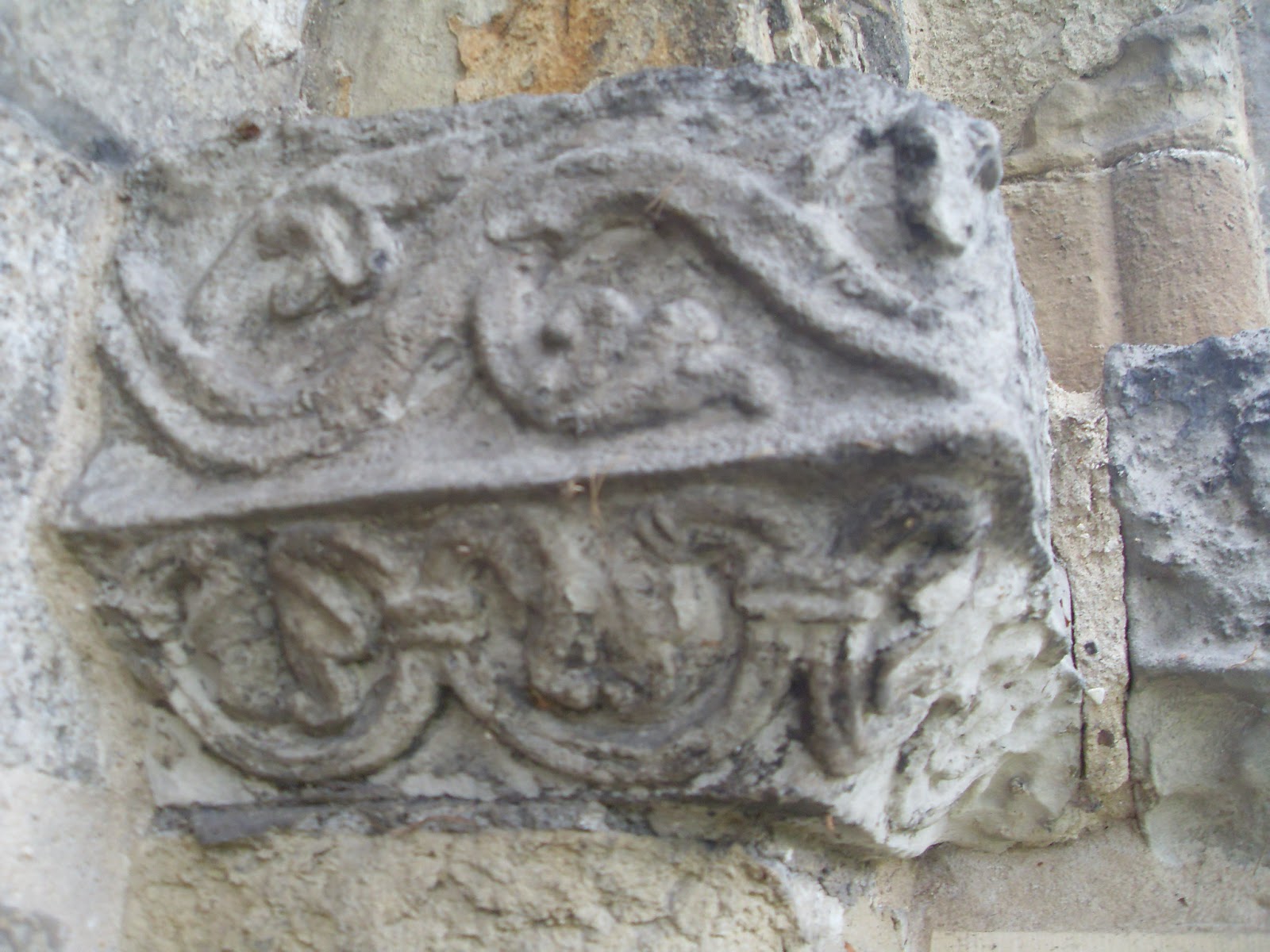
There are also some very interesting columns to be found in the doorway, some of which have undergone fairly recent restoration by the look of it. The first depicts of course Agnus Dei, the Lamb of God, one of the most iconic representations of Christ in Christian iconography. The second column depicts a saggitarius and some scene I don't recognise.

Although St. Lawrence's tower sadly is closed due to its status as defunct, it is nonetheless an interesting architectural feature and one of York's many hidden gems.


From that moment the serpents were my friends,
Because one of them wound about his neck
As if to say: "I want you to say no more"
- Inferno, Dante Alighieri (translated by Charles Sisson)