And was the holy Lamb of God,
On Englands pleasant pastures seen!
- And did those feet, William Blake
Viser innlegg med etiketten Aelred of Rievaulx. Vis alle innlegg

tirsdag 19. juli 2016

Saints, Stained glass, and Serendipity


Created purely from glass the saint stands,
Exposing his gifted quite empty hands
- Geoffrey Hill,
In Piam Memoriam


Towards the end of June I arrived in England for an intense bout of conference activities, starting in York for a few days and then continuing to Leeds. It was a hectic period, but by a stroke of luck it all began just in time for me to catch the last performance of the 2016 York Mystery Plays. From the beginning of the performances on 26 May I had seen several favourable comments and many tantalizing pictures from people who had gone to see the plays. I became very envious, especially since I had seen a performance of the 2012 Mystery Plays, and I knew I was missing out. I was therefore very happy when I had managed to procure a ticket for the very last performance in the evening of 30 June.

This year, the Mystery Plays were performed in York Minster, with a stage arranged like the stairs of a temple, with three broader steps on which the action was performed. The top step was Heaven, while the bottom step served both as the entrance to Hell and the tomb of Christ. It was a masterful performance, and I might write more about it at some later point. In this blogpost, however, my focus is a very serendipitous detail of that evening.


Window from the south side of the cathedral

Since the stage of the mystery plays was arranged like a stair, the seating was arranged like in a stadium, and in order to get a good overview I had bought a seat very high up, which brought me level with the first row of stained glass windows. I had been inside the Minster numerous times since my first visit there in 2009, but I have never been that high up and I might never be again. I knew that this might be a once-in-a-lifetime opportunity, so before the play started I made sure to examine the glass of the south wall as well as I could. Suddenly, however, I realized that I had been more fortunate than I could ever have imagined.


Edmund to the left of me, Edward to the right

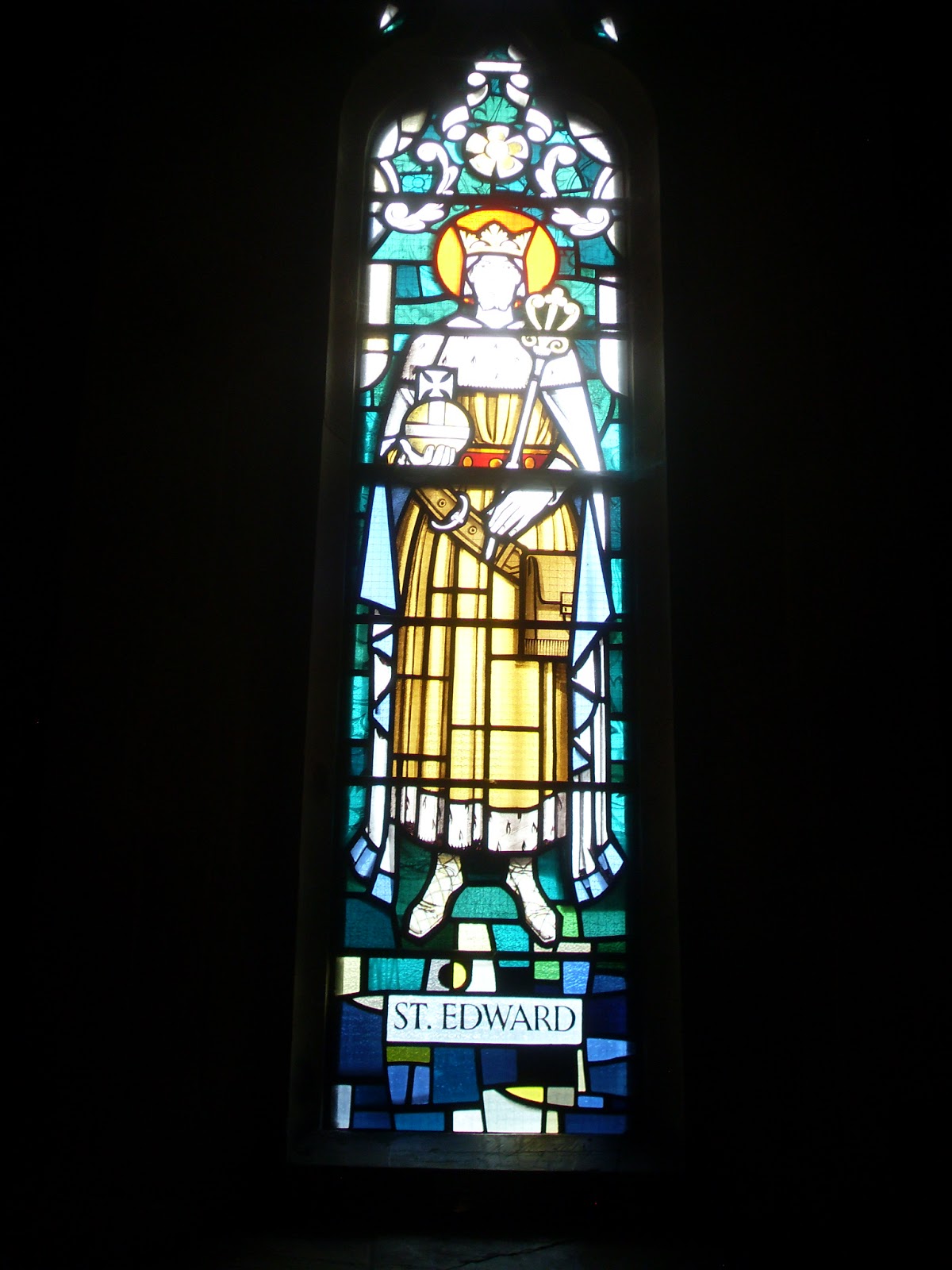
As I was standing by the railing, I saw that one of the closest windows contained stained glass depicting two saints with which I have become very familiar over the past few years, namely Edmund Martyr and Edward the Confessor. I knew that the two kings were to be found in the wilderness of stained glass in York Minster. I once wrote a blogpost about the iconography of these saints as found in York, and experts on the subject told me that they were there and provided me with details. But there I was, staring them in the face and for the first time seeing them in real life and with my own eyes. I spent a long time trying to take good pictures of the individual windows, and the best results can be seen below. Regular readers of this blog, or people who know me well enough, will know that I have something of an obsession with these two saints, and this obsession has its root in my academic career. I wrote my MA on the cult and literature of Edward the Confessor, and I'm currently working on a PhD thesis in which an examination of the cult material of Edmund Martyr is one of the three major parts.


Edward the Confessor is easily recognized in this right-hand panel. This is not the only depiction of Edward in York Minster, another stained glass window featuring the saintly king can be found in the chapter house vestibule, dated to the latter two decades of the 13th century. In both depictions, however, Edward is seen with the ring, which is perhaps his most famous attribute and the one which is most often used in representations of him in glass, sculpture, painting or illuminations. The ring is of great importance due to the miracle depicted in the stained glass window above.

The miracle of the ring appears first in Aelred of Rievaulx's Vita Sancti Edwardi, which was finished in 1163, two years after Edward's canonization and in time for his translation on October 13. According to Aelred, Edward had once met a beggar who asked for alms, and when Edward realized he had no money on him, he gave the beggar his ring instead. Later, two English knights in the Holy Land were approached by a man who said he was John the Evangelist, and gave them a ring which he asked them to bring to the king of England. This the knights did, and Edward recognized the ring understood the miracle. The miracle of the ring was so famous that it was included in the chapter on John the Evangelist in Legenda Aurea, but with Edmund Martyr in the place of Edward through some strange confusion.


Edmund Martyr is also found other places in the Minster. He is also found among the seven windows of the chapter house, and on a wooden panel once found in the chapter house ceiling (13th century), but now among the treasures of York Minster displayed in the crypt. Edmund is recognized by the arrow he holds in his hand, and this is his most common attribute. The arrow - or sometimes arrows - are the instruments of his torture. According to the first life of Edmund, Passio Eadmundi, which was written by Abbo of Fleury in the 980s, Edmund was seized by a group of Danish Vikings, tied to a tree like Christ on the cross and then pierced through with arrows like Saint Sebastian. When Edmund still refused to submit to the lordship of the Danish chieftain, he was decapitated and his head carried off, but that is another story.


Having worked this much with these two saints, it was a very pleasing serendipity to find myself on the level with these two otherwise inaccessible depictions, and that on the very last day it was possible for me to do so. Such instances of good luck can sometimes be found in the course of academic work, and they are always very welcome and very pleasing.


Similar blogposts


Edmund likened to a hedgehog

Edward the Confessor in the North of England

The miracle of the ring in Legenda Aurea

Edward the Confessor in Dringhouses, York

The cult of Edward the Confessor


søndag 20. mars 2016

Edward the Confessor in Dringhouses


Ever since writing my MA thesis on Edward the Confessor, I've had a minor obsession with all things related to his posthumous cult. Regular readers of this blog will be aware of this already, as might be attested to by the number of blogposts touching on this particular subject (a list of which will be added after the present post).

It was for this reason that I have been haunted by the idea to pay a visit to the Church of Saint Edward at Dringhouses, a village just outside York. Fortunately, while I was staying in York for two months as part of my PhD programme, I lived just about fifteen minutes away from the church and decided that it was high time I had a look around. Typical of my propensity for procrastination, I left it to the very last day I was in York, but luckily I did manage to get around it.  


The belltower. The spire was replaced in 1970


This part is most likely the vestry, which was added in 1902

The inner doorway

The church of Edward the Confessor was built between 1847 and 1849, and upon its completion it was dedicated to Saint Edward. This was in fact a re-dedication, as the new church replaced a church from 1725 which had been dedicated to Saint Helen, which in turn had replaced a chapel dedicated to the same saint. This chapel is mentioned in chantry certificates as early as in 1546 and 1548. The church was financed by the widow of the late Revd. Edward Trafford Leigh, and in memory of her husband she had it dedicated to his namesake saint. Saint Edward's became a parochial church in 1853 when Dringhouses parish was established from parts of the parishes of Holy Trinity and St Mary Bishophill Senior.

Saint Edward's church was constructed in decorated Gothic by the architects Vickers and Hugill (or Hugall) of Pontefract. This is perhaps especially evident in the windows and the doorways with their pointed arches and the leaf-work masonry on their side columns. Although there are several details of such beautiful handicraft, the exterior of the building is not remarkably opulent. The interior of the church is somewhat more so, owing in particular to the many splendid windows of stained glass.

Nave, towards the choir


The oldest stained glass windows were designed by William Wailes in 1849, and these depict figures and scenes from the Bible. The first two windows below are found on the left-hand side of the nave when facing the choir. The first window depict the prophet Elijah (here Elias) with the scene showing him being fed by ravens in the wilderness (1 Kings 17:4-6), and then Moses with the scene showing the rod with the brass serpent (Numbers 21:4-9). The second window shows Saint Simeon holding the Christ-child with a scene from the presentation of Christ in the temple below (Luke 2:25-32), and then John the Baptist with the scene showing the baptism of Christ in the River Jordan (Mark 1:1-8).


In the choir, the central window shows the crucifixion of Christ with Mary and John the Evangelist at his sides, with scenes from the Passion underneath. In the choir on the left-hand side are Matthew and Marcus, while on the right-hand side are Luke and John. Note especially how carefully John is made to be identical with the depiction in the central east window.  


On the right-hand side of the nave the windows depict scenes from the New Testament. The first shows parables of Christ, including the parable of the sower (Mark 3:4-9), the parable of the lost sheep (Matthew 18:12-17), what seems to be the parable of the talents (Matthew 25:14-30). The lower left panel might depict Christ being rejected by a pharisee. The second window shows Christ blessing the children (Matthew 19:14) with angels underneath.  


While the stained glass windows by Wailes were very beautiful, I was chiefly interested in the sundry depictions of Edward the Confessor himself, in order to see how his iconography had been represented. The first depiction of Saint Edward can be found in a niche above the doorway where a statue shows the Confessor, bearded, wearing a crown and holding a ring and a sceptre with a bird on its top.  


This iconography is typical of the tradition of Saint Edward's cult. His appearance as a bearded monarch is attested already in the first biography, written relatively shortly after Edward's death in 1066, now referred to as Vita Ædwardi Regis. His white, and virginal, beard is made into evidence of holiness in the two twelfth-century hagiographies written about him, the first by Osbert of Clare in 1138 and the second by Aelred of Rievaulx in 1163.

The ring and the bird refer to two of the most iconical legends concerning the Confessor. The story of the ring can first be found in Aelred of Rievaulx's Vita Sancti Eadwardi, where it is told that the Confessor gave his ring to a beggar. This beggar turned out to be Saint John the Evangelist in disguise (the Confessor's particular saint), and Saint John, again in the disguise of a beggar, gave the ring to two English knights in the Holy Land, with the orders to take it to the king and report how they had received it. The ring remains the key iconographical feature of Saint Edward. (More on this here.)

The bird is a later feature, but it may have entered the iconography as early as the 13th century. By the end of the fourteenth century, the coat-of-arms of Edward the Confessor was held to be a golden cross on a blue background with golden birds in the open spaces between the cross arms, and one golden bird underneath the cross. We see this from Richard II's merging of his own coat-of-arms with that of Saint Edward.

In time there emerged a legend saying that Edward had once been disturbed by nightingales during prayer, and when he prayed that they should cease their singing for a while they did so. This legend appears to have an early modern date rather than belonging to the medieval tradition. (More on this here.)


Edward the Confessor is also depicted inside the church. We see him on the right-hand side of the altar, where he is flanking Christ in majesty with Saint Peter standing on the left-hand side. The confessor is here surrounded by four angels, two of which are carrying some of the instruments of Christ's passion. Above Saint Edward's head we find his coat-of-arms.


We also find Saint Edward on the left-hand side of the bottom end of the nave (when facing the altar). This is a stained glass window put up in memory of churchwarden G. Raymond Burn who died in 1993. Here the Confessor is shown wearing his regalia, but in a distinctly more royal and notably less legendary form than in the other depictions. 


The dedication of the church has also given name to at least one more place name in Dringhouses, namely St Edward's Close, as depicted below.


Websites:


fredag 26. juni 2015

The Swineherd King


In the preface to his hagiography of Edward the Confessor, Aelred of Rievaulx comments that no other royal house of Europe can look back at such a plethora of saintly kings and queens. However, according to a tradition picked up by Jacobus de Voragine in his Legenda Aurea, the genesis of the British line of monarchs was quite humble, if not downright lowly, as the first in the new line of kings was a swineherd. The story is found in the legend of Saint Germain of Auxerre (c.380-448), a remarkable figure of the early Catholic church and whose life has become saturated with exactly the kind of stories and myths that make his entry in the Legenda Aurea a very entertaining read. 

Saint Germain looking at the opening to the first lesson in an office lectionary
Paris - Bibl. Mazarine - ms. 0399, f.111v, Abbey of Saint-Magloire, Paris, early 15th century Courtesy of enluminures.culture.fr

Germain was born to a noble family. He received a very good education first at Arles and Lyons and then in Rome, and he entered into contact with the imperial court. Eventually, the emperor appointed him duke and ordered him to return to Gaul where he took up residence in his native Auxerre. In 418 he was consecrated bishop of Auxerre, and according to the legend this move from the ducal to the episcopal seat came about in a Pauline conversion, which is a story fit for another time.

After more than ten years in his office, in the early 430s, Germain travelled to Britain together with Lupus to combat the Pelagian heresy which was then thriving in Britain. According to the chronicle of Saint Prosper, this was commissioned by Pope Celestine, while Bede in his Ecclesiastical History claims that Germain was sent by a synod. Germain's journey to the British Isles has also been woven into one of the early lives of Saint Patrick, in which it is claimed that Patrick was part of Germain's retinue. The account of Germain's mission is so suffused with legend that the exact details are winnowed only with difficulty. Jacobus de Voragine covers it very briefly, saying that the two bishops were welcomed by local clergy who had been told of their arrival by demons whom the bishops had driven out of the possessed. This appears to be a garbled version of Bede's account, as Bede tells us that the demons first tried to capsize Germain's ship in the Channel, and when they were chased away they came to England and there took possession of some of the Britons. When Germain came ashore, however, he freed the possessed and chased the demons further away.

It is likely that Jacobus drew on Bede for part of his account of Saint Germain, for Jacobus had access to Bede for some of his legends, though evidently he has here been writing from memory, or has received the story from a faulty source. We know that Jacobus sometimes transmits English material rather imperfectly, and in a previous blogpost I wrote about when he confused Edmund of East Anglia and Edward the Confessor.

Saint Germain looking the other way
Chaumont - BM - ms. 0033, f.319, Breviary, Use of Langres, c.1481
Courtesy of enluminures.culture.fr

As for Germain's campaign against Pelagianism, Jacobus - unlike the far more prolix Bede - merely states that the saint "convinced the heretics of their error" and that was that. Bede then claims that the Catholics went to the shrine of Saint Alban so as to ratify the conversion with the saint's blessing. Jacobus' silence on the matter suggests again that he is not writing this legend with the Ecclesiastical History at hand.

After a while, heresy resumed its grip in Britain and Germain was sent back to deal with it, and it is here we learn of the origins of the British monarchy. Jacbous tells us:

On one occasion while he was preaching in Britain, the king of Britain refused to give shelter to him and his companions. One of the king's swineherds, after feeding his charges and receiveing his wage at the palace,was on the way home and saw Germain and his fellows in sorry straits due to hunger and the cold. He kindly took them to his cottage and had his one and only calf killed for their supper. When the meal was finished, the bishop had all the calf's bones laid upon their hide, and as he prayed over them, the calf stood up whole and entire. The next day Germain accosted the king and asked him bluntly why he had refused him hospitality. The king overcome with astonishment, could think of nothing to say in response. Germain said: "Begone then, and leave the kingdom to a better man!" Then, by God's command, he had the swineherd and his wife summoned, and, to the amazement of all, proclaimed him king. Hence the monarchs who have ruled the British people since then are descendants of that swineherd.
- Jacobus de Voragine, Legenda Aurea (translated by William Granger-Ryan)

Miniature of Saint Germain
MS Egerton 1070, Book of Hours, France, c.1410
Courtesy of British Library

There are several noteworthy things in this passage. First of all, we note the similarity between the resusciation of the calf and the story of the rams of Thor, the Norse god of thunder, which could be flayed and eaten in the evening and be alive and well in the morning. Secondly, the legend casts a Biblical shine on the early British house of kings, since the British kings originate from a swineherd, just as the kings of Israel in Judaic tradition are descendants of the shepherd Saul, anointed by God's prophet Nathan. Since Germain is here acting on God's command, he effectively takes the role of Nathan and replaces the British line of kings with another, hand-picked according to Biblical principles.

I do not know where Jacobus came across this legend, it is certainly not Bede.


Bibliography

Books

Bede, The Ecclesiastical History of the English People, translated by Bertram Colgrave, Oxford World's Classics

Jacobus de Voragine, Legenda Aurea, translated by William Granger-Ryan, Princeton University Press, 2012


Websites

http://www.newadvent.org/cathen/06472b.htm 

torsdag 12. mars 2015

Edward the Confessor and the Nightingales


 The nightingales in Haveringatte-Bower
Sang out their loves so loud, that Edward’s prayers
Were deafen’d and he pray’d them dumb
- Alfred Lord Tennyson, Harold, Act I, Scene II


Edward the Confessor occupies a big place in English history and folklore, both because of his office as king of England and because of his role as one of England’s royal saints. As a consequence, there are several legends about him that have been in circulation throughout the centuries. One story claims that he aided Harold Godwinsson in the Battle of Stamford, while another, and one of the most widely famous of these legends, states that he gave his ring to a beggar who turned out to be John the Evangelist . We will return to this latter legend later on, but the main focus of this blogpost is another and much more recent story.


Wooden statue of Edward the Confessor, uncertain date but possibly Victorian
Note the bird on the sceptre - possibly a nightingale

In his play Harold, Alfred Lord Tennyson presents a dramatised account of the Norman Conquest centred around the figure of Harold Godwinsson. In Act I, Harold meets with his sister Edith, Edward the Confessor’s wife, and as Harold enters the stage he recounts the brief anecdote quoted above. The story goes that Edward, who was more of a monk than a king according to the very first biography of him, Vita Ædwardi (c.1070), spent his night in prayer and meditation. One night he was at Havering, the nightingales sang so loudly that they disturbed his prayers and so he prayed that they would be quiet. Since Edward had God’s attention, the nightingales turned silent.

We don’t know how old this legend is, but evidence suggests that it is not very old as far as legends go, and the earliest recorded instance is said to date from the seventeenth century, according to AHistory of the County of Wessex. There is no trace of it in the Latin vitae of Edward that were written during the Middle Ages, and nor can it be found in the historiographical or vernacular material – at least to my knowledge.  The earliest account seems to stem from the early modern period. Historian Deb Martin notes that a local legend – recorded by Essex historian Philip Morant in 1768 – claimed that after this incident, the nightingales never dared to sing in Havering again. By the 19th century, this legend seems to have passed into historiographical tradition, as we see in David Hughson’s London from 1809. Here, Hughson notes that Havering Bower “was the seat of some of the Saxon kings; particularly of Edward the Confessor, who took great delight in it, as being woody, solitary, and fit for devotion” (Hughson 1809, vol. VI: 195). He then goes on to quote the legend, and repeats the story recorded by Montagu that since then the nightingales had stopped singing in that place.

The story of Edward and the nightingales is a curious one, and even though we can’t say for certain when the nightingales at Havering entered the legendary of the Confessor, we can see in this story the conflation of two motifs from medieval folklore.

The first motif is that of animals being silenced by a saint. Many saints are said to have had command over animals, and this motif is found already in Athanasius’ Life of Antony in which we read how Antony of Egypt ordered animals to stay out of his vegetable garden. This was the foundation for the later version of Antony’s life in which it was said that he had a pet-pig, who became his primary iconographical attribute. A later example of this motif can be found in the legend of St Francis of Assisi, who was said to not only command birds but even locusts. In Legenda Aurea, Jacobus de Voragine records the following incident (translated by William Granger-Ryan): “He preached to the birds and they listened to him; he taught them and they did not fly away without his permission. When swallows were chattering when he was preaching, he bade them be silent and they obeyed” (Jacobus de Voragine 2012: 611). Whether there is a connection between this story and that of St Edward and the nightingales is beyond conjecture, but it is nonetheless interesting to see this motif recur in two such different settings.

Antony and his pet-pigs
MS Royal 2 A XVIII, early-fifteenth-century prayerbook
Courtesy of British Library

The second motif at play comes singularly from the legendary of Edward the Confessor, namely his connection to Havering. In 1809, Hughson stated that Havering had been a royal residence and that Edward had spent time there. Whether the Confessor ever did spend much time at Havering can not be ascertained, even though Hughson quotes the Domesday Book as marking Havering as a feudum of the king. The earliest known record of Edward staying at Havering comes from John Hardyng’s chronicle of 1437, where he states that Havering was the setting for the legend of St Edward’s ring. Hardyng’s treatment of the episode goes as follows:

In his forest, as he pursued a dere,
In Essex, a palmer with hym met,
Askyng hym good, whome gladly he dyd here,
He claue his ryng and in sonder it bette,
The halfe of whiche he gaue without lette
To the palmer that went awaye anone,
That other good to geue [hym] there had [he] none

But after that full longe and many [a] daye,
Two pylgrames came vnto that noble kynge,
And sayde, saint Iohn thappostell in pore araye
Vs prayed, and bad straytly aboue all thing,
To you present and take this halfe golde rynge,
Which ye gaue hym of almesse and charyte,
And bade vs say that right sone ye should him se:

Whiche ryng he set together there anone,
And that ylke place he called ay after Hauerynge,
And that same place where they it braste alone
He called by after that ryme Claueryng,
In Essex be bothe fayre standynge,
Where that he made two churches of saint Iohn
Theuangelyst, and halowed were anon
- The Chronicle of Iohn Hardyng, edited by Henry Ellis, printed in London, 1812: 232


Edward holding his ring
Statue of uncertain date, St Albans
Couresy of this website

Hardyng’s account is interesting in many ways. First of all, he introduces the novel idea that Edward broke the ring in two rather than giving it unbroken to the beggar (which is how it happens in Aelred of Rievaulx’s Vita Sancti Ædwardi (1163), the earliest source to mention this). Secondly, Hardyng states that Edward was hunting when he first met the Evangelist. This is significant in that it is a feature absent from the Latin hagiographical tradition, but it is included in William of Malmesbury’s Gesta Regum Anglorum, in which a hunting episode becomes an illustration of the king’s calm temper (William of Malmesbury 1998: 348-49).

In the chronicle of John Hardyng, no reference is made to nightingales, only his connection to Havering. We don’t know when the nightingales first enter the stage, or what was the origin of the legend. One likely source, however, is the Confessor’s coat of arms, which was a golden gross on a blue background surrounded by five gold martlets.

The supposed coat-of-arms of Edward the Confessor
Courtesy of Wikimedia


This coat of arms did not exist in the time of the Confessor, but was believed to have been his coat of arms in the fourteenth century. Therefore, when Richard II merged his own coat of arms with that believed to be the Confessor’s, the result was as follows.

Richard II's coat-of-arms, 1395-99
Courtesy of Wikimedia


The trajectory from Hardyng’s chronicle to the legend recorded by Montague, Hughson and Tennyson can not be recovered, but in the medieval texts and iconography we have seen here we might perceive at least the origin of this charming story.


For more on Edward the Confessor see these blogposts:

Overview of his cult

Edward in stained glass at Ickford

The celebration of his feast day


Bibliography


Primary Sources

Aelred of Rievaulx, The Life of Saint Edward, King and Confessor, translated by Jane Patricia Freeland, printed in Dutton, Marsha (ed.), Aelred of Rievaulx: The Historical Works, Cistercian Publications, 2005: 123-244

Evagrius, Life of Antony by Athanasius, translated by Carolinne White, printed in White, Carolinne (ed.), Early Christian Lives, Penguin Classics, 1998: 1-70

Hughson, David, London, Stratford, 1809

Jacobus de Voragine, The Golden Legend, translated by William Granger Ryan, Princeton University Press, 2012

John Hardyng, The Chronicle of Iohn Hardyng, edited by Henry Ellis, London, 1812

Tennyson, Alfred Lord, Harold

William of Malmesbury, Gesta Regum Anglorum, translated by R. A. B. Mynors, Clarendon Press, 1998


Secondary sources

Baker, Arthur, A Tennyson Dictionary, Haskell House Publishers, 1916

'Parishes: Havering-atte-Bower', in A History of the County of Essex: Volume 7, ed. W R Powell (London, 1978), pp. 9-17 http://www.british-history.ac.uk/vch/essex/vol7/pp9-17 [accessed 9 March 2015].

Websites

http://www.romfordrecorder.co.uk/news/heritage/havering_once_home_to_the_nightingale_but_where_are_they_now_1_1701752

: http://www.stedwardsromford.org/history/edward_the_confessor.html

torsdag 7. august 2014

Methodology of negatives


Yesterday, upon the stair,
I met a man who wasn't there
- Antigonish, Hughes Mearns


To a young scholar in training, there are certain things for which he or she can not fully prepare but rather has to experience when the time comes. One of these things is to deal with negative results in the humanities, which can become something of a problem when one line of inquiry yields almost more negative results than positive ones. For me this problem first arose in my research for the paper to IMC Leeds this year, in which I looked at sources for the cult of Edward the Confessor in France and Normandy. The following is a reflection/complaint/whining on some of the problems I faced when trying to make a case from more negative results than I had expected.

The purpose of my paper at Leeds 2014 was to look at three case-studies for devotion to the cult of Edward the Confessor as suggested by three types of source material in the period 1161-1480. These sources were a set of 12th-13th-century liturgical books from the archbishopric of Rouen and the Abbey of the Holy Trinity of Fécamp, a series of stained glass window from the same abbey dated to c.1307, and finally an antiphon found in a book compiled by a German Carthusian around 1480. From this material, scattered among several centuries, I tried first to compile a concise overview of the cult of Edward the Confessor in France following his canonisation in 1161. This were to prove very difficult, and it was here I was faced time and again with a number of negative inquiries.  

The Abbey of the Holy Trinity, Fécamp
Courtesy of Wikimedia

During my MA studies, I had often heard the dictum of one of the history professors at NTNU: Negative results are also results. This is of course well and true, but I was also aware that absence of evidence is not evidence of absence, and therefore it can be very difficult to extract a picture of historical development when there are gaping holes in the timeline. Given the unknown and unfortunately high number of medieval sources lost to us, we are not permitted to make bold claims when we face a lack of material, and at best we can make an educated guess about the possible scenarios such a dearth of evidence may signify.


To give an example: In order to attempt mapping the cult of Edward the Confessor in France, I sought to find out how he was represented in sources beyond hagiography and liturgy. I therefore had a look through one of the greatest works of historiograhpy from medieval France, namely Vincent of Beauvais' Speculum Historiale written in the 1240s and -50s, a vast encyclopedia drawing on a number of sources and covering a big range of historical events. Since Vincent's work was completed about eight or nine decades after Edward the Confessor's canonisation, I assumed that the monk of Beauvais would have been able to get hold of one of the hagiographies about Edward. At the very least I presumed Vincent would have read Aelred of Rievaulx's popular and influential Vita Sancti Edwardi. I was excited to find this out, because Vincent's source for Edward could tell a lot about the dissemination of hagiographies for the Confessor. 

Image allegedly of Vincent of Beauvais
Courtesy of Wikimedia

However, when I opened the big, heavy, yellow 1964 reprint of a Douai edition from 1624 - a book as big as my torso but not as thick - and finally found Vincent's chapter on Edward, I was much disappointed. In short, Vincent draws chiefly - and perhaps exclusively - on the Gesta Regum Anglorum of William of Malmesbury, completed in the 1130s, several decades prior to the canonisation of Edward the Confessor. As a consequence, Vincent of Beauvais writes something about the miracles and dreams of Edward - indeed he allots a surprising length to his dream of the seven sleepers - but the Confessor is not referred to as a saint for obvious reasons. I was a bit disappointed with this discovery. Although it did suggest that the hagiographies of Edward indeed were not widely disseminated in France, I couldn't suggest that this was the case unless it was corroborated by several other inquiries, which I didn't have the time to undertake.

After my dead-end-foray into Speculum Historiale, I turned my attention to sources more directly relevant for the cult of St Edward, namely liturgical books. The antiphon handed down to us by the 15th-century Carthusian from Cologne is an adaptation of an antiphon composed for St Louis around 1300. (For more on this antiphon, see here.) In order to see whether this adaptation did suggest exchange of cult material between the cult centres of the two confessor kings, Louis and Edward, I looked through the Westminster Missal and the liturgical material from Saint-Denis as treated by Anne Walters Robertson. What I had envisioned would be a time-consuming investigation into primary sources, was concluded in about fifteen minutes, most of which were spent taking the book from spot A to spot B. I still remember the slightly dejected sensation when I realised that Abbot Lytlyngton's Westminster Missal of c.1380 did not contain a single reference to Louis IX. 

Angels receiving the soul of Louis IX
Paris - Bibl. Sainte-Geneviève - ms. 0783, Grande Chroniques deFrance, 13th-14th centuries
Courtesy of enluminures.net

Of course, the negative results from the liturgical books were of a different nature than that of Speculum historiale. The fact that Louis was not celebrated at Westminster, nor Edward at Saint-Denis, pointed to a deliberate omission, since the contact between France and England was strong enough to ensure that both these monastic institutions knew of the other's patron saint. Consequently, this allowed me to build towards a conclusion in my paper, but - as in the case of Vincent of Beauvais - it was of course slightly frustrating to have to relegate so much research into footnotes that could not be included in my talk at Leeds.

In the end, I believe the paper itself went rather well and I managed to keep some coherence in my argument, but it was a long and arduous road to get there - and one that is not easily traced in the footnotes or in the text itself. This was something for which I was not prepared, despite having heard anecdotes and despite my experience from my MA dissertation. As stated above, it is the kind of experience you have to tackle head-on when it arises, and sometimes it can be very frustrating. It helps, of course, that there are several kinds of negative results. Vincent of Beauvais' reliance on William of Malmesbury was an omission of later material that may not have been deliberate but caused by limited available material. The fact that Louis IX did not appear in the Westminster Missal, composed more than eight decades after his canonisation, suggests a deliberate omission and can yield some ground for positive claims - i.e. that Louis' cult was not adopted at Westminster. A third kind of negative result is the lacunic absence of evidence which may be due to a loss of material or that the material sought was lacking form the start. This is the most frustrating kind, for this leaves only tentative conjectures.  


tirsdag 1. april 2014

Edward the Confessor as King David


So David and all the house of Israel brought up the ark of the Lord with shouting, and with the sound of the trumpet. And as the ark of the Lord came into the city of David, Michal Saul’s daughter looked through a window, and saw king David leaping and dancing before the Lord; and she despised him in her heart.
- 2 Samuel 6: 15-15 (KJV)

David humbling himself before God
The Morgan Bible, Paris, 1240s
Picture courtesy of this website

The story of the ark of the covenant's return to Jerusalem is a famous episode in the life of King David, and it shows the man of royal dignity humbling himself before God and rejoicing in the Lord's work. In the medieval hagiography this scene became an important source for hagiographers who wished to contrast the arrogance of the world - so frequently found in kings who challenged the so-called liberties of the church. The struggle between the temporal and the spiritual powers is a common theme in much of medieval history, and King David was often held up as an example of good kingship for the admonition of contemporary princes.

One such example comes from the mid-12th century in Aelred of Rievaulx's Vita Sancti Ædwardi, the hagiography of Edward the Confessor written in 1163 and prepared for the saint-king's translation of October 13 that year. This vita was dedicated to King Henry II and in the dedication Aelred expresses his hopes that the king might follow the example of St. Edward in the performance of his office. This was the year before the council of Clarendon where Thomas Becket and the king had a falling out over the constitutions which was said to encroach upon the liberties of the church. The struggle between Henry and the English church was at that point already long-standing, and it is likely that the Cistercian hagiographer Aelred - commissioned to write the vita by Abbot Laurence of Westminster, his kinsman - saw this as an opportunity to persuade the king off his current path.

In one anecdote from Aelred's work, Edward the Confessor is explicitly likened to King David in the healing of the crippled Gillemichel, an Irishman. This man has been told that he will receive a cure for his illness if King Edward will carry him on his back all the way to Westminster Abbey. This task was given to the king by St. Peter himself, who thus becomes a co-worker of miracles who commission his favourite on earth, Edward the Confessor, to complete the task. The king is told about this and agrees to help Gillemichel, thus humbling himself for the glory of God. The elaborate comparison with David should be seen in light of King Henry's politics against the church, and Edward provides for the king a model of emulation, strengthened by the comparison to the Old Testament exemplar.

The excerpt is translated by Jane Patricia Freeland and is taken from
Aelred of Rievaulx: The Historical Works, edited by Marsha L. Dutton, 2005: 163-64.

Meanwhile not a few of those standing by were laughing. Some teased the king about being fooled by the poor man, while others interpreted the righteous man's simplicity and gentleness as foolishness. See there a new David leaping and dancing; see a new Michal contemptuous and laughing! Yet their view was sounder who jduged the king happier under such a burden than under a golden crown. You, Christ Jesus, you yourself were being carried in the poor man, you who once were clothed as a poor man whom Martin clothed. But you made that known then by an oracle, this now by a miracle.

And so as the king moved forward little by little, burdened by this noble burdn, the tendons that the longstanding illness had contracted were suddenly extended, the passag of blood that his stiffened veins had restricted resumed, his bones became firm, and his withered flesh became warm again. His joints emerged out of his flesh and his feet were separated from the buttocks. The knees, which were now flexible and flowing with healthy blood. The royal clothing was adorned rather than defiled.

They all shout that the sick man has been healed enough now and that the king should now lay down his burden because of his filthy sores. The king, mindful of the command he had received, refused to listen to these siren songs. He entered the church and before the holy altar he resigned the offering he had been bearing to God and to blessed Peter.

[B]efore the holy altar he resigned the offering he had been bearing to God and to blessed Peter.
MS. Egerton 745, French collection of saints, 14th century
Courtesy of British Library

søndag 5. januar 2014

Dies Natalis Sancti Ædwardi


Here Edward king,
of Angles lord,
sent his stedfast
soul to Christ.
In the kingdom of God
a holy spirit!
- Entry in the Anglo-Saxon Chronicle for the year 1065, Whitelock, Dorothy, David, Douglas C., Tucker, Susie, I. (eds.), The Anglo-Saxon Chronicle: A Revised Translation, Eyre and Spottiswoode, 1962

On this day, the eve of the Epiphany, in 1066 Edward king of England died in sickbed only a few days after he had witnessed the consecration of Westminster Abbey. Edward died childless and was succeeded by Harold Godwinson, and he was revered by the new Norman overlords as a good and pious king. In 1161 he was canonised by Pope Alexander III and became known as Edward the Confessor. The cult was centred at Westminster and was initially embraced by King Henry II, who orchestrated the moving of his relics to a new tomb on October 13 1163. On this occasion, Henry was presented with a new vita of the Confessor, written by Aelred of Rievaulx, and this became the primary source for all subsequent renditions of Edward's life. In this blogpost, I aim to present an overview of this feast in liturgical sources from the High Middle Ages.

Edward the Confessor carrying book and sceptre
MS. Royal 20 A II, historical miscellany from England, c.1307-27
Courtesy of British library

When Edward's cult was established in 1161, there was only one celebration for the ministrants of Westminster Abbey, namely his dies natalis, January 5. The dies natalis meant the heavenly birthday of the saint, the day when, through dying, he or she entered the registers of the saint and was born into holiness. In the beginning of any cult, this day is the most important feast day, and so it was for Edward the Confessor up until the mid-13th century.

Despite Henry II's initial enthusiasm for Edward the Confessor's cult, it appears he never achieved any widespread popularity in England, and when Thomas Becket was canonised in 1173 the late archbishop's cult gained an overshadowing prominence in the realm. Becket's feastday was December 29 and thus his octave fell on the eve of Epihany, January 5, and in churches where Becket was the more important saint of the two, it is probable that Edward the Confessor was not celebrated with a complete office, but rather included in a minor memorial service.

Shrine of Edward the Confessor at Westminster
MS. Egerton 3028, Roman de Brut with continuation, England, 2nd quarter of 14th century
Courtesy of British Library

We have today very little liturgical material left from the repertoire of Edward the Confessor. In my MA work I have been able to date one text snippet to the timeframe 1161-66, and this text is a part of an office material that most likely was performed on January 5 at Westminster. The text in question is a responsory referred to by Aelred of Rievaulx in a sermon for January 5, held sometime in the aforementioned timeframe. Today, this responsory survives only in MS. Rawlinson liturg. g. 10 (c.1400), and its only translation into English can be found in my MA thesis and below. A responsory is a liturgical item that follows a reading, such as a lection in an office, and responds to the theme of the preceding text.


Responsum: Edwardus domino se vidit esse ditatum.
repetenda: A primis annis studuit vitare reatum.
Verse: Omnia contemnens que carni dant famulatum.
repetenda: A primis annis studuit vitare reatum.

R. Edward saw himself enriched by the Lord.
[r.] And from his earliest years on strove to avoid sin.
V. Avoiding all that could subject him to the flesh.
[r.] And from his earliest years on strove to avoid sin.


Material for Edward's dies natalis can also be found in a few liturgical books that do not follow the Westminster Use, i.e. liturgical formulae of Westminster and its related houses. Two of these antiphonaries are from the early 13th century (one from the Sarum Use, one from the Worcester Use), and what is more interesting is that they both only have material for October 13, not January 5. I don't know why this is, but I allow myself to speculate that this might be a consequence of the veneration of Thomas Becket's octave. Edward's lack of popularity around 1220, when these books were put together, can be seen in by Archbishop Stephen Langton's plea to Pope Gregory IX that he must command the English clergy to improve their veneration of the Confessor. The pope issued a bull to this effect in 1227.

Another interesting detail, however, is that a 14th-century antiphoner from Aberystwyth, following the Sarum Use, does indeed contain material for January 5. Why this is, I don't know, but it is interesting to note that a Westminster Missal finished prior to 1386 under the auspices of Abbot Lytlyngton, where January 5 is the most important feast, holding the same rank as Christmas.

The translation of Edward the Confessor
MS. Ee.3.59, La estoire de seint aedward le rei, 13th century
Courtesy of Cambridge Digital Library

By the middle of the 13th century Edward's long-suffering popularity received a boost from Henry III who embraced Edward as his particular saint, and who refurbished Westminster in his honour and had his corpse translated once more on October 13 1169. It is possible that Henry III saw a greater royal symbolism in the translatio, owing perhaps to the fact that it was Henry II who had overseen the translation of 1163, and this became now the most important feast, replacing January 5, the aforementioned importance of this date in the Lytlyngton Missal notwithstanding.

The final result of Henry III's initiated refurbishment of Westminster


Bibliography

Carpenter, D. A., "King Henry III and Saint Edward the Confessor: the Origins of the Cult", printed in English Historical Review, Vol. CXXII, No. 498, Oxford University Press, 2007

Hope, Steffen, The King's Three Images - the representation of Edward the Confessor in historiography, hagiography and liturgy, Trondheim, 2012

Legg, John Wickham, Missale ad usum Ecclesie Westmonasteriensis, Henry Bradshaw Society, London, 1891 (Vol. I), 1893 (Vol. II) and 1897 (Vol. III)

Luard, Henry Richard (ed.), Flores Historiarum, London, 1890

Raciti, Gaetano, Aelredi Rievallensis Sermones LXXXV-CLXXXII, Corpus Christianorum Continu-atio Medievalis IIC, Brepols Publishers, 2012 Vol. 4