And was the holy Lamb of God,
On Englands pleasant pastures seen!
- And did those feet, William Blake
Viser innlegg med etiketten Streets. Vis alle innlegg

lørdag 27. september 2014

Evil cast triumphantly to ground - dragonslayers in Odense


It is roughly a month since I came to Denmark to start my PhD, and in this time I have had some opportunities to explore the city centre with its charming streets, its lovely old-fashioned houses and its beautiful churches. Odense is one of the best preserved medieval cities in Denmark, and although much of today's cityscape is predominantly early modern, we find everywhere sundry reminders of the city's importance in the Middle Ages, like the statue of the sainted King Canute IV, the streets named after Franciscan and Dominican monasteries and the preponderance of places and institutions named after Saint Alban, whose relics were taken from England to Odense in the 11th century by the Danes.

Denmark has long been a Protestant country and the medieval vestiges are now mostly kept within a larger Protestant nostalgic framework, a framework of regional pride and romanticism towards the past. However, there is also the Catholic Church of Saint Albans, built in the early 20th century, and several streets still bear the name of saints such as Anne and Clara, illustrating that the medieval past is still a living part of the city. I have also found two dragonslayers in Odense, and in this blogpost I wish to present them to you.

St Alban's Church, Odense

St George and the dragon

The dragonslayers I encountered were different renditions of St George, the legendary fourth-century martyr from Cappadocia who became increasingly popular in the west from the 12th century onwards, and who became the patron saint of England in 1351. I have written a bit about him earlier (herehere and here), and he continues to fascinate me, largely because of the evolution of his iconography. In Scandinavia he is referred to as Sankt Jørgen (in Denmark and Norway) or Sankt Göran (in Sweden), and although his cult in the north is not yet fully examined, there are several tantalising hints about his popularity. One of these hints can be found in St Alban's Church in Odense, a Catholic church that was begun in 1906 and consecrated, although unfinished, in 1908 to St Albans, the Virgin and St Canute IV. The church became in this way a successor to the medieval St Alban's church where Canute IV had met his martyrdom in 1086. The church possesses some beautiful stained glass windows, which were crafted by Georg Schneider from Regensburg, the royal glass painter. One of these windows depicts Saint George. The window can be found to the far left as you enter the church, situated at the end of one of the side parts of the nave (German: Seitenschiff; Norwegian: sideskip). As can be seen below, George is here depicted as a blonde, clean-shaven knight, an iconographic composition harkening back to the Middle Ages which invokes the ideas of George as a virgin martyr, and at the same time conflating his office as a soldier with the image of the miles Christi, the soldier of Christ. (For more on this church - in Danish - see here.)


The iconography of Saint George is probably influenced by the iconography of Saint Michael, the slayer of Satan in the battle at the end of times as prophecised in the Bible. To some people, perhaps especially soldiers, George may have become a more accessible helper in the Middle Ages, in part because he had been a human, not an archangel and therefore differently placed in the celestial hierarchy, but perhaps also because his past as a soldier made it easier for knights to identify with him.


The second rendition of George and the dragon can be found on a house corner at the junction of Klaregade (St Clare's street) and Skt Anne gade (St Anne's street). The statue of Saint George is cast in bronze, but I don't know by whom or when. The state of the metal suggests a fairly late date, and as can be seen below it is masterfully positioned which gives a very good three-dimentional effect. That the statue in question is of Saint George rather than Saint Michael is suggested by the statue's lack of wings.


søndag 15. september 2013

Travels in Tuscany, part 4 - The City of a Hundred Towers


e quella faccia
di là da lui più che l'altre trapunta
ebbe la Santa Chiesa in le sue braccia:

dal Torso fu, e purga per digiuno
l'anguille di Bolsena e la vernaccia
- Purgatorio (XXIV), Dante Alighieri


and that face
Beyond him, more puckered than the rest,

Is that of a man who had the Church in his arms:
He was from Tours, and now fasts to purge himself
Of the Bolsena eels and the sweet wine.
- Translated by Charles Sisson


San Gimignano, seen from Certaldo

The man to whom Dante refers in this canto is Pope Martin IV, who reigned from 1281 to 1285, and who was infamous for his gluttony and therefore set to purge his body of his favourite delicacies in the company of other gluttons on the Sixth Cornice. The eels for which he had such an appetite in his mortal days were steeped in la vernaccia, a wine native of San Gimignano, a Tuscan city Dante once visited on a diplomatic mission, and which can be seen across the river valleys from the city of Certaldo, as seen in the picture above.

Porta San Giovanni


When I visited Tuscany for the conference in Certaldo this summer, I had left one day open in my itinerary for exploring. Certaldo is situated in close proximity to several historical centres, such as Pisa, Florence and Siena, but I was first of all attracted by the small hill town of San Gimignano, known as the city of a hundred towers, some distance south of Certaldo. In the end I decided to spend my day off here rather than Florence, because I thought to myself I would certainly visit Florence some other time, while I might not have the same opportunity to see San Gimignano for the foreseeable future. However, having visited the city of a hundred towers - or twenty-one, as I've heard is the correct number - I now realise I have to return to that city for a more thorough investigation.


Facade of the Franciscan convent, later Templar mansion and, after 1308, a house of the Maltese Order

Agnus Dei

A splendid torchholder

The city of San Gimignano has an old history reaching back to Etruscan times. According to legend it was founded by two Roman brothers who ran away from Rome in the aftermath of the Catiline conspiracy and named Citadel of Selva after one of them. Later it received its current name from Bishop Geminianus, a 4th-century bishop-saint from Modena who was venerated in the city and, according to legend, was counted as its saviour, though I'm not sure on what grounds. Devotion towards Geminianus became significant in the 12th century following a translation of the bishop-saint's relic in 1106. Towards the end of that same century, San Gimignano received its municipal independence from the bishops of Volterra, to whom it had been assigned by King Hugh in 929, apparently the first document to refer to the city.


Situated on the Via Francigena, the pilgrimage route to Rome from France, San Gimignano grew to a rich and formidable hill-town throughout the 13th century thanks to pilgrims, its export of wine and its varied manufacture (including glass and cloth). Its economic prosperity attracted rich families who in their turn gave rise to the town's characteristic towers, a symbol of power and wealth, and though only 21 of them remain today, it is said that as many as 76 towers once stood in the city. In addition, there grew up convents for Franciscans, Dominicans and Augustinians, and even the Templars set their mark upon the cityscape.

Torre Rognosa

Torre del Diavolo

Piazza della Cisterna

Like so many other Italian city-states, San Gimignano had a volatile political history, siding variously with the Ghibellines and the Guelphs. It was for this reason Dante visited the city in 1300, acting as an ambassador for the union of Guelph cities in Tuscany. Whether it was during this stay that the Florentine poet learned of Pope Martin's love of vernaccia-marinated eels I don't know, but I assume Dante himself had opportunity enough to acquaint himself with the sweet wine during his stay.


The wealth of San Gimignano resulted in much beautiful architecture and wonderful artistic expressions, and even following the plague's decimation of the populace the 14th century saw many spectacular artistic projects. The walls of San Gimignano's duomo are partcularly rich in this legacy, and the Sienese painter Bartolo di Fredi (c.1330-1410) painted a series of scenes from the Old Testament, which is facing a series of scenes from the New Testament of uncertain provenance. Both these series were completely breathtaking in all their horror and delight, and I could but admire and adore the faith, the talent and the dedication that went into making these frescoes. There is also a beautiful depiction of Saint Sebastian's martyrdom executed by Benozzo Gozzoli (ca.1420-1497) who also painted a frescoe on the same theme in the chiesetta in Certaldo.


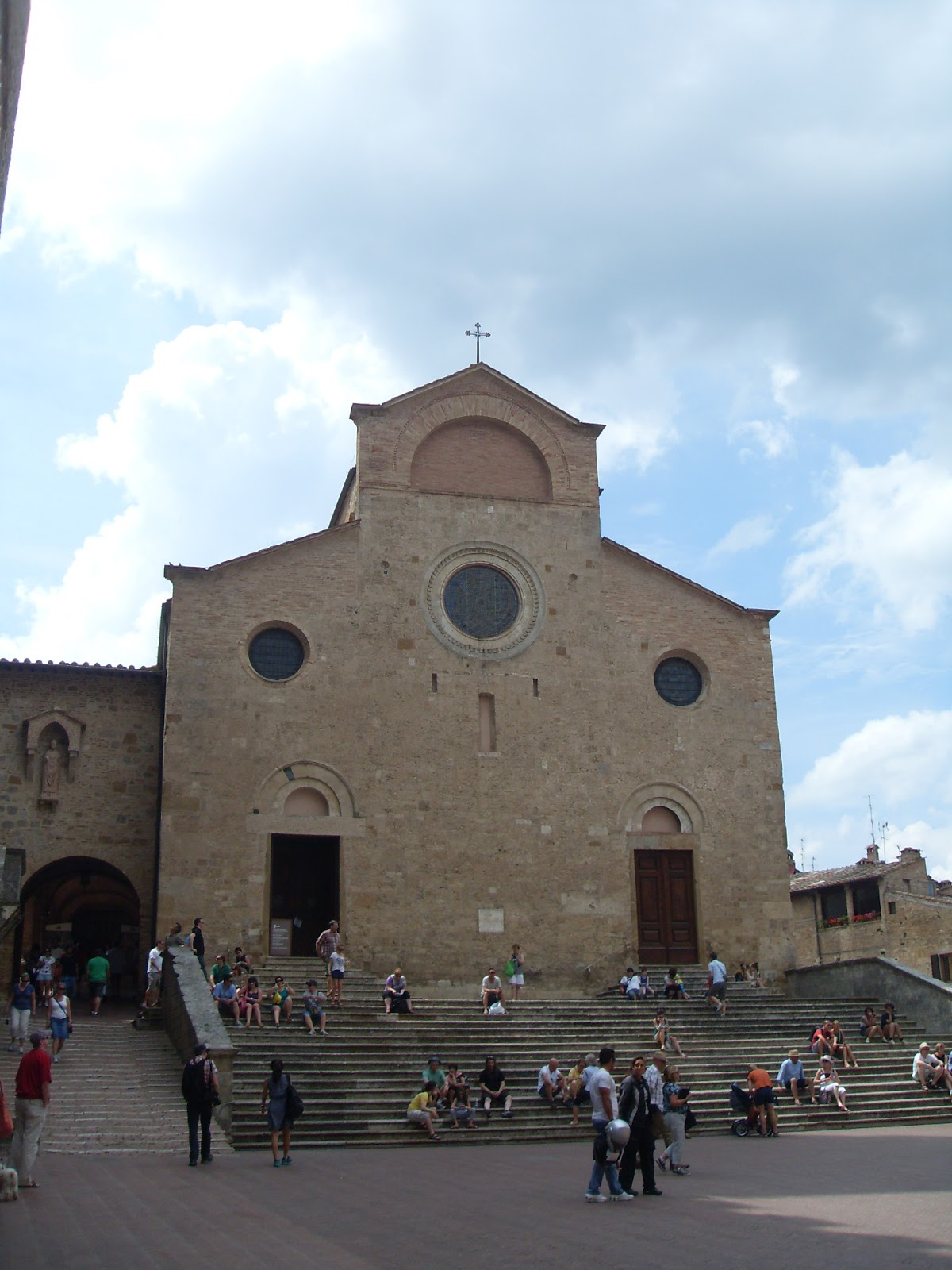
The city's medieval architecture is well-preserved and it really would feel like stepping back in time once you enter the Porta San Giovanni, were it not for the ubiquitous and occasionally boisterous tourists who swarm the streets in the summer. However, San Gimignano is so labyrinthine that it is easy to get away from the masses and explore the various arches, tunnels, alleys and walls undisturbed by the vulgar noises. There are also a number of fascinating and interesting sights, from the lowly, intimate churches to the soaring towers, and from the top of the Torre Grossa, reaching 54 meters and constructed in 1311, you have a magnificient view of the Tuscan landscape, and as you stand there and see the distant mountains, the vineyards and the green and luscious valleys it is almost as if you begin to doubt the existence of a world beyond the horizon.


Chiesa di San Bartolo, built in 1173


The Chancery Arch


Chiesa di San Agostino, consecrated in 1298


Courtyard of the late-13th-century town hall


View from Torre Grossa


Piazza del Duomo

With its richness of sights and nooks I didn't have the chance to fully explore San Gimignano the short afternoon I spent there, and I already look forward to revisit the city and see more of its fascinating history.

Piazza della Cisterna dalla Torre Grossa