And was the holy Lamb of God,
On Englands pleasant pastures seen!
- And did those feet, William Blake
Viser innlegg med etiketten Theatre. Vis alle innlegg

tirsdag 6. oktober 2015

One kiss more - Shakespeare, Verdi and Italian intertextuality


 As readers of this blog will know, I am a big literature enthusiast. My enthusiasm extends quite widely and I'm not very picky in my choice of reading. I generally tend to shy away from ideas about lesser and greater literature, because although I do think some literary expressions deserve a greater longevity than others, few things are as destructive to reading than to construct artificial divisions which exclude books because of some increasingly ancient canon. For that reason, I think great literature lies in execution rather than in form, and I maintain that some of my greatest literary experiences have been with comic books.

When I was little I grew up with Norwegian translations and editions of Italian stories of Donald Duck. These stories were compiled in pocket books and became a part of the Norwegian literary landscape in 1968. By that time, the Italian home production of Disney stories had been going on for more than ten years, and Italian comic book writers and artists had increasingly found their own voices in this format. Already in the 1950s there were made Donald Duck stories which imitated famous works of literature, such as Orlando Furioso and Doctor Faustus, to mention only a few. In future blogposts I will probably go into greater details, but here I want to highlight a minor case of delightful intertextuality in these stories.


Front page of  I Classici della Letteratura, vol. 38 

A few years back, the publishing house Corriere della Sera began a collected edition of literary parodies from the Italian Disney production, and the first edition reached 30 volumes in hardback. The second edition counted 40 volumes in paperback, with a slightly different order than in the first edition. In my attempts to learn Italian, I started to buy in a few of these volumes after I came to realise that many of the stories I had grown up with in Norwegian translation were often heavily abbreviated to suit the allotted page number in each pocket book. To read these familiar stories in the original language has been a great pleasure to me, and it has also given me great joy to embark on stories which have not been translated into Norwegian and which were completely new to me.

One of these volumes is the one shown above, a volume collecting three works by William Shakespeare, the first of which is the tragedy of Hamlet, King of Denmark with Donald Duck - or Paperino - in the lead role. The adaptation of the story was done by Giangiacomo Dalmasso and Giovan Battista Carpi, and it ran in three parts in the Italian Mickey Mouse magazine Topolino - Mickey's Italian name - in 1960: volume 226, 227 and 228, issued on January 10, January 25 and February 10 respectively.


The adaptation deviates significantly from the Shakespeare's version and necessarily so, most of all because this is a story for children played out by practically immortal characters, so the violence and the murders of the original are left out. However, several features of the play are retained: Prince Hamlet meets a king's ghost, the crown of the kingdom is usurped, and a Norwegian king - of sorts - makes an entrance.

As often is the case with these adaptations, there is a frame narrative which serves to justify the adaptation itself. As the above opening shows, Donald is taking a bath as the narrative begins and this leads to a sequence where he injures his head, confining the unlucky duck to the bed where he is given a copy of Hamlet.


The Duck household's edition of Hamlet

Reading Shakespeare's tragedy shapes the subsequent dream of the bed-ridden Donald, and in this dream the story unfolds within the framework of the Disney universe. As stated, there are many changes to the story and it reads perhaps more as a cloak-and-dagger castle intrigue than a deep psychological drama. The atmosphere is very dark, as can be seen below where Hamlet enters the treasure chamber of his uncle Scrooge (Paperone in Italian). This page also shows the ingenious playfulness of the writers and artists, as is evidenced by the coat of arms of Scrooge which bears the legend sola in auro exultatio, which can be roughly translated as "only in gold do I rejoice".


This playfulness is made manifest already in the opening page, and this is the very reason why I decided to write this blogpost. As seen above, the story opens with Donald in the bath, singing some lines in Italian. These lines are not just any lines but most likely selected carefully, resulting in a very beautiful intertextuality which gives a friendly nod not only to Shakespeare himself but also to the cultural legacy he inspired.


The lines sung by Donald comes from the opera Otello by Guiseppe Verdi, and these are the last lines of Othello as he smothers Desdemona in a jealous rage, heartbreakingly asking for "un bacio ancora", one more kiss. In other words, right in the opening of an Italian adaptation of Prince Hamlet, the mood is set by the performance of lines from an Italian opera based on another play by Shakespeare, an intertextuality which gave me great pleasure. For readers of this particular volume, moreover, the intertextuality becomes increasingly complex since the adaptation of Hamlet is followed by an adaptation of Othello, written by the very same author behind Amleto, Giangiacomo Dalmasso.


Othello as re-imagined by Giangiacomo Dalmasso & Giorgio Bordini
First published in Topolino, vol.851, March 19 1972

Desdemona and Othello the blackamoor
One of very few instances where an Italian Disney character has been portrayed as black

As I was growing up, I never read either of these adaptations so this has been my first encounter with them. Yet the many adaptations I did read made me familiar with a wide range of world literature, even though some of these works remained elusive to me until I reached adulthood. Nonetheless, I treasure these stories more now than ever, because as I learn more about world literature the more I see how beautifully and elegantly these adaptations are wrought.

Un bacio ancora as performed by Enrico Caruso
He has also been parodied in a Paperino comic - as a singing whale performing Figaro




torsdag 16. april 2015

Carols on the Lapidation


Today I have been teaching a class on popular - or lay - cult of saints, looking at various texts that unlike the grand Latin hagiographies were available to the common populace, not just because they were written in the vernacular, but also because they were performed in public. The emphasis of the lecture was on two types of texts. First we looked at a Corpus Christi play on Mary Magdalen, and it turned into a very enjoyable discussion on the relation of mystery plays with Ancient Greek and Roman theatre, following a question from one of my students, and this allowed me to point back to earlier lectures where I had talked about the transition from the Greek novel to early Christian hagiography. (I always feel a great pleasure when I'm able to connect the current lecture with earlier subjects.)

The second emphasis was on carols on saints, exemplified by a selection from Richard Leighton Greene's The Early English Carols (1977). Being in Middle English and interspersed with Latin quotations, the carols were difficult to grasp, and with the many uncertainties of the genre with regards to audience, authorship, purpose and rationale of form, we explored chiefly the carol as a form of hagiography conveying a condensed portrait of the saint's life and martyrdom, and how that life could be rendered very differently from one carol to the next.

To better illustrate this variation, we focussed on a selection of carols dedicated to St Stephen Protomartyr since his carols are numerous enough to allow for a relatively wide selection. In this blogpost I wish to present three of these carols, in which the martyrdom of St Stephen is narrated in rather different ways, showing the flexibility of the carol genre. The texts are taken from Greene's book, and in lieu of titles I use the numbering employed by Greene to differentiate between the carols.


97
Bodleian Library. MS. Douce 302
By John Audelay, 15th century


In reuerens of our Lord in heven,
Worchip this marter, swete Sent Steuen.


Saynt Steuen, the first matere,
He ched his blod in herth here;
For the loue of his Lord so dere
He sofird payn and passion.

He was stonyd with stons ful cruelle,
And sofird his payn ful pasiently:
'Lord of myn enmes thou Haue merce,
That wot not what thai done.'

He beheld into heuen on he
And se Jhesu stonde in his majeste
And sayd, 'My soule, Lord, take to the,
And foreyif myn enmys euerechon.'

Then, when that word he had sayd,
God thereof was wel apays;
His hede mekele to sleep he layd;
His sowle was takyn to heuen anon.

Swete Saynt Steuen, for vs thou pray
To that Lord that best may,
Whan our soule schal wynd away,
He grawnt us al remyssion.

Martyrdom - or lapidation - of Stephen
Yates Thompson 49, La légende dorée, Jacobus de Voragine, France, c.1470
Courtesy of British Library


98
Trinity College, Cambridge. MS. O. 3. 58
Fifteenth century

Eyam martir Stephane,
Prey for vs, we prey to the.

Of this marter make we mende,
Qui triumphauit hodie
And to heuene blysse gan wende
Dono celestis gracie.

Stonyd he was wyth stonys grete
Feruore gentis impie;
Than he say Cryst sitte in sete,
Innixum Patris dextere.

Thov preydyst Cryst for thinenmyse,
O martir inuictissime;
Thou prey for vs that hye Justyse
Vt nos purget a crimine.

Amen

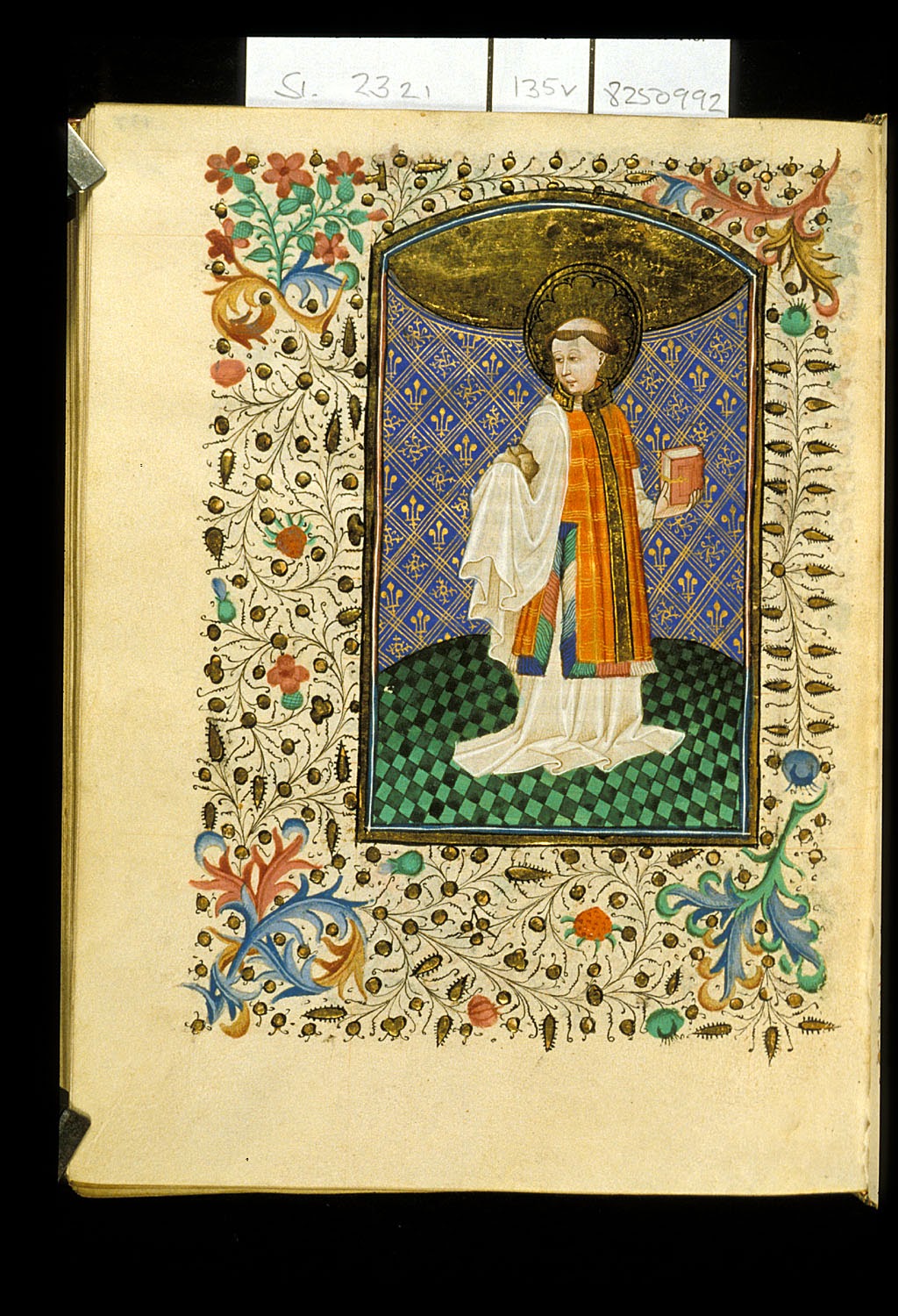
Stephen with his instruments of passion
Sloane 2321, English Book of Hours, use of Sarum, c.1440
Courtesy of British Library


100
Balliol College, Oxford. MS. 354
Sixteenth century

Nowe syng we both all and sum,
'Lapidauerunt Stephanum.'

Whan Seynt Stevyn was at Jeruzalem,
Godes lawes he loved to lerne,
That made the Jewes to cry so clere and clen,
'Lapidaverunt Stephanum.'

The Jewes, that were both false and fell,
Agaynst Seynt Stephyn they were cruell;
Hym to sle they made gret yell
Et lapidaverunt Stephanum.

They pullid hym without the town
And than he mekely kneled Down
Withle hte Jewes crakkyd his Crown,
Quia lapidavverunt Stephanum.

Gret stones and bones at hym they caste,
Veynes and bones of hym they braste,
And they kylled hym at the laste,
Quia lapidaverunt Stephanum.

Pray we all that now be here
Vnto Seynt Stephyn, that marter clere,
To save vs all from the fendes fere.
Lapidaverunt Stephanum.


These carols are interesting texts to research when looking at how the stories about saints are treated in different literary categories, and how the stories are rendered at different times in history. The three carols selected here are particularly fascinating in the difference between the first two, and the third. In the first two carols the narrative is focussed on Stephen and his martyrial triumph, and also his role as an intermediary, a point particularly clear in the first carol where Stephen prays for his enemies and is then exhorted by the singers of the carol. The third and latest carol, however, focusses rather gratuitously and viscerally on the martyrdom itself, the manner of Stephen's death and - with urgent insistence - on the guilt of the Jews in this enterprise. This is an interesting difference, but one from which it is difficult to extract much meaning as these carols are just snippets from a vast textual and cultural history, of which we know little of their immediate context of composition and who share only a subject matter and are not themselves textually related, at least not to our knowledge.

As the carols are presented in Greene's wonderful tome, it is also easy to fall prey to certain temptations in the attempted extraction of significance. Since these carols are numerically close together, thematically linked and follow a chronological trajectory where the last, most brutal of these selected here appear as an end-point, it's tempting to see that as an explanation of the increasingly vivid role of the Jews, who are more clearly represented in the second than in the first carol. This is of course tempting suggestion that caters to our taste for clear progression or regression in events, be they cultural, biological or psychological, but to follow such a thread would be to treat Greene's organisation of the carols as the original document rather than the result of an avid historian of carol and his attempt to handle an unwieldy mass of texts. I mention this as an apropos of how easy it is to give in to the urge towards orderly and simple transmissions of textual material, which is a methodological cul-de-sac for any historian of texts.


fredag 15. august 2014

That Catholic Round World - flat earth as counter-medievalism


JESPER BAILIFF: Ha, ha, ha, ha, ha, ha, let us talk of something else. That is some disturbed nonsense, it can make you Catholic in the head
- Ludvig Holberg, Erasmus Montanus (Act 3, Scene 2) (my translation)


Ludvig Holberg, c.1747 by Johan Roselius
Courtesy of this website
One of the most pernicious myths about the Middle Ages remains the idea that medieval people held the earth to be flat. This myth was perhaps most famously propagated in a 19th-century novel about Columbus, where the belief in a flat earth was deployed as a foil to enhance Columbus' intrepid greatness as an explorer and trailblazer. The belief in the medieval belief in a flat earth has stuck resiliently to the collective consciousness, and even today it lingers more strongly than medievalists would like to think.

It is difficult to pinpoint the exact origin of the flat earth myth. In a previous blogpost I offered a possible source for the idea that this was a medieval conviction, but the trajectory is difficult to map. However, in this blogpost, I want to present a very curious case from the 18th century, in which the idea that the earth is flat is presented as a firmly Protestant idea, and in which the idea of a round earth is frowningly labelled Catholic (and as such practically medieval), and also Atheist. (The tendency to conflate Atheism and Catholicism in Protestant countries reaches back to the 16th century.) The case in question is fictional, as it comes from the comedy Erasmus Montanus, written by the Norwegian playwright Ludvig Holberg in 1722-23. However, despite the fictionality of the story, the way the roundness of the earth is treated is a funny and unusual affair, and one that I as a medievalist find very pleasing. The translations of the quotes from Danish are all mine.


Scene from Erasmus Montanus
Wilhelm Marstrand (1810-73)
Courtesy of this website
The plot of the comedy is the homecoming of Rasmus Berg who has been studying in Copenhagen and there taken the Latinised name Erasmus Montanus. Upon his return, he starts exercising his prowess as a debater and both proves and disproves that his mother is a stone. It all goes wrong when he claims that the earth is round, because his fellow villagers can all see that the earth is "as flat as a pancake", and to claim otherwise is "disturbed nonsense" which "can make one Catholic in the head" (act 3, scene 2). It is further remarked that to believe in a round earth "is nothing else than turn all religion on the head and lead people away from faith. A heathen can not preach worse" (act 3, scene 4). By defending his words and beliefs for the glory of philosophy, Erasmus Montanus antagonises his father-in-law-to-be and various other persons of note. When Erasmus tries to prove the roundness of the earth by various scientific observations, he is met with scorn bred from common sense, and the bailiff comments that Erasmus "is quite close to become an Atheist" (act 3, scene 5). The debate enrages his father-in-law-to-be so much that he ends the bethrotal between his daughter and Erasmus on the grounds that his family has always been good Christian people. In the end Erasmus is tricked into enrolment in the army by a local lieutenant, and to escape from this predicament he rescinds his opinions and professes loudly and desperately that the earth "is as flat as a pancake".


Erasmus Montanus disputing with a local parson
Wilhelm Marstrand, 1843
Courtesy of this website
In 1722 when Holberg wrote Erasmus Montanus, Denmark had been Protestant for almost two centuries. It is therefore difficult to tell whether Catholicism was still seen as something of the old order, something of the very distant past, or something whose presence in Denmark was seen as newfangled and novel. Traditionally in Protestant countries around this period, Catholicism is seen as a vestige of an old world, an ancient superstition, an echo from a dark age. This view is made very clear, for instance, in John Milton's Paradise Lost, where the fallen Adam witnesses the future history of mankind up to the point of salvation and the second coming. We can't tell whether this was also how Holberg's fictional farmers, bailiffs and lieutenants would have seen things, and therefore we don't know whether the round earth is considered an ancient superstition, or a newfangled invention of the universities. Nonetheless, it is interesting to see a feature so widely regarded as belonging to the Catholic Middle Ages as the flat earth presented as a Protestant tenet, and as such counter-medieval (although of course Holberg himself does not suggest this). It is a useful reference for people who still believe that men and women in the Middle Ages held the world to be flat as a pancake.


The steadfastness of Erasmus Montanus
Wilhelm Marstrand, before 1869
Courtesy of this website