And was the holy Lamb of God,
On Englands pleasant pastures seen!
- And did those feet, William Blake

søndag 27. mai 2012

Da Nobis Tuam Lucem Domine

After Coel's death Constantius himself seized the royal crown and married Coel's daughter. Her name was Helen and her beauty was greater than that of any other young woman in the kingdom. For that matter, no more lovely girl could be discovered anywhere. Her father had no other child to inherit the throne, and he had therefore done all in his power to give Helen the kind of training which would enable her to rule the country more efficiently after his death. After her marriage with Constantius she had by him a son called Constantine.
- The History of the Kings of Britain, Geoffrey of Monmouth (translated by Lewis Thorpe)


Helena, the Mother of Constantine the Great, was held in high regard by Medieval men and women and she was recognised as an important saint. She was said to have embraced Christianity at an early stage and on a trip to Jerusalem it was claimed she had located the True Cross, an occasion celebrated in the liturgical year as the inventio crucis, the rediscovery of the Cross. Geoffrey of Monmouth, on behalf of the Britons, laid claim to Helena by pronouncing her British by birth and a royal princess by heritage, the daughter of King Coel of established legend. Not all chroniclers were equally blinded by enthusiasm, however. William of Malmesbury soberly followed the ecclesiastical tradition, leaning on Ambrose of Milan's statement that she was the daughter of a stable-boy. Matters of heritage aside she was revered and venerated throughout the Middle Ages and several churches were dedicated to her. One of these churches is St Helen's Church of York.


It is assumed that the veneration for Helena has long roots in the religious history of York, but the oldest sign of a church is the 12th-century font. The church itself has been rebuilt once in the 16th century and twice in the 19th century, but it is believed that the current design echoes that of the 14th and 15th-century architecture to a great extent, with the exception of the chancel built in 1857-58. Facing the church today is St Helen's Square, established in 1732 after the graveyard had been paved over and its bones removed to Davygate where gravestones still can be found.


Both the Anglican and Catholic branches of the modern church are today very aware that the historical Helena had no connection to neither York nor Britain. This is, however, of lesser importance, for in her posthumous life she had had an important place in lay religiosity of several parishes. This particular church, as stated, can only securely be dated to the 12th century, but there was in York also a second church dedicated to Helena, namely St Helen Aldwark which is no longer extant, but most likely of Anglo-Saxon origin. Whether her alleged connection to England, or for that matter York's historical connection to her son Constantine who was proclaimed Emperor by his troops at the Roman headquarter in the city, has in any way influenced her popularity can not be ascertained. She has nonetheless been embraced by York and a statue of her at the town hall.


The earliest reference to St Helen's Church in the sources dates from 1235, but not much of its 13th-century heritage survives today, the exception being a handful of spolia found throughout the church space. Masonry points to construction activity going back to the mid 12th century, and it is speculated that if there stood an Anglo-Saxon minster on this spot, its wooden structure may have been replaced by a stone church at about this time. The High Medieval architectural features are nonetheless scant, outweighed by the Late Medieval remnants such as parts of the stained glass. The 14th and 15th centuries saw the most significant part of the church's Medieval architectural emendations.


St Helen's Church did not have a large congregation and its priest had little in terms of income. Its Medieval parishioners were largely the glass-painters who lived and operated in Stonegate and several of the guild's members were interred in St Helen's throughout the 15th century. The glass-painters' motto was Da nobis tuam lucem Domine, give to us your light, Lord, and their work can be witnessed in the Medieval glasswork still extant in the church.


torsdag 17. mai 2012

The Pearl of York

This dusk-dim room with windows deep embedded,
These breathing walls, carved cupboards, sloping floor,
Formed loom for her wed life so gaily threaded,
Shrill-sweet with children tumbling at the door.
- A York Shrine, D. Douglas Lord


In the Shambles, the old butcher street in York, there is an inconspicuous house with a green, oval, cross-marked plate at its door, telling the passers-by that this house is the shrine St. Margaret Clitherow. During my student days in York I walked through the Shambles several times and I noticed both the sign there and the one in Newgate Market, but although I often thought I should visit the shrine it soon escaped my memory altogether. Consequently it was not until my return to York in September of last year that I sought out the shrine of Margaret Clitherow and stopped there to pray and learn about the saint's history.


Margaret was born to the chandler Thomas Middleton and his wife Jane in 1553, and she was baptised in St Martin-le-Grand on Coney Street. That same year King Edward VI was succeeded by his half-sister Mary Tudor who attempted to bring England back into the Catholic fold after her father's break with Rome. Her campaign was not well-received, owing in large part to the burning of about three hundred Protestants on the grounds of heresy. It was this mass execution that earned her the nickname Bloody Mary, and the Catholic faith was more unpopular than ever before as a consequence.


Margaret grew up in Elizabethan England, an increasingly Protestant kingdom where Catholics eventually were prohibited from holding mass or do mission work. She married the widowed butcher John Clitherow in 1571 in the same church where she was baptised. John was a Protestant whose brother was a Catholic priest and Margaret converted to the forbidden faith in 1574, seemingly with her husband's compliance. Two years later conversion to Catholicism, recusancy, became a treasonable offence. Margaret opened her house to Caholic prests and masses were held there clandestinely. Although these services remained secret for quite some time Margaret's faith was not unknown and in the years 1577-84 she was imprisoned for her Catholicism several times.


When Margaret was not in prison she secretly instructed local children in the Catholic faith and continued to shelter priests and hold masses. Several of the priests she harboured eventually became martyrs for the faith by hanging, and it is said Margaret conducted secret pilgrimages to pray by the gibbet.

In January 1586 her stepfather Henry May became Lord Mayor of York. Henry was dedicated to the policies of the Council of the North, a council centred in York and established in the time of Henry VIII to persecute Catholicism which remained very strong in Yorkshire throughout the 16th century. In the first year of his mayoralty Henry May rounded up and punished a number of recusants, among whom were his stepdaughter Margaret. She was charged for harbouring Jesuits and other Catholic priests and for having her son be trained as a priest in Douai. On 14 March 1586, four days after her arrest, she was trialed at the Guild Hall where she refused to plead, because if she did the witnesses - the little children and the servants she had schooled in the faith - would be guilty of her condemnation too. The penalty for not pleading was peine forte et dure, a method of execution where the sentenced was placed under for example a door and stones were heaped upon it until the sentenced died. The following day she was held in prison on Ouse Bridge until March 25 when she was executed in this manner at the Ouse Bridge toll booth. Her last words are reported to have been "Jesu, Jesu, Jesu, have mercy on me!"


After her exection Margaret's body was buried beside a city dunghill. Six weeks later she was exhumed by a group of Catholics who carried the body away and gave it a Christian burial. Centuries later, October 1970, she was canonised by Pope Paul VI in the basilica of St. Peter's in Rome and she became the patron saint of the Catholic Women's League. Her right hand is currently preserved at the Bar Convent at York, and a statue of her can be found in the Church of St. Wilfrid.


lørdag 12. mai 2012

Ignorance and Experience: An Illuminator's Trajectory


There is an animal called the elephant, which has no desire to mate.
- MS Bodley 764, translated by Richard Barber

Medieval bestiaries contained creatures both real and legendary, whose ways of life served as moral fables for humanity. These books were richly illustrated, but the illuminators rarely knew much about what the various beasts looked like, relying instead on traditional depictions or literary descriptions from authors like Pliny or Isidore of Seville. In some cases this should come as no surprise since many of the animals described did not exist or were at best distorted representations of actual animals. A favourite example of mine is the bonnacon, a beast with a bull's body and a horse's mane whose poisonous excrement was its only means of protection against predators.

Bonnacon from the MS Bodley 764

In other instances the beasts were less than realistically depicted on account of their foreign provenance, and this was of the case with the elephant. The author of the MS Bodley 764 bestiary, for instance, had heard or read about how the distant Indians or Persians used elephants in warfare, putting wooden towers on their backs and firing arrows from the ramparts. He had also learned that the elephant could only mate after having eaten from the mandrake - here depicted as a tree - and for this the elephant becomes an allegory of Adam and Eve who only indulged in the pleasures of the flesh after having eaten the forbidden fruit.

War elephant from MS Bodley 764

The elephant offers a rare example of an illuminator's trajectory from ignorance to experience. The illuminator in question is the Benedictine monk Matthew Paris, known for his historiographical and hagriographical works. In his bibliography we find the wonderful and wonderfully illuminated Chronica Majora, a universal chronicle whose last part covers the years 1254-59. The elephant occurs at least twice in the pages of this work and it shows very clearly the difference between knowing of an animal and actually knowing an animal.

In 1241 Richard, Earl of Cornwall, King Henry III's younger brother, returned from a crusade in the Holy Land. He probably met or corresponded with Matthew Paris at St. Albans, and the tale he told allowed the illuminator to fill his pages with a number of curiosities. One of these curiosities Richard experienced in Italy where he was Emperor Friedrich II's guest. When Richard went to the city of Cremona he was met with a joyous procession led by a decorated elephant with a brass band playing on its back. This was the emperor's elephant, a part of his exotic menagerie for which he was well known, and a beast Matthew Paris had never seen. Consequently his depiction of the elephant relied heavily on a convention established in the bestiaries, for instance the beast's lack of knees.

 The elephant of Cremona from Chronica Majora
 
In the second part of Chronica Majora we come across something very different. King Louis IX of France sent Henry III an elephant as a gift in 1255 and it was kept at the Tower of London together with the rest of the king's menagerie, a menagerie that among other specimens included an polar bear brought to him from King Håkon IV of Norway. For the first time Matthew Paris, who was both close to King Henry and badmouthed him quite viciously on occasion, had the opportunity to behold an exotic beast in the flesh and discover that it really possessed knees. This can be seen in the remarkably realistic portrayal of the king's elephant in Chronica Majora, a rare case in which we can see for ourselves the trajectory of a Medieval illuminator's experience.

King Henry III's elephant, also from Chronica Majora

mandag 7. mai 2012

Names of the Hedgehog


and whatsoever Adam called every living creature, that was the name thereof.
- Genesis 2:19

Linguistics is one of my many passions and I find great pleasure in learning new words or learning how words have come about. One of the great things about being a Medievalist is the opportunity the subject-matter gives you to come across and learn new words when elving into a past age and its texts. In the course of my thesis work I have come across several great words, both in English and in Latin, and this blogpost is dedicated to the words used to describe one particular animal: the hedgehog.


Edmund's martyrdom


Old English

The oldest of the texts I will deal with in this blogpost is Life of St. Edmund by Ælfric of Eynsham (c.950-c.1010). This text is a hagiography of king Edmund of East Anglia who was killed by Vikings in 869 and it is written in Old English. In the story King Edmund is captured by the Viking chieftain Hingwar who wants him to become his underking and reveal the whereabouts of the royal treasure. The king, a Christian, refuses to become the subject of a pagan and steadfastly resists the tortures brought about by the Vikings. Hingwar orders his men to pierce the king with arrows, a martyrdom like that of St. Sebastian. In describing this episode Ælfric employs a very effective comparison, effective both because it is precise and because its hyperbolic nature increases the shock-effect of the brutality of martyrdom: Edmund, pierced by arrows, resembles an ígl, a hedgehog. The passage concludes as follows:

he eall wæs besæt mid heora scotungum swilce igles byrsta, swa swa Sebastianus wæs.

(he was covered with arrows in the manner of a hedhehog, as was Sebastian)

This particular passage will be a recurring feature of this linguistic expedition since this is the story in which I have found most of the names of the hedgehog, and indeed it is the story that put me onto this idea in the first place.

The name in question here is, as mentioned, ígl, a name that can, according to the Old English dictionary also be rendered as ígil or íl. Interestingly this particular name can be recognised as the root of the modern Swedish word for hedgehog: igelkott.


 Hedgehogs from the Aberdeen bestiary, c.1200


Latin

Like all other animals of the Middle Ages, real or mythical, the hedgehog was interpreted allegorically or "in mystical terms" in the bestiaries where it was made a didactic example for men to learn from. In the bestiary of MS Bodley 764, written between 1220 and1250 and translated and abbreviated by Richard Barber, the author first describes the creature's habits and way of life. He commends it for its cleverness and claims that they gather grapes directly from their vine with their spines, a myth that probably dates all the way back to Roman times. When he turns to the didactic part of the text, the mystical interpretation, the author is quite severe and says that the hedgehog is "a sinner full of vices like spines, skilled in wicked cunning, and in deceits and robberies. He cheats others of the fruit of their labours and takes their food for himself." Like the sinner who fears the judgement of God, it is claimed, so the hedgehog hides among rocks.

This unfavourable reputation owes probably much of its severity to the Vulgate where Jerome mistook the Hebrew word for owl, kippoz, for kippod, hedgehog. In Bible passages such as Isaiah 34:11 and Zephaniah 2:14 the hedgehog thus becomes a symbol of desolation and deserted places, said to inhabit the places that will be destroyed in the vengeance of God.

In Latin the hedgehog is known by the name irenaceus or erinacius. According to the author of the MS Bodley 764 bestiary the animal was also known by the name echinus and this rendition, perhaps a vulgarisation, we will find vestiges of in vernacular texts.


 Hedgehogs from the MS Bodley 764


Middle English

In one of the secondary sources I've been working with, I have been referred to three Middle English texts in which the hedgehog is named. Each of these texts is a version of the story of St. Edmund and they all employ the classic simile when describing the pierced King Edmund. I have also come across another Middle English text in which the hedgehog features poetically, a poem by William Dunbar, but here the matter does not pertain to the life of Edmund of East Anglia.

The oldest of the three hagiographic texts is the South English Legendary. This book is a collection of saints' lives rendered in verse and composed in the latter half of the 13th century somewhere close to Gloucester. Here the vernacular word for hedgehog resembles very much the Old English word and we see here one of the stations in the word's trajectory towards modern Swedish. In the words of the compiler of the legend, King Edmund was [a]s ful as an illespyl is of pikes al about.

John Lydgate (c.1370-1449/50), a monk at Bury-St-Edmunds, wrote the poetical rendition of the lives of Edmund and his cousin Fremund as a gift for the child-king Henry VI. The king stayed at Bury from Christmas 1433 to April 23, St. George's day, the following year and was given this didactic present, presumably aimed at shaping the young monarch to become a good and righteous Christian. In this work we may detect that the evolution of the language has favoured the name most resembling the Latin word. John Lydgate states that Edmund [r]assemble an yrchoun fulfillid with spynys thikke /As was the martyr seint Sebastyan.

A similar usage we can also find in the third text, the Gilte Legende. This opus is a mid-15th-century hagiographical collection translated from the French work Legende doree, which in turn is a translation of Jacobus the Voragine's 13th-century Legenda Aurea. Although more or less contemporary with John Lydgate the saint's martyrdom is rendered differently, owing perhaps to a difference in sources or the fact that Lydgate wrote in rhyme royal. According to the author of the Gilte Legende King Edmund appierid fulle of arowys lyke as an urchyn fulle of pryckis.

In conclusion of this linguistic excursion we must turn to a work by William Dunbar (1460?–1513x30), The Tretis of the twa mariit wemen and the wido. This poem is Dunbar's longest opus and one of the first to be printed. It is a comical work recounting a conversation between the three titular women.The subject is the trials of marriage and in a passage dealing with a husband's kisses the husband's cheeks are compared to the pines of a hedgehog: He schowis one me his schewill mouth & schendis my lippis / And with his hard hurcheone scyne sa heklis he my chekis.

St Sebastian by Andrea Mantegna


With Dunbar we come to a close as he stood on the threshold of Modern English and the English Renaissance. As we have seen the hedgehog has furnished authors with poetic and didactic material - and the simile of Edmund can be said to be both - throughout the Middle Ages. Due to its recurring role we have here been able to follow the evolution of its name in a long-spanning, but of course vastly incomplete, trajectory. The names I have presented above are not the only names awarded the hedgehog in Medieval times, but they serve nonetheless as a nice overview.


lørdag 28. april 2012

Sacred and profane: a Selection of Medieval Music


Sing unto him a new song; play skilfully with a loud noise.
- Psalm 33:3

In the course of my thesis work I spend much of my time in the Middle Ages, reading Medieval texts, reading about Medieval texts and of course writing about Medieval texts. Many of these texts are liturgical texts, antiphons, responsories, versicles and so on, and I have to admit I'm less than fluent in this particular field of scholarship. In an attempt to acquire a better understanding of the material I'm working on, and in order to get in a proper "Medieval" mood, I usually listen to Medieval music when I'm writing. In this blogpost I would like to share a few of my favourite songs. This selection encompasses works meant for an ecclesiastical setting as well as the temporal sphere, including both liturgical pieces and dance music.

I feel obliged, however, to comment briefly on the title and the matter of dividing Medieval music into categories. The dichotomy sacred/profane was first formulated by the French sociologist Émile Durkheim (1858-1917) and it is accordingly an anachronism in this contexts since this was not a division employed by Medieval musicians. On the whole it is difficult to use Durkheim's dichotomy when describing the Medieval world, for the borders between sacred and profane were sometimes very blurry and sometimes virtually indistinguishable. Bishop Anthony Bek of Durham (d.1311), for instance, was both bishop and King Edward's official during the king's Scottish campaign.

There did exist a division, however, between the spiritual world and the temporal world, between the matters pertaining to salvation and the immortality of the afterlife on the one hand and the matters pertaining to the affairs of mortal and sinful men on the other. The Church naturally was in charge of the spiritual sphere, wielding the sword of God to paraphrase Augustine, while the monarchy was responsible for upholding the waning world, wielding the temporal sword and doing so under the auspices of the Church. At least this was the ideal, harkening back to Augustine and Pope Gelasius I (d.496), and this was also the cause of much contention between the king and the clergy throughout the High Middle Ages.

In Medieval music, however, this is a much more difficult division to make. We can, of course, safely say that liturgical pieces belong squarely in the spiritual sphere since they were intended to celebrate the life and times of Christ and the lives and deaths of the saints. Other pieces were undoubtedly temporal, such as dance music for bagpipes. Some songs are, however, quite difficult to place and most likely we should not even try too rigorously to categorise them. An example of this is the Roman de Fauvel, a work written by Gervais du Bus c.1316 and interspersed with musical pieces old and new. Although the work is written in French and intended for a temporal setting - it is a didactic text for the newly-crowned king Philip V of France - it treats matters of the spiritual sphere, admonishing the king to avoid the vices of the world and improve what is at fault in France lest the Antichrist strikes and ends the world as they knew it. The subject is therefore both temporal and spiritual at the same time and shows very nicely how averse reality is to simplistic categorisation.


From Messe de Notre Dame by Guillaume Machaut (1300-77)

Nuper rosarum flores by Guillaume Dufay (d.1474)

Supremum est mortalibus bonum by Guillaume Dufay

Psalm 2 as used in Le Roman de Fauvel

Ai vist lo lop, anonymous Occitan song, probably 13th century

14th-century saltarello, anonymous

fredag 20. april 2012

Life's Little Oddities, part IV - The Rockery


You could have got off with Shepherd Book at the Bathgate Abbey. Could've been meditating on the wonders of your rock garden by now.
- Capt. Malcolm Reynolds, Firefly S01E09

This month and the next my life is dominated by my MA thesis hurrying inexorably to its allotted end. One of the many consequences thereof will be that I no longer have that much time to dedicate on this blog, and my blogposts will be shorter, briefer and - much likely - more self-absorbed than usual. The subject of the first in what will probably be a long line of such posts is a minute feature in one of York's greatest attraction, the Yorkshire Museum and Gardens.


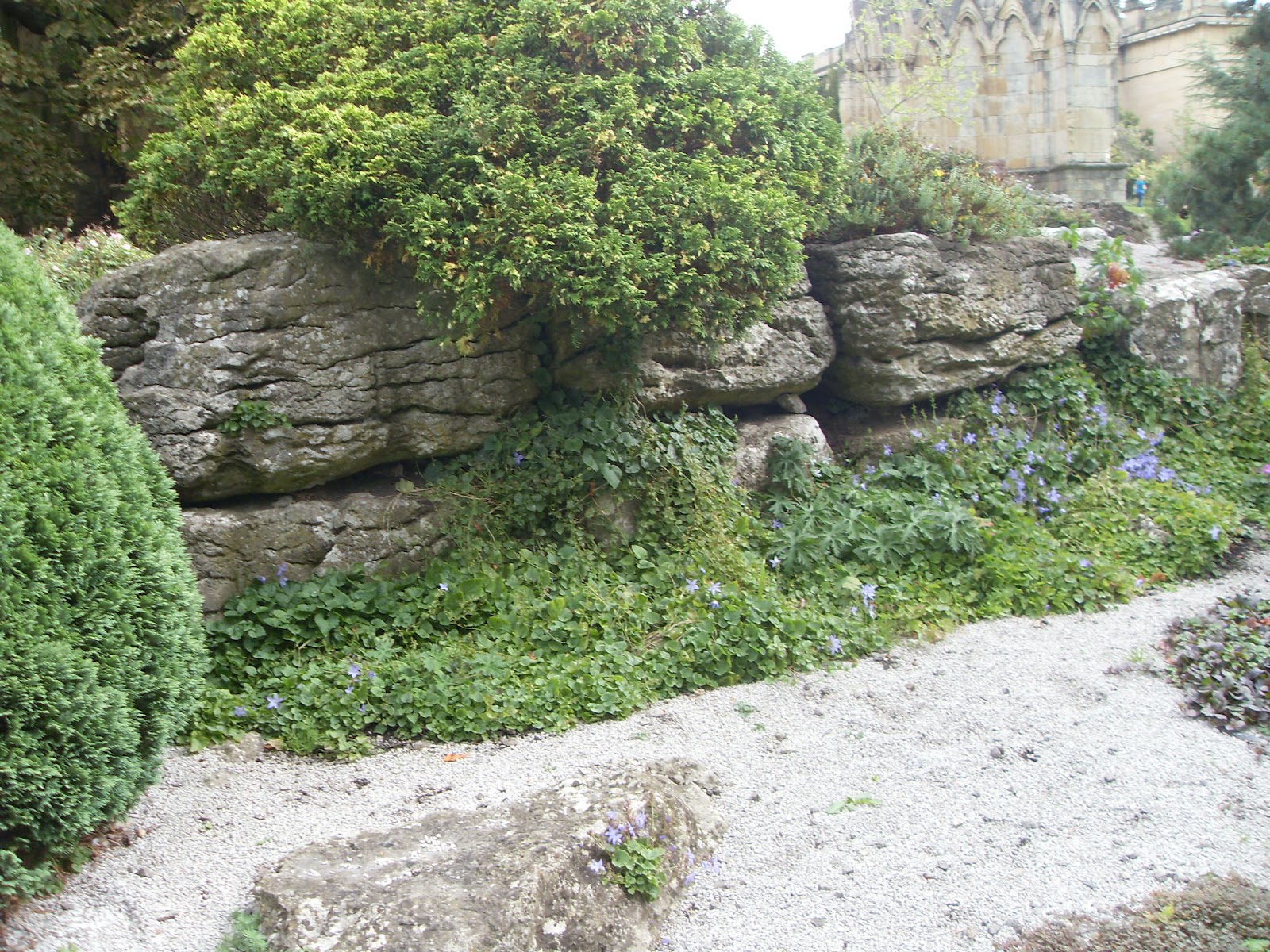
I was walking through the garden one day as I was wont to do when going between the city and Constantine House, when suddenly I noticed a sign telling me that what I had thought was rocks casually clumped together, actually was a deliberately designed rockery, a stone garden with alpine plants.


This stone garden was put together in 1980 by students of Askham Bryan College in commemoration of the Backhouse family nursery, an interesting feature of the city's commercial and scientific history that was operative between 1815 and 1955.


A nursery is a place for cultivation of plants, a business that stayed very lucrative throughout the 18th and most of the 19th century. The reason for this was that the gentry and the parvenus were putting up gardens and collecting curiosity cabinets, either for the purpose of displaying their wealth, acquiring knowledge or a blend of both, and this created a demand for plants to put there, preferably exotic and rare plants.

 
The Backhouse family nursery, first known as James Backhouse and Son of York, was established by James Backhouse III (1794-1869) and his brother Thomas (1792-1845). The brothers were of a wealthy Quaker family and this allowed them to buy the nursery of John and George Telford (or Tilford) situated on the grounds of an old Dominican friary at Tanner Row.


Since the wealthy of the north often were dependent on London nurseries to provide them with fine plants the Backhouse brothers' local supply must have made them ideally situated for competition with the southern businesses. When the railway station was built in 1841 transport became easier, faster and safer for the plants and seends. This was also a time when several new scientific societies, botanic and public gardens were founded and the upper classes, who made good money on the trade with the colonies, could afford to pursue their horticultural interests. In the decade leading up to the arrival of the railway in York, James Backhouse III had been away in Australia, engaged in mission activities, and he had collected and shipped home a number of seeds and plants. This may also have helped the business significantly.


From the 1860s and up to the 1890s the Backhouse nursery was at its summit, admired for its underground fernery (allegedly more impressive than that of Kew Gardens), its expensive rockery and its forty greenhouses. Because of the Agricultural Depression of the 1880s, the Land Tax of 1910, World War I and the establishment of competing nurserymen the business declined badly. In 1921 the nursery was forced to sell much of its land and in 1955 the firm closed down. What was left of the company's land was bought by York City Corporation and converted into a public park.

 
Today the only visible testament to this enterprise that I know of is this arrangement of rocks in the Yorkshire Museum Gardens. When I first became aware of these stones I had no idea that they would direct me to an interesting part of the city's modern history that so far was unknown to me. This is one of the beautiful things about the City of York: almost whenever you start looking for its history it will be there and it will surprise you.


Thence forward by that painfull way they pas,
Forth to an hill, that was both steepe and hy;
On top whereof a sacred chappell was,
And eke a litle Hermitage thereby
- The Faerie Queene, Edmund Spenser

torsdag 12. april 2012

The New Walk


If the strong Cane support thy walking Hand,
Chairmen no longer shall the Wall command
- Trivia, John Gay

In the beginning of the 18th century part of the public discourse of Britain was marked by a clash of estates over the use of the cityscape. While the members of the upper class desired to stroll the streets, the working class used the exact same space to conduct their business. In essence this was a debate with the mercantile interests on the one hand and the rising leisure culture of the gentry on the other, a struggle between producers and consumers, both of which were acknowledged as important parts of the proto-industrialist world of Britain.

 
The leisure culture of the early 18th century was made manifest in various ways. The book trade blossomed as a consequence of an increase in the spare time of the upper echelons, and throughout England parks were constructed for the pleasure of the rich. One of these parks - or what me might today call green lungs - was The New Walk of York, an elm-guarded avenue stretching from the Tower Gardens to the junction of the Foss and the Ouse. To access this pocket of peacefulness the walkers passed through an iron-gated stone arch - constructed in the Mayoralty of Jonas Thompson (1731-32) - that is no longer extant.


The New Walk was begun in the early 1730s at the behest of the York City Corporation and finished in 1733. Its purpose was to make York a social centre in Georgian England, providing an outlet for leisure to the gentry and parvenus. The Corporation also commissioned the Assembly Rooms, the Mansion House and the Racecourse for the same purpose, and the popularity of the project resulted in the construction of the original Blue Bridge in 1738, allowing the walk to extend even further along the riverbank.


In 1880-81 Skeldergate Bridge was constructed and the New Walk passed through a short tunnel that opened into St. George's Field where citizens in Medieval times were allowed to walk, practice with bows and arrows and to dry linen. Today the Field is occupied by a housing estate. Skeldergate Bridge was designed by Thomas Page (1803-77) who had also designed Westminster Bridge and Lendal Bridge in York.


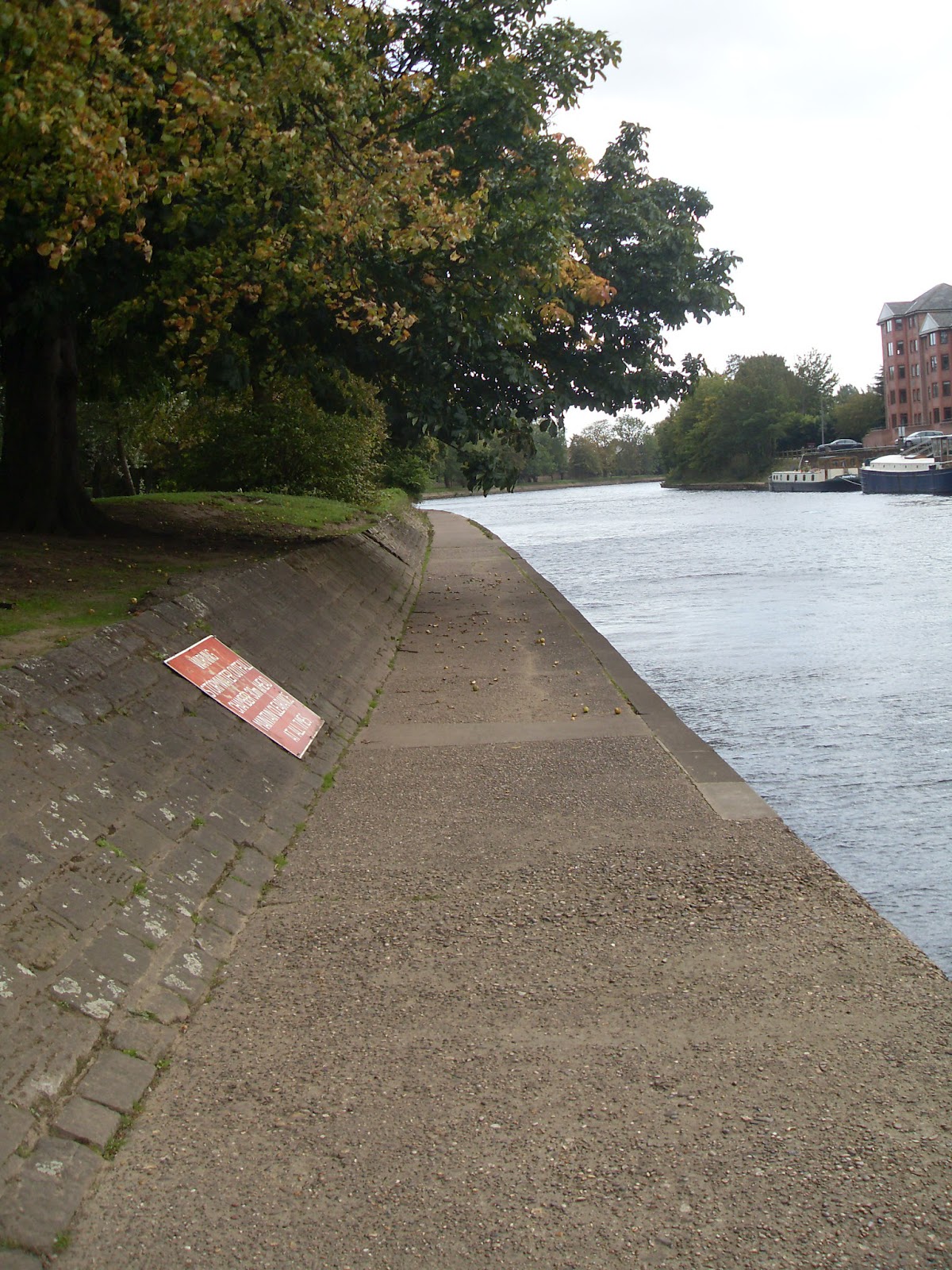
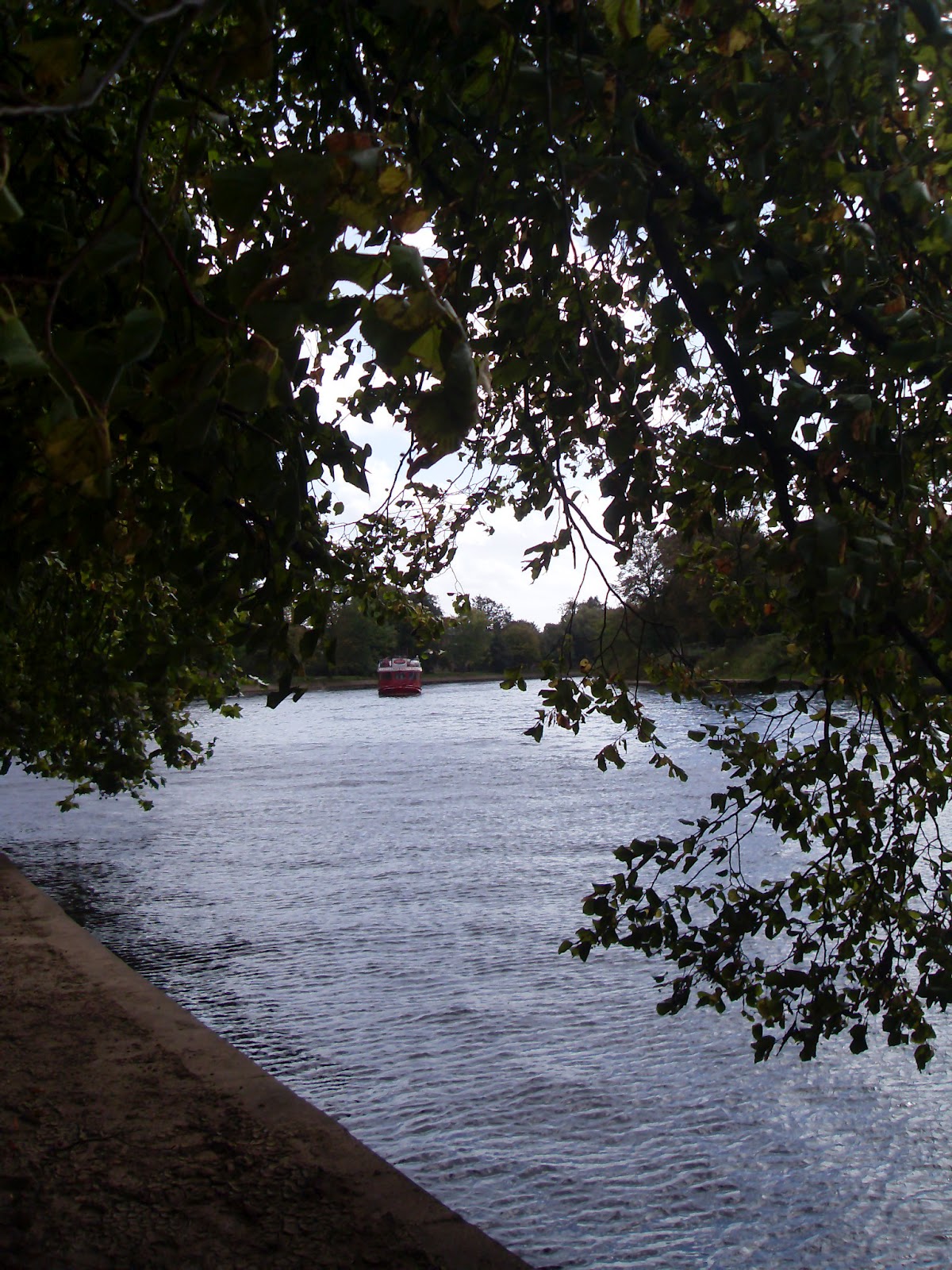
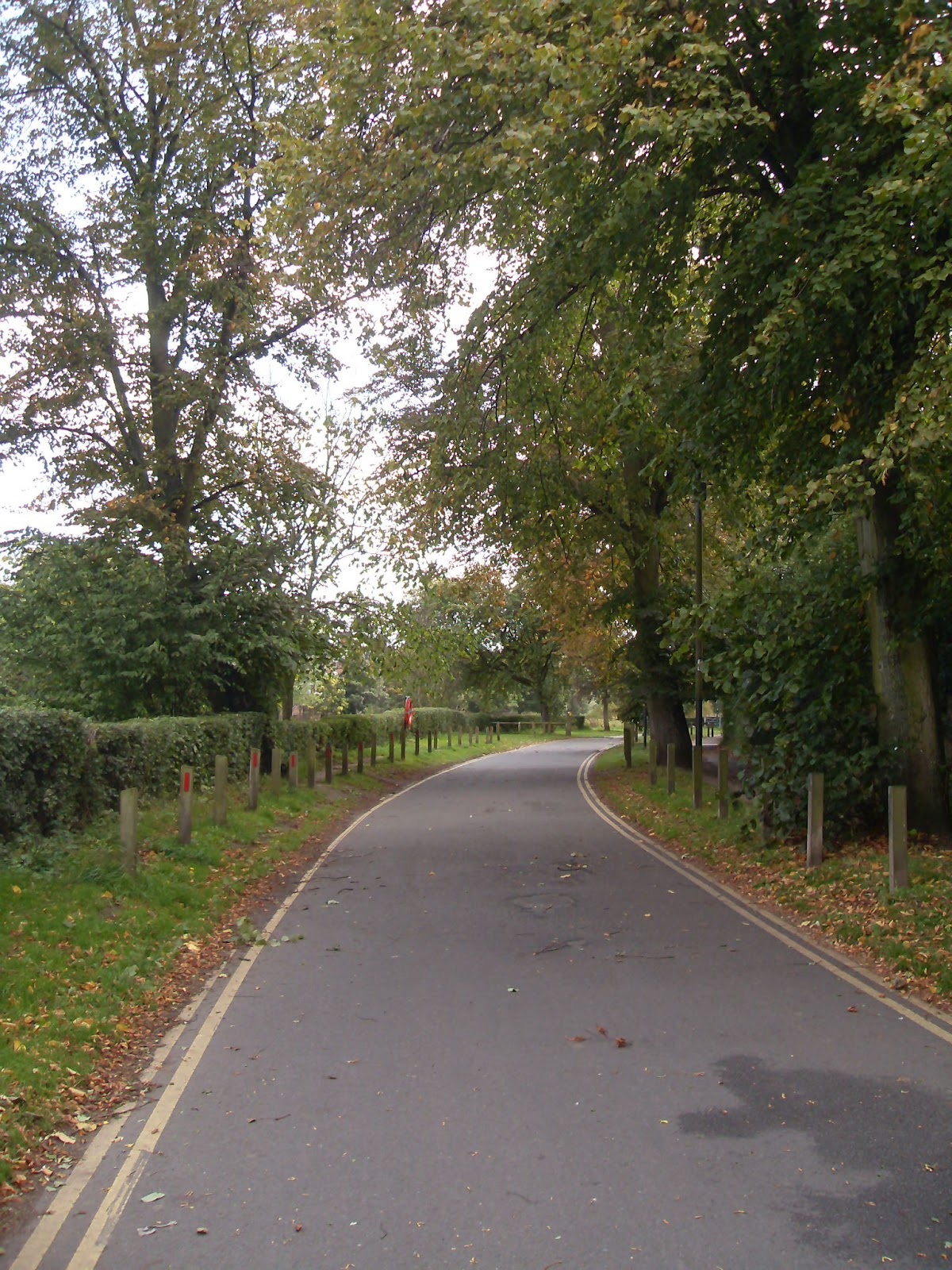
Today the New Walk offer a completely different experience to the modern walker than to the pedestrian of ages past, partly because of the changes in the surrounding geography, and partly - but perhaps most importantly - because of the changes in local society that makes the goals of its founders redundant. Today the City of York is in itself a major attraction for pedestrians. Cars are not allowed to drive certain streets within given timeframes, the majority of tourist attractions can be found within the city walls - themselves a pedestrian attraction - and numerous walks are arranged throughout the city that allow the walker to experience the city's history in a specific way. This shift has, however, restored one of the main features of the New Walk: here one can truly escape the hustle and bustle of the city, the commotion of streets packed with tourists and enjoy some peaceful solitude along the bank of the River Ouse.


When I returned to York in September 2011 I took the opportunity to take a solitary stroll up the river one beautiful summer day. The water level was sufficiently low to allow walking on the embankment between the river and the trees, but to my great delight - I have become very fascinated with this particular feature of the Ouse - the vestiges of a previous flood could still be seen in the footprints perforating the dried and cracked mud.


  One day, about noon, I was walking along the shore toward my boat, when, looking down, I saw in the sand the print of a man's naked foot.
- Robinson Crusoe, Daniel Defoe


After a short while I came upon the Blue Bridge, a curiously designed construction that has been rebuilt four times since 1738. The first bridge was made of wood, had a high-pitched roof and costed 100£, while the modern version is made of metal and was raised in 1929. In 1858 the Blue Bridge was flanked by two Russians cannons - spoil from the Crimean War - but these were melted down in World War II.


 In the background we see the Foss Barrier, a structure built after the severe floods of 1979 and 1982 to protect the city centre.


Past the Blue Bridge the scenery becomes more idyllic as the city disappears into the distance and the landscape beyond the river is dominated by a more forested landscape, allowing the walker to ignore the housing estate on his or her left-hand side. The Walk continues past Pikeing Well of which only its well-head is extant. This was commissioned by the York City Corporation in 1752 and constructed by the architect John Carr (1723-1807) at the cost of 80£. Pikeing Well was said to have curative properties and Lady Mary Wortley Montagu (d. 1762) was advised to let her son bathe here to cure his rickets.


                                                                            Pikeing Well

 
The natural end point of the New Walk is Millennium Bridge, constructed by the engineering firm Whitby Bird and Partners of London and opened to the public in 2000. From here the walker can either retrace his or her steps or cross the bridge and return to the city past Rowntree Park. I chose the latter.


Millennium Bridge is the first permanent bridge on this location. Prior to its construction the only means of traffic was a ferry operating between the New Walk and Clementhorpe. In 1955 a temporary bridge was put in place for the York Tattoo.

 
On my way back to the city I kept a lookout for the tansy beetle, a species of coleoptera located solely by the banks of the River Ouse. Its decline owes to the reduced availability of the tansy plant, its main foodsource. Unfortunately I was unable to find the beetle, but I did come across some other examples of the local wildlife.


As I was taking the above pictures I was accosted by a lady who asked me if I had been taking pictures of the push-chairs. I realised that lurching by the the fence of Rowntree Parkwith a camera and a hood pulled over my head - it was a windy day - was perhaps not the smartest thing to do. I was a bit taken aback by the question, but I appreciated her concern, knowing full well that my scruffy beard justified the assumption that I was a pervert. Fortunately she was convinced of my innocence when I showed her that none of the pictures featured push-chairs or humans for that matter.


Rowntree Park was a gift from Rowntree & Company Ltd. to the citizens of York and the City Corporation in 1921. The park was meant as a memorial to the staff of the cocoa company who fell in the Great War, while the gates were donated in 1955 as a memorial of World War II.


The New Walk is a nice change from the cityscape of York and leads you into a very different part of the local geography. As always in York history never lets go and modernity never fully retreats or stops, so the blend of old and new so integral to this wonderful city remains a salient feature even in the farthest reaches of the Walk. This probably accounts a great deal for its charm, as does the fact that tourists do not seem to seek out this locality.