And was the holy Lamb of God,
On Englands pleasant pastures seen!
- And did those feet, William Blake

onsdag 30. oktober 2013

Edward the Confessor at Ickford?


There's no hiding that ever since beginning my MA thesis I have been cultivating a minor obsession with Edward the Confessor (d. 1066, can. 1161), as may be evidenced by the number of blogposts wherein he features. One of my fascinations is to see how he has been represented throughout the ages, and how people at various times in history have formulated and envisioned him. On the whole, most of the depictions are similar, and this is of course to be expected as part of the point of such a depiction is to make it easily recognised by on-lookers. However, looking around on the Internet for images of Edward, I came across a stained glass window which was very unusual.


This stained glass window can be found at the Church of St. Nicholas in Ickford, Buckinghamshire. It was executed by Sir John Ninian Comper (1864-1960) in the 1920s, and is available on wikimedia.org thanks to Allan Barton, who has uploaded this image to his flickr account and provided the basic information.

It is an unusual picture. First there's his dress - which looks like a floreate leotard with buttons - whose pattern brings to mind the background vines of late medieval stained glass, and to my (albeit minor) experience this pattern is rarely given so much prominence. Nor does it add a regal look to one of England's most important royal saints. Secondly, Edward has no beard. This is the most interesting deviation from the norm, for ever since the first expansive sources depicting Edward, his beard has been mentioned and given some significance. This has been treated to some extent in an earlier blogpost. It has also been a major feature in portraiture depicting Edward throughout the Middle Ages and into the modern era. Some examples can be seen here.  A later depiction can for instance be found on this excellent blog.

Edward the Confessor as a beardless youth is therefore an unusual occurrence, and it has led me to think that the identification with the Confessor might be incorrect. If the stained glass window does depict Saint Edward, this might be Saint Edward the Martyr who died in 978 at around the age of fifteen. The confusion of these two saints is not uncommon.

Until I have been able to make further inquiries myself I cannot dismiss the identification, but I do remain somewhat skeptical. 


torsdag 24. oktober 2013

He was an errant knight


Mylde answer made: he was an errant knight
- The Faerie Queene, Edmund Spenser

A few days back I was roaming the Internet for Pre-Raphaelite paintings, when I happened to come across this beautiful piece by John Everett Millais (1829-96) from 1870 titled "Painting the Knight Errant". The title is a little misleading since, at least to the modern mind, it implies a meta-dimension, but this is not the case. The painting is a lovely composition and showcases the enthusiastic and fertile medievalism embraced by the Pre-Raphaelites.

Millais has chosen has his subject the errant knight, an important figure from medieval romance and renaissance epic. The most famous examples from English literature are found in Edmund Spenser's Faerie Queene, modelled to a significant extent on the great 16th-century Italian epics like Orlando Furioso by Ariosto (1474-1533) and Gerusalemme Liberata by Torquato Tasso (1544-95). Spenser's well-wrought allegory features several of these knights errants, who were armed soldiers roaming the world for quests and challenges, but not all of them are honourable or protagonists. What defines a good errant knight appears to be the nobility of the quests he agrees to undertake, and sometimes the grand, overarching quest which leads him through the world, such as The Redcrosse Knight's quest to liberate the Faerie Queene from a monstrous dragon.

The notion that the errant knight could have a potential for evil was also picked up by Alfred Lord Tennyson in his Idylls of the King, where he notes that before Arthur gained proper control of the land, many an errant knight could be found throughout it, and Tennyson uses them as one of the symbols of anarchy and chaos preceding the golden age of Arthur. The errant knights of Idylls of the King are markedly different from Arthur's knight in that they leave Camelot first when they have a quest, rather than sauntering throughout the world on the prowl for one. It is also emblematic that Geraint, after he has fallen prey of jealousy and succumbed to the intrinsic darkness, takes his wife Enid and wanders aimlessly about just like an errant knight.

In medieval romance and in renaissance epics, the trope of the errant knight is a brilliant pretext for action and an excellent way of making the adventure move from one location to another, and this was exuberantly taken advantage of by the epic poets of the 16th cenutry.

tirsdag 22. oktober 2013

A Silent Wood - poem by Elizabeth Siddal


Elizabeth Siddal, self-portrait
From wikimedia commons

Days are currently quite busy and I've little energy left for blogging, but in order to maintain a semblance of frequency, I'll put up more poetry now and then. Since I'm currently taking a course on medievalism in Victorian England, I found it fitting to present a poem by one of the key figures of the Pre-Raphaelite Brotherhood. Elizabeth Siddal (1829-62), a woman of considerable and versatile talents. She has probably gained most fame as a model for some of the most iconic paintings by the Pre-Raphaelites, but she was also herself a painter - as witnessed above - and a poet. Below is one of her poems, A Silent Wood, dated with some uncertainty to 1855-57 by William Michael Rossetti. The text is taken from The Pre-Raphaelites From Rossetti to Ruskin, edited by Dinah Roe and issued in the Penguin Classics series in 2010.


A Silent Wood

O silent wood, I enter thee
With a heart so full of misery -
For all the voices from the trees
And the ferns that cling about my knees.

In thy darkest shadow let me sit
When the grey owls about thee flit:
There I will ask of thee a boon,
That I may not faint or die or swoon.

Gazing through the gloom like one
Whose life and hopes are also done,
Frozen like a thing of stone,
I sit in thy shadow - but not alone.

Can God bring back the day when we two stood
Beneath the clinging trees in that dark wood?


Beata Beatrix (1864-70), Dante Gabriel Rossetti
One of the most famous paintings to which Elizabeth Siddal sat model

fredag 18. oktober 2013

The Humility of Snails, part 2 - The snail and the knight


For all those who exalt themselves will be humbled, and those who humble themselves will be exalted.
- Luke 14: 11


In my previous blogpost I launched the suggestion that snails in medieval marginalia might be read as symbols of humility, often depicted in contrast to the prideful life of knights and warriors. Furthermore, I suggested that this symbolism was influenced by the paradigm of sanctity that emerged with the foundation of mendicant orders, in which humility was now associated with good works, self-abnegation and a reclusive lifestyle. This is a change from the 12th-century, in which humility and warfare were often twin virtues, inspired by the legends of St. Alexis of Odessa and exemplified with the emergence of the orders of warrior monks such as the Knights Templar and the Hospitallers. This is of course not to say that the mendicant orders were in opposition to the crusades. On the contrary, the Franciscan liturgy for St. Louis - composed towards the turn of the 13th century - praises him for his crusades and viewed them as an imitatio Christi. However, warfare became frequently disassociated with sanctity in the 13th century, and Louis is therefore more a deviation proving the point than anything else.

This two-part exploration was triggered by a recent blogpost from the ever-so-lovely British Library's medieval blog, and the piece in question was written by Sarah J. Biggs. In this second part, I will provide examples from several manuscripts from the time of this paradigm of sanctity and into the 15th century, looking at how well they fit with the idea that the snail is a symbol for humility. For the pictures from MS. Yates Thomspon 27 I am gratefully indebted to Robert Miller. Almost all pictures courtesy of the British Library.


The Marginal Snail


The Gorleston Psalter


The Gorleston Psalter, found in Add. MS. 49622, is an English psalter made in the timeframe 1310-24, and contains two depictions of the snail that fit very well with the idea of the snail as a symbol of humility. The first example can be seen above, where a knight has planted his sword in the ground and lifts his hands, pressed together, at the snail as if in devotion. If the slug represents humility and the peaceful life, this scene may show a warrior, a man of pride, casting aside the weapon of his trade in devotion to the virtue which stands in starkest contrast to his own way of life. We might even imagine there has been some sort of combat or debate in advance of this scene, and the knight is now defeated and yield to the humble victor. This idea is strengthened by the second example, as seen below.

Monkey business of the worst kind

Here we see combat depicted, an arrow launched by an ape is flying towards the snail. Apes (distinguished from the monkeys by their lack of tails) were frequently associated with evil and vices in medieval imagination. Bestiaries claimed that they took their name from the fact that they aped after humans, and as such came to represent a mirror-image to the human world, where apes and other simia were doing the devil's work or at least turned the ideals of the Christian world upside down. This ape is clearly at war with humility, and from the look of it he seems to be winning, reminding perhaps the viewer that the devil can overcome mankind's humility.

MS. Yates Thompson 19


Next up is MS. Yates Thompson 19, containing Li Livres dou Trésour, an encyclopedia written in 1264 by Brunetto Latini, the master of Dante Alighieri. The manuscript was made in the timeframe 1315-25 in Northern France. As an encyclopedia it was not exclusively - nor perhaps even primarily - a work of devotion, but we might presume that Christian devotion is not absent from the work.


In the manuscript, as seen above, we find another combat scene featuring a snail, here standing against a charge by an armoured knight. We don't know the outcome, but here we might imagine the haughtiness of war about to do battle with the virtue of humility. This scene is particularly interesting because of another, similar, combat scene, in which the knight's target is not a snail, but a gryllus, otherwise known as a hybrid.


The meaning of such hybrids is still a matter that remains unsolved, but the snail and the gryllus can easily be contrasted as representatives of two different worlds, the virtuous and the viceful, the good and the evil. If this is the case, the scenes above can be said to depict examples of bad and good chivalry respectively, for it was customary in medieval didactic writing to educate through good and bad examples alike, a tradition reaching all the way back to Bede's Historia Ecclesiastica and beyond.
The Luttrell Psalter

This psalter, found in MS. Add 42130, was made in the timeframe 1325-40 on the orders of Geoffrey Luttrell III (1276-1345), a Lincolnshire landowner. The work was carried out in stages and its illumination programme was left unfinished for reasons unknown. The snail found in this psalter is different from the rest here presented, in that it does not seem to interact with anyone, so that it does not invite comparison with a representative of either vices or virtues. It is simply a bas-de-page illumination, yet it might be intented to serve as a mnemonic helper for the psalm text. The text is from Psalm 89 and the snail is just below the verse "Blessed are those who have learned to acclaim you, who walk in the light of your presence". If this snail, too, represents humility or meekness, it certainly fits well with the psalm text in question.

Picture courtesy of this website


The Hours of Yolande of Flanders

This book of hours, following the Use of Paris and found in MS. Yates Thompson 27, was made in the timeframe 1353-63 for Yolande of Flanders. This wonderfully weird book contains three snails, all of which can be successfully read as symbols of humility. It is of course particularly interesting to note that as a female member of high society, Yolande was a representative of that echelon from which the Roman Catholic sanctorale drew many of its new members in the 14th century.


In the selection above we find again the motif of snails and knights. The first seems frightened and awestruck by his encounter with the gastropod, possibly in the realisation that he has erred in his ways, or something in that vein. The second might be considered a continuation of the first scene, and this knight - or the same knight - has succumbed to the mastery of the snail, yielded his pride of arms, perhaps, to the humility so emblematic of 14th-century sainthood.


There is also another fascinating example in this MS., as seen above. What this naked man represents is difficult to say, though if the snail is a symbol of humility this might very well be pride sitting astraddle the animal, chastising it with a club.


Spiegel der Weisheit

The last example in this blogpost takes us out of the 14th-century and the mendicant paradigm of sainthood, and also away from the psalters and books of hours. Like Latini's Books of Treasure, this is an anomaly, but intended as a continuation of the collection so far considered. This book is Ulrich von Pottenstein's Spiegel der Weisheit, here found in MS. Egerton 1121, an Austrian MS. from 1430. Here, as seen below, a snail is standing face to face with a black cat, which, as we know, has accrued a particularly negative reputation. If the snail here, too, is meant as a representative of humility, it is presumably mirroring the wickedness commonly ascribed to the cat. Their symbolic difference may perhaps be exacerbated by the fact that the snail is here rendered in white - though that might also owe to the fact that Southern European snails do have white shells.


Summary remarks

The array of books presented in this two-part blogpost spans a wide variety of literature, about two centuries and several countries. Each has contained some depiction of a snail or a snail-like hybrid. Reading these images as symbols of humility, in tune with the Christian virtues and the emphasis of contemporary sanctity, gives meaning and makes sense of the snails and their companions and environment on the page, both as protagonists facing a viceful foe or as mnemonic devices accompanying the page's text.

This in its turn proves nothing. We have too little information about the extent and the frequency of snail imagery in devotional books - and non-devotional for that matter - to make any broad statements. This has merely been a thought-experiment in which the snail has been interpreted in a particular manner. As I hope to have successfully shown, it is indeed a possible conjecture which fits both with the contemporary currents and the purpose of the books in which most of them are found. Much remains to be done here, and in the future it will be necessary to carefully consider each illumination together with accompanying text and the illumination programmes of their respective books. However, I hope this demonstration has established one possible way of making sense of these images, which might be considered just as plausible as the suggestions put forth by past scholarship.


søndag 29. september 2013

The Humility of Snails, part 1 - The problem with gastropods


[E]x Africa semper aliquid novi
- De Rerum Natura, Lucretius (8.42)


Boy fighting snail with sling, MS. Royal 10 E IV
Courtesy of British Library


Introduction

Out of Africa something new always comes, remarked Lucretius in his famous poem on the nature of things. In a somewhat similar way there always comes something new from the wonderful British Library's medieval blogpost. Recently, they issued a lovely post on marginal snails in medieval manuscripts, which can be read here. As pointed out by the eminent Sarah J. Biggs, there are various explanations proffered for what the snails meant to the medieval onlooker, what role or roles they play in the theatre of the page and how they should be understood.

Some of these explanations have been summarised by Michael Camille in his famous book on medieval marginalia, Image on the Edge, and also in the British Library blogpost. To my mind, removed as it is from the early scholarly discussion on the subject, all of these suggestions are wanting to some extent. While some of them, like Lilian Randall's suggestion positing the snail as a counterpoint of chivalry, may have validity in some geographies and some particular epochs, it can only be applied with extreme caution and acute sensibility to the historical context of the manuscript in question.

In this two-part blogpost, therefore, I would like to postulate another possible approach for how the snail should be understood in medieval iconography. Naturally, I lay no claim to have found the definite answer, but it might help us to get closer to some of the aspects of the snail imagery.

The pictures in this post are all from the British Library, though some have been gathered from extraneous sources, and I am particularly indebted to Sarah J. Biggs for some of them. As the reader will notice, several of them are also found in the British Library blogpost. This is not an attempt to copy the great work performed there, but rather a necessity owing to limited time and the desire to present a selection which offers a somewhat diachronic overview.

The reason why this blogpost is two-part is because there is a lot of minutiae to take into consideration in this analysis, and to spare the reader any excess of verbosity, the essay has been divided into two parts. This part presents the problem, and two of its exhibits.

Snails were not the only creature who were manhandled at the bottom of the pages
Bas-de-page from MS. Royal 10 E IV
Courtesy of British Library

The symbolism of the snail

One of the reasons it is difficult to make assessments about the meaning of the snail, is that the extent of its symbolism in the Middle Ages is obscure to us. The basic characterstics of the snail are of course timeless, such as its slow speed and its house, but how these characteristics were applied can not be easily mapped. Hans Biedermann points out that throughout the ages the snail has variously been considered as a symbol of simple living, and a symbol of the Resurrection.

The snail was also said to have medicinal properties. Hildegard von Bingen (1098-1179) claimed that powder ground from snail shells should cure a person bitten by serpents, whereas a concoction made of slugs and earthworms allegedly cured abscesses. Hildegard also referred to snails as testudines, meaning turtles.

These are small glimpses into how the snail was perceived in past times. For some reason they appear not in some of the most famous bestiaries of the High Middle Ages - that of Philippe de Taon (written c.1119) and the MS. Bodley 764 (mid-13th-century) - and the main source to animal reception is therefore seemingly unhelpful, although a more rigorous search may yield more material. Joyce Coleman, in a comment on the British Library blogpost, quotes Chandos Herald's (fl.1360s-80s) Life of the Black Prince written in the late 14th century as giving an example of people mimicking snails. The author refers to such people in a rather disdaining tone, as were it unworthy of a nobleman.

The mendicant paradigm

Because it is so difficult to assess the particulars of the snail's place in the medieval mind, we therefore have to consider each occurrence of this symbol in light of its historical context. In the following I will look at a few selected examples - too few for assessments, but sufficiently many for guesswork - which will be discussed in light of context. The timeframe of the works selected is c.1290-1430 and the selection contains images from England, France, Holland and Austria.

The working hypothesis for this blogpost is that several of the snails from medieval margins can be understood when seen in light of the ideal of religious humility, which found a certain mendicant shape in the religious milieu following the foundation of the Franciscan and Dominican orders in the early 13th century.

Humility has of course always been a key virtue in Christian theology, but it has been formulated in various ways throughout the centuries. In the 12th century, the age of crusades, there sprang forth a new ideal of sainthood which praised the saint who abandoned his riches and fought for the cause of God. This ideal was moulded on the legend of Alexis of Odessa, a nobleman who renounced wealth and family for a life of religious asceticism. Within this paradigm of the world-renouncing recluse, asceticism was conjoined with a militant apostolicity, which can be seen in the hagiology of the royal saints Stephen of Hungary and Charlemagne. It was this paradigm which most likely served as conduit for the orders of warrior monks which emerged in the first half of the 12th century.

In the 13th century there was a paradigm change. Following the teachings of Dominic and Francis, there came a new ideal of sainthood during the 13th century. The militant apostolicity was no longer as important, and the emphasis was on self-abnegation, poverty, munificence towards the poor and meditation on God's truth. This resulted in the canonisations of saints who differed from the high ecclesiastics and royal saints of the 12th century, namely reclusive noblewomen and mendicant preachers. This is not to say that military feats were not important. In the canonisation proceedings of Louis IX of France (canonised 1297), his role as crusader was of some importance. Interestingly enough, it was the Franciscans who most vociferously had urged on the crusades of Louis. Nonetheless, the mendicant paradigm of the 13th and the 14th centuries tended to emphasise a kind of humility which embraced poverty and good works, which almost disassociated itself from the militant prowess of the lay aristocracy.

The selection of marginalia in this post is largely gathered from the period when the mendicant ideal of humility exerted strong influence over Western Christendom, and (with one exception) before it entered into the most excessive forms of public self-mortification witnessed in the wake of the black plague.

Deer running, perhaps competing with snails, perhaps a pairing of virtues
MS. Royal 10 E IV
Courtesy of British Library

The marginal snail


The Smithfield Decretals

The first manuscript to be considered is MS. Royal 10 E IV, also known as the Smithfield Decretals. This is a MS. from the turn of the 13th century containing the decretals of Pope Gregory IX, edited by Raymund de Piñafort (c.1175-1275) with a gloss of Bernard of Parma (d.c.1266), and it is of Southern French origin. This is a collection of Papal letters and as such belongs to the very diverse category of religious literature, though there might also be some political content to the texts. Although the book is of French origin, some of its illuminations were later English additions.

Here are two particularly striking renditions of the snail in combat. One of these can be seen above, where a youngster prepares to attack a snail with slingshot in the manner of David. Whether this is a representation, a mock-representation or an inversion of David and Goliath - or none of these - can not be ascertained. Although the sling is a typical attribute of David, usage of this weapon may not be limited only to him. It is therefore possible that this is a representation of youth disdaining humility, though of course this is mere conjecture.

We also find another scene of combat between snail and man in the Smithfield decretals, as seen below. Here the knight, armed with a club, engages in hand-to-hand combat - or hand-to-horn combat - with what seems like a rather aggressive snail. Whether it is significant that the knight here uses a club rather than the noble sword I cannot say, but if the hypothesis on the snail as a icon of humility, this may represent the unchivalrous soldier whose pride eclipses the virtues sought among the Christian soldiery. The case here is very uncertain, however, since I do not know the texts these images accompany, and I can therefore not judge the extent to concordance between text and image.

Knight fighting snail with club
MS. Royal 10 IV E
Courtesy of British Library

The Maastricht Hours

This book, MS. Stowe 17, or the Maastricht Hours, dates from the first quarter of the 14th century. It is a book of hours produced in Maastricht, Holland, for a noblewoman. As a female of the higher echelons of society, she belongs to the very societal group who throughout the 13th century had produced an increasing number of saints, and would continue to do so in the decades ahead. It is therefore likely that humility was one of the key virtues which the lady was exhorted to embrace. With some liberty of fancy, one might image it was this same noblewoman who seems to communicate with the stag on f.205, where the text is taken from Job 13: answer me, how many sins and iniquities do I have. The deer is among other virtues praised for its caring for other members of its society, and to be a hunter of serpents, i.e. sins.

Historiating woman and marginal stag
MS. Stowe 17
Courtesy of British Library

The snail imagery in the Maastricht Hours does not belong to combat scenes, but to a very curious hybrid, namely a cat popping its head out of a snail shell, disguised with the snail's horns. It appears next to a prayer for the family, common to missals, Deus qui caritatis dona per gratiam sancti spiritu tuorum cordibus fidelium infundis, God who give Your charity through the grace of Your Holy Spirit, pour it unto the hearts of the happy (my translation). 

Snail-cat
MS. Stowe 17
Courtesy of British Library

Whether this cat in a shell bears any connotations of humility remains unsolved, but the combination of these two beasts is interesting in light of the humility of the mendicant paradigm of sainthood. While the cat was considered appropriate company for nuns, the snail may in its turn represent the virtue of humility and possibly also self-abnegation that the saintly lay woman was expected to strive for in the 14th century.

The helpful cat
MS. Stowe 17
Courtesy of British Library


Here ends the first part. With the exposition of the approach and two starters, I hope this will be a good starting point for the tentative conclusion in my next blogpost, where I will examine select images from five more manuscripts in light of the hypothesis of the snail as a symbol of humility.

onsdag 25. september 2013

Travels in Tuscany, part 5 - The Blessed Fina of San Gimignano


Beata Fina di San Gimignano, Benozzo Gozzoli (1420-97)
Courtesy of Wikimedia

Italy can boast a wide number of saints, many of whom are local figures whose cults may be restricted to a small geography, such as one particular commune, most likely their native one, but nonetheless have resulted in a rich cultural and devotional expression. The blessed Fina of San Gimignano is one such saint whom I happened to come across during my wanderings in the city of a hundred towers.


Casa di Fina, which sadly was closed by the time I got there


Fina was born in San Gimignano in 1238 and died at the age of fifteen in 1253 on March 12. March is the season of gillyflowers in San Gimignano, and hence these became known as fiori di Santa Fina, the flowers of Santa Fina. According to local legend, they blossomed all over the city when she died. Her death had reputedly been foretold her three months in advance by St. Gregory the Great, to whom she was particularly devoted.

Gregory announcing the death of Fina, Scuola di Ghirlandaio, Capella di Fina

During her short life, Fina excelled in the ascetic religiosity that had become so extremely popular in the course of the 13th century. This was the age of mendicant friars, of Francis of Assisi and Dominic of Caleruega, and poverty and selfabnegation were keywords in the new paradigm of sainthood. Fina was struck by illness at the age of ten and became bedridden, and she was later orphaned. During her suffering she was known to proclaim to her visitors the devotion she harboured to Gregory, the Virgin and Christ until her death. This display of unwavering, patient religiosity no doubt struck a chord in the contemporary milieu, and would continue to attract attention as these virtues remained popular well into the 14th century.

Capella di Fina, duomo di Maria Assunta, scuola di Ghirlandaio
Pictures from the chapel courtesy of this website


After her death, it was reported that numerous miracles occurred at her tomb - or the plank that had been her bed according to some - and she became the centre of a local cult. In addition to the ascetic nature of her devotion, the fourteenth-century devotees may also have been attracted to her cult for her reclusion, an ideal of female sanctity that grew popular in those times. The typology of the female recluse also accorded well with the asceticism of the 13th century since the typical recluse-saint performed her imitation of Christ, the imitatio Christi, through poverty and self-mortification. This also became the century of the flagellants, which took this ideal in a somewhat different and more public direction.

It was a Dominican friar who wrote the vita of Fina di San Gimignano, Giovanni del Coppo who also was a native of that town, and it was typical for the mendicant orders to produce hagiography for local saints in the 1300s. Andre Vauchez notes that mendicant friars showed considerable interest in female lay sanctity in this period, regardless of whether the saints in question had belonged to their orders (Vauchez 2005: 210).

Another current of religiosity typical of the 14th century is also applicable to the posthumous life of Fina di San Gimignano. This is the veneration of saints who were not formally acknowledged by the Papacy, but who nonetheless attracted tremendous local popularity and who even were celebrated in the local liturgy. After the Papacy gained monopoly on canonisations in 1234 under Pope Gregory IX, such practice had never quite died out, but was very carefully executed. In the 14th century, however, this became increasingly normal, and Vauchez suggests this might have a connection to the schism and the crisis of authority prevalent in that time. It is of course also important to note that Italy, due to its fragmentary political map, had always and would continue to act rather independently of external authorities.

The casket of Blessed Fina
Courtesy of this website

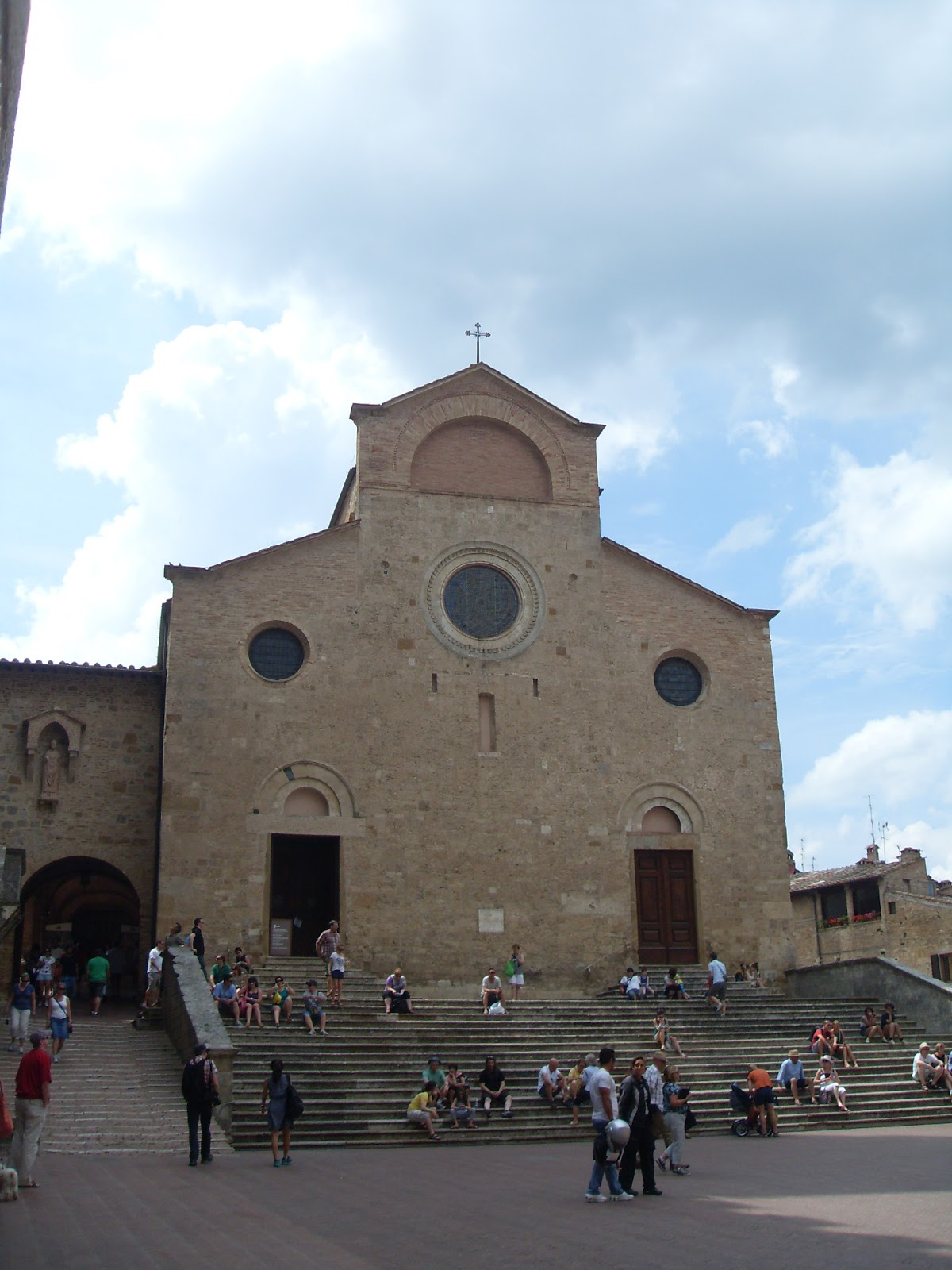
The cult of Fina set its marks clearly on the city of San Gimignano. She was eventually elected to be the patron saint of the city, and a hospital in her honour was built only fifty years after her death. In 1457 the Popular Council decided to furnish a beautiful chapel dedicated to her in the collegiate church of Our Lady of the Assumption. The chapel was built in the period 1468-72 by Giuliano da Maiano, and his brother Benedetto made the altar in 1475. The walls of the chapel were decorated by Domenico Ghirlandaio and his school, as seen above.

Perhaps the most hauntingly beautiful artistic expression of Fina's cult is the portrayal of her life by Florentine artist Lorenzo di Niccolò. Here, Fina is shown here as the patron saint of the city, holding her native town in her left arm and some gillyflowers in her right hand. She is positioned next to St. Gregory, her particular saint.

Reliquary for Beata Fina by Lorenzo di Niccolò (1373-1412)
Courtesy of Wikimedia


søndag 15. september 2013

Travels in Tuscany, part 4 - The City of a Hundred Towers


e quella faccia
di là da lui più che l'altre trapunta
ebbe la Santa Chiesa in le sue braccia:

dal Torso fu, e purga per digiuno
l'anguille di Bolsena e la vernaccia
- Purgatorio (XXIV), Dante Alighieri


and that face
Beyond him, more puckered than the rest,

Is that of a man who had the Church in his arms:
He was from Tours, and now fasts to purge himself
Of the Bolsena eels and the sweet wine.
- Translated by Charles Sisson


San Gimignano, seen from Certaldo

The man to whom Dante refers in this canto is Pope Martin IV, who reigned from 1281 to 1285, and who was infamous for his gluttony and therefore set to purge his body of his favourite delicacies in the company of other gluttons on the Sixth Cornice. The eels for which he had such an appetite in his mortal days were steeped in la vernaccia, a wine native of San Gimignano, a Tuscan city Dante once visited on a diplomatic mission, and which can be seen across the river valleys from the city of Certaldo, as seen in the picture above.

Porta San Giovanni


When I visited Tuscany for the conference in Certaldo this summer, I had left one day open in my itinerary for exploring. Certaldo is situated in close proximity to several historical centres, such as Pisa, Florence and Siena, but I was first of all attracted by the small hill town of San Gimignano, known as the city of a hundred towers, some distance south of Certaldo. In the end I decided to spend my day off here rather than Florence, because I thought to myself I would certainly visit Florence some other time, while I might not have the same opportunity to see San Gimignano for the foreseeable future. However, having visited the city of a hundred towers - or twenty-one, as I've heard is the correct number - I now realise I have to return to that city for a more thorough investigation.


Facade of the Franciscan convent, later Templar mansion and, after 1308, a house of the Maltese Order

Agnus Dei

A splendid torchholder

The city of San Gimignano has an old history reaching back to Etruscan times. According to legend it was founded by two Roman brothers who ran away from Rome in the aftermath of the Catiline conspiracy and named Citadel of Selva after one of them. Later it received its current name from Bishop Geminianus, a 4th-century bishop-saint from Modena who was venerated in the city and, according to legend, was counted as its saviour, though I'm not sure on what grounds. Devotion towards Geminianus became significant in the 12th century following a translation of the bishop-saint's relic in 1106. Towards the end of that same century, San Gimignano received its municipal independence from the bishops of Volterra, to whom it had been assigned by King Hugh in 929, apparently the first document to refer to the city.


Situated on the Via Francigena, the pilgrimage route to Rome from France, San Gimignano grew to a rich and formidable hill-town throughout the 13th century thanks to pilgrims, its export of wine and its varied manufacture (including glass and cloth). Its economic prosperity attracted rich families who in their turn gave rise to the town's characteristic towers, a symbol of power and wealth, and though only 21 of them remain today, it is said that as many as 76 towers once stood in the city. In addition, there grew up convents for Franciscans, Dominicans and Augustinians, and even the Templars set their mark upon the cityscape.

Torre Rognosa

Torre del Diavolo

Piazza della Cisterna

Like so many other Italian city-states, San Gimignano had a volatile political history, siding variously with the Ghibellines and the Guelphs. It was for this reason Dante visited the city in 1300, acting as an ambassador for the union of Guelph cities in Tuscany. Whether it was during this stay that the Florentine poet learned of Pope Martin's love of vernaccia-marinated eels I don't know, but I assume Dante himself had opportunity enough to acquaint himself with the sweet wine during his stay.


The wealth of San Gimignano resulted in much beautiful architecture and wonderful artistic expressions, and even following the plague's decimation of the populace the 14th century saw many spectacular artistic projects. The walls of San Gimignano's duomo are partcularly rich in this legacy, and the Sienese painter Bartolo di Fredi (c.1330-1410) painted a series of scenes from the Old Testament, which is facing a series of scenes from the New Testament of uncertain provenance. Both these series were completely breathtaking in all their horror and delight, and I could but admire and adore the faith, the talent and the dedication that went into making these frescoes. There is also a beautiful depiction of Saint Sebastian's martyrdom executed by Benozzo Gozzoli (ca.1420-1497) who also painted a frescoe on the same theme in the chiesetta in Certaldo.


The city's medieval architecture is well-preserved and it really would feel like stepping back in time once you enter the Porta San Giovanni, were it not for the ubiquitous and occasionally boisterous tourists who swarm the streets in the summer. However, San Gimignano is so labyrinthine that it is easy to get away from the masses and explore the various arches, tunnels, alleys and walls undisturbed by the vulgar noises. There are also a number of fascinating and interesting sights, from the lowly, intimate churches to the soaring towers, and from the top of the Torre Grossa, reaching 54 meters and constructed in 1311, you have a magnificient view of the Tuscan landscape, and as you stand there and see the distant mountains, the vineyards and the green and luscious valleys it is almost as if you begin to doubt the existence of a world beyond the horizon.


Chiesa di San Bartolo, built in 1173


The Chancery Arch


Chiesa di San Agostino, consecrated in 1298


Courtyard of the late-13th-century town hall


View from Torre Grossa


Piazza del Duomo

With its richness of sights and nooks I didn't have the chance to fully explore San Gimignano the short afternoon I spent there, and I already look forward to revisit the city and see more of its fascinating history.

Piazza della Cisterna dalla Torre Grossa