And was the holy Lamb of God,
On Englands pleasant pastures seen!
- And did those feet, William Blake

onsdag 30. april 2014

Aprill full of lustyhed


In the Cantos of Mutabilitie, the only known excerpts from Edmund Spenser's seventh book of The Faerie Queene, there is a procession of all the months, in which each month is depicted in accordance with its typical attributes. In this blogpost, even though this is the very last day of the month, I present to you Spenser's depiction of April in this procession.


Taurus
From MS. Arundel 60, English psalter from 3rd quarter of the 11th century
Courtesy of British Library

Next came fresh Aprill full of lustyhed,
And wanton as a Kid whose horne new buds:
Vpon a Bull he rode, the same which led
Europa floting through th' Argolick fluds:
His hornes were gilden all with golden studs
And garnished with garlonds goodly dight
Of all the fairest flowres and freshest buds
Which th'earth brings forth, and wet he deem'd in sight
With waues, through which he waded for his loues delight.
- Mutabilitie, Canto VII, 33


lørdag 26. april 2014

April in 19th-century Norway


One of Norway's most famous and important writers was Bjørnstjerne Bjørnson (1832-1910). He is most known for his plays, his short novels and for penning the lyrics to the Norwegian national anthem, but he also composed a number of shorter poems. Bjørnson was a controversial figure in his own time because of his attacks on the establishment, siding with the weaker elements of society and relentless in his verbal attacks on those with whom he disagreed. His literary output was substantial and wide-ranging, and he was awarded with the Nobel Price for literature in 1903 as the third recipient in its history.

In this blogpost I present to you one of his shorter poems, April, which was first published in Dikte og Sange 1870, poems and songs, and an abbreviated version was printed in his collection Guldkorn, gold nuggets, in 1888. An image of the poem as it appears on the page of this latter collection can be seen below. I have translated the poem into English below, but with the purpose chiefly to retain the exuberant rhythm of the lines rather than keeping the rhyme-scheme or to present an elegant translation.

The abbreviated version, from Guldkorn, 1888
Courtesy of this website


April

Jeg vælger mig april!
i den det gamle falder,
i den det ny får fæste,
det volder lidt rabalder, -
dog fred er ej det bedste,
men at man noget vil.

 Jeg vælger mig april,
fordi den stormer, fejer,
fordi den smiler, smelter,
fordi den ævner ejer,
fordi den kræfter vælter, -
i den blir somren til!

Bjørnstjerne Bjørnson, 1903
Courtesy of wikimedia


April

I select April!
in that the old things fall,
in that new things take hold,
it causes some commotion, -
though peace is not the best thing
but that something is desired.

I select April,
because it rages, sweeps,
because it smiles and melts,
and ability possesses,
because forces are upturned, -
in that is summer made!


mandag 7. april 2014

Histrionic Historicity - or Why We Need Historians


In this orgy of rhetoric one almost loses sight of another very important statement

- In the Presence of the Dead, Karsten Friis-Jensen (2006)


As every historian learns to know at some point, the conveying of historical fact and historical narratives is fraught with numerous challenges and difficult choices. To write about historical issues is therefore a delicate matter, and to navigate and negotiate vast chronologies or to assemble a bric-a-brac of historical material, require great care and sobriety. It is therefore always frustrating and saddening to me when an unprofessional decides to dabble in history and present it to an audience, without the proper methodological schooling or awareness. This blogpost is a response to a recent example of such dabbling, a piece on the Vikings written by Irish journalist and Middle East correspondent Patrick Cockburn, published in The Independent. The piece in question was a response to the current Viking exhibition at British Museum.

In my response, I do not wish to be facetious, nor do I wish to be ungenerous, and I will therefore state rightaway that I sympathise and agree with Cockburn's major point, namely that the Vikings were a band of brutal warriors who were responsible for great atrocities, and that in our times there is a certain revisionism that tends to downplay this aspect of the Viking culture. This basic point is true. Murder, rape, enslavement and pillage were all part of the job description for a Viking, and these are not to made a trifle of. The problem is that Cockburn commits so many methodological fallacies and descends into rhetoric and ahistoricity that this central point disappears in comparisons that are obfuscating rather than clarifying, in a rhetoric that is histrionic and in a presentation of history that is grossly imprecise and simplistic.


Danish Vikings attacking England
From Morgan Pierpoint Library Ms. M. 736, Life, Passion and Miracles of St. Edmund, King and Martyr
Courtesy of Wikimedia

Category mistakes

Things go awry from the very beginning, as the lead paragraph states that "Norsemen carried out atrocities to equal those of the German SS". This is problematic on several levels, and if one of my students had written this in an essay, I would have refused to let him pass and given him a severe scolding for such anachronism. And this is the first issue, namely the juxtaposition of two phenomena separated by almost a millennia, which arose in widely different cultural and political contexts and that overall are not in any way connected by historical developments. There is no trajectory that ties the Vikings and the Waffen SS together, and a juxtaposition of these historical categories are consequently pointless and vastly problematic.

Furthermore, it does not make sense to juxtapose these the Vikings and the Waffen SS because they do not belong to the same historical categories. First of all, a Viking denotes a man with a certain modus operandi, working in teams, but initially not as a part of a codified or unified programme. The unification came to some extent later, when Danish kings like Ivar Boneless or Canute the Great organised mass pillaging in Britain, but they were not bound together by an overarching ideology. The Waffen SS, on the other hand, was a group of people united by a common codified political programme and vision.

Moreover, the term Viking denotes people inhabiting a long chronology and a large geographical area. The traditional dating for the Viking period is 793-1066 and this period was marked not only by Viking raids but also by Norse settlement and interaction. Every series of raids and every large-scale invasion was a response to circumstances that were specific to its contemporaneity, dependent on concerns, personal choices and a thousand factors that were impossible to map back then, and more so in our time. The Waffen SS, however, was comprised of a group of people from a limited geography and a very short period of time. Even though each member of Waffen SS had his own personal reasons for joining, each member was suffused by an ideology that presented a specific world-view and operated within a nationalistic construct. In short, the genesis of Waffen SS was driven by a political purpose at a specific cultural and geographical point in history. The Vikings, however, were driven by very material concerns, namely food and riches. In other words, the Vikings and the Waffen SS are not comparable categories at all, and Cockburn's juxtaposition is therefore pointless and fruitless. 
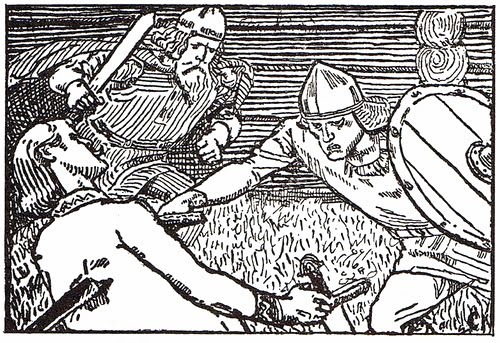

How to die in the Viking age
Illustration to the 1899 edition of Heimskringla by Christian Krohg
Courtesy of heimskringla.no
A troublesome insistence

The fundamental problem in Cockburn's piece is, as stated, a matter of category mistakes. Another, and equally problematic issue, is his insistence on being topical. Throughout his text, Cockburn suggests similaritites between the Anglo-Saxon victims of the Vikings and the victims of the current strife in Iraq and Syria. While the human trauma of both these historical situations are not to be underestimated, it makes little sense to juxtapose them. Again, they grew out of completely different historical circumstances, and to compare these circumstances will add nothing to our understanding of either.

Another problem about this insistence on topicality, is that Cockburn fails to realise that certain terms and concepts are, because of their historical uniqueness, fraught with subtexts that can not be transmitted to other historical phenomena. The Waffen SS committed atrocities directed and subsumed by an imperialist, anti-semitic, eugenicist, nationalistic agenda, and these atrocities are still within living memory. The term Waffen SS, therefore, brings to mind an orchestrated genocide that lacks parallels prior to the 20
th century, and which evokes great personal trauma that creates a lense which colours any juxtaposition in accordance with these memories. We are, in other words, coaxed into imagining an 11th-century Norseman carrying a swastika and killing people in the name of the Third Reich. This is a manipulation of historical memory which is ludicrously imprecise. It is also extremely disrespectful towards those who were the victims of such trauma, since historical phenomena are jumbled together and assembled in a way which removes them from their own contemporary contexts. Such a strategy is effective, especially in light of the adoption of Norse symbols and culture into Nazism and Neo-Nazism, but it is dishonest.


Propaganda poster showing the Norwegian Nazi party's adoption of Viking culture
Courtesy of this website
Incongruities

Having established the fundamental methodological weaknesses and injustices committed by Cockburn, it is time to turn to some of the stylistic incongruities of the piece.

The chief stylistic incongruity is one perhaps most easily detected by the professional historian, and I say this without smugness or arrogance. The chief incongruity is namely the histrionic pathos that emerges from Cockburn's repetitive insistence on topicality, where the Viking raids – gruesome and pitiless though they were – are evocatively but fraudulently presented as the architects and perpetrators of one of the worst genocides history has ever seen. It is reminiscent of Christopher Hitchens' terrible highfalutin bathos whenever he would use the term "medieval" or talk about religion. In other words, Cockburn's tone of voice in his piece is incongruous with the sobriety demanded by a careful historical riposte against revisionism, which he states himself is at the heart of the matter.

Another incongruity is the succession of points made by Cockburn towards the end. After describing the death of Alphege of Canterbury and thus having established the ferocity of the Vikings, Cockburn then moves on to the St Brice's Day Massacre to further his point of the barbarity of the Norsemen. This is a very strange choice, since this was a massacre perpetrated against the Danes by the Anglo-Saxons. Cockburn is aware of this, however and comments that this was the case, which only goes to befuddle the reader, for surely, this does not strengthen his case.

After this incongruity, Cockburn opens his next paragraph by saying "[o]verall, the Scandinavians have a lot to apologise for", and here I will allow myself to be a little facetious, for it sounds as if he criticises the Norsemen for the inconvenience of dying on British soil. Of course, this is not what he means and I do understand his point, but it is so poorly put that it does little service to his central argument. This makes it the final incongruity I will touch upon here, for even though every discerning reader understands what Cockburn is getting at – that the Vikings were responsible for many atrocities – it would nonetheless, considering how he jumbles historical elements about, be very surprising if he were to mean modern-day Scandinavians. In short: Cockburn's anachronistic juxtaposition of historical elements disrupts chronology and presents a simplistic view of how complex history really is, thereby removing all credibility he has in the matter.


Concluding points

As a person who, by virtue of a master's degree in history, is a professional historian, I'm often forced to justify my value to a society increasingly blind to immaterial gain. I don't find this a difficult thing to do, providing I'm given time and place to speak, but it is nonetheless a concern that is constantly at the forefront of my mind. Consequently, I react very negatively when a person who is not professionally trained in the art of history presents a narrative which distorts chronology, ignores fundamental methodological concerns and is void of any humility and nuance. The heart of the problem is when complex historical issues are stripped down to a ludicrous juxtaposition without taking into account historical context, and then presented in a histrionic manner ill-suited for the kind of sober reflection needed when aiming to give an accurate rendition of a historical epoch. Cockburn's piece is a poorly written, highfalutin text that has little value in a debate on historical matters. This is very sad, and especially because I agree with Cockburn's central point: that the atrocities of the Vikings should be at the core of any presentation of their culture. However, because the piece is written the way it is, and because he fails to engage properly with the material, he fails to create a good arena for a debate. To my mind, this is an excellent example of why we need professional historians, lest we sacrifice accuracy and complexity for imprecise simplicity.

tirsdag 1. april 2014

Edward the Confessor as King David


So David and all the house of Israel brought up the ark of the Lord with shouting, and with the sound of the trumpet. And as the ark of the Lord came into the city of David, Michal Saul’s daughter looked through a window, and saw king David leaping and dancing before the Lord; and she despised him in her heart.
- 2 Samuel 6: 15-15 (KJV)

David humbling himself before God
The Morgan Bible, Paris, 1240s
Picture courtesy of this website

The story of the ark of the covenant's return to Jerusalem is a famous episode in the life of King David, and it shows the man of royal dignity humbling himself before God and rejoicing in the Lord's work. In the medieval hagiography this scene became an important source for hagiographers who wished to contrast the arrogance of the world - so frequently found in kings who challenged the so-called liberties of the church. The struggle between the temporal and the spiritual powers is a common theme in much of medieval history, and King David was often held up as an example of good kingship for the admonition of contemporary princes.

One such example comes from the mid-12th century in Aelred of Rievaulx's Vita Sancti Ædwardi, the hagiography of Edward the Confessor written in 1163 and prepared for the saint-king's translation of October 13 that year. This vita was dedicated to King Henry II and in the dedication Aelred expresses his hopes that the king might follow the example of St. Edward in the performance of his office. This was the year before the council of Clarendon where Thomas Becket and the king had a falling out over the constitutions which was said to encroach upon the liberties of the church. The struggle between Henry and the English church was at that point already long-standing, and it is likely that the Cistercian hagiographer Aelred - commissioned to write the vita by Abbot Laurence of Westminster, his kinsman - saw this as an opportunity to persuade the king off his current path.

In one anecdote from Aelred's work, Edward the Confessor is explicitly likened to King David in the healing of the crippled Gillemichel, an Irishman. This man has been told that he will receive a cure for his illness if King Edward will carry him on his back all the way to Westminster Abbey. This task was given to the king by St. Peter himself, who thus becomes a co-worker of miracles who commission his favourite on earth, Edward the Confessor, to complete the task. The king is told about this and agrees to help Gillemichel, thus humbling himself for the glory of God. The elaborate comparison with David should be seen in light of King Henry's politics against the church, and Edward provides for the king a model of emulation, strengthened by the comparison to the Old Testament exemplar.

The excerpt is translated by Jane Patricia Freeland and is taken from
Aelred of Rievaulx: The Historical Works, edited by Marsha L. Dutton, 2005: 163-64.

Meanwhile not a few of those standing by were laughing. Some teased the king about being fooled by the poor man, while others interpreted the righteous man's simplicity and gentleness as foolishness. See there a new David leaping and dancing; see a new Michal contemptuous and laughing! Yet their view was sounder who jduged the king happier under such a burden than under a golden crown. You, Christ Jesus, you yourself were being carried in the poor man, you who once were clothed as a poor man whom Martin clothed. But you made that known then by an oracle, this now by a miracle.

And so as the king moved forward little by little, burdened by this noble burdn, the tendons that the longstanding illness had contracted were suddenly extended, the passag of blood that his stiffened veins had restricted resumed, his bones became firm, and his withered flesh became warm again. His joints emerged out of his flesh and his feet were separated from the buttocks. The knees, which were now flexible and flowing with healthy blood. The royal clothing was adorned rather than defiled.

They all shout that the sick man has been healed enough now and that the king should now lay down his burden because of his filthy sores. The king, mindful of the command he had received, refused to listen to these siren songs. He entered the church and before the holy altar he resigned the offering he had been bearing to God and to blessed Peter.

[B]efore the holy altar he resigned the offering he had been bearing to God and to blessed Peter.
MS. Egerton 745, French collection of saints, 14th century
Courtesy of British Library

mandag 31. mars 2014

A church of its time - a brief history of the Church of St. Olav, Trondheim


In recent years Catholicism has been on the rise in Norway. This is partly a consequence of immigration from Catholic countries – such as Poland or the Philippines – but another significant reason is the increase of converts, many of whom are intellectuals dissatisfied with the lack of mysticism in the Protestant Church of Norway.

Catholicism has not always had a good condition in Post-Reformation Norway. When our constitution was drafted in 1814, it stated specifically that monastic orders and Jews were denied access to the realm. We have fortunately come a long way since then, and today both monastic orders and – more importantly – Jews are welcomed to our country. As a result of this, several monastic sites in Norway have resumed their activity, and in the vicinity of Trondheim – where I study – we have several active monasteries.


In the early 20th century a Catholic church was built with significant financial support from professors of the Norwegian Technical College, one of the predecessors of the modern-day university conglomerate known as the Norwegian University of Science and Technology. This church was torn down after a few decades and a new church was built which still stands, albeit only for a short while longer. Amusingly enough, this is the cathedral of Trondheim in the true sense, since it is here, in the Church of St. Olav in Trondheim, that the Catholic bishop has his cathedra.

Modern statue of St. Olav from the eponymous church, conspicuously beardless
Photo credits: Eline Løvlien

The heavily-restored medieval cathedral, the church's neighbour
Also, what everyone thinks of when they talk about the cathedral of Trondheim

The new church was built in the 1970s and was designed to meed the immediate needs of a church building. It was not built to last, and the architect was surprised to learn from the current priest – in a fairly recent conversation - that it was still standing. This almost intentional brevity was not evident to the church authorities at the time, and they commissioned the Norwegian artist Håkon Bleken – one of our most celebrated modernists – to paint an altar fresco.

Håkon Bleken before his modernist altar piece
Courtesy of Adresseavisen

When considering the architecture of the place, it is not surprising that the building is lumbering heavily under the ad-hoc nature of its design. The walls are made of concrete interspersed with glass roundels and it is, to my own and personal opinion, aesthetically displeasing, and from a practical point of view this architectural solution is both costly and cumbersome, since it requires a lot of electricity to heat up the central nave. As a consequence, a new church will be built in its stead, and construction will being after the celebration of Easter Week this year. Bleken's altar fresco has been the major challenge in this process, but now it has been agreed that it will be dismantled and stored by the science museum belonging to the Norwegian University of Science and Technology.  


onsdag 19. mars 2014

Saint Sebastian in Tuscany - two martyrdoms by Benozzo Gozzoli


The martyrdom of Saint Sebastian is a recurring theme on this blog, as can be seen here, here and here. This time I wish to introduce you to two renditions of this legend by 15th-century Italian painter Benozzo di Lese (1420-97), better known by his cognomen Gozzoli, which suggests he was fond of a feast (gozzoviglia = party). One of Gozzoli's perhaps most splendid and well-known works is his fresco work at the Chiesa di San Agostino in San Gimignano, executed in the period 1463-65. He did, however, also paint some magnificent frescoes in the Duomo di Santa Maria di Assunda, namely the decorations for the chapel of the city's patron saint Fina and a spectacular martyrdom of Saint Sebastian.


Courtesy of Wikimedia

I saw this wonder myself as I explored the cathedral of San Gimignano last summer, but then I had no idea that it was a work by Gozzoli. The fresco is found on the rear wall of the nave and is executed very skilfully in that familiar theatrical composition so typical of the Quattrocento, and which becomes particularly evident in the depictions of Saint Sebastian.

San Gimignano

Duomo di Santa Maria Assunta

Sebastian was a very popular saint in 15th-century Italy because he was believed to guard his devotees against the sundry plagues that haunted the communes. In cities like San Gimignano, which had a rich mercantile estate willing to express its devotions expensively, it is therefore no wonder to find such a sumptuous and centrally located depiction as Gozzoli's.


During my stay in Tuscany I also happened upon another Gozzoli's renditions of Saint Sebastian, this time in the nearby city of Certaldo, which can be seen from the towers of San Gimignano. In one of the churches of the old city, the Chiesa di SS Tommaso e Prospero, located right next to the Pretorian palace, a beautifully painted altar can be found, where the martyrdom of Saint Sebastian can be found on the backside.

Chiesa di SS Tommaso e Prospero

As seen below, the martyrdom is splendidly depicted and surrounded by the coat-of-arms of the city (as seen by the onion, Certaldo's most famous produce) and local families. It is less grandiose than the fresco of San Gimignano, but the rigid style, the profusion of arrows and the beard of the saint are all recognisable features. It was likely executed around 1464-65, when Gozzoli was in Certaldo for the decoration of another local chapel.


What is most interesting about thes frescoes, however, is to note Sebastian's ante-apollonian beard, a detail that fell out of vogue towards the close of the 15th century, as painters like Mantegna and Botticelli turned to Classical renditions of Apollo for their models (hence ante-apollonian). This fashion is particularly evident in Mantegna's three paintings of the saint, the first of which dating as early as the 1450s. Benozzo Gozzoli, in other words, stuck to an older, pre-Quattrocento paradigm in his depictions of Saint Sebastian.

torsdag 13. mars 2014

A town of books


(...) but it behoves a man who wants to see wonders sometimes to go out of his way.
- Sir John Mandeville, The Travels (translated by C. W. R. D. Moseley)


In Fjærland, Western Norway, nestled in a fjord under looming mountains, snow-clad even in the summer months, lies the Norwegian book town, a range of second-hand book shops comprising the centerpiece of the small rural community of Fjærland. The book town was founded in 1995 and modelled after the Welsh village Hay-on-Wye which took its first modest stepts toward a book community in the 1960s. The Norwegian book town boasts its approximately four kilometers of books, and buildings of various kinds - barn, bank, post office - are converted into charming shops with numerous nooks and crannies and small hidden gems.


The book shop "Thousand nights and a night", home of many good books


Perhaps needless to say, the Norwegian book town is one of my favourite places in the whole world, and although I try not to go there very often, for economic reasons, I'm always very pleased to saunter among the numerous shelves, half-searching for new treasure with Serendipity as my main method. This is often an exercise in self-restraint. Being a voracious reader and a committed bibliophile, I take interest in almost any kind of books and lest common sense got the better of me, I would descend into economic ruin upon every visit.


Fjøsen, i.e. The Barn


Although my favourite part about the book town is the vast amount of books - to me a sacred manifestation of the divine creativity with which humanity is blessed - I also find the surroundings very pleasing. Being a Western Norwegian, I feel at home among mountains, fjords and wooden houses erected in the first half of the 20th century. I like the rural Norwegian architecture, I like how the buildings have negotiated their positions between fields, woods and salt water. I like that there is a small communal green area where one can enjoy a book while casting the occasional glance towards the mountains.


Aside from these attractions, I am also very pleased with the literary diversity that the book town can offer. I have found a number of fascinating books in both Norwegian and English, some of which I would not expect to see in a remote Western Norwegian book shop. Among the gems I have found there are Jorge Luis Borge's collected fictions, the complete Wakefield Mystery Plays, Charles Homer Haskins' medievalist classic The Renaissance of the 12th century and the complete poems of Thomas Moore and Elizabeth Barren Browning, to mention just a few. There is also a lovely little shop filled with second-hand comic books, and I always make sure to drop by and have a look around.


I love the Norwegian book town for all these reasons and many more. An ardent lover of books, I always find a great peace when walking along rows fully stacked with books of various kinds, being reminded of mankind's tireless fondness for invention, creation, poetry in all its numerous forms, and to find this kind of solace in a small, distant Norwegian farming community, must be like finding a life-giving oasis in the middle of the Saharan desert. Fjærland is a good way away from the larger communities of the Western Fjords, but, as John Mandeville reminds us, sometimes it is necessary to go that distance when one wishes to see wonders.