The other day I got a worried message from a close friend. He was asking my opinion about the Russian invasion of Ukraine, and showed great concern for how the situation would evolve. My first response was quite simply to disavow any form of expertise on the subject, because I am not an expert on the region, and neither am I an expert in the history of the relationship between Ukraine and Russia. I am following the analyses of experts in order to get a good understanding of what is happening, but there is little I can say beyond simple moral points, namely that any act of invasion is an abomination, and that a mad imperialist will use any excuse and any pretense to execute what they have already planned. To condemn tyranny is easy. To analyse and comprehend the specific mechanics of a specific tyranny is anything but, at least for those who have not studied the tyranny in question.
One thing that did strike me after the message from my friend, however, and one thing that was reinforced by a number of poorly formulated and quite simply idiotic takes that are still circulating on social media, is that this tragedy highlights the importance of not adhering to grand narratives when understanding history and the world. There are several such grand narratives that can be glimpsed in various comments either on social media or in the regular media. For instance, there is the shock of realising that this kind of atrocity can take place in a European country, because this does not fit with the grand narrative of modern Western civilisation and its journey towards peace. It is a particularly nonsensical grand narrative, considering that Russia, in recent years, has exerted pressure on both Ukraine and Georgia, with the 2014 claim to Crimea and the invasion of Georgia in 2008. Other ways to dismiss this grand narrative is the Balkan War, the troubles in Ireland, and any other armed conflict that has taken place in Europe in the past 150 years.
Another grand narrative is that of a country's natural form, a grand narrative that sees illegal annexations, invasions and domination as a country's process for resuming its boundaries at any given historical reference point. This kind of grand narrative usually sees history as mechanistic, governed by strategies and goals, rather than by the whims, personalities and flaws of individual humans. Some, who defend Vladimir Putin's imperialist transgressions, express variants of this grand narrative.
There are others as well, and they come in different guises, and one particular type of grand narrative can have numerous variants, depending on the situation to which they pertain or the people by whom they are pushed. In our times, however, when information comes instantly and where the process of maturing information into knowledge is sometimes denied us, it becomes especially clear how ludicrous and damaging any grand narrative can be.
Since any grand narrative provides a simplistic overview of things, a grand narrative can also be fear-inducing and paralysing, strengthening the sensation that what happens is inescapable and beyond human control. A grand narrative can do this because of its many elisions that have gone into putting the grand narrative together. Among these elisions I will especially point to four which exemplify excellently well why grand narratives are problematic.
First of all, a grand narrative elides the numerous lived experiences that are happening simultaneously. We are all experiencing the world differently, even if we experience the same events, but this kind of complexity is utterly lost in a grand narrative that sees everything as a homogeneous process.
Secondly, events unfold in a piecemeal fashion. This means that even though we get information about something right after it has happened, or perhaps while it is happening, it is important to remember that there are many steps in any event, major or minor. Things hardly ever occur as swiftly as they might appear to do for a bystander, and a grand narrative therefore gives the impression that an event unfolded quickly, and also that all subsequent events will follow equally quickly. This is connected to the third point.
Thirdly, a grand narrative elides the numerous possibilities that are open at any given time. A grand narrative is typically teleological, seeing historical events as necessary and inescapable, which in turn tends to provide some sort of justification or trivialisation of the atrocities that have presided over the events in question. However, just as events happen in a piecemeal fashion, no outcome is one hundred percent guaranteed or dictated by laws of history - especially because no such laws exist.
Fourthly, a grand narrative tends to elide the human factor in historical events. Typically, historical events will be talked about in terms of strategy, rationality, or perhaps unseen, amorphous forces that bend history according to their nature. That humans are capable of making extremely stupid decisions, or that humans are capable of being kind or sacrificing to the point of self-destruction are only two of the elements of human nature that makes human history utterly unpredictable, but that also help human history make perfect sense once we have all the information we need for careful analysis in the aftermath. (Although we rarely, if ever, have all that information.) Because of the human factor, grand narratives cannot be anything but faux-intellectual constructs that hinder rather than provide a good understanding of reality.
In a time of crisis, grand narratives often become reference points in the discourse, especially because people who do not know enough about a situation to provide insightful and accurate commentary can often rely on grand narratives to find something to talk about and appear well-informed and intelligent. But grand narratives are useless tools for understanding reality. They can generate misunderstanding and exacerbate panic and fear, and they do not help explaining how we got where we are, or where we are going next.
søndag 27. februar 2022
A brief point about grand narratives of history

torsdag 24. februar 2022
Achronology and the lives of saints - the case of Saint Servatius at Skive Church, Denmark
In
a previous blogpost, I wrote about how medieval art sometimes condenses
elements of a saint’s life into an achronological summary, where several key
points from different parts of a saint’s life are brought into the same frozen
here-and-now. This kind of amalgamation is part of what Cynthia Hahn has called
“pictorial hagiography”, a term that reminds us that medieval art had a
narrative function, and that a single image could convey an entire story. This
kind of narrative snapshot, however, is not uniquely medieval, and it is not
something we have lost in our own time, but we often tend to forget that this
kind of sophisticated thinking where chronological borders melt into one
another was also present in the Middle Ages.
When last I wrote about this issue on the blog, I used an example from the
Church of Our Lady at Skive, a town in Northern Jutland. The church, built
around 1200, contains an impressive programme of frescoes depicting saints, a
programme that was painted in 1522, a date which has been incorporated into several
of the frescoes. My example then was Saint Martin, shown in bishop’s attire
while cutting his cloak in half, a deed he committed when he was still a
soldier. The other day, however, I came across yet another example from the
same wall-painting programme, and as this example works slightly differently
from the case of Saint Martin, I decided to dedicate this blogpost especially
to analysing it.

Eminen and his son Servatius, the future bishop
The saint in question is Saint Servatius of Maastricht, shown in one of the vaults of the church nave, who was venerated as a relative of Christ through his great-grandmother, Hismeria, was the sister of Anna, the grandmother of Christ. In this way, Saint Servatius was part of the extended holy family, whose members had been recorded in apocryphal literature. When Jacobus de Voragine composed his Legenda Aurea in the 1260s, he provided an overview of this extended family in his chapter on the Nativity of the Virgin Mary (September 8). While Legenda Aurea was a repository of already well-established knowledge, and therefore did not contain much in terms of new information, the popularity of the book ensured that a lot of details concerning the saints became more widely and commonly known as Legenda Aurea and its translations spread across Latin Christendom in the Later Middle Ages. These details also reached Denmark.
The case of Saint Servatius is a particularly interesting example of how Legenda Aurea functioned as a vehicle of canonicity. By this I mean that information that had not been widely known, or perhaps not widely accepted, was transformed into established canon through the sheer popularity and reach of Jacobus’ book. Before the 1260s, the cult of Saint Servatius was predominantly, perhaps exclusively, located in Maastricht, where his relics were kept. I do not yet know the history of the legend of Servatius and his kinship with Christ, and I do not yet know how it emerged at Maastricht, but by the mid-thirteenth century, the claim that Servatius was of the Holy Family had reached Genoa and was incorporated into Legenda Aurea and established as a canonical fact. It should also be noted that this kind of historical refashioning or reimagining of the history of a patron saint was not uncommon in the Middle Ages, although not every such refashioning had the impact of Saint Servatius.
We do not know how the knowledge of the kinship between Christ and Saint Servatius reached Northern Jutland, but there were many possible routes by which that information could have travelled, be it directly from Legenda Aurea, from a German translation, through sermons, through merchants, and so on. Saint Servatius’ presence in Skive is, therefore, no surprise. What is particularly interesting is, as stated earlier, the way that the fresco in Skive combines crucial elements of his life. As can be seen in the picture above, Servatius is shown as a child wearing a bishop’s mitre. That he is intended to be understood as a child is clear when we compare his size with that of his father Eminen, standing next to him. Does this mean that Servatius was understood as a child-bishop? Probably not. Most likely, what we see here is a way of highlighting that he was a member of the holy family, but a young member of a later generation than that of his great-grandmother Hismeria and his great-grandaunt Anna. A similar way of showing the difference between generations can be seen in the depiction of John the Baptist in another section of the vault, where he, too, is depicted as a child. This kind of representation of several generations in one image is typical of the images that modern scholarship call Anna self-third, where we see the three generations of Anna, the Virgin Mary, and the Christchild. This iconography was very popular in the Later Middle Ages.
The depiction of Servatius as a child, then, shows his kinship with Christ and as a late generation of the holy family. In other words, we see an element of the very beginning of his life, an element that in and of itself was cause for a claim to holiness. The simultaneous depiction of him as a bishop, however, points to a later part of his life – a part that would become his future when he was a child, and that was also a part of the distant past by the time this image was painted in Northern Jutland. Onlookers would, in this way, get a summary of Servatius most salient claims to holiness, his kinship and his office as a bishop, in one and the same glance.
lørdag 19. februar 2022
The biggest book so far
We do not always foresee the consequences of our actions. About two weeks ago, I ordered a book through the university library, which is practically a daily pastime for me whenever I have access to an interlibrary loan system. Earlier this week the book arrived, but when I went to the library to collect it, the librarian was at first unable to find it in the shelves reserved for interlibrary loans. I then noticed that on top of the relatively low book case someone had placed a behemoth of a book, and with a slight worry that soon proved to be justified I suggested that this might be the one in question. Returning to my office turned out to be the most gruelling bout of exercise I have had since Christmas, not least because the spine of the monster contained an unrepaired tear that could easily become enlarged if handled carelessly.

The book in question is the eighth volume of Corpus Codicum Danicorum Medii Aevi, a series of editions and facsimiles of books from the Danish Middle Ages. I needed this particular volume since it contains an edition of a collection of various letters and charters pertaining to the cathedral church of Ribe in Denmark. This collection is colloquially known as "Ribe Oldemoder", the Ribe great-grandmother, and was begun at the end of the thirteenth century. The source is both famous in Danish medievalist circles and of course very important for our understanding of medieval Denmark. I had hoped that this fame and popularity would have ensured that it had been issued in a slightly more manageable format. It turned out I was very naïve in thinking so.
Aside from an unexpected training session, the book also provided me with a new personal record in biggest book borrowed. To better appreciate the size of this gargantuan specimen, I have placed it next to one of the two volumes of the Oxford Medieval Texts edition of Gesta Danorum by Saxo Grammaticus (fl.c.1200), mainly because this was the fattest volume I could find in my office, but also because I found it symmetrically pleasing to compare two Danish books with one another. The previous record for biggest book borrowed was held by a mid-twentieth-century reprint of an early modern edition of Vincent of Beauvais' Speculum Historiale, which I first handled a few months after the defence of my MA dissertation. While that book was indeed unwieldy, it had nothing of the back-breaking qualities that have ensured this volume of Corpus Codicum Danicorum Medii Aevi its first place in a competition inadvertently initiated in 2013.
mandag 14. februar 2022
How to choose a book - on lists and selecting
In
two recent blogposts (here, and here) I gave an overview of some of the main
principles that guide my selection of reading materials through any given year,
namely a plethora of lists that provide a wide range of opportunities that can
fit almost any mood. The logic behind having several lists rather than just one
comes down to a personal quirk of mine: I struggle to stick to a reading plan
over a longer period, and I get easily drawn in by items that feature on other
lists, or on none of my lists. Since variety is an integral element of my lists,
my choices can fit these lists without putting demands on myself that might go
contrary to my reading mood on any particular day.
As a self-diagnosed mercurial reader, I am often not entirely sure why I ended
up reading what I have read at any given moment. While some books have been
waiting in line for me to get in the right mood, and while some books have been
delayed simply because I look forward to reading them so much that I want to
enjoy the waiting a bit longer, there are other books that seem to simply just
arrive in my hands. The latest book that I finished was precisely such a book,
and this is what prompted me to write this blogpost.
Earlier today, I read the last pages of François Mauriac’s Le Næud de vipères,
the knot of vipers, translated into Norwegian as Slangeknuten (The snake
knot) by Fride Friestad. Since beginning this novel sometime last week, I have
been returning to the deceptively simple question of how I came to select this
particular book, and I have still not found a satisfying answer. The more I
think about it, the more it feels as if the book selected me and not the other
way around. The reason I continue to have this sensation is that until last
week, I did not know that Le Næud de vipères even existed.

Translation by Fride Friestad
As I mentioned in one of my previous blogposts on reading by lists, one list is comprised of the Nobel laurates in literature. This is the list that I feel the least drawn to, probably because I have no influence on the elements in that list, and I am therefore at a greater risk of ending up with books that I have no real interest in reading, but whose sheer canonicity compels me to finish them. Several of these authors are figures whose works are obscure to me, and I cannot say with certainty that I know all their names, either. If this is an indictment, it is of me, however, and not the authors in question, and the point is merely that this is a list that does not guide me very strongly.
Even so, despite my lukewarm attitude to the list of Nobel laureates in literature, last week I found myself looking for a Nobel laureate to read. I remember using the search engine of my university’s library, and I seem to recall a certain urgency that meant that my decision was, at least in part, based on what was available and what I could get hold of very quickly. For some reason, the name of François Mauriac popped into my head, and after having refreshed my memory and done a superficial amount of research about his novels and their availability in Norwegian – my preferred language for translations from any Romance language – I ended up with Le Næud de vipères.
By a stroke of luck, the book got hold of me very quickly. Its deep psychological insights, its complex and, at times, disturbingly recognisable protagonist, its terse but evocative descriptions of early-twentieth-century France, and its beautiful language caused me to enjoy every single page, even the brilliantly nuanced descriptions of tortured relationships between people whose torture stems simply from an inability to see things from the perspective of others. As a Sunday treat for myself, I sought out a café whose menu was French inspired, and which I had eyed on my way to and from work for months already, and this combined wonderfully with the content of the book, meaning that the book and the café enhanced one another and me added delight when contemplating either of them.
The question of how I came to choose this book rather than any of his other books remains unsolved. Neither can I explain why I decided on Mauriac rather than any of the numerous other French Nobel laureates whom I have not yet read – and I do think the French element played a crucial part in this process. Ultimately, I expect this to be of no great interest to anyone but myself, and perhaps not even myself once I have written this particular blogpost in full. But what this episode has reminded me of, however, is that even with a reading list whose content is not of your choosing – at least on the level of authors – there are potentially great rewards in following such a list anyway. While I do not need the praise of any committee as a reason for reading an author – I actually think such canonicity might just as easily make me averse to such an author – the lack of expectations that come with a list chosen by others can perhaps make the delightful surprises even more delightful. Naturally, the reverse can also be true, but I choose not to be too guided by that worry, perhaps because I am, despite everything, still an optimist.
søndag 30. januar 2022
A mingled past - or, Adventures in medievalism, part 3
Uses of the Middle Ages in a modern context are a bit like dust bunnies: Once you start looking for them, they are everywhere, sometimes even in rather surprising locations, or in unexpected forms and shapes. One frequently recurring form of medievalism is the use of the Middle Ages as an origin point for modern commercial products, where a modern manufacturer will employ references to the medieval period as a way to sell their merchandise, creating the illusion of a link with ancestral practices. The reference points depend on the culture in which the merchandise is peddled. Knights, monks, saints, Vikings, crusaders, kings, queens, nuns and jesters are some of the typical figure that are employed either separately or together, serving ultimately to persuade the buyer that by choosing this particular product, they will connect to a heritage that extends centuries into the past. Such strategies can yield amusing or funny results, but they can also be quite insidious given the right political context.

One such example of a product that relies on the buyer's fascination with the Middle Ages is a range of herbal teas that I have encountered both in the fjords back home, as well as in the Museum of Cultural History in Oslo, where the above picture was taken. The herbal teas are named after two of the most important Norwegian saints, SS Sunniva and Olaf. So far I have not been able to find a tea named after the third main Norwegian saint, Hallvard.
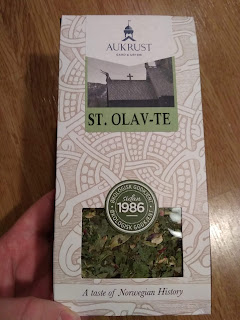

Products that rely so clearly on the medieval past to sell their product often find different ways to do so, but a common strategy is to provide a bit of explanatory text, whereby the link is forged a bit more clearly. In the case of the St. Olav tea, this link is forged by reference to two typical but in a way disparate elements from the Norwegian Middle Ages. The herbs are said to be well-known staples of monastic herb gardens, and the selection includes angelica, which is here claimed to be a Nordic contribution to those herb gardens. This claim is notable since it emphasises Nordic participation in the development of medieval monastic culture, and in a way can be said to present Norway as an active part on the medieval stage. The connection between the tea and medieval monastic practices is also strengthened by the patterns and the logo of the brand, which are taken from the stave church in Lom. Although a stave church was a parish church and not connected to a monastic establishment, the evocation of one religious foundation helps bring the mind towards another type of religious foundation.
Interestingly, the manufacturer has not only employed the image of the idyllic cloister garden, but also combined this with references to Vikings. In the presentation of the product, the manufacturer states that Vikings used wild-growing herbs, and then going on to provide an estimate of the number of stave churches that were erected after Norway's Christianisation. This joining of two disparate types of imagery - warriors and the institutions they sacked - is at first confusing, but can also be said to make perfect sense from a marketing point of view: All bases are addressed, both those who are drawn to the quiet romanticism of monastic life, and those who aspire to be manly men like the Vikings. The link to the Vikings are also alluded to in the opening text of the content description, where the tea is described as a tea for peaceful times between the battles. Now, the expression "between the battles" is very typical in Norwegian, and simply means between busy periods. In a context that plays on a connection with Vikings, and for a product that is named after a Viking-turned-Christianising-king-turned-saint, the expression does take on a slightly more literal meaning.
The marketing strategy in this case fascinates me, as it is a typical yet very convoluted and layered employment of Norway's medieval past in order to sell tea, a product that was not known or used in medieval Norway. In this way, there is both an element of achronology - Norway's pre-Christian and Christian past evoked in the same breath - but also of anachronism, since the product that is supposed to embody these links to the past was not used in the past to which it is being connected. I find this interesting because I believe the strategy says a lot about us modern people, not only the manufacturer, but also those who buy the product. And after all, even though I have bought this tea for the sake of a scholarly point, I have spent just as much money on it as someone who buys it in order to be more like a monk, or a Viking, or like Saint Olaf. So it is clear that advertisements work.


tirsdag 25. januar 2022
The saint in the pot - Saint Erasmus at Skive
One of my various side-projects these days entails a revisit to the saints of the Church of Our Lady in Skive in Northern Jutland. The church, built around 1200, was decorated with an extensive wall-painting programme of various saints in 1522, and thanks to restoration work in the 1900s, most of these can still be seen today. I have touched upon several of these saints in earlier blogposts (see here, here, here, here, and here). The best treatment of these wall-paintings can be found in a small pamphlet from 1993, Kalkmalerierne i Vor Frue Kirke Skive (The frescoes of the Church of Our Lady, Skive), published by Bodil Glad and Ingvar Glad in 1993. Having read through this excellent resource, I was notified of one particular and in a way delightful detail that I had caught on camera during my visit there in 2019, but which I had subsequently overlooked - no doubt distracted by the host of other details to draw the eye.
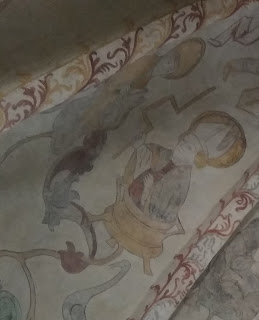
The detail in question concerns the representation of Saint Erasmus, also known as Saint Elmo, whom we find in the second vaulting of the nave next to Saint Denis, or Dionysius if one prefers. Saint Erasmus was, according to legend, the bishop of Formia, who was martyred in a typically gruesome fashion: He had his entrails drawn out with a windlass, and he was himself boiled in a pot. As is typical in medieval Christian art, the martyr Erasmus is depicted holding one of the (often several) instruments of his torture, in this case the windlass. Among the other saints in Skive we see the same pattern, although some have other symbols of their martyrdom than the instruments, such as Erasmus' neighbour Denis, who holds the top of his skull, which his assailants chopped off.
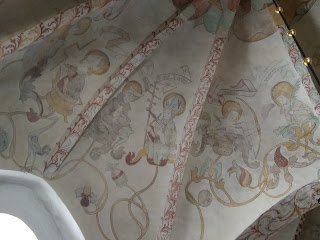
In the case of Saint Erasmus, however, the artist has decided to present the legend of the saint by more ways than one. Possibly inspired by the vogue of the time which had saints emerge from flower bulbs, the artist has replaced the bulb with the pot from Saint Erasmus' passion, making the saint stand out among his colleagues, as can be seen in the second of the blogpost's two images. The reason for this choice is unknown to us, and can be interpreted in several ways. Was it a humorous choice? Or did it grow - pun intended - out of devotion for the saint, resulting from a wish to make Erasmus more notable, or to have his legend represented in more detail? Did it follow a wider trend of the period, a period in which Erasmus enjoyed widespread popularity as one of the fourteen holy helpers? Ultimately we do not know, but we can still enjoy the result of this decision taken during the work of 1522.
fredag 7. januar 2022
Saint Knud Dux, Saint Hulpe, and the limits of saintly fame
Today,
January 7, is the feast of Knud Lavard, son of the Danish king Erik Ejegod (r.1095-1103),
who was murdered by his cousin Magnus, son of King Niels (r.1104-34). The
murder took place at Haraldsted near Ringsted on Sjælland, and Ringsted became
the centre of Knud’s cult. While the formal canonisation of Knud only came in
1169, the Benedictines of Ringsted Abbey began preparing the ground for his
cult already in the 1130s. Knud is typically known as Knud Dux, in order to
distinguish him from his sainted uncle Knud Rex, who was killed in Odense in 1086.
The cult of Knud Dux was strongly promoted by Knud’s son Valdemar (sole king of
Denmark 1157-82), apparently in direct competition with the cult of Knud Rex,
whose centre was in Odense. Knud Dux became a patron saint of Valdemar’s new
dynasty, but due to tumultuous periods of conflict between various pretenders
to the Danish throne throughout the thirteenth and early fourteenth century,
the cult of the sainted duke appears to have had limited, albeit notable,
impact beyond Sjælland. One example of this limited but notable impact can be
found in a book printed in Lübeck in 1492, and this blogpost aims to explain
both how the inclusion of Knud Dux in this book shows both the significance as
well as the limit of his cult in the later Middle Ages.
The book in question is the collection of saints’ lives Das Leuend der Hÿlghen,
or Passionael, printed by Steffen Arndes. The first edition of this book
appeared in 1488, and a second expanded edition came in 1492. In the second
edition, Arndes included a number of Scandinavian saints, including both Knud
Rex and Knud Dux. As both these saints were known in the cultural geography in
which both Northern Germany and Denmark participated, the inclusion of these
saints are not surprising. Moreover, Arndes had several customers in Denmark
and Sweden, so the inclusion of these saints can also be seen as a kind of
marketing.
Passionael contains a number of beautiful woodcuts depicting the saints of
the given chapters. In many cases, the woodcut was specifically made for the
saint in question, such as the vignette for Knud Rex, which depicts him as a
king and shows him holding a sword, which was his main attribute. At the
opening of the chapter of Knud Dux (f.181r), the vignette shows a youngish man
with hair to his shoulders and with his palms pressed against each other,
ostensibly in prayer. His head resting on a cliff or a rock. Around his neck is
a collar that possibly is meant to signify ermine, thereby pointing to his
noble or royal background. Above him stands an executioner with a curved sword whose
edge is planted firmly in the saint’s head.

The legend of Knud Dux from Das Leuend der Hÿlghen, f.181r
Syddansk Universitetsbibliotek RARA M 15
The vignette does in a way fit with the legend of Knud Dux in that the person in the picture is young and of highborn status. However, the death of Knud was brought about not by an executioner but by a group of his cousin Magnus’ men, not by an executioner who, in saint stories at least, is effectively an official representative of secular power. The legend of Knud Dux as it is narrated in Passionael follows its typical pattern, although its precise source has not yet been established, and therefore there is a distinct dissonance between the legend and the image. The explanation is simply that the image is recycled.
The image of the young man appears again on f.400r, and although it appears later in the book, this chapter appears to have been part of the first edition from 1488. The chapter beginning on f.400r tells the legend of Saint Hulpe, the son of the king of Sicily at the time of a certain Emperor Anthony. Saint Hulpe is likely apocryphal, and the history of his cult is unknown to me at this stage. What is notable, however, is that Hulpe fits the vignette much better than does Knud Dux, and it seems certain that Arndes recycled the image for the Danish saint because of some overlaps between the two: youngish age, royal background, killed by the sword.
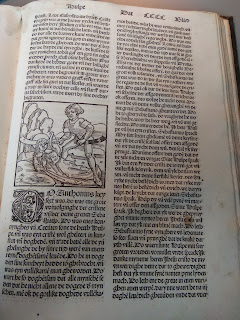
The legend of Saint Hulpe from Das Leuend der Hÿlghen, f.400r
Syddansk Universitetsbibliotek RARA M 15
Such recycling of images is not uncommon in printing, so it is not surprising to see it done in Passionael. What is interesting about it, at least to me, is what it tells us about the impact of the cult of Knud Dux at the close of the fifteenth century. On the one hand, he was a figure sufficiently well known throughout the Western Baltic that he was included in a collection of saints’ lives produced in Lübeck. On the other hand, he appears to have not been sufficiently important to warrant the production of a specially made woodcuts, even though such woodcuts were made for most, perhaps even all, of the other saints whose chapters were added in the second edition of Passionael. Granted, we need to be careful about using the recycling of woodcuts and images as measures of popularity. There might have been other elements at play than Knud Dux’ fame or relative lack thereof, but the case nonetheless serves as an interesting reminder of the potential limits of a cult’s popularity, despite its relative broad dissemination beyond its cult centre.