onsdag 31. juli 2013
Oh, to be in England
Due to technical difficulties, my blog is currently in a doldrum. Consequently, I found it proper to put up this lovely poem by Robert Browning in order to keep up the frequency of posts (four a month as a minimum). It is not April, Eliot's cruellest month, nor am I abroad pining for my native home, yet I have recently felt a growing desire to see England again, and since Browning wrote this in Italy, where I've spent a week myself this summer, I thought it a thematic fit.
Home thoughts, from abroad
Oh, to be in England
Now that April's there,
And whoever wakes in England
Sees, some morning, unaware,
That the lowest boughs and the brushwood sheaf
Round the elm-tree bole are in tiny leaf,
While the chaffinch sings on the orchard bough
In England—now!
And after April, when May follows,
And the whitethroat builds, and all the swallows!
Hark, where my blossomed pear-tree in the hedge
Leans to the field and scatters on the clover
Blossoms and dewdrops—at the bent spray's edge—
That's the wise thrush; he sings each song twice over,
Lest you should think he never could recapture
The first fine careless rapture!
And though the fields look rough with hoary dew,
All will be gay when noontide wakes anew
The buttercups, the little children's dower
—Far brighter than this gaudy melon-flower!

mandag 22. juli 2013
Travels in Tuscany, part 2 - Boccaccio's Birthplace
(...) if ever
anyone required or appreciated comfort, or indeed derived pleasure
therefrom, I was that person.
- The Decameron,
preface, Giovanni Boccaccio (translated by G. H. Mcwilliam)
In the previous
blogpost I gave a very brief summary of the Conference for Medieval
and Renaissance Music held this year in Certaldo, July 4-7. Certaldo
claims to be the birthplace of Giovanni Boccaccio (1313-75), and I
believe it was for this reason it was chosen as the host of this
year's conference, seeing as this year is the 700th anniversary for
Boccaccio's birth. In this blogpost, therefore, I aim to show you how
great a star Boccaccio truly is in his alleged birthplace.
It
is, of course, no wonder that the Certaldese have pressed Giovanni
Boccaccio to their collective bosom. He is one of the major literary
figures in Italian and also world history, and his most famous work,
The Decameron, is one
of the most important pieces of secular literature to have come out
of the Middle Ages. Despite Boccaccio's great renown, however, there
are some important details missing from his biography, and
particularly his place of birth has been a matter of some contention.
Previously, there circulated a theory that his mother was French and
that he himself had been born in Paris. G. H. McWilliam, translator
of the Penguin Classics edition of The Decameron,
dismisses this idea in the introduction to his 1972 translation.
Paris being
discarded, there are currently two major candidates to the title of
Boccaccio's birthplace. One is Florence, the other is Certaldo, and
although McWilliams favours the former, the latter has spared no
enthusiasm in commemmorating their potential native son, as will soon
be quite evident. It should also be noted, however, that although
Certaldo may not be Boccaccio's birthplace, he did spend his last
thirteen years in this city, so their enthusiasm is not completely
misplaced should it turn out he was born in Florence.
Regardless of
precisely where Boccaccio entered this world, he was born of a
well-off family. His father was a Florentine merchant-banker from the
Compagnia dei Bardi, and in the mid-1320s Boccaccio was sent to
Naples to learn the basics of trade and commerce. His time in Naples,
and his mercantile background, can be seen reflected in several of
his stories, in particular the fifth story of the second day.
Eventually, it became clear that the young Tuscan was not cut out for
the banking business, and was turned to the study of canon law. This
attempt ended the same way as his banking career, and soon he
dedicated himself to literary pursuits. At this time, Naples was a
significant intellectual centre thanks to the court of King Robert of
Anjou, where Boccaccio gained entrance through his family
connections. His time in Naples was, in the words of G. H. McWilliam,
"crucial to the development of his artistic sensibility".
In
1341 Boccaccio returned to Florence where, according to his
introduction to The Decameron,
he witnessed the ravages of the plague. To what degree this is true
remains uncertain, and it may very well be that Boccaccio had himself
done what his literary figures would later do and fled the town.
Later, he was sent on several minor diplomatic missions, representing
the commune of Florence, and these missions took him both to the
Papal court of Avignon and Naples. He later settled in Certaldo,
where he is said to have contracted the plague and died.


Casa Boccaccio, Certaldo Alto
The Certaldese take immense pride in their claim to fame in Italy's literary history, and this is reflectd in the numerous venues named after the great writer. The two most important and significant places of interest for Boccaccio enthusiasts are located in the old city, Certaldo Alto or High Certaldo, overlooking the river valley from its plateau. Here, pilgrims will find the house in which Boccaccio lived, Casa Boccaccio, a favourite motif for the local postcard industry, which is now a museum open to the public, and where the book presentations during the MedRen conference were held. Secondly, there is the Church of Saints James and Philip, located by Via Boccaccio, the main street of the old city, where the writer lies buried not far from the local saint Blessed Giulia. To a medievalist like myself, this is of course the two most tantalising targets for a literary pilgrimage.

Chiesa di Santi Jacopo e Filippo


Me posing with Boccaccio at the Pretorian palace, Certaldo Alto
Image credits: Danette Brink
For those more
attentive to their stomachs than their minds, there are alternate
venues in which to commemmorate Giovanni Boccaccio, namely
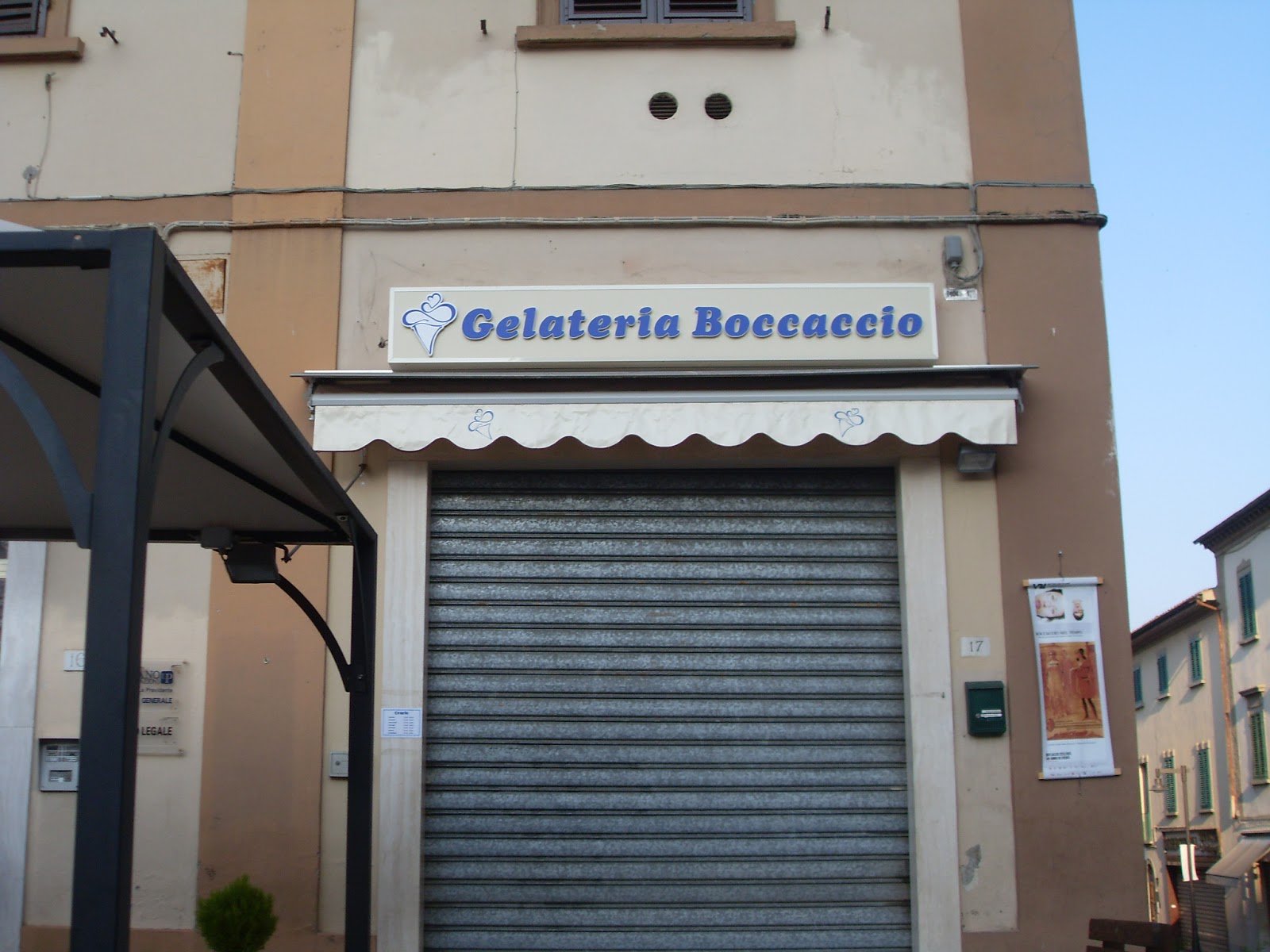
restaurants and cafés, such as Bar Boccaccio or Enacoteca Boccaccio.


More venues of this
kind - heaped under the general umbrella of gusteria, or
pleasure - can be found in the new city, Certaldo Basso. Here is a
pizzeria and a gelateria named after the author, and also a theatre
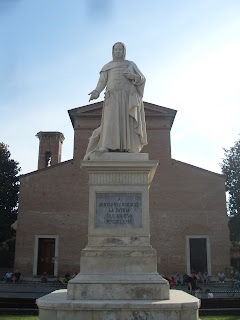
of some kind, and of course, a white statue right outside the church
of St. Thomas the Apostle and close to the cable-car going up to
Certaldo Alto.



It was very clear
that the city was engaged in the seventh centennial of Boccaccio's
birth. Everywhere there were posters advertising a new play based on
the ten storytellers of The Decameron, and in a local pastry
shop this baked beauty could be found:

And what's more:
even in the tiniest minutiae of public life, a nod to the great
author could be spotted, such as this environmental advertisement
fastened to one of the public litter bins, ostensibly making a pun on
the Italian word boccaccia, which means grimace:

All in all, it is
very evident that the Certaldese take immense pride in their
connection with Giovanni Boccaccio, and that they exploit this aspect
of their history to full effect. In some respects there is something
charming and lovingly about this embrace, such as the statue in
Certaldo Basso and his monument in Chiesa di Sancti Jacopo e Filippo,
yet other nods are more clearly designed to draw a crowd rather than
being done out of any love for the author. This is of course
understandable, but it becomes wearisome in the end, and is a good
reason for spending most of the time in Certaldo Alto, where such
references are widespread but more natural.
References
All information concerning Boccaccio's life is taken from
Boccaccio, Giovanni, The Decameron, translated by G. H. McWilliam, Penguin Classics, 1972
References
All information concerning Boccaccio's life is taken from
Boccaccio, Giovanni, The Decameron, translated by G. H. McWilliam, Penguin Classics, 1972
søndag 14. juli 2013
Travels in Tuscany, part 1 - The Conference in the Citadel

The whole
company, ladies and gentlemen alike, were in favour of telling
stories.
- The Decameron,
Giovanni Boccaccio (translated by G. H. McWilliam)
Every year a large
group of musicologists gather for the Conference of Medieval and
Renaissance Music, both for the purpose of presenting new finds of
their own and to learn of new finds by fellow researchers. This group
encompasses both the very seasoned professors and the undergrad
neophyte, and the range of subjects being treated is delightfully
diverse. This year, for instance, there were papers on topics such as
the office for Saint Catherine, the liturgical programme of
Reconquista Spain, a song from the Cambridge Songs and late medieval English carols.

Via Boccaccio, from Palazzo Pretorio
The MedRen
conference was this year held in the Tuscan town of Certaldo,
allegedly the hometown of Giovanni Boccaccio, and my supervisor for
my Master's thesis invited me along to participate in a session
arranged by one of his colleagues. Naturally, I accepted the offer
gladly, and for a few days in the beginning of July I sauntered among
musicologists in the medieval old city of Certaldo Alto overlooking
the Tuscan denes and hills and soaked up knowledge.
The reason why I - a
mere historian - was invited to a conference for musicologists was as
follows. For my thesis I had looked at various texts for Edward the
Confessor, and in particular a set of liturgical texts contained in a
manuscript from the turn of the 14th century which had until then
been ignored by scholarship. In the course of my work I managed to
date one of these liturgial texts - an hexameter couplet - securely
to the timeframe 1161-66, and this was one of the major discoversies
of my research. The item in question belonged to the liturgical
repertoire of Matins - known as the historia or the part of
the liturgy recounting biographical details of the saint - and since
the session in Certaldo took the historia as its subject, I
was asked to contribute.

The conference
lasted four days was comprised of 52 sessions. Each session was about
90 minutes long, and four sessions ran parallel at their alloted
hours, with intermingled coffee breaks, lunches, book presentations
and concerts. I went to a number of these sessions, but I could only
manage two sessions a day since in many cases the papers given dealt
with details far too technical for me to grasp or follow at great
length. I felt very much like a fish out of water, but then again,
that was how evolution started, so I absorbed as much knowledge as I
could master and I did indeed learn a great deal. When I was not
listening to papers, I walked about the old medieval town in
exploration of its museums, churches, streets and gelaterias, or
socialised with fellow academics who, like me, had come to present
their findings. I met a great number of interesting people, and I
almost learned as much from these sociable chats as from the papers
themselves, and although I acknowledged the gap between their mastery
of the subject and my own feeble clutching at straws, I found it very
inspiring to be in the presence of such a great number of brilliant
people.

Palazzo Pretorio
Unfortunately, this
was the last day of the session, so some people were already leaving
town, while others were perhaps drawn more to the parallel sessions.
Whatever the reasons, the turnout was not great and I would have
liked a more numerous audience. Nonetheless, it was a good and
attentive crowd - with the exception of two rude cretins who walked
out in the middle of my paper (seriously, you don't do that) - and I
very much enjoyed presenting my findings.

The Chiesetta, dedicated to Saints Thomas and Prospero
The conference
experience was, in sum, a very encouraging experience, and it
reinforced my belief in the necessity of interdisciplinarity in
medieval studies, for although I am no musicologist I nonetheless
found it extremely rewarding to exchange experiences and knowledge
with the brilliant minds in the field of musicology, and I do hope
that the musicologists, too, will see the benefits in such an
exchange - which I'm confident that they will, because they are
brilliant.

Coffee break in the courtyard of the pretorian palace

onsdag 3. juli 2013
The King's Beard - Richard II and the Wytham Roundel

[He was] tall and
slim, wise, regal and his beard was white as milk, his skin roseate
and his face appeared satisfied.
- The Life of
Blessed Edward King and Confessor, Osbert of Clare (my translation)


The Wilton Diptych, from wikimedia commons
Recently, on one of
my favourite blogs, I read a wonderful little piece in
which Wytham Church of All Saints in Oxfordshire was presented. The current church was rebuilt to its
present appearance in the period 1811-12. On the inside it is
decorated with sculpture and stained glass from sundry epochs that
have been gleaned from various other venues. I was particularly
fascinated by two roundels with stained glass, and they led me to
write this present piece. The images are most courteously lent by A Clerk of Oxford.

14th-century saint ostensibly modelled on Anne of Bohemia, courtesy of A Clerk of Oxford

14th century saint ostensibly modelled on Richard II, courtesy of A Clerk of Oxford
According to the
church website and information made available at the church itself,
these two roundels date from the late 14th century, and they are said
to depict royal saints rather than contemporary historical figures.
Despite this claim, however, it is acknowledged that the two faces in
question bear resemblance to King Richard II and his wife Anne of
Bohemia. In this blogpost I will take this claim seriously and
compare this image of a saint looking like Richard II with other
contemporary representations of him.
Richard II died in
1400, about 33 years old, and depictions of him portray him often as
a young man. In the the Wilton Diptych, commissioned by the king and
executed in the mid-to-late 1390s, his youth appears almost
exaggerated considering he was nearing thirty by the time it was
ordered. It may, however, be that the image is meant to capture the
king's likeness in retrospect, depicting the accession to the throne
as a boy of 10 in 1377. This hypothesis is strengthened when we
compare the Wilton Diptych with the depiction of Richard in the Liber
Regalis - the book of the coronation order - from c.1382,
prepared for the accession of his wife Anne of Bohemia. Here we see
Richard's face adorned by the two wisps of beard, similar to the face
in the Wytham roundel.

Liber Regalis, c.1382, from wikimedia commons
By this time the
king was about 15 years old. It is tempting to say that the
illuminator of Liber Regalis has added some age to Richard's
appareance - perhaps to give him greater gravity - and thus gone the
opposite route of the makers of the later Wilton Diptych. This is,
however, mere speculation.
Despite the king's
aged countenance in Liber Regalis, several depictions from the
1390s portray Richard II as a young-faced monarch. First of all, we
see this in one of the most famous images of the king, showing
Richard seated on his throne in coronation regalia. This
panel-painting - allegedly the earliest portrait of an English
monarch - was made in the 1390s by an unknown master. Although the
coronation regalia suggest that this depiction, like the Wilton
Diptych, may be retrospective, it is interesting to note that two
such portraits came about in the 1390s.

Anonymous master, Richard II, from wikimedia commons
Another
depiction, however, suggests that the above image is not
retrospective but contemporary. The depiction in question is an
illumination from Philippe de Mézières' Epistre
au roi Richart, the letter to
king Richard, composed in Central France in 1395-1396. This book was
given as a token of friendship from the French king and his people,
and on the second folio we see an illumination showing Philippe de
Mézières handing his book to Richard II. The king is here depicted
as a young and clean-shaven man.

The
last portrait of Richard II from his own lifetime to be presented
here, is the effigy made for his tomb in Westminster Abbey. Here we
find once more the king's characteristic wisps of beard issuing from
either side of his chin, though less profusely than in Liber
Regalis. The king's youth is
hard to detect in this effigy, but whether this is because age has
been added for gravity or whether he had aged significantly during
the times of civil unrest remains an open question. It may also,
however, have been that the artist making the effigy added years
because he did not expect the young king to depart very soon.

Richard II's tomb, copyright Westminster Abbey

Richard II's effigy, copyright Wesminster Abbey
King
Richard II was deposed by Henry Bolingbroke in 1399 and died the year
after. Shortly after his death, the Book of the Capture and Death of
King Richard II - La Prinse et mort du roy Richart
- was prepared in Central France. The book came about in the timespan
c.1401-c.1405 and was written by Jean Creton. Here we see a number of
illuminations of Richard II, in all of which his wisps of beard are
depicted clearly, but these representations appears to add some age
to his features, though it is difficult to assess whether this is
actually the case, or - if it really is the case - whether this is
deliberate or not.

Richard II at Conway, MS. Harley 1319, courtesy of British Library


Richard II disguised as a priest, MS. Harley 1319, courtesy of British Library

Richard the II and Bolingbroke, MS. Harley 1319, courtesy of British Library
Now
let us return to the Wytham roundels. From the images we have seen
depicting Richard II,we see there is a clear resemblance betweent
these and the face of Wytham, characterised first of all by the
easily recognisable beard. However, if we are to accept the claim
that this is not Richard but a saint made to resemble him, a very
interesting question naturally arises: which saint is this?
To my
mind, the most probable answer is St. Edward the Confessor (d. 1066,
c. 1161), whom Richard II adopted as his particular saint. Richard's
embrace of Edward the Confessor manifested itself in 1381 when the
king started to visit his tomb in times of trouble for solace and
counsel. Gradually, Richard's devotion to the Confessor became more
acute, and in 1390 he attended Prime, Vespers, Compline and Matins on
Edward's translatio,
and during Mass that day he wore his crown. Richard II also began
more and more to identify with, or at least emulate, Edward the
Confessor, and in the Wilton Diptych we see Richard presented to the
virgin by Edward, Edmund and John the Baptist. Furthermore, Richard
impaled his coat of arms with the arms of the Confessor, and although
this was not done publicly until 1397, we see this new heraldic
conflation on silverware items from before that year.

Katherine
J. Lewis has also suggested that following the death of Anne of
Bohemia in 1394, and prompted by his childlessness, Richard began to
emulate the Confessor's virginal virtue by presenting himself as a
virgin king.
If
the Wytham roundel is meant to depict St. Edward the Confessor, it is
therefore only natural that the depiction should be modelled on the
king who was his most eager devotee. This idea is particularly
tantalising when we consider that the glass was donated by the
Golafre family, who had served at Richard's court and must have been
familiar with his devotional tastes.
The
case for Edward the Confessor therefore fits well with both the times
and the religious climate at court. It is further supported by the
conflation of appearances executed in the roundel. The face has
Richard's characteristic beard, but it is given the whiteness of old,
sagacious age so common to the representations of Edward the
Confessor.

Edward the Confessor, MS. Royal 20 A II, courtesy of British Library
Whether
the roundel at Wytham does depict Edward the Confessor or not, may
probably never be properly answered. Nonetheless, the evidence in
favour of this proposition is considerable. It may be further
strengthened by the fact that a boss inside the church depict the
arms of the Confessor, but this may be a coincidence given the
compilatory nature of the decorations, or it may refer to the
University College of Oxford, which in modern times has adopted the
legendary arms of Edward the Confessor as its emblem. In any case, it
makes perfect sense if the donors of the glass modelled Edward the
Confessor's likeness on that of Richard II, resulting in perhaps the
most overt conflation of devoted and devotee in the history of
English royalty.

Arms of Edward the Confessor, courtesy of A Clerk of Oxford
References
Books
Binski, Paul, Westminster Abbey and the Plantagenets: kingship and the representation of power, 1200-1400, Yale University Press, New Haven, 1995
Bloch, Marc (ed.), “La Vie de S. Edouard le Confesseur par Osbert de Clare,” Analecta Bollandiana 41, 1923
Hector, L. C., and Harvey, Barbara F. (eds. and transl.), The Westminster Chronicle 1391-1394, Clarendon Press, Oxford, 1983
Lewis, Katherine, "Becoming a Virgin King: Richard II and Edward the Confessor ", printed in Riches, Samantha J. E. and Salih, Sarah (eds.), Gender and Holiness - Men, women and saints in late medieval Europe, Routledge, 2002
Mitchell, Shelagh, "Richard II: Kingship and the Cult of Saints", printed in Gordon, Dillian, Monnas, Lisa and Elam, Caroline, The Regal Image of Richard II and the Wilton Diptych, Harvey Miller Pub-lishers, London, 1997
Saul, Nigel, Richard II, Yale University Press, New Haven, 1997
Tuck, Anthony, ‘Richard II (1367–1400)’, Oxford Dictionary of National Biography, Oxford University Press, 2004; online edn, Jan 2009 [http://www.oxforddnb.com/view/article/23499, accessed 3 July 2013]
Websites
http://aclerkofoxford.blogspot.no/2013/06/white-at-wytham.html
http://www.westminster-abbey.org/our-history/royals/coronations/guide-to-the-coronation-service
http://www.westminster-abbey.org/our-history/royals/coronations/richard-ii-and-anne-of-bohemia
http://www.wytham-church.org.uk/stained-glass-all-saints-church-wytham.htm


torsdag 20. juni 2013
Saint Sebastian with beard
As
readers of this blog will have noticed, I have a particular
fascination for Saint Sebastian (as evidenced here and
here).
This fascination stems in part from how his cult has affected
medieval art and iconography, and in part from the iconographic
evolution the saint himself underwent toward the close of the Late
Middle Ages, when he was adapted into a more apollonian iconography.
For more information on this transition, see Hasan Niyazi's excellent blogpost.
The
transition of Sebastian from a soldier-saint largely of the same
mould as SS. George and Christopher into an apollonian youth, is a
testament to the quattrocento's commitment to classical postures and
imagery. This is also the transition - or perhaps rejuvenation - of a
bearded late-antique soldier growing into a barefaced athletic
youngster. Such a transformation should of course not be
misunderstood as a pagan appropriation or a return to the Roman
pantheon, but it is interesting to note how ancient iconography was
adapted into a Christian context, and how the Christian Saint
Sebastian became represented through the symbols of the religious
system he allegedly abandoned and which in turn resulted in his
martyrdom.
In
this blogpost, however, I present a few representations of Saint
Sebastian from before and into the apollonian shift, depicting him
with a bearded face in a manner customary to non-clerical male
saints. It is interesting to note that the selection spans four
centuries and includes both French, Italian and German renditions. Almost all the images are taken from the British Library online catalogue.

The torture of Saint Sebastian, MS. Royal 20 D VI, France, 2nd quarter of 13th century

From MS. Royal 19 B XVII, Legenda Aurea, France, 1382

From MS. Egerton 1070, French book of hours, c.1410


From MS. Yates Thompson 5, book of hours after the Roman Use, Central France, c.1500
In the last case I have cheated a little bit, since we clearly operate in a borderland. I have nonetheless decided to include this 16th-century German depiction, just to illustrate the variety which existed well into the apollonian paradigm.

Saint Sebastian, detail from the Isenheim Altarpiece by Matthias Grünewald, c.1510
Image courtesy of this website
As we see, the depictions of Saint Sebastian retained a certain variety even after the Italian masters such as Andrea Mantegna and Sandro Botticelli had cast the saint in a new, apollonian appearance. We see also that Sebastian enjoyed a fairly wide geography of devotion, and this may of course account for some of this variety. It is, in any case, important to note that the most famous rendition of Saint Sebastian is far from the only one.

torsdag 13. juni 2013
A Spanish Romance of Tristan
The romance of Tristan and Isolde is one of the most enduring and widely disseminated romances of the Middle Ages, and it was known in numerous renditions, adaptations and translation. In the mid-12th century, an Anglo-Norman verse rendition was written at the court of Henry II by an author known only by his first name, Thomas. This work survives only in fragmentary form, and was probably written for Eleanor of Aquitaine. M. Dominica Legge suggests that it was through the Angevins this work was transmitted to other countries. Through her daughters the opus most likely travelled to Spain, Sicily and Germany, and by 1226 it had also been rendered into Norwegian.

Tristan battling fourteen knights of the round table, from the Prose Tristan
MS. Additional 5474, French, last quarter of the 13th century
Courtesy of British Library
The poem I want to present to you is a short Spanish ballad written sometime in the 15th or 16th centuries, known as Romance de Don Tristán. It depicts Tristan's death, but from the vantage point of an unknown female figure who concludes the narration with a strange story of her pregnancy. How this relate to the story of Tristan's death I do not know, but it is presumably an allusion to the Virgin Mary and the lily of the Annunciation. The translation is by J. M. Cohen.
Romance de Don Tristán
Herido está Don Tristán - de una mala lanzada,
diérasela el Rey su tío - con una lanza herbolada.
Diósela desde una torre, - que de cerca non osaba.
Que el hierro tiene en el cuerpo, - de fuera le tiembla el asta;
valo a ver la reina Iseo, - la su linda enamorada,
cubierta de un paño negro, - que de luto se llamaba.
Viéndole tan mal parado - dice así la triste dama:
"Quien te hirió, Don Tristán - heridas tenga de rabia,
que no hallase maestro - que sopiese de sanallas."
Júntanse boca con boca - como palomillas mansas,
llora el uno, llora el otro, - la cama bañan en agua;
Júntanse boca con boca - como palomillas mansas,
llora el uno, llora el otro, - la cama bañan en agua;
allí nace un arboledo - que azucena se llamaba,
cualquer mujer que la come - luego se siente preñada.
!Así hice yo, mezquina, - por la mi ventura mala!
Romance of Sir Tristram
Sir Tristram has been wounded by an evil lance-thrust, which the King his uncle gave him with a poisoned lance. He dealth it him from a tower, for he dared not come near. He has the iron in his body, and the haft trembles without; Queen Iseult, his lovely mistress, goes to see him, swathed in black cloth which was called the (cloth of) mourning.
Seeing him in such an evil plight, the sorrowful lady said: 'May he who wounded you, Sir Tristram, suffer in agony. For there is no surgeon to be found skilled enough to cure your wounds.'
They put their mouths together like tame turtle-doves. The one weeps, the other weeps, they bathe the bed in tears. There grew a bush that was called the white lily; any woman who eats of it immediately feels herself pregnant. I did so, poor girl that I am, to my own misfortune.
References
Cohen, J. M. (ed. and transl.), The Penguin Book of Spanish Verse, Penguin Books, 1988
Legge, M. Dominica, Anglo-Norman Literature and its Background, Clarendon Press, 1963
Rindal, Magnus (transl.), Soga om Tristram og Isond, Det Norske Samlaget, 2003
tirsdag 11. juni 2013
The Mystery of the Maastricht Monkeys, part II - The Ship of Fools
Laughter abounds
in the mouth of the fool
- Latin proverb
(my translation)
For fools a mirror shall it be
For fools a mirror shall it be
Where each his
counterfeit may see
- The Ship of
Fools, Sebastian Brant (translated by Edwin Zeydel)

Frontispiece to The Ship of Fools, Master of Hainz Narr, courtesy of this website
In the previous blogpost I took as my starting point an illumination, shown below,
from the early 14th-century book of hours MS. Stowe 17, examining its
execution in view of the beast-fable tradition of medieval
literature, reaching back into the mid-11th century and going up to
the 14th. In this instalment, I wish to look at another literary
tradition - the topos of the ship of fools - and contemplate this
illumination as a possible precursor to this topos. This is not to
say that I postulate a direct connection between the illumination and
the ship of fools; I do not believe such connections can easily be
established and I will not attempt it here. However, what I seek to
do is to position this illumination at the onset of a tradition that
informed Sebastian Brant's satire Das Narrenschyff, or The
Ship of Fools, from 1494, suggesting that the same current which
informed this illumination may have laid the groundwork for what
later grew into a clearly discernible literary topos of its own. To
do this, I will first bridge the gap between the early 14th-century
illumination and Brant's satire by giving an overview of literary
influences from the 14th century and up to 1494. I will then explain
the concept of the ship of fools topos, and afterward conclude with
some summary remarks.
Again I want to thank Johan Oosterman and Sarah J. Biggs for their invaluable contributions to this blogpost.
Again I want to thank Johan Oosterman and Sarah J. Biggs for their invaluable contributions to this blogpost.

MS. Stowe 17, early 14th century, Liège, courtesy of British Library (with thanks to Sarah)
Background -
Early 14 century to 1494
Medieval satire often attacked, and sometimes sought to redress, various vices termed as follies, and this was, as Edwin Zeydel points out, a commonplace in medieval literature (1). What constituted such behaviour could vary according to the author's emphasis. Nigel Wireker's late-12th-century Speculum Stultorum, the Mirror of Fools, specifically targeted ambitious and hypocritical clerics, while Fiore di virtù - attributed to Tommaso Leoni and adapted by Hans Vintner in 1411 as Pluemen der Tugend - made a showcase of several types of fools.
The archetypal fool was of course the Biblical fool referred to in psalms 14 and 53 who "saith in his heart, there is no God", and at the medieval court the jester's bauble - his "rod of office (...) carved with an elaborate head with the ears of an ass" (2) - was a stark contrast to the king's rod and sceptre, making the jester akin to a mirror image of the wise king of medieval kingship, based on the rex sapiens of Proverbs and Wisdom (3).

Dixit
insipiens in corde suo: Non est Deus
MS. Hague KB78D38, 15th century, with thanks to Erik Kwakkel
MS. Hague KB78D38, 15th century, with thanks to Erik Kwakkel

Fool in yellow, with thanks to Johan Oosterman
Medieval
kingship contributed another counterpart to the fool, namely the king
who dared humiliate himself in the eyes of God like King David had
done when he stripped naked and danced, mocked by his wife Michal (2.
Sam. 6:20). This was frolicking of a pious kind, and stood in
contrast to the insipid revelry of the fool.

Medieval
satirists employed various conceits to convey their message, and an
important conceit was the foundation of a religious order, comprising
foolish clergy. This occurs both in Speculum
Stultorum
and John Lydgate's Order of Fools,
and although both Wireker and Lydgate were English, it is believed
that the latter brought this conceit back into England via France
(4). Lydgate ordered his satire as a "catalogue of isolated
traits" (5) and made a showcase of them, much in the manner of
Brant's 1494 satire. Sebastian Brant, however, allegedly knew neither
of these works (6), but they are both important stepping stones in
the tradition which later burgeoned into the Ship of Fools.
While
Wireker and Lydgate placed their fools in cloistered communities,
other satires employed the conceit of the ship freighting a merry
band of delinquents and Zeydel remarks that "the idea of placing
careless livers, rakes, drinkers, and the like together upon a ship
was widespread from Holland to Austria before Brant's time" (7).
How the image of a ship became used in this fashion is a matter of
some contention. Early critics of Brant's Narrenschyff
probably drew on a false etymology when they conjectured that it
might stem from carnival floats, which did transport "various
types of comical or fantastic characters", yet not solely in the
guise of ships but also wagons and other types of vessels (8). It may
also be that the image of a ship of fools served as an inversion of
the Ship of God, i.e. the Church.

Prefatory vignette, courtesy of this website
The
idea of a host of fools brought together in a ship and setting off
for a promised land of their own, appeared in several satirical works
of the Later Middle Ages. This paradise of fools had roots in the
Goliardic poetry, and one the early-14th-century Kildare poems
satirises over the corrupt monks living in luxury in the land of
Cockayne. This conceit entered the various languages of Western
Christendom. In German the land was known as Schluraffenland
or Schlauraffenland
(rendered in modern Norwegian as Slaraffenland),
in French Pays
de Cocaygne,
in Italian Cuccagna
and in Holland it was known as dat
edele Lant van Cockaenghen
(9).

The paradise of fools as imagined by Pieter Brueghel the Elder: Het Luilekkerland, 1567
Having
considered the destination of the ship, it is time to say a bit more
about the ship itself as a tradition of medieval satirical imagery.
One example close to the date of the Maastricht illumination is the
Renart-le-Nouvel,
the new Reynard, a late-13th-century continuation of the Reynard
Romance by the Flemish troubadour Jacquemars Giélée which retained
significant popularity into the 16th century (10). Here the ship
metaphor is merely suggested (11), but later works featured it more
heavily. An important example is the Austrian Heinrich der Teichner's
satire Das
Schif der Flust
from c.1360, which tells of a ship filled with gamblers, adulterers
and the like sailing from Linz (12). Their destination is Hungary,
not an imaginary realm, but the conceit is the same as later used by
Sebastian Brant.
The ship laden with moral outcasts continued into 15th-century literature and appeared in Jacob van Oestvoren's Die Blauwe Schute, a Dutch Shrovetide verse from 1413. Here it is stated that Ende alle ghesellen van wilde manieren / (...) Te comen in die Blauwe Scuut (all the wild lads come with you in the blue ship - my translation) (13). Parsons and Jongenelen states that this blue ship is probably based on the carts of Dutch Shrovetide plays (14). It is also interesting to note that Pieter van der Heyden - emulating Hieronymus Bosch - gave The Blue Ship as the title for his 1559 rendition of this topos.
The ship laden with moral outcasts continued into 15th-century literature and appeared in Jacob van Oestvoren's Die Blauwe Schute, a Dutch Shrovetide verse from 1413. Here it is stated that Ende alle ghesellen van wilde manieren / (...) Te comen in die Blauwe Scuut (all the wild lads come with you in the blue ship - my translation) (13). Parsons and Jongenelen states that this blue ship is probably based on the carts of Dutch Shrovetide plays (14). It is also interesting to note that Pieter van der Heyden - emulating Hieronymus Bosch - gave The Blue Ship as the title for his 1559 rendition of this topos.

Hieronymus Bosch, c.1490-1510, from wikimedia commons

Pieter van der Heyden, 1559, from wikimedia commons
However,
Edwin Zeydel identifies some lesser known sources as the more
immediate antecedents for Brant's satire. The probably oldest of
these is the anonymous Die
acht Schalkheiten (c.1450)
which comprised eight woodcuts with rhyming texts (15). Next in the
chronological order is a sermon from the 1460s or 1470s which treats
dem
geistlichen narrenshiff,
i.e. the clerical ship of fools, held on St. Ursula's day and
therefore nicely contrasted with the saint's iconic ship (16). Two
more immediate sources are Felix Hemmerlin's Doctoratus
in stultitia,
which Brant himself edited (17), and finally the academic humorous
oration Monopolium
et societas vulgo des Lichtschiffs,
held by Jodocus Gallus in Heidelberg late in the 1480s and published
in Strassburg in 1489 at the behest of one of Brant's friends. This
oration appears to have drawn from both Teichner and van Oestvoren
(18), and it is through this work we finally arrive in 1494 by the
time of Brant's own satire.

Cart and boat, courtesy of this website
The
Ship of Fools by Sebastian Brant
Sebastian Brant (1457-1521) was born in Strassburg and educated at the University of Basel, an important centre for humanism. He became a teacher and practicioner of canon law, and later entered the realm of book-printing (19). In 1494 he wrote his most famous work, The Ship of Fools, a satire on various fools and expounds in humorous detail the ways in which they err and miss the mark. The satire is described as a compilation of what may have been fliegenblätter, leaflets, focussed on one particular topic and here bound together in one unit (20). The book is divided into 112 chapters, each introduced by a woodcut vignette depicting the foible specific to the chapter (although sometimes the same woodcuts are used for two chapters). In the prologue he devises how he would equip a vessel to gather up the many fools of the world, commenting snidingly that one ship would not be sufficient due to their great number. The ship imagery itself, however, recurs fairly seldom - only in chapters 48, 75, 103, 108 and 109 - and this strengthens the supposition that many of the chapters were written prior to the application of this conceit.

Of Bad Marksmen, chapter 75 (courtesy of this website)
Brant's satire is
rife with humanistic ideal, and irreligion and contempt of wisdom are
some of the most frequent targets for his verbal barrages. The first
chapter, for instance, is dedicated to fools who collect books they
do not understand, and feign learning by replacing certain native
phrases with Latin ones. Sebastian Brant is, however, not a distant
judge. He acknowledges his own folly and dedicates chapter 111 to the
poet's apology, judging himself the way he judges others.

Of Heedless Fools, chapter 12 (courtesy of this website)
In
Brant's contemporary language there were many words for fools, such
as narr,
tore,
affe,
esel
and gouch
(21). This diversity in nomenclature can be said to be reflected in
the wide variety of fools inhabiting Brant's satire, and he ruminates
on such subjects as teaching of children (chapter 6), taking offense
at fools (chapter 40), dancing (chapter 60) and gamblers (chapter 77)
to mention only a few. Despite this diversity, however, the fools
aboard the ship have some important aspects in common: they are all
fools, although their foolery comes in various guises, and they are
all dressed to emphasise this.

My ears are covered
up for me,
If they were not, an
ass I'd be
- The Ship of Fools (chapter 26),
Sebastian Brant (transl. by Edwin Zeydel)
However, although the satire is a general attack on fools, it appears that Brant treats some fools harder than others. These fools are the schluraffen, the lazy-apes inhabiting the land of indolence and luxury, the German rendition of Cockayne. However, although denizens of this fabled country, this is not their final destination. Rather, they're heading for Narragonia, a land invented by Brant himself, and in chapter 108 Sebastian Brant states that "this ship a wreck will be", prophesying a particularly bad end to the fools who also are lazy-apes, "the lazy, carefree carousers of the Land of Cockayne" (22).

You fellows, come
and be on hand,
We're headed for
Schluraffen land
And yet we're stuck
in mud and sand
- The Ship of Fools
(chapter 108), Sebastian Brant (transl. by Edwin Zeydel)
Courtesy of this website
Courtesy of this website

The Antichrist versus Saint Peter, chapter 103, courtesy of this website
Concluding
remarks
What,
then, is the connection between the Maastricht monkeys and the ship
of fools topos? If there is any such connection, I believe it must be
sought in the literary works which combine the various satirical
currents of medieval literature, such the beast-fable exemplified by
Jacquemars Giélée, the idea of an inverted paradise exemplified by
The Land of Cockayne and the idea of a ship manned with the inversive
elements of medieval society exemplified by Jacob van Oestvoren. This
is not to say that there is a direct connection between the
illumination and Brant's satire. Nor is it to say that the Maastricht
monkeys can be placed in squarely in these traditions. Rather, we see
here how certain currents and ideas permeated the medieval conscience
and resulted in various expressions and various media. What all these
currents and depictions have in common is a focus on subversive
elements who go contrary to the ideals of the satirists, often
seeking to rectify these elements, but sometimes merely using them
for a humorous story. What connects the Maastricht monkeys and the
Ship of Fools
is that they both have this focus and that they are informed by
satirical currents prevalent in medieval literature. These currents
drew on a common stock of iconography, which is why we sometimes find
several elements recur in widely different works of literature and
art, exemplified by the illumination from the Austrian Ulrich von
Pottenstein's Spiegel
der Weisheit
(c.1430), seen below. By examining the traditions which informed the
makers of these works we find ourselves in a wonderful world of
mirror-images and mockery through which we may acquire a more complex
understanding of the ideals of medieval society.

Into the fool's ship
toss the ape
- The Ship of Fools,
Sebastian Brant (transl. by Edwin Zeydel)
MS. Egerton 1121, c.1430, Austria, Spiegel der Weisheit, Ulrich von Pottenstein
Courtesy of British Library, with thanks to Damien Kempf
MS. Egerton 1121, c.1430, Austria, Spiegel der Weisheit, Ulrich von Pottenstein
Courtesy of British Library, with thanks to Damien Kempf

Blind fools can only
see this earth
- The Ship of Fools,
Sebastian Brant (transl. by Edwin Zeydel)
16th-century print, with thanks to Erik Kwakkel
16th-century print, with thanks to Erik Kwakkel
Notes
1: Zeydel 1962: 9
2: Corèdon and
Williams 2007: 35
3: Gaposchkin 2010: 106-07
3: Gaposchkin 2010: 106-07
4: Schirmer 1979: 95
5: Zeydel 1962: 10
6: Zeydel 1962: 10
7: Zeydel 1962: 12
8: Zeydel 1962: 11
9: Heuser 1904: 141
10: Houdoy and
Roussel 1874: 14-15
11: Zeydel 1962: 12
12: Pleij 1983: 182
13:
http://www.dbnl.org/tekst/verw011vrou01_01/verw011vrou01_01_0012.php
14: Parsons and
Jongenelen 2012: 37-38
15: Zeydel 1962: 9
16: Zeydel 1962: 13
17: Zeydel 1962: 9
18: Zeydel 1962: 13
19:
Zeydel
1962: 3
20:
Zeydel
1962: 15
21: Zeydel 1962: 9
22: Zeydel 1962: 15

German woodcut, 1549, from wikimedia commons
References
Books
Brant,
Sebastian, The
Ship of Fools,
translated by Edwin Zeydel, Dover Publications, 1962
Corèdon,
Christopher and Williams, Ann, A
Dictionary of Medieval Terms and Phrases,
D. S. Brewer, 2007
Gaposchkin,
Cecilia, The
Making of Saint Louis,
Cornell University Press, 2010
Heuser, Wilhelm, Die Kildare-gedichte; die ältesten mittelenglischen denkmäler in anglo-irischer überlieferung von Dr. W. Heuser, 1904
Heuser, Wilhelm, Die Kildare-gedichte; die ältesten mittelenglischen denkmäler in anglo-irischer überlieferung von Dr. W. Heuser, 1904
Houdoy,
Jules and Roussel, Henri (eds.), Renart-le-Nouvel:
roman satirique composé au XIIIe siècle,
1874
Parsons,
Ben and Jongenelen, Bas (eds.), Comic Drama in the Low Countries,
C.1450-1560: A Critical Anthology,
2012
Pleij,
Hermann, Het
gilde van de Blauwe Schuit: literatuur,
volksfeest en burgermoraal in de late middeleeuwen; met een
nabeschouwing van de auteur,
Amsterdam University Press, 1983
Schirmer,
Walter Franz, John
Lydgate: A Study in the Culture of the XVth Century,
Greenwood Press, 1979
Websites
http://publicdomainreview.org/2011/10/25/navigating-durer%E2%80%99s-woodcuts-for-the-ship-of-fools/
http://www.dbnl.org/tekst/verw011vrou01_01/verw011vrou01_01_0012.php
DISCLAIMER: I have taken most of the woodcut images from The Public Domain Review, where it is stated that these woodcuts were made by Albrecht Dürer. This is a matter of contention and due to lack of evidence I myself do not subscribe to this theory.
Abonner på:
Innlegg (Atom)