And was the holy Lamb of God,
On Englands pleasant pastures seen!
- And did those feet, William Blake

torsdag 30. desember 2021

A year in reading - 2021


I am an indifferent diarist, both because I lack the required stamina and because my life is not sufficiently interesting to warrant much page-space. There are, however, some ways by which I record the vicissitudes of the years, and one such way is by keeping track of my reading. Both as a scholar and as a private individual, much of my time is taken up by reading and also, to a lesser extent by writing, and when I am doing neither I am very often thinking about what I should be reading or what I should be writing. In essence, my life revolves around texts, as is the case of so many others of my various friends and colleagues.     

My reading through a calendar year is guided by various lists. These are goalposts I have set myself, and that have guided my reading for years – the first of these lists came into place in 2008, and since then new lists have emerged. In another blogpost, I might go into greater detail about this reading by lists, as it is a key aspect of how I choose my books and how my reading comes together in the course of a year. For the current blogpost, however, I merely mention this as an explanation of the seemingly sprawling nature of my literary choices, as I take the opportunity of the closing year to reflect on some of my highlights from a year of reading.          


Travelling by page    

Given the pandemic, as well as constrictions owing to money and work, my travelling this year has been rather limited. However, one way of creating some balance in an otherwise rather stationary daily life is to travel by page, and throughout the year I have visited several countries in this way. Some of these countries I have visited for the first time, such as the Marshall Islands, Qatar, Guinea Bissau and Libya. In other cases, the travels have been either revisits or parts of a longer travelogue from a time when the political map was very different from what it is now, meaning that the current names have little meaning when outlining the journeys. Examples of such books are the travelogues of Benjamin of Tudela and Odoric of Pordenone. 


Marshall Islands legends and stories, collected by Daniel A. Kelin II


The Corsair by Abdulaziz al-Mahmoud (translated by Amira Nowaira)

The Ultimate Tragedy by Abdulai Sila (translated by Jethro Soutar)

The Slave Yards by Najwa Bin Shatwan (translated by Nancy Roberts)


Improving languages

Reading is not only done for the purposes of vicarious travel, but also for maintaining my linguistic skills. This element is part of every kind of reading I do, no matter whether the text is in my native Norwegian or another language. This year, I have dedicated some time to improving my Spanish, a language I love dearly and which I should know more fluently than I currently do. Throughout the year, therefore, I have kept returning to various books in the Spanish language – books at various levels, ranging from the comic Mortadelo y Filemón by Francisco Ibáñez to the more complex baroque prose of Jorge Luis Borges or the poetic scenes of Raquel Lanseros and Maribel Llamero, two of my favourite poets in any language. Especially the books of poetry have been of great use in this endeavour, as I have brought them with me on various hikes and journeys, and in this way also used them to connect more strongly with my own native land – but this connection, however, is material for another blogpost


La lentitud del liberto by Maribel Llamero

Matria by Raquel Lanseros

The poem "La loca más cuerda" from Matria


New places for reading        

One important and pleasurable aspect of a reading life is to find new places in which to read, new vantage points from which to see the world, and, very often, new scenes that can provide contrasts between what is being read and where it is being read. For the first eight months of 2021, I was in one way quite constrained in my options for new places for reading, since I was staying in my native village in the Norwegian fjords where I grew up. However, even though the village itself is very small, the area throughout which the village is sprawled is quite vast and full of various nooks, crannies and overlooked places. Additionally, although I was staying in my late grandparents’ house, a house where I spent a large part of my childhood, this year I started using some new spaces in the house for work – and work usually entails at least a modicum of reading. So it was that from January through August, I installed myself in a temporary office indoors, then, when the temperatures permitted, I moved to the porch. Moreover, I spent several wonderful afternoons paddling along the shores of the lake behind the house, deliberately seeking out new spots for reading, and I found a few that served excellently well. These were places that I knew about, but which I had typically passed by when traversing the lake, be it on ice or by canoe, but upon closer inspection they proved to be ideal reading spots as well.


In my late grandfather's room, reading Benjamin of Tudela's Itinerary (translated by A. Asher)


Reading the poem "El sueño de la razón produce monstruos" by Maribel Llamero

This ledge in the cliff was made accessible due to a drought


The opportunities for finding new places for reading opened up even further when I started a new job in Oslo in September. Despite pandemic restrictions and a general caution on my part, I found that the library café of the humanities campus of the University of Oslo provided a splendid vista for early morning reading on the way to the office, or as a workspace for writing notes for articles. 


I also sought out new haunts in the city centre, and I was enchanted by the café Kaffistova (literally, the coffee room), which used to be a meeting place for students and academics from Western Norway about a century ago. While it is now a popular spot for a much wider clientele, there is something of the romantic in me that takes pleasure in reading in a place where other Western Norwegians in academic exiles gathered for a bit to eat and, presumably, to feel a little closer to home. In this place, I have so far mostly read classics from the Oslo literature – books that are set in Oslo and that provide very fascinating details to the city as it was in a bygone age. The first of these was Bondestudentar (Farmer Students) by Arne Garborg, (1851-1924 who also was a Western Norwegian studying and working in Oslo. 

Bondestudentar (Farmer Students) by Arne Garborg

Sult (Hunger) by Knut Hamsun


Another aspect of finding new places is that these places open up for new contrasts between the reading and the place of reading. This aspect also ties in with travelling by page, and since I have mostly done my reading in Norway this year – and exclusively in the northern half of Europe – there can sometimes be quite notable contrasts between where my body is located and where my mind is wandering, guided by the words penned by authors from other parts of the world. So it was that in the Norwegian urban autumn of Central Oslo I read short stories from Morocco by Leila Abouzeid, and while the first significant snowfall still covered the pavements, I read Norbert Zongo’s dictator novel The Parachute Drop, set in the sweltering heat of a fictional West African republic. 


The Year of the Elephant by Leila Abouzeid


The Parachute drop by Norbert Zongo (translated by Christopher Wise)


Sundry highlights     

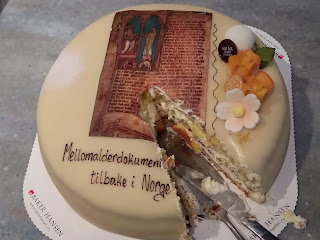
In addition to these three categories, there were also other highlights that are not as easily categorised, but which nonetheless were key points in making my reading year both memorable and pleasurable. For instance, my family and I visited the Norwegian book town (Den norske bokbyen) in the village of Fjærland, a couple of fjords to the south of my own native village. It is always a joy to wander among the numerous book stalls and shops surrounded by a spectacular scenery, and it was great to be back for the first time in several years. Another, and very unexpected highlight, came when I attended a seminar organised by colleagues in Oslo, where they were celebrating that the thirteenth-century manuscript Codex Hardenbergianus containing the law code of King Magnus Lagabøte (r.1263-80), the Law-mender, had been returned to Norway from Denmark. For the occasion they had commissioned a cake containing a picture of the first folio of the manuscript, and I was fortunate enough to have a slice of it. 


A cake featuring the first folio of Codex Hardenbergianus


Other highlights came during a trip to Odense, where I had been invited to speak at a workshop on medieval manuscript fragments. This allowed me to visit a city that is one of my homes away from home, and where I had not been since the autumn of 2019. I sought out one of my favourite cafés and sat down with a cup of tea and Albert Memmi’s The Colonizer and the Colonized while enjoying the familiar scenery and the familiar sounds. The workshop also brought me back to the researcher’s reading room at the University Library of Southern Denmark, where I spent much of 2018 and the spring of 2019 researching the fragments of the university library’s special collections. It was also there that I gave my presentation, addressing several of the fragments that a friend and colleague and brought out for the occasion. The workshop culminated with my first trip to the National Archives in Copenhagen, where we were shown some of the many treasures kept there. 


The Colonizer and the Colonized by Albert Memmi (translated by Howard Greenfeld)


One of the final highlights of the year came when I returned home for Christmas, and was met with an author’s copy of a journal issue to which I had contributed. The text itself was written in 2015, so it is not new as such, but back then it was only published digitally, so it was a great pleasure to see it in the paper.


There were several other memorable moments of reading this year, moments that remind me how much I gain from reading in the way I do, and moments that inspire me to press onward and explore new literary horizons in the coming years. I am already excited about what reading I have ahead of me in 2022, and while I know some of the titles to add to my list of read books – the closest I’ll come to a diary, I suspect – there are others that are as of yet unknown to me. 


Similar blogposts 

For other blogposts touching on my encounters with books in 2021, please see the following. 

The joy of aimless reading, on reading without a particular purpose beyond learning. 

Remembered readings, on recalling circumstances from past encounters with books. 

Travelling by page, elaborating a little on this aspect mentioned in the present blogpost. 

A return to the roots, on going back to a book once frequently used. 

Read at the right time, a reflection on the feeling of immersing oneself in a book at a serendipitous point in time. 

Back to the old haunt, a reflection on the fragment workshop in Odense.


søndag 26. desember 2021

San Esteban in Segovia

 
Today is the feast of Stephen Protomartyr, whose death by stoning is recorded in Acts 7 and came to be a ubiquitous scene in pictorial programmes of Christian art in the Latin West. The figure of Stephen was an important point of orientation in the Christian cult of saints, and since he belonged to the biblical saints his cult spread early, quickly, and widely. Consequently, his feast was celebrated with a high liturgical rank, and churches were dedicated to him throughout the Christian world.

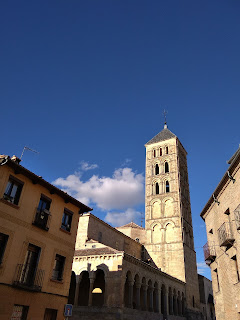
One of these churches is the beautiful Romanesque structure of San Esteban in Segovia, situated within the medieval city and dating to the decades around 1200. Its tower, typical of Spanish churches of the period, is a characteristic feature in the cityscape, and can be seen from quite some distance despite the clustered buildings of the medieval centre. Of all the many landmarks in Segovia, this is by far my favourite, even more so than the impressive late medieval cathedral.   


I have passed by this church a number of times, but never found it open. I keep hoping that next time I visit this wonderful city, I will be able to find my way in.


onsdag 15. desember 2021

Rediscovering work done in a pandemic


This autumn, the main purpose of my paid job is to do research and write articles. It is a phenomenal luxury to do so, and while it keeps me very busy I am also savouring the feeling of being able to focus most of my energy to my two favourite aspects of academic life - two aspects that I have not been paid to prioritise since the autumn of 2017. 

As I'm settling into this new job, I am adjusting to a new rhythm, and as part of this adjustment I am now able to take stock of what I have been doing in the course of the past two years. These two years were very hectic, marked by short term contracts, a lot of teaching and supervision (which was rewarding but very demanding), and innumerable minor but time-consuming administrative tasks. Most of this work was carried out in the early stages of the pandemic, and the added stress of reorganising and accommodating the tight teaching and supervision schedule to an online format required a lot of focus and energy. That stress was further enhanced by the slow response to the pandemic in Sweden, which led to long bouts of self-isolation and worry - but that is an entirely different story. 

The point of this jeremiad is not so much to complain about work - I was fortunate to have it and much of it was very interesting. However, because whatever work I did was marked by the constrictions and limitations imposed by the practical issues of the pandemic, the everyday work schedule became shuffled, altered, and at times rather topsy-turvy, so that it became very difficult to get a good sense of the particulars of that work. As a consequence of this very blurred perception of time, by the end of 2020 I was left with a feeling that I had done nothing to further my academic credentials beyond teaching. And as valuable as teaching is, an academic career depends on the old adage "publish or perish", which meant that I was increasingly left with the feeling that once these short term contracts were done and could no longer be renewed, I did not have very much to show for. I could not remember doing much in terms of writing, except for one short encyclopedia entry and a couple of book reviews. Moreover, archive work was out of the question, and the opportunities for research on primary sources were very limited, especially due to lack of time. By the end of 2020, in other words, I was left with the feeling that I had achieved very little, and my ability to be noted in a very competitive job market had not been improved.  

A year later, however, things have changed sufficiently much that I am able to look back at 2020 and 2021 and evaluate things more calmly more carefully. On the one hand, it is true that my research output has been very limited. On the other hand, however, I did manage to schedule several bouts of source work, in which I did quite a lot of transcription. This work has provided me with material for conference presentations and articles that are currently being written, and this output would have been significantly delayed, perhaps downright impossible, had it not been for the work that I had done in the course of the first year of the pandemic. I had forgotten about this work because the pandemic eclipsed so much of my memory, but now that the rhythm of my working life is different, more secure, I am able to rediscover the work that stress and worry had pushed into oblivion. 

I suspect that this kind of rediscovery, or reminding if you prefer, is waiting to happen for a lot of my fellow academics. Despite my complaints, I have been very lucky and gone through the first two years of the pandemic relatively unscathed, so it has been easier to rediscover the work that I did in-between the recurring online sessions for teaching, supervision, meetings and discussions. This rediscovery is a reminder of how memory can be manipulated and messed up - how time can be squeezed into an achronic ball that lets you remember only muddled collages of moments, and that makes you lose sense of progression and what you have actually achieved. Fortunately, I have been able to straighten that once achronic mess, and I hope that one by one my fellow academics will be able to do the same, because the feeling of not having achieved anything - a feeling not commensurate with historical reality - can really put a dent in both self-esteem and motivation, and essentially lead to a self-fulfilling prophecy.   

tirsdag 14. desember 2021

The Middle Ages as a litmus test

 
The other day, I was shown an excerpt from a recently published book that aimed to provide a reinterpretation of human history, and as a medievalist I was immediately both exasperated and dissuaded from reading the book in question. I am not providing the title of the book because I have not yet read it myself, and because the point of this brief blogpost is not that particular book but rather the problem that the exasperating excerpt represents. 

In short, the brief snippet from the book's introduction made some very general and sweeping statements concerning the Middle Ages, essentially treating the whole millennium-long period as a unified homogenous whole that can easily be represented by a handful of details from one very limited section of that timescape, in this case Latin Christendom. The reason why this is so frustrating to a medievalist, and why this is such a tremendously bad sign for the overall content of any book, is that it is reductive, and also a litmus test that has just been failed. 

Of all the periods into which we have divided historical time - a consequence both of convenience and of limited knowledge or understanding of historical time in general - no period is as weighed down by a negative reputation as what we call the Middle Ages. For the past five hundred years, a very popular narrative has been perpetuated in the West that with the end of the medieval period, humanity entered into a new and better world that had shed itself of its problematic past like a snake sheds its skin. This narrative is problematic in a number of ways, but there are two main issues that cast very long and important shadows. First of all, this narrative sets the trajectory of Western Europe as the standard against which the histories of all other cultures must be measured, which prevents an understanding of those cultures and therefore provide the construction of reductive myths that have little to do with reality. Secondly, the narrative sets up the Middle Ages as a foil for the modern period by which any negative aspects of the modern period are by default overshadowed by the negative aspects of the medieval period. As has been voiced by many medievalists, perhaps most succinctly by Mateusz Fafinski, such a narrative of progress exonerates the modern period for its sins, and makes us blind to the negative aspects that are uniquely modern and that can only be solved by an acknowledgement of the modern nature of those aspects. In addition, a sharp divide between the medieval and the modern periods also prevents us from understanding how many of aspects of modernity actually have their roots in the medieval period, and thus have exerted influence on the historical trajectory for far longer than we tend to think. 

The common view of the Middle Ages is that it was a period of unbridled violence, superstition, regression and ignorance. This view is neatly summarised in the term "the Dark Ages", which is commonly used to signify the entire medieval period, whenever that was according to those who use this expression. Fortunately, there are many brilliant scholars who are working hard to counter and dispel this myth, and I sometimes attempt to do so myself. Unfortunately, however, this effort is made extra difficult not only because this myth is perpetuated by non-experts outside of academia, but also by non-experts within academia. And as any scholar might tell you, when myths are perpetuated by non-experts within academia, that expertise - even though it is completely irrelevant to the subject at hand - gains an enormous weight and roots it even more deeply in the common consciousness. And now we get to the problem about the book mentioned in the beginning of this blogpost. 

Because the Middle Ages are so weighed down by a negative reputation, the medieval period serves as a litmus test for a non-expert's understanding of their knowledge and for that non-expert's understanding of the limits of that knowledge. In academic outreach and popularised presentations of historical issues, we often encounter statements about a period that have been made by someone who is not an expert in that period. An expert in twentieth-century diplomatic history who is talking about the eighteenth century, for instance, will necessarily have a poorer understanding of that period than someone who has dedicated their working life to gain a greater familiarity with that particular period. However, as long as the person acknowledges the limits of their knowledge and manages to emphasise the necessary caveats and to refer to experts who are better placed than they are, this problem is minimised. At the very least, the twentieth-century historian will have some understanding of the basic methodological issues at play, and can therefore better map out their ignorance in the field. If the non-expert talking about a historical period is not trained in history, or in the humanities in general, the risk for making mistakes increases significantly. 

Because the Middle Ages are so weighed down by a negative reputation, the risk of misrepresentation by non-experts becomes particularly high. For this reason, treatment of the Middle Ages by non-experts is a litmus test for how well someone understands their own scientific limitations. In the case alluded to in the beginning, the excerpt was so damning that it suggested a very poor understanding of those limitations, and this problem has implications beyond the book's treatment of the medieval period. To put it bluntly: If a writer is careless about the complexity about the Middle Ages, which other periods or cultures are misrepresented? In the case of the Middle Ages, there exists a sufficiently large corpus of scholarship that can rectify misrepresentations, even though that is often a Sisyphean task. In the case of other historical periods or cultures, however, existing scholarship is perhaps not as large or not as accessible to effectively contradict mistakes, misrepresentations, or myths. In other words, if we are able to catch mistakes concerning the Middle Ages, are there perhaps mistakes that we are unable to catch because those mistakes pertain to fields even less familiar to us than medieval history?  

The Middle Ages are a litmus test because the period occupies a very strange space that combines familiarity and ignorance. On the one hand, non-experts are familiar with the period because they encounter the Middle Ages at school and in popular culture. On the other hand, those encounters at school or in popular culture are often deeply erroneous. The familiarity will therefore create an exaggerated view of someone's knowledge of the period, while the errors inherent in that familiarity will prevent any real understanding. How a non-medievalist talks about the Middle Ages tells you a lot about how that person understands their own knowledge. In other words, the Middle Ages are a litmus test of scholarly humility. And if that litmus test fails, it has implications that reach far beyond issues concerning medieval history.  


tirsdag 30. november 2021

Back to the old haunt - a brief note about a workshop in Odense


A little over a week ago, I was able to travel back to Odense in order to participate in a workshop on fragments of medieval manuscripts. The occasion was immensely joyous to me for several reasons. Most importantly, I got to meet up with old friends, and I was able to revisit some of the places I used to frequent when I was living there. The workshop was also a great opportunity to present some of the material I started working on during the last year of my PhD, and which I have been dealing with on and off ever since then. In particular, it was a true delight to give my presentation in the research reading room of the university library, where I had conducted quite a lot of my research and where I had gathered most of the material for my work on fragments. Another very pleasant detail was that my colleague and friend - with whom I had worked together on a pilot project right after completing my thesis - had put out a few of the books that had fragments in their bindings, some of which I mentioned in my talk. It was great to see those fragments in the vellum again, and it was very much a nostalgia trip. In one sense the workshop was the culmination of research that has been going on for five years, and it was wonderful to share my findings with colleagues who were able to both appreciate and add to the work that had been done. Additionally, however, the workshop was also a reminder that this work is not yet complete - that there are conclusions that need to be questions, hypotheses that need to be calibrated, and an ever-increasing stream of new fragments that come to light in the library's special collection. In other words, the workshop was a reminder of the long processes in academia - the good type of long processes, the ones that mature thoughts into substance and make things come out in a clearer light. I have been very fortunate to have been able to keep up this kind of long-term work despite the vicissitudes of my professional life in the past five years, and for that I remain very grateful, especially to my friends and colleagues who enable me to conduct this work in the middle of everything else.  

Unfortunately, in all the excitement and the discussions with friends and colleagues, I was sidetracked from the photographing I had hoped to do, so I only have a few pictures to commemorate the event - including the library's strict prohibition against dancing on the tables.  


fredag 26. november 2021

Achronology and exoticism - the past as a muddled country


My thinking was: very olden days; almost mythical; so 1628

- Philippa Perry, Richard Osman's House of Games S05E59


Earlier this week I stopped by the campus bookshop, and was met by the array of books for sale shown in the picture below. At first I was naturally drawn to the selection of titles – each of these books covers a subject that I know very little about, and I did end up with a book on the Phoenicians. But once the initial excitement had subsided a bit, I found myself immensely annoyed at several aspects of this series. For now, however, let us leave aside the issue concerning the decision to dedicate one book to “The Barbarians”. Let us also leave aside the troubling word choices that underpin the rationale of the series, namely “lost” and “civilisation”, choices that could fill essays of invective. Instead, I will here say a little bit about why the selection of cases for this book series is, in my view, very problematic.         


As can be seen in the picture, the selection favours what we consider ancient history, with Sumer setting the starting point quite far back in time. This selection is representative of the entire series, where the only other post-ancient cultures represented are from the Americas (the Maya, the Inca, and the Aztecs), with the exception of the Goths. Focussing on the table that I encountered in the bookshop, the problem with this selection becomes even more acute: The Aztecs – or rather, the Nahua – are lumped together with cultures that are much more distant from the Nahuas themselves than our twenty-first-century contemporaneity is to the Nahuas. In other words, the inclusion of the Nahua in a collage of the past that contains elements unmistakably ancient means that the non-expert onlooker is fed the impression that the Nahua, too, are immensely ancient.   

While I am no expert on the Nahua culture, I am deeply concerned about any kind of exoticising of the past, and one way to present something as exotic is to place it in a deep, distant, remote, unimaginable past. By emphasising the chronological distance, historical cultures appear incomprehensible and alien, perhaps even barbaric, depending on how you view history and humanity. The main problem here is, as mentioned, that what we tend to call the Aztec empire, or the Aztec culture, flourished in a brief period of time beginning in the fourteenth century and ending in the sixteenth – not by loss but by destruction. Moreover, while the polity of the Aztecs was conquered by the Spanish and their native allies, the people, the Nahua, continue to live in Mexico to this day. The idea of the Aztecs as a lost civilisation, therefore, not only buries the culture in a distant, cut-off past, but also blinds us to what continuity there actually was in the wake of the Aztec polity’s demise. A series that advertises “lost civilisations” and places the Aztecs on the same plane of chronological remoteness as the Sumerians, the Phoenicians and the Etruscans fortifies the alienation that a general lack of knowledge about the Nahua has already established.          

As a historian, I am frequently alerted to the fact that my vision of history is very different from that of people who are not experts in history. Even though my particular area of expertise is very limited – I mainly work on Latin Christendom in the period 1000-1300, with a particular focus on Northern Europe – I still need to understand my slice of time within a wider geographical and chronological context. I might not know much about what happens, say, in Eastern Europe in the course of the sixteenth century, or about the evolution of the Graeco-Bactrian culture of Central Asia, but if someone tells me that an event took place in 1649 or in 543 BC, I can place the event in question in a rather different way than people who see everything before a certain date to be uniformly remote. An example of such thinking – of the distant past as an achronological chronotope – is shown in the epigraph for this blogpost. To me, 1628 is not very olden days. Neither do I consider the Aztec empire, for want of a better term, to be ancient.           

I do not, however, judge non-historians for thinking in this way. It is quite natural, and the only reason I think differently is that I am trained to do so in my profession. The problem is when the kind of muddled achronology that contributes and prepares the ground for an exotic outlook on the past is aided and abetted by a serious publisher whose books are put together by experts. As much as I welcome the opportunity to get a crash-course in the history of the Aztecs, I also have to recognise that this publisher, Reaktion Books, is also making my job as a teacher much more difficult.  


lørdag 20. november 2021

Jetmundkyrkja - The church of Saint Edmund in Åheim, Norway

 
Today is the feast of Edmund of East Anglia, a king who was killed by Danish raiders in 869, and who shortly afterwards became the subject of a cult. I wrote about Edmund in my PhD thesis (which can be accessed here), and I have written several blogposts about aspects of his cult throughout the medieval period (for instance here, here, and here). My interest in Edmund continues, and I am always on the look-out for evidence of his veneration. This blogpost is about one such piece of evidence from Western Norway. 

February this year, my parents and I went for a roadtrip to the coast of Selja municipality, a dangerous area on the sea route from Bergen to Trondheim, known for its often harsh seas and stormy conditions. In the medieval period, Selja was an important node in the traffic between Trondheim - one of the main trade hubs and ecclesiastical centres of the kingdom - and the rest of the world. Of particular importance to the topic of this blogpost was Selja's connection to England. The currents of the North Sea made Selja a natural stopover for pilgrims, merchants and travellers of any other kind, as is suggested by the idea that Olaf Haraldsson, the later Saint Olaf, went ashore here on his return to Norway from England in 1016, at least according to the twelfth-century chronicler Theodoricus Monk. A more concrete testament to the English connection can be found in the Benedictine abbey of Selja, which was founded around 1100 and dedicated to Saint Alban, the protomartyr of England, ruins of which still stand today. Not far from this abbey, in a fjord a little to the north, lies the Church of Saint Edmund, known in Norwegian as Sankt Jetmund-kyrkja, as Jetmund is the Norse variant of Edmund.   


The Church of Saint Edmund, Åheim, looking east


The commonly accepted scholarly interpretation is that the church was built around the middle of the twelfth century, although the exact date is unknown, and that it was connected with the abbey at Selja, possibly as a tithe church established to generate funds to the Benedictine community. The dedication of the church to Saint Edmund supports the connection to the English monks, although the general influence from England on the cult of saints in Norway was significant. 

Little is known about the church throughout the medieval period, and to my knowledge it has not left any traces in the surviving written material. The best clue to the medieval church is the building itself, or at least what can be reasonably dated to the medieval period. Unfortunately, as the building was abandoned as a parish church for the village of Åheim in 1863, much of the stone was repurposed. This was a consequence of a law from 1851, which stated that all churches needed to have sufficient room to house 30 percent of the congregation within its walls, and the small medieval structure failed to meet these demands.  


The church was subject to a restoration project that began in the 1930s, discontinued in the course of the 1940s due to the war, and completed in 1957. In many ways, the reconstructed building represents a reasonable hypothesis about the shape of the church, as it follows the design of typical Norwegian twelfth-century church with a square basic structure, pointed roofs, and a free-standing church tower in wood. Some elements, however, appear to have survived the dismantling of the church, such as the decorated capitels of arch separating the choir from the nave. Similarly, a segment of the wall that rises about one metre from the ground appears to have been remained by the time the restoration began, and this original section can be seen below a horizontal line visible on the inside of the wall, separating the older and the newer layer (cf. photograph below).


A piece of the original church decorations

The layer that separates the medieval, undisturbed section and the later restoration


The choir
Note the horizontal line that separates the original and the restored layer


The Church of Saint Edmund as it stands today in its restored fashion is a beautiful piece of architecture, and although we will never know exactly how well it corresponds with the building used in the Middle Ages, we are nonetheless able to get some sense of the importance of the church in the local landscape. Due to the topography in the fjords, which in many places has remained unchanged in its basic elements through millennia, we have a very good sense of how the church must have appeared to travellers coming by boat into the Vanylven Fjord, either from the coast or one of the neighbouring fjords. Lying on the alluvial plain where Åheim River runs into Vanylven Fjord, the church would have been easy to see from afar, and it would have stood out in the deceptively open landscape. And this visibility can still be appreciated and noticed by a modern traveller.


The view from the church, as would have been visible to medieval churchgoers