And was the holy Lamb of God,
On Englands pleasant pastures seen!
- And did those feet, William Blake

mandag 25. april 2016

The Martyrdom of Mark the Evangelist


Today is the feast of Mark the Evangelist, often believed to have been a disciple of Peter. The shortest and the oldest of the four gospels is attributed to him, and in the Middle Ages a vast repository of legends accrued around him. Most famously, Mark achieved a central position in the mythology of Venice as the city's patron and defender. At a later point I hope to return to the Venetian tradition, whose legitimacy might have been aided by its dissemination through Jacobus de Voragine's Legenda Aurea, but for the present post I will give you the passion of Saint Mark as it is told in the Old English Martyrology.


The martyrdom of Saint Mark
BL MS Royal 20 D VI, Lives of the saints, Wauchier de Denain, 2nd quarter of the 13th century
(Courtesy of British Library)


On the same day [as Rogation Day] is the passion of St Mark the Evangelist. He was St Peter's godson in baptism, and he learned from him. And what St Peter said to peopel about Christ during the day, that St Mark then wrote down at night. And he first concealed that from St Peter, wherefore his gospel is thus called furtum laudabile, praiseworthy theft. He was the first Christian bishop in the great city of Alexandria; and he first converted to God's faith the province of Egypt and the province of Libya, and Marmarica, and Pentapolis. In these countries there used to be people so unclean that they worshipped devils and ate carrion. This St Mark healed sick people and lepers, and resuscitated dead people from death. But then some impious men became envous of that [and] went to a church on the first day of Easter when he was celebrating mass, and tied a rope around his neck and dragged him out across the stones on the ground, in such a way that his flesh stuck to the ground and the stones were stained crimson with his blood. And then in the evening they put him into prison; there God's angel appeared to him at night and said to him that the next morning he would depart to eternal rest. And finally Christ himself appeared to him and said to him: 'Peace e with you, our Evangelist Mark.' Then in the morning the pagans dragged him with the rope, until he gave up the ghost to God. Then they wanted to incinerate his body. Then came thunder and rain [and] killed many of the pagans, and the others ran away. And devout men buried his body in a great and wonderful church which is in the city of Alexandria.
- The Old English Martyrology, edited and translated by Christine Rauer, D. S. Brewer, 2013: 87-89

onsdag 20. april 2016

The Extinguished Fire - a miracle from the legend of Santa Agnese di Montepulciano


Today is the feast of Santa Agnese di Montepulciano (1268-1317). She renounced a worldly life and left a wealthy family to give herself to the service of Christ, and became a Dominican nun. (This is symbolized by the two dogs carrying torches in the portrait below, an image taken from a dream ascribed to the mother of Dominic de Guzman when pregnant with him.) She became very popular in Montepulciano and further off, and Catherine of Siena became one of her followers. For the general details of Agnese's life, I refer you to this older blogpost.

In this blogpost I wish to present you with a miracle from her vita, the hagiographical account of her life which was written by Raymond of Capua (c.1330-1399). Raymond served as rector of the monastery of Dominican nuns in Montepulciano from 1363 to 1367, and he also became the confessor of Catherine of Siena. He undertook to write a biography of Agnese, possibly inspired by his contact with nuns at Montepulciano who had themselves had contact with her around fifty years ago. Raymond might also have been impressed by the devotion to Agnese evident in the city where she was referred to as Santa Agnese. From his biography of her, we also see that he probably did think that she was indeed a vessel for God's miraculous power. At this time she had not been recognized by the papal authorities as a genuine saint, and Raymond's hagiography seeks to support her case for canonization. This was part of a recent trend within the Dominican order, that they promoted the cults of religious women from their ranks. This trend partly grew out of a genuine belief in the sanctity of these women, but it was also a way for the Dominican order to increase their own prestige.

I hope to return to Raymond of Capua's book on Agnese in later blogposts, but for now I will be content with present a miracle from the third part of Raymond's book. This part is concerned with the miracles wrought after Agnese's death, and the miracle in question comprises the sixth chapter


Agnes of Montepulciano with Dominican dogs, portrait on ceramic
Anonymous artist connected with the circle of Hernando de Valladares,
Second third of the 17th century, Museo de Bellas Artes, Sevilla
(Courtesy of Wikimedia)


Another miracle I found often repeated in the book [possibly a compilation of miracles held at Montepulciano] , whose excellent and widespread fame I am driven and constrained to relate unto the glorification of Agnes. In the territory of Perugia there is a hamlet called by its rustic inhabitants Cigliano, in which a few months after Agnes' death, a huge fire, caused by vicious carelessness, was raging out of control. Fear seized the inhabitants because their dwellings were not made of stone but rather of strong wooden beams covered with dried rushes which could only serve as fuel for the flames. Therefore, when they saw that no natural means would save them, since a strong wind was blowing in the direction of the village, the villagers, who had learned by hearsay of the wonderful works of Agnes, ran to divine aid. They made a vow to the holy virgin that, if she delivered their cottages from being burned in the fire, they would personally visit her precious relics. What a wondrous deed, unseen in our days! As the ones making the vow afterward recounted in Montepulciano before the governors of the territory, many notaries and witnesses, under pain of oath, immediately upon utterance of the vow, the fire, robbed of its power, grew cold. It did not touch any cottage, except one which was consumed before the vow. Even more, the ones it had begun to touch it miraculously withdrew from, so that not a trace of the fire could be seen afterward. Whence the narrators of this miracle put forward this testimony with an oath, that, when the fire was raging in one cottage, it was so completely extinguished by the power of Agnes that it was as if a river of water had been poured on it. For this reason, the inhabitants, giving immense thanks to the almighty Lord and to his holy virgin, with one accord fulfilled their vow and boldly and openly proclaimed the stupendous prodigy of Agnes to everyone.
- Raymond of Capua, The Life of Saint Agnes of Montepulciano, translated by Sister Mary Martin Jacobs OP, DNS publications, 2012: 110-12


There are several things to comment on in this brief section, but I will limit myself to two items. First of all, it is interesting to note Raymond's claim that the extinguishing of fire is a miracle "unseen in our days!". The belief that saints could plead for God to aid against wildfire is an old one, and it is attributed to several saints throughout the Middle Ages. The claim that this miracle is "unseen in our days" need not imply novelty, but it does seem to suggest a certain uniqueness, at least within a historical period, which then gives an impression of Agnes having special favour in God's eyes. Miraculous rescue from fire is an old topos, and the claim that a miracle is unique in a certain contemporaneity is likewise a topos of hagiography.

The remaining element I want to comment on pertains to the translation. Unfortunately I do not have Raymond's original Latin text at hand, but there is one word which is of significant importance. This word is Sister Mary's translation "power" when talking about Agnes. The Latin original almost certainly uses "virtus" which can be translated as "power" and is often not translated as such into English, even in cases where the context suggests that to be the right translation. Here, however, I'm tempted to speculate whether "virtus" should rather be rendered as "virtue". This is because to say that the fire was extingusihed "by the power of Agnes" suggests that the agent of the miracle was Agnes herself, while in the theology of miracles the saints are not agents but vessels for the miraculous power of God. I hesitate to criticize the translation without having seen the original, but I do want to emphasize to readers that either "by" or "power" could also be understood differently.


Bibliography


Raymond of Capua, The Life of Saint Agnes of Montepulciano, translated by Sister Mary Martin Jacobs OP, DNS publications, 2012

Vauchez, André, Sainthood in the later Middle Ages, translated by Jean Birrell, Cambridge University Press, 2005

torsdag 14. april 2016

Narrative and Saints' Lives, part IV - Saints without their own biographies


In the series of blogposts called Narrative and Saints' Lives I've been exploring how certain features of saint legends affect the narrative. I've talked about how the narrative is affected by a legend's brevity, I've talked about how a narrative deals with a vast number of characters, and I've talked about the use of dialogue, all very briefly and tentatively. In this blogpost I want to address a case where lack of biographical material makes the saints into secondary characters in other legends.

It is not unusual in the history of the cult of saints that the legends of some saints become confused or combined with legends of other saints. In the case of Dionysus the Areopagite he becomes, through a conflation of three historical or semi-historical figures, the French patron saint Denis. In some cases tradition tied legends of different saints together, as happened in Milan after Ambrosius had on two separate occasions unearthed relics of old, near-forgotten saints (which is dealt with here and here).

A similar fate befell the three saints in question, namely Tiburtius, Valerianus and Maximus. In the Oxford Dictionary of Saints, David Farmer summarizes our knowledge of them in the following way: "Roman martyrs who were buried at the cemetery of Praetextatus on the Appian Way. Nothing more is known of them". He then adds that they were given parts to play in the Acts of Cecilia, a hagiographical account of the late fifth century whose historicity is highly dubious, both because it is so removed from the historical Cecilia - whatever can be said of her - and because it merges the legend of the three aforementioned martyrs with her legend. This confusion need not have been deliberate, but it might be seen as a testament to the lack of any independent tradition around Tiburtius, Valerianus and Maximus. As a result of this independent tradition they became subsumed into the legend of Cecilia, but this might also in turn have resulted in their dissemination beyond a merely local cult at Rome.

A testament to this dissemination is found in the Old English Martyrology from the ninth century. Here their story is presented as an independent legend, but their dependence on Cecilia is nonetheless revealed in the inclusion of the antagonist Almachius, who comes from the Cecilia tradition. In the Martyrology the story goes as follows:


On the fourteenth day of the month is the feast of the holy brothers St Valerianus and St Tiburtius; Almachius, the reeve of the city of Rome, forced them under tortures to renounce Christ. When they refused, he commanded them to beheaded. Then the man who was supposed to see that they got beheaded, weeping and swearing an oath - he said that he saw their souls leave the body beautifully adorned, and that he saw God's angels as radiant as the sun, and carried them to heaven with the flying of their wings. And the man then believed in God, and he was beaten to death for Christ, and his name was Maximus.- The Old English Martyrology, translated by Christine Rauer, D. S. Brewer, 2013: 81-83.


We see here that this is a very formulaic summary of their martyrdoms, containing several of the typical elements: A pagan figure of power, an unsuccessful torture session with subsequent beheading, and a convert who then submits to death in turn. The name of Almachius is the only specific element, and that belongs to the legend of a different saint.

Tiburtius, Valerianus and Maximus
Avignon - BM - ms. 0136, f.235v, Roman missal, c.1370
Courtesy of enluminures.culture.fr


Further testament to the three martyrs' dependence on the Cecilia legend can be found in the Legenda Aurea. Unlike the Old English Martyrology, the Legenda does not give Tiburtius, Valerianus and Maximus their own chapter. Instead, they feature as secondary characters in two other chapters, those of Saint Urban and Saint Cecilia, because the pope and the virgin are also connected according to tradition. In the story of Urban, Tiburtius and Valerianus are mentioned only briefly together with Cecilia. This mention comes from the prefect Almachius, and the three are only mentioned as examples of people Urban has led into Christianity.

A more extensive inclusion of Tiburtius and Valerianus is found in the chapter on Cecilia in Legenda Aurea. In this chapter, Valerianus is the betrothed of Cecilia but is turned from paganism to Christianity by Urban, and the young man is given a substantial part in the narrative. He undergoes the change from jealous lover-to-be to a Christian convert who in turn persuades his own brother Tiburtius to receive the faith of Christ. Valerianus himself is converted in the following way:


Valerian, guided by God's will, said: "If you want me to beleive you, show me this angel of yours, and if I see for myself that he is really an angel, I will do as you are exhorting me to do; but if I see that you love another man, I will finish off both of you with my sword." (...) Valerian set out and, following the directions given to him, found his way to Saint Urban the bishop, who was hiding among the tombs of the martyrs. (...) And now there apepared to them an aged man clothed in garments as white as snow, holding a book written in gold letters. When Valerian saw this, he was so afraid that he fell as if dead, but was raised to his feet by the old man and read in the book: "One Lord, one faith, one baptism, one God and father of all, who is above all and through all and in all of us." When Valerian had read those words, the old man asked him: "Do you believe that this is so, or do you still doubt?" Valerian exclaimed: "There is nothing else under heaven that could be more truly believed!"
- Jacobus de Voragine, The Golden Legend, translated by William Granger Ryan, Princeton University Press, 2012: 705


The passage in the book is from Paul's letter to the Ephesians 4:5. In this account we see Valerianus as a passionate young man easily swayed by emotion, and he does appear as an individual character with an interior life of his own. However, this lively depiction is made possible because the Valerianus of history is forgotten and only his name remains to be applied at will. The story is a fiction, and the legend of Cecilia becomes in a way a replacement biography for Valerianus and his brother Tiburtius, and also the later convert Maximus.

The hagiographical adoption of Tiburtius, Valerianus and Maximus is not a unique occurrence in the legends of the saints. Because all saints were seen as members of a holy collegium, it was only to be expected that there were crossovers between the legends, either by way of two saints being contemporaneous, or by way of some senior saint posthumously extending his or her care to another saint. This shows the malleability of the legends of the saints, and also how narratives about saints can change significantly over time. 


Bibliography


Farmer, David, Oxford Dictionary of Saints, Oxford University Press, 2004

Jacobus de Voragine, The Golden Legend, translated by William Granger Ryan, Princeton University Press, 2012

Rauer, Christine (ed. and transl.), The Old English Martyrology, D. S. Brewer, 2013


fredag 25. mars 2016

Upon the Annunciation and Passion falling on one day, by John Donne


March 25 is a day of great importance in the Christian calendar since it is celebrated as the feast of the Annunciation, when Gabriel the Archangel visited Mary and announced that she would carry the son of God. It is commonly held that Christ was immaculately conceived in this episode from the Gospel of Luke, chapter 2, which is daily rehearsed in the liturgical office as the Magnificat. The Annunciation has been a feast of high status throughout Christian history, and even after the Reformation it was celebrated in Protestant countries. In Norway, for instance, the feast is known as "Maria bodskapsdag" (in Nynorsk) or "Bebudelsen" (in Bokmål), meaning the day of Mary's message.

This year, however, March 25 has a double importance as it is also Good Friday, the day of Christ's crucifixion, one of the two most important events in the Christian salvation story. That these two celebrations are conjoined in one and the same day is of great mystical importance to a Christian, as it is possible to commemorate both the conception and the death of Christ, both the beginning and the end of his life as a man on earth (save a short while after the Resurrection).

This combination of feasts is a rare occurrence, and I was first notified of it via a recent blogpost on the excellent blog Clerk of Oxford. For the details I will therefore refer you to the Clerk's exposition. In the Clerk's blogpost, however, I was made aware of a poem by John Donne which he wrote when the same confluence occurred in 1608. Being immensely fond of John Donne's poetry, I've read the verse twice today, and I'm presenting it to you here so that you can share the brilliance that is Donne.


Upon the Annunciation and Passion falling on one day

1608

Tamely frail body' abstain today; today
My soul eats twice, Christ hither and away.
She sees him man, so like God made in this,
That of them both a circle emblem is,
Whose first and last concur; this doubtful day
Of feast or fast, Christ came, and went away;
She sees him nothing twice at once, who is all;
She sees a cedar plant itself, and fall,
Her maker put to making, and the head
Of life, at once, not yet alive, and dead;
She sees at once the virgin mother stay
Reclused at home, public at Golgotha.
Sad and rejoiced she's seen at once, and seen
At almost fifty, and at scarce fifteen.
At once a son is promised her, and gone,
Gabriel gives Christ to her, he her to John;
Not fully a mother, she's in orbity,
At once receiver and the legacy;
All this, and all between, this day hath shown,
Th'abridgement of Christ's story, which makes one
(As in plain maps, the furthest west is east)
Of the angel's Ave, 'and Consummatum est.
How well the Church, God's court of faculties
Deals, in sometimes, and seldom joining these;
As by the self-fixed pole we never do
Direct our course, but the next star thereto,
Which shows where the 'other is, and which we say
(Because it strays not far) doth never stray;
So God by his Church, nearest to him, we know
And stand firm, if we by her motion go;
His Spirit, as his fiery pillar doth
Lead, and his Church, as cloud; to one end both:
This Church, by letting these days join, hath shown
Death and conception in mankind is one:
Or 'twas in him the same humility,
That he would be a man, and leave to be:
Or as creation he had made, as God,
With the last judgement, but one period,
His imitating spouse would join in one
Manhood's extremes: he shall come, he is gone:
Or as though one blood drop, which thence did fall,
Accepted, would have served, he yet shed all;
So though the least of his pains, deeds, or words,
Would busy a life, she all this day affords;
This treasure then, in gross, my soul uplay,
And in my life retail it every day.


Here taken from Carey, John (ed.), John Donne - the Major Works, Oxford World's Classics, 1990: 155-56.

torsdag 24. mars 2016

Saint Wilfrid and the Easter controversy


In the Christian year, the celebration of Easter is the mystical climax and the most important feast of the annual cycle. Since Easter is a movable feast there have been many debates throughout the early Christian centuries about when the feast should be celebrated, and there have been many attempts at calculating a calendar cycle that would accurately predict the time of Easter.

One of the arguably best known examples of this ongoing Easter controversy took place in England at the Synod of Whitby in 664, where representatives of the Celtic and the Roman churches presented their arguments for their respective views. The story is perhaps most famously recorded in Bede's Ecclesiastical History, book III, chapter 25, but it is also expounded in dramatic detail in the Life of Wilfrid written by Eddius Stephanus in 720. Wilfrid (d.709) was a monk from Lindisfarne who studied in Rome and became bishop of York, and he was among the representatives from the Roman church at the Synod in 664. In the account by Eddius Stephanus' it is Wilfrid who single-handedly is responsible for the victory of the Roman party and the introduction of the Roman calculation in all of Britain.

I will not go into great detail here regarding the Synod of Whitby (an introduction can be found here). Suffice it to say that the matter was one of great importance, since there were in Britain at that time two competing Christian traditions. The Celtic church had its origin in the Roman era and had established its own missionary tradition which had founded centres on the Continent, and which had a strong influence in the north of England. The other side is referred to as the Roman side since it had been established by the missionary work from Rome as ordered by Pope Gregory the Great. At Whitby, therefore, not only correct religious observance - itself an important issue - but also ecclesiastical power struggles were at play.

As an overview of this event and as a reminder of the importance of Easter, I will here quote from J. F. Webb's translation of Eddius Stephanus' Life of Wilfrid, published in The Age of Bede, Penguin Classics, 2004: 116-17. The account is found in chapter 10. Eddius' introductory information about Bishop Colman is largely incorrect (see Webb 2004: 116). It is also worth noting that this takes place before Wilfrid ascended to the episcopacy of York.


October, with Wilfrid on the far right
BL MS Royal 17 A XVI, almanac, England, c.1420
Courtesy of British Library


On a certain occasion while Colman was bishop of York and metropolitan archbishop, during the reign of Oswiu and Alhfrith, abbots, priests, and clerics of every rank gathered at Whitby Abbey in the presence of the most holy Abbess Hilda, the two kings and Bishop Colman and Agilberht, to discuss the proper time for celebrating Easter: whether the practice of the British, Scots, and the northern province of keeping it on the Sunday between the fourteenth and twenty-ssecond day of th moon was correct or whether they ought to give way to the Roman plan for fixing it for the Sunday between the fifteenth and twenty-first days of the moon. Bishop Colman, as was proper, was given the first chance to state his case. He spoke with complete confidence, as follows: 'Our fathers and theirs before them, clearly inspired by the Holy Spirit,as was Columba, stipulated that Easter Sunday should be celebrated on the fourteenth day of the moon if that day were a Sunday, following the example of St John the Evangelist "who leaned on the Lord's breast at supper", the disciple whom Jesus loved. He celebrated Easter on the fourteenth day of the moon, as did his disciples and Polycarp and his disciples, and as we do on their authority. Out of respect to our fathers we dare not change, nor do we have the least desire to do so. I have spoken for our party. Now let us hear your side of the question.'

Agilberht, the foreign prelate, and his priest Agatho bade St Wilfrid, priest and abbot, use his winning eloquence to express in his own words the case of the Roman Church and Apostolic See. His speech was, as usual, humble. 

'This question has already been admirably treated by a gathering of our most holy and learned fathers, three hundred and eighteen strong, at Nicaea, a city in Bithynia. Among other things they decided upon a lunar cycle recurring every nineteen years. This cycle gives no room for celebrating Easter on the fourteenth day of the moon. This is the rule followed by the Apostolic See and by nearly the whole world. At the end of the decrees of the fathers of Nicaea come these words: "Let him who condemns any one of these decrees be anathema."'

These are Wilfrid's word on the subject, and the chapter continues with the king asking rhetorically the synod whose authority is the greatest, Columba or Peter the apostle. Since no one can deny the primacy of the prince of apostle, the case is settled and Colman is allowed to resign rather than having to enforce a break with his own tradition.

The Easter controversy was a matter of great contention, and we do well in treating Eddius' report with due skepticism. However, what we know for certain is that the Roman party won, and Wilfrid solidified his reputation as a learned man in these debates.  

As a final note of explanation: Bishop Colman argues that they follow the tradition established by Saint John the Evangelist, and although both this and the Roman use of Saint Peter are questionable in historical weight, this highlights the importance of longevity, tradition and Biblical roots in church ritual. What is of particular interest to a saint-scholar like me is the reference to Polycarp (d.155). He was martyred in Smyrna and was believed to have been the disciple of John the Evangelist, hence his inclusion in Colman's argument of the chain of tradition. Aside from being a valuable insight to the rhetoric of the period, Colman's speech gives us also a glimpse of the standing of Saint Polycarp in seventh-century Britain.

søndag 20. mars 2016

Edward the Confessor in Dringhouses


Ever since writing my MA thesis on Edward the Confessor, I've had a minor obsession with all things related to his posthumous cult. Regular readers of this blog will be aware of this already, as might be attested to by the number of blogposts touching on this particular subject (a list of which will be added after the present post).

It was for this reason that I have been haunted by the idea to pay a visit to the Church of Saint Edward at Dringhouses, a village just outside York. Fortunately, while I was staying in York for two months as part of my PhD programme, I lived just about fifteen minutes away from the church and decided that it was high time I had a look around. Typical of my propensity for procrastination, I left it to the very last day I was in York, but luckily I did manage to get around it.  


The belltower. The spire was replaced in 1970


This part is most likely the vestry, which was added in 1902

The inner doorway

The church of Edward the Confessor was built between 1847 and 1849, and upon its completion it was dedicated to Saint Edward. This was in fact a re-dedication, as the new church replaced a church from 1725 which had been dedicated to Saint Helen, which in turn had replaced a chapel dedicated to the same saint. This chapel is mentioned in chantry certificates as early as in 1546 and 1548. The church was financed by the widow of the late Revd. Edward Trafford Leigh, and in memory of her husband she had it dedicated to his namesake saint. Saint Edward's became a parochial church in 1853 when Dringhouses parish was established from parts of the parishes of Holy Trinity and St Mary Bishophill Senior.

Saint Edward's church was constructed in decorated Gothic by the architects Vickers and Hugill (or Hugall) of Pontefract. This is perhaps especially evident in the windows and the doorways with their pointed arches and the leaf-work masonry on their side columns. Although there are several details of such beautiful handicraft, the exterior of the building is not remarkably opulent. The interior of the church is somewhat more so, owing in particular to the many splendid windows of stained glass.

Nave, towards the choir


The oldest stained glass windows were designed by William Wailes in 1849, and these depict figures and scenes from the Bible. The first two windows below are found on the left-hand side of the nave when facing the choir. The first window depict the prophet Elijah (here Elias) with the scene showing him being fed by ravens in the wilderness (1 Kings 17:4-6), and then Moses with the scene showing the rod with the brass serpent (Numbers 21:4-9). The second window shows Saint Simeon holding the Christ-child with a scene from the presentation of Christ in the temple below (Luke 2:25-32), and then John the Baptist with the scene showing the baptism of Christ in the River Jordan (Mark 1:1-8).


In the choir, the central window shows the crucifixion of Christ with Mary and John the Evangelist at his sides, with scenes from the Passion underneath. In the choir on the left-hand side are Matthew and Marcus, while on the right-hand side are Luke and John. Note especially how carefully John is made to be identical with the depiction in the central east window.  


On the right-hand side of the nave the windows depict scenes from the New Testament. The first shows parables of Christ, including the parable of the sower (Mark 3:4-9), the parable of the lost sheep (Matthew 18:12-17), what seems to be the parable of the talents (Matthew 25:14-30). The lower left panel might depict Christ being rejected by a pharisee. The second window shows Christ blessing the children (Matthew 19:14) with angels underneath.  


While the stained glass windows by Wailes were very beautiful, I was chiefly interested in the sundry depictions of Edward the Confessor himself, in order to see how his iconography had been represented. The first depiction of Saint Edward can be found in a niche above the doorway where a statue shows the Confessor, bearded, wearing a crown and holding a ring and a sceptre with a bird on its top.  


This iconography is typical of the tradition of Saint Edward's cult. His appearance as a bearded monarch is attested already in the first biography, written relatively shortly after Edward's death in 1066, now referred to as Vita Ædwardi Regis. His white, and virginal, beard is made into evidence of holiness in the two twelfth-century hagiographies written about him, the first by Osbert of Clare in 1138 and the second by Aelred of Rievaulx in 1163.

The ring and the bird refer to two of the most iconical legends concerning the Confessor. The story of the ring can first be found in Aelred of Rievaulx's Vita Sancti Eadwardi, where it is told that the Confessor gave his ring to a beggar. This beggar turned out to be Saint John the Evangelist in disguise (the Confessor's particular saint), and Saint John, again in the disguise of a beggar, gave the ring to two English knights in the Holy Land, with the orders to take it to the king and report how they had received it. The ring remains the key iconographical feature of Saint Edward. (More on this here.)

The bird is a later feature, but it may have entered the iconography as early as the 13th century. By the end of the fourteenth century, the coat-of-arms of Edward the Confessor was held to be a golden cross on a blue background with golden birds in the open spaces between the cross arms, and one golden bird underneath the cross. We see this from Richard II's merging of his own coat-of-arms with that of Saint Edward.

In time there emerged a legend saying that Edward had once been disturbed by nightingales during prayer, and when he prayed that they should cease their singing for a while they did so. This legend appears to have an early modern date rather than belonging to the medieval tradition. (More on this here.)


Edward the Confessor is also depicted inside the church. We see him on the right-hand side of the altar, where he is flanking Christ in majesty with Saint Peter standing on the left-hand side. The confessor is here surrounded by four angels, two of which are carrying some of the instruments of Christ's passion. Above Saint Edward's head we find his coat-of-arms.


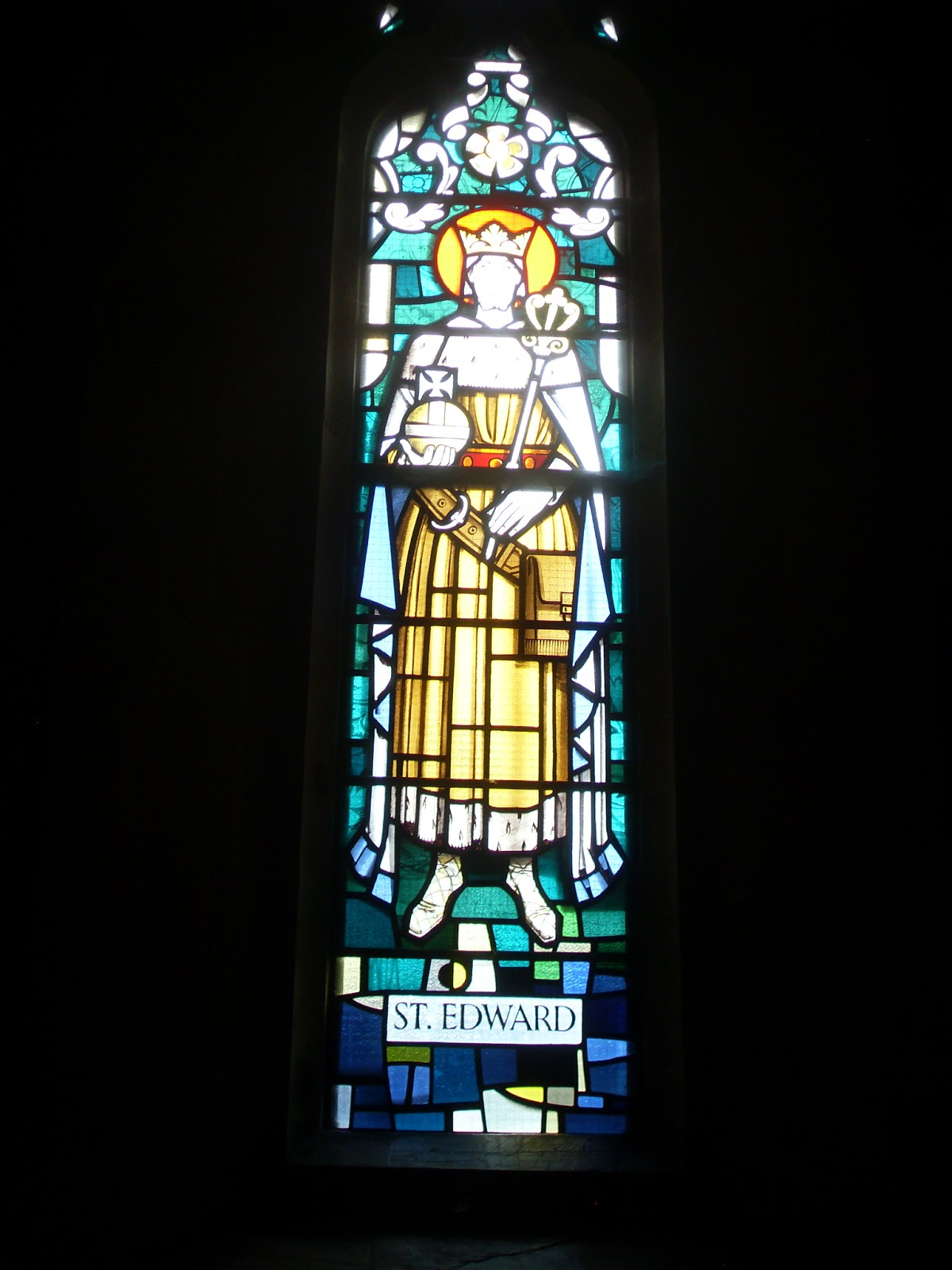
We also find Saint Edward on the left-hand side of the bottom end of the nave (when facing the altar). This is a stained glass window put up in memory of churchwarden G. Raymond Burn who died in 1993. Here the Confessor is shown wearing his regalia, but in a distinctly more royal and notably less legendary form than in the other depictions. 


The dedication of the church has also given name to at least one more place name in Dringhouses, namely St Edward's Close, as depicted below.


Websites:


tirsdag 8. mars 2016

Three meditations on mortality


I find myself very fascinated with the different ways in which mankind approaches its own mortality. Reflections on death and transience are at the core of some of the most beautiful expressions of human culture, either in art, in writing, or in music. In the present blogpost I wish to present three items that share a common engagement with death, and which have caught my attention lately.


The first item belongs to music, namely Chopin's piano sonata no. 2 in B minor, opus 35, which is most commonly known as Marcha Fúnebre, Funeral March. This is a deeply iconic piece which I myself remember to have associated with death from a very early age, since it has been used in many forms of popular culture to denote death and mortality, to such a degree that merely to hum its theme has become a non-verbal shorthand for death and funerals. 


Marcha Fúnebre, by Frédéric Chopin


The second item is from literature, and it is one I encountered for the first time only a few days ago. This is a brief poem by the Greek poet Constantine P. Cavafy (1863-1933), one of the major figures of modern Greek poetry. He lived most of his life in his native Alexandria, Egypt, with shorter residences abroad. The following poem is translated into English by Evangelos Sachperoglou and published in The Collected Poems, Oxford World Classics, 2007: 3-5.


Candles

The days to come are standing right before us,
like a row of little lighted candles -
golden, warm, and lively little candles.

The bygone days are left behind,
a dismal row of burned-out candles;
those that are nearest smoking still,
cold candles, melted and bent.

*

I don't want to see them; their sight saddens me,
and it saddens me to recall their former glow.
I look ahead at my still lighted candles.

I don't want to turn around, lest I see and shudder
how fast the darksome line grows longer,
how fast the burned-out candles multiply.


And with these last two heavy lines still echoing in the mind, I present the third and final item, this one from art, namely the death-mask of Cavafy himself, made in 1933 by an unknown artist and currently placed in the house-museum of Cavafy in Alexandria.


Courtesy of Wikimedia, Roland Unger


For similar blogposts, see:

Dance macabre

Et in Arcadia ego

Vanity of vanities