And was the holy Lamb of God,
On Englands pleasant pastures seen!
- And did those feet, William Blake
Viser innlegg med etiketten Archaeology. Vis alle innlegg

mandag 23. mars 2026

A thousand years is not that long - an example from Aarhus


The past is not as unfamiliar as is often presumed. Those who work on history-related subjects know this well. In the present day, however, this knowledge is often overshadowed by a pervasive sense of progressivism, by which I mean the idea that human history is constantly progressing, and often towards some specific goal. The most forceful form of progressivism nowadays is that which touts the blessings of artificial intelligence, colonising Mars, and other technological wonders that will change our relationship with earth, with knowledge, with ourselves, and so on ad nauseam.  


For me, however, raised as a son of farmers in the Western Norwegian fjords, elements of the past often resembles things from my own background. These resemblances are not due to the fjords being particularly backwards - although I suspect a lot of urban Norwegians would protest that this is exactly what it means - but rather that certain technologies are perfected very early in their history, and a lot of such technologies pertain to farm life. As a consequence, the solutions offered by these early technologies are still in use. 


I was reminded of this longue durée history of technology when I was visiting the Viking Museum in Aarhus this weekend. (Not to be confused with the famous Moesgaard Museum a bit south of the city.) The museum is small, but contains a lot of interesting archaeological finds from the centre of old Aros, the tenth- and eleventh-century city which was located in what is currently the centre of Denmark's second largest city. The items displayed in the museum are typical of such trading hubs as Aarhus was in that period - typical, but no less interesting for that - and include cooking pots of soapstone, nails from boats, weights from a loom, and whetstones. One of the items that caught my eye was a sinker, a rounded stone used to weigh down a fishing net so that one of its ends is dragged down into the water and prevents the net from just floating on the surface. 


Fishing with nets remains the best method for catching large amounts of fish on a lower scale, and in my family we are always paying attention to when the ice will break on one of the lakes back home, so that we can begin the season. Moreover, when I am out walking with my parents and we are traversing rocky ground, my father will often keep an eye out for rocks that might be suitable as sinkers. They are not as rounded and polished as the one found in the archaeological layers in Aarhus, but in order to serve as sinkers a stone only needs to be heavy but not too much, a bit thin and elongated so that it is possible to tie a cord around it, and shaped in such a way that it is easy to carry.  


The sinker is a technology that need not be improved upon, and I am not sure that it can be improved upon either, only altered in various ways that might give the illusion of improvement. There are several such technologies, and I think it is healthy to be reminded that due to their longevity, they connect us to the past in useful ways - useful because it is good to realise that some solutions have been perfected early, and also useful because modern people do sometimes need the reminder that a thousand years is not that long ago in certain respects. 


søndag 22. januar 2023

The Svingerud stone - the world's oldest dateable rune stone


Yesterday I went to the Museum of Cultural History in Oslo to buy a book, and also to check whether the world's oldest dateable rune had already been put on display. To my luck, this proved to be the case, and I was able to have my first encounter with the recently-excavated Svingerud stone. 

News of this find broke on January 17, when the museum publicised that excavations in Ringerike had yielded a rune stone found in layers from the first two centuries of the common era. The excavations were carried out in 2021, and for the past years runologists, linguists and archaeologists have examined and interpreted the stone and its several inscriptions. Runologist Kristel Zilmer provided a thorough and fascinating overview of the research process in a thread of tweets (in English), and another overview (in both English and Norwegian) was published on the website of the University of Oslo. A description of the exhibition is found on the museum's website.

The main inscription reads "idiberug", which is interpreted to be a woman's name, although the date of the inscription and the lack of comparable sources mean that is impossible to speak in certainties on this matter. The Svingerud stone - named after the location where it was found - also contains other human-made markings, but these are more difficult to interpret.  


idiberug


The exhibition is located in one of the smallest rooms in the museum's third floor, and it only contains the stone in its two fragments, a poster, and a video running on a loop. The video can also be seen on the museum's website. The smallness of the room is perfect for an exhibition of this kind, and as I entered I could note the excitement among the visitors gathered around the glass case, visitors ranging from around eight to around eighty. A member of staff was on site to answer questions, and as I stood and took it all in, I noted how several of the visitors turned to the guide or talked among themselves, both in Norwegian and in English. (It was especially heartening to learn that an American and his grandchild just happened to be in Oslo in time for the exhibition and had taken the opportunity to go.)  

It was a marvellously joyous occasion, as the buzz in the room was an almost tangible reminder of how much fascination and interest can be found among the members of the public, and how valuable such exhibitions are since they provide both an outlet and a focal point for this enthusiasm. I walked about the room taking photographs, listening to the video and the guide, and seeing the stone from various angles while letting other visitors close to the exhibition case as well. I was smiling stupidly behind my face mask, because I was reminded yet again how much interest people have in the past, and how energising that interest can be.  


The coming years will be very exciting, and I look forward to read the studies coming out from the team working on the Svingerud stone. We are presented with a chance to learn more about a part of Norway's history about which very little is known, and we are able to put our existing knowledge in a much wider context. The fact that this stone pushes the date for the carving of runes in what came to be Norway even further back in time means that we have to expand our chronological frame when thinking about the historical development of this geography. We - scholars, members of the public, the world at large - have an opportunity to learn and broaden our horizon, and this is in and of itself wonderful. 

The joy, the immense joy, in all of this is nonetheless tinged with some bitterness. While new finds are emerging from excavations and studies, while we have a large number of experts in relevant fields, and while we have an unprecedented level of knowledge about conservation, excavation, locating and interpreting the new materials that are found throughout Norway, we are also living in a time when jobs in the relevant fields are cut, funding is reduced, and money and monetisability remain the guiding stars for the people in charge. As a consequence, we are squandering our opportunities to make the most of the combination of expertise and materials, of enthusiasm and a public that is open to the news and the knowledge concerning these finds. I can only hope that we are slowly able to turn this trend and ensure that the requisite research is being done. 


tirsdag 15. november 2016

The church containing Olaf Haraldsson's first shrine has probably been found


This is pretty exciting. For quite some time there has been an ongoing archaeological excavation in Trondheim, north of the public library in the city centre. Excavations began as a routine check of the area due to plans for a new building on the site. A few days ago, the main city newspaper of Trondheim, Adresseavisa, issued a video report from the dig where they interviewed project leader Anna Petersén. The archaeologists have found a graveyard and the remains of a church altar, most likely from the early part of the eleventh century. The preliminary conclusion is that this is the Church of Saint Clement, and this is where the excitement really kicks in - at least for me.

The Church of Saint Clement was namely the first church in which the body of Olaf Haraldsson was placed after it was exhumed on August 3, 1031. The exhumation was commissioned by Grimkell, an Englishman who was the bishop of Trondheim and who had followed Olaf Haraldsson to Norway. According to skaldic poems written within twelve years of the exhumation, the hairs and nails on the dead king were seen to have continued to grow in death. This, together reports of healings performed on the site, was seen as a sign of Olaf's holiness, and Grimkell declared Olaf to be a saint and had the body translated to the Church of Saint Clement. This was at a point in history when bishops had the authority to proclaim sainthood for dead people. Olaf's body was enshrined in the church and this shrine soon became a site of pilgrimage, and both the enshrinement and the pilgrims are attested to by skaldic poems written before 1043, namely Glælognskvida (c.1032) by Thorarin Loftunga and Erfidrápa (c.1042) by Sigvat Tordsson. A few decades later, the body of Saint Olaf was later moved to the Church of Christ which was built on the site where Olaf was belived to have been buried before his enshrinement in the Church of Saint Clement. The new church, situated where the current cathedral of Trondheim is placed, was commissioned by Olaf Kyrre (ruled 1067-93).

It has long been speculated about where the Church of Saint Clement was to be found, and until the current find it was believed to be somewhere else. Naturally, one always has to be cautious when making claims about the identity of medieval ruins, but here there is a strong likelihood that the identification is correct.

A video and a description of the find in English can be found here:

http://www.heritagedaily.com/2016/11/archaeologists-in-norway-church-and-altar-of-viking-king-olav-haraldsson/113227


Bishop Grimkell washes the exhumed body of Olaf Haraldsson
Detail from an altar front, Trondheim, early 14th century


A few final remarks to those of you who have by now read the article:


- The remark that the church was "a wooden stave church" is a pleonasm. All stave churches were made of timber.

- That the find gives credibility to saga accounts is less important than one might think. Snorri Sturlusson is not the first to have written about this, and his sources were in fact the two skaldic poems mentioned above. That these poems, composed so close to the events themselves and known through written records that Snorri relied on, were right about the translation and the enshrinement should not surprise anyone.

- That Olaf was "declared a saint by popular acclaim" might be something Snorri claims, but this is very unlikely to be true. There might have been some knowledge of the Christian concept of sanctity among the Norwegian Christians, but for there to have been commissioned an exhumation of the body, and for the king to have been declared a saint, it was necessary to have episcopal authority at the very least. Nothing of the story as it is found in the early skaldic poems suggests that the first cult of Olaf was a popular cult that was later embraced by the church. On the contrary, the accounts present the story as something entirely orchestrated by the ecclesiastical power, which at that time was Bishop Grimkell. The people did probably embrace the cult quickly, but it was due to Grimkell it all started.


lørdag 30. april 2016

Excavations in Odense - the Middle Ages brought to light


In the city of Odense, Denmark, where I currently live, there is an ongoing excavation in the city-centre, and today there was an open day at the excavation area for the general public to have a look at some of the recent work. Naturally, I decided to go into town and have a look for myself.

Odense is an old settlement, and its name is first recorded in an imperial charter from 988, a time when Svein Tveskæg (Forkbeard) was king of Denmark. In this charter, Emperor Otto III accords privileges to the Danish bishoprics, and is commonly referred to as Odense's birth certificate. The city itself is much older, and recent archaeological excavations have shown that during the reign of Harald Blåtand (Bluetooth) (c.930-c.987) the city was an important royal centre with defensive ramparts. It was during the reign of Harald Blåtand that Denmark adopted Christianity after pressure from the German empire. This led to the establishment of the Danish bishoprics, and a recent excavation in Odense unearthed a bishop's tomb on the spot where the first church was built in the city. This church was made of wood and dedicated to Saint Alban, the English protomartyr. It was in this church that King Knud IV (Canute) was killed in 1086 following an uprising from the nobility and brought on mainly by excessive taxation. Knud was later translated to a new church and canonized in 1102. This church is the city's cathedral and was a Benedictine church in the Middle Ages.

From the 12th century onwards Odense was an important Danish city and this can be seen in some of the results from the ongoing excavations.


Area of the excavations. To the right, the new, Catholic St. Alban's church (1908)


To the left, the washing tent where the soil from the dig is examined

Much of the ongoing excavation is done outside what was once the bishop's palace (not pictured), and where there had been a cemetery in pre-Reformation times. In the washing tent (above) they have found many remnants from the late-medieval market square and from what is possibly the kitchen scraps from the dinners of several bishops. I popped by the tent and had a look, and only today they had discovered several nutshells, old bones and even fish scales. I was allowed to give the washing a try myself and I felt a distinctly boyish excitement as I was washing away the sand and could find several animal bones and fish scale as well.


In the pictures below we see a house which belonged to the guild of Our Lady in the 15th century. The guild itself was established around 1435, while the house is referred to in a textual document from the mid-fifteenth-century, and it is mentioned as belonging to the guild. The dating of the house itself is still not certain, since it is unknown whether the guild had the house built or whether the guildmen moved into a house that was already in place.


Below are some pictures from the excavated cemetery. The skeletons (see further below) are not yet dated, and an archaeologist at the scene told me that they could be from anywhere between 1000 and 1500.


In the pictures below we see the remnants of a wooden structure far deep in the loam. The archaeologists have suggested that it was a bridge that once crossed a moat built to protect the episcopal palace from attacks. This hypothesis is strengthened by the accounts from when the bishop's quarters were assaulted during the Reformation, when a party of attackers came down the river which runs right next to the palace, charged up to the palace itself and set fire to the doors. This was in the course of a brief civil war in Denmark which raged from 1534 to 36.


The supporting beams of the (probable) bishop's bridge

The light-brown, pointed surface is believed to show the remnants of a supporting structure, strengthening the idea of a bridge


mandag 4. februar 2013

The Greyfriars Skeleton - A Case for History


 Richard III's motto, photo taken at the Richard III Museum in York

From 10.00 to 11.00 AM GMT today there was held a press conference in Leicester presenting the verdict on the so-called Greyfriars Skeleton, which was unearthed in an archaeological excavation beneath a Leicester car park in September last year. The excavation was organised in a joint venture by Leicester University, the Richard III Society and Leicester City Council, and its specific purpose was to find the remains of King Richard III, who was said to have been laid to rest in a church now lost. When the skeleton was found, its spinal curvature prompted speculations on whether this could be the infamous king, immortalised by William Shakespeare as a monstrous hunchback, and it seemed indeed as if the excavation had found exactly what it sought to find. On today's press conference, the team of archaeologists from Leicester University - headed by Richard Buckley - presented their skeletal evidence, the historiographical evidence and ultimately the DNA results in an orderly and sober fashion. The academic verdict of the team was that the skeleton "beyond reasonable doubt" belonged to the last Plantagenet king.

The conference attracted great attention both in the UK and abroad, and it was a much-anticipated event for historians and lay enthusiasts alike. The case is - by the time I write this - the most viewed news-report on BBC's homepage, and on twitter Richard III has been trending for hours as a consequence. Following the verdict, the University of Leicester launched a new website about the excavation, and I'm confident we will see many more activities pertaining to the unearthed king in the foreseeable future.

 Greyfriars, Leicester. Map taken from wikimedia

The resounding enthusiasm has, unsurprisingly, found its counterpart in certain sceptical and/or dismissive voices. This is of course a natural reaction, and academics are, after all, required by their work description to be sceptical about these things. Charlotte Higgins of the Guardian, for instance, commented that this was "not really history, not in any meaningful sense ", and that the ultimate importance of the "jamboree" was raising awareness of the university, attract interested people to the discipline of archaeology by showcasing how experts work and, finally, to secure funding.

Personally, I believe Higgins's article, while raising an important concern, is too insistent upon its own scepticism to comprehend the big picture. That the three points she mentioned were achieved is - like the identity of the skeleton - beyond reasonable doubt, and they are all three truly important. However, the fact that we now have identified the remains of a historical person, allows us to realign the facts we knew and the myths we believed into a picture more fitting with the most recently unearthed facts. This is indeed history in a meaningful sense.

However, I also believe that the verdict concerning the identity of the Greyfriars skeleton was not the most important aspect of today's conference. During the conference, as the experts presented the various facts they had discovered - tacitly and carefully tying it into the big question of whether this was Richard, while still withholding the ultimate verdict - it struck me that regardless the end result of the conference, this event had already proved its big importance. The most important aspect of today's conference was not the identity of the skeleton, but rather showing how much people actually care about history and that history is not merely a thing of the past.

Today's verdict may be refuted in times to come when technology has become even more refined, and people will eventually grow accustomed to the revisions and confirmations of historical facts today's verdict has provided. However, to my mind the conference is a firm proof that historians and archaeologists are needed in today's society, that they play their roles and that their endeavours are justified by the enthusiasm of both professionals and layfolk alike. In an age where there is a demand for solid and tangible results in academia, events like this show that not only do humanists achieve results, but that the populace eagerly anticipates and show enthusiasm over these results. There is, in other words, sufficient interest in history to not only justify but necessitate professional historians and archaeologists, in order to unearth and ultimately make sense of new facts. Whatever the duration of today's verdict in Leicester, this particular aspect will stand the test of time.


tirsdag 31. mai 2011

Selections from the Anglo-Saxon Chronicle

At first the inhabitants of this island were Britons, who came from Armenia and first occupied southern Britain. Then it happened that the Picts came from the south, from Scythia, with a few warships, and landed first in North Ireland.
- Preface to manuscripts D, E and F of the Anglo-Saxon Chronicle


The first page of the Peterborough Chronicle, also known as the E manuscript of the Anglo-Saxon Chronicle.

One of my modules in York was named England in Europe - which I kept referring to as Europe after Rome, thanks to Julia Smith - and it was in many ways a splendid class. As a part of the curriculm we had the Anglo-Saxon Chronicle, a historical record found in several and sometimes contradictory manuscripts, that was begun in the reign of Alfred the Great (871-900 AD). Its original language is Old English and it chronicles the events of English/British history starting with Gaius Julius Caesar's defeat of the Britons in the year 60 BC.

The chronicle is a complicated set of documents, partly due to inconsistencies and conflicting biases between the manuscripts, but also because of the authors' anonymity. I found it a very rewarding read for several reasons, perhaps most of all for some of its prose which occasionally is terse, pregnant and beautifully concise, although not historically reliable. Below is a selection of excerpts from the various manuscript - imaginatively called A, B, C, D, E, F and G for brevity - all of which struck a chord in me one way or another. Sadly I don't have many photographs of my own which are relevant to the period in question, but unless stated otherwise the pictures are either mine or taken from wikimedia.


Nero Claudius Caesar Augustus Germanicus

Then after Claudius Nero succeeded to the thone, who finally abandoned the island of Britain because of his sloth.
- Entry for the year 47 AD in the D and E manuscripts


In this year there was an eclipse of the sun on 16 February from daybreak until nine o'clock in the morning.
- Entry for the year 538 in the E manuscript

Natural phenomena were often taken as portents of good or evil that would ensue and occur frequently throughout the chronicle. However, the scribes rarely draw clear connections between the portents and subsequent events, but by juxtaposing occurrences such as comets or eclipses with bad harvests or Viking attacks, the reader is allowed to make his or her own conclusion thanks to beautiful displays of parataxis. An example of this is found below in the entry for 664.


Anglo-Saxon helmet displayed at Yorkshire Museum.

In this year Ceawlin and Cutha fought against the Britons at the place which is called Fethanleag, and Cutha was killed there; and Ceawlin captured many villages and countless spoils, and in anger returned to his own land.
- Entry for the year 584 in the E manuscripts

The above entry is a good example of the clear-cut, terse prose that describes the events in a tone seemingly void of any emotion, but pregnant with meaning and content which come alive in the reader's mind. In addition there is the tongue-in-cheek disdain heavily embedded in the final sentence.


In this year there was an eclipse of the sun, and Eorcenberht, king of the people of Kent, died.
- Excerpt from the entry for the year 664 in the C, A and B manuscripts

Replica of a bird figure from the Sutton Hoo excavation.

In this year there was the great mortality of birds.
- Entry for the year 671 in the C, A, B and E manuscripts

This particular passage has fascinated me ever since I came across it. I suspect it may be a case similar to that of January this year, when dead birds fell to the ground in Louisiana, Arkansas and Sweden. I seem to recall that this stirred up minor occurrences of apocalyptic paranoia in some places, and I can't help wondering what impact a sight like this would have had on the people of 7th century England.


In this year the star called comet appeared; and Bishop Wilfrid was driven from his bishopric by King Ecgfrith.
- Entry for the year 678 in the C, A and B manuscripts


Abbess Hilda and King David as represented on a commemorative cross in the cemetery of St. Mary's Church, Whitby.

In this year Archbishop Theodore presided over a synod in Hatfield, because he wished to correct the faith in Christ; and the same year the Abbess Hilda died.
- Entry for the year 680 in the C, A, B and E manuscripts

Those of you who have read this blog more or less attentively will perhaps recongise Abbess Hilda from my blogposts on Whitby. She was evidently a very important figure, since few women apart queens or widow queens are mentioned in the Chronicle.


In this year there occurred in Britain bloody rain, and milk and butter were turned to blood.
- Entry for the year 685 in the F manuscript

Yes, I do have a certain fascination for the apocalyptic, especially when found in a Medieval milieu which adds extra social and religious dimensions to the horrid portents. The chronicle Annales Cambrenses, by the way, records this to have happened in 689 rather than in 685.

This church vessel was among the items of the archaeological find called the York Viking hoard. It was probably looted from a church by a Viking, or buried by a cleric to hide it from Viking invaders. It is now on display in Yorkshire Museum.


In this year Æthelbald occupied Somerton, and there was an eclipse of the sun.
- Entry for the year 733 in the C, A, B, E and D manuscripts

Much in the same vein as portents described above, yet with a slight reversal of the parataxis, either because the events are recorded to have happened in that chronological order, or maybe to blame Æthelbald for the eclipse. I also have a particular appreciation of an elaboration found in the F manuscript: "and all the circle of the sun became like a black shield." 
 
Durham Cathedral, where the remains of Bede are now buried.

In this year the moon looked as if it were suffused with blood, and Tatwine and Bede died.
- Entry for the year 734 in the C, A, B, E and D manuscripts

This entry is included mainly for the sake of Bede, whose tomb can be found in the Lady Chapel of Durham Cathedral and who was the hero of 12th century historian William of Malmesbury. In York I purchased his Ecclesiastical History of the English People and I hope it will not be too long until I can devote enough time to read it. His death, however, more likely occurred in 735 rather than in 734.


St. Mary Bishophill Junior, York. This tower is Anglo-Saxon and, if I remember correctly, the oldest remaining ecclesiastical structure in York, which in Anglo-Saxon times was named Eoforwick.

In this year York was burnt down.
- Entry for the year 741 in the D and E manuscripts


Anglo-Saxon bowl from c. 750, currently on display in Yorkshire Museum.


In this year occurred the great winter.
- Entry for the year 762 in the C manuscript, while the A, D, E and F manuscripts record this to have happened in 761. The scholarly edition sets it to 763

In this year a red cross appeared in the sky after sunset. And that year the Mercians and the people and the people of Kent fought at Otford. And marvellous adders were seen in Sussex.
- Entry for the year 774 in the C, D, E, F and G manuscripts, while the A manuscript records this to have occurred in 773. The year in the scholarly edition sets it to 776.

Such constantinian visions as crosses in the sky are reported to have happened later on as well, as was the case in 806 when, according to the F manuscript, "the sign of the cross was revealed in the moon".

If you look closely you may discern two adders intertwined on this Anglo Saxon nose flap. I find that quite marvellous.


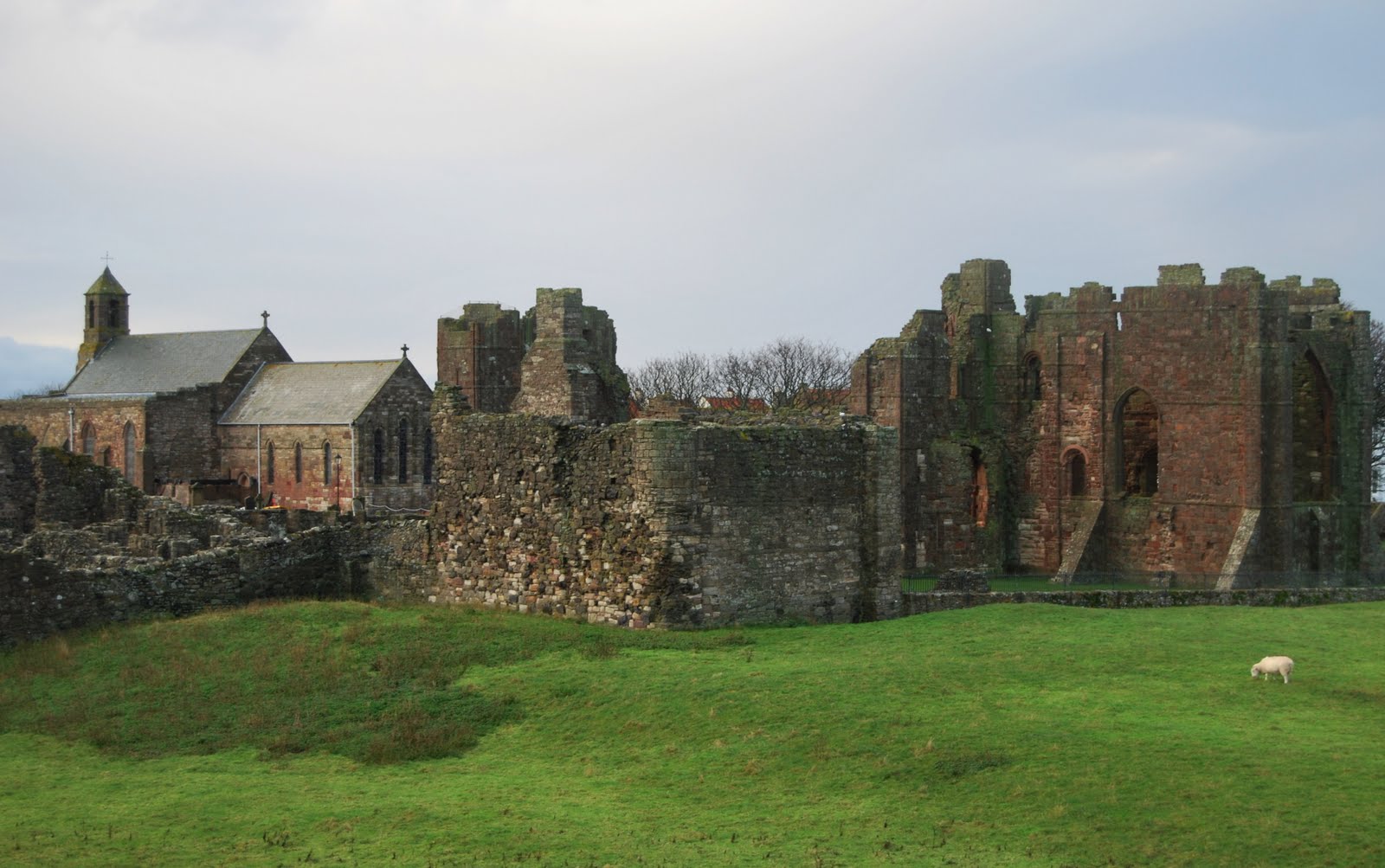
Ruins of Lindisfarne Abbey.

In this year dire portents appeared over Northumbria and sorely frightened the people. They consisted of immense whirlwinds and flashes of lightning, and fiery dragons were seen flying in the air. A great famine immediately followed those signs, and a little after that in the same year, on 8 June, the ravages of heathen men miserably destoryed God's church on Lindisfarne, with plunder and slaughter. And Sicga died on 22 February.
- Entry for the year 793 in the D and E manuscripts

I include this entry primarily for the portents. It is the first time I have encountered dragons in the Chronicle, although invaders labelled Northmen are mentioned in several manuscripts already in 789. These Northmen are called Danish in the C and A manuscripts, whereas manuscripts D, E and F record that the heathens came from Hörthaland in Norway. Some people may find that slightly arousing, I don't. 
 
Part of the archaeological find named the York Viking hoard, a treasure unearthed a couple of years ago. Treasures like this were often buried to keep them away from the Vikings, or buried by Vikings to keep them away from other Vikings. The date of this hoard is set to 927/928 due to a coin with an inscription pertaining to king Athelstan of Wessex's claim to kingship of Britain in its entirety.


Brihtric had helped Offa because he had married his daughter.
- Excerpt from the entry for the year 839 in the C and A manuscripts

I decided to include this excerpt in order to illustrate what roles Anglo Saxon women could play in English politics, namely as manifestations of alliances. As stated above, women rarely feature in the Chronicle and when they do it is often as pawns in the game of Anglo Saxon politics. It should also be noted that the Offa mentioned above is not the famous Mercian king, he lived in the 8th century.


And the same year after Easter, at the Rogation days or before, there appeared the star which is called in Latin cometa. Some men say that it is in English the long-haired star, for there shines a long ray from it, sometimes on one side, sometimes on every side.
- Entry for the year 892 in the A manuscript

I find the above section very poetic in its terse brevity, and may very well be my favourite description of a comet I've ever come across in the Chronicle.


That same year a bloody cloud was often seen in the likeness of fire, and especially it was revealed at midnight, and it was formed in various shafts of light. When day was about to dawn, it disappeared.
- Entry for the year 979 in the C manuscript

These coins are from the York Viking hoard and come from Afghanistan and Samarkand.

And in this same year the sester of wheat rose to 55 pence, and even higher.
- Excerpt from the entry for the year 1040 in the E and F manuscripts


(...) and Leofgar who was Harold's priest was appointed bishop, and in his priesthood he had his moustaches until he was a bishop.
- Excerpt from the entry for the year 1056 in the D manuscript

I particularly like this brief glimpse into the world of ecclesiastical fashion. The scribe includes this detail clearly out of derision for Leofgar's vanity and unclerical behaviour, and for anyone interested in the mentalities of bygone ages this is gold.


In this year Earl Ælfgar was banished but he got back by violence forthwith through Griffith's help. And a naval force came from Norway. It is tedious to relate fully how things went.
- Entry for the year 1058 in the D manuscript

It appears scribes can sometimes be quite fed up with their work.


This year the king led an army into Wales and there liberated many hundreds of men.
- Entry for the year 1081 in the E manuscript

I wonder whether the Welsh were equally enthusiastic

William the Bastard, liberator of...gas?


The Anglo-Saxon Chronicle draws on numerous historical works, ranging from monastery annals to solo-projects like Bede's Ecclesiastical History of the English People. The entries naturally vary greatly since this is a joint venture, and since it is written over a period of roughly 250 years. Although exaggerated at some points and frustatingly brief at others, it remains our key literary source to the late Anglo-Saxon period and the early Norman age.