And was the holy Lamb of God,
On Englands pleasant pastures seen!
- And did those feet, William Blake
Viser innlegg med etiketten Eskil of Lund. Vis alle innlegg

tirsdag 10. august 2021

An interdict from Saint Lawrence's day - ecclesiastical conflict in twelfth-century Ribe


Today, August 10, is the feast of Saint Lawrence, an early Christian saint made famous, in part, through his inclusion in the hagiographic poem Liber Peristephanon, book of the martyrs, by Prudentius. Lawrence, or Laurentius, was one of the major universal saints of Latin Christendom, and his feast was celebrated in all calendars. The present blogpost, however, is not so much about Saint Lawrence, interesting though he is, but rather about an event in which Lawrence's feast-day figures as a temporal marker. The event unfolded in the Danish episcopal see of Ribe, and it is recorded in the anonymous Chronicon Ripense, Chronicle of Ribe, believed to have been written c.1230. The chronicle has been edited by Ellen Jørgensen, and there exists a Danish translation by Helge Søgaard.


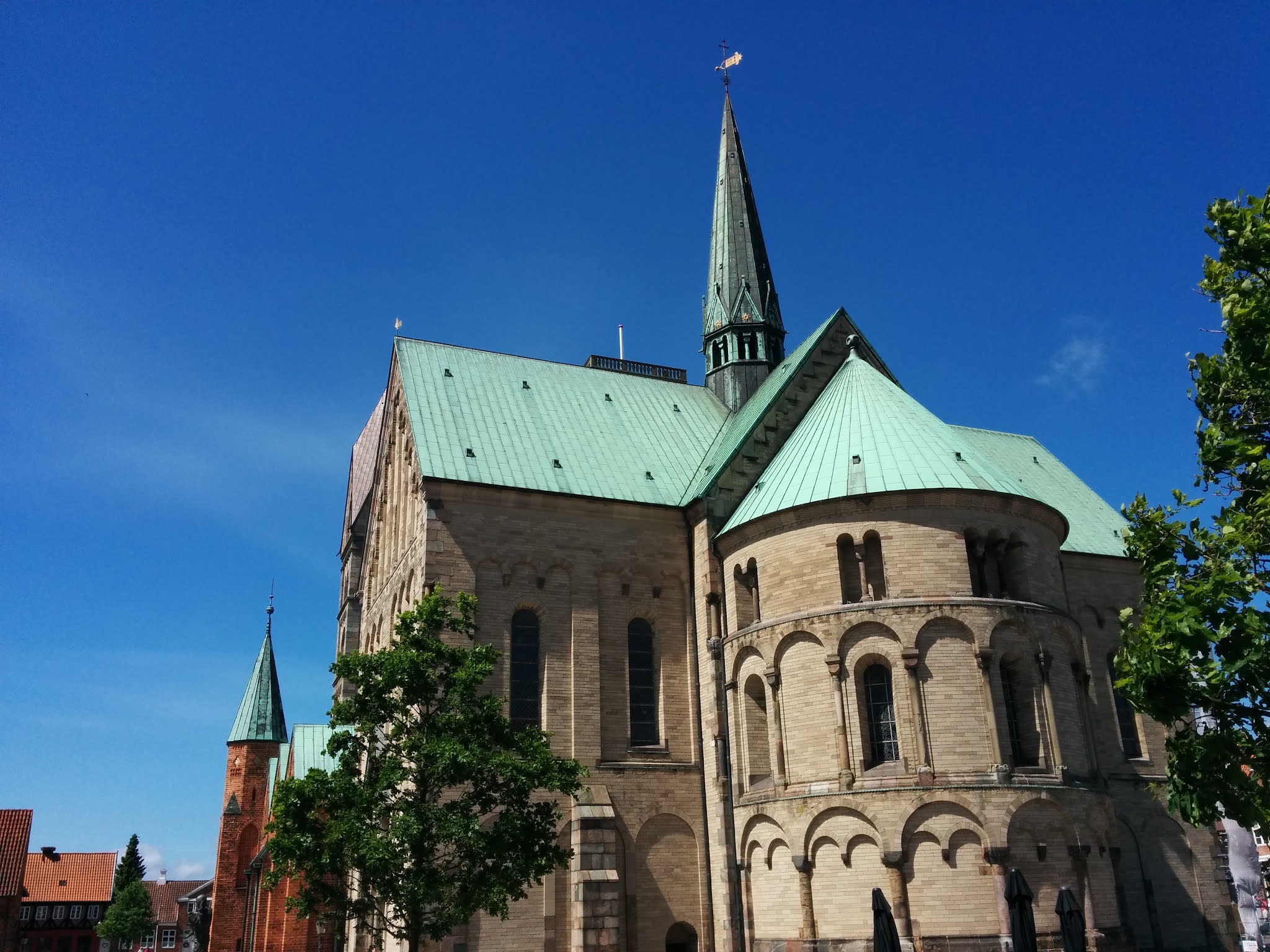
Ribe Cathedral 


The anonymous account provides an overview of the episcopacy of Radulph, an Englishman who had been the chancellor of King Valdemar I (r.1157-82) and who became bishop of Ribe around 1160. The chronicle's dating is imprecise, and Helge Søgaard suggests that Radulph began as bishop in 1162, whereas the surviving text of the chronicle has 1152 instead. Radulph was a controversial man, and his inauguration as bishop was delayed four years pending charges of murder and apostasy, but eventually he began his office as bishop of Ribe.  


The episcopacy of Radulph was a dynamic period, perhaps in part due to the ongoing rift between the Danish archbishop, Eskil of Lund, and King Valdemar I. One episode, the one that I will focus on here, provides a view of one of the rifts between the bishop and the clerics at the cathedral. According to Chronicon Ripense, Bishop Radulph sought to appoint his chaplain, a certain Vincent, as a cathedral canon. The other canons were deeply averse to this, and the reason appears to be that a canon should be elected by the other canons, and not appointed by the bishop. The hierarchical structure of the church community was clearly delineated, and the election of its members was one of the prerogatives of the chapter of canons. 

The matter of Vincent's appointment was so contentious that it came to blows, and the anonymous Ribe chronicler describes how the bishop's clothes were torn, and how the head of the cathedral school, a certain Boniface, was beaten up in the chapter house. Judging from the location, this must have been during one of the regular community meetings, that in most, if not all, ecclesiastic and monastic communities took place in chapter. The conflict led to an interdict being placed on Ribe, and this interdict - during which all church services in the diocese were null and void - began on August 10, Saint Lawrence's day, and lasted until Maundy Thursday. The right of the canons to elect their members was then confirmed. 


The story of the tumult in Ribe cathedral might at first seem odd, or perhaps amusing, but most importantly it is a window into the complex world of medieval ecclesiastic and monastic communities. These communities were comprised of people of diverse personalities, and often with diverse aims and opinions about how to achieve those aims. They were communities in which life was balanced by rights and duties, privileges and demands, and where life was guided by custom and institutional identity. For the canons at Ribe, the appointment of someone by the bishop was a breach of that balance by which the community sustained itself. Consequently, that the controversy resulted in a fist fight is not necessarily indicative of the ease with which medieval ecclesiastics resorted to violence - although that was by no means rare - but it should perhaps primarily be seen as an indicator of how serious this matrix of rights and duties were to the canons. We are reminded, in other words, that the medieval world was, as all human worlds are, infinitely complex and often surprising. 


tirsdag 29. desember 2020

Saint Thomas of Canterbury at Lund


Today is the feast of Thomas of Canterbury, better known as Thomas Becket, archbishop, who was killed at the altar of Canterbury Cathedral in 1170, when a group of knights broke into the church. The murder must be understood against the six-year-long conflict between Thomas and King Henry II of England about the juridical borders and the power balance between church and king, which in turn was part of a power struggle that marked the political discourse of all of Latin Christendom at the time. When the English strand of this conflict culminated with the death of Thomas, he became a figurehead for the reformists of the church who championed the idea of the supremacy of the church not only in spiritual but also in worldly matters, and also the independence of the church from worldly government. Consequently, Pope Alexander III canonised Thomas in 1173, and his cult was disseminated widely throughout Latin Christendom. 

The cult of Saint Thomas of Canterbury came to the Norse world very early, and while we do not know much about the concrete details of the dissemination, we know that there were several routes by which his cult could have travelled to each of the different Nordic countries, such as trade, diplomacy, ecclesiastical connections or monastic networks (in particular the Cistercians). Our earliest sources for Thomas' cult in Denmark can be seen in three stories recorded by William of Canterbury in a miracle collection, while printed breviaries from the Danish archbishopric of Lund can be seen to retain the liturgical repertoire that was imported into Denmark already in the latter quarter of the twelfth century.

While there are many things that deserve to be said about the cult of Thomas in the medieval Norse world, there are also many of those things that need to be more thoroughly researched and that are tied up with various works in progress. So for this blogpost - marking the 850th anniversary of his death and forming part of the hashtag Becket 2020 - I'll limit myself to commenting on a late source that perhaps points to a continuous, or at least long-lasting, popularity around the martyred archbishop in medieval Denmark.  


Breviarium Lundense (Kongelige Bibliotek København, R 665 8°), f.98v


The source in question is a detail I encountered in the breviary of Lund, which was printed in 1517 in Paris. By this time, Lund was part of the medieval kingdom of Denmark - it is now in Sweden - and had been its metropolitan see since 1104. Due to Archbishop Eskil's connection with the reformist movement and the Cistercian order, it is likely that Lund was one of the first religious centres in Denmark, even in the Norse world, that adopted the cult of Thomas of Canterbury. The liturgy used for the celebration of Thomas' feast-day was likely brought directly from Canterbury, and it was retained without any notable changes in the printed breviary from 1517, pointing to the durability and conservative nature of liturgical material.

Yet even though the liturgical content of the printed breviary can, in the case of Thomas of Canterbury, be traced back to the twelfth century, there is one aspect of the breviary that is distinctly contemporary with the book itself, namely the note scribbled along the top margin of the page seen in the picture above. The page, folio 98v, begins with the eighth lesson for the hour of Matins - the liturgical apex of the daily round of hours - in which Thomas' role as a good shepherd is highlighted. The good shepherd is one of the roles of Christ, and every clergyman serving as a shepherd is modelled on Christ in this aspect. When Thomas' role as a good sheperd is highlighted here, the author of the liturgical office - belived to be Benedict of Peterborough - strengthens the sainted archbishop's similarity with Christ, as Thomas not only was a martyr in imitation of Christ's sacrifice on the cross, but also was a shepherd in imitation of Christ as a protector. This lesson caught the attention of some canon or priest - perhaps the archbishop himself - in the early sixteenth century at Lund. And since the Reformation was brought to Denmark in 1536/37, the window for dating the writing of this note is pleasingly narrow. 

The content of the note itself I have not yet managed to decipher, despite some frustrating attempts. The handwriting is not from my period of expertise, and I will probably ultimately have to rely on colleagues for this part. Yet even so, until such time that this is solved, it does nonetheless show that Thomas retained relevance in medieval Denmark as late as the period 1517-36/37, and that his liturgical office continued to be performed and exert an influence on at least some of its listeners centuries after it first was introduced to Denmark.


For other blogposts touching on Thomas of Canterbury, see:


A comparison of the cults of Thomas and Edward the Confessor

The chant Thomas Gemma Cantuarie

A wall-painting in the Cistercian monastery of Chiaravalle, Milan

A liturgical commemoration from the Norwegian medieval liturgical ordo

A fifteenth-century wall-painting in Skive, Denmark

Some reflections on the iconography of Saint Thomas in late medieval Europe


lørdag 28. desember 2019

Saint Thomas of Canterbury in Skive Church


Today is the feast of Saint Thomas of Canterbury, more commonly known as Thomas Becket, who was killed in Canterbury Cathedral on this day in 1170. The murder of the archbishop at the hand of knights in King Henry II's retinue was a scandal in its time, and even though the English king had not himself ordered the death of Thomas, he was widely blamed for the deed, especially in ecclesiastical circles.

The cult of Thomas spread quickly throughout Latin Christendom. This was in large part due to the network of ecclesiastical figures to which Thomas had belonged, and that shared his reformist views on the relationship between royal and ecclesiastical power that marked the political map of the twelfth century. The key figure in this network was Pope Alexander III (r.1159-81) who had supported Thomas' cause during the archbishop's exile in France from 1164 to 1170. It was Alexander who canonised Thomas in 1173.

Other important reformist figures were the Norwegian archbishop Eystein Erlendsson (r.1157-88) who is largely credited with bringing the cult of Thomas to Norway (see this blogpost), and the Danish archbishop Eskil Christiernson, or Eskil of Lund, who is considered to be responsible for bringing the cult of Thomas to Denmark, in no small part through the Cistercian order to whom both Eskil and Thomas were close. 

The cult of Thomas in medieval Denmark is still a subject that requires more work, and I hope to be able to contribute to this scholarly lacuna in the coming year. As a way to remind myself of the work to be done, I'm sharing with you one late medieval example of the veneration of Thomas in Denmark, namely a wall-painting from Skive Church in Northern Jutland.


Tomae de Cantuarienus [sic]
Wall-painting from Skive Church, Northern Jutland, c.1500


The example in question comes from the Church of Our Lady in the town of Skive in Northern Jutland. The church was built around 1200, and it is commonly known as Skive Old Church to distinguish it from the eighteenth-century church situated nearby, and which appears to be the hub of today's religious life in Skive.

The early history of Skive is uncertain, and the current scholarly consensus is that the town was most likely established around 1100. Its status as a market town - i.e. a town with particular mercantile privileges - was confirmed in a letter from 1326 (see this website), but the status might have been achieved earlier. Judging from the Church of Our Lady, Skive appears to have been an important town by the turn of the twelfth century, and its importance can be explained or measured by three main factors. First of all, Skive lies very close to Viborg, the episcopal see of Central Jutland which was established c.1060 and thus one of the main power centres in the area. Secondly, a royal manor, Skivegård, is mentioned in the survey of King Valdemar II (r.1201-41), the so-called Liber Census Daniae (see here), and points to the town's vicinity to royal power in addition to the episcopal power at Viborg. The third factor is the fish trade which is likely to have brought a lot of money to the town's wealthier inhabitants. These three factors must all be taken into account as possible explanations for the erection of the Church of Our Lady around 1200.


Vor Frue Kirke, Skive


Vor Frue Kirke, Skive, interior, towards the main altar


In the nineteenth century, the Church of Our Lady was about to be demolished, which was the fate of several redundant churches in Denmark at the time. Fortunately, an impressive programme of late medieval wall paintings was discovered in time, and the church was preserved. It is in this programme that we find the aforementioned late medieval depiction of Thomas of Canterbury. 

The interior of Skive Church is filled with a vast array of saints. These saints were painted c.1500, and it is thought that the workshop that executed these paintings was the same, or was at least connected to, the workshop that decorated Roskilde Cathedral (see here, and here). Among these many saints we find Thomas of Canterbury, situated in the vaulted roof between Peter Martyr of Verona (d.1252) and Sebastian. The question then is how we are to understand this as an expression of veneration of Thomas.


The painting of Thomas of Canterbury in Skive is interesting, both because it is one of very few known medieval Danish depictions of him, and also because of its wider pictorial context. Thomas is here one of many saints. On the one hand, these wall-paintings were commissioned by local donors who might have given very specific instructions about which saints to include. It is therefore tempting to see the inclusion of Thomas in light of the wider history of his cult in medieval Denmark. 

On the other hand, we might understand this as just an expression of his general popularity in Latin Christendom at the time. The saints of Skive Church are for the most part universally venerated in the Latin Church and by the time of the programme's execution these universal saints had been venerated for a very long time. Even the youngest of the saints included, Peter Martyr and Roch (whose traditional, but not uncontested, year of death is 1327), became widely celebrated within a relatively short timespan and are therefore unsurprising to see among more veteran saints. Even those saints that are not universally venerated outside the Nordic countries are nonetheless of regional importance, such as Knud Rex (d.1086) and Knud Dux (d.1131) whose cults were established throughout all of Denmark, and Saint Olaf of Norway (d.1030) whose cult was immensely popular throughout the Nordic world. The inclusion of Thomas in this saintly collegium is, therefore, a testament to the contemporary trends within the cult of saints, rather than a stage in a continuum in the veneration of Saint Thomas in medieval Denmark.

Even so, while the depiction of Thomas in Skive Church might not yield much information about his Danish cult, it nonetheless provides evidence of the endurance of his cult in Latin Christendom, and we see both that he was one of the trendy saints even in Northern Europe around 1500, and that he was one of the many ways in which the donors of Skive's wall-paintings sought to express their participation in the religious trends of Latin Christendom.


Similar blogposts

Saint Olaf in medieval Denmark

Thomas of Canterbury in medieval Norway

On the early cult of Thomas of Canterbury

A song for Thomas of Canterbury

Martin of Tours in Skive Church