And was the holy Lamb of God,
On Englands pleasant pastures seen!
- And did those feet, William Blake
Viser innlegg med etiketten St. Sebastian. Vis alle innlegg

mandag 20. januar 2025

Cantigas de Compostela, part 3: Saint Sebastian


Around 1450, a chapel was built in the cathedral complex of Santiago de Compostela, dedicated to the Holy Spirit. The chapel contained stone statues of various saints, one of whom was Saint Sebastian. Towards the end of the Middle Ages, Sebastian was one of the most ubiquitous figures of the collegium of holy men and women venerated in Latin Christendom. According to tradition, he was a Christian soldier who was arrested for preaching the Christian faith, tied to a pillar and shot through with arrows. He survived, and was healed back to life by Irene, a fellow Christian. Later, when he had resumed his preaching activities, he was clubbed to death. This was part of the Diocletian Persecutions, c.300-c.303.


The cult of Saint Sebastian appears to have emerged in the late fourth century, but it is uncertain whether he was a historical figure or one that was retroactively imagined or created after Christianity had become legal and had undergone some institutional solidification in places such as Rome and Milan. Sebastian's popularity, however, was not steady until the late thirteenth century, and then surged significantly in the fourteenth century. One of the main factors in this development was the inclusion of his story in Legenda Aurea, a collection of legends by the Dominican friar Jacobus de Voragine, later archbishop of Genoa. The collection was disseminated across Latin Christendom, and appeared in numerous translations and vernacular adaptations and imitations. Another main factor for the surging popularity of Sebastian was that Legenda Aurea identified him as a saint who was particularly effective when praying against plague.  


The statue in Compostela, perforated and blood-soaked, followed a typical contemporary iconography established in Italy, where Sebastian is muscular, beardless, and shot trough with arrows. It is uncertain whether the artist operating in Compostela was familiar with the Italian tradition, or whether the similarity in execution is due to indirect influence mediated through workshops in Catalonia or Burgos, for instance. In any case, for the artisans working on this chapel around 1450, it was a modern, trendy rendition of the saint that was taking shape.  


Cathedral museum, Santiago de Compostela


lørdag 10. august 2024

Saint Lawrence from a Burgos workshop


Today, August 10, is the feast of Saint Lawrence, a deacon of Rome reportedly martyred in 258. He is one of the oldest and most popular of the post-biblical saints to have enjoyed a sustained popularity and widespread cult since Late Antiquity. Part of his popularity might stem from the nature of his legend, according to which he was placed on a large gridiron to be roasted to death - a story narrated in gruesome detail by the fourth-century Christian poet Prudentius in his book on martyrs, the Liber Peristephanon. Due to his popularity and that he is easily recognised by his main attribute - his gridiron - he can often be found in medieval and early modern art.  


One example of Saint Lawrence in medieval art is the below detail from a predella belonging to an altarpiece made by a workshop of artists in Burgos, Spain, in the second half of the fifteenth century. This is a period of great artistic craft in the style now known as Hispano-Flemish Gothic, a name that points to the close artistic ties between Spain and Flanders in the period. Lawrence is found next to Ambrose of Milan, and the predella also features SS Sebastian, Augustine, Helena, and Barbara. The predella is currently housed at the Museo Arqueológico Nacional in Madrid. 


lørdag 20. januar 2024

Saint Sebastian in Vienna Cathedral


Today is the feast of Saint Sebastian, a saint with whom I am inexplicably fascinated - inexplicably because I cannot define exactly what fascinates me about him and his cult. While his historicity is widely regarded as doubtful at best, at least by modern scholars, his iconography has left a massive imprint in the history of medieval and early modern art. Part of the success of his cult - success here understood as longevity and widespread fame - can be explained by his status as a plague saint, a patronage that continued to be relevant in Europe throughout the Late Middle Ages and the Early Modern Period. Consequently, I am always happy to see a representation of Saint Sebastian on my travels, but very rarely surprised by such encounters. Today, I met him again. 

As I am writing this blogpost, I am in Vienna for a work trip, and this Saturday is the first day where I have been able to do some real sightseeing. One of the main sights that I wanted to see was the Vienna Cathedral, the Stephansdom, dedicated to Stephen Protomartyr, which was consecrated in 1147, ten years after the building work commenced. The cathedral is an overwhelming and beautiful building, with a lot of wonderful architectural and iconographical details, and one can easily get lost if one tries to see all of them. Since this is my first time in Vienna, and since most of my time has been taken up by work, I had not planned my visit very carefully, and ambled about the church space as someone coming into a different world, not really knowing what to expect. This kind of exploration by accident, as it were, has its benefits, because sometimes you see details that are not necessarily highlighted by the available literature. One such figure was that of Saint Sebastian, placed in a niche high above the floor of the nave, not difficult to notice yet also not difficult to miss. 

The beardless, contorted, perforated figure was a familiar sight. I have as yet found no information about when this figure was made, or by whom, but it looks perfectly in tune with the ideals of sixteenth-century Mannerism with its slightly exaggerated movements and bending bodies. In its iconography, the Sebastian figure in Vienna Cathedral follows the typical standard established in fifteenth-century Italy, and which continued to be followed well into the seventeenth century, and arguably into our own times. The figure was a lovely, if grotesque, reminder of the ubiquity of Sebastian's cult, and the iconographical continuity with which he is represented.     


torsdag 25. mars 2021

A fondness for small things – minor saints and the value of impossible questions

 
As I mentioned in my previous blogpost, I am currently working as a member of a research project which, among other things, involves identifying which saints have been celebrated in medieval calendars. While this might sound straightforward and fairly simple, it is very often anything but. Certainly, a lot of saints are easily identifiable because they were widely venerated, because they were famous, because they came into being late enough for us to have a good understanding of their cult, or because they have names that are not easily confused with the names of other saints. But there are also others: Saints whose cults began in obscure circumstances, or who never attained great popularity, or whose names are shared by a wide number of saints – some of whom perhaps more famous – and whose identities can therefore be difficult to ascertain, especially in the modern world where material has been lost to the Protestant Reformation, or where cults of doubtful authenticity have either been removed from catalogues by church councils, or relegated to the status of curiosities. Luckily, there are plenty of resources for scholars who try to make sense of obscure saints, but even these resources might sometimes not be sufficient (as I learned the hard way earlier today).          
           
For all my frustrations about the time spent chasing down details that can carry the definitive proof in an identification, and for all my teeth-grinding annoyance about the number of saints called Maximus or Felix, my exposure to the minutiae of medieval liturgical calendars have reminded me that I do actually have a deep fondness for these minor saints, and that I find them utterly fascinating. In part, I believe this fondness stems from a kind of sympathy with neglected materials – things that have been either discarded or overlooked because they would only yield limited results research-wise, or because researchers sometimes are drawn to more shiny things. I know from my own experience that it can be much more tempting to engage with a breadth of material that keeps you occupied for years on end, especially when a saint’s cult has had a tangible impact on historical events and inspired, or been the centrepiece of, tomes of writing, impressive architectural projects, or art of an outstanding and impressive quality.   

Yet despite the limited amount of knowledge that can be ascertained about the cults of minor saints, they do offer some valuable methodological challenges, and for this reason, my fondness for small things becomes entwined with some of the most fundamental aspects of being a historian. For instance, how do we use these minor saints to understand the general history of the cult of saints? How do these half-forgotten, confusing, obscure holy figures teach us something about the way that the cult of saints was disseminated in the early history of a newly-Christianised region? What does it tell us that some names are shared by calendars followed in Italy, Spain, Ireland, Norway, Poland, yet appear to be equally unknown in all these places? It is because of these questions, as well as others, that the minor saints can be important tools in assembling a better understanding of the historical development of medieval religion.  

Some of these questions might appear easy enough at first. For instance, the popularity of saints often tends to wax and wane over longer periods, and a failure to regain lost popularity might be explained by a lack of miracles, the appearance of a new cult that eclipses an older cult, or the absence of written material sometimes needed to keep the momentum of trust going when dealing with a saint whose role as intercessor and advocate appears to have become less efficacious in later years. That such ebbs and tides are typical of the cult of saints is well established, as exemplified by bouts of textual production, the main aim of which is to reignite the popularity of an old but seemingly dormant saint. After all, such reignition, or perhaps rediscovery, became a topos of hagiographical writing in its own right already in the fourth century. The idea that saints could be recovered from oblivion – perhaps of their own volition or in response to their own hints – is the very starting point of the cult of Gervasius and Protasius in Milan (for more on this cult, see this blogpost). We know from one of Ambrose of Milan’s letters to his sister, Marcellina, that the archbishop actively started digging in the ground in search for saints when he needed relics for the consecration of his new church. The basis for this was some vague stories he had heard, and which he decided to put to the test, and the result was the unearthing of two skeletons who were named after the protagonists of one such vague, half-forgotten story.       

In other words, we know something of the broader mechanics of how popularity ebbs and surges in the cult of saints. Yet the finer mechanics might bring us closer to questions about specific historical moments, or transitions of cult material from one region to the next, or remind us that the less-celebrated names of a calendar once commanded great devotion and received the attention of hosts of faithful flocking to a cult site in hope or in thanksgiving. And while much about the histories of these minor saints and their cults remain obscure to us, we are reminded that we cannot remain content with the broader understanding. Yes, we do know the circumstances by which the cult of Gervasius and Protasius underwent a resurgence at the turn of the fourth century. And yes, we do know, for instance, why Saint Sebastian’s association with plague caused a great boost for his cult in the course of the fourteenth century. But there are other cults whose endurance remain puzzling.        

For instance, we have the case of Abdon and Sennen (see this blogpost). These two saints are of particular curiosity to me, since their feast day, July 30, is the day after the feast of Saint Olaf of Norway, on whom I have worked a lot since starting my PhD back in 2014. In the calendars of medieval Norway, Abdon and Sennen were included, and a commemoration of them was most likely performed following the grander liturgical celebrations of Norway’s patron saint, which, in the case of the metropolitan see, was one of the liturgical high points of the year. We do not know whether the legend of Abdon and Sennen was known to the Norwegian clergy, or whether their feast was simply a collateral detail when the cult of saints was introduced to Norway and materials from England and Germany served as the basic start-up kit for the Norwegian churches. And to cast a wider perspective: We do now know exactly why it was that these two saints of uncertain historicity came to occupy such a secure place in the collective memory of Latin Christendom that their names continued to be celebrated – however perfunctorily – more than a thousand years after their supposed existence, and in geographies more or less completely unknown to those who first put their names into writing.   


Abdon and Sennen, here represented by a woodcut used for several saints throughout the book
Das Leuend der Hÿlghen, Steffen Arndes, Lübeck, 1492
Syddansk Universitetsbibliotek, RARA M 15, f.91r


Minor saints, such as Abdon and Sennen, and also such as Gervasius and Protasius, or Felix and Adauctus, or Maximus the abbot whose identity I still have not ascertained, are important figures when researching the cult of saints, because they pose impossible but productive questions. They provide insights into the mechanics of canon formation, about the balance between endurance and oblivion, about the strength of memory despite a very meagre foundation. They also force us to speculate about the reception of such seemingly empty names in newly Christianised regions, and their continuity centuries thence. It is perhaps especially useful to be exposed to the place of these minor saints in the religious life of Latin Christendom when otherwise spending most research time delving into the better known, larger cults. We are reminded that the cult of saints was a framework of many pieces great and small, and that the small pieces could have functions that we do not yet quite understand, and that they could prove important to our understanding of the structure as a whole.    


mandag 30. mars 2020

Saints for the season - a reflection on plague saints


Tu de peste huiusmodi
Nos defende et custodi

- Motet for Saint Sebastian, Guillaume Dufay


In these times of a global pandemic, a lot of people seek out something topical on which to turn their attentions. Some find this topicality in books, in particular Giovanni Boccaccio's Decameron, but also Daniel Defoe's A Journal of the Plague Year, and, in Norway, Sigrid Undset's trilogy about Kristin Lavrandsdatter. Interest in historical pandemics is rekindled as well, and this is particularly the case for the Black Death, which has resulted in an increased dissemination of the first volume of the journal The Medieval Globe, namely Pandemic Disease in the Medieval World edited by Monica Green (2014).

For me as a saint scholar, there is one particular outcome of this quest for topicality that has caught my interest, namely the attention given to the relatively obscure Saint Corona, a martyr of uncertain date who suffered along with Saint Victor (one of at least three soldier saints with that name, and the least well known among them). The interest in Saint Corona must in large part be ascribed to the likeness of her name with that of the corona virus of the ongoing pandemic, and this similarity has led to Corona being talked about as the patron saint of epidemics. This patronage, however, is the result of our tendency as human being to seek out patterns even where there are none, and the inaccuracy of this claim has been discussed by Dr. Patricia Cullum on Twitter (see this thread), and Dan Evon has addressed the matter on snopes. This renewed attention concerning Saint Corona has also resulted in her relics being brought out from storage at Aachen Cathedral, so as to make it available for pilgrims.

The case of Saint Corona is interesting for many reasons. First of all, it shows the constant relevance of saints, also in our modern times. Secondly, it is a good example of how saints evolve according to the needs of the living. The debate concerning the patronage of Saint Corona has mostly focussed on the fact that she is not historically considered as a patron against epidemics, and that the hope in her role as a plague saint is a modern one. However, while it is important to have a historically accurate understanding of the cult of Saint Corona, it is also necessary to keep in mind that the patronages and the cults of saints undergo changes whenever the need arises. Therefore, it is true that Saint Corona, historically, is is not the patron saint of epidemics. But we must also be aware that the designation of saintly patronage is not subject to any specific religious authority, and in many cases the attribution of  a particular patronage is the result of pressure from below. In other words, if enough people believe that Saint so-and-so can intervene against a particular sickness, people will start flocking to that saint for healing, and cures will be attributed to the intervention of Saint so-and-so. This means, in turn, that if the mere resemblance of the name of the saint with the name of the virus results in people turning to Saint Corona for cures, she will become one of the several saints whose catalogue of patronages includes epidemics. The attention given to Saint Corona reminds us that saints are not static. While their earthly lives might be given a more or less concrete time-frame, they are also believed to continue intervening in affairs of this world after their death.   


Saint Sebastian
Skive Church, Northern Jutland, Denmark, c.1500


There are several saints who have acquired new patronages at various points in the course of the history of their cults. One example is one of the most famous plague saints of all, namely Saint Sebastian. Sebastian is of uncertain historicity, but his death is usually dated to the reign of Diocletian, and a cult appears to have been in place by the second half of the fourth century. The early trajectory of his cult is obscure, but in his Historia Langobardorum of the late 700s, Paulus Diaconus recounts how a plague in the seventh century was averted in Pavia when an altar to Saint Sebastian was erected in the city. This anecdote was later repeated by Jacobus de Voragine in his Legenda Aurea from the 1260s, and it is likely due to the popularity of Legenda Aurea that Sebastian became an immensely famous plague saint in the course of the Black Death. Sebastian was often named among the Fourteen Holy Helpers, a group of saints whose members varied in different geographies. This group emerged in the Rhineland in the early stages of the Black Death, and it was a collective of saints who were called upon in crises, and Sebastian's frequent inclusion in this group testifies to his popularity.  

Saint Sebastian's plague patronage is similar to the modern attributions to Saint Corona as a patron saint of epidemics, in that it is a patronage that appears to have been acquired after several centuries. Moreover, while the idea that Saint Corona is a saint against epidemics due to her name, it is often believed that the patronage of Saint Sebastian against the plague can be ascribed to the imagery of him being perforated by arrows, as the imagery is believed to invoke the idea that the god Apollon sent plagues by shooting pestilent arrows to the earth. Whether the origin of Sebastian's plague patronage lies the Apollonian imagery or not, the fact that this association is sometimes made points to an important aspect of how patronages are attributed: Humans look for patterns.


Martyrdom of Saint Sebastian
Amiens - BM - ms. Lescalopier 017, f.250v, 1415-20, Champagne 
(Courtesy of enluminures.culture.fr)


 In addition to Saint Sebastian, there are also several other saints who are believed to assist in times of plague. One particularly important late medieval example is the cult of Saint Roch (d.1327), the son of the governor of Montpellier who is said to have wandered from city to city to heal the plague-stricken, and who eventually died in prison. It is important to note that Roch, a historical person, died before the Black Death, which serves as a useful reminder that plague was a perennial problem in the Middle Ages. Saint Roch's patronage of plague victims was directly connected with his earthly life, and this catapulted him into fame at a relatively early point, and his relevance continued throughout the Middle Ages, as evidenced in the wall-painting below from Northern Denmark, dated to c.1500. Here we see the typical depiction of Roch indicating a plague sore on his inner thigh, attended to by an angel. In several cases, as seen in the illumination further down, Saint Roch is depicted together with a dog. It is interesting, though perhaps not indicative of an iconographical connection, that the angel and dog are elements from the biblical story in the now-apocryphal Book of Tobit, where Tobias goes in search for a cure for his father Tobit who has become blind.   


Saint Roch (on the right) showing his plague sore to the onlooker
Skive Church, Northern Jutland, c.1500


Saint Roch with angel and dog
Châlons-en-Champagne - BM - ms. 0337. f.144, book of hours, 1506 
(Courtesy of enluminures.culture.fr)


Another plague saint who is more limited in her geographical reach but of immense popularity is Saint Rosalia of Palermo, a twelfth-century anchoress who became a plague saint in the seventeenth century, when a vision instructed the citizens of Palermo to collect her neglected relics and parade them around the city. As with Saint Corona today, the life of the saint and the attribution of a plague patronage happened late. And as with the recent surge in the interest in Saint Corona, Saint Rosalia also demonstrates the continued relevance of saints in times of crisis.

As in the cases mentioned here, and presumably in other cases as well, the idea of Saint Corona as a plague saint might very well become a reality, because that is often how such patronages are designated. Moreover, that there so far seems to be little more than the name of the saint and the name of the virus to connect the saint with the patronage, we see in the cases of plague saints that not much more is needed to create the necessary association that initiates a saint's career as a patron against epidemics.


Bibliography

Antonio Borrelli, "Santi Vittore e Corona", santiebeati.it

Madeline Chambers and Gareth Jones, "German cathedral dusts off relics of St Corona, patron of epidemics", Reuters, March 25, 2020

Dan Evon, "Is Corona the Patron Saint of Plagues?", Snopes, March 24, 2020

David Farmer, The Oxford Dictionary of Saints, Oxford University Press, 2011

Monica Green (ed.), Pandemic Disease in the Medieval World: Rethinking the Black Death, volume 1 of The Medieval Globe, 2014

Lorenzo Tondo, "Palermo pins hopes on patron saint to rid Italy of coronavirus", The Guardian, March 13, 2020


onsdag 30. januar 2019

The hagiographic function of liturgy - the case of a motet for Saint Sebastian


Our modern minds, so accustomed to neat categorisations and precise labels, are often struggling to understand the fluidity between medieval genres of text. This is especially apparent in the traditional approach to the term “hagiography”, widely used as a synonym to a saint’s life written in prose. However, because the cult of the saints was such a fundamental aspect of medieval life, formulations of a saint’s story – their life, passion, death, related miracles – could be found in many different renditions in medieval media. The art historian Cynthia Hahn has even argued, in her monograph Portrayed on the heart, that medieval art depicting the lives of saints should be understood as “pictorial hagiography”. I agree completely with this, as paintings, statues, textiles and carvings could display condensed representations of the legend of a saint, highlighting the most important scenes or iconographical details.         

Just as the hagiographic quality of medieval art is sometimes overlooked, it is similarly common to overlook that liturgy in the honour of a saint likewise serves to tell the saint’s story. The main venue for this liturgical retelling of a saint’s legend is in the office for the saint’s feast-day, in which chants and readings are combined in a cycle of performed text and music in which the most important aspects of the saint are highlighted and told. An important aspect of the liturgical office is that it teaches the performers, as well as those few non-performing listeners who comprehend Latin sufficiently well to understand what is being said, about the saint’s legend. Another, and just as crucial, aspect is that the liturgical office serves as a form of communication with the saint. In this communication with the saint, it appears to be very important to allude to the most important aspects of the legend and the iconography, most likely as a way to demonstrate to the saint that their story is known and venerated. In short, a liturgical performance aimed at thanking or placating the saint – who served as the community’s ambassador before the throne of God – must also demonstrate knowledge of the saint’s legend on the part of those who are beseeching the saint for their intercession.


Martyrdom of Sebastian -
Aix-en-Provence - BM - ms. 0016, f.278, Book of Hours, Use of Paris, between 1480-90
(Courtesy of enluminures.culture.fr)


As an example of the importance of displaying knowledge of the saint, I will here rely on a motet by Guillaume Dufay (1397-1474), who spent the 1420s and part of the 1430s in Italy, where he came into contact with the d’Este family who ruled the city state of Ferrara. The motet in question, O sancte Sebastiane, is traditionally held to have been composed for the city of Ferrara following an outbreak of plague, and it addresses Saint Sebastian who was considered one of the foremost patron saints to help against the plague. It is unclear whether the motet was composed with the purpose of calling for Sebastian’s help, or whether it is a motet of thanksgiving after the plague had left Ferrara.

While there is much to say about this motet, I will here limit myself to one point striking at the heart of what I’m addressing in this blogpost, namely the function of liturgy as a venue for presenting the legend of a saint. The text of the motet consists of three parts, one for each of the voices: triplum, motetus and contratenor. Of interest to us here is the text for the triplum voice, which consists of four strophes. The first strophe is an address to Sebastian, exhorting him to guard against the plague with lines such as “Me protege and conserva”, protect and preserve me. The second strophe continues, opening with “Tu de peste hujusmodi / Me defende et custodi”, defend and protect me against the plague in your manner, and continues the exhortation. In the third and four strophes, however, the content of the text shifts from the purely exhortative address to what is in effect a condensed rendition of the legend of Sebastian.


O sancte Sebastiane
Motet by Guillaume Dufay


The third strophe signals this shift by addressing Sebastian as “Tu Mediolanus civis”, you citizen of Milan, thus demonstrating to the saint that the singer is well acquainted with the legend. It is tempting to suggest that the version of the legend on which Dufay based his motet was that of Jacobus de Voragine’s Legenda Aurea, in which the opening of the legend – after the customary etymological explanation of Sebastian’s name – states that Sebastian was a native of Narbonne and a citizen of Milan. After establishing the singer’s knowledge of Sebastian’s citizenship, the text continues the exhortation for the saint to rely on his meritum – i.e. the merit accumulated in the course of the saint’s earthly life – and beseech God for His help against the plague.                   

In the fourth strophe of the triplum voice, the text returns to the hagiographic description, referring to the first miracle God performed through Sebastian, namely the healing of the muteness of Zoe, the woman in whose house Sebastian preached Christianity during Diocletian’s persecutions. Then the second and third strophes allude to the healing of Zoe’s husband Nicostratus, while the rest of the triplum text addresses how Sebastian consoled others who were to be martyred, reminding them of the eternal life that lay ahead.         

What we see here in this cursory overview of the motet O sancta Sebastiane is that the legend of the saint is an important foundation for the singer’s pleading with the saint. While the first two strophes of the triplum voice attempt to persuade the saint through straightforward exhortation, the last two strophes demonstrate the singer’s knowledge of Sebastian’s story and thus shows part of the reason why the saint should come to the singer’s aid: This is not some idle request, this comes from someone who is intimately familiar with the saint’s legend and therefore turns to the saint out of veneration and knowledge.    


Saint Sebastian comforting Marcus and Marcellinus in prison
Amiens - BM - ms.0108, f.219, Bible and legends of the saints, 1197, Pamplona
(Courtesy of enluminures.culture.fr)


In this way, we see how knowledge of the life of a saint served an important function in what we might call the negotiating process, whose endpoint was to have the saint serve as the ambassador in Heaven and bring about help through the intervention of God. In other words, liturgy – even in such a brief form as the motet – served a hagiographic function, and it also served to convey history.


fredag 20. januar 2017

Geoffrey Hill's "The Martyrdom of Saint Sebastian"


Today is the feast of Saint Sebastian, who, according to tradition, was a Christian soldier in the Roman army during the reign of Diocletian. Since Christianity was forbidden, Sebastian was arrested when his Christianity was found out, and he is said to have suffered martyrdom around 300. This martyrdom is often depicted as Sebastian being tied to a tree and pierced by arrows, but this was only the first part of his passion story. According to legend, Sebastian was later taken care of by a woman called Irene, later known as Irene of Rome, and he recovered from his wounds. His martyrdom was later consummated when Diocletian had his soldiers beat him to death with clubs when Sebastian confronted the emperor.

The story of Sebastian has enjoyed varied but immense popularity through the Middle Ages, and the arresting quality of his iconography - owing in part to its likeness with Christ's crucifixion - has inspired later legends as well as later art.

The image of Saint Sebastian has been used as the starting  point of a poem by Geoffrey Hill in his sequence Of Commerce and Society from his first poetry collection. The poem itself is a social commentary and has little to do with the story of Sebastian itself, and even his cause of death is incorrectly stated as being the arrows. Nonetheless, it is a beautiful poem whose reliance on the haunting imagery of Sebastian's passion story heightens the sense of drama and adds drama to the social commentary.


From Of Commerce and Society

6 The Martyrdom of Saint Sebastian

Homage to Henry James
'But then face to face'

Naked, as if for swimming, the martyr
Catches his death in a little flutter
Of plain arrows. A grotesque situation,
But priceless, and harmless to the nation.

Consider such pains 'crystalline': then fine art
Persists where most crystals accumulate.
History can be scraped clean of its old price.
Engrossed in the cold blood of sacrifice

The provident and self-healing gods
Destroy only to save. Well-stocked with foods,
Englarged and deep-oiled, America
Detects music, apprehends the day-star

Where, sensitive and half-under a cloud,
Europe muddles her dreaming, is loud
And criticial beneath the varied domes
Resonant with tribute and with commerce.
- Published in For the Unfallen (1959)


Martyrdom of Sebastian
Aix-en-Provence - BM - ms. 0016, f.278, Book of Hours, Use of Paris, between 1480-90
(Courtesy of enluminures.culture.fr)


For other blogposts on Saint Sebastian:


Poems on Saint Sebastian

On Sebastian and hedgehog iconography in the legend of Saint Edmund Martyr

Guillaume Dufay's two motets for Saint Sebastian

On Sebastian depicted with a beard

Two Tuscan depictions of Sebastian's martyrdom


tirsdag 19. juli 2016

Saints, Stained glass, and Serendipity


Created purely from glass the saint stands,
Exposing his gifted quite empty hands
- Geoffrey Hill,
In Piam Memoriam


Towards the end of June I arrived in England for an intense bout of conference activities, starting in York for a few days and then continuing to Leeds. It was a hectic period, but by a stroke of luck it all began just in time for me to catch the last performance of the 2016 York Mystery Plays. From the beginning of the performances on 26 May I had seen several favourable comments and many tantalizing pictures from people who had gone to see the plays. I became very envious, especially since I had seen a performance of the 2012 Mystery Plays, and I knew I was missing out. I was therefore very happy when I had managed to procure a ticket for the very last performance in the evening of 30 June.

This year, the Mystery Plays were performed in York Minster, with a stage arranged like the stairs of a temple, with three broader steps on which the action was performed. The top step was Heaven, while the bottom step served both as the entrance to Hell and the tomb of Christ. It was a masterful performance, and I might write more about it at some later point. In this blogpost, however, my focus is a very serendipitous detail of that evening.


Window from the south side of the cathedral

Since the stage of the mystery plays was arranged like a stair, the seating was arranged like in a stadium, and in order to get a good overview I had bought a seat very high up, which brought me level with the first row of stained glass windows. I had been inside the Minster numerous times since my first visit there in 2009, but I have never been that high up and I might never be again. I knew that this might be a once-in-a-lifetime opportunity, so before the play started I made sure to examine the glass of the south wall as well as I could. Suddenly, however, I realized that I had been more fortunate than I could ever have imagined.


Edmund to the left of me, Edward to the right

As I was standing by the railing, I saw that one of the closest windows contained stained glass depicting two saints with which I have become very familiar over the past few years, namely Edmund Martyr and Edward the Confessor. I knew that the two kings were to be found in the wilderness of stained glass in York Minster. I once wrote a blogpost about the iconography of these saints as found in York, and experts on the subject told me that they were there and provided me with details. But there I was, staring them in the face and for the first time seeing them in real life and with my own eyes. I spent a long time trying to take good pictures of the individual windows, and the best results can be seen below. Regular readers of this blog, or people who know me well enough, will know that I have something of an obsession with these two saints, and this obsession has its root in my academic career. I wrote my MA on the cult and literature of Edward the Confessor, and I'm currently working on a PhD thesis in which an examination of the cult material of Edmund Martyr is one of the three major parts.


Edward the Confessor is easily recognized in this right-hand panel. This is not the only depiction of Edward in York Minster, another stained glass window featuring the saintly king can be found in the chapter house vestibule, dated to the latter two decades of the 13th century. In both depictions, however, Edward is seen with the ring, which is perhaps his most famous attribute and the one which is most often used in representations of him in glass, sculpture, painting or illuminations. The ring is of great importance due to the miracle depicted in the stained glass window above.

The miracle of the ring appears first in Aelred of Rievaulx's Vita Sancti Edwardi, which was finished in 1163, two years after Edward's canonization and in time for his translation on October 13. According to Aelred, Edward had once met a beggar who asked for alms, and when Edward realized he had no money on him, he gave the beggar his ring instead. Later, two English knights in the Holy Land were approached by a man who said he was John the Evangelist, and gave them a ring which he asked them to bring to the king of England. This the knights did, and Edward recognized the ring understood the miracle. The miracle of the ring was so famous that it was included in the chapter on John the Evangelist in Legenda Aurea, but with Edmund Martyr in the place of Edward through some strange confusion.


Edmund Martyr is also found other places in the Minster. He is also found among the seven windows of the chapter house, and on a wooden panel once found in the chapter house ceiling (13th century), but now among the treasures of York Minster displayed in the crypt. Edmund is recognized by the arrow he holds in his hand, and this is his most common attribute. The arrow - or sometimes arrows - are the instruments of his torture. According to the first life of Edmund, Passio Eadmundi, which was written by Abbo of Fleury in the 980s, Edmund was seized by a group of Danish Vikings, tied to a tree like Christ on the cross and then pierced through with arrows like Saint Sebastian. When Edmund still refused to submit to the lordship of the Danish chieftain, he was decapitated and his head carried off, but that is another story.


Having worked this much with these two saints, it was a very pleasing serendipity to find myself on the level with these two otherwise inaccessible depictions, and that on the very last day it was possible for me to do so. Such instances of good luck can sometimes be found in the course of academic work, and they are always very welcome and very pleasing.


Similar blogposts


Edmund likened to a hedgehog

Edward the Confessor in the North of England

The miracle of the ring in Legenda Aurea

Edward the Confessor in Dringhouses, York

The cult of Edward the Confessor


torsdag 4. desember 2014

Saint Sabinus the Warrior


In the medieval historical understanding, the early fourth century after the birth of Christ was a period that produced a great number of saints, many of whom enjoyed a significant longevity, either locally or throughout the entirety of Christendom. Historically, this era was the time of persecutions of Christians carried out under the auspices of Diocletian and Maximinian, so it was perfectly natural to situate these saints, whose historicity was uncertain and in most cases probably non-existent, in an age where martyrdoms were common. Most of the virgin martyrs, for instance, belong to this period, such as Barbara, Agnes, Catherine and Lucy. Also Sebastian and Cyprian of Antioch were situated in this time, and so was Sabinus of Spoleto, also known as Sabinus of Assisi. Whether he was a historical figure is highly uncertain, but he was known to his devotees as bishop and martyr, and he was claimed by several Italian cities as their bishops. There is conflicting information concerning his feast day, but it is commonly set to December, with December 7 as the earliest alternative. Although it is a few days left until the seventh, I here present to you an anecdote concerning St Sabianus which is found in Paulus Diaconus' Historia Langobardorum, written in the late eighth century. The following excerpt is my rendition into English of a Norwegian translation of the original Latin text, and the Norwegian translation was done by Anne Katrine Frihagen and Bjørg Tosterud. Their edition of Historia Langobardorum was issued in 2003 as part of the Norwegian series "Thorleif Dahls kulturbibliotek".

Passion of SS Sabinus and Cyprian
Fresco from Abbey Church of Saint-Savin-sur-Gartempte, c.1100
Courtesy of Wikimedia


In the following year [i.e. 602] duke Ariulf died, who had succeeded Farvald in Spoleto. When this Ariulf waged war against the Romans at Camerino and had won a victory, he asked his men who the man was whom he had seen fight so bravely in this war. When his men replied that they had seen no one there who fought more bravely than the duke himself, the duke said: “Yes, I saw another there who was much better than me in every way, a brave man who always protected me with his shield every time an enemy tried to cut me down.” But when the duke came to Spoleto, where the church of the holy martyr Bishop Sabinus rests, and where his glorious body rests, he asked to whom this splendid building was consecrated. By the pious men he was told that it was the martyr Sabinus who rested there. To him the Christians used to call for aid every time they entered battle against their enemies. Ariulf, who still was a heathen, replied: “Can it be possible that a dead man can provide any form of help to the living?” When he had said this, he stepped down from his horse and entered the church to inspect it. While the others were praying, he began to admire the images in the church. When he saw a painting that showed the holy martyr Sabinus, he immediately swore that the man who had protected him in the war had looked exactly like that. Then it was understood that it was the holy martyr Sabinus who had given him aid in the battle.
- Paulus Diaconus,
Historia Langobardorum, Book 4, Chapter 16

SS Sabinus and Venustatus
From the Maestà by Duccio, Siena, 1308
Courtesy of Wikimedia

There are several interesting things about this little anecdote. One noteworthy aspect is the central role given to a pictorial rendition of the saints at this early time in the Middle Ages. We know from other sources that this was common - as seen in the sixth-century mosaics of San Vitale in Ravenna - but it is nonetheless fascinating to see this referred to in a historical chronicle. What is more, it appears that these renditions commonly were sufficiently individual in their depictions as to allow for recognition. We should not take this anecdote at face value, of course, but to Paulus, writing almost two centuries after Ariulf's reign, seems to have found this entirely plausible.

A second interesting aspect which I would like to emphasise here, is the portrayal of Sabinus - a bishop and martyr - as a militant saint. In the medieval sanctorale there are several saints who were known to give aid in battle and protect one of the sides in a conflict. The most famous example is perhaps St James the Greater, the alleged apostle of Spain, who became known as Santiago Matamoros - Killer of Moors - in the late medieval Spanish grand narrative. Other examples are Thomas Becket, who purportedly ensured Henry II the victory over the Scots in 1172, and Olav Haraldsson of Norway who guarded his Varangian devotees in a battle recorded in the twelfth-century Passio et Miracula Beati Olavi. Even Edward the Confessor, whose reign was known as a golden age of Solomonic peace, was reported to appear before Harold Godwinson in a vision and helping him win the Battle of Stamford Bridge. These examples are all from the Central Middle Ages and pertain to Northern European cults. Thus, the perhaps most significant aspect of Paulus' anecdote is that the saint-type of the militant protector goes back several centuries prior to these examples, but also that it is a saint-type not singularly located in the Northern European devotional landscape.

Martyrdom of Saint Sabinus
Carlo Cogrossi, Duomo Ivrea, 18th century
Courtesy of Wikimedia

onsdag 19. mars 2014

Saint Sebastian in Tuscany - two martyrdoms by Benozzo Gozzoli


The martyrdom of Saint Sebastian is a recurring theme on this blog, as can be seen here, here and here. This time I wish to introduce you to two renditions of this legend by 15th-century Italian painter Benozzo di Lese (1420-97), better known by his cognomen Gozzoli, which suggests he was fond of a feast (gozzoviglia = party). One of Gozzoli's perhaps most splendid and well-known works is his fresco work at the Chiesa di San Agostino in San Gimignano, executed in the period 1463-65. He did, however, also paint some magnificent frescoes in the Duomo di Santa Maria di Assunda, namely the decorations for the chapel of the city's patron saint Fina and a spectacular martyrdom of Saint Sebastian.


Courtesy of Wikimedia

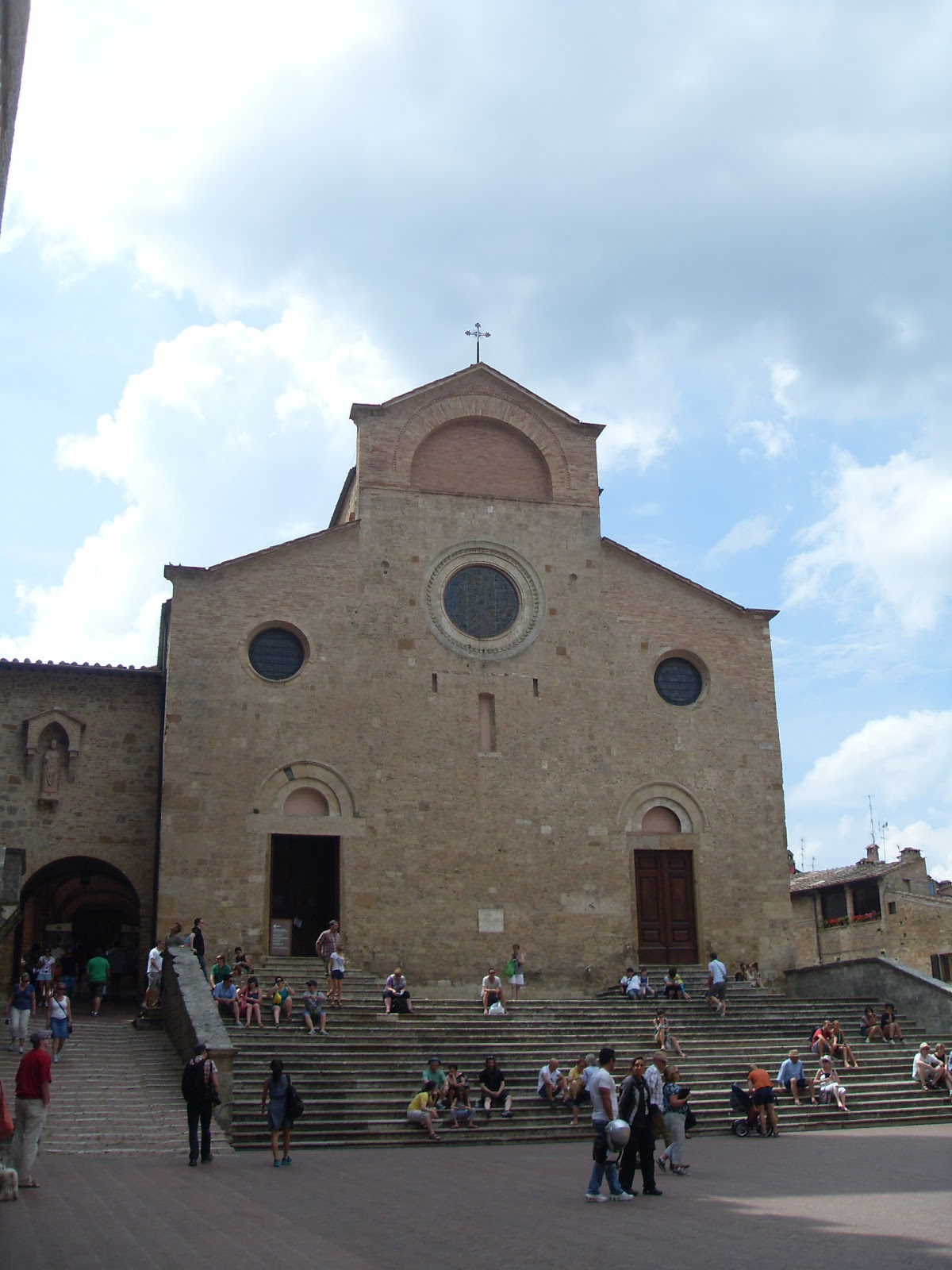
I saw this wonder myself as I explored the cathedral of San Gimignano last summer, but then I had no idea that it was a work by Gozzoli. The fresco is found on the rear wall of the nave and is executed very skilfully in that familiar theatrical composition so typical of the Quattrocento, and which becomes particularly evident in the depictions of Saint Sebastian.

San Gimignano

Duomo di Santa Maria Assunta

Sebastian was a very popular saint in 15th-century Italy because he was believed to guard his devotees against the sundry plagues that haunted the communes. In cities like San Gimignano, which had a rich mercantile estate willing to express its devotions expensively, it is therefore no wonder to find such a sumptuous and centrally located depiction as Gozzoli's.


During my stay in Tuscany I also happened upon another Gozzoli's renditions of Saint Sebastian, this time in the nearby city of Certaldo, which can be seen from the towers of San Gimignano. In one of the churches of the old city, the Chiesa di SS Tommaso e Prospero, located right next to the Pretorian palace, a beautifully painted altar can be found, where the martyrdom of Saint Sebastian can be found on the backside.

Chiesa di SS Tommaso e Prospero

As seen below, the martyrdom is splendidly depicted and surrounded by the coat-of-arms of the city (as seen by the onion, Certaldo's most famous produce) and local families. It is less grandiose than the fresco of San Gimignano, but the rigid style, the profusion of arrows and the beard of the saint are all recognisable features. It was likely executed around 1464-65, when Gozzoli was in Certaldo for the decoration of another local chapel.


What is most interesting about thes frescoes, however, is to note Sebastian's ante-apollonian beard, a detail that fell out of vogue towards the close of the 15th century, as painters like Mantegna and Botticelli turned to Classical renditions of Apollo for their models (hence ante-apollonian). This fashion is particularly evident in Mantegna's three paintings of the saint, the first of which dating as early as the 1450s. Benozzo Gozzoli, in other words, stuck to an older, pre-Quattrocento paradigm in his depictions of Saint Sebastian.

søndag 15. september 2013

Travels in Tuscany, part 4 - The City of a Hundred Towers


e quella faccia
di là da lui più che l'altre trapunta
ebbe la Santa Chiesa in le sue braccia:

dal Torso fu, e purga per digiuno
l'anguille di Bolsena e la vernaccia
- Purgatorio (XXIV), Dante Alighieri


and that face
Beyond him, more puckered than the rest,

Is that of a man who had the Church in his arms:
He was from Tours, and now fasts to purge himself
Of the Bolsena eels and the sweet wine.
- Translated by Charles Sisson


San Gimignano, seen from Certaldo

The man to whom Dante refers in this canto is Pope Martin IV, who reigned from 1281 to 1285, and who was infamous for his gluttony and therefore set to purge his body of his favourite delicacies in the company of other gluttons on the Sixth Cornice. The eels for which he had such an appetite in his mortal days were steeped in la vernaccia, a wine native of San Gimignano, a Tuscan city Dante once visited on a diplomatic mission, and which can be seen across the river valleys from the city of Certaldo, as seen in the picture above.

Porta San Giovanni


When I visited Tuscany for the conference in Certaldo this summer, I had left one day open in my itinerary for exploring. Certaldo is situated in close proximity to several historical centres, such as Pisa, Florence and Siena, but I was first of all attracted by the small hill town of San Gimignano, known as the city of a hundred towers, some distance south of Certaldo. In the end I decided to spend my day off here rather than Florence, because I thought to myself I would certainly visit Florence some other time, while I might not have the same opportunity to see San Gimignano for the foreseeable future. However, having visited the city of a hundred towers - or twenty-one, as I've heard is the correct number - I now realise I have to return to that city for a more thorough investigation.


Facade of the Franciscan convent, later Templar mansion and, after 1308, a house of the Maltese Order

Agnus Dei

A splendid torchholder

The city of San Gimignano has an old history reaching back to Etruscan times. According to legend it was founded by two Roman brothers who ran away from Rome in the aftermath of the Catiline conspiracy and named Citadel of Selva after one of them. Later it received its current name from Bishop Geminianus, a 4th-century bishop-saint from Modena who was venerated in the city and, according to legend, was counted as its saviour, though I'm not sure on what grounds. Devotion towards Geminianus became significant in the 12th century following a translation of the bishop-saint's relic in 1106. Towards the end of that same century, San Gimignano received its municipal independence from the bishops of Volterra, to whom it had been assigned by King Hugh in 929, apparently the first document to refer to the city.


Situated on the Via Francigena, the pilgrimage route to Rome from France, San Gimignano grew to a rich and formidable hill-town throughout the 13th century thanks to pilgrims, its export of wine and its varied manufacture (including glass and cloth). Its economic prosperity attracted rich families who in their turn gave rise to the town's characteristic towers, a symbol of power and wealth, and though only 21 of them remain today, it is said that as many as 76 towers once stood in the city. In addition, there grew up convents for Franciscans, Dominicans and Augustinians, and even the Templars set their mark upon the cityscape.

Torre Rognosa

Torre del Diavolo

Piazza della Cisterna

Like so many other Italian city-states, San Gimignano had a volatile political history, siding variously with the Ghibellines and the Guelphs. It was for this reason Dante visited the city in 1300, acting as an ambassador for the union of Guelph cities in Tuscany. Whether it was during this stay that the Florentine poet learned of Pope Martin's love of vernaccia-marinated eels I don't know, but I assume Dante himself had opportunity enough to acquaint himself with the sweet wine during his stay.


The wealth of San Gimignano resulted in much beautiful architecture and wonderful artistic expressions, and even following the plague's decimation of the populace the 14th century saw many spectacular artistic projects. The walls of San Gimignano's duomo are partcularly rich in this legacy, and the Sienese painter Bartolo di Fredi (c.1330-1410) painted a series of scenes from the Old Testament, which is facing a series of scenes from the New Testament of uncertain provenance. Both these series were completely breathtaking in all their horror and delight, and I could but admire and adore the faith, the talent and the dedication that went into making these frescoes. There is also a beautiful depiction of Saint Sebastian's martyrdom executed by Benozzo Gozzoli (ca.1420-1497) who also painted a frescoe on the same theme in the chiesetta in Certaldo.


The city's medieval architecture is well-preserved and it really would feel like stepping back in time once you enter the Porta San Giovanni, were it not for the ubiquitous and occasionally boisterous tourists who swarm the streets in the summer. However, San Gimignano is so labyrinthine that it is easy to get away from the masses and explore the various arches, tunnels, alleys and walls undisturbed by the vulgar noises. There are also a number of fascinating and interesting sights, from the lowly, intimate churches to the soaring towers, and from the top of the Torre Grossa, reaching 54 meters and constructed in 1311, you have a magnificient view of the Tuscan landscape, and as you stand there and see the distant mountains, the vineyards and the green and luscious valleys it is almost as if you begin to doubt the existence of a world beyond the horizon.


Chiesa di San Bartolo, built in 1173


The Chancery Arch


Chiesa di San Agostino, consecrated in 1298


Courtyard of the late-13th-century town hall


View from Torre Grossa


Piazza del Duomo

With its richness of sights and nooks I didn't have the chance to fully explore San Gimignano the short afternoon I spent there, and I already look forward to revisit the city and see more of its fascinating history.

Piazza della Cisterna dalla Torre Grossa