And was the holy Lamb of God,
On Englands pleasant pastures seen!
- And did those feet, William Blake
Viser innlegg med etiketten Roman. Vis alle innlegg

søndag 28. desember 2025

Synchronicities of reading, part 1 - garum in Lisbon


Life is full of synchronicitites, episodes in one's life that bear some kind of resemblance to one another, or that provide a sense of symmetry or of patterns. A reading life is particularly full of them, as the variables at play are much more numerous than in a life where reading plays no part at all, simply because reading allows a person to encounter more topics and travel by page to a wide variety of locations, which provides more elements that can be found to rhyme somehow. I have experienced quite a few of them so far, but I was particularly struck by one such synchronicity this Christmas, one which was centred on Lisbon and which involved garum. 


The Norwegian translation of Asterix album no. 41, Asterix in Lusitania
(Text by Fabrice Caro, or Fabcaro, art by Didier Conrad, translation by Svein Erik Søland)


This Christmas, I was reading the latest Asterix album, Asterix in Lusitania, by Fabcaro and Conrad. The biannual publication of the new albums produced after the death of Albert Uderzo in 2009 has become subsumed into the great Norwegian tradition of Christmas comic books, and the album was part of this year's haul. The story revolves around an attempt to prove the innocence of a wrongfully condemned producer of garum, a type of fish sauce, who is accused to trying to poison Julius Caesar. The climax of the scene occurs in Lisbon, and the cover of the album invokes a Lisbon view so characteristic that I was immediately brought back to my trip there last spring. And as I was reading the story, I was again brought back to Lisbon because of the garum. 


Lisbon streetscape near the Castle of São Jorge


View of the Tagus River


Translating the Relics of St. James, edited by Antón M. Pazos (2016)


While I was in Lisbon last year, I was reading up on the medieval cult of Saint James the Elder. I had travelled from Santiago de Compostela where I had spent five days as a kind of research-tourist, and I had brought a collection of articles with me on the journey. The collection included articles on the Compostelan cult, as well as a few texts that sought to elucidate the context of the historical James, the fisherman who became one of the twelve apostles. One of these articles delved into the fishing industry on the Sea of Galilee, part of which included the production of garum. This was not the first time I had heard of this fish sauce, but I had never read about it at lenght, nor had encountered it within the context of the wider Roman world. 


I read this and other of the book's interesting articles at what became my regular café during my brief sojourn in the Portuguese capital, where I drank black tea with lemon and devoured delicious local cookies - and where I was mistaken for the Portuguese politician Rui Tavares. It was therefore a surprising realisation as I was reading the latest Asterix album during the darkness of a Norwegian December that this was the second time in two years that the elements of garum and Lisbon had converged in my life. The great benefit of this particular synchronicity was that I could relive those lovely Lisbon days thanks to the memories spurred on by a key plot device in a comic book. 


lørdag 6. april 2024

The early cult of saints – an attempted history


[The following is an attempt at a brief history of the development of the Christian cult of saints in the first 500 years. This period saw a rapid development of this phenomenon, yet the relative paucity of the sources means that it can sometimes be difficult to understand that despite the rapidity of the process, it was also piecemeal and slow, as well as both decentralised and not streamlined. What prompted me to write this text was a promise to help a colleague with providing an overview of the cult of saints, and I ended up putting together this text which is aimed at giving those unfamiliar with the topic some sense of the historical process, as well as some key terms and dates.] 


Terminology and the first hundred years    


The word ‘saint’ is the English translation of ‘sanctus’, which in turn is the Latin translation of the Greek ‘hagios’, which means ‘holy’. In the epistles of Paul, this term is used indiscriminately about all followers of Christ, but it later came to signify an especially holy kind of Christian. There was, in other words, a shift from the more general use of ‘hagios’ to a kind of elite Christians. Here, the elite status is based on whether they died for the faith, not their social standing or their position in the early church hierarchy. The circumstances of this shift are nebulous to us, and it was likely a gradual development that grew out of the early persecutions of Christians. (Although it is likely that the persecutions under Nero were too early to have an impact on this shift, and it is more likely that the persecutions under Domitian and Trajan had the most immediate effect – especially those of Domitian.) It is not clear how this change in terminology began, whether it was initiated by the leaders of the early congregations, or whether it emerged from common usage that eventually became the standard way of referring to those who had shown their faith more clearly and publicly. These persecutions served to solidify the sense of a shared identity among Christians, and therefore also gave root to a stronger development of a Christian collective memory. This memory was perpetuated in part through the celebration of the anniversaries of those who had died for the faith. These celebrations were held at the graves of the dead, and from this practice grew the elaborate liturgical celebrations that came into place in the fourth and fifth centuries. The day of the saint’s death became known as ‘dies natalis’, birthday, as it was the beginning of the saint’s life in Heaven. Eventually, as Christianity became more widely common and eventually legalised, the remnants of the especially holy dead Christians could be moved into churches or other sacred spaces intended for the veneration of these remnants. These remnants were relics, which were held to be sacred, and to provide a tangible contact point through which the power of God could work miracles for the glory of the saint (cf. ‘translation’ below).     

            We do not know who were the first saints. Arguably, the apostles, John the Baptist and perhaps also the Virgin Mary are likely to have been held in very high regard from the earliest stages of the Christian religion. Because the early church was both scattered and very heterogenous, however, it is doubtful that we can surmise any coherent approach to the memorialisation of those who died for the faith. In both the Latin and Greek traditions, one of the earliest saints is said to have been Polycarp of Smyrna, whose death is conventionally dated to 155 CE. Early accounts of his death were written in both Latin and Greek, which shows that there was a lot of exchange between those Christians who were Greek-speaking inhabitants of the Roman Empire – not necessarily citizens, although some, like Paul, were – and those whose main written language was Latin. Stories travelled, and so did the terminology. In some cases, this exchange led to the translation of Greek terms into Latin – ‘hagios’ to ‘sanctus’, for instance – but in other cases the Greek terms became dominant also in the Latin language. The best example of this retaining of Greek is seen in the word ‘martyr’, which means witness, and came to mean someone who bore witness to their Christian faith by accepting death rather than recanting their faith. Another of these Greek terms is ‘apostolos’, which means envoy or messenger, and which became slightly Latinized as ‘apostolus’.   


The early literature: c.160-c.400     


The account of Polycarp of Smyrna’s death – commonly known as The Martyrdom of Polycarp – is believed to have been written relatively shortly after his death, and is often dated to 160 CE. This text is interesting because it shows that many of the typical features of later literature about saints were already in place by the mid-second century CE. For instance, there is an elaborate martyrdom, the remnants of Polycarp were gathered by Christians and held in greater value than jewels – this is perhaps the earliest reference to the veneration of the relics of saints – and the text also exhibits very strong anti-Semitism. Throughout the second and third centuries, several texts about the especially holy Christians appeared, perhaps most famously the Passion of Perpetua and Felicitas, written in Carthage around the year 200 CE. In this early period, however, there was no coherent genre for writing about saints. The term ‘hagiography’, writing about the holy, was first used by Greek-speaking Jews to refer to the Ketuvim, but at some later point became adopted by Christians to refer to the accounts of saints and their deaths and deeds. As far as I know, we cannot say for certain when this terminology came into this Christian usage.

            Following the legalisation of Christianity during the reign of Emperor Constantine, the churches became more stable centres of administration and memory-production. The various church leaders were able to communicate more frequently with one another, and this exchange led to a streamlining of both terms, practices and forms of memorialisation. By Constantine’s death in in 337, the veneration of relics had become standard practice among Christians, and rich Christians had begun collecting them and turning their house complexes into memorial spaces. The memories of the recent persecutions under Diocletian – particularly in the period c.300-305 – were transformed into a collective memory that further solidified a Christian, but also a Roman Christian, identity. One of the best examples of this memory-making is Pope Damasus I (r.366-84). He himself was born around the time of the Diocletian persecutions, and as bishop of Rome he began to collect the bones of those who had died in the persecutions. These bones were placed in churches and the places of their martyrdoms were memorialised through epigrams. This effort effectively converted Rome into a Christian space, and several popular saints – such as Agnes and Sebastian – became famous through the efforts of Damasus. These epigrams were also part of the early literature about saints.

            In the second half of the fourth century, some of the most impactful texts about saints were written, and these came to establish the form that hagiography would retain throughout the medieval period and into the modern era. The biographical accounts of Martin, bishop of Tours (d.397), written by Sulpicius Severus while Martin was still alive, and the account of Anthony, the Egyptian hermit, by Bishop Athanasius of Alexandria (d.373) came to provide a template for later saint-biographers. The biography of a saint – often called ‘vita’, life, or ‘passio’, passion, or even ‘acta’, acts – typically described the saint’s childhood and background, their conversion or at least deeper commitment to Christianity, their suffering, their good deeds, their deaths, and eventually also the appearance of miracles. These two biographies also established more clearly that even those who had not died for their faith – which neither Martin not Anthony had done – could be considered holy, because their way of life had proved their commitment to Christ. They were ‘confessores’, confessors, of their faith, rather than martyrs. 

            The emergence of a more formally coherent Christian literature also led to the more coherent stylistic form of saint-biographies. Although a Christian was always supposed to imitate the life of Christ, this was paramount in the case of the saints. The early saints had imitated Christ by choosing death, and died like Christ, even though the manner of dying was not necessarily on a cross. This imitation of Christ, ‘imitatio Christi’, became more important to demonstrate with the cessation of persecutions, and the relative scarcity of new martyrdoms that followed the legalisation of Christianity. From the late fourth century onwards, therefore, saint-biographers modelled their accounts even more explicitly on episodes from the Gospels, and emphasised the parallels between the life of Christ and the saints more strongly. This practice continued throughout the medieval and modern periods.

            As part of the more formalised and streamlined cult of saints, collections of miracles became more common. I do not know exactly when such accounts of miraculous events first became committed to writing, but it is likely that an expectations of signs and miraculous cures led to orally transmitted accounts in the early period of the veneration of saints. Augustine’s City of God includes an account of the miracles said to have appeared in the wake of the finding of the body of Saint Stephen Protomartyr in 417, and the arrival of some of the relics of Stephen in Carthage in 424. The popularity of Augustine’s writings also had an impact on later miracle collections.    


Saints in the Christian cosmology  


We know little about how the earliest venerators of Christian saints understood the place of the especially holy dead in the greater scheme of things. There was an expectation of an afterlife, and most likely the saints were believed to be in Heaven. It is unclear whether the veneration of the early saints was done with the hope that those who were venerated would provide help, but such an expectation came into place as the cult of saints became more Romanised. The collection of verse biographies by the poet Prudentius – Liber Peristephanon – shows that by the turn of the fourth century, Christians in the Roman Empire, at least those who belonged to the upper classes, understood the saints as ‘advocati’, intercessors or ambassadors, in the Heavenly Senate. In other words, the system of Roman society – where the rich were patrons who bestowed favours on the common people in return for services, and where the Senate was the house of ultimate authority – was transposed onto the greater cosmology. Saints were understood as patrons, and in return for their aid – ‘beneficium’ – the living Christians performed their duties or their labours, ‘officium’. This idea of saints as interceding before God on behalf of the living has remained a key point in Christian thinking. The ‘beneficium’ usually came in the form of cures or other miraculous events by which God was believed to demonstrate the holiness of his saints. The ‘officium’ usually signified the celebration of the anniversaries of the saints, mainly their day of death or the day of the moving of the relics, the so-called translation. The term ‘officium’ later came to denote the performance of liturgical songs and readings in the course of a daily round in a church or a monastery. Saints interceded on behalf of the living, but they could also punish the living for wrongdoing, neglect of their patrons, or heresy.     


Continuity and discontinuity


There has been a lot of discussion about the degree to which we can see a continuity from the pagan polytheism to the role of the saints within Christian monotheism. The traditional argument has been that the old gods were simply replaced with different figures, and that people attributed to these figures a lot of the same properties and powers that they did the old gods. Since Peter Brown’s monograph The Cult of Saints (1981), however, the main consensus is that the situation is more complicated than that. Naturally, there might well have been Christian converts who did not discern much of a difference between the saints and the old gods, but to the Christian theologians and, indeed, to the bishops and missionaries, there were many important differences. First of all, a saint does not make any decisions of their own, but with the approval of God. Miracles, moreover, are not brought about by the saint. Instead, God performs the miracle as a favour to the saint in return for the saint’s merit – ‘meritum’ – which is the quality of the saint’s life on earth. Furthermore, while the Christians venerated the saints as heroes, and although Paul’s epistles uses terms like soldier and athlete – there was nothing physically violent about the way the saints met their demise. They fight consisted of enduring violence – often described in gruesome detail by Christian authors – and from the point of view of the pagan Romans, there was little heroic about such passivity. In other words, and following the arguments of Peter Brown, the heroes and gods of the pagan pantheon had little in common with the heroes of the Christians.      

            The differences between the worship of pagan gods and the veneration of Christian hero, however, do not mean that there were not continuities. As the Christian religion became legalised and increasingly infused with Roman impulses – one of which was the transposition of the patron-client system onto the Christian cosmological system – there were several aspects of the various polytheistic religions that came to shape Christian religious practice. For instance, the practice of incubation ritual, where someone sleeps at a shrine in order to acquire a religious experience, was very common among various polytheistic religions. This practice was adopted by Christians, and from miracle collections from the Middle Ages we often read about cures and visions that happened to those who slept or kept a vigil by the saint’s shrine.

            Another form of continuity can be seen in the deliberate re-use of pagan cult places by Christians. Pagan shrines, temples or sacred trees were destroyed with the purpose of replacing the pagan holy place with a Christian one. Among the earliest surviving records of this idea is the Life of Saint Martin by Sulpicius Severus, where Martin cuts down a sacred tree. In Gregory the Great’s Dialogues – a collection of saint stories written during his papacy (590-604) – we read that Saint Benedict of Nursia destroyed a shrine of Apollo and replaced it with an altar of Saint Martin, which suggests a deliberate imitation of the holy bishop. This incident is also a reminder that saints could imitate other saints, not only Christ or biblical figures. In addition, however, it is important to be cautious about whether this hagiographical topos was indeed enacted in real life, or whether it was only a literary claim. It is likely that the hagiographical topos did indeed inspire real-world events, but it is also possible that in some cases we are dealing with a claim of imitation only, not an actual event.  


+++    


Key terms      


Apostolos: Greek for envoy or messenger; term used for those of Christ’s early followers who were missionaries, but also used about those saints credited with introducing Christianity to a new place or a new people


Beneficium: the favours given by a saint to the living


Confessor: those who testified to their faith by their Christian living, but who did not die a violent death (cf. martyr)


Dies natalis: the Heavenly birthday of the saint, meaning their day of death


Hagiography: writing about the holy; in the Christian sense, any text that provides an account of the saint’s life, characteristics, death, and/or associated miracles. What makes a text hagiographic is that it has its focus on the saint, and many different types of texts therefore qualify as hagiographic, not solely biographies of saints


Hagios: Greek for ‘holy’, Paul’s word for the early followers of Christ


Imitation of Christ: every saint was expected to imitate Christ to some degree; this imitation could be achieved in many different ways, either by simply sacrificing their life for the faith, or by imitating specific episodes from the Gospels. Saints could also imitate other saints


Martyr: Greek for witness; a term used for those who died for the faith and thereby testified to their conviction


Meritum: the quality of a saint’s life which makes the saint earn the goodwill of God; the better a saint’s meritum, the more efficient the saint is as an intercessor for the living


Miracle: in Christian terms, signs by which God shows His will on Earth, and through which humans are expected to recognise the holiness of a saint  


Officium: the veneration given by the living in order to deserve the favours given by the saint


Passio: Latin for ‘suffering’, a word commonly used to describe accounts of the saint’s tortures and subsequent death (cf. The Passion of Perpetua and Felicitas)


Relics: the remnants of the saints, usually their bodies or bones; some relics were so-called contact relics, meaning relics that had absorbed some of the holiness of the saints by contact with them – either while the saint was living or after the saint’s death. Through this contact, items such as clothes placed on the saint’s relics or the saint’s shrine could become a new tangible relay point through which God’s power worked miracles. The container in which these relics were placed is commonly referred to as a reliquary, but also sometimes a shrine (cf. ‘shrine’)


Sanctus: Latin for ‘holy’; the root of the English ‘saint’


Shrine: can be used to refer to the holy space in which a saint is placed and venerated, but it could also mean the casket or container in which the saint’s body or the saint’s bones, dust and ashes were placed


Translatio: the moving (translation) of a saint’s relics to a place of rest, sometimes to a new place of rest. The occasion could be celebrated by an anniversary feast.  


Vita: Latin for ‘life’, a very common term to denote biographical account of a saint  (cf. Life of Saint Martin)


+++    


Brief timeline (all years in CE)       


c. 30: commonly accepted date of Christ’s death


c.35-64: the missionary activity of Paul the apostle


54-68: reign of Nero; possibly the first, and if so very limited, Christian persecutions


81-96: reign of Domitian; first major persecutions of Christians


155: conventional date of Bishop Polycarp of Smyrna       


c.160: composition of The Martyrdom of Polycarp


203: conventional date for the death of Perpetua and Felicitas in Carthage, whose imprisonment was recorded in an account that partly might be dictated by Perpetua herself          


249-51: reign of Decius, which saw a major persecution of Christians  


257-58: the Valerian persecutions; Bishop Cyprian of Carthage died in 258  


c.300-305: the Diocletian persecutions


313: the Edict of Milan, which legalised Christianity


366-84: papacy of Damasus I, one of the major campaigns for Christianising the topography and urban space of Rome


373: death of Athanasius of Alexandria, author of The Life of Anthony of Egypt         


397: death of Martin of Tours       


415: death of Prudentius, author of Liber Peristephanon    


417: the finding of the body of Stephen Protomartyr


424: the arrival of some of the relics of Stephen Protomartyr in Carthage        


425: death of Sulpicius Severus, author of The Life of Martin 


430: death of Augustine of Hippo


543: death of Benedict of Nursia


590-604: the papacy of Gregory the Great

fredag 19. februar 2016

Narrative and Saints' Lives, part III - Drama through Dialogue, and the Legend of Saint Valentine


For this was sent on Seynt Valentyne's day
Whan every foul cometh ther to choose his mate

- Geoffrey Chaucer, Parliament of Foules

In this series of blogposts I'm looking at certain narrative aspects and techniques in the lives of the saints. Previously, I have looked at narrative technique in very short accounts, touching on how thenarrative is affected by its brevity, and also on how narratives are shaped when the legend is concernedwith a multitude of protagonists. In this blogposts, I use the legend of Saint Valentine to look how the narrative changes through the use of direct speech, as compared to a more straightforward account. As an example of the latter, I rely on the legend of Valentine as contained in the Nuremberg Chronicles and as told in the Legenda Aurea.

Saint Valentine is arguably among the most widely known saints of the world, although I think it's a fair assumption to say that the knowledge does not go very far beyond the name and his feast-day, February 14, alternately known as all hearts' day and singles awareness day. This connection between Valentine and the celebration of couples in love is attested to by the epigraph above, taken from Chaucer's Parliament of Foules, and can thus be suspected to be commonplace in the fourteenth century England. 


Almanac for February, with the bird of Valentine to the far right on the other page
BL MS Royal 17 A XVI, agricultural almanac with calendar, c.1420
Courtesy of British Library


The Nuremberg Chronicle

Another and quite pervasive story claims that the connection between Valentine and love is far older and stronger than that. According to this version, Valentine was a late Roman priest who married couples despite the prohibition against Christian marriage under imperial law. There might an old legend making such claims, and according to the Wikipedia article on Saint Valentine this story is found in the Nuremberg Chronicle, written by Hartmann Schedel and published in 1493. The Nuremberg Chronicle is a world history including many episodes from the lives of the saints. Valentine's legend is recounted on folio 122r, a folio which contains the tail end of the martyrdoms of the eighth persecutions and the beginning of the ninth persecution of the church by Roman authorities.

In the searchable online edition of Walter Schmauch's English translation of the Chronicle, this account appears to be the only one depicting the death of Valentine, and it contains no reference to marriage, only Valentine's mockery of the pagan gods. The legend goes as follows (my brackets):

[Valentine], a Roman priest, after giving evidence of exceptional learning and writing, was imprisoned by the Emperor Claudius; and being asked his opinion concerning the pagan gods, said: Jupiter, Mercury, and the other gods were miserable human beings. Afterwards he enlightened the daughter of Asterius [by healing her blindness]. He brought her and forty-nine persons of her household to the Christian faith. Finally, at the command of the emperor, he was severely beaten with clubs, and was beheaded on the 14th day of the month of February.
- Hartmann Schedel,
The Nuremberg Chronicle, translated by Walter Schmauch

The confusion regarding Saint Valentine goes very far back, as even old martyrologies contained reference to two or even three martyrs called Valentine being celebrated on February 14. One Valentine is a Roman priest, another a bishop of modern-day Terni in Italy, but both being killed during the reign of Emperor Claudius II. David Farmer in his
Oxford Encyclopedia of Saints suggests that these Valentines are one and the same.

 
Valentine interrogated
BL MS Royal 2 B VII, English psalter, c.1310-c.1320
Courtesy of British Library


Legenda Aurea

The legend of Valentine is presented in a slightly more elaborate and dramatic fashion in Jacobus de Voragine's
Legenda Aurea, written around 1260 in Italy. The elaboration consists in snippets of direct speech, but it contains no further essential details than what we find two centuries later in the Nuremberg Chronicle (although they disagree on the method of execution). The story is nonetheless markedly different, because Jacobus gives the characters of the legend their own speeches, thus making them coming alive, making them more memorable. The version by Jacobus comes after an explanation of the meaning of Valentine's name and goes as follows (my brackets):
Valentine was a venerable priest, whom the emperor Claudius [II] summoned before him. "What is this, Valentine?" he asked. "Why do you not win our friendship by adoring our gods and abandoning your vain superstitions?" Valentine answered: "If you but knew the grace of God, you would not say such things! You would turn your mind away from your idols and adore the God who is in heaven." One of the people standing by Claudius said: "Valentine, what have you to say about the holiness of our gods?" "All I have to say about them," Valentine replied, "is that they were wretched human beings full of every uncleanness!" Claudius spoke: "If Christ is true God, why do you not tell me the truth?" Valentine: "Truly Christ alone is God! If you believe in him, your soul will be saved, the empire will prosper, and you will be granted victory over all your enemies!" Claudius responded, saying to those around him: "Men of Rome, heed how wisely and rightly this man speaks!" Then the prefect said: "The emperor is being led astray! How shall we give up what we have believed from infancy?"
At this the heart of Claudius was hardened, and he turned Valentine over to the prefect to be held in custody. When Valentine came into this man's house, he said: "Lord Jesus Christ, true light, enlighten this house and let all here know you as true God!" The prefect said: "I wonder at hearing you say that Christ is light. Indeed, if he gives light to my daughter who has been blind for a long time, I will do whatever you tell me to do!" Valentine prayed over the daughter, her sight was restored, and the whole household was converted to the faith. Then the emperor ordered Valentine to be beheaded, about A.D. 280 [a date which is ten years after the death of Claudius II].
- Jacobus de Voragine,
The Golden Legend, translated by William Granger Ryan, 2012


Valentine beheaded
BL MS Royal 2 B VII, English psalter, c.1310-c.1320
Courtesy of British Library


On narrative and dramatic speech

As we see, the use of dialogue makes the story of Valentine according to Jacobus become much more captivating and dramatic than is the case in the
Nuremberg Chronicle. One important consequence is that the narrative is more memorable: Valentine is not a taciturn figure whose narrative is left solely to the narrator, he is a character in a dramatic passion play, his own passion play. Furthermore, he also becomes quotable, delivering verbal punches of Christian defiance. In addition, the legend of Valentine becomes in this way peopled by more characters with whom Valentine can perform his verbal battle, and who serve as foils for his perfect Christian truth: The emperor begins promisingly but falls because he listens to others instead of following his heart, while the prefect begins as a pagan responsible for Valentine's imprisonment but becomes the saint's Christian brother instead. These two minor personal dramas are played out within the passion story of Valentine, and we only properly access these personal dramas by way of dialogue, as the dramatic speech provide brief glimpses into the thoughts and concerns of the two antagonistic figures in the narrative.

The question then is why the legend is rendered in this way by Jacobus. One possible explanation is that he quotes directly from an existing
vita, though the lack of detail and the brevity of the narrative might suggest that he draws from his own memory rather than a specific written source. It is important to underline, that the difference between the story as presented in Legenda Aurea and the Nuremberg Chronicle does not have to do with the different genres at play, hagiography and historiography. Indeed, chronicles often contained direct dramatic speech, and the contents of these were likely to be put in the mouths of the characters by the historiographers to increase the drama or to present the complex rationale behind an action in an easily accessible way. Among the many medieval historians who practiced this kind of editorial inventiveness I want to name the tenth-century Italian bishop Liutprand of Cremona, and the twelfth-century English historian Henry Huntingdon, to suggest how widespread this phenomenon was.

Since the distinguishing feature is, in my mind, not the genre of the work, I will instead suggest that the key lies in the purpose of the work. Jacobus de Voragine wrote
Legenda Aurea as a compendium for homilists from which they could find material for their sermons on the various liturgical feasts. I therefore suggest that the dramatic dialogue serves partly as a mnemonic tool by which homilists could more easily remember the story, hence the result that the story becomes more memorable. Another point to make is that, as mentioned, Valentine becomes quotable, thus providing the homilists with material by which they can make their sermons more exciting.

A third and final point regarding the dialogue is that we might consider it as a form of
imitatio Christi. I have elsewhere written about how a debate between the saint and pagans about the nature of divinity or other subjects could be ways of imitating Christ when he was twelve and lectured the learned men in the temple. This kind of rhetorical imitatio is perhaps most famously known as performed by Catherine of Alexandria, but we can also see some of this in Valentine's dismissal of the pagan gods.

In short, I believe that Jacobus' use of dramatic speech is there to bring the story more alive to his audience who in turn had as their job to make the story more alive to their own audiences in church. It might also be that the dialogue serve to embellish a narrative about a saint of whom very little is known.

Afterthought

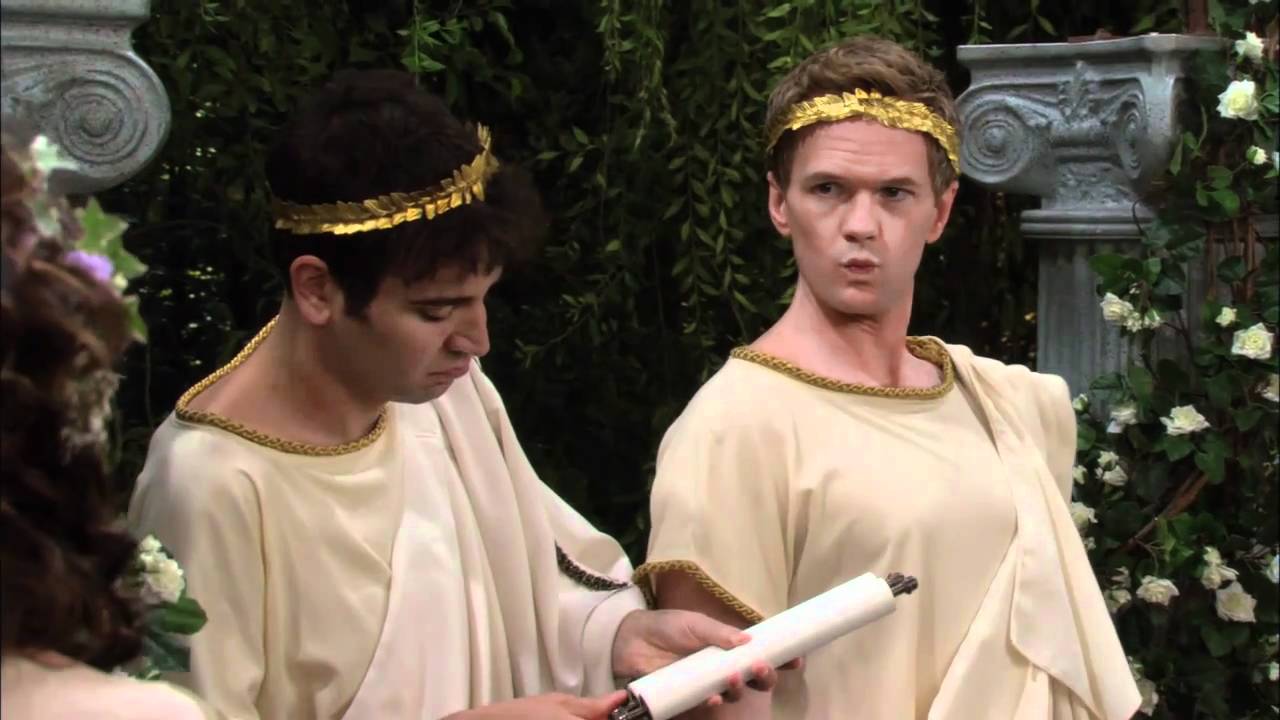
As an afterthought, Jacobus is not the only one to dramatize the story of Saint Valentine. One dramatic rendition of the legend was narrated by Barney Stinson in How I Met Your Mother, S06E16. Its veracity is dubious on many accounts, but I will let that doubt speak for itself.

Valentine and his best bro Desperatius
From HIMYM S06E16 (for the full clip, see below)

Courtesy of this website


Bibliography

Farmer, David,
The Oxford Encyclopedia of Saints, Oxford University Press, 2004

Jacobus de Voragine,
The Golden Legend, translated by William Granger Ryan, Princeton University Press, 2012

Schedel, Hermann,
The Nuremberg Chronicle, translated by Walter Schmauch, accessed at Morse Library, Beliot College, online edition: https://www.beloit.edu/nuremberg/


Websites

The Catholic Encyclopedia: http://www.newadvent.org/cathen/15254a.htm

Wikipedia: ttps://en.wikipedia.org/wiki/Saint_Valentine

fredag 20. desember 2013

Et in Arcadia ego


in Arcadia there were born
A shepherd
- The Faithful Shepherd, Giambattista Guarini (translated by Richard Fanshawe)


Les Bergers d'Arcadie, Nicholas Poussin (1637-38)
Courtesy of Wikimedia Commons

In my previous blogpost I gave a brief introduction to the development of the vanitas motif in art, and this blogposts examines another step in this evolution, namely the motif of death in Arcadia, collectively known as Et in Arcadia ego. This artistic genre draws on a long legacy of bucolic writing reaching back into Greek and Roman literature, with Vergilius' Bucolica and Georgica, pastoral eclogues detailing the idyllic life of shepherds, as perhaps the most important works. They retained their popularity throughout the Middle Ages, and Vergilius' position in the eyes of the medieval learned is perfectly exemplified by his role as Dante's guide through Hell and Purgatory.

In the 16th century pastoral poetry gained increased momentum with the critical debates concerning Aristotle's Poetics, which had been translated into Latin late in the preceding century. Aristotle's rules of drama gave rise to the modern theatre, and also caused a lot of controversy among literary theorists who sought to reconcile the Poetics with Horatius' Ars Poetica, and some of the key points of tension were whether the satyr play and the shepherd play were the same, and whether either could be seen as a genre of its own on par with the tragedy and the comedy. As these definitions were tried and experimented with, a significant body of pastoral literature arose. This occurred primarily in Italy, but several important works were also written in England. These pastoral works were often composed for the court, and frequently contrasted the deceits of courtly life with the simplicity of the pastoral scene, often represented by Arcadia, a region in Greece that had become synonymous with The Pastoral Idyll.

Woodcut from second eclogue of Spenser's Shepheardes Calender, 1579
Courtesy of this website

Among the most important literary works to shape the late medieval and early modern pastoral were the plays Aminta (1573) by Torquato Tasso and The Faithful Shepherd (1590) by Giambattista Guarini. These were not only texts to be performed, but statements in the ongoing debate on genre, where the views of the playwright were put to paper and then executed on stage. The Arcadian scene was already a long-standing feature in Italian literature, from Jacopo Sannazzaro's very influential poem Arcadia from 1504 and onwards. This tradition also influenced English writers of the times, and among the foremost are Edmund Spenser, who wrote his Shepheardes Calender in 1579 in imitation of Vergilius, and Sir Philip Sidney, whose The Duchess of Pembroke's Arcadia drew on Sannazzaro's poem, among others.

In the 17th century, this pastoral tradition was merged with the contemporary vanitas motif in art, and resulted in some beautiful and deeply unsettling paintings, where the pastoral idyll was disrupted by the discovery of death's presence, even in the blissful Arcadia. The first example of this sub-genre, that I know of, is a painting by Giovanni Francesco Barbieri executed in the the period 1618-22. Barbieri, also known as Guercino, or the Squinter, here depicts two shepherds discovering a human skull, the proof that death also lurks in the blessed Arcadia. This sinister composition is given extra gravity when compared with another of Guercino's paintings, Apollo and Marsyas, where the same shepherds are witness to Marsyas' penalty, as seen below.

Et in Arcadia Ego, Guercino (1618-22)
Courtesy of Wikimedia Commons

Apollon and Marsyas, Guercino (1618)
Courtesy of Wikigallery

The most famous rendition of death in Arcadia was painted by Nicholas Poussin in 1637-38 and titled Les Bergers d'Arcadie, The Shepherds of Arcadia, as seen above. This iconic painting of shepherds examining a tomb was, however, a later variation of the theme, and the first painting was finished in 1627 with a slightly different composition as seen below.

Les Bergers d'Arcadie, Nicholas Poussin (1627)

These doleful meditations on death's omnipresence are a very beautiful confluence of the vanitas motif and the literary pastoral, evoking the mythological register of Arcadia while playing on the symbolism of the vanitas in a manner worthy of the rising Baroque of the first half of the 17th century, giving a contemporary touch to elements of a rich and long-standing history.


Bibliography

Hagen, Margareth,
1500 - poetikk, intertekst og sjanger i italiensk 1500-tallslitteratur, 2013

Hayward, Malcolm, introduction to Torquato Tasso's
Aminta, 1997: http://www.english.iup.edu/mhayward/aminta.htm

Penman, Bruce, Five Italian Renaissance Comedies, Penguin Classics, 1978


lørdag 13. april 2013

Oxen under the Sea


matre satus Terra, monstrum mirabile, taurus
parte sui serpens posteriore fuit
- Fasti, Ovidius
This week in my Medieval Latin class we have been working with an extract from the fourth book of Adam of Bremen's (fl.c.1075) Gesta Hammaburgensis Ecclesiae Pontificum. While the three first books of this work are dedicated to the history of the See of Hamburg, while the fourth is a topographical exposition of the northernmost reaches. As he himself puts it (in my translation): "And in this way Norway is the outermost province of the earth, therefore it is proper that we set this book in the outermost place [of our work]. The fourth book was written in the 1070s and much of the information he received at the court of the Danish king Svein Estridson (1047-76), possibly in modern day Sjælland. Adam himself probably never visited Norway and certainly not Northern Norway. Accordingly, what he tells us from this part of the region, he knew through hearsay at the Danish court, and also through older authorities such as Solinus and Paul the Deacon's Historia Langobardorum. In addition to some interesting factual information - for example pertaining to the cult of Olav Haraldsson - the book gives an interesting view of how Norway was conceived in the contemporary mindset. This is especially the case for Northern Norway which is presented as a region encompassing both the savage and the sacred. The savage is represented by bearded women and strange beasts such as black foxes (presumably polar foxes which indeed have a brown/black pelt), while the sacred is represented by localised versions of the legend of the seven sleepers, and the tale of Saint Ursula of Cologne and the 1100 virgins, some of whom, Adam contends, escaped to Norway. It is perhaps this spin-off or extension which later grew into the legend of Saint Sunniva, or it may be that Adam confused Sunniva with Ursula.

The purpose of this blogpost, however, is not to go into great details about Adam's fascinating work, but to look at one animal which caught my attention. In his exposition of the wildlife of Norway Adam says:
In these same mountains there are there are untamed beasts of such a plenitude, that in many parts of the region they feed only on wild animals. There they capture oxen, buffalos and moose as they do in Sweden; furthermore bisons which they [also] capture in Slavonia and Russia; only Norway [however] has black foxes and white hares and martens [presumably stoats], and bears of the same colour, who live under the ocean in the same manner as the oxen.
- Gesta Hammaburgensis Ecclesiae Pontificum, Adam of Bremen, book 4, chapter 32 (my translation)

Mosaic of an ophiotaurus, exhibited at Yorkshire Museum, York
 
It was of course this latter idea that caught my attention. I'm accustomed to many strange ideas from ages past pertaining to the habitation of animals, and I knew about the myth of barnacle geese hibernating in barnacles. However, the thought that oxen should be living under the sea was very quaint, and Adam himself continues these lines by saying "several [of these things] appear strange and unaccustomed to us". The most likely explanation of these submarine oxen are, in my mind, that they are a confusion of the walrus. However, the idea has an interesting classical counterpart, namely the ophiotaurus - as shown above - and the taurocampus, which appear to be variations of the same mythological theme.

The ophiotaurus is found only in the poem Fasti by Ovidius, as quoted in the epigraph,and the name means snake-bull. According to the poem whoever burned the beast's entrails would gain the power to overthrow the gods. The distich above describes it as follows (in my translation):
brought forth by Earth its mother the marvellous monster
was a bull and its hindpart was like a serpent.

From the baths in Ostia Antica, courtesy of giannidedom

This description also fits the beast known as the taurocampus. I don't know the origins of this particular animal, nor am I familiar with any classical references to it, but the name is a amalgamation of taurus and campus, which appears to be a common name for water beasts whose hindparts are coiling in a manner more akin to an eel than a serpent. There are numerous beasts such as this is Roman iconography, and we see a great variation in the mosaics of Roman baths, such as the one above from Ostia Antica. In this particular fauna, "campus" appears to be merely a suffix describing the sligthly serpentine tail, and we therefore have beasts such as pardalocampus (with the foreparts of a leopard) and the hippocampus (with the foreparts of a horse, presumably moulded on the seahorse). The latter beast also found its place in the medieval world through its inclusion in bestiaries, such as the one below.

Submarine creatures from MS Harley 4751, 2nd quarter of 13th century, England

Whether Adam of Bremen knew about the ophiotaurus or the taurocampus is beyond conjecture. We know he was familiar with several classical authors, such as Vergilius, and it is far from unlikely that he had read Fasti. The conclusive proof, however, eludes us, and we can only guess whether Adam, when writing about the oxen who lived under the sea along with the white bears, thought of the monster who was half-ox and half serpent as imagined by the Romans.

References


Adam of Bremen,
Gesta Hammaburgensis Ecclesiae Pontificum

Farmer, David,
Oxford Dictionary of Saints

Publius Ovidius Naso,
Fasti

http://www.newadvent.org/cathen/01132c.htm


fredag 10. juni 2011

Sundries of York

Time which antiquates Antiquities, and hath an art to make dust of all tings, hath yet spared these minor Monuments.
- Urne Buriall, Sir Thomas Browne

To see a world in a grain of sand,
And a heaven in a wild flower
- Auguries of Innocence, William Blake


Since York is such a marvellous place in many respects there are many great pictures to be taken and many amusing motives to be found. Several of these, sadly, I missed despite my many excursions, but a number of them have been presented on this blog already and some will be presented in future posts. In this particular blogpost, however, I aim to compile certain photographs who just don't fit in anywhere else, or which I have forgotten to include in previous arrays. This, and the fact that the pictures were taken in York, are the only over-arching themes uniting them. Aside from that they have very little in common, and I think that is part of the fun. I have used "sundries" partly because it is very apt, but mainly because I like word; it is for instance used as a collective term for the minor courses on the menu at York Arms. 

York is a city very proud of its history, and that is partly why being a history student in York was so much fun. Throughout the city you will come upon plaques dedicated to the memory of persons or places worthy of commemoration, some of which are familiar to outsiders, some of which are known primarily within York. In other words, it seems that regardless of the geographical extent of one's fame, the city of York will honour your legacy somehow if you have an affinity to the place. I am myself very flattered that there is a street called Hope Street, and I'm sure if I return to York often enough there will be a couple of buildings named after me as well. Christ once said that nobody becomes a prophet in his own country, but if you are from York or connected to York you will at least achieve some degree of fame, even if your sole material legacy is a plaque on a wall. 


Marygate Tower, situated at the junction of Marygate and Bootham. It was damaged during the Siege of York (1644), when Parlamentarian forces tried to take the Royalist city.

If Silvio Berlusconi ever visits York he can not walk on the city walls.

The below picture, which I believe is from the 17th century, is situated in York Castle Museum, and it mesmerised me from the first time I saw it. The image is a splendid portrayal of the post-Renaissance melancholia and the preoccupation with the brevity of life, frailty of man and fickleness of fame that is found to such great extent in works of Spenser, Donne and Browne.
Death be not proud, though some have called thee
Mighty and dreadfull, for, thou art not so,
For, those, whom thou think'st, thou dost overthrow,
Die not, poore death, nor yet canst thou kill me.
- Death be not proud, John Donne

This sign marks the direction to a particular exhibition in York Castle Museum:
In ages past when spells were cast
In a time of men in steel
Where a man was taught no special thing
It was all done by feel
- Listen learn read on, Deep Purple

Tea, among the greater part of those who use it most, is drunk in no great quantity. As it neither exhilarates the heart, nor stimulates the palate, it is commonly an entertainment merely nominal, a pretence for assembling to prattle, for interrupting business, or diversifying idleness. They, who drink one cup, and, who drink twenty, are equally punctual in preparing or partaking it; and, indeed, there are few but discover, by their indifference about it, that they are brought together not by the tea, but the teatable.
- Review of "A Journal of Eight Days' Journey", Samuel Johnson

I was told that glass and other sharp materials were embedded in the brick walls to prevent pigeons from perching there. The pigeons are a pest in York, but fortunately their number has now attracted falcons who hunt them for food. As long as people do not pay attention to the "don't feed the pigeon" signs, this is a solution I approve.

The white building in front of St. Wilfrid's Church is the De Grey Rooms, a 19th centry building where the Yorkshire Hussars had their officers mess. It is now the main tourist information centre in York.

A little bit behind this section of the wall is King's Manor where the Centre for Medieval Studies is situated.

A flower-bed meant to symbolise the city's emblem: the white rose of York.

Memorial for those who fell in what the British call the Second South African War, but which is more commonly known as the Boer War.

While the dealers they get together
And they decide who gets the breaks
And who's going to be in the gallery
- In the gallery, Dire Straits


Our Banners to th'Alhambra's turrets bear;
Then, wave our Conqu'ring Crosses in the Aire
- The Conquest of Granada, John Dryden


This 14th century timber-framed house is called the Bowes Morrell House, and it is named after John Bowes Morrell who had a remarkable career in this city. He also was a key figure in establishing the University of York which was founded in 1963, and the main campus library is named after him as well as this beautiful Medieval house. 


I presume the spikes are meant to keep the pigeons off the bars, but why place the bars there in the first place?


O, you most shameless desperate ruffian, you
O, villain, villain, arrant vilest villain!
Who seized our Cerberus by the throat, and fled,
And ran, and rushed, and bolted, haling of
The dog, my charge!
- The Frogs, Aristophanes


 I have heard there is an old law that says if a Scotsman is found within the city walls of York carrying an arbalest, or any other long-range weapon presumably, he must be shot. I suspect that this society is a part of a cunning plan to lure more Scotsmen within the city walls.


Bootham Bar.

At least the Romans gave them sanitation.


Lastly, Whereas men affirm this colour was a Curse, I cannot make out the propriety of that name, it neither seeming so to them, nor reasonably unto us; for they take so much content therein, that they esteem deformity by other colours, describing the Devil, and terrible objects, white.
- Vulgar Errors, Sir Thomas Browne

This may be a coincidence. I sincerely hope it is.


This is the Centre for Medieval Studies where I spent the mornings three days a week. It is an utterly charming place, although it reeks heavily of the 1960s, and I believe this to be the only place in York where they do not have separate taps for hot and cold water.

Macavity, Macavity, there's no one like Macavity,
He's broken every human law, he breaks the law of gravity.
His powers of levitation would make a fakir stare,
And when you reach the scene of crime - Macavity's not there!
You may seek him in hte basement, you may look up in the air -
But I tell you once and once again, Macavity's not there!
- Macavity the Mystery Cat, T. S. Eliot

On my way home from a trip to the Merchant Adventurers' Hall I stumbled upon this guy.

He promised that if any of his swords fell down and killed any children, he would help their mothers make new ones. Not many people laughed.

Well, God give them wisdom that have it, and those that are fools, let them use their talents.
- Twelfth Night, William Shakespeare

I really, really like this pun.

Hey, how many trees did you have to hug to get that strong?
- Bucky Katt

This commemorative plaque is located inside the Guildhall and states yet again the particular fondness the citizens of York seem to harbour for their long-dead king. I did not discover this until after my double blogpost on Richard III, but due to that post I felt compelled to put this picture up.

The fesaunt, scorner of the cok by nighte
- The Parlement of Foules, Geoffrey Chaucer

This pheasant started to hang out in our backyard a few days prior to my departure. He was the third - and last - pheasant I came across in the course of my stay.

Donuts. Is there anything they can't do?
- Homer Simpson

The expression "sleeping with the fishes" suddenly took on a new meaning.


These were all the sundries I were able to find this time around (with the exception of the last two pictures, which were taken in 2009), but please stay tuned for more blogposts concerning my English adventures.