Ever since writing my MA thesis on
Edward the Confessor, I've had a minor obsession with all things
related to his posthumous cult. Regular readers of this blog will be
aware of this already, as might be attested to by the number of
blogposts touching on this particular subject (a list of which will
be added after the present post).
It was for this reason that I have been haunted by the idea to pay a visit to the Church of Saint Edward at Dringhouses, a village just outside York. Fortunately, while I was staying in York for two months as part of my PhD programme, I lived just about fifteen minutes away from the church and decided that it was high time I had a look around. Typical of my propensity for procrastination, I left it to the very last day I was in York, but luckily I did manage to get around it.
It was for this reason that I have been haunted by the idea to pay a visit to the Church of Saint Edward at Dringhouses, a village just outside York. Fortunately, while I was staying in York for two months as part of my PhD programme, I lived just about fifteen minutes away from the church and decided that it was high time I had a look around. Typical of my propensity for procrastination, I left it to the very last day I was in York, but luckily I did manage to get around it.


The belltower. The spire was replaced in 1970


This part is most likely the vestry, which was added in 1902

The inner doorway
The church of Edward the Confessor was
built between 1847 and 1849, and upon its completion it was dedicated
to Saint Edward. This was in fact a re-dedication, as the new church
replaced a church from 1725 which had been dedicated to Saint Helen,
which in turn had replaced a chapel dedicated to the same saint. This
chapel is mentioned in chantry certificates as early as in 1546 and
1548. The church was financed by the widow of the late Revd. Edward
Trafford Leigh, and in memory of her husband she had it dedicated to
his namesake saint. Saint Edward's became a parochial church in 1853
when Dringhouses parish was established from parts of the parishes of
Holy Trinity and St Mary Bishophill Senior.
Saint Edward's church was constructed in decorated Gothic by the architects Vickers and Hugill (or Hugall) of Pontefract. This is perhaps especially evident in the windows and the doorways with their pointed arches and the leaf-work masonry on their side columns. Although there are several details of such beautiful handicraft, the exterior of the building is not remarkably opulent. The interior of the church is somewhat more so, owing in particular to the many splendid windows of stained glass.
Saint Edward's church was constructed in decorated Gothic by the architects Vickers and Hugill (or Hugall) of Pontefract. This is perhaps especially evident in the windows and the doorways with their pointed arches and the leaf-work masonry on their side columns. Although there are several details of such beautiful handicraft, the exterior of the building is not remarkably opulent. The interior of the church is somewhat more so, owing in particular to the many splendid windows of stained glass.

Nave, towards the choir

The oldest stained glass windows were
designed by William Wailes in 1849, and these depict figures and
scenes from the Bible. The first two windows below are found on the
left-hand side of the nave when facing the choir. The first window
depict the prophet Elijah (here Elias) with the scene showing him
being fed by ravens in the wilderness (1 Kings 17:4-6), and then
Moses with the scene showing the rod with the brass serpent (Numbers
21:4-9). The second window shows Saint Simeon holding the
Christ-child with a scene from the presentation of Christ in the
temple below (Luke 2:25-32), and then John the Baptist with the scene
showing the baptism of Christ in the River Jordan (Mark 1:1-8).


In the choir, the central window shows
the crucifixion of Christ with Mary and John the Evangelist at his
sides, with scenes from the Passion underneath. In the choir on the
left-hand side are Matthew and Marcus, while on the right-hand side
are Luke and John. Note especially how carefully John is made to be
identical with the depiction in the central east window.


On the right-hand side of the nave the
windows depict scenes from the New Testament. The first shows
parables of Christ, including the parable of the sower (Mark 3:4-9),
the parable of the lost sheep (Matthew 18:12-17), what seems to be
the parable of the talents (Matthew 25:14-30). The lower left panel
might depict Christ being rejected by a pharisee. The second window
shows Christ blessing the children (Matthew 19:14) with angels
underneath.


While the stained glass windows by
Wailes were very beautiful, I was chiefly interested in the sundry
depictions of Edward the Confessor himself, in order to see how his
iconography had been represented. The first depiction of Saint Edward
can be found in a niche above the doorway where a statue shows the
Confessor, bearded, wearing a crown and holding a ring and a sceptre
with a bird on its top.


This iconography is typical of the tradition of Saint Edward's cult. His appearance as a bearded monarch is attested already in the first biography, written relatively shortly after Edward's death in 1066, now referred to as Vita Ædwardi Regis. His white, and virginal, beard is made into evidence of holiness in the two twelfth-century hagiographies written about him, the first by Osbert of Clare in 1138 and the second by Aelred of Rievaulx in 1163.
The ring and the bird refer to two of the most iconical legends concerning the Confessor. The story of the ring can first be found in Aelred of Rievaulx's Vita Sancti Eadwardi, where it is told that the Confessor gave his ring to a beggar. This beggar turned out to be Saint John the Evangelist in disguise (the Confessor's particular saint), and Saint John, again in the disguise of a beggar, gave the ring to two English knights in the Holy Land, with the orders to take it to the king and report how they had received it. The ring remains the key iconographical feature of Saint Edward. (More on this here.)
The bird is a later feature, but it may have entered the iconography as early as the 13th century. By the end of the fourteenth century, the coat-of-arms of Edward the Confessor was held to be a golden cross on a blue background with golden birds in the open spaces between the cross arms, and one golden bird underneath the cross. We see this from Richard II's merging of his own coat-of-arms with that of Saint Edward.
In time there emerged a legend saying that Edward had once been disturbed by nightingales during prayer, and when he prayed that they should cease their singing for a while they did so. This legend appears to have an early modern date rather than belonging to the medieval tradition. (More on this here.)

Edward
the Confessor is also depicted inside the church. We see him on the
right-hand side of the altar, where he is flanking Christ in majesty
with Saint Peter standing on the left-hand side. The confessor is
here surrounded by four angels, two of which are carrying some of the
instruments of Christ's passion. Above Saint Edward's head we find
his coat-of-arms.


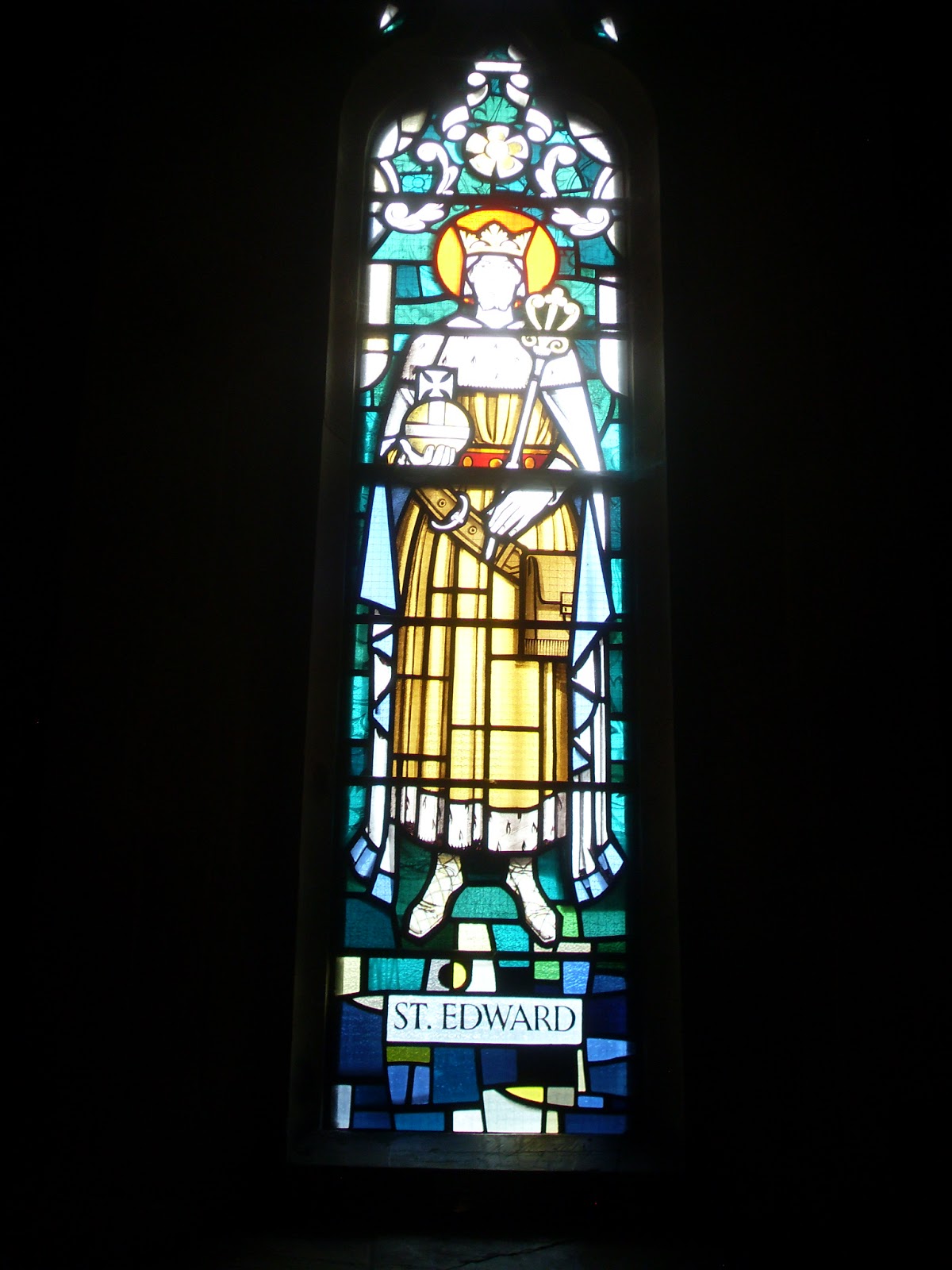
We
also find Saint Edward on the left-hand side of the bottom end of the
nave (when facing the altar). This is a stained glass window put up
in memory of churchwarden G. Raymond Burn who died in 1993. Here the
Confessor is shown wearing his regalia, but in a distinctly more
royal and notably less legendary form than in the other depictions.


The dedication of the church has also given name to at least one more place name in Dringhouses, namely St Edward's Close, as depicted below.


Websites:
http://www.british-history.ac.uk/vch/yorks/city-of-york/pp365-404
http://www.genuki.org.uk/big/eng/YKS/ARY/Dringhouses/Dringhouses90.html
https://historicengland.org.uk/listing/the-list/list-entry/1256466
For similar blogposts, see:
An overview of Edward's cult
Edward the Confessor and Thomas Becket
A wall-painting at Lyddington
Edward the Confessor and Kenelm of Mercia
Edward the Confessor and Saint George
The Wytham roundel
Edward the Confessor and Louis IX
Edward the Confessor's bloodless martyrdom
Edward the Confessor at Ickford
Edward the Confessor in Northern England
Edward the Confessor's feast-day
Edward the Confessor as King David
http://www.genuki.org.uk/big/eng/YKS/ARY/Dringhouses/Dringhouses90.html
https://historicengland.org.uk/listing/the-list/list-entry/1256466
For similar blogposts, see:
An overview of Edward's cult
Edward the Confessor and Thomas Becket
A wall-painting at Lyddington
Edward the Confessor and Kenelm of Mercia
Edward the Confessor and Saint George
The Wytham roundel
Edward the Confessor and Louis IX
Edward the Confessor's bloodless martyrdom
Edward the Confessor at Ickford
Edward the Confessor in Northern England
Edward the Confessor's feast-day
Edward the Confessor as King David


