And was the holy Lamb of God,
On Englands pleasant pastures seen!
- And did those feet, William Blake
Viser innlegg med etiketten Osbert of Clare. Vis alle innlegg

lørdag 30. mai 2026

Saint Julian in a fragment - chance survivals, canonicity, and the cult of saints in medieval Scandinavia


Much of my research deals with questions pertaining to the cult of saints in medieval Scandinavia. This is a topic that labours under the double-edged problem of having both very few surviving sources - making it difficult to make strong claims about certain questions - as well as such a wide variety of source types, making it difficult to have the required expertise to use all these sources together. Concerning the cult of saints, we know that there were many more sources used and produced in medieval Scandinavia than those we have access to today. The surviving sources have, therefore, provided a skewed sense of the saints venerated by the medieval Scandinavians, as well as the stories told about those saints. Due to the source situation - combined with the nationalistic tilt embedded into the foundations of medieval studies in each Scandinavian country - we have a tendency to focus on the cult of native saints, especially the royal saints. Aside from the biblical saints and the most famous of the early Christian saints - especially Laurentius, who was patron saint of the Church of Lund, which became a metropolitan see in 1104 - there has been relatively little work done on the veneration of the saints less known in our own time. Judging from surviving materials, we have a pretty good idea of how popular and important these famous saints were. But we cannot really know whether some of the saints that we consider minor today were, in actuality, major saints throughout the Scandinavian Middle Ages, or at least within one time period or within one milieu. 


I was reminded of this issue earlier this spring, when I was at the Danish National Archives in Copenhagen to research some manuscript fragments. In one of the boxes I had ordered was the upper part of a two-columned page from a twelfth- or early-thirteenth-century manuscript, the text of which is the saint-biography of Julian Martyr, also known as Julian of Le Mans. The fragment is well known in medieval studies and I have seen it mentioned and analysed several times. It is most likely produced in Scandinavia, probably in Norway, and it is a important witness to the earliest stages of native Norwegian manuscript production. The content of the fragment, however, has received much less attention than its codicological, palaeographical and iconographical aspects. This text provides a very good starting point for reflecting on the state of our knowledge about the cult of saints in twelfth-century Norway.


Rigsarkivet, Fr. 251

Rigsarkivet, Fr. 251


Saint Julian was a third-century bishop of Le Mans. Since he was martyred during the heroic age of Christianity in what was later to become France, his cult and his figure appear to have been important elements not only of Le Mans' own identity but also the identity of France as a kingdom having received special divine attention. This kingdom-wide identity was also propped up by the cults of Saint Dionysius of Paris, of Saint Remigius and the Holy Ampulla, and eventually also the cult of Saint Louis IX. The early date of Julian's life and martyrdom also meant that he was included in several early martyrologies and calendars, and his cult was disseminated far and wide. 

In Scandinavia, there are few surviving traces of Julian in the sources. For example, the only sources from Sweden, as far as I am aware, are twelve calendars that contain his feast-day, which is celebrated either on January 26 or Janaury 27. Since most calendars used in medieval Sweden have survived only as fragments, however, the actual number of calendars containing his feast-day was significantly higher. In any case, no other sources are known - not sculptures, not altarpieces, not wall-paintings. I know of no sources from medieval Denmark, although I have not yet checked whether his feast is included in the late-medieval printed breviaries. In Breviarium Nidrosiense, the breviary printed in Paris in 1519 and aimed at the entire Norwegian church province, his feast is not included. In other words, Saint Julian of Le Mans appears to have been virtually unimportant in the cult of saints in medieval Scandinavia. 

However, Saint Julian was at least known, if only in the monastic or ecclesiastical community in which the manuscript containing his passion story was used. We do not know what community this was, but it is likely that the manuscript was a collection of saints' lives produced for - and perhaps at - one of the leading religious centres of twelfth- or early-thirteenth-century Norway. My own hunch is that the original manuscript was a typical hagiographical collection that was used during the Matins of the feast-day of the saints included in the collection. Matins was the divine service in the middle of the night, and it was during this service that the saint was venerated with a liturgical office which included both chants and readings from the saint's biography. The original manuscript, therefore, is likely to have contained the legends of several other saints aside from Julian. 

What, then, are we to make of the inclusion of Saint Julian of Le Mans in this hypothetical, now-lost hagiographical collection. Probably not much. Such collections were typically compiled from available materials, and those materials tended to contain those stories and legends that were widely accessible rather than those which were particularly important to a specific diocese or church province. Put differently, the legend of Saint Julian was sufficiently widespread that it was easy to get hold of. Its appearance in Norway reflects Julian's general canonicity as a saint in Latin Christendom by the late twelfth century rather than the importance of his cult among Norwegian Christians. 

On the other hand, the fact that Julian's legend was available in Norway and accessible at one - if not more - major religious centre should be taken seriously. What happens at such an institution when the available hagiographical material is limited? Do those stories that are available become more important than they otherwise would be? Can the cult of Saint Julian have been strengthened at this institution simply because the clerics or monastics who comprised the institution's community were familiar with his legend? Very likely, because cults tended to be shaped by the personal devotion of those who were part of the veneration of saints at religious centres. Surges in a saint's popularity could be shaped by events that were interpreted as intercession from that saint, it could be shaped by dreams of individuals, of the constant, long-term pressure from exposure to the saint's story. We see this happen in the cult of Edward the Confessor, for instance, whose main promoter before the 1160s was the figure of Osbert of Clare who believed himself to have been healed due to the saint-king's intercession. Might not a similar causality - however imagined - also not affect the cult of a well-known but otherwise not particularly important saint-bishop? 

We do not have any evidence to suggest that the knowledge of Julian's legend made an impact on his cult in medieval Norway. And personally, I do not think it did, simply because this possibility hinges on our knowledge of one sole surviving fragment. However, this reflection is not primarily about Julian or his cult, but about how our ideas about canonicity and the cult of sains is shaped by the chance survivals of sources. The fragment containing part of the prologue of Julian's saint-biography proves that he was known somewhere in medieval Norway, and for at least a period, even if that period might only be the generation of clerics or monastics that first made use of this manuscript. 

As scholars we need to be very careful in assuming that the canon of literature that we imagine today based on the survival of sources is necessarily the same as the canon of literature of the Middle Ages. Indeed, we know very well that the so-called bestsellers of medieval Latin Christendom - such as the Imago Mundi of Honorius of Autun, or the Sententiae of Peter the Lombard - receive much less attention from and are much less accessible to modern readers than works such as Beowulf, which only survives in one single manuscript. The modern medieval canon is, in other words, very different from the medieval medieval canon. Similarly, the cult of saints as we understand it today might have been configured somewhat differently in the Middle Ages, with saints now lost to us or ignored by us having much greater prominence than we will ever know. 


Rigsarkivet, Fr. 251

Rigsarkivet, Fr. 251


søndag 20. mars 2016

Edward the Confessor in Dringhouses


Ever since writing my MA thesis on Edward the Confessor, I've had a minor obsession with all things related to his posthumous cult. Regular readers of this blog will be aware of this already, as might be attested to by the number of blogposts touching on this particular subject (a list of which will be added after the present post).

It was for this reason that I have been haunted by the idea to pay a visit to the Church of Saint Edward at Dringhouses, a village just outside York. Fortunately, while I was staying in York for two months as part of my PhD programme, I lived just about fifteen minutes away from the church and decided that it was high time I had a look around. Typical of my propensity for procrastination, I left it to the very last day I was in York, but luckily I did manage to get around it.  


The belltower. The spire was replaced in 1970


This part is most likely the vestry, which was added in 1902

The inner doorway

The church of Edward the Confessor was built between 1847 and 1849, and upon its completion it was dedicated to Saint Edward. This was in fact a re-dedication, as the new church replaced a church from 1725 which had been dedicated to Saint Helen, which in turn had replaced a chapel dedicated to the same saint. This chapel is mentioned in chantry certificates as early as in 1546 and 1548. The church was financed by the widow of the late Revd. Edward Trafford Leigh, and in memory of her husband she had it dedicated to his namesake saint. Saint Edward's became a parochial church in 1853 when Dringhouses parish was established from parts of the parishes of Holy Trinity and St Mary Bishophill Senior.

Saint Edward's church was constructed in decorated Gothic by the architects Vickers and Hugill (or Hugall) of Pontefract. This is perhaps especially evident in the windows and the doorways with their pointed arches and the leaf-work masonry on their side columns. Although there are several details of such beautiful handicraft, the exterior of the building is not remarkably opulent. The interior of the church is somewhat more so, owing in particular to the many splendid windows of stained glass.

Nave, towards the choir


The oldest stained glass windows were designed by William Wailes in 1849, and these depict figures and scenes from the Bible. The first two windows below are found on the left-hand side of the nave when facing the choir. The first window depict the prophet Elijah (here Elias) with the scene showing him being fed by ravens in the wilderness (1 Kings 17:4-6), and then Moses with the scene showing the rod with the brass serpent (Numbers 21:4-9). The second window shows Saint Simeon holding the Christ-child with a scene from the presentation of Christ in the temple below (Luke 2:25-32), and then John the Baptist with the scene showing the baptism of Christ in the River Jordan (Mark 1:1-8).


In the choir, the central window shows the crucifixion of Christ with Mary and John the Evangelist at his sides, with scenes from the Passion underneath. In the choir on the left-hand side are Matthew and Marcus, while on the right-hand side are Luke and John. Note especially how carefully John is made to be identical with the depiction in the central east window.  


On the right-hand side of the nave the windows depict scenes from the New Testament. The first shows parables of Christ, including the parable of the sower (Mark 3:4-9), the parable of the lost sheep (Matthew 18:12-17), what seems to be the parable of the talents (Matthew 25:14-30). The lower left panel might depict Christ being rejected by a pharisee. The second window shows Christ blessing the children (Matthew 19:14) with angels underneath.  


While the stained glass windows by Wailes were very beautiful, I was chiefly interested in the sundry depictions of Edward the Confessor himself, in order to see how his iconography had been represented. The first depiction of Saint Edward can be found in a niche above the doorway where a statue shows the Confessor, bearded, wearing a crown and holding a ring and a sceptre with a bird on its top.  


This iconography is typical of the tradition of Saint Edward's cult. His appearance as a bearded monarch is attested already in the first biography, written relatively shortly after Edward's death in 1066, now referred to as Vita Ædwardi Regis. His white, and virginal, beard is made into evidence of holiness in the two twelfth-century hagiographies written about him, the first by Osbert of Clare in 1138 and the second by Aelred of Rievaulx in 1163.

The ring and the bird refer to two of the most iconical legends concerning the Confessor. The story of the ring can first be found in Aelred of Rievaulx's Vita Sancti Eadwardi, where it is told that the Confessor gave his ring to a beggar. This beggar turned out to be Saint John the Evangelist in disguise (the Confessor's particular saint), and Saint John, again in the disguise of a beggar, gave the ring to two English knights in the Holy Land, with the orders to take it to the king and report how they had received it. The ring remains the key iconographical feature of Saint Edward. (More on this here.)

The bird is a later feature, but it may have entered the iconography as early as the 13th century. By the end of the fourteenth century, the coat-of-arms of Edward the Confessor was held to be a golden cross on a blue background with golden birds in the open spaces between the cross arms, and one golden bird underneath the cross. We see this from Richard II's merging of his own coat-of-arms with that of Saint Edward.

In time there emerged a legend saying that Edward had once been disturbed by nightingales during prayer, and when he prayed that they should cease their singing for a while they did so. This legend appears to have an early modern date rather than belonging to the medieval tradition. (More on this here.)


Edward the Confessor is also depicted inside the church. We see him on the right-hand side of the altar, where he is flanking Christ in majesty with Saint Peter standing on the left-hand side. The confessor is here surrounded by four angels, two of which are carrying some of the instruments of Christ's passion. Above Saint Edward's head we find his coat-of-arms.


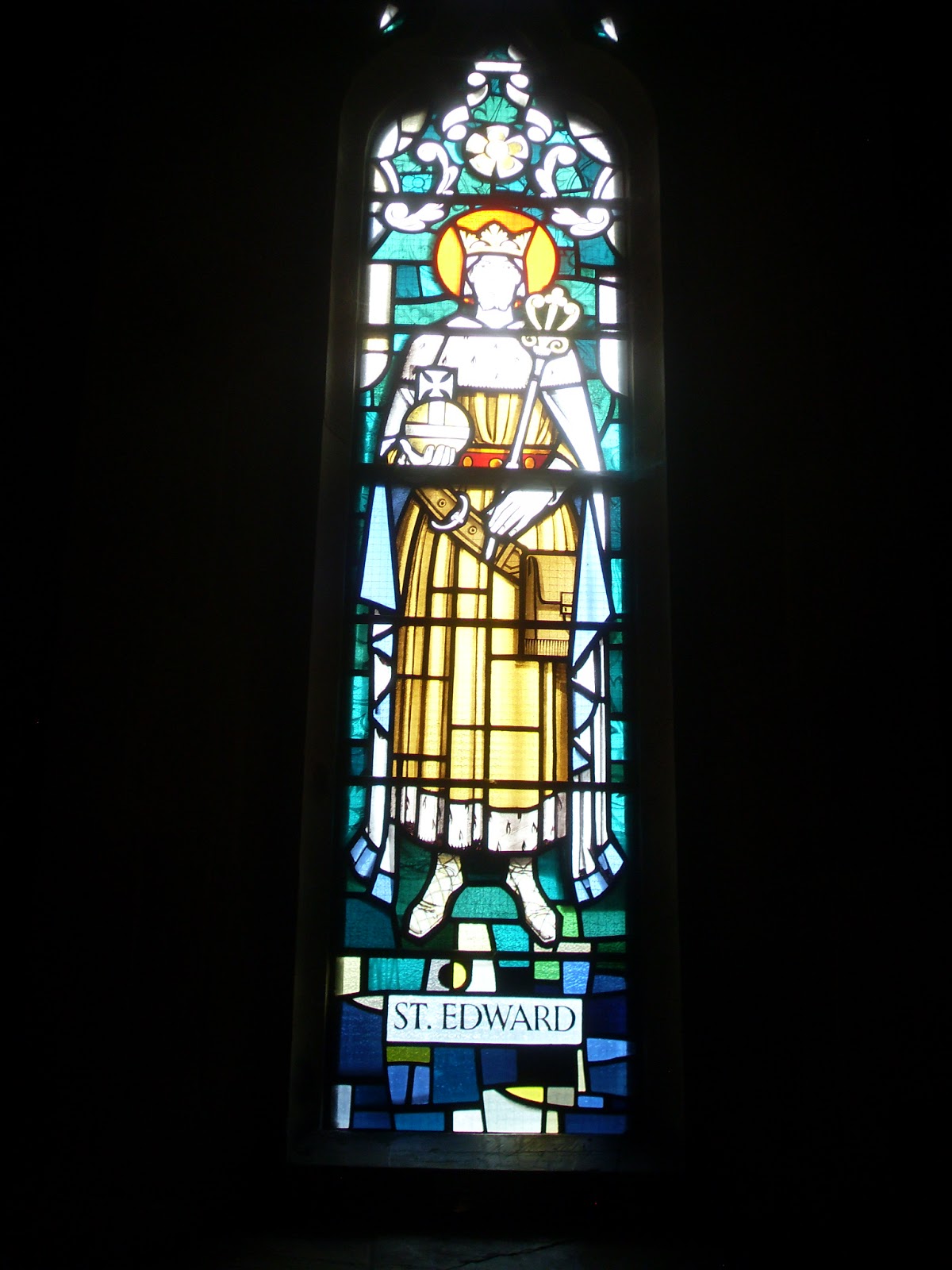
We also find Saint Edward on the left-hand side of the bottom end of the nave (when facing the altar). This is a stained glass window put up in memory of churchwarden G. Raymond Burn who died in 1993. Here the Confessor is shown wearing his regalia, but in a distinctly more royal and notably less legendary form than in the other depictions. 


The dedication of the church has also given name to at least one more place name in Dringhouses, namely St Edward's Close, as depicted below.


Websites:


fredag 18. desember 2015

Some thoughts on an inclusive syllabus - gender


Jousting women
BL MS Royal 2 B VII, f.197v, psalter, England, between 1310 and 1320
Courtesy of British Library


A few days ago, November 30, academic and blogger Erin Wunker launched an appeal to fellow academics for crafting syllabi that emphasised inclusiveness and diversity. The appeal was disseminated on Twitter via the hashtag inclusivesyllabus, devised by Wunker's co-blogger Aimée Morrison (Associate Professor at University of Waterloo). I myself became aware of this appeal thanks to medievalist Dorothy Kim who picked itand redirected it more specifically to teachers of the pre-1500 eras. What followed was an engaging discussion about various ways in which to make syllabi more inclusive. Some of the suggestions that arose were collected in storify by Jonathan Hsy, and it became evident that there were many ways to go about making a syllabus more inclusive.

Personally, as a historian of medieval texts, I embrace the idea of an inclusive syllabus because a history syllabus should reflect historical reality, and the reality is that the medieval world was both diverse and complex (though often not inclusive in the modern sense). In this blogpost I wish to present some of my ideas for an inclusive syllabus, ideas which emerged in the course of the Twitter discussion, and which I think are more easily fleshed out here. In the following I will only address one topic, and hopefully I will return to other topics in later blogposts. Since this post is the result of a collaborative discussion my ideas were inspired by the suggestions of several people, sometimes in agreement, sometimes in opposition. I will try my best to provide due acknowledgement for these ideas, and if some readers who participated in this discussion feel they have been forgotten, please let me know.

The following is a set of works, themes and strategies by which I believe a syllabus of a course in medieval studies can become more inclusive. It is worth noting that this is not an exhaustive list by any means. It is also worth noting that the following does not comprise a syllabus of its own, but that it is intended to provide ideas for those who are designing their own syllabi. Moreover, I want to emphasise that a great number of participants in this dicussion come from literary studies, while I myself have a background predominantly from history. This means that my perspective will be somewhat different, and it also means that many suggestions might be more suitable for history rather than, say, English courses. However, I'm of the opinion that to teach medieval literature without also bringing in medieval history to provide a context for this literature is shoddy and wrong.

A final remark worth making is that the degree and level of diversity and inclusiveness in a medieval studies syllabus depends very much on the course itself. I for my part would love to design a course which was centred on precisely the diversity of medieval history. However, even though syllabi can often emphasise diversity only up to a point, the important thing is to be aware that measures can be taken to ensure an increased attention to diversity, both in introductory courses and more specialised courses.


Marie de France writing her lais
Bibliothèque nationale de France - BnF, Arsenal Library, Ms. 3142 f. 256, France, 1285-92
Courtesy of Wikimedia


Suggestions for inclusive syllabi - gender


Scholarship and secondary reading

There are many ways in which a syllabus can be made more inclusive, and a good place to start is to make sure that the reading list includes scholarship done by both men and women. In medieval studies, this is not difficult at all: Many brilliant scholars, both male and female, have contributed to the field of medieval studies for decades, and to have both men and women is important not only because it is more inclusive but also because that often is the only way to accurately represent the contributions done in a field of medieval scholarship. Once when I was a teaching assistant at the Norwegian University of Science and Technology, after having finished my MA thesis, I was approached by one of the female history students who asked if I could give her some names of female academics. She made it quite clear that she wanted someone of her own gender to look up to, and in a field like history I can understand that very well as it often comes across - at least to first-year students - that history is largely written, and enacted, by men. Having done my MA thesis on the cult of Saint Edward the Confessor in the High Middle Ages, I was not short on suggestions and ended up compiling a long list of female academics whom I had myself relied on for my dissertation. To provide students with the sensation that they have someone from their own gender to look up to, and via those role models to be reassured that their gender does not prohibit a career in a field of medieval studies, is one of the cornerstones of an inclusive syllabus.

The same point, that students need to feel represented, should also be made when it comes to ethnicity. However, in medieval studies - especially history - that is less easily done simply because a vast majority of medieval scholarship is conducted by Caucasian men and women in Europe and in North America. When possible, inclusion of relevant scholarship by non-Caucasian academics is a positive thing and is to be encouraged. 


Catherine of Siena
Autun - BM - ms. 0269, f.170v, Book of Hours, Use of Autun, c.1480-1490
Courtesy of enluminures.culture.fr

Female medieval authors

The majority of recorded medieval history is dominated by men. The majority of known individuals from the Middle Ages, both in the political sphere, the religious sphere, the cultural sphere, the mercantile sphere and so on, are men. Most of the texts written in the Middle Ages were written by men and largely for men. This is how the situation is, and the majority of primary sources for a syllabus in medieval studies is most likely to be comprised of male writers or male authors (not always the same thing in the Middle Ages), unless the course was designed specifically to teach female writers, which would be an interesting challenge. The problem, however, is not that most medieval sources were written by men, this is to be expected. The problem arises when the many female influences on medieval texts are ignored, and it is here an inclusive syllabus can make an important difference.

Although most medieval authors were men, we have quite a list of female authors as well and these can be employed in a wide range of syllabi, covering several angles and subjects. Since women in the Middle Ages had several restrictions for how they could participate in society. However, many women did become notable authors, for instance due to their education as nuns. Moreover, it is important to keep in mind that many authors did not themselves write the works they authored, but dictated them to a scribe. This also meant that the literacy was not necessarily the obstacle we might think it is. I also want to point to Hildegard of Bingen for a case where lack of education was seen as a strong point. In her collection of celestial visions Scivias, Hildegard emphasises her insufficient education and lifts it up as a mark of the authenticity of her vision. Because she is lacking rhetorical prowess and can only describe her visions in simple words, her prose is also - she argues - more true, more accessible, more accurate. This claim of superiority in content through inferiority in style is a timeworn topos of much medieval writing and originated in part in opposition to the rhetoric of pagan writers of the early Christian period. Hildegard is here following an old tradition, but she employs the motif as a woman: Since she, as a woman, is less educated than high-ranking churchmen, her prose is untouched - thus not falsified - by rhetorical ornament.

It is also important to note that although there were many medieval femal writers and authors, several female voices gained dissemination through the translation of their words into Latin. This was the case with Saint Birgitta of Sweden whose revelations were translated by her confessor. In the case of some Italian female recluses who became venerated as saints, their stories were also written down into Latin by their male, mendicant confessors. The stories and the content of the works came from women, but word and content was shaped by men educated in the hagiographic genre.

Despite social restrictions, women could become powerful voices in their age, and could be ardent critics of men of powers, be they kings or popes, such as Birgitta of Sweden and Catherine of Siena respectively. Most of the primary sources from the Middle Ages which have a female authorship are religious works since it was in the religious sphere could be most active and could most easily express themselves in literature. These works, however, are applicable not only to religious matters but can be used to explore several aspects of medieval culture. 


Christine de Pizan
BL MS Harley 4431, various works by Christine de Pizan, France, c.1410-c.1414
Courtesy of British Library

Below is an incomplete list of female late-antique and medieval authors which provides important suggestions to elements of an inclusive syllabus:


Anna Komnene, The Alexiad

Anonymous nun of Barking Abbey, Life of Edward the Confessor (in Anglo-Norman verse)

Birgitta of Sweden, Revelations

Christine de Pizan, The Book of the City of Ladies; The Treasure of the City of Ladies

Clemence of Barking, Life of Saint Catherine (in Anglo-Norman verse)

Egeria, The Pilgrimage

Elisabeth von Schönau, various works

Hadewijch of Brabant, various works

Heloise, Letters

Hildegard von Bingen, Scivias

Hrothsvita of Gandersheim, various works

Jorunn Skáldmær, skaldic extracts preserved in The Prose Edda

Margery Kempe, The Book of Margery Kempe

Marie de France, Lais


Medieval women as patrons

As was pointed out by Erica Weaver, medieval women of power - either as queens or abbesses - were important patrons of arts and were the dedicatees of many important works of medieval literature. Chrétien de Troyes, for instance had Marie duchess of Champagne as his patron, and Marie's mother Eleanor of Aquitaine was the patron of writers such as Wace and Benoit de Sainte-Maure. One of the perhaps most interesting cases of female medieval patronage is Queen Emma of England who commissioned the historiographical work now known as Encomium Emmae Reginae (alternately Gesta Cnutonis). This latter work is available in translation and has been the subject of much excellent scholarship.


Emma receiving the encomium
BL MS Add. 33241, Encomium Emmae Reginae eleventh century
Courtesy of Wikimedia

It is here important to note that although female literacy was generally lower than the literacy of men, literacy in the Middle Ages is not the same as being familiar with literature. In the Middle Ages, reading was a communal activity and one person would often read aloud to others, either during mealtimes in the monastery, in the royal court, or in the families of nobles and the merchants. Precisely since the ability to read was so limited, those who could read were often given the task of reading to others, and sometimes work could be recited from memory - which was made easier by writing in verse, and which is why prose texts could sometimes be rendered into verse as a mnemonic tool. Medieval literature had a strong oral element we sometimes tend to overlook.


Medieval female saints

In addition to teaching works authored by women, an inclusive syllabus also needs to contain works written about women, even though these works were authored by men. One helpful perspective here is history, where legal documents of various kinds provide examples of the the roles, the constrictions, but also the possibilities of women in the Middle Ages. Even in a literature course, it would be a great addition to provide some historical context for the lives of medieval women, for women in the Middle Ages were not secondary characters to historical events although they have been made to be so by traditional historiographical works.


Four female saints (the Magdalene, Mary of Egypt, Margaret and one more)
BL MS Royal 2 B VII, f.308, psalter, England, between 1310 and 1320
Courtesy of British Library

One field in which the role of women, the perception of women and the importance of women in the Middle Ages can be seen is in the cult of saints. I emphasise this field because the cult of saints is my own particular field, so I am more than a little biased. Nonetheless, I maintain that in the cult of saints we see the convergence of many subjects and many perspectives which are useful to the topic at hand. For instance, when reading texts pertaining to medieval female saints, we can in some cases grasp the outlines of the historicity of the lives of these women (though that historicity has been obscured by the pre-requisites of hagiography). We can also be able to detect how male medieval writers viewed women. A great number of such writers held a view of women which was tinged with various degrees of misogyny inherited largely from patristic writers and parts of the Biblical narrative, and which was cultivated by a monastic environment in which celibacy and separation of the sexes were seen as crucial steps towards spiritual perfection. Also secular writers, like Giovanni Boccaccio, were likely to hold such views of the feminine. However, men who wrote down hagiographies for women were faced with a subject which had attained holiness and yet belonged to what was considered the weaker sex. In these hagiogaphies, therefore, male writers were compelled to provide a more nuanced depiction of women, and even though they might exude a more negative attitude to women in general they at least had to acknowledge that their protagonists were holy persons.

The cult of saints is an important source for an inclusive syllabus, not only because it is a repository for mixed attitudes towards women, but also because women themselves could write hagiographies. I've mentioned above the Life of Saint Catherine written by Clemence of Barking, for instance. Clemence's Life was, however, an adaptation, a vernacular version of an existing legend.The norm was that men were the ones writing the Latin, seminal lives, such as when Goscelin of Saint-Bertin and Osbert of Clare were commissioned to write the vitae of English female monastics who were believed to be saints. In the genre of hagiography, however, we see an interesting intersection of men and women in the cases where the lives of the women were dictated by the women themselves in the vernacular and then translated into Latin as the vita of that woman by a male figure, often her confessor. This is believed to be the case with Christina Markyate in the twelfth century, and became a widespread trend in the emergence of cults of female recluses in Italy in the thirteenth and fourteenth century. In the case of the Italian ascetic women, their confessors and/or hagiographers were often monks of the Dominican and Franciscan orders who sought to make of these women examples for others to follow, and who also were likely to give these vita a certain mendicant spin. This relationship between a female author and a male writer, translator and editor is an interesting area of study, and there are numerous examples of this relationship. As mentioned above, the same relationship goes for male scribes who latinized the visions and polemics of women religious who later became saints, such as Birgitta of Sweden, but in those cases we can at least expect that the author has been active in the editing process, whereas in the case of hagiographies the author and protagonist has been dead for some time by the time the hagiography is published.


Elizabeth of Hungary reading
Chambéry - BM - ms. 0004, f. 652, Franciscan breviary, Milan, c.1430
Courtesy of enluminures.culture.fr

During the Middle Ages, there were many female saints which were venerated throughout Christendom. Some of these women were mythical and belonged to such a distant past that their mere historicity is dubious, namely SS Margaret, Lucy, Agnes, Agatha, Catherine of Alexandria, Barbara and others. Some were results of more slowly coalescing legends, as in the cases of SS Ursula, and Sunniva of Norway. Other women were historical, although veneration and hagiography naturally added some sediments of myth to their stories, such as Eadburga of Winchester, Elizabeth of Hungary, or Margaret of Scotland. This rich repository of medieval stories about women is a great and needful addition to an inclusive medievalist syllabus.

Below is a list of some lives of female saints available in English translation:

Anonymous, The Life of Christina Markyate (Oxford World Classics)

Clemence of Barking, Life of Saint Catherine (Everyman)

Geoffrey of Burton, Life and Miracles of St Modwenna (Oxford Medieval Texts)

Goscelin of Saint-Bertin, texts on the female saints of Ely (Oxford Medieval Texts)

Niketas Magistros, Life of Theoktistes of Lesbos (Dumbarton Oaks)

Raymond of Capua, The Life of Agnes of Montepulciano (Dominican nuns of summit)


Shorter versions of legends and lives can be found in Jacobus de Voragine's The Golden Legend (Princeton University Press). For a more detailed studies of these women, it is also necessary to work with their liturgical offices.

In addition to these female saints, it is of course important to remember the omnipresent cult of the Virgin Mary, which resulted in an expansive body of literature, both in Latin and in the vernacular. This subject is too big for this present blogpost, but should not be overlooked as it covers both religious and secular literature, hymns, liturgical offices, miracle collections and prose narratives. 


Mary of Egypt
BL MS Royal 20 D VI, Lives of the saints, Wauchier de Denain, France, 13th century
Courtesy of British Library

Women also appear in medieval texts as representatives of otherness, but this is a subject I hope to cover in a later blogpost.


mandag 29. desember 2014

Gerald of Wales and the Irish saints


 This seems to me a thing to be noticed that just as the men of this country are during this mortal life more prone to anger and revenge than any other race, so in eternal death the saints of this land that have been elevated by their merits are more vindictive than the saints of any other region.
- Gerald of Wales, The Topography of Ireland (transl. by John O'Meara)


A priest accosted by a werewolf
MS Royal 13 B VIII, Gerald's Topographia, England, c.1196-c.1223
Courtesy of British Library

In this blogpost I'm looking at Gerald of Wales' presentation of some Irish saints in his famous work Topographica Hiberniae which was composed in the latter half of the 1180s. The book is in part a recollection of things Gerald heard or witnessed during his trips to Ireland in the period 1183-85. On his second visit he was a part of King Henry II's retinue and was the tutor of his son John. When Gerald returned to Ireland in 1185, he was part of John's retinue. Gerald was also related to members of the Anglo-Norman invasion force, and was therefore doubly invested in the Anglo-Norman campaign to subdue Ireland.


It is in this context Gerald's comments on Ireland and its people must be understood, and in this blogpost I wish to see how Gerald's treatment of Ireland's saints can be explained by context of invasion and subjugation (I hesitate to use the term "colonial context").

The fish with three gold teeth
MS Royal 13 B VIII, Gerald's Topographia, England, c.1196-c.1223
Courtesy of British Library

Gerald's views on the Irish saints as expressed in the epigraph are found as the last chapter of part two of his Topographia hiberniae. In this chapter, Gerald records the wonders, the miracles and the holy men and women of Ireland. The chapter begins with natural wonders, such as a fish with three gold teeth, or the wonderful well of Munster whose water turned things put into it grey. After these natural wonders, Gerald moves on to wonders pertaining to men and beasts, and he records a boy of Wicklow who was a man in most physiognomical respects, but whose nose, eyes, hands and feet resembled those of an ox. This deformed boy was regularly given food at the court of Maurice fitzGerald, one of Gerald's relatives and one of the leaders of the Anglo-Norman invasion of Ireland.

The werewolves of St Natalis
MS Royal 13 B VIII, Gerald's Topographia, England, c.1196-c.1223
Courtesy of British Library


Saint Natalis and the Werewolves

As for the Irish saints, their vindictive nature becomes apparent already in the first story in Gerald's catalogue of animal wonders. The story tells of a priest who was travelling through a wood together with a young boy, and after they had lit up a fire for the night a wolf came up to them and started speaking. In order to calm them down, the wolf spoke about God - and said reasonable and Catholic things, Gerald notes - and then he explained what he wanted:

We are natives of Ossory. From there every seven years, because of the imprecation of a certain saint, namely the abbot Natalis, two persons, a man and a woman, are compelled to go into exile not only from their territory but also from their bodily shape. They put off the form of man compltely and put on the form of wolf. When the seven years are up, and if they have survived, two others take their place in the same way, and the first pair return to their former country and nature.
- Topography of Ireland, chapter 52 (translated by John O'Meara)


The wolf then goes on to explain that his "companion in this pilgrimage" is close to death, and he asks the priest to give her the solace of divine mercy at her life's end. The priest agrees and after some exhortation also gives the dying woman the last rites, including the communion. This story bears some echoes of an old Celtic tale where two brothers are punished by being sent into the woods as a he-wolf and a she-wolf. They later return in their human shape and with the children they have incestuously reared while bearing the shape of wolf. This is not to say that Gerald knew this story, or that it had any impact on the anecdote related above, but it suggests a deep-rooted belief in lycanthropy in Irish folklore. More interesting for my purpose here, is the detail that the fate of these wolves was ordained by St Natalis as a punishment, perhaps a particularly Irish punishment at that, which presents us right away with the vindictive nature of the Irish saints.
St Kevin and the blackbird
MS Royal 13 B VIII, Gerald's Topographia, England, c.1196-c.1223
Courtesy of British Library

The Curse of Saint Kevin

Another example of this vindictiveness is related in chapter 61, which tells about St Kevin, "a great confessor of the faith". Kevin is perhaps most famous for his patience exhibited when, during the saint's prayer, a blackbird started building a nest in his outstretched hand, which was the subject of a poem by Seamus Heaney. In kindness to the bird, Kevin did not move until the birds were hatched, and Gerald notes that because of this, the blackbird features in the iconographical representations of the saint. However, Gerald also tells us about Kevin's vengefulness to birds. We are told that on his feast days, the ravens of Glendalough are "prevented by a curse of Saint Kevin" from being on the ground and from eating, so the birds fly about the village and make "a great noise". The reason for this curse, Gerald speculates, might be that the ravens had caused one of Kevin's students to spill some milk.  

The teal of St Colman
MS Royal 13 B VIII, Gerald's Topographia, England, c.1196-c.1223
Courtesy of British Library

The Teal of Saint Colman

The next chapter records a story in which saintly vindictiveness is protecting rather than harming birds. Here Gerald tells of some teal inhabiting a lake in Leinster, who have resided there since the time of St Colman (it is not specified when that time was). These birds are tame enough to take food from people's hands, but

[w]henever any injury or molestation happens to the church, the clergy, or themselves, they go off to a lake at some distance, and do not return to their former abode until due satisfaction has been made. In the meantime during their absence the waters of the lake, which before were limpid and clear, become brackish and dirty, and cannot be use either for man or beast.
- Topography of Ireland, chapter 62 (translated by John O'Meara)

Gerald further records that once a teal was accidentally brought back from the lake with some cooking water, but although the water was cooking for a long time, the bird - thanks, no doubt, to the miraculous protection of St Colman - remained unhurt. Similarly, Gerald tells of a story happening "in our own times" when the Anglo-Norman invader Robert fitzStephen travelled through the area in the company of King Dermot of Leinster. An archer, ostensibly belonging to the retinue of King Dermot, shot one of the teal and tried to cook it for his king. When he showed King Dermot the miserable result of hours and hours of cooking, the king understood that this was a bird protected by Colman, and exclaimed "Alas form me! That this misfortune should ever have happened in my house". The archer perished miserably a short while after.

The anecdote is relatively sparing in contextual detail, but it is tempting to see King Dermot's fear of St Colman's vengeance in the light of his apparent alliance with the Anglo-Normans, dreading perhaps that his seemingly secure standing would change in the vicissitudes of occupation. Or perhaps this anecdote can be seen as Gerald's warning to the Anglo-Norman barons and their soldiers, that although the subjugation of Ireland is right - since they presented as a nation of bestial and uncivilised men - they should not suffer needless injuries, and nor should their churches be plundered. This should be seen in light of part three of the book, where Gerald gives praise to the Irish clergy, both monks and priests, although he reproves them for lack of discipline.
Minor incidents and lack of vermin

After the anecdote about the teal of St Colman, Gerald soon comes to some minor examples of the powers of Irish sanctity. The first of these is treated in chapter 64, where we are told of a village in Connacht which was "celebrated for a church of Saint Nannan". Once this village was badly infested with fleas, but St Nannan had them miraculously brought to a meadow close by, where the fleas were confined and made it inaccessible to men and beasts alike.

A similar story follows in chapter 65, where we learn of the district of Ferneginan. Here lived Bishop Yvor, who was so plagued by rats eating his books that he cursed them, and the result was that they all were expelled from Ferneginan, and from that day on, it was impossible for rats to live in that district. If rats were to be brought in, they would die. This particular anecdote becomes even more interesting because of its similarities to the supposition noted by Gerald in chapters 21 and 22 that poisonous reptiles are not found in Ireland. This is an old story, and the legend states that it was St Patrick who drove the snakes and other reptiles from the island. Gerald records this belief as a "pleasant conjecture that Saint Patrick and other saints of the land purged the island of all harmful animals", but goes on to suggest that Ireland must have been without these creatures from the beginning of the island's existence.
 
However, this does not explain why reptiles brought into the island perish upon entering the the land, and in chapter 23 Gerald suggests that this has to do with qualities in the Irish soil rather than saintly protection. What is significant about this, is that in chapter 48 Gerald tells how the jurisdiction of the island of Man was granted to Britain rather than Ireland, because poisonous reptiles could live there. And already in chapter 25 Gerald has recorded the discovery of a live frog near Waterford - significantly where the Anglo-Norman invaders entered Ireland in 1174 - which was taken as a sign by King Duvendalus "of the coming of the English, and the imminent conquest and defeat of his people". Ireland allows for heretofore alien reptiles and prepares itself to allow the Anglo-Norman conquest. But the saints are not in the picture, they are not relinquishing patronage nor endorsing the invaders, it is the soil itself that changes - although presumably through divine machinations. Gerald does not pit Irish saints against English saints, but relies instead on what we might call scientific rumination to explain the relationship of reptiles to Ireland.  

The book-eating rats of Ferneginan
MS Royal 13 B VIII, Gerald's Topographia, England, c.1196-c.1223
Courtesy of British Library

Miracles of St Brigid

The next saint to be treated in Gerald's catalogue of wonders is "the glorious Brigid". Some miracles pertaining to St Brigid's fire are mentioned, and a longer account is given of a falcon in Kildare who was believed to have lived there since the time of Brigid (i.e. several generations). This bird is used by Gerald as an example "of honour to churchmen", because during its mating season it flew away from the hallowed precincts of the church where it resided and fornicated elsewhere. The bird "was killed by a rustic" at the time when John, son of King Henry, departed from Ireland the first time.

For my purpose here, however, the significant aspect of St Brigid's powers is her protection of a hedge which surrounds the perpetual fire which is kept burning by her devotees. Since only women are allowed to perform the office as fire-keepers, a man who crosses the hedge "does not escape the divine vengeance". The curse of St Brigid also prevents goats to "have young here".

St Brigid's hedge is described in chapter 69, and Gerald returns to it in chapter 77 where we learn of an archer belonging to the retinue of the Anglo-Norman earl Richard. The archer crossed the hedge and blew upon the saint's fire and immediately went mad. The chapter concludes with an anecdote about a man who had only gotten his shin across the hedge before he was pulled back, and consequently lost his leg. This kind of violent territorial protection is not a feature unique to the Irish saints. Several instances are found in hagiographical texts from all over the Latin West, perhaps most famously St Edmund's killing of Sweyn Forkbeard at Bury St Edmunds. However, when seen in the context of Anglo-Norman invasion and settlement, this anecdote seems to reinforce Gerald's preoccupation with the importance of respecting the Irish places of religion. It seems as if common decency can't prevent the invaders from violating the churches, perhaps a fear of the vengeance of saints might be of help.


Protection of the Land

Keeping in this vein, in the following chapters we find several anecdotes rehearsing the dangers of encroaching upon land belonging to the Irish saints. Chapter 78 contains an anecdote about a soldier who had unlawfully expropriated land belonging to St Finbar in Cork. The bishop of the place, in sadness and anger, asked God (rather Finbar himself) not to allow this land to bear fruit. God listened to the bishop and performed the requested miracle "through the merits of the holy man" (although we are left uncertain as to whether this is Finbar the saint or the bishop of Cork).

The next chapter records how two Anglo-Normans were punished for their lack of piety. The first was Philip of Worcester who forced tribute from the clergy of Armagh, the seat of St Patrick, during Lent. On his departure from Armagh, Philip "was stricken with an illness and scarcely survived". Then we are told of Hugh Tyrrell who stole a cooking-pot from the clergy of Armagh, and the night after he had returned to his lodgings in Louth a fire broke out that burned down a great part of the settlement, killing two horses that had carried the pot away from Armagh. Tyrrell himself was later cast into a civil strife between Anglo-Norman factions. Although it is not elaborated upon, the two aforementioned anecdotes are related to injuries committed against the clergy of Armagh, i.e. under the protection of Patrick, patron of Ireland.

After these vengeful miracles of St Patrick, we are presented with two revenges performed by St Fechin, who was very protective of a mill in Meath, which he had himself cut "out of the side of a rock". When a archer in the army of Hugh de Lacy raped a girl there, he "was stricked in his member with hell-fire in sudden vengeance and immediately began to burn throughout his whole body. He died the same night". Fechin's protection of his mill was not only concerned with violent injuries, but also with minor occurrances. In chapter 82, Gerald tells that two horses who had eaten stolen corn from the mill died afterwards.  

Bernard and the horn of St Brendan
MS Royal 13 B VIII, Gerald's Topographia, England, c.1196-c.1223
Courtesy of British Library

Confessors, not martyrs

Gerald's Topographia hiberniae is to a great degree a document intended to justify the Anglo-Norman conquest of Ireland, yet as we have seen it is apparent that Gerald is concerned with the proper conduct of the conquerors. Ireland is lawfully occupied by the Anglo-Normans because, as is suggested in part three, the Irish are uncivilised and maintain evil customs (ch. 100), not all of them have been baptised (ch. 103) and their kingship ritual contains element of bestiality (ch. 102). However, Ireland and its places are not completely up for grabs, for the Irish saints are protecting their clergy, their pastures and their holy places with a fearful vengeance and they must therefore be respected. Furthermore, despite some shortcomings in discipline and religious practice, the Irish clergy has many good qualities, and its people has a proper respect for saints and their relics. As an example of this, Gerald includes in chapter 108 an anecdote that happened in Wales, where an Irishman carried a horn which was a relic of St Brendan. The horn was held in such great reverence that nobody dared to blow it, and when a Welsh priest did this, he turned mad and had to learn the psalter from the start.

However, despite the vindictiveness "in which the saints of this country seem to be very interested", the saints of Ireland appear to have accepted the coming of the Anglo-Normans. An explanation for this is offered by Gerald in chapter 105, in which he provides further comments on the nature of the Irish saints. For he states that

all the saints of this country are confessors, and there is no martyr. It would be difficult to find such a state of things in any other Christian kingdom. There was found no one in thise parts to cement the foundations of the growing church with the shedding of his blood. There was no one to do this service; not a single one.
- Topography of Ireland, chapter 105 (translated by John O'Meara)

These lines are very important for several reason. Although Gerald emphasises the sanctity of the Irish holy men and women, it appears that he suggests there is no protector of Ireland as a whole, not even the venerable Patrick. Gerald blames the Irish prelates for this state of affairs, because none of them have stood up for their church, or shed blood or suffered exile for its cause. Since this is written less than twenty years after the martyrdom of Thomas Becket (d.1170), for which King Henry II was punished and for which he sought reparation, it is tempting to suggest that Gerald has the model of Becket in mind when he chastises the Irish clergy. He then recounts a comment made by the Archbishop of Cashel:

'It is true,' he said, 'that although our people are very barbarous, uncivilized, and savage, nevertheless they have always paid great honour and reverence to churchmen, and they have never put out their hands against the saints of God. But now a people has come to the kingdom which knows how, and is accustomed, to make martyrs. From now on Ireland will have its martyrs, just as other countries.'

The archbishop's words are chilling and seem prophetic in such a short time after the battle at Waterford, and the canonisation of Becket (1169/70 and 1173 respectively). However, Gerald states that the archbishop's comment, although hard-hitting, does not invalidate Gerald's opinion on the Irish prelates.


Saints and the conquest of Ireland

A final point is worth noting in Gerald's treatment of the Irish saints. As stated, the holiness of the Irish saints remains undisputed and their vengeful patronage are held up as a perennial warning against misconduct against the Irish churches. In chapter 97, Gerald records how the Anglo-Normans themselves showed their due respect for the native saints of Ireland:

Saint Columba and Saint Brigid were contemporaries of Patrick. Their three bodies were buried in Ulster in the same city, namely, Down. They were found there in our times, in the year, that is, that Lord John first came to Ireland, in a cave that had three sections. Patrick was lying in the middle, and the others were lying one on either side. John de Courci, who was in command there, took charge when these three noble treasures were, through divine revelation, found and translated.
- The Topography of Ireland, chapter 97 (translated by John O'Meara)

In other words, through the revelatory will of God, the Anglo-Norman conquerors have become devotees of Ireland's three major saints, and the patrons of Ireland are now the patrons of the Anglo-Normans. The episode is reminiscent of the legend of the seven sleepers at Ephesus recorded at length by Osbert of Clare in his hagiography of Edward the Confessor (c.1138). It is also interesting for its resemblance to similar aspects of Plantagenet appropriation of popular belief. In 1198 the remains of King Arthur and Queen Guinevere were reported to have been found in Glastonbury, thus proving to the Celtic world that Arthur was not resting at Avalon or anywhere else, but was dead and buried. In the late 1200s, King Edward I, during his Welsh campaign, had Arthur's remains translated and perhaps even canonised (although informally so since it was never accepted by the papal church). The purpose was the same at both these instances: to expropriate local history, and display the dynasty's reverence of and protection from these legendary figures.

It is tempting to suggest that this strategy had also been used by the Anglo-Norman conquerors in Ireland, and although Gerald does not elaborate on the importance of this revelation in any great degree, it might explain why Gerald's concern is to warn about local patronage and vindictiveness rather than worrying about the revenge of the great patrons of Ireland.

The making of an Irish king
MS Royal 13 B VIII, Gerald's Topographia, England, c.1196-c.1223
Courtesy of British Library


fredag 22. november 2013

Edward the Confessor in the North


Ever since completing my MA thesis I have had a potentially unhealthy obsession with Edward the Confessor. This is why I tend to use him as a point of reference when exploring the medieval catalogue of saints, and this is also why I keep a lookout for his iconography, and I'm always excited to learn of new images and new renditions of him. For this reason I was very happy to find a stained glass window in York, which to my mind most likely depicted Edward the Confessor, and this blogpost gives an introduction to Edward's standing in the North.


The above stained glass can be found in St. Helen's Church, York, and dates to the later Middle Ages. The church is situated in the centre of York and was the parish church of glass-painters who resided in Stonegate, and their emblem can be found among the extant stained glass paintings.


The window portraying Edward the Confessor is placed in a group comprised of - from left to right - William of York, the Virgin Mary and St. Helen. Edward is the rightmost figure, and as seen above he holds an object which looks like the ring he reportedly received from John the Baptist, and which was one of his major attributes in medieval renditions of him. The story was told by Aelred of Rievaulx and gained immense popularity. In the information leaflet provided in the church, it is suggested that this figure is Emperor Constantine, but this is highly unlikely since he was not considered a saint in medieval times - at least not officially. In a book on stained glass in York which I stupidly forgot to note, but which can be bought at Waterstones in the city, it is stated that the glass does indeed depict the Confessor, though no evidence is cited for this. I, however, believe this to be the only likely explanation for iconographic reasons.

William of York (d.1154, can.1227)

Virgin Mary

Interestingly, this painting situated below that of the Virgin Mary, may also depict the Confessor, possibly together with St. John the Evangelist, to whom Edward was especially devoted

St. Helen

After this find I went to visit York Minster's undercroft where I happened to note a roof painting from the York Minster chapter house depicting St. Edmund of East Anglia. The painting in question dated from c.1290. I was quite excited to see this, since I have a major fascination for the cult of St. Edmund as well as that of St. Edward, and these two saints often appear together in later medieval art (and also sometimes in literature). This was the second depiction of St. Edmund I had found in York, the first being a carving from St. Mary's Abbey, which was refurbished in the 13th century. The figure can be found at Yorkshire Museum together with St. Cuthbert.

Edmund holding his arrows

Cuthbert, holding the head of St. Oswald

After having found St. Edmund, I went to ask one of the curators whether there were any depictions of Edward the Confessor in the Minster, and he told me there was none to be found to my initial surprise, seeing as the Confessor had in his time been generously munificient towards the Minster. The curator was wrong, however, as there is a 14th-century depiction of Edward in the lady chapel, but this I learned later. As I talked about the subject with the curator, however, I remembered a few important details from my MA research which made it all abundantly clear why Edward should ostensibly - yet incorrectly - not be present in the York Minster art programme.

St. Edmund and his arrows, painting from York Minster's chapter house, c.1290

Edward's lack of widespread support in the North is a result of the long-standing conflict between the North and the South, and in particular between the Archbishopric of York and the Archbishopric of Canterbury, at that time locked in a continuous squabble over whose archbishop was the primate of England.

This division in the English medieval church runs deep, and when Osbert of Clare failed in his petition to have Edward canonised by the Papacy around 1138, lack of wide ecclesiastical support was probably one of the main reasons why he failed, together with King Stephen's meddling in the Church's affairs. After the Anarchy, however, Alexander III granted the request for canonisation due to the wide clerical support Osbert that had been lacking earlier, and the 12 surviving petition letters do indeed represent a wide clerical spectrum, including the Archbishop of York. However, this unity proved deceptive and when Edward the Confessor was translated to a new tomb at Westminster on October 13 1163, only the diocese of Canterbury was represented.

The lack of devotional paraphernalia pertaining to Edward the Confessor in York suggests that this strife between the two archbishoprics were long-standing and that to the northerners, Edward the Confessor remained a southern saint. It should also be noted, however, that Edward never achieved any wide popularity beyond Westminster and the royal court, so this is not very surprising after all. However, not even Henry III's presence in York - he refurbished Clifford's Tower as his royal manor - was sufficient to move York towards greater appreciation of Edward, and instead the citizens and the clergy focussed on local saints and, as it seems, St. Edmund, whose fame rivalled that of Edward for most of the 12th and 13th centuries in the country at large. Interestingly, this goes contrary to the claim made in the liturgy for Edward the Confessor, composed at Westminster in the 12th century, where it is stated that the entire country rejoices in his sanctity.

I do not know who commissioned the stained glass windows of St. Helen's and York Minster's lady chapel, or what moved the former to place Edward alongside an important local saint such as William of York. Nonetheless, this is an interesting anomaly in York's devotional landscape, and it shows the disparity between the overarching devotional trends and personal preference.

It is of course important to note that absence of evidence is not evidence of absence, and it may be that Edward had a more prominent role among York's medieval citizenry than has been known or is suggested by the surviving material. Yet ecclesio-political considerations suggest that there is not much to find in this department, and it is perhaps emblematic that the only church around York dedicated to Edward that I know of, is the 19th-century church at Dringhouses.


Bibliography


Dutton, Marsha (ed.) and Freeland, Jane Patricia (transl.), Aelred of Rievaulx: The Historical Works, Cistercian Publications Inc., 2005

Farmer, David, Oxford Dictionary of Saints, Oxford, 2004

Hope, Steffen, The King's Three Images - The representation of St. Edward the Confessor in historiography, hagiography and liturgy, Trondheim, 2012

Rex, Peter, King & Saint: The Life of Edward the Confessor, The History Press Ltd, 2008

Scholz, Bernhard W., "The Canonization of Edward the Confessor", printed in Speculum, Vol. 36, No. 1, 1961

Williamson, E. W. (ed.), The Letters of Osbert of Clare Prior of Westminster, Oxford University Press, 1998