And was the holy Lamb of God,
On Englands pleasant pastures seen!
- And did those feet, William Blake
Viser innlegg med etiketten Food. Vis alle innlegg

mandag 22. juli 2013

Travels in Tuscany, part 2 - Boccaccio's Birthplace


(...) if ever anyone required or appreciated comfort, or indeed derived pleasure therefrom, I was that person.
- The Decameron, preface, Giovanni Boccaccio (translated by G. H. Mcwilliam)


In the previous blogpost I gave a very brief summary of the Conference for Medieval and Renaissance Music held this year in Certaldo, July 4-7. Certaldo claims to be the birthplace of Giovanni Boccaccio (1313-75), and I believe it was for this reason it was chosen as the host of this year's conference, seeing as this year is the 700th anniversary for Boccaccio's birth. In this blogpost, therefore, I aim to show you how great a star Boccaccio truly is in his alleged birthplace.

It is, of course, no wonder that the Certaldese have pressed Giovanni Boccaccio to their collective bosom. He is one of the major literary figures in Italian and also world history, and his most famous work, The Decameron, is one of the most important pieces of secular literature to have come out of the Middle Ages. Despite Boccaccio's great renown, however, there are some important details missing from his biography, and particularly his place of birth has been a matter of some contention. Previously, there circulated a theory that his mother was French and that he himself had been born in Paris. G. H. McWilliam, translator of the Penguin Classics edition of The Decameron, dismisses this idea in the introduction to his 1972 translation.

Paris being discarded, there are currently two major candidates to the title of Boccaccio's birthplace. One is Florence, the other is Certaldo, and although McWilliams favours the former, the latter has spared no enthusiasm in commemmorating their potential native son, as will soon be quite evident. It should also be noted, however, that although Certaldo may not be Boccaccio's birthplace, he did spend his last thirteen years in this city, so their enthusiasm is not completely misplaced should it turn out he was born in Florence.

Regardless of precisely where Boccaccio entered this world, he was born of a well-off family. His father was a Florentine merchant-banker from the Compagnia dei Bardi, and in the mid-1320s Boccaccio was sent to Naples to learn the basics of trade and commerce. His time in Naples, and his mercantile background, can be seen reflected in several of his stories, in particular the fifth story of the second day. Eventually, it became clear that the young Tuscan was not cut out for the banking business, and was turned to the study of canon law. This attempt ended the same way as his banking career, and soon he dedicated himself to literary pursuits. At this time, Naples was a significant intellectual centre thanks to the court of King Robert of Anjou, where Boccaccio gained entrance through his family connections. His time in Naples was, in the words of G. H. McWilliam, "crucial to the development of his artistic sensibility".

In 1341 Boccaccio returned to Florence where, according to his introduction to The Decameron, he witnessed the ravages of the plague. To what degree this is true remains uncertain, and it may very well be that Boccaccio had himself done what his literary figures would later do and fled the town. Later, he was sent on several minor diplomatic missions, representing the commune of Florence, and these missions took him both to the Papal court of Avignon and Naples. He later settled in Certaldo, where he is said to have contracted the plague and died.


Casa Boccaccio, Certaldo Alto

The Certaldese take immense pride in their claim to fame in Italy's literary history, and this is reflectd in the numerous venues named after the great writer. The two most important and significant places of interest for Boccaccio enthusiasts are located in the old city, Certaldo Alto or High Certaldo, overlooking the river valley from its plateau. Here, pilgrims will find the house in which Boccaccio lived, Casa Boccaccio, a favourite motif for the local postcard industry, which is now a museum open to the public, and where the book presentations during the MedRen conference were held. Secondly, there is the Church of Saints James and Philip, located by Via Boccaccio, the main street of the old city, where the writer lies buried not far from the local saint Blessed Giulia. To a medievalist like myself, this is of course the two most tantalising targets for a literary pilgrimage.


Chiesa di Santi Jacopo e Filippo


Me posing with Boccaccio at the Pretorian palace, Certaldo Alto
Image credits: Danette Brink

For those more attentive to their stomachs than their minds, there are alternate venues in which to commemmorate Giovanni Boccaccio, namely restaurants and cafés, such as Bar Boccaccio or Enacoteca Boccaccio.


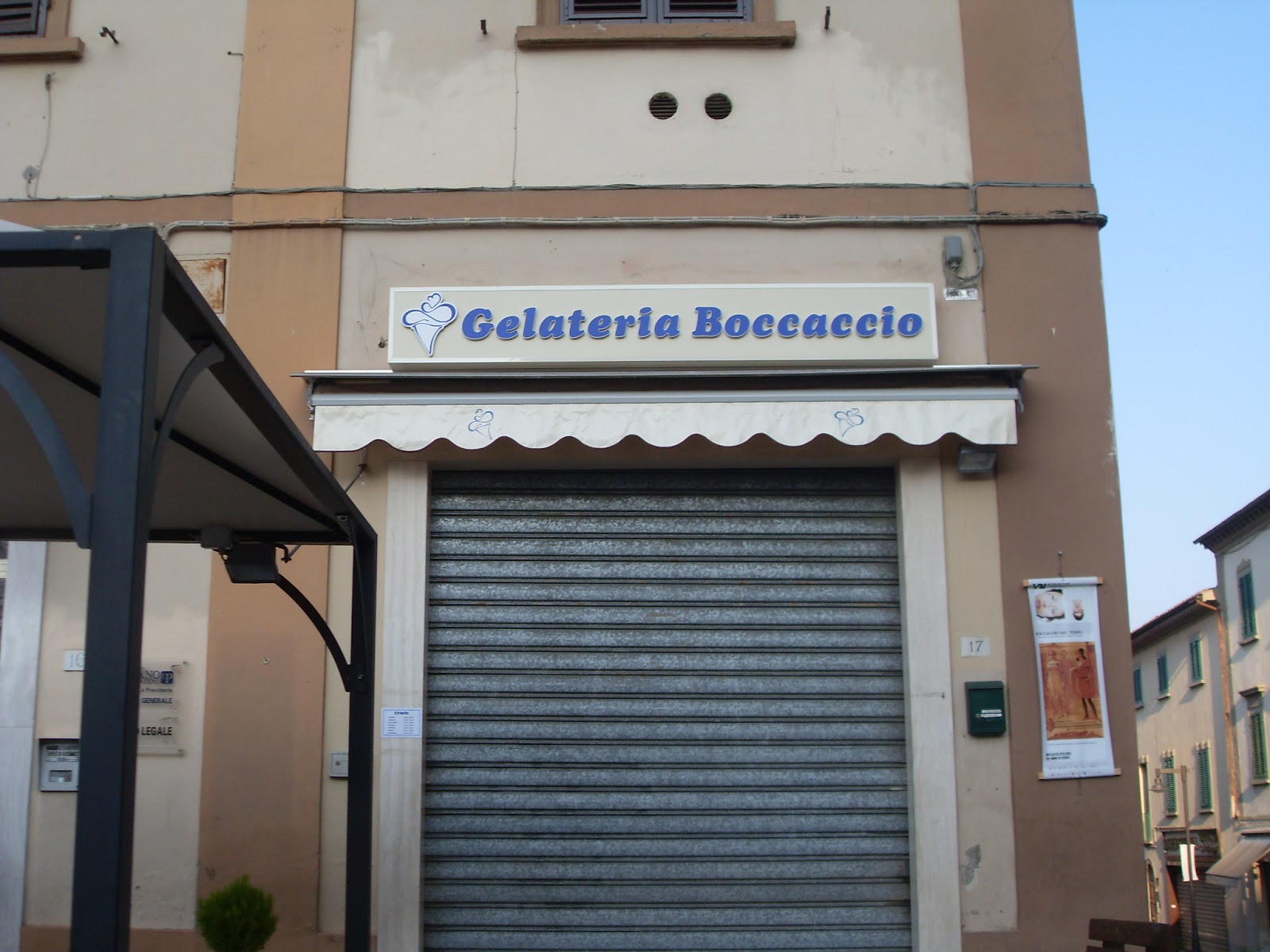
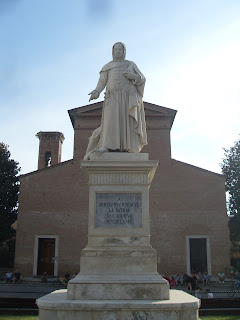
More venues of this kind - heaped under the general umbrella of gusteria, or pleasure - can be found in the new city, Certaldo Basso. Here is a pizzeria and a gelateria named after the author, and also a theatre of some kind, and of course, a white statue right outside the church of St. Thomas the Apostle and close to the cable-car going up to Certaldo Alto.


It was very clear that the city was engaged in the seventh centennial of Boccaccio's birth. Everywhere there were posters advertising a new play based on the ten storytellers of The Decameron, and in a local pastry shop this baked beauty could be found:


And what's more: even in the tiniest minutiae of public life, a nod to the great author could be spotted, such as this environmental advertisement fastened to one of the public litter bins, ostensibly making a pun on the Italian word boccaccia, which means grimace:


All in all, it is very evident that the Certaldese take immense pride in their connection with Giovanni Boccaccio, and that they exploit this aspect of their history to full effect. In some respects there is something charming and lovingly about this embrace, such as the statue in Certaldo Basso and his monument in Chiesa di Sancti Jacopo e Filippo, yet other nods are more clearly designed to draw a crowd rather than being done out of any love for the author. This is of course understandable, but it becomes wearisome in the end, and is a good reason for spending most of the time in Certaldo Alto, where such references are widespread but more natural.


References
All information concerning Boccaccio's life is taken from

Boccaccio, Giovanni, The Decameron, translated by G. H. McWilliam, Penguin Classics, 1972

tirsdag 11. september 2012

Many sundry meats

And eet manye sondry metes, mortrews and puddynges,
Wombe cloutes and wilde brawen and egges [with grece yfryed].
- Piers Plowman, William Langland

He was deep in thoughts of bacon and eggs and toast and butter when he felt something touch him.
- The Hobbit, J. R. R. Tolkien


One of the recurring features of this blog is my exploration of British cuisine which I undertake partly to challenge the firmly rooted negative stereotypes it suffers from. The pith of the problem is indubitably that British hygiene is widely considered to be wanting and that this reflects on the food in unfortunate ways. Now there are issues to be had with hygiene in the British Isles - for instance the facts that they have separate taps for hot and cold water and like to carpet every inch of their floors - but the food deserves to be lauded far more often than it is. This August I returned once again to York and I made sure my diet consisted of things old and new, things salt and sweet and things with these common denominators: neither were particularly healthy, all of them were tasty.

Blackadder: Now; Baldrick, go to the kitchen and make me something quick and simple to eat, would you? Two slices of bread with something in between.
Baldrick: What, like Gerald, Lord Sandwich, had the other day?
Blackadder: Yes -- a few rounds of Geralders.
- Blackadder, S03E02


Sandwiches

The sandwich is one of the greatest culinary concepts ever invented and it is a great shame it is not as ubiquitous in Norway as it is in the UK. When I studied in York in 2011 I made a habit of dropping by Sainsbury's on my way to class and pick up one of the many sandwiches displayed there for breakfast. The sandwich has many incarnations and there seems to be no consensus as to what type of bread to use, nor what they may contain. Some features are of course fairly universal such as lettuce while others are reserved for one particular combination.


This picture is taken on a southbound train from Aberdeen via Edinburgh. The sandwich consists of lettuce, tomato, cheese, ham and pickles, a combination I have grown very fond of. However, the main reason for picking this particular sandwich, I think, was the name, since it reminded me about the Middle English dream poem
Piers Plowman.


This pork sandwich with apple sauce and sage stuffing - one of my absolute favourite foodstuffs in York - was purchased at Uppercrust on Lendal Street, a very small, charming shop with a very amiable staff and a nice selection of fillings.


One of the sweet ladies behind the counter added this piece of crackling to my sandwich. That was very nice indeed.


Technically this is a ciabatta, but since ciabatta essentially is Italian for sandwich I find it safe to include it here. This tasty delight was also purchased on Lendal Street, but in a different sandwich shop whose name I sadly have forgotten. I was informed about this place by one of my former flatmates of York last year and this time I followed her preferences and purchased this nice white goat cheese and pepper ciabatta.


This is a mango chutney sandwich bought at Pret-a-manger, a British chain of sandwich shops. It was delicious and the chutney blended very well with the ham and cheese. If I ever had my doubts about mango chutney up to this point, this sandwich did away with all that.


And of course, being in Britain, I washed it all down with some Yorkshire tea at the Three Legged Mare, a pub on High Petergate that does not serve food and therefore allows you to bring your own.


For ye han harmed us two in that ye eten the puddyng,

Mortrews and oother mete - and we no morsel hadde.
- Piers Plowman, William Langland

Pub food

When visiting York I took great advantage of my friends who lived there and one of them, poor girl, had to endure my presence for a whole week (which she bore with great composure). To rectify this major imposition I treated her to pub food a couple of times, one of the things we are both major fans of.


This pork burger with bacon was purchased at The Old White Swan, a beautiful pub situated on Goodramgate in a building from the late Middle Ages. We ate there twice and I feel comfortable saying that this is one of my absolute favourite pubs. How can it not be, the pub has a Tudor room?


Another of my favourite pubs is The Hole in the Wall on High Petergate and it remains a favourite for two reasons. First of all its selection of food is delicious and very reasonable, secondly it was the first pub I ate at when I came to York as a student. This time around I tried a horseradish burger which was a pleasing experience. I have through the years established a certain liking for horseradish, which of course is necessary for a burger like this: the taste of horseradish was really dominating.

 (...) I don't know the recipe; but it is biscuitish, keeps good indefinitely, is supposed to be sustaining, and is certainly not entertaining, being in fact very uninteresting except as a chewing exercise.
- The Hobbit, J. R. R. Tolkien

The Brits like their carbohydrates. They like them very much, as illustrated by this plate of battered chicken with barbecue sauce, bacon and sides purchased at The Hornblower in Ripon. Fortunately I like them too and I could thoroughly enjoy this meal, although I have to admit chicken needs not be battered at all.


[Britain]has broad fields and hillsides which are suitable for the most intensive farming and in which, because of the richness of the soil, all kinds of crops are grown in their season. It also has open woodlands which are filled with every kind of game.
- The History of the Kings of Britain, Geoffrey of Monmouth

Sundries

Rhubarb! Rhubarb! Rhubarb!
- Captain Rum, Blackadder S02E03

During my stay this August I suddenly became aware of one of the greatest differences between Norway and England when it comes to food: the English national culinary repertoire is simply much more varied than the Norwegian one. By this I mean that there is a greater number of fruits, meats and vegetables used in manufactured foodstuffs (i.e. food you can buy at the supermarket) than the case is in my home country. While Norwegian cordial, for instance, is based around a handful of fruits, English cordials cover a much wider range of tastes. This also reflects in ice cream, as illustrated by the two scoops above, one with blueberry, one with rhubarb.


 Cokes and hire knaves cryden, "Hote pies, hote"
Goode gees and grys! Go we dyne, go we!
- Piers Plowman, William Langland

Pies are perhaps even more emblematic of British cuisine than the sandwich and I am very enthusiastic about them. This particular specimen is a vegetable pie I was treated to while I lodged at a couple of friends for the last four days of my sojourn. I especially like this pie because it is decorated with a woodwose, and it was delicious.


I should of course not omit this risotto which, although not English in any way, was made by the friend I
first stayed with and was so tasty it deserves an effusive mentioning in this blogpost.

fredag 30. desember 2011

Refection

When he finishes refection,
Knife and fork he never lays
Cross-wise, to my recollection
- Soliloquy of the Spanish Cloister, Robert Browning

We'll pray for her soul...after pudding.
- Adele Goffe, Inspector Lewis (S5E2)

Although my main purpose of returning to York this September was to reunite with my friends I was also mindful of the English cuisine which I had become so fond of during my student days. Despite its rather dubious reputation I find English cooking both tasteful and enjoyable and I looked forward to taste things new and old, some in the company of friends, others in solitude. This time around I have included pictures of the venues in question so that it might be easier to locate for anyone intent on meandering the streets of York to acquire some of these delicacies.

From The Hole in the Wall, High Petergate


Yorkshire pudding

I fear that we shall be obliged to leave this pudding
- The Tale of Samuel Whiskers, Beatrix Potter

This classic dish is an obligatory implement of a culinary excursion in York, consisting of a bread-like bowl filled with gravy, meat - in this case presumably hog - and a ball of sage and onion stuffing, accompanied - if I remember correctly - by the ubiquitous side-dish of chips.

It is a very filling meal and I fell short of consuming all of it, especially because the heavy gravy soaks the pudding and makes it excessively soggy. Additionally I have to add that despite my outspoken fondness for sage and onion stuffing, this marvellous invention becomes too compressed and dry when served like a ball. Consequently I did not enjoy the pudding as much as I could have, and despite my well-established faith in kitchen of the Hole in the Wall, I cannot recommend its Yorkshire pudding. For those who would like to try this I direct you to the Yorkshire Hogroast in Stonegate. It should, however, be noted that there are good alternatives at the Hole in the Wall, one of which is my long-time favourite as seen below.

Ham and eggs


The Hole in the Wall ham and eggs was the first warm meal I consumed on the day of my arrival in York as a student January this year, and although the taste is nothing spectacular - it is rather bland - I kept coming back for it on a number of occasions, partly owing to it being perhaps the cheapest on the menu, partly due to the fact that I am a person who very quickly establishes traditions and sometimes has a hard time breaking free from them. This particular tradition, however, is not something I have a strong urge to break free from in any case.


From Uppercrust, Lendal


Uppercrust was a relatively late discovery for me as it came to my attention only in the last few weeks of my stay in York this spring, but after I had discovered their excellent pork sandwiches - of which I have spoken of effusively in a previous blogpost - I quickly became a regular up until the point the ladies behind the counter recognised me when I came by. Although my stay in York this September was considerably shorter I made sure to visit this venue as often as my stomach would allow me, and so I again became a regonised regular for a few days.


They also have a nice selection of other comestibles, but since I am somewhat single-minded at intervals, I did not explore these options this time around. 


From The Cornish Pasty Bakery, Coney Street


Like the pork sandwich the Cornish pasty is also an item I have dealt with in greater detail previously, but this time I remembered to take a photograph of one of the venues. There is also a Cornish Pasty Bakery shop in Colliergate which is somewhat bigger and has a bigger selection. Regardless of which venue one decides to visit one can be assured to find a wide range of fillings to suit any palate.


From Classic Crepe Company


One of the many nice little details in the cityscape of York is the various portable vendor stalls purveying food. This particular stall - the Classic Crepe Company - is at no fixed location, at least not as far as I have established, and as such must sometimes be sought out or stumbled upon by happy accident. Due to limited time of my stay I couldn't allow myself to feast on every item available, so I settled for a regular crepe with chocolate, a delightful - and quite filling - snack on the go.


From the Lamb & Lion Inn, High Petergate

Located by Bootham Bar the Lamb & Lion Inn is a deceptively spacious pub with an impressive menu. I went there with a couple of friends late in the evening. Although the ambiance is pleasant and the selection includes deliciously sounding items as rabbit and various pies, they were not very well-supplied at the time of our visit and I had to try at least three times before I found something on their menu that actually was available. This item was the pork chops served with apple sauce, forcemeat mashed potatoes and vegetables.


Although the food looked lovely the pork chops tasted somewhat overdone and aside from the forcemeat there was not much flavour to be had from the meal. I am, however, willing to be lenient and ascribe this to a busy evening and I haven't completely given up on The Lamb and the Lion Inn, although next time I hope they have rabbit.


From Evil Eye Lounge, Stonegate

Whew! We'll have our platter burnished,
Laid with care on our own shelf!
- Soliloquy of the Spanish Cloister, Robert Browning

To celebrate that a friend from Constantine House had handed in her MA dissertation a couple of friends and I went to Evil Eye Lounge, a pub with an emphasis on Asian cooking, but also serving very Anglo-American lunches on Sundays. This was a Sunday lunch and I decided to order the turkey platter, filled with cabbage, carrots, broccoli, potatoes, fennel, sausage, cranberry sauce, Yorkshire pudding and even more which I can't remember. Seeing the vast array of trimmings I decided to go for a children's platter and I still didn't manage to finish all of it. The meal - taken in the Lhasa Lounge on what the Brits call the first floor - was wonderful and rich in taste, and the experience was of course made all the better for the company of my friends. In the end we were all so full that when I left them for a couple of errands I had to hug one of them sideways.


From the Gourmet Burger Kitchen, Lendal

This little venue was brought to my attention by a couple of friends one day we went strolling about town for a bit, and having been alerted to its rich selection I stopped by a couple of times due to its convenient location.

Pork pie

York is famous for its long traditions of pork meat and I felt obligated to try a pork pie at some point. I discovered, to my delight, that these could be acquired at The Gourmet Burger Kitchen to a very reasonable price, and I have to admit there is something deeply satisfactory about eating pie in England, at least to a committed anglophile such as myself.

Quiche

The world's moved on from cheese and tomatoes, Sir.
- Sergeant Gavin Troy, Midsomer Murders (S3E1)

A nice alternative to the very English pie is the slightly more French quiche, equally reasonable in terms of price and almost just as filling. This particular one was a very tasty, savoury tomato and leek quiche.

Sausage roll


This is another very distinctly English contrivance, a flaky dough wrapped around a sausage comprised of more fat than meat, and although it is filling enough to serve as a quick brunch it is neither very tasty nor particularly appetising. It is one of those culinary idiosyncracies that sometimes have to be tested for the sake of one's curiosity, but which you may eventually regret trying, especially if you have a beard that will catch the flakes of dough. 


From La Bodrum, Bootham

(...) which is more of a Constantine experience
- Former flatmate on La Bodrum (paraphrase)

At an early stage of my student days in York I was introduced to La Bodrum, a rather mediocre takeaway place on Bootham. Its proximity to Constantine House made it a natural choice whenever we were feeling a bit peckish late in the evening or were on our way back to the house from some late night excursion. A friend and I established a tradition of movie nights and La Bodrum pizza, a tradition we resurrected during my revisit in September.

Pizza, Persuasion and personal friends. One of the perks of being a Constantine.


Miscellaneous


Many of my culinary adventures took place in Constantine House or on the go, and sometimes I forgot to document the venues I visited. Below is a minor selection of foodstuffs typical of my days in York.


To my taste the chips in England are far superior to any similar comestible I've encountered in Norway or the United States, and although one easily tires of them due to their ubiquitousness they are nonetheless a nice grub on the go. The above pictures were taken at a fish and chips shop one evening we were heading for The Golden Ball. On the last picture can be seen my travelling hat, given to me by fellow Constantines.

Boy, you really like those cookies.
- Fellow Constantine's comment on my consumption of caramel digestives

Caramel digestives became a favourite of mine back in 2009 when a friend and I were visiting York for a couple of days. We no longer have this delicacy in Norway and to compensate I consumed more than my fair share of these biscuits, as may be guessed by my former flatmate's above comment.


When some friends and I headed back from a meal at The Lamb and the Lion Inn - as mentioned above - it was decided we should deep-fry cake. This had been done once before, in January, but I had not dared to taste it back then and I was now quite curious to find out what it was like.


The selection included biscuits, one cream cake and a third kind I no longer remember, and they all tasted like dire, undelicate - but not undelicious - transgressions against the body.

And of course they came with sprinkles.


The above examples of available foodstuffs in York is a far from exhaustive list, neither with regards to foodstuffs or venues in which to acquire foodstuffs. For anyone staying or planning to stay in York I will recommend not only to seek out these venues I've presented here, but also to try new things and look for venues that appear pleasant when meandering the streets of York. The pleasure of discovery is essential to the joy of eating, and to a newcomer in York there is a vast range of places to discover.