And was the holy Lamb of God,
On Englands pleasant pastures seen!
- And did those feet, William Blake
Viser innlegg med etiketten Viking. Vis alle innlegg

fredag 31. oktober 2025

The Danes are coming - or, Adventures in medievalism, part 7


Every now and again I find myself baffled at how the past is used as a vessel to promote something in the present. Even though I have been exposed to some very curious and strange applications and abuses of the past, the wide variety in a given period's reception history never ceases to amaze me. My most recent encounter with baffling use of the past occurred in Odense, Denmark, just as I was making my way from the tram to the main building of the campus of the University of Southern Denmark. The incident concerned a sticker promoting some sport team or other - confusingly, this is not specified on the sticker, so it must be aimed at an audience already familiar with the iconography used on the sticker. As seen below, the sticker does speak for itself in a certain way, but also merits some further unpacking. 


The use of viking iconography - however anachronistic - to imbue a sports team with the aura of plunderers and rapists from the increasingly distant past is a familiar phenomenon. The Norwegian football team Viking and the American football team Minnesota Vikings are only some that join this unspecified Danish team in their employment of modern ideas about the Norse raiders. The purpose is usually the same, namely to make the players appear tough and unconquerable, because that is how modern popular culture has taught us to think of the vikings. The combination of stylised longships, the colours of the Danish flag Dannebrog - first used in the early thirteenth century - and the horned helmets of nineteenth-century artistic imagination telescopes history into a unified whole, which suggests the idea that this sports team stands in a direct genealogical relationship to the violent marauders of the past. 


This iconography plays into familiar references, and the use of these symbols and figures might simply be to bolster the self-image and have a bit of fun with well-known tropes. But self-images tend to reveal deeply held convictions - and also delusions - and such self-representations as seen in this stickers therefore should be taken seriously as a good way of measuring how our contemporaries understand - or rather, misunderstands - the past. Only by understanding this misunderstanding can we also map its effect in our own here-and-now. 


søndag 27. august 2023

The Viking Troll - or, Adventures in medievalism, part 6

 
Being a Norwegian medievalist has made visiting souvenir shops in Norway a very complicated affair. On the one hand, I am always filled with intense embarrassment when I see how my fellow Norwegians market our country to visitors. The mixture of tropes and stock figures for the purpose of earning money and playing on a small register of globally known reference is deeply unpleasant. On the other hand, part of my job is to explore how we in our contemporary world make use of, and think about, the past. Consequently, such souvenir shops are ideal research arenas, because they provide great examples of how we present ourselves to the world, and what ideas about Norway and its past we can expect people from other countries to receive. I therefore do sometimes walk among the grim displays of tat and junk, and I do look closely at the various historical misconceptions brought together in a hodge-podge of confusion and poorly-conceived national pride. Let no-one say I do not suffer for my work. 

Two weeks ago, I was in Bergen and had the opportunity to visit some extraordinary remnants from medieval Norway, things that I hope to blog about later. Several of these remnants served to showcase the complexity and variety of medieval culture, and they also serve to remind the viewer that the Middle Ages cannot be reduced to a handful of stock figures - at least not if the aim is to present a faithful idea of the medieval past. Souvenir shops, and souvenir designers, however, do not use the Middle Ages in ways meant to be accurate, but rather to pander to the preconceptions and expectations of visitors who have been fed a simplistic diet of cultural key words. In order to maximize the effect of these preconceptions - at least so I presume - the various tropes are sometimes blended in ways that have little to with how the ingredients of this blend have had their places and functions in Norwegian cultural history.  

One example of this blend was the Viking troll, which can be seen below. This figure is an incongruous mixture of stereotypical features that are all frequently used in marketing of Norway, its landscapes, and its history. This mixture is also highly anachronistic. We have the troll, which is an old legendary being in Norwegian folklore, but whose depiction here has more to do with nineteenth- and twentieth-century re-imaginings of the troll rather than the more fearsome and downright dangerous visions of earlier generations. There is the Norwegian flag, which was adopted through parliamentary vote in 1821. Then there is the Viking helmet, internationally recognized as such, even though it is fashioned according to the fantasies of nineteenth-century scholars rather than historical reality. In other words, the horns have nothing to do with historical Norse people, but they have everything to do with how we imagine Vikings in our modern times. The helmet also carries the word 'fjord' on it, the quintessential Norwegian word, and perhaps the only one that has gained some sort of international recognition. The sword is presumably part of the Viking attire, and serves to complete the transformation of this lovable troll-boy into a loveable Viking, ready to be an ambassador for Norway, and ready to convince visiting tourists from around the world that they finally get something authentically Norwegian to bring home. What we see, in other words, is a fanciful condensation of elements scattered across the timeline of Norway's history, assembled to bring out the perceived essence of our country and its culture.    


The Viking troll is an interesting case study in cultural stereotypes, and it summarizes how Norway is perceived abroad, as well as how we, or some of us at least, wish to be seen by those outside our country. There is also a calculating logic to this amalgamation. A typically capitalist logic of more being always better, where the customer's attention is drawn to a blend of identifiable ingredients, where each of the individual ingredients is a finished product in and of itself. This is the fried chicken sandwich - where deep fried chicken fillets are used instead of buns - of Norwegian tourism, and just looking at it makes me feel weird. And, as is typical of such blends, the act of blending makes each individual ingredient lose some of their original meanings, as they are decontextualized and then recontextualized to serve different purposes than they originally did. The blending is, however, not my main gripe, but that this blending is purely done in order to boost sales. Had we Norwegians engaged with this blend as part of our self-understanding, I would have been used to it - it would be a kind of cultural evolution or adaptation that aims to serve its own people rather than capering to the tastes of others. In this case, however, we are dealing with the view from outside and those who seek to satisfy and titillate that view. And we see, then, yet again, how medievalism serves to make people reach for a fantasy rather than reality, and how the Middle Ages sell.  


mandag 29. mai 2023

Object lessons in commercial medievalism - or, Adventures in medievalism, part 5

 
I use this particular blogpost series, Adventures in medievalism, to examine some of the many forms of medievalism that can be found in modern society. Medievalism, as I most commonly use it, means the deliberate use of the medieval past for a particular purpose. Moreover, that use represents a discontinuity with the past, and the use is based on the idea that the Middle Ages is notably different - that it is a chronological other. 

This blogpost is the result of some encounters I have had during my travels this past month, which reminded me that one of the most prevalent forms of medievalism today is commercial medievalism, namely the use of the past for commercial purposes. The past sells, and various commercial actors have understood this fact, and they have therefore made their advertisements or even their products in such a way that it appeals to people's fascination with history. 

Medievalism consists of various stock figures that represent the Middle Ages and that serve as a kind of shorthand for the past, evoking a historical period in a simple and effective way. One of the most widely used stock figures is the Viking, and because of the Viking's ubiquity in popular culture, it has also become ubiquitous in commerce. I was reminded of this ubiquity several times during my recent travels. 

One of the least surprising uses of the Viking in commercial medievalism is in Scandinavian souvenirs. All kinds of things are being sold through the appeal and the recognisability of the Viking, and apparently it works. For a medievalist scholar, however, the manifestations of commercial medievalism, i.e., the objects that are being sold, as well as their form and design, can often reach parodic levels. During a recent stay at Oslo airport, for instance, I encountered a couple of such unintentionally parodic, ridiculous souvenirs, and I must admit that I was not prepared for just how risible I found these particular objects to be. The figure of a strong, bearded, manly Viking with the requisite unhistorical horned helmet, was used to decorate a key chain and a bottle opener cum fridge magnet. The violent, warlike aspect of the Viking is used in different ways in both these object. One Viking is heavily armed and appeals perhaps more to a younger audience, children still playing war with each other or with toy figurines. The other has muscular arms and flowing blonde hair, and is likely to be aimed more at adults, mainly adult men who want themselves to be muscular with flowing blonde hair. In both cases, the iconography of the Viking is used to appeal to the prospective buyer's desire to emulate - whether in play or in reality - the figure of the past.   


Encountering Vikings as an avatar of commercial medievalism is common enough in Norway - and I would say depressingly so - but since the Viking is a global figure in modern popular culture, the use of the Viking for commercial purposes can also appear in rather unexpected places. One such place is Toledo, where I encountered a shop of local delicacies which advertised mead through the stock figure of the Viking. The Viking, again with the unhistorical horned helmed, was depicted leaning on his axe and raising a drinking horn of mead, with the text of the poster saying "Mead - the Viking beer". 

That Vikings are used to sell mead is not surprising - after all, mead is famous as a drink widely used by the Norse in the Middle Ages. What was surprising in this case, however, was that the Vikings never went to Toledo, and mead can hardly be said to be a traditional delicacy of Toledo. While we do know that Norse raiders attacked Spanish shores on several occasions, and that Norse travellers often stopped in Iberia, they mainly stayed along the coast or, in case of pilgrims to Santiago de Compostela, went overland along the northern route. Toledo, situated almost in the middle of the Iberian pensinsula, whose only waterway is the beautiful but very shallow river Tajo, would be beyond the reach of Vikings. However, medievalism has very little to do with the actual past, and since Vikings are so widely known, this particular shop has decided to use a stereotypical Viking to sell their goods. 

The case of the Toledan Viking was particularly amusing to me, as this was the first time I had learned the Spanish word for mead, "hidromiel" or "water-honey", and later that day I was asked by a Mexican friend in Madrid what hidromiel was. I was only able to explain the concept thanks to the Toledan Viking. 


Vikings are used to sell things because Vikings themselves sell. Modern popular culture and people's fascination with the past both contribute to the enduring appeal of Vikings. These object lessons are just a few, but they highlight some of the key aspects of commercial medievalism: a clear aim at an audience (whether children or adults), the use of recognisable features (the horned helmet, the axe, the beard), and the complete irrelevance of whether the use of the Viking has any historical grounding. Recognising these aspects of commercial medievalism is important in helping us understand how this form of medievalism works, and why it can work all over the world. 


+++ 


Similar blogposts: 


Adventures in medievalism, part 1 

Adventures in medievalism, part 2 

Adventures in medievalism, part 3 

Adventures in medievalism, part 4

søndag 12. mars 2023

Creative googling and its consequences - or, Adventures in medievalism, part 4


Friday, March 10, I gave a seminar on Vikings in medievalism, explaining how our current ideas about Vikings were shaped by the renewed interest in medieval history in nineteenth-century Scandinavia. The ideas that came into place in this period were formed by a very particular context which blended romanticism, nationalism and scholarship. In Norway, for instance, one of the driving forces behind this interest in medieval history was the desire to provide nineteenth-century Norwegians with a golden age that could serve as a reference point in moulding the Norwegian nation-state of the 1800s, a period when Norway the weaker part of a union with Sweden. In Denmark, the interest in medieval history was in part moved by the loss of Norway to Sweden in 1814, and later pressure from expansionist Prussia which in turn resulted in the loss of Schleswig-Holstein in 1864.


While Swedish, Norwegian and Danish interests were moved by different impulses, these interests were nonetheless part of a wider phenomenon that appeared in many Western European countries. Consequently, despite the particulars of, say, Swedish medievalism, the Swedish ideas about the medieval past were part of a wider discourse and was therefore shaped by that discourse. This discourse also included input from Germany, the United Kingdom, and the Scandinavian diaspora in Canada and the United States.


The details concerning this historical developments are both interesting and numerous, and will hopefully be dealt with in a future blogpost, or perhaps several. However, in this present blogpost, my main aim is to share some of the reflections I made in the preparation for the seminar, and what I learned from the preparation process. It all started with some creative googling.


Even though the seminar was primarily focussed on nineteenth-century medievalism and how that medievalism shaped the modern ideas about the Viking, I thought this seminar would be a good opportunity to follow these ideas into the twenty-first century. I therefore decided to spend a couple of hours on the Internet, using very general search-terms that might yield some broader understanding of how pervasive and ubiquitous the figure of the Viking actually is in our day and age. One important foundational principle for this more or less aimless foray into cyberspace is the idea that the Viking is one of those reference points in a common register of what we might call ludic figures. These figures that are employed in cultural outputs because they are known by a very wide audience, and are therefore often used for play or gaming purposes. Examples of such ludic figures are pirates, ninjas, and cowboys, and such figures are often used in the same cultural expression, for instance if a film, a novel or a comic-book features pirates and cowboys in the same story, something which frequently happens. Because the Viking is a ludic figure, the Viking is often brought into play in cultural outputs, even when Vikings do not normally appear in the chronological or geographical setting in which that cultural output takes place. For instance, Rudyard Kipling’s story ‘The Knights of the Joyous Venture’ from his short-story collection Puck of Pook’s Hill (1906) tells of Vikings reaching West Africa, thereby using the commonly-known figure of the Viking in a setting untypical of the Viking to create an entertaining story.

Knowing that Vikings are often fused with other such ludic elements popular in the common frame of reference, I decided to see what I could find, and how far afield I could follow the Vikings in the popular imagination. Since Vikings are not only used in entertainment and culture, but also for commercial purposes and in politics, I went on to cast a very wide net. My first port of call was Vikings and pizza. Remembering a pizzeria in York, UK, called Viking Pizza, I decided to dig a bit further, and learned that not only is this pizzeria still going – serving among other things its Viking pizza which is six toppings of your choice – but also that there is a nationwide chain called Vikings Pizza, whose website was blocked for Norwegian IP addresses, for some peculiar reason. This foray into modern food culture also brought to mind an advertisement campaign from my native Norway about twenty years ago, when a new brand of ham and tomato pizza made a claim that Vikings were the first to put tomato on their bread, on account of their contact with – the tomato-less – Vinland. Both these examples remind us that Vikings sell.


Moving on from culinary commercialism, I decided to try out various geographical connections. This yielded a throve of material. For instance, I found a picture of a reconstruction of a Viking ship in Sydney Harbour, taken in 2013, and learned of a collaboration between the Australian National Maritime Museum and the Swedish History Museum. Another antipodean find was a dart made in New Zealand called a ‘Viking hammer dart’, with decorations reminiscent of generic Norse knotwork patterns, and with an advertisement text that made a great effort in connecting the modern ideas about the Vikings – rampage and destruction – with this particular product.


Further geographically oriented searches produced a number of results pertaining to Vikings in space, including the 1963 novel Space Vikings by H. Beam Piper, and some short videos that dealt with the idea of Vikings in space. While I included Piper’s novel as a way to demonstrate how far removed from their chronological and geographical contexts Vikings could be used, it also served as a useful way to point out that this common imagination also yields real-life consequences, and in the mid-1970s the space probe programme called Viking was launched.


I also tried a few searches that connected Vikings with other ludic reference points, such as dinosaurs and robots, and the results were both varied and numerous, and provided good examples of just how ubiquitous the Viking is in the common imagination. Things did, however, take a weird turn, and not very long into my creative googling – I mean, my research. When searching for results in connections with Vikings at the centre of the earth – which was about halfway in my efforts – I got my first hit that pertained to literary pornography. The Internet being what it is, I guess it was inevitable that some of my searches should bring me into contact with pornography – thankfully, its literary kind – but the particular form was nonetheless unexpected. It was about this point that I became a bit despondent about my endeavours, and although I appreciate some forms of unbridled creativity, I had hoped to avoid certain of its incarnations.


At about the one-hour mark, I suspect, the overload of impressions and impulses had worn me out quite a bit, partly through the many encounters of Vikings in space and the various iterations of this theme, but especially due to the brief contact with erotic literature – erotic literature of a very weird kind. While at first I laughed heartily in my office when grasping what this result actually was, it was also something that hinted of a subtext and a subculture that employ these ludic figures in ways that are very far from my own comfort zone. My despondency grew even worse once I made some attempts to find useful material concerning the right-wing use of the Vikings, although that was an expected outcome since it always depresses me to do research on contemporary right-wing culture. 


On the whole, the two hours spent more or less aimlessly looking into various nooks and crannies of the Internet served me very well in the seminar, and it generally gave me a much broader understanding of the Viking in popular culture, and as a contemporary point of reference. My endeavour also fortified my conviction that having a broad familiarity with popular culture is crucial to our scholarly efforts, because this familiarity enables us to explain why a figure such as the Viking has had such a forceful impact, and also to evaluate what kind of impact the use of this figure might have in future iterations. In short, we understand better the after-history of our subject when we pay attention to its use in our own time.


The kind of magpie approach that I used, however, has both its benefits and its drawbacks. On the positive side, I now have a much broader understanding of Vikings in popular culture. On the negative side, the quick deep-immersion into such a vast trove as the Internet very quickly became both very weird and very much, and I felt as if my brain were melting after a while. Instead of doing this brief but intense foray into the subject, it would be better to have a small team dedicated to a concerted effort of gathering material. One day, this might be done and result in some very interesting books. 


+++ 

Similar blogposts: 

Adventures in medievalism, part 1 

Adventures in medievalism, part 2 

Adventures in medievalism, part 3  


søndag 25. september 2022

Achronology as a cultural force, part 1


I can see through time           

- Lisa Simpson, The Simpsons S05E13


As a historian, I am trained to divide history into periods, and I am also trained to deconstruct such periods and critique them. Periodisation is a tool for making sense of large amounts of information, and sorting various narratives and various blocks of information into more comprehensible units. But such tools as periodisation can easily become weapons, which is why so much of the historian’s task is taken up by explaining why terms such as “the Middle Ages”, “Antiquity”, “pre-modern” and “the Enlightenment” are deeply problematic and can be used to promoted racist, nationalist, supremacist agendas. Periodisation can, in such instances, become a cultural force in that it helps create sensations of history moving towards predestined or inherently natural endpoints, which can be used to interpret any major event in history. Such teleological views of history can function as rallying points for groups or organisations, and they also serve to establish an idea of any given group being at the centre of history, whereas all other groups are merely extras or collateral. However, periodisation is not the only understanding of history that can have an impact on how societies and groups approach the past. Another such understanding is what we can call “achronology”, and in this blogpost and the next I will explore some aspects of the achronological view of the past, and what how that view can shape current events.  

Achronology is in a way the opposite of periodisation, because while periodisation rigidly – often too rigidly – divide the past into temporally sequenced blocks, achronology undoes that sequence and puts every part of history into the same block. Since every part of history inhabits the same block, achronology opens up for encounters between historical individuals, phenomena, concepts or objects that could not possibly encounter one another. In this way, achronology is also different from anachronism. Anachronism means that something is in the wrong time period, and we typically see this in works of historical fiction, be it in novels, comics, films, etc. One of my favourite examples is when the eponymous protagonist of the comic strip series Prince Valiant meets Marino, the founder of the independent country San Marino, while also fighting the Huns of Attila. According to legend, Marino operated around 301, while Attila ruled the Huns from the 440s until his death in 455. There is, in other words, no way that Prince Valiant could have encountered both Marino and Attila. What makes Prince Valiant’s impossible encounters anachronistic rather than a case of creative achronology is that the adventures of Prince Valiant are firmly set in the fifth century. Consequently, when later concepts such as crusading ideology or later phenomena such as the Viking raids are brought into Prince Valiant’s world, the boundaries of time are broken and anachronisms are being committed. In achronology, on the other hand, such boundaries cannot be broken because they do not exist in the first place. While periodisation and anachronism predicate chronological differences, achronology obliterates those differences and puts everything into a temporal here-and-now. This also means that time travel stories are not achronological, because such stories depend on the ability to traverse those temporal divides that achronology refuses to acknowledge.        

Like creative anachronism, achronology is also a concept commonly employed in entertainment. Neil Gaiman’s novel Neverwhere, for instance, takes place in a London Below that effectively comprises all elements of London’s history in one and the same time-space. The events in Neverwhere are located in a fixed time period, the here-and-now, but that time period encompasses all other periods and can therefore not be considered a case of anachronism. Similarly, Robert Holdstock’s novel Mythago Wood employs achronology by constructing a complex woodland that contains within it corporeal manifestations of the myths of all peoples and cultures that have lived in that part of Britain since the Ice Age. While the novel does operate with the concept of chronological divides, and while this wood is sectioned according to a chronological scheme, those that enter the wood are not subject to the constraints of that chronology. Consequently, Robin Hood, Cú Chulainn and Saxon immigrants all inhabit the same here-and-now.         
       
Achronology is a very fruitful creative tool, just like anachronism, and can be used to very entertaining and also educational ends. I am myself very much in favour of achronology when used in such positive creative ways. But like everything in culture, achronology can also be used as a cultural force, namely something that shapes the culture that receives it. When I call achronology a cultural force I mean this: that the erasure of temporal divides can convey an understanding of the past as a single, unified block whose main defining feature is that it isn’t now, and this understanding can in turn shape how people go about in shaping the present and the future. How achronology impacts contemporary culture depends on where it is received, when it is received, and by whom it is received.   

In some cases, the impact of achronology can take the form of constructing folk-spirits where one feature of a people’s past becomes the defining essence of that people. This essence can then be imagined as a constant to be found in all of the past. Such an idea can lead in two main directions, both of which are sinister and deeply problematic. One direction is to see this spirit or essence is still with us, and that can be used to set a people apart from others and to insist on their primacy in world events, where all of the amorphous, unified past serves as a heavy legitimising weight behind such a claim. The second direction is to fuel fantasies of degradation, where this essence now is lost and must be recovered, which in turn is a way of alienating everyone that does not have a claim to this essence. In Norway, invocations of the Viking spirit – which appears from time to time – is a form of this achronological thinking.      

It is important to emphasise that what I have drawn up here is a scheme of the impact of achronology in its purest form. It is a model of an intellectual construct, and such models rarely map perfectly onto reality. There are very few cases – if any – of pure achronology at work in the cultural discourse, at least when that achronology is not employed for creative ends. But there are elements of achronological thinking at work in society, and these erase or hinder a nuanced understanding of chronological progress. Such achronological thinking might not completely remove any understanding of the past as divided into periods, but the length of those periods and the connection between those periods are obscured, and this obscurity simplifies the past. It is in this simplification that achronology strikes most forcefully.  

While periodisation has its problems, it does help us to comprehend how incrementally history is meted out, and how much human activity and how many human lives go into a year, a decade, or a century. In other words, history is a long process where things can chronologically progress slowly or quickly depending on various factors. (I here use progress not in the qualitative, teleological sense, but just as a way of describing the passing of time from one year to the next.) It is this understanding of history as a complex chain of temporalities that contain numerous known and unknown lives and deeds that prevent us from seeing the past as something simple. Achronology, however, works to simplify the past by erasing or obscuring the temporal divides. One of the most dangerous consequences of that erasure is that people who lose or are prevented from accessing the complex understanding of history are more likely to be receptive to conspiracy theories that stretch back into the very distant past. Ideas about sinister global cabals – typically launched against Jews and still employed in contemporary anti-Semitic discourse to devastating effects – depend on a kind of achronology in which it is possible to maintain large-scale secret society that can pass down its work through generations. Because achronology facilitates a thinking about the past as a single block, it is easier to accept the ludicrous idea that such societies have been in operation across centuries.     

A similar version of such achronological thinking was launched in Norway a few years back, when a freemason suggested that the Freemasons had roots in the Vikings, and as evidence he used a figurine from a third-century burial mound that sported a cloth that the freemason interpreted as the apron that is part of Freemason insignia. What we see here is that the Viking Age – a purely historiographical construct – was extended back in time to the third century, connected to the mythical history of the Freemasons. Because Freemason mythology claims to have roots in the period of the reign of King Solomon, the Norwegian freemason effectively latched his extended Viking period onto the more extensive Freemason period, and managed to connect three dots – the reign of King Solomon, the Viking Age, and eighteenth century – into a unified history. While this kind of historical fantasy does operate with temporal divides, these divides are both closer to one another and more permeable than in reality, and this provides fertile ground for fantasies of continuity, whether those fantasies are used for embellishing one’s institutional identity or fomenting anti-Semitic hatred.          

There are numerous other examples of how achronology works as a cultural force, and this preliminary sketch is just a first attempt to put the fundamental idea into writing. I will emphasise that I don’t disapprove of creative anachronism, I relish it when it is done well, and I also do not think that achronological thinking exist in its purest form. But my point here is by simplifying the past and the slow chronological progress of that past, we can become receptive to fantasies that impact how we view or current time, and how we engage politically in the current time. Belief in the possibility of secret societies sustained across centuries or millennia, or belief in folk-spirits that remain unchanged across centuries or millennia, are both very dangerous because such belief makes the believer receptive to propaganda, manipulation and political programmes designed to alienate or ostracise individuals or entire peoples. Achronology plays a part in the willingness some people have to accept simplistic or conspiracy theory-oriented explanations of the past. And while there also are other factors at play, such as national mythologies or economic pressures, the misunderstanding of the past according to principles of achronology is one of the important factors to facilitate the weaponisation of the past to abuse people in the present.      

In my next blogpost, part 2, I will focus on one specific case which can be said to be fuelled by achronology.        


søndag 31. oktober 2021

In another country - or, a Norwegian in Oslo


so I've got, ehm, a beard, and, eh, Viking horns 

- Rachel Riley, 8 out of 10 cats does countdown S17E02


It is common for people who come from outside Oslo to say that Oslo is not really Norway. It is also common, I was told my a colleague before beginning my new job, that to people in Oslo, everything outside the city is abroad. Such a dynamic is, I believe, quite typical between capitals and the rest of the country. Perhaps the dynamic is particularly strong in Norway because we do not have great cities, and because so many parts of the country remain districts despite the ongoing urbanisation. 

Considering this dynamic, it is always a curious experience to saunter about in the cityscape, and to explore the various attempts at metropolitanism that can be found in the city, and also to see the many examples of why those of us who do come from the district struggle to see Oslo as part of our country. For instance, there are the neo-classical facades of public buildings, the neo-romanticism of the villas in the city's posher quarters, or the cutting-edge modern of the opera house, and the various shops and restaurants that allow the residents to sample different corners of the world in their everyday life. These are all good things, each in their own way, and there are aspects about the city that I have very much come to enjoy even after only two months of residence. But every once in a while I am reminded that Oslo tries to be more Norway than the rest of Norway - that when communicating to tourists and exploiting the various preconceptions that non-Norwegians have about the country, things tend to go a bit awry. 


Contemporary medievalism


This Thursday I was in town in the late afternoon to get something to eat. As I made my way through some of the more crowded streets close to various sights and popular tourist spots, I noticed that one of the shops was offering a selection of stereotypical Viking helmets, the ones that you often see either used by football fans at the stadium, or by children dressing up. Even though I do not specialise in Viking history, I am, as I believe most medievalists are, often plagued by this recurring trope of medievalism, as it is both widespread and impossible to root out, no matter how often experts will say that the Vikings did not have horns on their helmets. But the tourist industry knows very well that this is what foreigners expect to find in Norway, and this is what they are given.   


On my way home from dinner, I passed by another souvenir shop. Although I had passed it before, this was the first time I had seen it lit up in the twilight in this way, and the lighting made some of its aspects stand out more strongly against the surroundings. One such aspect was, of course, the polar bear. I also could not help noticing the reindeer on the first floor. Both these animals are quintessentially Norwegian according to the canon established by the tourist industry. It does not matter that polar bears do not live in mainland Norway, or that reindeer are nowhere to be found in the hinterland of Oslo, they are both avatars of archetypal Norwegianness, and therefore they are to be found in the heart of Oslo. 

As much as I see the logic behind such displays, and as much as I know that this catering to prejudice and expectation has little to do with, and cannot be countered by, facts and reality, there is something slightly carnivalesque about such shops and such assemblages of elements that have nothing to do with Oslo. And this carnivalesque sensation is exactly one of those reasons why I, as a Norwegian in Oslo, feel like I am in another country altogether. 


lørdag 29. mai 2021

The ludic vision of America - or, Adventures in medievalism, part 2


About a month ago, I participated in an online conference on medievalism in twenty-first-century audiovisual media, which gave me an opportunity to delve into how modern culture has engaged with the historical contact between Norse seafarers and Indigenous people in what is modern-day Canada. The subject is immensely rich, as there have been comics, cartoons, films, TV-series and computer games that have dealt with this subject in various ways. Due to the richness of this material, my presentation on the subject served mainly as an inroad that opened up a wealth of questions and sources, and I will use this blog from time to time as a vehicle for thinking about and grappling with the material. The present blogpost is, therefore, the second instalment in a series called “Adventures in medievalism” (the first instalment can be found here).       

At the aforementioned conference, “Medievalisms on the screen”, I argued, among other things, that due to the cultural engagements with the topos of Norse contact with pre-Columbian America, the Norse have become part of the modern American vision of history. To put it in a different way, the Norse have become a staple of how Americans – and indeed many non-Americans – imagine and encounter American history. It is of little consequence that the Norse impact on the geography we now call America appears to have been rather limited (albeit more extensive than previously thought). What matters is that through the Norse landfalls at various points on the American landmass, there has been established a historical link between what has been thought of as the old world and the new. This means that to modern-day Americans of European heritage, the Norse contact has provided them with a kind of pre-history of USA and Canada that includes a European, and a Northern European, white, element. The details of this fascination are better fleshed out by E. R. Truitt in a 2016 article.            

Because the Norse element in the history of the American landmass has been blown out of proportions in cultural expressions dealing with American history, the Norse – or rather, the Vikings – have become a topos of the historical understanding of America. Such topoi are important marks of how non-experts in history receive, understand and misunderstand the past of a given area or a given culture. In the case of America, and particularly in the case of the US, there are several such topoi that have become so deeply-rooted in the modern cultural imagination that they become part of what I call the ludic vision of America. It is this concept I will try to flesh out in somewhat greater detail in the present blogpost. 


Prince Valiant in the New World by Hal Foster
Collected comic strips from 1956 
Courtesy of abebooks.com


By the term “ludic vision”, I mean the kind of vision of something – or someone, or somewhere – that is conjured up or that informs a playful, ludic, engagement with it. In terms of American history, there is a ludic vision of this which is shared by people within and without the US, and this vision is comprised of specific terrains, specific types of people or characters, and specific events. For instance, Western films, books and comics, and lately also games, employ landscapes and topoi that simply and easily invoke the historical period that is being enacted, or, rather, that is being ludically re-imagined. Such Western topoi can include cowboys, bounty hunters, trappers, Native Americans, American soldiers, and also landscapes like canyons, deserts, prairies, etc. These combine to make a ludic vision of America, and due to modern culture’s fascination with American history, this ludic vision comprised of the aforementioned topoi are disseminated widely, and consequently also shared, and developed further, by creators and consumers of culture from many different backgrounds. Moreover, because these topoi are so widely shared, there is also a more widely unified ludic vision of America, which means that fewer individual topoi are needed to invoke the full-scale vision. One Native American warrior, for instance, is sufficient to invoke the totality of post-Columbian American history because modern culture has made the Native American warrior a topos, or perhaps rather an avatar or an emblem, of that part of American history. (Similarly, of course, the Native American warrior represents the pre-Columbian history, but this period has gained less traction in modern culture, despite the fascination with the historical contact between the Norse and the Indigenous, and it is therefore likely that a Native American warrior is employed to signify the post-Columbian era in modern cultural expression.)          

While the various topoi of the Western genre of cultural expressions comprise the perhaps most significant aspect of our contemporary ludic vision of American history, there are also others such topoi. For instance, the typical pirate employed in modern culture is, in terms of geography, an American pirate, set in the Caribbean and operating within a wider American geographical remit. This is so despite the fact that piracy has been a part of maritime history all across the inhabited globe, and it is a consequence of the widespread dissemination and popularity of the cultural imagination centred on the American pirates. Other such topoi are, for instance, conquistadors and, thanks to Arthur Conan Doyle, dinosaurs.   

Similarly, the Norse, or the Vikings, have also become part of the ludic vision of America. One of the perhaps most influential examples of this is Hal Foster’s comic strip Prince Valiant. The topos of Vikings in America has also been picked up by comic book creators from the US (such as Donald Duck stories by Carl Barks and Don Rosa), Spain (Capitán Trueno by Victor Mora), and Belgium (Jean van Hamme). In addition, this topos is also employed in films (such as Pathfinder), TV series (Vikings), and computer games (such as Age of Empires and Dead in Vinland). In other words, Vikings have become a very important part of how we playfully imagine America. 


Cover from "Ombre del passato" from 1981 by G. L. Bonelli and Guglielmo Letteri
Adapted for a collected volume in Norwegian translation, Egmont, 2016 


One important aspect of the ludic vision of America is the employment of achronology. This is a topic to which I aim to return in later blogpost, but the main point of is that by removing chronological boundaries and merging all historical periods into an atemporal here-and-now, topoi from across the chronological spectrum can be brought into play. Achronology can be employed in various ways, and very often it takes the form of relict societies – peoples who have continued their lives in the form of a particular historical period all the way to the present day. In some cases, this is how Vikings are introduced into a particular enactment of the ludic vision of America. In the Tex Willer story “Shadows from the past” by G. L. Bonetti and Guglielmo Letteri from 1981, for instance, the protagonists encounter a Viking society on a forbidding and secluded island on the north-western coast of Hudson Bay. Here we see an example of how Italian comic book creators also share in the same ludic vision of America as seen in the cases from the US, Spain and Belgium mentioned above.      

Another example of how the trope of relict societies facilitate the employment of Vikings is the original DuckTales series. In episode 61 of season 1, “Maid of the myth”, a gang of Vikings raid Duckburg and return to a secluded island somewhere in the Arctic – an island surrounded by solid ice but warmed by hot springs that allow for the growing of palm trees. Here, too, we see that the Vikings are part of a ludic vision of America – and that they are even turned into Americans, as two of these Vikings become fond of root beer in the course of the Viking raid. 


Root beer-drinking Vikings
Screenshots from DuckTales S01E61, "Maid of the Myth"


The ludic vision of America is complex, and can be further divided into several categories. Moreover, while the general ludic vision is shared by people from many different backgrounds – as exemplified above – the ways in which the ludic vision is enacted can vary significantly, and the ludic vision is of course also constantly developing. But despite changes and variations, it is important, I believe, to recognise that there is such a shared vision of America and American history that furnishes, facilitates and influences how we engage with American history in modern culture. The reason why this is important is that modern culture influences our understanding, or, perhaps more often, our misunderstanding. In order to understand how we understand or misunderstand, we must know how this ludic vision functions, and which elements it is comprised of. In this blogpost, I have tried to sketch the general outlines and pinpoint some of its characteristic, defining features, but I will need to develop the idea further.


mandag 21. juli 2014

Seamus Heaney in Iceland


To a medievalist, summer season is conference season, and in the course of June and July several conferences have been arranged and are being arranged for the purpose of bringing together people who study the Middle Ages in some capacity. I myself gave a paper at the annual International Medievalist Congress in Leeds, and in time I might dedicate a somewhat lengthy blogpost on this wonderful experience. I'm still composing myself in the aftermath of the congress and finally moving out of my apartment, so I'm still not in a frame of mind suitable for writing lengthy blogposts. In the interrim, here is a poem by Seamus Heaney, which is a friendly nod to my fellow medievalists who last week participated at the New Chaucer Society at Reykjavik. 


Ingolfr Arnasson at Reykjavik
Johan Peter Raadsig (1806-82)
Courtesy of Wikimedia


A Postcard from Iceland

As a dipped to test the stream some yards away
From a hot spring, I could hear nothing
But the whole mud-slick muttering and boiling.

And then my guide behind me saying,
'Lukewarm. And I think you'd want to know
That luk was an old Icelandic word for hand.'

And you would want to know (but you know already)
How usual that waft and pressure felt
When the inner palm of water found my palm.


The Althing
W. G. Collingwood
Courtesy of Wikimedia


mandag 7. april 2014

Histrionic Historicity - or Why We Need Historians


In this orgy of rhetoric one almost loses sight of another very important statement

- In the Presence of the Dead, Karsten Friis-Jensen (2006)


As every historian learns to know at some point, the conveying of historical fact and historical narratives is fraught with numerous challenges and difficult choices. To write about historical issues is therefore a delicate matter, and to navigate and negotiate vast chronologies or to assemble a bric-a-brac of historical material, require great care and sobriety. It is therefore always frustrating and saddening to me when an unprofessional decides to dabble in history and present it to an audience, without the proper methodological schooling or awareness. This blogpost is a response to a recent example of such dabbling, a piece on the Vikings written by Irish journalist and Middle East correspondent Patrick Cockburn, published in The Independent. The piece in question was a response to the current Viking exhibition at British Museum.

In my response, I do not wish to be facetious, nor do I wish to be ungenerous, and I will therefore state rightaway that I sympathise and agree with Cockburn's major point, namely that the Vikings were a band of brutal warriors who were responsible for great atrocities, and that in our times there is a certain revisionism that tends to downplay this aspect of the Viking culture. This basic point is true. Murder, rape, enslavement and pillage were all part of the job description for a Viking, and these are not to made a trifle of. The problem is that Cockburn commits so many methodological fallacies and descends into rhetoric and ahistoricity that this central point disappears in comparisons that are obfuscating rather than clarifying, in a rhetoric that is histrionic and in a presentation of history that is grossly imprecise and simplistic.


Danish Vikings attacking England
From Morgan Pierpoint Library Ms. M. 736, Life, Passion and Miracles of St. Edmund, King and Martyr
Courtesy of Wikimedia

Category mistakes

Things go awry from the very beginning, as the lead paragraph states that "Norsemen carried out atrocities to equal those of the German SS". This is problematic on several levels, and if one of my students had written this in an essay, I would have refused to let him pass and given him a severe scolding for such anachronism. And this is the first issue, namely the juxtaposition of two phenomena separated by almost a millennia, which arose in widely different cultural and political contexts and that overall are not in any way connected by historical developments. There is no trajectory that ties the Vikings and the Waffen SS together, and a juxtaposition of these historical categories are consequently pointless and vastly problematic.

Furthermore, it does not make sense to juxtapose these the Vikings and the Waffen SS because they do not belong to the same historical categories. First of all, a Viking denotes a man with a certain modus operandi, working in teams, but initially not as a part of a codified or unified programme. The unification came to some extent later, when Danish kings like Ivar Boneless or Canute the Great organised mass pillaging in Britain, but they were not bound together by an overarching ideology. The Waffen SS, on the other hand, was a group of people united by a common codified political programme and vision.

Moreover, the term Viking denotes people inhabiting a long chronology and a large geographical area. The traditional dating for the Viking period is 793-1066 and this period was marked not only by Viking raids but also by Norse settlement and interaction. Every series of raids and every large-scale invasion was a response to circumstances that were specific to its contemporaneity, dependent on concerns, personal choices and a thousand factors that were impossible to map back then, and more so in our time. The Waffen SS, however, was comprised of a group of people from a limited geography and a very short period of time. Even though each member of Waffen SS had his own personal reasons for joining, each member was suffused by an ideology that presented a specific world-view and operated within a nationalistic construct. In short, the genesis of Waffen SS was driven by a political purpose at a specific cultural and geographical point in history. The Vikings, however, were driven by very material concerns, namely food and riches. In other words, the Vikings and the Waffen SS are not comparable categories at all, and Cockburn's juxtaposition is therefore pointless and fruitless. 


How to die in the Viking age
Illustration to the 1899 edition of Heimskringla by Christian Krohg
Courtesy of heimskringla.no
A troublesome insistence

The fundamental problem in Cockburn's piece is, as stated, a matter of category mistakes. Another, and equally problematic issue, is his insistence on being topical. Throughout his text, Cockburn suggests similaritites between the Anglo-Saxon victims of the Vikings and the victims of the current strife in Iraq and Syria. While the human trauma of both these historical situations are not to be underestimated, it makes little sense to juxtapose them. Again, they grew out of completely different historical circumstances, and to compare these circumstances will add nothing to our understanding of either.

Another problem about this insistence on topicality, is that Cockburn fails to realise that certain terms and concepts are, because of their historical uniqueness, fraught with subtexts that can not be transmitted to other historical phenomena. The Waffen SS committed atrocities directed and subsumed by an imperialist, anti-semitic, eugenicist, nationalistic agenda, and these atrocities are still within living memory. The term Waffen SS, therefore, brings to mind an orchestrated genocide that lacks parallels prior to the 20
th century, and which evokes great personal trauma that creates a lense which colours any juxtaposition in accordance with these memories. We are, in other words, coaxed into imagining an 11th-century Norseman carrying a swastika and killing people in the name of the Third Reich. This is a manipulation of historical memory which is ludicrously imprecise. It is also extremely disrespectful towards those who were the victims of such trauma, since historical phenomena are jumbled together and assembled in a way which removes them from their own contemporary contexts. Such a strategy is effective, especially in light of the adoption of Norse symbols and culture into Nazism and Neo-Nazism, but it is dishonest.


Propaganda poster showing the Norwegian Nazi party's adoption of Viking culture
Courtesy of this website
Incongruities

Having established the fundamental methodological weaknesses and injustices committed by Cockburn, it is time to turn to some of the stylistic incongruities of the piece.

The chief stylistic incongruity is one perhaps most easily detected by the professional historian, and I say this without smugness or arrogance. The chief incongruity is namely the histrionic pathos that emerges from Cockburn's repetitive insistence on topicality, where the Viking raids – gruesome and pitiless though they were – are evocatively but fraudulently presented as the architects and perpetrators of one of the worst genocides history has ever seen. It is reminiscent of Christopher Hitchens' terrible highfalutin bathos whenever he would use the term "medieval" or talk about religion. In other words, Cockburn's tone of voice in his piece is incongruous with the sobriety demanded by a careful historical riposte against revisionism, which he states himself is at the heart of the matter.

Another incongruity is the succession of points made by Cockburn towards the end. After describing the death of Alphege of Canterbury and thus having established the ferocity of the Vikings, Cockburn then moves on to the St Brice's Day Massacre to further his point of the barbarity of the Norsemen. This is a very strange choice, since this was a massacre perpetrated against the Danes by the Anglo-Saxons. Cockburn is aware of this, however and comments that this was the case, which only goes to befuddle the reader, for surely, this does not strengthen his case.

After this incongruity, Cockburn opens his next paragraph by saying "[o]verall, the Scandinavians have a lot to apologise for", and here I will allow myself to be a little facetious, for it sounds as if he criticises the Norsemen for the inconvenience of dying on British soil. Of course, this is not what he means and I do understand his point, but it is so poorly put that it does little service to his central argument. This makes it the final incongruity I will touch upon here, for even though every discerning reader understands what Cockburn is getting at – that the Vikings were responsible for many atrocities – it would nonetheless, considering how he jumbles historical elements about, be very surprising if he were to mean modern-day Scandinavians. In short: Cockburn's anachronistic juxtaposition of historical elements disrupts chronology and presents a simplistic view of how complex history really is, thereby removing all credibility he has in the matter.


Concluding points

As a person who, by virtue of a master's degree in history, is a professional historian, I'm often forced to justify my value to a society increasingly blind to immaterial gain. I don't find this a difficult thing to do, providing I'm given time and place to speak, but it is nonetheless a concern that is constantly at the forefront of my mind. Consequently, I react very negatively when a person who is not professionally trained in the art of history presents a narrative which distorts chronology, ignores fundamental methodological concerns and is void of any humility and nuance. The heart of the problem is when complex historical issues are stripped down to a ludicrous juxtaposition without taking into account historical context, and then presented in a histrionic manner ill-suited for the kind of sober reflection needed when aiming to give an accurate rendition of a historical epoch. Cockburn's piece is a poorly written, highfalutin text that has little value in a debate on historical matters. This is very sad, and especially because I agree with Cockburn's central point: that the atrocities of the Vikings should be at the core of any presentation of their culture. However, because the piece is written the way it is, and because he fails to engage properly with the material, he fails to create a good arena for a debate. To my mind, this is an excellent example of why we need professional historians, lest we sacrifice accuracy and complexity for imprecise simplicity.

lørdag 12. november 2011

Life and Times of Alfred, King of Wessex

But I have explained this concern for learning how to read among the young and old in order to give some idea of the character of King Alfred.
- Life of King Alfred, Asser (translated by Simon Keynes and Michael Lapidge)


One of the great perks of being a student of Medieval history is the opportunity to become acquainted with a wide variety of literary sources to ages past, small windows into a world now lost to our understanding. Recently, in the course of my MA work, I decided to have a look at the Penguin anthology of sources to the age of King Alfred to find out whether Asser's biography could have had some bearing on the hagiographical tradition of Edward the Confessor. It turned out in the end that I could glean little from Asser's Life of King Alfred since it was poorly disseminated in the High Middle Ages and as such probably had little influence on later biographical texts. However, because it is a rather brief text I decided to read through it for the sheer pleasure and because I'm becoming increasingly fascinated with the Anglo-Saxon period.

The item on the front cover is the Alfred Jewel bearing the inscription AELFRED MEC HEHT GEWYRCAN, Alfred ordered me to be made. The jewel is now at display in the Ashmolean Museum, Oxford.

Life of King Alfred was written in 893 by Asser, a clergyman, perhaps even a bishop if we are to believe Gerald of Wales (12th century), of St David's in Wales. His Welsh origin led him often to use Welsh colloquialisms such as marking directions as being on "the right hand of Severn" rather than to the south of Severn, and he often provided the - sometimes false - Welsh rendition of a placename in addition to the Latin and English. Asser was summoned by King Alfred in the mid 880s to enter into his service and after some consideration he decided, in the early 890s, to accept the offer, dividing his time between the king's retinue and St David's in Wales.

The text is a quaint literary product. Some of the chapters take the shape of chronicle, sometimes even recounting events in France and, on one occasion, passing judgements on the strife following the death of Charles the Fat of the Carolingian empire. Other sections, however, recount with a mixture of fondness and admiration the king's passion for literature, and a large portion of the book is dedicated to a detailed description of how Alfred often had clergymen read aloud to him from Scripture or poetry whenever affairs of the realm allowed him some leisure. A third emphasis - connected to both of the previous ones but the latter in particular - was the king's religious life, how he would go off at night and pray, always hearing mass before going on his morning hunt and how he would care for the poor. These sections comes very close to hagiography and it might have been the case that Asser had certain plans in that direction, but since the manuscript was abruptly left unfinished we shall never know this.

The king's love of literature is a key aspect of this anthology of sources to King Alfred the Great, translated and edited by Simon Keynes and Michael Lapidge. In addition to Asser's biography there are selections from the Anglo-Saxon Chronicle, a project instigated by Alfred himself, excerpts from works by Pope Gregory, Augustine and Boethius translated into Old English at the king's behest and a compilation of other - chiefly legislative - sources. All in all it is a treasure trove for anyone who wishes a better insight in the era of King Alfred and the various literary and political undertakings that make his reign such an interesting period.

Despite his sobriquet "the Great" Alfred only achieved this fame relatively late and it is doubtful whether he was held in particularly high regard by the first generations following his death. The Cistercian monk Aelred of Rievaulx, Edward the Confessor's last Latin hagiographer, dedicated an extensive section of his Genealogy of the English Kings (1157-58) to "the very pious King Alfred", but how old this tradition was at the time of Aelred's composition is uncertain.

Alfred was the son of Æthelwulf and Osburh and became king of Wessex on the death of his brother Æthelred in 871, ruling the kingdom until his death in 899. The time of his reign was a tempestuous era of recurring attacks from marauding Vikings and his biographer Asser notes that Alfred was greatly troubled "by the relentless attacks of foreign peoples, which he continually sustained from land and sea without any interval of peace." These tribulations caused enormous material and - more importantly - human damage throughout Britain and to ward off the raiders Alfred was forced into guerilla warfare and spurred on to improve fortifications and build new strongholds where required. The reader sometimes learns of fierce encounters between the king's army and the Vikings, such as the breaching of York's walls in 867.

For in those days the city did not yet have firm and secure walls.
- Life of King Alfred, Asser

To me, however, the time of King Alfred is of interest not so much because of the ceaseless carnage, but because of the great literary endeavours that took place in that period, samples of which comprise an important part of the anthology as noted above. Illiterate and speaking only the vernacular Alfred had several texts of great cultural importance translated into Old English, and he himself kept a book in which he had jotted down certain passages of particular beauty which he carried on his body. Asser shows a particular fondness in recounting these details and likewise at the end of the document where, as the epigraph illustrates, the king's men are admonished for not being literate. A similar satisfaction on the part of Asser can be detected when the king "prompted by Heaven, took it upon himself to begin on the rudiments of Holy Scripture on St Martin's Day", 11 November, 887, i.e. when the king decided to learn Latin sufficiently enough to master the various extracts he had gathered in his little book.


This is, all in all, a delightful anthology, perfect for the Medieval enthusiast and a good starting point for those interested in the cultural exchange of the Anglo-Saxon world. In time, when time and money allow, I look forward to add it to my own book collection.

tirsdag 31. mai 2011

Selections from the Anglo-Saxon Chronicle

At first the inhabitants of this island were Britons, who came from Armenia and first occupied southern Britain. Then it happened that the Picts came from the south, from Scythia, with a few warships, and landed first in North Ireland.
- Preface to manuscripts D, E and F of the Anglo-Saxon Chronicle


The first page of the Peterborough Chronicle, also known as the E manuscript of the Anglo-Saxon Chronicle.

One of my modules in York was named England in Europe - which I kept referring to as Europe after Rome, thanks to Julia Smith - and it was in many ways a splendid class. As a part of the curriculm we had the Anglo-Saxon Chronicle, a historical record found in several and sometimes contradictory manuscripts, that was begun in the reign of Alfred the Great (871-900 AD). Its original language is Old English and it chronicles the events of English/British history starting with Gaius Julius Caesar's defeat of the Britons in the year 60 BC.

The chronicle is a complicated set of documents, partly due to inconsistencies and conflicting biases between the manuscripts, but also because of the authors' anonymity. I found it a very rewarding read for several reasons, perhaps most of all for some of its prose which occasionally is terse, pregnant and beautifully concise, although not historically reliable. Below is a selection of excerpts from the various manuscript - imaginatively called A, B, C, D, E, F and G for brevity - all of which struck a chord in me one way or another. Sadly I don't have many photographs of my own which are relevant to the period in question, but unless stated otherwise the pictures are either mine or taken from wikimedia.


Nero Claudius Caesar Augustus Germanicus

Then after Claudius Nero succeeded to the thone, who finally abandoned the island of Britain because of his sloth.
- Entry for the year 47 AD in the D and E manuscripts


In this year there was an eclipse of the sun on 16 February from daybreak until nine o'clock in the morning.
- Entry for the year 538 in the E manuscript

Natural phenomena were often taken as portents of good or evil that would ensue and occur frequently throughout the chronicle. However, the scribes rarely draw clear connections between the portents and subsequent events, but by juxtaposing occurrences such as comets or eclipses with bad harvests or Viking attacks, the reader is allowed to make his or her own conclusion thanks to beautiful displays of parataxis. An example of this is found below in the entry for 664.


Anglo-Saxon helmet displayed at Yorkshire Museum.

In this year Ceawlin and Cutha fought against the Britons at the place which is called Fethanleag, and Cutha was killed there; and Ceawlin captured many villages and countless spoils, and in anger returned to his own land.
- Entry for the year 584 in the E manuscripts

The above entry is a good example of the clear-cut, terse prose that describes the events in a tone seemingly void of any emotion, but pregnant with meaning and content which come alive in the reader's mind. In addition there is the tongue-in-cheek disdain heavily embedded in the final sentence.


In this year there was an eclipse of the sun, and Eorcenberht, king of the people of Kent, died.
- Excerpt from the entry for the year 664 in the C, A and B manuscripts

Replica of a bird figure from the Sutton Hoo excavation.

In this year there was the great mortality of birds.
- Entry for the year 671 in the C, A, B and E manuscripts

This particular passage has fascinated me ever since I came across it. I suspect it may be a case similar to that of January this year, when dead birds fell to the ground in Louisiana, Arkansas and Sweden. I seem to recall that this stirred up minor occurrences of apocalyptic paranoia in some places, and I can't help wondering what impact a sight like this would have had on the people of 7th century England.


In this year the star called comet appeared; and Bishop Wilfrid was driven from his bishopric by King Ecgfrith.
- Entry for the year 678 in the C, A and B manuscripts


Abbess Hilda and King David as represented on a commemorative cross in the cemetery of St. Mary's Church, Whitby.

In this year Archbishop Theodore presided over a synod in Hatfield, because he wished to correct the faith in Christ; and the same year the Abbess Hilda died.
- Entry for the year 680 in the C, A, B and E manuscripts

Those of you who have read this blog more or less attentively will perhaps recongise Abbess Hilda from my blogposts on Whitby. She was evidently a very important figure, since few women apart queens or widow queens are mentioned in the Chronicle.


In this year there occurred in Britain bloody rain, and milk and butter were turned to blood.
- Entry for the year 685 in the F manuscript

Yes, I do have a certain fascination for the apocalyptic, especially when found in a Medieval milieu which adds extra social and religious dimensions to the horrid portents. The chronicle Annales Cambrenses, by the way, records this to have happened in 689 rather than in 685.

This church vessel was among the items of the archaeological find called the York Viking hoard. It was probably looted from a church by a Viking, or buried by a cleric to hide it from Viking invaders. It is now on display in Yorkshire Museum.


In this year Æthelbald occupied Somerton, and there was an eclipse of the sun.
- Entry for the year 733 in the C, A, B, E and D manuscripts

Much in the same vein as portents described above, yet with a slight reversal of the parataxis, either because the events are recorded to have happened in that chronological order, or maybe to blame Æthelbald for the eclipse. I also have a particular appreciation of an elaboration found in the F manuscript: "and all the circle of the sun became like a black shield." 
 
Durham Cathedral, where the remains of Bede are now buried.

In this year the moon looked as if it were suffused with blood, and Tatwine and Bede died.
- Entry for the year 734 in the C, A, B, E and D manuscripts

This entry is included mainly for the sake of Bede, whose tomb can be found in the Lady Chapel of Durham Cathedral and who was the hero of 12th century historian William of Malmesbury. In York I purchased his Ecclesiastical History of the English People and I hope it will not be too long until I can devote enough time to read it. His death, however, more likely occurred in 735 rather than in 734.


St. Mary Bishophill Junior, York. This tower is Anglo-Saxon and, if I remember correctly, the oldest remaining ecclesiastical structure in York, which in Anglo-Saxon times was named Eoforwick.

In this year York was burnt down.
- Entry for the year 741 in the D and E manuscripts


Anglo-Saxon bowl from c. 750, currently on display in Yorkshire Museum.


In this year occurred the great winter.
- Entry for the year 762 in the C manuscript, while the A, D, E and F manuscripts record this to have happened in 761. The scholarly edition sets it to 763

In this year a red cross appeared in the sky after sunset. And that year the Mercians and the people and the people of Kent fought at Otford. And marvellous adders were seen in Sussex.
- Entry for the year 774 in the C, D, E, F and G manuscripts, while the A manuscript records this to have occurred in 773. The year in the scholarly edition sets it to 776.

Such constantinian visions as crosses in the sky are reported to have happened later on as well, as was the case in 806 when, according to the F manuscript, "the sign of the cross was revealed in the moon".

If you look closely you may discern two adders intertwined on this Anglo Saxon nose flap. I find that quite marvellous.


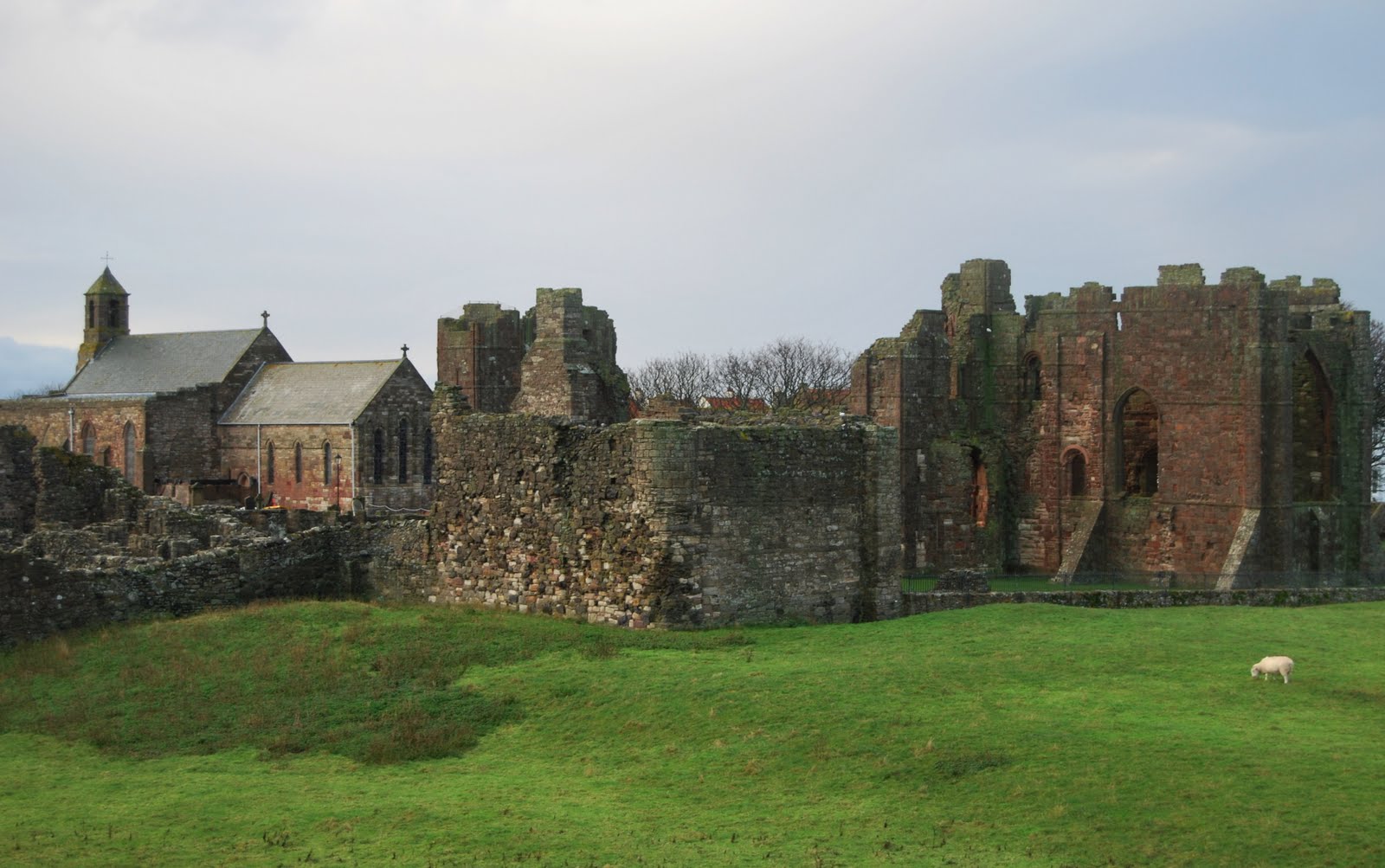
Ruins of Lindisfarne Abbey.

In this year dire portents appeared over Northumbria and sorely frightened the people. They consisted of immense whirlwinds and flashes of lightning, and fiery dragons were seen flying in the air. A great famine immediately followed those signs, and a little after that in the same year, on 8 June, the ravages of heathen men miserably destoryed God's church on Lindisfarne, with plunder and slaughter. And Sicga died on 22 February.
- Entry for the year 793 in the D and E manuscripts

I include this entry primarily for the portents. It is the first time I have encountered dragons in the Chronicle, although invaders labelled Northmen are mentioned in several manuscripts already in 789. These Northmen are called Danish in the C and A manuscripts, whereas manuscripts D, E and F record that the heathens came from Hörthaland in Norway. Some people may find that slightly arousing, I don't. 
 
Part of the archaeological find named the York Viking hoard, a treasure unearthed a couple of years ago. Treasures like this were often buried to keep them away from the Vikings, or buried by Vikings to keep them away from other Vikings. The date of this hoard is set to 927/928 due to a coin with an inscription pertaining to king Athelstan of Wessex's claim to kingship of Britain in its entirety.


Brihtric had helped Offa because he had married his daughter.
- Excerpt from the entry for the year 839 in the C and A manuscripts

I decided to include this excerpt in order to illustrate what roles Anglo Saxon women could play in English politics, namely as manifestations of alliances. As stated above, women rarely feature in the Chronicle and when they do it is often as pawns in the game of Anglo Saxon politics. It should also be noted that the Offa mentioned above is not the famous Mercian king, he lived in the 8th century.


And the same year after Easter, at the Rogation days or before, there appeared the star which is called in Latin cometa. Some men say that it is in English the long-haired star, for there shines a long ray from it, sometimes on one side, sometimes on every side.
- Entry for the year 892 in the A manuscript

I find the above section very poetic in its terse brevity, and may very well be my favourite description of a comet I've ever come across in the Chronicle.


That same year a bloody cloud was often seen in the likeness of fire, and especially it was revealed at midnight, and it was formed in various shafts of light. When day was about to dawn, it disappeared.
- Entry for the year 979 in the C manuscript

These coins are from the York Viking hoard and come from Afghanistan and Samarkand.

And in this same year the sester of wheat rose to 55 pence, and even higher.
- Excerpt from the entry for the year 1040 in the E and F manuscripts


(...) and Leofgar who was Harold's priest was appointed bishop, and in his priesthood he had his moustaches until he was a bishop.
- Excerpt from the entry for the year 1056 in the D manuscript

I particularly like this brief glimpse into the world of ecclesiastical fashion. The scribe includes this detail clearly out of derision for Leofgar's vanity and unclerical behaviour, and for anyone interested in the mentalities of bygone ages this is gold.


In this year Earl Ælfgar was banished but he got back by violence forthwith through Griffith's help. And a naval force came from Norway. It is tedious to relate fully how things went.
- Entry for the year 1058 in the D manuscript

It appears scribes can sometimes be quite fed up with their work.


This year the king led an army into Wales and there liberated many hundreds of men.
- Entry for the year 1081 in the E manuscript

I wonder whether the Welsh were equally enthusiastic

William the Bastard, liberator of...gas?


The Anglo-Saxon Chronicle draws on numerous historical works, ranging from monastery annals to solo-projects like Bede's Ecclesiastical History of the English People. The entries naturally vary greatly since this is a joint venture, and since it is written over a period of roughly 250 years. Although exaggerated at some points and frustatingly brief at others, it remains our key literary source to the late Anglo-Saxon period and the early Norman age.