And was the holy Lamb of God,
On Englands pleasant pastures seen!
- And did those feet, William Blake
Viser innlegg med etiketten Skive. Vis alle innlegg

mandag 17. mars 2025

Saint James the Elder in Skive


These days, I'm preparing for an upcoming talk at a conference in Spain, where I will once more delve into the history of the cult of Saint James the Elder. The cult of Saint James is one of the most remarkable iconographical metamorphoses, as the apostle became a pilgrim and then became known as such throughout the entire medieval Latin Christendom. The signature hat, staff and scallop shell are all part of a recognisable iconography that continues to resonate to this day, and that can often be found in small places far away from the cult centre in Santiago de Compostela. One such place is Skive in Northern Jutland. 


Saint James the Elder
Skive Church


In my upcoming talk, my focus is on the cult of Saint James - as Santiago, which serves as a useful shorthand for the Compostelan iteration of the saint - and his medieval cult in the Nordic sphere. One of the examples of his cult is a wall-painting in the Church of Our Lady in Skive, which is part of a fresco cycle that was completed in 1522. The cycle consists of several saints, some of whom I have written about in other blogposts. Saint James appears as his pilgrim self on the side of the archway that separates the choir from the nave. This archway and the choir are dedicated to the Trinity and the apostles, except Saint Matthias who for some reason is not included.  

That Saint James the Elder appears as a pilgrim is only to be expected, given that saints were depicted in ways that would make them recognisable. It is, however, a fascinating testament to the flexibility of medieval temporal imagination that a saint is placed in a distinctly biblical context, yet is depicted as what would be a post-biblical figure representing the later development of his cult. There is no contradiction in this, at least from the point of view of medieval venerators, since once a saint entered Heaven they were atemporal and existed in all time periods postdating their deaths. What we see here, therefore, is not so much anachronistic a achronic - an example of how time exists on a different plane than mere history, at least within the perspective of the medieval cult of saints. 


onsdag 6. september 2023

New publication: 'Helgenerne i Skive. Deres udvalg i kontekst'

 
The end of August saw the publication of a book to which I have been fortunate enough to contribute, namely Dansk senmiddelalder, reformationstid og renæssance [Danish Late Middle Ages, Reformation era, and Renaissance]. The book, edited by Louise Nyholm Kallestrup and Per Seesko-Tønnesen, is a festschrift to my primary PhD supervisor, Lars Bisgaard, who is both a lovely man and one of the leading Danish medievalists of our times.

My contribution is a chapter called '
Helgenerne i Skive. Deres udvalg i kontekst [The saints of Skive. Their selection in context']. The article examines the wall-painting cycle of the Old Church in Skive, Northern Jutland, about which I have written several blogposts. The article provides an interpretation of the selection of saints, suggesting how we might understand the inclusion of some and the exclusion of others.  

The most rewarding aspect of this article was to be able to pay a small homage to a supervisor to whom I owe much more than I can ever repay. I was also very happy that the invitation allowed me to write up an article idea that I had had on my mind since the spring of 2019, following a visit to the medieval church of Skive. As such, this publication is yet another reminder of how such ideas that seem too small or too vague at the time of conception can mature into something interesting and worthwhile, given the opportunity.  

The book, most of whose contributions are in Danish, can be purchased here


Dansk senmiddelalder, reformationstid og renæssance 
Ed. by Louise Nyholm Kallestrup and Per Seesko-Tønnesen
(Photo courtesy of Syddansk Universitetsforlag)


søndag 23. april 2023

Saint George in Skive

 
Today, April 23, is the feast of Saint George, a saint with whom I am particularly fascinated, and about whom I have already written several blogposts (see below). Due to the widespread popularity of Saint George in the later Middle Ages, there are several depictions and narrations of his legend - in text and image - which survive from Latin Christendom. In this cultural geography, Latin Christendom, the figure of Saint George became increasingly well known in the course of the twelfth century, possibly because his legend made it possible for him to be reactualised and reimagined as a chivalric figure. This hypothesis is supported by the shift from illuminations focusing on his elaborate and gruesome passion narrative to his victory over the dragon. From the fourteenth century onwards, however, the popularity of Saint George skyrocketed thanks to two converging and related factors: The popularity and accessibility of Legenda Aurea, through which the legend was disseminated more broadly and to new audiences, and Saint George's inclusion among the fourteen holy helpers, a group of saints with changeable configuration which emerged in Germany. 

For this year's feast of Saint George, I present you with one depiction which, as I argue in a forthcoming article, is a consequence of impulses from both Legenda Aurea and German religious trends. The depiction in question comes from the Church of Our Lady in Skive, a church from c.1200 and decorated with an extensive programme of wall-paintings in 1522.


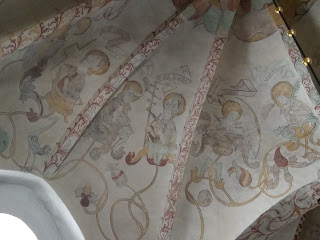
The image in question is found in a section of one of the vaults in the nave of the church. In these vaults, saints are predominantly depicted in pairs, and Saint George is shown together with Saint Knud Dux (also known as Saint Knud Lavard). The depiction of Saint George is both typical and untypical at the same time. Since the saint is shown as emerging from a flower - as are almost all the other saints, with the curious exception of Erasmus - the choreography of the scene is different, as there is no horse, and George wields a sword rather than a lance. The position of the saint above the dragon, however, and the saint wearing contemporary armour, are both common features. Interestingly, since Saint George emerges from a flower, the artist has taken the opportunity to increase the drama of their encounter by making the dragon tangle his tail around the stem of the flower, thereby seeking to topple his antagonist. 

The wall-paintings at Skive are intriguing, both for their variety, their typicality, and their untypicality. There are still several questions that remain to be answered, and even more questions that will never be answered in a fully satisfactory way. For instance, we do not know why Saint George is paired with Saint Knud Dux. The number of such details and the various possible interpretations mean that we scholars will continue to grind our brains against the wall-paintings in Skive for generations to come, and that's part of the fun of it. 


Similar blogposts concerning Saint George 

Saint George and Saint Edward the Confessor in comparison 

Saint George in Odense 

Saint George in the Old English Martyrology 

Saint Alexandria, the martyr-queen 

Saint George in Ribe  

The changing iconography of Saint George 

Saint George at Sanderum  


Similar blogposts concerning Skive Church 

Saint Martin in Skive 

Saint Olaf in late-medieval Denmark 

Saint Thomas of Canterbury in Skive 

Saint Servatius in Skive 


torsdag 24. februar 2022

Achronology and the lives of saints - the case of Saint Servatius at Skive Church, Denmark

 
In a previous blogpost, I wrote about how medieval art sometimes condenses elements of a saint’s life into an achronological summary, where several key points from different parts of a saint’s life are brought into the same frozen here-and-now. This kind of amalgamation is part of what Cynthia Hahn has called “pictorial hagiography”, a term that reminds us that medieval art had a narrative function, and that a single image could convey an entire story. This kind of narrative snapshot, however, is not uniquely medieval, and it is not something we have lost in our own time, but we often tend to forget that this kind of sophisticated thinking where chronological borders melt into one another was also present in the Middle Ages.            

When last I wrote about this issue on the blog, I used an example from the Church of Our Lady at Skive, a town in Northern Jutland. The church, built around 1200, contains an impressive programme of frescoes depicting saints, a programme that was painted in 1522, a date which has been incorporated into several of the frescoes. My example then was Saint Martin, shown in bishop’s attire while cutting his cloak in half, a deed he committed when he was still a soldier. The other day, however, I came across yet another example from the same wall-painting programme, and as this example works slightly differently from the case of Saint Martin, I decided to dedicate this blogpost especially to analysing it. 


Eminen and his son Servatius, the future bishop

The saint in question is Saint Servatius of Maastricht, shown in one of the vaults of the church nave, who was venerated as a relative of Christ through his great-grandmother, Hismeria, was the sister of Anna, the grandmother of Christ. In this way, Saint Servatius was part of the extended holy family, whose members had been recorded in apocryphal literature. When Jacobus de Voragine composed his Legenda Aurea in the 1260s, he provided an overview of this extended family in his chapter on the Nativity of the Virgin Mary (September 8). While Legenda Aurea was a repository of already well-established knowledge, and therefore did not contain much in terms of new information, the popularity of the book ensured that a lot of details concerning the saints became more widely and commonly known as Legenda Aurea and its translations spread across Latin Christendom in the Later Middle Ages. These details also reached Denmark.        

The case of Saint Servatius is a particularly interesting example of how Legenda Aurea functioned as a vehicle of canonicity. By this I mean that information that had not been widely known, or perhaps not widely accepted, was transformed into established canon through the sheer popularity and reach of Jacobus’ book. Before the 1260s, the cult of Saint Servatius was predominantly, perhaps exclusively, located in Maastricht, where his relics were kept. I do not yet know the history of the legend of Servatius and his kinship with Christ, and I do not yet know how it emerged at Maastricht, but by the mid-thirteenth century, the claim that Servatius was of the Holy Family had reached Genoa and was incorporated into Legenda Aurea and established as a canonical fact. It should also be noted that this kind of historical refashioning or reimagining of the history of a patron saint was not uncommon in the Middle Ages, although not every such refashioning had the impact of Saint Servatius.

We do not know how the knowledge of the kinship between Christ and Saint Servatius reached Northern Jutland, but there were many possible routes by which that information could have travelled, be it directly from Legenda Aurea, from a German translation, through sermons, through merchants, and so on. Saint Servatius’ presence in Skive is, therefore, no surprise. What is particularly interesting is, as stated earlier, the way that the fresco in Skive combines crucial elements of his life. As can be seen in the picture above, Servatius is shown as a child wearing a bishop’s mitre. That he is intended to be understood as a child is clear when we compare his size with that of his father Eminen, standing next to him. Does this mean that Servatius was understood as a child-bishop? Probably not. Most likely, what we see here is a way of highlighting that he was a member of the holy family, but a young member of a later generation than that of his great-grandmother Hismeria and his great-grandaunt Anna. A similar way of showing the difference between generations can be seen in the depiction of John the Baptist in another section of the vault, where he, too, is depicted as a child. This kind of representation of several generations in one image is typical of the images that modern scholarship call Anna self-third, where we see the three generations of Anna, the Virgin Mary, and the Christchild. This iconography was very popular in the Later Middle Ages.         

The depiction of Servatius as a child, then, shows his kinship with Christ and as a late generation of the holy family. In other words, we see an element of the very beginning of his life, an element that in and of itself was cause for a claim to holiness. The simultaneous depiction of him as a bishop, however, points to a later part of his life – a part that would become his future when he was a child, and that was also a part of the distant past by the time this image was painted in Northern Jutland. Onlookers would, in this way, get a summary of Servatius most salient claims to holiness, his kinship and his office as a bishop, in one and the same glance.


tirsdag 25. januar 2022

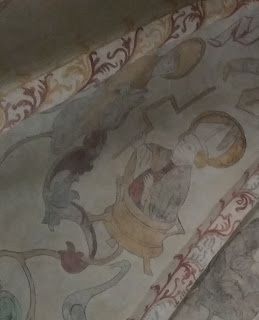
The saint in the pot - Saint Erasmus at Skive


One of my various side-projects these days entails a revisit to the saints of the Church of Our Lady in Skive in Northern Jutland. The church, built around 1200, was decorated with an extensive wall-painting programme of various saints in 1522, and thanks to restoration work in the 1900s, most of these can still be seen today. I have touched upon several of these saints in earlier blogposts (see here, here, here, here, and here). The best treatment of these wall-paintings can be found in a small pamphlet from 1993, Kalkmalerierne i Vor Frue Kirke Skive (The frescoes of the Church of Our Lady, Skive), published by Bodil Glad and Ingvar Glad in 1993. Having read through this excellent resource, I was notified of one particular and in a way delightful detail that I had caught on camera during my visit there in 2019, but which I had subsequently overlooked - no doubt distracted by the host of other details to draw the eye. 

The detail in question concerns the representation of Saint Erasmus, also known as Saint Elmo, whom we find in the second vaulting of the nave next to Saint Denis, or Dionysius if one prefers. Saint Erasmus was, according to legend, the bishop of Formia, who was martyred in a typically gruesome fashion: He had his entrails drawn out with a windlass, and he was himself boiled in a pot. As is typical in medieval Christian art, the martyr Erasmus is depicted holding one of the (often several) instruments of his torture, in this case the windlass. Among the other saints in Skive we see the same pattern, although some have other symbols of their martyrdom than the instruments, such as Erasmus' neighbour Denis, who holds the top of his skull, which his assailants chopped off. 

In the case of Saint Erasmus, however, the artist has decided to present the legend of the saint by more ways than one. Possibly inspired by the vogue of the time which had saints emerge from flower bulbs, the artist has replaced the bulb with the pot from Saint Erasmus' passion, making the saint stand out among his colleagues, as can be seen in the second of the blogpost's two images. The reason for this choice is unknown to us, and can be interpreted in several ways. Was it a humorous choice? Or did it grow - pun intended - out of devotion for the saint, resulting from a wish to make Erasmus more notable, or to have his legend represented in more detail? Did it follow a wider trend of the period, a period in which Erasmus enjoyed widespread popularity as one of the fourteen holy helpers? Ultimately we do not know, but we can still enjoy the result of this decision taken during the work of 1522.

Saint Erasmus in a pot, next to Saint Denis with the top of his skull

Saint Erasmus in immediate context 
(Denis, Erasmus, Peter Martyr, Thomas of Canterbury, Sebastian and Vincent)

fredag 18. september 2020

The imperfectly remembered archbishop - three late-medieval images of Saint Thomas of Canterbury


Today, September 18, I virtually attended a workshop on hagiography, comprised of scholars working in the Nordic countries. It was a welcome opportunity to present research, which is something I have missed more than I thought I would in this year’s string of conference cancellation. My talk was focussing on the cult of Saint Thomas of Canterbury in medieval Denmark, a topic on which I have spent a lot of time this year, and which continues to fascinate me. As I was preparing for my talk, I was reminded of one quandary that has been in the background of much of my research on the cult of saints. When trying to chart the development of a particular saint’s cult, or the role of saints in a particular historical period, one important perennial question is this: How do we measure the popularity of a saint outside that saint’s cult centre? And more to the point, how do we measure that popularity when the saint in question is of very widespread fame?       

This matter is particularly pressing in the case of Thomas of Canterbury. Due to his role as a figurehead for the struggle of ecclesiastical power against royal power in the twelfth century, the cult of Thomas was disseminated throughout Latin Christendom very rapidly following his canonisation in 1173. Because of this widespread reception of his cult, the figure of Thomas is a ubiquitous feature in sources pertaining to the cult of saints in the later Middle Ages, and in particular liturgical books and legendaries. The papal request to include Thomas in liturgical calendars meant that Thomas can be encountered in probably every church province of the papal church. Similarly, because Thomas was one of few modern saints included in Legenda Aurea by Jacobus de Voragine in the 1260s, the martyred archbishop was included in practically every edition, translation and adaptation of this collection of saints’ lives, which was one of the most popular books produced in the medieval period. Consequently, Thomas of Canterbury appears in a wide range of sources from all over Latin Christendom from the late twelfth century onwards. Because of this wealth of cult material pertaining to Thomas of Canterbury, I find myself asking the question: To what extent do these numerous witnesses to his cult actually indicate popularity?          

To answer this question would require a scholarly article, perhaps even a monograph, but all I have at the present is this blogpost. I therefore wish to go into some of the ways in which we approach this question, and what follow-up questions that we need to posit in order to find at least a tentative conclusion.    

First of all, we need to ask whether the source in question contains a version of the legend of Thomas which follows the narrative of his vita. This is of course a question that can only be put if the source allows for a narrative, be it textual or pictorial. In the event that the source provides a narrative of sorts, we need to consider whether this source follows the narrative of the vita to a significant degree. If the answer is yes, we might tentatively interpret this as evidence of popularity.   

However, if the source only follows the narrative of the vita to a limited degree, or perhaps not at all, we have to go back to another set of questions. In this case, we need to consider whether the discrepancy in the narrative can be explained by a local tradition about Thomas. If so, we should probably interpret this as an expression of popularity. On the other hand, if the discrepancy stems from an imperfect attempt at recording a narrative that is not well known in and of itself, we should not interpret the inclusion and depiction of Thomas as anything but the sign of the universality of his cult, and not as a sign of popularity.    

In addition to the narrative of the vita, we also need to pose these questions when looking at the iconography of Thomas that appears in the source, and here I mean both textual and pictorial iconography. Do the images employ or point to a notable familiarity with the legend of Thomas and with his iconographic tradition as it was established in the twelfth century? Does the iconography differ? And if it differs, is this because the source in question follows a local tradition – which would suggest popularity – or does it differ due to a lack of familiarity with the established iconographic tradition? Moreover, if the divergence comes out of a lack of familiarity with established iconography, should we interpret this as a lack of popularity, as indifference, or even unpopularity?    

I do not have the answers to these questions myself – at least not yet. But as a kind of scholarly experiment, I want to point to three late-medieval images from different parts of Latin Christendom. All these images depict the martyred archbishop of Canterbury in different ways, and in ways that do not correspond very well to the iconographic tradition of the twelfth century onwards, as it was formulated in England and France. 


A very curial Thomas of Canterbury
Avignon - BM - ms. 0136, f.015v, missal, Bologna, late C14
(courtesy of enluminures.culture.fr.)

 
The first image comes from a fourteenth-century missal, produced in Bologna and used at the papal court of Avignon, with the shelfmark Avignon – BM – ms. 0136. This book reportedly belonged to pope Urban V and his controversial successor antipope Clement VII, and it is a sumptuously illustrated manuscript. On folio 15v, we find the above initial in the introit of the mass for Thomas of Canterbury. Thomas himself is depicted as what we might presume to be a typical senior churchman of the times, holding the palm to signify his martyrdom. This image is very different from the earlier depictions of the archbishop with which I am familiar. The difference lies in the static nature of the image. In older illuminations, we usually see Thomas being martyred, usually with an indication of how the archbishop received the wound in the head. In the Bologna missal, however, we see a typical martyr-archbishop, a stock figure ready to be inserted whenever the need arose. Should we interpret this as a sign of papal veneration of Thomas of Canterbury? Or should we see this as a sign that in this missal, Thomas was just one in the crowd of universal saints and of no particular importance? Or should we perhaps see this in another way? Perhaps as a way to present this famous archbishop as a contemporary bishop, which would signify a departure from iconographic tradition for the purpose of exploiting his symbolism? It is impossible to say for certain, of course, but we see a clear departure from the iconographic tradition as it had been formulated in the past two centuries.


Thomas of Canterbury out in the open
Das Leuend der Hÿlghen, Syddansk Universitetsbibliotek RARA M 15, f.311r


The second image comes from Germany. This is a woodcut from the incunable Das Leuend der Hÿlghen, printed by Steffen Arndes in Lübeck. The image in question comes from the 1493 edition, here seen in the book with the shelfmark Syddansk Universitetsbibliotek RARA M 15. Das Leuend der Hÿlghen was one of several German collection of saints’ lives that were based on Legenda Aurea, but which also added a number of local and regional saints, and which were adaptations rather than translations in the strictest sense. In this image, we can clearly note a connection to the established iconographic tradition: The protagonist is an archbishop, and his killer has raised his sword in a movement that foreshadows the imminent blow to the head. That the archbishop has his back to the murderer is in keeping with the established tradition, but this would also have been the case if Thomas had faced the murderer, since this was also a version which came into place already in the late twelfth century.          

However, there are two other features in this image which suggest that this depiction is not in keeping with the established tradition. First of all, the archbishop is being led away by a soldier. In the traditional narrative, as depicted in all the early vitae and almost all older representations of the scene, the knights do not lead away the archbishop, but murder him on the spot. What appears to be an arrest of Thomas in the woodcut is, therefore, a feature that is not based on the original narrative. Moreover, the scene of the martyrdom is clearly out in the open, as seen by the winding road in the background. This, too, is a deviation from the narrative of the vitae, since the martyrdom expressly took place inside the cathedral of Canterbury, which added to the transgressive nature of the crime. Here, too, it is difficult to assess how to interpret these deviations, but it does beg the question whether the Lübeck printers had any particular interest in the famous archbishop.


Wall-painting from Skive Church, Northern Jutland, c.1500


The final image is also one of German production, although it is situated in Northern Jutland in Denmark. This is a detail from the wall-paintings of the Church of Our Lady in the town of Skive, and it is one of several saint figures that decorate the vaults of the church interior. The church itself was built around 1200, but the wall-paintings are from around 1500, and they are believed to have been produced by a workshop of German painters. The iconographic programme of the church shows a selection of the most common and famous universal saints in the liturgical calendar, with a few Nordic saints included as well. In other words, the frescoes seem to be a standard selection of the saints deemed most powerful and meritorious among those in vogue at the time. This is in and of itself an indication that the selection should not be interpreted as a sign of the personal devotion of the donors of these wall-paintings.      

This suspicion seems strengthened, perhaps even confirmed, when we turn to the depiction of Thomas of Canterbury. The image clearly depicts him as an archbishop, and the text-scroll above his head states that he is indeed the martyr of Canterbury. However, the sword protruding from his chest is not in keeping with the traditional narrative of his death. The sword is pierced through his breast from the front and out the back, whereas the established tradition clearly states that Thomas received his wound in the head. There exist other images that also present Thomas as dying from being pierced rather than being cut, but these are later and do in their own way deviate from established tradition. In light of how the image differs from the tradition, and in light of the general context of the pictorial programme, it feels relatively safe to say that this depiction of Thomas of Canterbury does not suggest a particular popularity, but rather a more general fame, a fame shared with a plethora of other saints also depicted in the church.


These thoughts are some tentative ideas about how to interpret images that do not conform with iconographical tradition. But to be more certain of these interpretations, I would have to delve deeper into the issue, and one day I hope I get the chance and the time to do just that.


mandag 30. mars 2020

Saints for the season - a reflection on plague saints


Tu de peste huiusmodi
Nos defende et custodi

- Motet for Saint Sebastian, Guillaume Dufay


In these times of a global pandemic, a lot of people seek out something topical on which to turn their attentions. Some find this topicality in books, in particular Giovanni Boccaccio's Decameron, but also Daniel Defoe's A Journal of the Plague Year, and, in Norway, Sigrid Undset's trilogy about Kristin Lavrandsdatter. Interest in historical pandemics is rekindled as well, and this is particularly the case for the Black Death, which has resulted in an increased dissemination of the first volume of the journal The Medieval Globe, namely Pandemic Disease in the Medieval World edited by Monica Green (2014).

For me as a saint scholar, there is one particular outcome of this quest for topicality that has caught my interest, namely the attention given to the relatively obscure Saint Corona, a martyr of uncertain date who suffered along with Saint Victor (one of at least three soldier saints with that name, and the least well known among them). The interest in Saint Corona must in large part be ascribed to the likeness of her name with that of the corona virus of the ongoing pandemic, and this similarity has led to Corona being talked about as the patron saint of epidemics. This patronage, however, is the result of our tendency as human being to seek out patterns even where there are none, and the inaccuracy of this claim has been discussed by Dr. Patricia Cullum on Twitter (see this thread), and Dan Evon has addressed the matter on snopes. This renewed attention concerning Saint Corona has also resulted in her relics being brought out from storage at Aachen Cathedral, so as to make it available for pilgrims.

The case of Saint Corona is interesting for many reasons. First of all, it shows the constant relevance of saints, also in our modern times. Secondly, it is a good example of how saints evolve according to the needs of the living. The debate concerning the patronage of Saint Corona has mostly focussed on the fact that she is not historically considered as a patron against epidemics, and that the hope in her role as a plague saint is a modern one. However, while it is important to have a historically accurate understanding of the cult of Saint Corona, it is also necessary to keep in mind that the patronages and the cults of saints undergo changes whenever the need arises. Therefore, it is true that Saint Corona, historically, is is not the patron saint of epidemics. But we must also be aware that the designation of saintly patronage is not subject to any specific religious authority, and in many cases the attribution of  a particular patronage is the result of pressure from below. In other words, if enough people believe that Saint so-and-so can intervene against a particular sickness, people will start flocking to that saint for healing, and cures will be attributed to the intervention of Saint so-and-so. This means, in turn, that if the mere resemblance of the name of the saint with the name of the virus results in people turning to Saint Corona for cures, she will become one of the several saints whose catalogue of patronages includes epidemics. The attention given to Saint Corona reminds us that saints are not static. While their earthly lives might be given a more or less concrete time-frame, they are also believed to continue intervening in affairs of this world after their death.   


Saint Sebastian
Skive Church, Northern Jutland, Denmark, c.1500


There are several saints who have acquired new patronages at various points in the course of the history of their cults. One example is one of the most famous plague saints of all, namely Saint Sebastian. Sebastian is of uncertain historicity, but his death is usually dated to the reign of Diocletian, and a cult appears to have been in place by the second half of the fourth century. The early trajectory of his cult is obscure, but in his Historia Langobardorum of the late 700s, Paulus Diaconus recounts how a plague in the seventh century was averted in Pavia when an altar to Saint Sebastian was erected in the city. This anecdote was later repeated by Jacobus de Voragine in his Legenda Aurea from the 1260s, and it is likely due to the popularity of Legenda Aurea that Sebastian became an immensely famous plague saint in the course of the Black Death. Sebastian was often named among the Fourteen Holy Helpers, a group of saints whose members varied in different geographies. This group emerged in the Rhineland in the early stages of the Black Death, and it was a collective of saints who were called upon in crises, and Sebastian's frequent inclusion in this group testifies to his popularity.  

Saint Sebastian's plague patronage is similar to the modern attributions to Saint Corona as a patron saint of epidemics, in that it is a patronage that appears to have been acquired after several centuries. Moreover, while the idea that Saint Corona is a saint against epidemics due to her name, it is often believed that the patronage of Saint Sebastian against the plague can be ascribed to the imagery of him being perforated by arrows, as the imagery is believed to invoke the idea that the god Apollon sent plagues by shooting pestilent arrows to the earth. Whether the origin of Sebastian's plague patronage lies the Apollonian imagery or not, the fact that this association is sometimes made points to an important aspect of how patronages are attributed: Humans look for patterns.


Martyrdom of Saint Sebastian
Amiens - BM - ms. Lescalopier 017, f.250v, 1415-20, Champagne 
(Courtesy of enluminures.culture.fr)


 In addition to Saint Sebastian, there are also several other saints who are believed to assist in times of plague. One particularly important late medieval example is the cult of Saint Roch (d.1327), the son of the governor of Montpellier who is said to have wandered from city to city to heal the plague-stricken, and who eventually died in prison. It is important to note that Roch, a historical person, died before the Black Death, which serves as a useful reminder that plague was a perennial problem in the Middle Ages. Saint Roch's patronage of plague victims was directly connected with his earthly life, and this catapulted him into fame at a relatively early point, and his relevance continued throughout the Middle Ages, as evidenced in the wall-painting below from Northern Denmark, dated to c.1500. Here we see the typical depiction of Roch indicating a plague sore on his inner thigh, attended to by an angel. In several cases, as seen in the illumination further down, Saint Roch is depicted together with a dog. It is interesting, though perhaps not indicative of an iconographical connection, that the angel and dog are elements from the biblical story in the now-apocryphal Book of Tobit, where Tobias goes in search for a cure for his father Tobit who has become blind.   


Saint Roch (on the right) showing his plague sore to the onlooker
Skive Church, Northern Jutland, c.1500


Saint Roch with angel and dog
Châlons-en-Champagne - BM - ms. 0337. f.144, book of hours, 1506 
(Courtesy of enluminures.culture.fr)


Another plague saint who is more limited in her geographical reach but of immense popularity is Saint Rosalia of Palermo, a twelfth-century anchoress who became a plague saint in the seventeenth century, when a vision instructed the citizens of Palermo to collect her neglected relics and parade them around the city. As with Saint Corona today, the life of the saint and the attribution of a plague patronage happened late. And as with the recent surge in the interest in Saint Corona, Saint Rosalia also demonstrates the continued relevance of saints in times of crisis.

As in the cases mentioned here, and presumably in other cases as well, the idea of Saint Corona as a plague saint might very well become a reality, because that is often how such patronages are designated. Moreover, that there so far seems to be little more than the name of the saint and the name of the virus to connect the saint with the patronage, we see in the cases of plague saints that not much more is needed to create the necessary association that initiates a saint's career as a patron against epidemics.


Bibliography

Antonio Borrelli, "Santi Vittore e Corona", santiebeati.it

Madeline Chambers and Gareth Jones, "German cathedral dusts off relics of St Corona, patron of epidemics", Reuters, March 25, 2020

Dan Evon, "Is Corona the Patron Saint of Plagues?", Snopes, March 24, 2020

David Farmer, The Oxford Dictionary of Saints, Oxford University Press, 2011

Monica Green (ed.), Pandemic Disease in the Medieval World: Rethinking the Black Death, volume 1 of The Medieval Globe, 2014

Lorenzo Tondo, "Palermo pins hopes on patron saint to rid Italy of coronavirus", The Guardian, March 13, 2020


lørdag 28. desember 2019

Saint Thomas of Canterbury in Skive Church


Today is the feast of Saint Thomas of Canterbury, more commonly known as Thomas Becket, who was killed in Canterbury Cathedral on this day in 1170. The murder of the archbishop at the hand of knights in King Henry II's retinue was a scandal in its time, and even though the English king had not himself ordered the death of Thomas, he was widely blamed for the deed, especially in ecclesiastical circles.

The cult of Thomas spread quickly throughout Latin Christendom. This was in large part due to the network of ecclesiastical figures to which Thomas had belonged, and that shared his reformist views on the relationship between royal and ecclesiastical power that marked the political map of the twelfth century. The key figure in this network was Pope Alexander III (r.1159-81) who had supported Thomas' cause during the archbishop's exile in France from 1164 to 1170. It was Alexander who canonised Thomas in 1173.

Other important reformist figures were the Norwegian archbishop Eystein Erlendsson (r.1157-88) who is largely credited with bringing the cult of Thomas to Norway (see this blogpost), and the Danish archbishop Eskil Christiernson, or Eskil of Lund, who is considered to be responsible for bringing the cult of Thomas to Denmark, in no small part through the Cistercian order to whom both Eskil and Thomas were close. 

The cult of Thomas in medieval Denmark is still a subject that requires more work, and I hope to be able to contribute to this scholarly lacuna in the coming year. As a way to remind myself of the work to be done, I'm sharing with you one late medieval example of the veneration of Thomas in Denmark, namely a wall-painting from Skive Church in Northern Jutland.


Tomae de Cantuarienus [sic]
Wall-painting from Skive Church, Northern Jutland, c.1500


The example in question comes from the Church of Our Lady in the town of Skive in Northern Jutland. The church was built around 1200, and it is commonly known as Skive Old Church to distinguish it from the eighteenth-century church situated nearby, and which appears to be the hub of today's religious life in Skive.

The early history of Skive is uncertain, and the current scholarly consensus is that the town was most likely established around 1100. Its status as a market town - i.e. a town with particular mercantile privileges - was confirmed in a letter from 1326 (see this website), but the status might have been achieved earlier. Judging from the Church of Our Lady, Skive appears to have been an important town by the turn of the twelfth century, and its importance can be explained or measured by three main factors. First of all, Skive lies very close to Viborg, the episcopal see of Central Jutland which was established c.1060 and thus one of the main power centres in the area. Secondly, a royal manor, Skivegård, is mentioned in the survey of King Valdemar II (r.1201-41), the so-called Liber Census Daniae (see here), and points to the town's vicinity to royal power in addition to the episcopal power at Viborg. The third factor is the fish trade which is likely to have brought a lot of money to the town's wealthier inhabitants. These three factors must all be taken into account as possible explanations for the erection of the Church of Our Lady around 1200.


Vor Frue Kirke, Skive


Vor Frue Kirke, Skive, interior, towards the main altar


In the nineteenth century, the Church of Our Lady was about to be demolished, which was the fate of several redundant churches in Denmark at the time. Fortunately, an impressive programme of late medieval wall paintings was discovered in time, and the church was preserved. It is in this programme that we find the aforementioned late medieval depiction of Thomas of Canterbury. 

The interior of Skive Church is filled with a vast array of saints. These saints were painted c.1500, and it is thought that the workshop that executed these paintings was the same, or was at least connected to, the workshop that decorated Roskilde Cathedral (see here, and here). Among these many saints we find Thomas of Canterbury, situated in the vaulted roof between Peter Martyr of Verona (d.1252) and Sebastian. The question then is how we are to understand this as an expression of veneration of Thomas.


The painting of Thomas of Canterbury in Skive is interesting, both because it is one of very few known medieval Danish depictions of him, and also because of its wider pictorial context. Thomas is here one of many saints. On the one hand, these wall-paintings were commissioned by local donors who might have given very specific instructions about which saints to include. It is therefore tempting to see the inclusion of Thomas in light of the wider history of his cult in medieval Denmark. 

On the other hand, we might understand this as just an expression of his general popularity in Latin Christendom at the time. The saints of Skive Church are for the most part universally venerated in the Latin Church and by the time of the programme's execution these universal saints had been venerated for a very long time. Even the youngest of the saints included, Peter Martyr and Roch (whose traditional, but not uncontested, year of death is 1327), became widely celebrated within a relatively short timespan and are therefore unsurprising to see among more veteran saints. Even those saints that are not universally venerated outside the Nordic countries are nonetheless of regional importance, such as Knud Rex (d.1086) and Knud Dux (d.1131) whose cults were established throughout all of Denmark, and Saint Olaf of Norway (d.1030) whose cult was immensely popular throughout the Nordic world. The inclusion of Thomas in this saintly collegium is, therefore, a testament to the contemporary trends within the cult of saints, rather than a stage in a continuum in the veneration of Saint Thomas in medieval Denmark.

Even so, while the depiction of Thomas in Skive Church might not yield much information about his Danish cult, it nonetheless provides evidence of the endurance of his cult in Latin Christendom, and we see both that he was one of the trendy saints even in Northern Europe around 1500, and that he was one of the many ways in which the donors of Skive's wall-paintings sought to express their participation in the religious trends of Latin Christendom.


Similar blogposts

Saint Olaf in medieval Denmark

Thomas of Canterbury in medieval Norway

On the early cult of Thomas of Canterbury

A song for Thomas of Canterbury

Martin of Tours in Skive Church


mandag 29. juli 2019

Saint Olaf in Denmark - late medieval examples


Today is the feast of Saint Olaf, patron saint of Norway, who was killed in the Battle of Stiklestad in 1030 in an attempt to regain the title of Norwegian king. Throughout the Middle Ages, Olaf was an important saint in the religious landscape of Scandinavia, and his cult flourished outside the borders of both the Norwegian kingdom and the significantly more extensive Norwegian archdiocese. Due to the extensive contact between Norway and Denmark - through trade and political and religious ties - the cult of Saint Olaf was very strong among the Danes, and several churches, chapels and altars were dedicated to him. Part of the reason why the cult of Saint Olaf gained such popularity in Denmark had to do with him being seen as protector of seafarers, which can be seen in some of the miracles associated with him that have been recorded in the saint-biography now known by the title Passio et Miracula Beati Olavi. Another reason for Olaf's popularity in Denmark had to do with one fundamental feature of the Danish cult of saints. This feature was that the cult of native saints in Denmark - i.e. saints who were either Danish by origin or who had died in Denmark - was very regional. Consequently, there were very few Danish saints whose cults had a significant impact throughout all of Denmark.


Saint Olaf and Saint Knud Rex
The Church of Our Lady, Skive, Northern Jutland, c.1500


The two Danish saints that came closest to a Denmark-wide veneration were Knud Rex (d.1086) and Knud Lavard (d.1131, can.1169), but even though both their cults were propagated by the reigning royal dynasty for a period, this was not sufficient to maintain a long-standing popularity throughout Denmark. The popularity of Knud Rex was revitalised with the establishment of the Kalmar Union, where Knud and Olaf became representatives of two of the three union kingdoms (Saint Erik of Sweden was the third representative). As a consequence, Olaf and Knud, and sometimes also Erik, were increasingly depicted together from the late 1300s onwards. This can be seen in the pictures from Skive Church in Northern Jutland, which were executed around 1500, where Olaf can be seen holding his battle axe (which by this point had become a halberd), and Knud Rex holds his sword. It is tempting to suggest that because of Olaf's popularity in Denmark prior to the Kalmar Union, it was perhaps more natural for Danish patrons to commission Olaf and Knud Rex as part of their pictorial programme, while often leaving Erik of Sweden out of it, because he did not have a strong place in the Danish catalogue of saints prior to 1397.


Saint Olaf and Saint Knud Rex
The Church of Our Lady, Skive, Northern Jutland, c.1500


The interior of the Church of Our Lady, Skive

The Church of Our Lady, Skive, c.1200


Due to the regional nature of the Danish cult of saints, Olaf was more widely venerated in Denmark than any native Danish saint. This can be seen in the higher number of dedications of both churches, chapels and altars when compared with the saints native to Denmark. Moreover, while each of the episcopal centres of medieval Denmark had its own patron saint that bound their region to the divinely ordained history of Christendom - as per the historical understanding of medieval Christians - the veneration of Saint Olaf was present in the episcopal cities as well. For instance, in the bishopric of Odense, where Knud Rex had his cult centre, there were two chapels dedicated to Olaf, while in the city itself there was established a hospital shortly before 1437 by the priest Peder Jensen, which was dedicated to the Holy Ghost, Saint Antony (either of Egypt or of Padua) and Saint Olaf.     


Saint Olaf and the dragon
Roskilde Cathedral, c.1500


Also the episcopal city of Roskilde displays several examples of the cult of Saint Olaf, especially from the turn of the fifteenth century. Two wall-paintings featuring the same motif - Olaf trampling the dragon - can be found, one in the chapel of the three magi (above), and one on a column in the nave (below). The city of Roskilde also had a church dedicated to Saint Olaf, and two more such churches were found in the diocese. Many of these examples of the cult of Saint Olaf in Denmark have survived, but many more have been lost, and we must expect the popularity of the king-saint to have been even more significant than we can establish from surviving evidence.


Bishop flanked by Saint Lucius and Saint Olaf
Roskilde Cathedral, c.1500


Sanctus Olauus
Roskilde Cathedral, c.1500


tirsdag 28. mai 2019

Achronicity and the lives of saints - the case of Saint Martin of Tours at Skive Church


Last week I visited Skive Church in Northern Jutland, a beautiful stone church built around 1200 and dedicated to the Virgin Mary. What brought me there were the early sixteenth-century wall paintings covering the vaults of the nave and the choir, which is an impressive catalogue of saints similar in selection and execution to the wall paintings of Roskilde Cathedral, which likely were painted by the same workshop of artists. There are many beautiful details in the iconographic programme of Skive Church, but here I want to touch on one particular issue that really struck me as I was examining the various figures, namely how medieval art often employs achronicity to convey a saint's life in a single image. This use of achronicity is a very effective way of telling a saint's story through an assemblage of key aspects of that story. In so doing, the medieval artists fused various times, or perhaps rather various temporal moments, into one unit. The result is similar to what we often find in liturgical offices, where past and present commingles in a way that effectively - to use a beautiful phrase by Henry Parkes in a 2014 article - collapses time. In Skive Church I saw this particularly clearly in the depiction of Saint Martin of Tours.


Vor Frue Kirke, Skive, c.1200


Martin and Roch
Skive Church, Northern Jutland, early fifteenth century


The story of Saint Martin was widely known in the Middle Ages, as he was one of the oldest of the major non-biblical saints in the calendar, and as his cult was disseminated throughout all of Latin Christendom. In short, Martin was a Roman soldier of Pannonian origin who converted to Christianity, abandoned the army and settled as a hermit in some old ruins outside of Tours. When the bishopric of Tours became vacant, Martin was approached to become the next bishop, a position he very unwillingly accepted. His unwillingness later became the foundation for a story about how he hid among geese so as not to be found, but the geese made such a fuss about it that he was found. This story is neither in the first life of Martin by Sulpicius Severus (before 397) nor in any of the miracle accounts recorded in the sixth century by Gregory of Tours, Martin's successor and most efficient promoter. The most famous story from Severus' Life of Martin is arguably the story of how he divided his cloak while he was a soldier in order to give half of it to a beggar. This scene - usually featuring an equestrian soldier cutting his cloak with a sword - is found in many media of art throughout the medieval period. This scene is also used in the depiction of Saint Martin at Skive Church.

What struck me about Saint Martin at Skive, however, was that it was not the soldier on horseback who divided his cloak with his sword, but the bishop in full regalia who performed this act of charity. In terms of the legend of Saint Martin, this is a historical impossibility since Martin only became a bishop at a much later stage in his life. But in the narrative, achronic logic of medieval art, it makes perfect sense. The people attending services in the church who knew the story of Saint Martin - and such people were most likely in an overwhelming majority to those who did not - would easily recognise Martin from his particular act of charity, and they would know that he is to be remembered as a man of the church rather than a soldier saint. Because even though Saint Martin was a soldier, his story is only concerned with this aspect of his life to a minor degree. His most iconic act took place in this period, but it was also this act which prompted Martin to leave the army, as he afterwards had a vision of Christ praising him for his Christian charity. To put it in a different way, the deeds of Martin were carried out mainly as a bishop and his Christian acts were predominantly enacted as a man of the church. This is unlike soldier saints such as Mauritius and the Theban Legion who were martyred as soldiers and therefore enacted their sainthood as soldiers. This means that in the painting at Skive Church, Martin's role as an ecclesiastical saint is emphasised, and his saintliness is not given a militaristic tinge, so as to make clear his saint-type as a bishop and confessor, not a soldier and martyr.

In this way, we see how achronicity serves to summarise the key points of a saint's story - in this case by fusing one specific act with the profession he held at a later point - and at the same time provide the correct typology for the saint in question. Various temporal points in Saint Martin's life are merged into a symbolic, achronic here-and-now. It is, however, not timeless - at least not in the way liturgical narrative is often timeless by fusing past with the present and sometimes even with an apocalyptic future through references to Judgement Day - because both of the aspects represented in this image are of the historic, past Martin. However, there is still a sense of timelessness in what we see here as well, because this achronic representation of a historical person is also there to serve as a reminder that he, the saint, is always present and ready to receive the supplications of the faithful. In other words, while the image itself represents two separate stages of the past, it also contains in itself the promise of aid in the present as well as in the future, forever and ever, in saecula saeculorum.

This is, in short, a reminder of how wonderfully complex and sophisticated medieval art could be.    


Bishop Martin dividing his soldier's cloak
Skive Church, Northern Jutland, ealry fifteenth century