And was the holy Lamb of God,
On Englands pleasant pastures seen!
- And did those feet, William Blake
On Englands pleasant pastures seen!
- And did those feet, William Blake
Viser innlegg med etiketten Travel. Vis alle innlegg
tirsdag 27. august 2019
A new chapter
This autumn I'm starting a new chapter in my life. Until the end of January, I will be working as a university lecturer in history at the Linnaeus University, and I'm already looking back at my first week. My office is in Växjö, once an important episcopal seat close to the Danish border and the centre of a flourishing medieval church parish. As the pictures below will show - a very modest selection for the time being - it is a beautiful place, marked by lakes and pine forests and a harsh soil that once drove thousands of Swedes from this region to emigrate to America, a higher number than any other region of Sweden. A small town, beautiful in its architecture and one I look forward to explore further in the weeks ahead.
I am immensely glad to have been given this opportunity. I have daunting tasks ahead, and in the process of dealing with these tasks I will learn a lot, and by the end I think I will look back at this time as hectic but immensely rewarding.
I'm slowly settling in, slowly learning the nuances that separate Sweden from Norway, but also the nuances that are shared and familiar. My Swedish improves, a new national literature is awaiting to be explored, and there are new places to visit. It is a new chapter, and I welcome it.
søndag 28. februar 2016
City of Books, part IV - A Temporary Library
I've now been here for about one and a half months, and I'm nearing the end of my time here. However, the brevity of my stay has not kept me from accumulating a library in my room. I find that this is a recurring pattern for me: Wherever I stay for a longer or shorter period of time, I always end up accumulating a library.
To me this is an inevitable development since I'm a massive bibliophile, and since I don't feel quite at home anywhere without books. In this particular case, the accumulation of the library is also helped by the fact that there are many bookshops in York, and I usually tend to drop by and leave them in turn with less money than when I came in but infinitely richer. Another factor in the current mass-accumulation is that I've taken the opportunity to buy a lot of books - especially academic books - online. As a result, my temporary library in this city of books is bigger than I first had imagined.

My current temporary library

Most of these are booty from recent bookshop explorations
Due to number of books I manage to buy in a relatively short period of time, it goes without saying that I don't manage to read the books I buy before I leave a place. But this year, however, I've happily found that I have managed to combine work and spare time in such a way that I've read at least some of the fiction I've acquired, as seen below.
One of the great surprises this time around in York was the discovery of a fairly new bookshop, The Grimoire on High Petergate, which was a welcome sight after having lost a couple of the bookshop I used to visit before. This bookshop has a lovely selection of fiction, and it was here I found a copy of Brian Jacques' novel High Rhulain, a book in the Redwall series. I was first introduced to this series five years ago when I studied in York as part of my MA, but it was not until now I got around to begin reading it. It stands as one of my best reading experiences I have ever had, and it was suitable that I should read it here in this very city. The books in this blogpost have mostly been acquired at Minstergate Books and The Grimoire.

we close our eyes to Anselm and lie calm
- Geoffrey Hill, An Apology for the Revival of Christian Architecture in England, part 10, Fidelities
The above selection is exactly that, just a selection of my temporary library, but it gives a good representations of some of the books that occupy my mind these day. I find that some books I start reading right away, and some books I need around me for some time, tempting me, before I give in and start devouring them. This is one reason why I see it as a necessity to be surrounded by more books than I manage to read, even when I know my stay will only be a short one, and my time for reading non-academic material is severely limited. Yet as a bibliophile, it is sometimes less about the reading as the inspiration to read that can be drawn from a temporal library, and this is perhaps the case this time around.
For previous blogposts in this series, see:
City of Books, part I
City of Books, part II
City of Books, part III
onsdag 13. januar 2016
Long road into York
I have arrived in York. I have arrived in York where I will be doing my work for the next two months, as a part of an exchange deal between the universities of York and Southern Denmark, the two hosts for the Centre of the Medieval Literature. I arrived in York early Monday morning after a thirty-hour journey about which I've complained to many of my colleagues already, and I'm still in the long process of settling in. I'll return with posts more pertinent to my doings here, and with reports from one of my favourite cities in the world, but for the time being I'm still heavily encumbered by travel fatigue and from all the details that need to be sorted, so I'll let T. S. Eliot's poem Journey of the Magi represent my mental state at present.

Adoration of the magi
MS Egerton 2781, f.13v, book of hours, use of Sarum, 2nd quarter of the 14th century
Courtesy of British Library
'A cold coming we had of it,
Just the worst time of the year
For a journey, and such a long journey:
The ways deep and the weather sharp,
The very dead of winter.'
And the camels galled, sorefooted, refractory,
Lying down in the melting snow.
There were times we regretted
The summer palaces on slopes, the terraces,
And the silken girls bringing sherbet.
Then the camel men cursing and grumbling
and running away, and wanting their liquor and women,
And the night-fires going out, and the lack of shelters,
And the cities hostile and the towns unfriendly
And the villages dirty and charging high prices:
A hard time we had of it.
At the end we preferred to travel all night,
Sleeping in snatches,
With the voices singing in our ears, saying
That this was all folly.
Then at dawn we came down to a temperate valley,
Wet, below the snow line, smelling of vegetation;
With a running stream and a water-mill beating the darkness,
And three trees on the low sky,
And an old white horse galloped away in the meadow.
Then we came to a tavern with vine-leaves over the lintel,
Six hands at an open door dicing for pieces of silver,
And feet kicking the empty wine-skins.
But there was no information, and so we continued
And arriving at evening, not a moment too soon
Finding the place; it was (you might say) satisfactory.
All this was a long time ago, I remember,
And I would do it again, but set down
This set down
This: were we led all that way for
Birth or Death? There was a Birth, certainly
We had evidence and no doubt. I had seen birth and death,
But had thought they were different; this Birth was
Hard and bitter agony for us, like Death, our death.
We returned to our places, these Kingdoms,
But no longer at ease here, in the old dispensation,
With an alien people clutching their gods.
I should be glad of another death.
Text courtesy of this website
onsdag 25. september 2013
Travels in Tuscany, part 5 - The Blessed Fina of San Gimignano

Beata Fina di San Gimignano, Benozzo Gozzoli (1420-97)
Courtesy of Wikimedia
Italy can boast a
wide number of saints, many of whom are local figures whose cults may
be restricted to a small geography, such as one particular commune,
most likely their native one, but nonetheless have resulted in a rich
cultural and devotional expression. The blessed Fina of San Gimignano
is one such saint whom I happened to come across during my wanderings
in the city of a hundred towers.
Casa di Fina, which sadly was closed by the time I got there
Fina was born in San
Gimignano in 1238 and died at the age of fifteen in 1253 on March 12.
March is the season of gillyflowers in San Gimignano, and hence these
became known as fiori di Santa Fina, the flowers of Santa
Fina. According to local legend, they blossomed all over the city
when she died. Her death had reputedly been foretold her three months
in advance by St. Gregory the Great, to whom she was particularly
devoted.

Gregory announcing the death of Fina, Scuola di Ghirlandaio, Capella di Fina
During her short
life, Fina excelled in the ascetic religiosity that had become so
extremely popular in the course of the 13th century. This was the age
of mendicant friars, of Francis of Assisi and Dominic of Caleruega,
and poverty and selfabnegation were keywords in the new paradigm of
sainthood. Fina was struck by illness at the age of ten and became
bedridden, and she was later orphaned. During her suffering she was
known to proclaim to her visitors the devotion she harboured to
Gregory, the Virgin and Christ until her death. This display of
unwavering, patient religiosity no doubt struck a chord in the
contemporary milieu, and would continue to attract attention as these
virtues remained popular well into the 14th century.

Capella di Fina, duomo di Maria Assunta, scuola di Ghirlandaio
Pictures from the chapel courtesy of this website
After her death, it
was reported that numerous miracles occurred at her tomb - or the
plank that had been her bed according to some - and she became the
centre of a local cult. In addition to the ascetic nature of her
devotion, the fourteenth-century devotees may also have been
attracted to her cult for her reclusion, an ideal of female sanctity
that grew popular in those times. The typology of the female recluse
also accorded well with the asceticism of the 13th century since the
typical recluse-saint performed her imitation of Christ, the imitatio
Christi, through poverty and self-mortification. This also became
the century of the flagellants, which took this ideal in a somewhat
different and more public direction.
It was a Dominican
friar who wrote the vita of Fina di San Gimignano, Giovanni
del Coppo who also was a native of that town, and it was typical for
the mendicant orders to produce hagiography for local saints in the
1300s. Andre Vauchez notes that mendicant friars showed considerable
interest in female lay sanctity in this period, regardless of whether
the saints in question had belonged to their orders (Vauchez 2005:
210).
Another current of
religiosity typical of the 14th century is also applicable to the
posthumous life of Fina di San Gimignano. This is the veneration of
saints who were not formally acknowledged by the Papacy, but who
nonetheless attracted tremendous local popularity and who even were
celebrated in the local liturgy. After the Papacy gained monopoly on
canonisations in 1234 under Pope Gregory IX, such practice had never
quite died out, but was very carefully executed. In the 14th century,
however, this became increasingly normal, and Vauchez suggests this
might have a connection to the schism and the crisis of authority
prevalent in that time. It is of course also important to note that
Italy, due to its fragmentary political map, had always and would
continue to act rather independently of external authorities.

The casket of Blessed Fina
Courtesy of this website
The cult of Fina set
its marks clearly on the city of San Gimignano. She was eventually
elected to be the patron saint of the city, and a hospital in her
honour was built only fifty years after her death. In 1457 the
Popular Council decided to furnish a beautiful chapel dedicated to
her in the collegiate church of Our Lady of the Assumption. The
chapel was built in the period 1468-72 by Giuliano da Maiano, and his
brother Benedetto made the altar in 1475. The walls of the chapel
were decorated by Domenico Ghirlandaio and his school, as seen above.
Perhaps the most
hauntingly beautiful artistic expression of Fina's cult is the
portrayal of her life by Florentine artist Lorenzo di Niccolò. Here,
Fina is shown here as the patron saint of the city, holding her
native town in her left arm and some gillyflowers in her right hand.
She is positioned next to St. Gregory, her particular saint.

Reliquary for Beata Fina by Lorenzo di Niccolò (1373-1412)
Courtesy of Wikimedia
onsdag 14. august 2013
Travels in Tuscany, part 3 - The Way to Dusty Death
- The Tragedy of
Macbeth, William Shakespeare
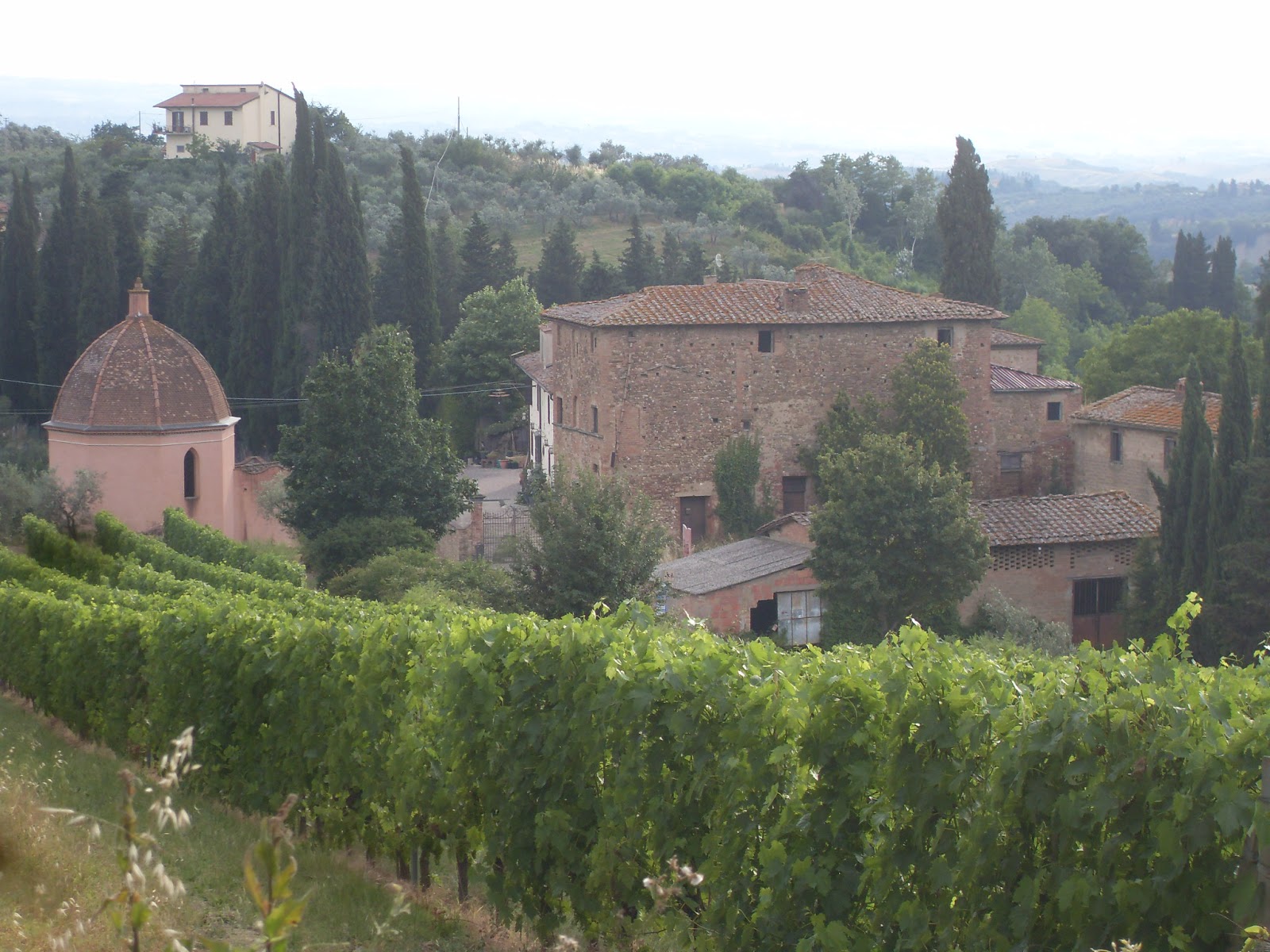
View from my room at Casachianti
During my stay in
Tuscany I stayed at a wine farm turned bed & breakfast called
Casachianti, situated seven kilometers outside of Certaldo and
belonging to the village of Fiano. The B&B is a lovely old
building with three very spacious rooms and a restaurant downstairs,
and I became very pleased with the venue due to its old-fashioned
aesthetics and its spaciousness - so pleased, in fact, that I wasn't
too bothered by the lack of Internet access. Its distance from the
city of Certaldo lent a mild serenity to the surroundings, and when
looking out on the landscape I could see the rolling hills stretch
far and wide, covered in grapevine or olive trees, and the air was
heavily perfumed by the Italic pines and various roadside plants
whose names I don't know. I had missed this perfume sorely ever since
my last trip to Italy in 2008, and I spent much time leaning out of
the window and breathe in the fragrance. Casachianti, in sum, is a
very idyllic location and I enjoyed my time there immensely.
However, nothing on
earth can be truly paradisical without some kind of antagonistic
element. In the Tuscan countryside this antagonistic element is the
traffic. There is, sadly, a large grain of truth to the various jokes
and stereotypes pertaining to the Italian way of driving, and during
my stay at Casachianti I would become well acquainted with this facet
of Italian culture. Although Casachianti's remote location was a balm
to the mind after a busy, long conference day, it presented a major
obstacle when it came to transport. The B&B is, as stated,
situated seven kilometers from Certaldo, and due to the recend
economic troubles, the local government had recently decided to
reduce the bus schedule to a bare minimum, and I never encountered a
bus heading for Certaldo as long as I was there. I did have the phone
number to the B&B's regular taxi driver, but if I were to use his
services both to and from Certaldo I would spend far more money than
I was willing to do. The only logical solution was, of course, to
hitch-hike.
Had I been a woman I
believe I would have hesitated to hitch-hike through the Italian
countryside on my own, but being an elderly-looking man I decided to
rely on the kindness of strangers for my transport into town. I had
high hopes in this cunning plan, since my stereotypical Italian
driver is, among other things, a social creature who likes helping
other people. This stereotype proved to be largely incorrect, as I
had to walk quite a distance before a kind stranger did at last show
me some needed mercy from the scorching sun.
The first day I
tried this strategy I was picked up by a truly stereotypical Italian.
He was a middle-aged man, he had half-long hair with certain dimly
grey streaks, a moustache, sun-glasses and a pink shirt carefully
unbuttoned at the top, driving a black cabriolet through the Tuscan
landscape to the sound of Italian techno music. It was a
spectacularly strange experienced and I savoured every minute of it.
The second day I was
aided by another kind man, who was not particularly stereotypical but
nonetheless looked the way Italians in their sixties often look in
mafia movies. Unlike my first patron, this man spoke perfect English
and turned out to be a painter with a studio in Certaldo Alto, and it
was envigorating to hear him talk about his business. I was invited
to drop by whenever I had the time, but although I did set aside an
hour for this purpose, I couldn't find his studio despite directions.
I hope I get the chance later.
The third day I
tried hitch-hiking (which was the fifth day of my stay), I was picked
up by a man at my own age, who kindly drove me all the way to
Certaldo even though he lived outside the city centre. Like many
Italians his English was a bit lacking, yet it was far better than my
Italian, although I had some spirited conversations with my taxi
driver, despite the fact that his English vocabulary contained little
beyond "okay".
While waiting for the bus, I was visited by a beautiful rose chafer
These experiences
lay behind my optimism when I left for the train station the last
day. I left Casachianti very early in the morning and ventured into
the Tuscan hillscape while the sun was still merely a promise. It was
somewhat chilly in the air, yet I recall that the swallows were
already chirping wildly in the trees, having taken over the watch
from the nightly cicadas. On my previous wanderings in the area I had
learned a few important lessons - such as never, ever stand at level
with the car when you hear someone coming around a bend - and I
threaded the narrow road as the bends demanded, lugging my heavy
suitcase with me. Eventually, I noticed a change in the light and saw
that the sun was rising behind one of the narrow ridges, and although
there were several drivers racing through down the road, none of them
were willing to take me on board. Consequently, I was forced to walk
through the Tuscan morning on my own while the sun climbed steadily
into the air, trying my best to dodge the onslaught of Italian
drivers who seemed to care little about any signs urging them to slow
down for the sake of the children. About one hour and a half later,
however, I arrived at the train station.
It was a very mixed
experience to walk seven kilometers through the Tuscan hills like
that. On the plus side, I got to see the landscape in a rapidly
changing light which few people ever see, and it was a very beautiful
scenery that surrounded me all the way from the rugged hilltops of
Fiano to the vague suburbia of Certaldo. However, it was also a very
demanding journey as I time and again had to keep out of the way for
motocars seemingly intent on scissoring the roadside bushes, and I
had to cross the road several times in order to keep a clear view
when the road became particularly winding. I'm very glad I've done
it, if for nothing else than that it was a rather unique experience,
but it is very evident that that Tuscan countryside is not very
suitable for pedestrians. The roads are narrow, the drivers are fast
and - or so it appears - very reckless with what they might run over
in the process, and you can't abandon the road in the hope of finding
a deer track or walk along the vineyards, for the soil is crumbly and
there are thorny bushes stretching along the ground which you rarely
see before you stand ankle-deep in them. The beauty of Tuscany should
therefore, in other words, be chiefly enjoyed in a car when
traversing long distances, and the apostles' horses should only be
used when exploring some immediate vicinity.
Certaldo
Abonner på:
Innlegg (Atom)