And was the holy Lamb of God,
On Englands pleasant pastures seen!
- And did those feet, William Blake
Viser innlegg med etiketten Canute Lavard. Vis alle innlegg

søndag 23. april 2023

Saint George in Skive

 
Today, April 23, is the feast of Saint George, a saint with whom I am particularly fascinated, and about whom I have already written several blogposts (see below). Due to the widespread popularity of Saint George in the later Middle Ages, there are several depictions and narrations of his legend - in text and image - which survive from Latin Christendom. In this cultural geography, Latin Christendom, the figure of Saint George became increasingly well known in the course of the twelfth century, possibly because his legend made it possible for him to be reactualised and reimagined as a chivalric figure. This hypothesis is supported by the shift from illuminations focusing on his elaborate and gruesome passion narrative to his victory over the dragon. From the fourteenth century onwards, however, the popularity of Saint George skyrocketed thanks to two converging and related factors: The popularity and accessibility of Legenda Aurea, through which the legend was disseminated more broadly and to new audiences, and Saint George's inclusion among the fourteen holy helpers, a group of saints with changeable configuration which emerged in Germany. 

For this year's feast of Saint George, I present you with one depiction which, as I argue in a forthcoming article, is a consequence of impulses from both Legenda Aurea and German religious trends. The depiction in question comes from the Church of Our Lady in Skive, a church from c.1200 and decorated with an extensive programme of wall-paintings in 1522.


The image in question is found in a section of one of the vaults in the nave of the church. In these vaults, saints are predominantly depicted in pairs, and Saint George is shown together with Saint Knud Dux (also known as Saint Knud Lavard). The depiction of Saint George is both typical and untypical at the same time. Since the saint is shown as emerging from a flower - as are almost all the other saints, with the curious exception of Erasmus - the choreography of the scene is different, as there is no horse, and George wields a sword rather than a lance. The position of the saint above the dragon, however, and the saint wearing contemporary armour, are both common features. Interestingly, since Saint George emerges from a flower, the artist has taken the opportunity to increase the drama of their encounter by making the dragon tangle his tail around the stem of the flower, thereby seeking to topple his antagonist. 

The wall-paintings at Skive are intriguing, both for their variety, their typicality, and their untypicality. There are still several questions that remain to be answered, and even more questions that will never be answered in a fully satisfactory way. For instance, we do not know why Saint George is paired with Saint Knud Dux. The number of such details and the various possible interpretations mean that we scholars will continue to grind our brains against the wall-paintings in Skive for generations to come, and that's part of the fun of it. 


Similar blogposts concerning Saint George 

Saint George and Saint Edward the Confessor in comparison 

Saint George in Odense 

Saint George in the Old English Martyrology 

Saint Alexandria, the martyr-queen 

Saint George in Ribe  

The changing iconography of Saint George 

Saint George at Sanderum  


Similar blogposts concerning Skive Church 

Saint Martin in Skive 

Saint Olaf in late-medieval Denmark 

Saint Thomas of Canterbury in Skive 

Saint Servatius in Skive 


fredag 7. januar 2022

Saint Knud Dux, Saint Hulpe, and the limits of saintly fame


Today, January 7, is the feast of Knud Lavard, son of the Danish king Erik Ejegod (r.1095-1103), who was murdered by his cousin Magnus, son of King Niels (r.1104-34). The murder took place at Haraldsted near Ringsted on Sjælland, and Ringsted became the centre of Knud’s cult. While the formal canonisation of Knud only came in 1169, the Benedictines of Ringsted Abbey began preparing the ground for his cult already in the 1130s. Knud is typically known as Knud Dux, in order to distinguish him from his sainted uncle Knud Rex, who was killed in Odense in 1086.   

The cult of Knud Dux was strongly promoted by Knud’s son Valdemar (sole king of Denmark 1157-82), apparently in direct competition with the cult of Knud Rex, whose centre was in Odense. Knud Dux became a patron saint of Valdemar’s new dynasty, but due to tumultuous periods of conflict between various pretenders to the Danish throne throughout the thirteenth and early fourteenth century, the cult of the sainted duke appears to have had limited, albeit notable, impact beyond Sjælland. One example of this limited but notable impact can be found in a book printed in Lübeck in 1492, and this blogpost aims to explain both how the inclusion of Knud Dux in this book shows both the significance as well as the limit of his cult in the later Middle Ages.

The book in question is the collection of saints’ lives Das Leuend der Hÿlghen, or Passionael, printed by Steffen Arndes. The first edition of this book appeared in 1488, and a second expanded edition came in 1492. In the second edition, Arndes included a number of Scandinavian saints, including both Knud Rex and Knud Dux. As both these saints were known in the cultural geography in which both Northern Germany and Denmark participated, the inclusion of these saints are not surprising. Moreover, Arndes had several customers in Denmark and Sweden, so the inclusion of these saints can also be seen as a kind of marketing.    

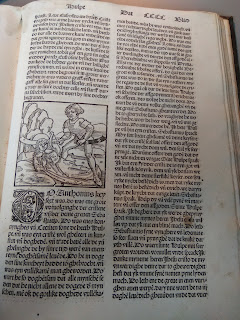
Passionael
contains a number of beautiful woodcuts depicting the saints of the given chapters. In many cases, the woodcut was specifically made for the saint in question, such as the vignette for Knud Rex, which depicts him as a king and shows him holding a sword, which was his main attribute. At the opening of the chapter of Knud Dux (f.181r), the vignette shows a youngish man with hair to his shoulders and with his palms pressed against each other, ostensibly in prayer. His head resting on a cliff or a rock. Around his neck is a collar that possibly is meant to signify ermine, thereby pointing to his noble or royal background. Above him stands an executioner with a curved sword whose edge is planted firmly in the saint’s head.           


The legend of Knud Dux from Das Leuend der Hÿlghen, f.181r
Syddansk Universitetsbibliotek RARA M 15


The vignette does in a way fit with the legend of Knud Dux in that the person in the picture is young and of highborn status. However, the death of Knud was brought about not by an executioner but by a group of his cousin Magnus’ men, not by an executioner who, in saint stories at least, is effectively an official representative of secular power. The legend of Knud Dux as it is narrated in Passionael follows its typical pattern, although its precise source has not yet been established, and therefore there is a distinct dissonance between the legend and the image. The explanation is simply that the image is recycled.            

The image of the young man appears again on f.400r, and although it appears later in the book, this chapter appears to have been part of the first edition from 1488. The chapter beginning on f.400r tells the legend of Saint Hulpe, the son of the king of Sicily at the time of a certain Emperor Anthony. Saint Hulpe is likely apocryphal, and the history of his cult is unknown to me at this stage. What is notable, however, is that Hulpe fits the vignette much better than does Knud Dux, and it seems certain that Arndes recycled the image for the Danish saint because of some overlaps between the two: youngish age, royal background, killed by the sword. 


The legend of Saint Hulpe from Das Leuend der Hÿlghen, f.400r
Syddansk Universitetsbibliotek RARA M 15


Such recycling of images is not uncommon in printing, so it is not surprising to see it done in Passionael. What is interesting about it, at least to me, is what it tells us about the impact of the cult of Knud Dux at the close of the fifteenth century. On the one hand, he was a figure sufficiently well known throughout the Western Baltic that he was included in a collection of saints’ lives produced in Lübeck. On the other hand, he appears to have not been sufficiently important to warrant the production of a specially made woodcuts, even though such woodcuts were made for most, perhaps even all, of the other saints whose chapters were added in the second edition of Passionael. Granted, we need to be careful about using the recycling of woodcuts and images as measures of popularity. There might have been other elements at play than Knud Dux’ fame or relative lack thereof, but the case nonetheless serves as an interesting reminder of the potential limits of a cult’s popularity, despite its relative broad dissemination beyond its cult centre. 

lørdag 28. desember 2019

Saint Thomas of Canterbury in Skive Church


Today is the feast of Saint Thomas of Canterbury, more commonly known as Thomas Becket, who was killed in Canterbury Cathedral on this day in 1170. The murder of the archbishop at the hand of knights in King Henry II's retinue was a scandal in its time, and even though the English king had not himself ordered the death of Thomas, he was widely blamed for the deed, especially in ecclesiastical circles.

The cult of Thomas spread quickly throughout Latin Christendom. This was in large part due to the network of ecclesiastical figures to which Thomas had belonged, and that shared his reformist views on the relationship between royal and ecclesiastical power that marked the political map of the twelfth century. The key figure in this network was Pope Alexander III (r.1159-81) who had supported Thomas' cause during the archbishop's exile in France from 1164 to 1170. It was Alexander who canonised Thomas in 1173.

Other important reformist figures were the Norwegian archbishop Eystein Erlendsson (r.1157-88) who is largely credited with bringing the cult of Thomas to Norway (see this blogpost), and the Danish archbishop Eskil Christiernson, or Eskil of Lund, who is considered to be responsible for bringing the cult of Thomas to Denmark, in no small part through the Cistercian order to whom both Eskil and Thomas were close. 

The cult of Thomas in medieval Denmark is still a subject that requires more work, and I hope to be able to contribute to this scholarly lacuna in the coming year. As a way to remind myself of the work to be done, I'm sharing with you one late medieval example of the veneration of Thomas in Denmark, namely a wall-painting from Skive Church in Northern Jutland.


Tomae de Cantuarienus [sic]
Wall-painting from Skive Church, Northern Jutland, c.1500


The example in question comes from the Church of Our Lady in the town of Skive in Northern Jutland. The church was built around 1200, and it is commonly known as Skive Old Church to distinguish it from the eighteenth-century church situated nearby, and which appears to be the hub of today's religious life in Skive.

The early history of Skive is uncertain, and the current scholarly consensus is that the town was most likely established around 1100. Its status as a market town - i.e. a town with particular mercantile privileges - was confirmed in a letter from 1326 (see this website), but the status might have been achieved earlier. Judging from the Church of Our Lady, Skive appears to have been an important town by the turn of the twelfth century, and its importance can be explained or measured by three main factors. First of all, Skive lies very close to Viborg, the episcopal see of Central Jutland which was established c.1060 and thus one of the main power centres in the area. Secondly, a royal manor, Skivegård, is mentioned in the survey of King Valdemar II (r.1201-41), the so-called Liber Census Daniae (see here), and points to the town's vicinity to royal power in addition to the episcopal power at Viborg. The third factor is the fish trade which is likely to have brought a lot of money to the town's wealthier inhabitants. These three factors must all be taken into account as possible explanations for the erection of the Church of Our Lady around 1200.


Vor Frue Kirke, Skive


Vor Frue Kirke, Skive, interior, towards the main altar


In the nineteenth century, the Church of Our Lady was about to be demolished, which was the fate of several redundant churches in Denmark at the time. Fortunately, an impressive programme of late medieval wall paintings was discovered in time, and the church was preserved. It is in this programme that we find the aforementioned late medieval depiction of Thomas of Canterbury. 

The interior of Skive Church is filled with a vast array of saints. These saints were painted c.1500, and it is thought that the workshop that executed these paintings was the same, or was at least connected to, the workshop that decorated Roskilde Cathedral (see here, and here). Among these many saints we find Thomas of Canterbury, situated in the vaulted roof between Peter Martyr of Verona (d.1252) and Sebastian. The question then is how we are to understand this as an expression of veneration of Thomas.


The painting of Thomas of Canterbury in Skive is interesting, both because it is one of very few known medieval Danish depictions of him, and also because of its wider pictorial context. Thomas is here one of many saints. On the one hand, these wall-paintings were commissioned by local donors who might have given very specific instructions about which saints to include. It is therefore tempting to see the inclusion of Thomas in light of the wider history of his cult in medieval Denmark. 

On the other hand, we might understand this as just an expression of his general popularity in Latin Christendom at the time. The saints of Skive Church are for the most part universally venerated in the Latin Church and by the time of the programme's execution these universal saints had been venerated for a very long time. Even the youngest of the saints included, Peter Martyr and Roch (whose traditional, but not uncontested, year of death is 1327), became widely celebrated within a relatively short timespan and are therefore unsurprising to see among more veteran saints. Even those saints that are not universally venerated outside the Nordic countries are nonetheless of regional importance, such as Knud Rex (d.1086) and Knud Dux (d.1131) whose cults were established throughout all of Denmark, and Saint Olaf of Norway (d.1030) whose cult was immensely popular throughout the Nordic world. The inclusion of Thomas in this saintly collegium is, therefore, a testament to the contemporary trends within the cult of saints, rather than a stage in a continuum in the veneration of Saint Thomas in medieval Denmark.

Even so, while the depiction of Thomas in Skive Church might not yield much information about his Danish cult, it nonetheless provides evidence of the endurance of his cult in Latin Christendom, and we see both that he was one of the trendy saints even in Northern Europe around 1500, and that he was one of the many ways in which the donors of Skive's wall-paintings sought to express their participation in the religious trends of Latin Christendom.


Similar blogposts

Saint Olaf in medieval Denmark

Thomas of Canterbury in medieval Norway

On the early cult of Thomas of Canterbury

A song for Thomas of Canterbury

Martin of Tours in Skive Church


mandag 29. juli 2019

Saint Olaf in Denmark - late medieval examples


Today is the feast of Saint Olaf, patron saint of Norway, who was killed in the Battle of Stiklestad in 1030 in an attempt to regain the title of Norwegian king. Throughout the Middle Ages, Olaf was an important saint in the religious landscape of Scandinavia, and his cult flourished outside the borders of both the Norwegian kingdom and the significantly more extensive Norwegian archdiocese. Due to the extensive contact between Norway and Denmark - through trade and political and religious ties - the cult of Saint Olaf was very strong among the Danes, and several churches, chapels and altars were dedicated to him. Part of the reason why the cult of Saint Olaf gained such popularity in Denmark had to do with him being seen as protector of seafarers, which can be seen in some of the miracles associated with him that have been recorded in the saint-biography now known by the title Passio et Miracula Beati Olavi. Another reason for Olaf's popularity in Denmark had to do with one fundamental feature of the Danish cult of saints. This feature was that the cult of native saints in Denmark - i.e. saints who were either Danish by origin or who had died in Denmark - was very regional. Consequently, there were very few Danish saints whose cults had a significant impact throughout all of Denmark.


Saint Olaf and Saint Knud Rex
The Church of Our Lady, Skive, Northern Jutland, c.1500


The two Danish saints that came closest to a Denmark-wide veneration were Knud Rex (d.1086) and Knud Lavard (d.1131, can.1169), but even though both their cults were propagated by the reigning royal dynasty for a period, this was not sufficient to maintain a long-standing popularity throughout Denmark. The popularity of Knud Rex was revitalised with the establishment of the Kalmar Union, where Knud and Olaf became representatives of two of the three union kingdoms (Saint Erik of Sweden was the third representative). As a consequence, Olaf and Knud, and sometimes also Erik, were increasingly depicted together from the late 1300s onwards. This can be seen in the pictures from Skive Church in Northern Jutland, which were executed around 1500, where Olaf can be seen holding his battle axe (which by this point had become a halberd), and Knud Rex holds his sword. It is tempting to suggest that because of Olaf's popularity in Denmark prior to the Kalmar Union, it was perhaps more natural for Danish patrons to commission Olaf and Knud Rex as part of their pictorial programme, while often leaving Erik of Sweden out of it, because he did not have a strong place in the Danish catalogue of saints prior to 1397.


Saint Olaf and Saint Knud Rex
The Church of Our Lady, Skive, Northern Jutland, c.1500


The interior of the Church of Our Lady, Skive

The Church of Our Lady, Skive, c.1200


Due to the regional nature of the Danish cult of saints, Olaf was more widely venerated in Denmark than any native Danish saint. This can be seen in the higher number of dedications of both churches, chapels and altars when compared with the saints native to Denmark. Moreover, while each of the episcopal centres of medieval Denmark had its own patron saint that bound their region to the divinely ordained history of Christendom - as per the historical understanding of medieval Christians - the veneration of Saint Olaf was present in the episcopal cities as well. For instance, in the bishopric of Odense, where Knud Rex had his cult centre, there were two chapels dedicated to Olaf, while in the city itself there was established a hospital shortly before 1437 by the priest Peder Jensen, which was dedicated to the Holy Ghost, Saint Antony (either of Egypt or of Padua) and Saint Olaf.     


Saint Olaf and the dragon
Roskilde Cathedral, c.1500


Also the episcopal city of Roskilde displays several examples of the cult of Saint Olaf, especially from the turn of the fifteenth century. Two wall-paintings featuring the same motif - Olaf trampling the dragon - can be found, one in the chapel of the three magi (above), and one on a column in the nave (below). The city of Roskilde also had a church dedicated to Saint Olaf, and two more such churches were found in the diocese. Many of these examples of the cult of Saint Olaf in Denmark have survived, but many more have been lost, and we must expect the popularity of the king-saint to have been even more significant than we can establish from surviving evidence.


Bishop flanked by Saint Lucius and Saint Olaf
Roskilde Cathedral, c.1500


Sanctus Olauus
Roskilde Cathedral, c.1500


søndag 12. januar 2014

The Early Cult of Canute Lavard


Tjuandedag-Knut
jagar jula ut
- Old Norwegian saying

Despite the fact that Norway became officially Lutheran, as part of the kingdom Denmark-Norway, in the 1530s, several vestiges of the Catholic past remained as a part of folklore and tradition. One such remnant was the name of certain dates from the sanctorale. Candlemas (February 2) and Peter's Chair (February 22) and Michaelmas (September 29) were all important reference point even to my grandparents' generation, and Michaelmas remained a holy day in Norway until 1770. (1) Another Catholic leftover was twentieth-day Canute, a name given to Canute Lavard (c.1096-1131, can.1169), and the old Norwegian saying - often quoted to me by my grandmother - claimed that "twentieth-day Canute chases the Christmas out", putting an official end to the celebrations at January 13, the twentieth day of Christmas. I'm a bit at a loss to understand how Canute Lavard was given this name, especially since his feast day traditionally was January 7. However, because of this Norwegian tradition, I will today give a quick presentation of Canute Lavard, duke of southern Jutland and martyr.

Wall painting of the enthroned Canute Lavard, St. Bent's Church, Ringsted, early 14th century
Courtesy of Danske leksikon
Copyright Nasjonalmuseet, Copenhagen

Canute was the son of King Eric Ejegod (the Good) of Denmark and was brought up in part at the Saxon court of Lothair who later became emperor. As a second son, he was a duke whose territory served as a bulwark against the Slavic Wends, whom he also encouraged Bishop Vicelin of Oldenburg to convert. His power in the Wendish march grew, to the anxiety of his uncle King Niels, especially as he was recognised by Lothar as the king of the Wends.(2) Whether Canute himself had any royal ambitions can not be ascertained, but he was hailed as a just and peaceful man, and his name suggests he was viewed, either by contemporaries or posthumously, as a lord. His cognomen, Lavard, means bread-giver, and is related to the Old English word "hlaford", "loaf-giver", from whence "lord" is derived. If this name was appended in his lifetime, it must certainly have made King Niels worried about his nephew's aspirations, and he feared Canute sufficiently much to have two of his sons murder their cousin near Ringsted in 1131.

Some decades later, Canute's son and king of Denmark, Valdemar I requested his father's canonisation. This was in the 1160s and royal saints had very recently become something of a vogue of Western sainthood, and this must be seen in light of the schism which divided Western Christendom at the time. Although theological considerations should not be underestimated in these proceedings, the canonisations of royals were procured in large part due to the support from the saints' royal successor. The first of these canonisations was that of Edward the Confessor in 1161, a canonisation that had been pending for some time, but the support of Henry II given to Pope Alexander III must certainly given added impetus. This canonisation was countered by Antipope Paschal III in support of Frederick Barbarossa, and although King Valdemar I had supported Barbarossa during the schism, Alexander decided to grant Valdemar's request in 1169. At this time the antipope was dead and the schism healed, so the canonisation might be to welcome Valdemar back into the fold, or perhaps as a reward for Archbishop Eskil who had remained loyal to the pope. Interestingly, the canonisation bull from 1169 was modelled on that of Edward the Confessor, (3) suggesting very clearly that the "royal saint" was now becoming a type of its own.

Evidence for Canute's sanctity was brought to bear by the archbishops of Lund and Uppsala, and on June 25 in the year after the canonisation, Canute's relics were translated at Ringsted, presided over by Archbishop Eskil. Although Canute was a Danish martyr, and an important rallying point for a Denmark torn by years of civil strife, the most important impulses to his cult might have come from abroad. As stated, the papal bull was in essence a recycling of that used for Edward the Confessor, and this might have had ramifications for how he was formulated by the liturgists at Ringsted. Furthermore, his hagiography, Vita sancti Canuti ducis, had been composed by the Englishman Robert of Ely shortly after Canute's death in the 1130s. The office for Canute Lavard hailed him for his mildness and his Christlike suffering, and he was depicted as shepherd and the light of his people. It has been suggested by Professor Nils Holger Petersen that this non-military representation might stem from a desire to depict Denmark as a Christian nation as a contrast to the decades of civil unrest. (4)

This non-military representation can be seen for instance in the 12th repertory of the Canute office, where he is rendered in monkish terms, a helper of the poor, rather than a military leader (as would be natural considering his title "dux", which has military implications). (5) Other characteristics menitoned are Canute's exile and noble heritage. (6) Such a representation might suggest inspiration from the cult of Edward the Confessor, whose characterisation was markedly non-military, and where exile and heritage is referred to, but this might also be a consequence of the typology of martyrdom. However, it is interesting to note that Roskilde Cathedral used to celebrate Edward the Confessor's dies natalis on January 7, the very feast which a few years later became the dies natalis of Canute Lavard. Whether this had implications for the cult of Canute is not known, but it is an interesting thing to note anyway. (7)

Wall painting from Vigersted Church near Ringsted, c.1450
Courtesy of Wikimedia Commons

The cult of Canute Lavard was a Benedictine cult, embracing the peaceful aspects of the saint, and although the expansionist ambitions of Denmark was performed in the name of Canutus Dux, his iconography was never militarised, not even by the late 12th-century chronicler Saxo Grammaticus.(8)

References

1) http://snl.no/Mikkelsmess

2) Farmer, David, Oxford Dictionary of Saints, Oxford, 2005

3) Bergsagel, John, "Between Politics and Devotion: the Canonizations of Knud Lavard and Edward Confessor", printed in Hankeln, Roman, Political Plainchant? Music, Text and Historical Context of Medieval Saints' Offices, Institute of Mediaeval Music, Ottawa, 2009: 54 and Bergsagel, John, The offices and masses of St. Knud Lavard (Kiel, Univ.Lib. MS S.H. A. 8 ), Copenhagen, 2010: xviii-xix

4) Petersen, Nils Holger, "Theological construction in the offices of St Knud Lavard", seminar presentation given at Hell, Norway, August 16 2012

5) Petersen 2012

6) Hope 2012: 49, n363 and XIX

7) Bergsagel 2009: 54

8) Petersen 2012


Sources

Bergsagel, John, "Between Politics and Devotion: the Canonizations of Knud Lavard and Edward Confessor", printed in Hankeln, Roman, Political Plainchant? Music, Text and Historical Context of Medieval Saints' Offices, Institute of Mediaeval Music, Ottawa, 2009

Bergsagel, John, The offices and masses of St. Knud Lavard (Kiel, Univ.Lib. MS S.H. A. 8 ), Copenhagen, 2010

Farmer, David, Oxford Dictionary of Saints, Oxford, 2005

Hope, Steffen, The King's Liturgical Image - the representation of Edward the Confessor in historiography, hagiography and liturgy, MA-thesis, Trondheim, 2012

Petersen, Nils Holger, "Theological construction in the offices of St Knud Lavard", seminar presentation given at Hell, Norway, August 16 2012


Encyclopedias

http://www.denstoredanske.dk/Danmarks_geografi_og_historie/Danmarks_historie/Danmark_f%C3%B8r_Reformationen/Knud_Lavard

http://snl.no/Mikkelsmess