And was the holy Lamb of God,
On Englands pleasant pastures seen!
- And did those feet, William Blake
Viser innlegg med etiketten Spain. Vis alle innlegg

fredag 24. juli 2026

The iron pilgrim - an aspect from the cult of Saint James the Elder


Ne wight with him for his assistance went, 

But that great yron groome, his gard and gouernment 

- Edmund Spenser, The Faerie Queene (Book 5, Canto 4, Verse 3) 


What did you see? Mere ironwork ... He exists without existing, understand, recruit? 

- Italo Calvino, The Nonexistent Knight (translated by Archibald Colquhoun) 


As today is July 25 - at least in my time zone - I am reflecting on the cult of Saint James the Elder, whose feast is today. One of Christ's closest apostles, he became the focal point of a cult centred in Compostela which surged in the early twelfth century, and which resulted in a plethora of various depictions and interpretations throughout the centuries. There are several images of Saint James the Elder - both in texts and pictorial art - which emphasise different aspects of him. For some, he is the apostle, for others he is the battle-helper, the pilgrim, or the moor-slayer. And for some, he is all of these things and more. This multifacted interpretation of a figure is something that fascinates me, as the various images that co-exist and circulate concurrently are excellent ways of analysing and understanding historical memory of one or several communities. 


Throughout the Middle Ages, Saint James the pilgrim became widely known from the twelfth century onwards, due to a concerted effort from the custodians of the saint's cult at Compostela in Galicia. As they were the keepers of the saint's holy body, they were best situated to offer interpretations of his patronage to the wider world. Through sermons, prose narratives, liturgy and various forms of pictorial art commissioned for the church space, archbishop and his retinue presented the faithful with a composite image of the saint which allowed various audiences different reference points for connecting with the holy man. For some, James' protection of pilgrims was of particular interest, so this aspect was what they emphasised, and it was this patronage they sought when needed. Since the fame of Saint James spread through pilgrims, it is no wonder that so much of the surviving source material of texts and images depict the saint dressed in the characteristic broad hat, carrying the staff and the flask, all of which are emblematic of the pilgrim and - by extension - of the saint and therefore of the connection between pilgrim and saint. This emphasis was a historical interpretation, and a shaping of historical memory. Saint James the pilgrim remains a powerful figure in today's cult, too. 


As I was going through some photos from my first visit to Santiago de Compostela, I came across one picture that caused me to think more carefully about the iconography of saints in genereal. The figure is a machine that allows you to insert coins and imprint a commemorative stamp on them as a keepsake of the journey to one of the largest pilgrimage sites of Latin Christendom. The machine is shaped like a pilgrim, recognisable in its hat and carrying the iconic staff. In this way, a common tourist trap has been dressed up with a local specificity, and it becomes in effect a nexus between images of faith and images of commerce. The commercial interests of the shops borrow the iconography of the religious centre in order to make money. This is a very medieval practice, and not very far removed from the pilgrim badges sold at the various cult centre.   


This nexus beteween the religious iconography of the cult of Saint James on the one hand, and the derivative iconography of local tourism poses an interesting quandary for saint scholars. Because on the one hand, it seems fair to assume that this mechanical pilgrim is not meant to depict Saint James himself, but rather a stylised pilgrim. On the other hand, however, the stylised pilgrim is an iconographical shorthand for Saint James. Those who travel to the shrine at Compostela will immediately recognise the hat-wearing holy man in the various statues and images encountered throughout the city. Even though the stickers on the machine advertise new coin-stamps that depict apostolic, ecclesiastical iconography, most visitors will be aware that Saint James the Apostle and Saint James the Pilgrim are one and the same figure.  


Can we, then, at some level, claim that this metal pilgrim shaped to attract visitors depicts Saint James the Elder? It depends on how we understand iconographical representation. That the two figures - the saint and the pilgrim - are connected is beyond any controversy. But to what extent can a figure be seen as separate from its representative. I believe that this separation is a spectrum, and that it depends entirely on the viewer whether what is seen should be understood as a representational depiction or a direct depiction, whether it is depicting a symbol of the saint or the saint himself. Someone sufficiently well-versed in the iconography of Saint James the Elder but not particularly careful in their observation might take this machine to be a statue of the saint himself - a rather simplistically stylised statue but nonetheless an image of the holy man believed to be buried in the cathedral. A passer-by might offer a prayer to the metal figure, thinking it to be one of those pictorial renditions of the saint that serve to allow for a more tangible point of connection between the earthly and the heavenly. After all, a wooden statue of Saint James would partly have precisely the same function. 


This pilgrim-shaped machine is a reminder that religion is formed in large part by those who practice it, and that individual religious expressions must be understood as elements in the sum total of that religion's history. If someone interprets this pilgrim-shaped machine as a holy statue, the machine becomes such a statue to all intents and purposes, at least for the person who makes that interpretation. For me, a researcher whose analysis is mainly limited to the official, authoritative images of saints and other memorialised figures, these impossible questions about individual expressions of faith provide good reminders that what I study is only part of a greater whole. Reminders that there can at any point exist interpretations of saints to which I will have no access because those interpretations have not been committed to sources. Such reminders serve to keep me from being overly confident in my own analysis, and that is a very good thing. 


lørdag 28. februar 2026

A stranger to someone - a view of Norway from Salamanca


los raudos torbellinos de Noruega 

- Luís de Gongora, Soledades 


In the library of the University of Salamanca there are four globes, donated in the eighteenth century. They are known as the "round books", and the story goes that they were called that because the library would only accept donations in the form of books. They are displayed in the main room, available to visitors, and last year I was able to see them again when I was visiting Salamanca for a conference. 


Whenever I see early modern globes or maps of the world, I am naturally drawn towards Norway. Over the years, I have seen a lot of different premodern and early modern depictions of my native country, and I am always fascinated how these depictions deal with the rather complicated outline of the Norwegian coastline. The degree to which the map fits the terrain is an interesting starting-point for understanding what kind of cartographical information existed about Norway at the time, and very often it will become evident that to a lot of continental cartographers Norway was not very well known, at least compared to what one might expect given the relative proximity between the big map-making centres and Scandinavia. 


These maps are sources to Norwegian history, at least as long as we ask the right questions. On a non-academic level, the maps also serve as good reminders that one will always be a stranger to someone, that our known world will seem alien to someone else. In our own age, when information - if not necessarily knowledge - is easy to come by, it can also be easy to forget that our ideas about other parts of the world rarely fit with reality. And to see oneself from the outside, to see Norway from Salamanca through eighteenth-century eyes and map-making hands, is a useful reminder of the gap between perception and reality. And this is a good thing to keep in mind, both for academics and for non-academics alike. 


søndag 28. desember 2025

Synchronicities of reading, part 1 - garum in Lisbon


Life is full of synchronicitites, episodes in one's life that bear some kind of resemblance to one another, or that provide a sense of symmetry or of patterns. A reading life is particularly full of them, as the variables at play are much more numerous than in a life where reading plays no part at all, simply because reading allows a person to encounter more topics and travel by page to a wide variety of locations, which provides more elements that can be found to rhyme somehow. I have experienced quite a few of them so far, but I was particularly struck by one such synchronicity this Christmas, one which was centred on Lisbon and which involved garum. 


The Norwegian translation of Asterix album no. 41, Asterix in Lusitania
(Text by Fabrice Caro, or Fabcaro, art by Didier Conrad, translation by Svein Erik Søland)


This Christmas, I was reading the latest Asterix album, Asterix in Lusitania, by Fabcaro and Conrad. The biannual publication of the new albums produced after the death of Albert Uderzo in 2009 has become subsumed into the great Norwegian tradition of Christmas comic books, and the album was part of this year's haul. The story revolves around an attempt to prove the innocence of a wrongfully condemned producer of garum, a type of fish sauce, who is accused to trying to poison Julius Caesar. The climax of the scene occurs in Lisbon, and the cover of the album invokes a Lisbon view so characteristic that I was immediately brought back to my trip there last spring. And as I was reading the story, I was again brought back to Lisbon because of the garum. 


Lisbon streetscape near the Castle of São Jorge


View of the Tagus River


Translating the Relics of St. James, edited by Antón M. Pazos (2016)


While I was in Lisbon last year, I was reading up on the medieval cult of Saint James the Elder. I had travelled from Santiago de Compostela where I had spent five days as a kind of research-tourist, and I had brought a collection of articles with me on the journey. The collection included articles on the Compostelan cult, as well as a few texts that sought to elucidate the context of the historical James, the fisherman who became one of the twelve apostles. One of these articles delved into the fishing industry on the Sea of Galilee, part of which included the production of garum. This was not the first time I had heard of this fish sauce, but I had never read about it at lenght, nor had encountered it within the context of the wider Roman world. 


I read this and other of the book's interesting articles at what became my regular café during my brief sojourn in the Portuguese capital, where I drank black tea with lemon and devoured delicious local cookies - and where I was mistaken for the Portuguese politician Rui Tavares. It was therefore a surprising realisation as I was reading the latest Asterix album during the darkness of a Norwegian December that this was the second time in two years that the elements of garum and Lisbon had converged in my life. The great benefit of this particular synchronicity was that I could relive those lovely Lisbon days thanks to the memories spurred on by a key plot device in a comic book. 


fredag 30. mai 2025

Saint Martin and the birds in Salamanca


From the Middle Ages, we have numerous stories about saints and animals. Some of these stories are about animal companions, such as Saint Hugh of Lincoln and his swan. Others are stories of protection (Saint Giles and the wounded hind), stories about healing and recovery  (Saint Thorlak and the lost cow), or stories about control over the animals (Saint Francis and the singing locust, or Saint Edward the Confessor and the nightingales). Regardless of the shape of these stories, they all serve to demonstrate the holiness of the saint in question because of their care for animals or their owners, or because of their miraculous communication with them. These stories also convey the hierarchy of Creation, according to Christian theology, in which humans were set above the beasts and were commanded to be custodians of the earth.  


The various topoi of animals in saint-stories provide a useful background for appreciating a symbolic convergence in the Church of Saint Martin in Salamanca. I went past this church a couple of times when I last visited Salamanca earlier this year, and I happened to note that there is an extensive avian symbolism in both the decoration and the use of the church - all of which has nothing to do with the legend of Saint Martin, but serves to highlight how such coincidences can reinforce pre-existing associations. 


One of the entrances to the church was easily accessible as I walked between my hotel and the university area, and I was entranced by the beautiful carvings on the Romanesque portal, a nice - if partial - survival of the twelfth-century stone church, which has been expanded and renovated at various times. The figure of Saint Martin seen above the portal is most likely form the renovation campaign of 1586, but the figures in the arches of the portal show the typical design of the twelfth century, and also has the wear to be expected of carvings that old. In capitals between the pillars and the arches are several winged creatures, including what appear to be sphinxes, long-necked birds (possibly storks), and harpies. These figures are stock characters in Romanesque art, possibly signifying the wild and chaotic world beyond Christian civilisation which the church visitor leaves behind when entering the hallowed space beyond the doors. 


These figures have nothing to do with Saint Martin and his legend. While there is an avian episode from the story of Martin of Tours - in which he hid among geese to avoid being elected bishop - these particular carvings are part of the portal because they were typical figures of their time. Despite not pertaining to Saint Martin's legend, however, these winged creatures do bring a certain symmetry, not so much to the legend itself, but to the Salamancan church of today. Above the church bell, a pair of storks have built a nest and were flying back and forth across the neighbouring streets. As storks are common in Salamanca, there is nothing uncommon about this sight, nor does it have any particular significance for the legend of Saint Martin. Nonetheless, there is something pleasing about the coincidental convergence of iconography and reality when storks settle on the building dedicated to a saint who hid among birds, and which building is also decorated with several avian creatures, including what might possibly be storks. These are coincidences, serendipities, happenstances - but they do converge in a wonderful way to show how life and art sometimes line up, and when you know the art you can also appreciate this convergence more strongly. And we should expect that medieval venerators of Saint Martin would do just that in case they saw birds nesting on this church in the Middle Ages. 


tirsdag 27. mai 2025

Lost stories - a possible example from Santiago de Compostela


As a historian predominantly concerned with texts, I am keenly aware of how important stories are to the shaping of societies, identities - indeed, of history in general. The way our understanding of the world is shaped happens through stories, often in ways we do not notice. This is why it is so crucial to get at the narrative drive behind people's actions, and also why it can be so difficult to make certain people understand that their understanding of historical reality is not built on solid ground. 


My research deals with stories practically every day. I analyse them, compare them, keep track of their variations, and try to examine how they have shaped the historical context of any given period, and - mutatis mutandis - how the historical context has shaped the stories. The stories that I research are usually well known, if only within a specific field of history or literature, and it has never happened that I have encountered a previously unknown story. (I came close once, but that is a tale for another day.) However, sometimes I do come across stories in images which I do not recognise. For instance, several of the full-page illuminations of the so-called Rothschild Canticles - a fourteenth-century religious florilegium - depict scenes that I do not know, and that I cannot decipher. Although these stories are unknown to me, however, I am certain that there are experts who will be able to recognise them.


Last year, when I visited the cathedral museum of Santiago de Compostela, I was struck by a series of carved pillars displayed there. The pillars date to the twelfth century, and are from an early stage in the cathedral's building history. They are exquisitely carved and testify to the skill and craft that went into decorating and constructing the cathedral. Along the winding grooves of each pillar are figures and floral forms that seem to depict episodes from stories - perhaps even consecutive episodes from one and the same story. And even though I looked at them carefully while I was there, and even though I have looked at them even more carefully since, I cannot identify the story or stories they represent. The Compostelans who passed by them in the cathedral, however, most likely understood exactly what these carvings meant. They might have heard the stories from sermons, or they might know the stories on which the related sermons were based, or they might have talked to the masons who carved them once they had received instructions from the cathedral clergy. Perhaps pilgrims from all across Latin Christendom were likewise able to recognise these figures. After all, several individuals, both masons and clerics, who were active in twelfth-centuy Compostela came from France and might have brought stories with them from their native places. To us, or at least to me, these stories are lost. 


The loss of stories is a colossal barrier to our understanding of the past. Without catching the various references that remain in the surviving source material, we are unable to understand parts of the storyworlds of the people in a specific period - storyworlds whose stories might have influenced how they made certain decisions, for instance through fear of becoming like the fool in a story, or through a desire to become like the hero of a particularly beloved story. As an example of such a story that might not be altogether lost - I hope those who know it will tell me - but very much lost on me, I give you a sequence of figures from one of the twelfth-century pillars. 


From the top and downward in a spiral, we see a devil standing behind a mermaid, while holding the tale of a snake which is coiling itself around the rightarm and shoulder of the mermaid. The mermaid is clutching her tail with her righthand and holding her tailfin with her left. From under her tail emerges the serpent's head, and it seems to spew a jet - probably of poison - arches its way behind a pair of human figures. The figure closest to the serpent's head is a man who might be hooded. In his right hand is a knife whose blade lies flat along his right thigh. The other figure has a headdress which suggests that it is a woman, and she has seductively placed her right hand on top of the man's right thigh while the left is equally seductively placed on the inside of the man's left shin. The hem of the man's dress - possibly a monk's habit - can be seen flowing behind the woman's head, suggesting she has free access to the man's body.    


What is the story? From these details, it might appear some kind of clerical warning against the sins of the flesh. The mermaid, or siren, is a typical symbol for lust - always blamed on the women - and the devil holding a serpent might be a reference to the temptation of Adam and Eve. The two figures, however, are clearly not Adam and Eve, because they are already dressed - at least partially - and the man is holding a knife. Is he about to castrate himself in order to avoid the temptation of carnal congress? Perhaps in recollection of Christ's words in Matthew 18:9 about cutting out the eye that tempts you to sin? Or is he about to kill the woman, just as we read in stories about some saints to whom the devil appeared as a seductress? The story unfolding along the pillar might draw on all these references mentioned here - after all, they were part of the Latin Christian storyworld. But even if my interpretation of the individual elements is correct - and it might not be - the story itself is no clearer. Are we dealing with a legendary episode? Or perhaps something from Galicia, something even witnessed by those who commissioned the carvings to be made? Or is it more a collection of semiotic signs that together are meant to remind clerics of key aspects of their supposedly chaste way of life, rather than a story as we commonly think of it? It is easy enough to ask these questions, but the story that is likely to be behind this sequence of carvings is lost to me. 


tirsdag 29. april 2025

Compostela by night


This month, I have spent much time writing about the cult of Saint James the Elder in medieval Europe, as he was formulated and disseminated at and from the cult centre at Santiago de Compostela. Today, April 29, most of my work day was dedicated to writing a one and a half page summary of the cult-making process of the twelfth century. While the writing itself only took a few hours, those hours were founded on long periods of reading, travelling, writing, discussing and researching spread throughout 2024. In order to write that page and a half, I relied on notes and memories, and in order to reach this particular point in my work I have read three books, numerous articles, travelled to Santiago de Compostela twice, prepared and given two conference presentations, and expanded my personal library. This preparatory work is part of the pleasure of writing academic texts, but it is work that is rarely acknowledged by funding bodies or by universities. But today, I could relish in all those hours spread across 2024 that I had dedicated to researching the cult of Saint James and the history of Santiago de Compostela. And part of that relish rested on some of the glorious views of the city that I was able to witness in the course of my travels. Below are some of those views, taken a late evening in December, on a day that cemented my love for Santiago de Compostela even more strongly, and made me feel even more at home in its confusing and confounding streetscape. 


lørdag 19. april 2025

Pain in stone - the Deposition of Christ at Aguilar de Campoo


There is a narrative about modernity that presupposes that people of the past did not have the same kinds of emotions as we do today - that they were harder, more toughened by high death rates and statistically low life expectancy. There is a variant of this narrative - once uttered by a friend of mine who is an early modernist - where medieval art is said to have been static and without emotion, in contrast to the glorious geniuses of the Renaissance. Both narratives come from the same place, namely the identity-construction of the Enlightenment and its latter-day versions promoted by capitalists, industrialists and techbros. The basic purpose of this idea is to argue that we as humans are evolving, becoming more civilised, that we are more elevated than the people of the past, especially the Middle Ages. Both these narratives are pure nonsense, and there are plenty of sources that provide evidence against them. 

Since today is Holy Saturday, I will take the opportunity to provide one of my favourite examples of such sources, namely the Deposition of Christ as depicted on a capital in the church of the monastery of Aguilar de Campoo in Northern Spain. The capital, along with others from the same church, are currently kept in the Museo Arqueológico Nacional in Madrid, and it is one of the many masterpieces of Spanish Romanesque art.  

These pictures were taken in the spring of 2024, and I viewed this capital from every possible angle. The pain carved into these figures is breathtaking, and would have been even more powerful in their original locations as they would likely have been painted, meaning that the death-closed eyes of Christ had provided an even more powerful contrast to the Virgin Mary's eyes shut in the pain of weeping. This capital is a wonderful, painful, amazing reminder that the pain of love - in its myriad manifestations - is universally human and not something that came about in modernity, or something that is typically modern. 


tirsdag 25. mars 2025

Joys of returning - an evening meal in Salamanca


As much as I enjoy seeing new places, there is a particular joy in returning to somewhere familiar. Since I am currently in Salamanca, a city I have loved for ten years, I am particularly reminded of this, and especially when I am navigating the food scene. The first evening, I went out to get a quick bite to eat before bedtime, and I ended up in a bar with an intriguing selection of toasts. Spanish toasts are, luckily, more elaborate than the ones commonly found in the UK, for instance, and these were laden with delicious spreads and condiments. Trying to make decisions, I asked the waitress what the things were, and I could not help notice a bemused look that bordered on delight when she witnessed this very obvious foreigner correctly identifying such local specialties as the morcilla, the blood sausage. It turned out to be spectacular, but the joy of the food itself was nothing compared to that deep feeling of belonging - of having returned to a beloved place and, while clearly not a native, being sufficiently well-versed in the language, the various references, the iconography, to encounter the familiar yet also to expand the horizon in different directions. 


fredag 21. mars 2025

Utopia closed - encountering a literary topos in Pontevedra


Every once in a while, reality corresponds with fiction, and sometimes in delightful ways. These are the brief moments that remind us that even though literary topoi have often come to be seen as signs of literature being divorced from reality - relying instead on cliches and intertextual games to express things - these topoi do resonate with reality. To paraphrase Siri Hustvedt in The summer without men, something that never happens in modern fiction might still happen in modern life. Conversely, just because something is a literary topos does not mean that it cannot echo the real world in some way or another. I was reminded of this puzzling relationship between truth and fiction during a visit to Pontevedra in Galicia. I took a bus from Santiago de Compostela in the morning, and around midday I found myself walking the quiet streets of a town preparing for the mid-afternoon rest. 


Not far from the bus station, I happened upon a bar with the promising name Utopia. For me, having dedicated much of my research time to utopian literature, this felt like a lovely example of synchronicity, where two elements of your life come into contact by chance rather than design. I would have felt professionally obliged to visit this bar, but unfortunately it was closed. However, although I was disappointed not being able to enter Utopia, there is also a delightful aspect to my misfortune. After all, utopian spaces - broadly understood as locations where life is better than elsewhere - are typically closed off for the majority of people. Only those who are selected or who otherwise fit the criteria for entry are allowed to access Utopia. We find this restriction in classical literature, medieval formulations of ideal spaces, and the more purified literary versions in early modern texts. In other words, this chance encounter at the wrong time of day enabled me to live a literary topos.  


mandag 17. mars 2025

Saint James the Elder in Skive


These days, I'm preparing for an upcoming talk at a conference in Spain, where I will once more delve into the history of the cult of Saint James the Elder. The cult of Saint James is one of the most remarkable iconographical metamorphoses, as the apostle became a pilgrim and then became known as such throughout the entire medieval Latin Christendom. The signature hat, staff and scallop shell are all part of a recognisable iconography that continues to resonate to this day, and that can often be found in small places far away from the cult centre in Santiago de Compostela. One such place is Skive in Northern Jutland. 


Saint James the Elder
Skive Church


In my upcoming talk, my focus is on the cult of Saint James - as Santiago, which serves as a useful shorthand for the Compostelan iteration of the saint - and his medieval cult in the Nordic sphere. One of the examples of his cult is a wall-painting in the Church of Our Lady in Skive, which is part of a fresco cycle that was completed in 1522. The cycle consists of several saints, some of whom I have written about in other blogposts. Saint James appears as his pilgrim self on the side of the archway that separates the choir from the nave. This archway and the choir are dedicated to the Trinity and the apostles, except Saint Matthias who for some reason is not included.  

That Saint James the Elder appears as a pilgrim is only to be expected, given that saints were depicted in ways that would make them recognisable. It is, however, a fascinating testament to the flexibility of medieval temporal imagination that a saint is placed in a distinctly biblical context, yet is depicted as what would be a post-biblical figure representing the later development of his cult. There is no contradiction in this, at least from the point of view of medieval venerators, since once a saint entered Heaven they were atemporal and existed in all time periods postdating their deaths. What we see here, therefore, is not so much anachronistic a achronic - an example of how time exists on a different plane than mere history, at least within the perspective of the medieval cult of saints. 


mandag 20. januar 2025

Cantigas de Compostela, part 3: Saint Sebastian


Around 1450, a chapel was built in the cathedral complex of Santiago de Compostela, dedicated to the Holy Spirit. The chapel contained stone statues of various saints, one of whom was Saint Sebastian. Towards the end of the Middle Ages, Sebastian was one of the most ubiquitous figures of the collegium of holy men and women venerated in Latin Christendom. According to tradition, he was a Christian soldier who was arrested for preaching the Christian faith, tied to a pillar and shot through with arrows. He survived, and was healed back to life by Irene, a fellow Christian. Later, when he had resumed his preaching activities, he was clubbed to death. This was part of the Diocletian Persecutions, c.300-c.303.


The cult of Saint Sebastian appears to have emerged in the late fourth century, but it is uncertain whether he was a historical figure or one that was retroactively imagined or created after Christianity had become legal and had undergone some institutional solidification in places such as Rome and Milan. Sebastian's popularity, however, was not steady until the late thirteenth century, and then surged significantly in the fourteenth century. One of the main factors in this development was the inclusion of his story in Legenda Aurea, a collection of legends by the Dominican friar Jacobus de Voragine, later archbishop of Genoa. The collection was disseminated across Latin Christendom, and appeared in numerous translations and vernacular adaptations and imitations. Another main factor for the surging popularity of Sebastian was that Legenda Aurea identified him as a saint who was particularly effective when praying against plague.  


The statue in Compostela, perforated and blood-soaked, followed a typical contemporary iconography established in Italy, where Sebastian is muscular, beardless, and shot trough with arrows. It is uncertain whether the artist operating in Compostela was familiar with the Italian tradition, or whether the similarity in execution is due to indirect influence mediated through workshops in Catalonia or Burgos, for instance. In any case, for the artisans working on this chapel around 1450, it was a modern, trendy rendition of the saint that was taking shape.  


Cathedral museum, Santiago de Compostela


onsdag 8. januar 2025

A year in reading - 2024


For me, 2024 was the closing of a chapter, as my forty-month postdoctoral contract came to its end. The knowledge that this would quite possibly be my last year in a long while having access to a university library, did have a significant impact on how I went about my reading. While most of my reading in any given year is a balance between the structure and chaos, between plans and whims, the struggle between these opposing forces was felt more keenly as I sat out to prioritise like someone saving books from a burning building.


Luckily, 2024 was a busy year for me, one that provided a lot of opportunities to travel, and a lot of opportunities to delve into new material and expand my horizon in many different directions. As I always enjoy how travel and books serve to reinforce the impressions from either in my brain, there turned out to be many memorable moments throughout the year.


Travelling by page   

While I have been fortunate enough to do a lot of travelling during my recent employment, most of my travelling is by page. I always try to travel as widely as possible, but this year I was particularly anxious to explore new countries through their books, since I wanted to make the most of the university library’s holdings, as well as the interlibrary loan system. In the end, I think it would be an overstatement to say that I made the most of it, but I did manage to tick several countries off my list.     


Juan Tomás Ávila Laurel, By night the mountain burns
(Translated by Jethro Soutar)


The first country I visited was Equatorial Guinea, through Juan Tomás Ávila Laurel’s novel By night the mountain burns, which describes life on the island of Annobón. The book was a steadfast companion during my wanderings in Madrid, and by a lovely coincidence I was still reading this novel by the time I visited the anthropological museum and beheld some artefacts from Equatorial Guinea (although the mainland, rather than Annobón).            


Several of my paginated peregrinations this year were directed to the Arab-speaking world, partly by deliberate choice since I saw an opportunity to fill in the blanks on the Arabian peninsula. Unlike the synchronicity of reading By night the mountain burns, the three books in question contrasted notably with my surroundings as I was reading my way through them. The best example is perhaps Rajaa Alsanea’s Girls of Riyadh, which is a fantastic portrayal of social stratification and gender roles in turn-of-the-century Saudi Arabia. I read most of this book during a train journey between Bergen and Oslo that was delayed by several hours, and where the snow-covered mountains were a world away from urban life in Riyadh. The contrasts were less striking when I read Wajdi al-Ahdal’s A land without Jasmine (a crime story from Yemen), since I was then travelling through the Netherlands and Belgium. This was also the case when reading Sarah A. al Shafei’s Yummah (a sort-of historical novel from Bahrain), as I was then in a relatively warm Oslo. Nonetheless, the differences between the read and the travelled worlds were notable. I learned a lot through these books, especially Girls of Riyadh, which should be read by most men due to its various insights into the vulnerability of women in a patriarchal society.        


Rajaa Alsanea, Girls of Riyadh
(Translated by Rajaa Alsanea andMarilyn Booth)

Wajdi al-Ahdal, A land without jasmine 
(Translated by William Maynard Hutchins)

Sarah A. al Shafei, Yummah

As for the remaining three countries, the contrasts were also notable. Men of Maize by Miguel Ángel Asturias provided fascinating views of Guatemalan folklore, as well as social history, and most of this book was consumed en route to and from the narrow and extremely beautiful village of Flåm in the Western Norwegian fjords. Mother’s Beloved, a collection of short stories by Laotian author Outhine Bounyavong depicted a world very different from December in Western Norway. Similarly, the dry desert vistas and narrow vales of Azerbaijan in Kurban Said’s Ali and Nino (in a Norwegian translation) was in many respects alien to my own frame of reference. Yet all these novels did provide an inroad that allowed me to sense a deep-running vein of familiarity, namely because they all dealt with aspects of rural societies. Even though life on a farm is significantly different in Norway compared to these countries, the concerns and much of the work remain startlingly similar in various aspects, and I felt I could immerse myself more deeply in these books than I might otherwise have been able to do, had I not had a farming background.    


Outhine Bounyavong, Mother's Beloved
(Translated by Bounheng Inversin, Roger Rumpf, Jacqui Chagnon, 
Thipason Phimviengkham, and William Galloway)


New places for reading       

Luckily, 2024 was a year of travelling, both for work and for my personal pleasure. For me, part of the pleasure of travelling consists of finding new places for reading. The very act of moving through pages in a new location makes me connect more strongly to that place, and what might otherwise have been a very fleeting and difficult-to-remember occasion, instead becomes lodged in my memory in a very positive way. Such memories are important, as they are part of the arsenal to wield against those dreary days where routine and overwork make time feel like a grey stodge.    


Some of the most memorable reading-places of 2024 are connected with my foray into the history of the cult of Saint James the Elder in Santiago de Compostela. Not only did I travel to Compostela twice in the course of the year, I also read several books about the cult and its development. Reading some of those texts in Compostela made it easier to envision the past about which I sought to learn and write. I found it particularly thrilling to read part of the liturgical repertoire of Saint James – as contained in the first book of Codex Calixtinus, a mid-twelfth-century collection of texts pertaining to that cult – while staying in the place where this repertoire was put together. Relying on a translation of the liturgical texts, I read them both at what became my regular haunt in Compostela during a five-day sojourn, and also in the nave of the cathedral itself. Reading liturgy hits very differently when you imbibe the words in the very same location where they have been performed for generations, and, perhaps more importantly, where they were intended to be performed.


My regular haunt in Santiago de Compostela


The nave of the cathedral of Santiago de Compostela


Antón de Pazos (ed.), Translating the Relics of St James – From Jerusalem to Compostela
Santiago de Compostela

My regular haunt in Lisbon

In the course of two trips, I spent ten days in Compostela last year, and this was not enough time to get through all the texts pertaining to Saint James that I read throughout 2024. After leaving Compostela, I went to Lisbon. There, I found another regular haunt – as is my habit when staying somewhere for several days – and at this café just beside the entrance of where I was staying, I continued the literary journey that had reached its zenith in Galicia. This was in May, and a few months later I continued this particular theme when travelling to Belgium, where the chance encounter of a chapel dedicated to the Compostelan patron reminded me that this particular cult was an important phenomenon in the Middle Ages.     


John Williams and Alison Stones (eds.), The Codex Calixtinus and the Shrine of St. James
A charming café in Lier, Belgium


Even though the cult of Saint James the Elder loomed large in last year’s reading, there were many other books, and many other travels which brought about new places for reading. A trip to Vienna in January allowed me to read about medieval European perceptions of otherness while sharing in the Austrian penchant for apricot juice. Moreover, as I was in Vienna for work, and as my colleagues and I were working in a converted post office which now houses the Austrian Academy of Sciences, I occasionally withdrew to the ground floor café where the architectural grandeur of a bygone age became a pleasant framework for both reading and writing. My travels in the Iberian peninsula also provided good opportunities for finding new places. Aside from those examples that I have already noted in relation to my reading about Saint James the Elder, I also took great delight in reading about the cult of saints in medieval France while eating traditional Galician cooking in both Compostela and Pontevedra, especially because these were places frequented by the locals. Similarly, as cancelled plans provided me with a very quiet December Saturday in Madrid, I could read about relics in the medieval Nordics at an almost empty little café in one of the barrios on the outskirts of the capital.       


Shirin A. Khanmohamadi, In light of another's word


View from the café in the old post office, now housing the Austrian Academy of Sciences


Thomas Head, Hagiography and the cult of saints
Pontevedra


Thomas Head, Hagiography and the cult of saints
Santiago de Compostela

Lena Liepe, Reliker och relikbruk i det medeltida Norden
Madrid


Reading by lists       

While I am a chaotic reader, driven by impulses to a far greater degree than I would like to admit, I do try to follow a set list of twelve items each year, divided by four categories: a) Nobel laureates, b) Norwegian books, c) academic books, and d) books from a list I put together during my first year at university. However, since I was painfully aware that my current chapter was coming to a close, and since I own many of the books in category d, I neglected this category completely, and instead focussed especially on academic books. Consequently, I did a lot of learning as I delved into a number of fascinating monographs and article collections, several of which pertaining to the cult of Saint James the Elder. Other academic books, however, were chosen for different reasons, and partly owing to my unwillingness to be too logical about my chosen reading. It was on an unrestrained impulse of this latter kind that I ended up reading Jennifer Nelson’s wonderful Disharmony of the Spheres, a brilliant analysis of the theological, scientific and art-historical zeitgeist of the 1530s. This is a book that has little to do with my own work, at least for the time being, but it was very inspiring, and a true eye-opener.    


Jennifer Nelson, Disharmony of the spheres

This year, I also mostly neglected Nobel laureates, with the exception of Asturias’ Men of Maize. On the other hand, my work allowed me to delve into a number of Norwegian historical sources, both medieval chivalric romances, and medieval laws. The deep-dive into the laws was prompted by the 750-year-anniversary of the Norwegian law of the realm of 1274. This anniversary was an event that presided over the public discourse throughout the country, and it provided me with a good opportunity to incorporate the law material in my teaching as well as in public lectures. Moreover, a friend and I were commissioned to write the script for an exhibition at the historical site of Moster in Western Norway, where we provided a longue durée perspective in Norwegian law history. Naturally, 2024 was the year when I finished reading the Law of the Gulathing province (written down in the mid-twelfth century) and the Law of the realm. As interesting as these books are as sources, they are nonetheless slow reads, and therefore they came to play a big part in my year of reading.  


The Law of the Gulathing province
(Translated by Knut Robberstad)
Reading while waiting outside a lovely Tamil restaurant in Oslo


The Law of the realm
(Translated by Absalon Taranger)
Read on the train en route to a conference in Bergen


A meeting in Madrid           

The greatest book-related highlight of the past year was a meeting in Madrid, where I caught up with Raquel Lanseros, my favourite poet of all time. Her verses are deeply important to me, and they have been so ever since I first encountered them in the first spring of the pandemic. At the time, I was cooped up in a small barrack on the edge of a Swedish wood, and translating some of her poems into Norwegian became a way of keeping relatively sane. Thanks to her immense generosity, moreover, I was allowed to put these translations on the blog, and share them with readers. This generosity laid the foundation for a treasured friendship, and in 2024 we finally managed to meet up. I was then gifted her latest collection of poetry, namely El sol y las otras estrellas (The sun and the other stars), which is a powerful meditation on love in its myriad iterations. This collection became a treasured companion that I read at my regular haunt during my Madrid sojourn, in Compostela, and finally in the Western Norwegian fjords, where I finished it.


Raquel Lanseros, El sol y las otras estrellas
Read at my regular haunt in Madrid (April/May 2024)

Santiago de Compostela


Utopian literature   

As in 2023, last year I immersed myself in utopian literature, aiming to read a number of texts related to this topic. Part of the motivation for doing so was a course I co-designed with a colleague and friend, where we traced certain themes in utopian thinking from Antiquity through the Middle Ages and into the Early Modern Period. However, I have also been able to work on this topic for articles, lectures, and conference presentations, and it has been a great pleasure to immerse myself in a wide variety of such texts. As part of this work, I have read The Letter of Prester John, a forgery made at the court of Frederick Barbarossa, which purported to be sent from a Christian king who ruled a fantastical kingdom in the middle of India. The figure of Prester John had a massive impact on Western European utopian thinking form the twelfth century onwards, and continued to provide a touchstone for several generations of utopists.    


Other texts in this theme have been Anno 7603 (1781), a time-travel theatrical play by Johann Herman Wessel, Denis Veiras’ The History of the Sevarambians (1675), A Narrative of the Life and astonishing Adventures of John Daniel (1751) by Ralph Morris, and The Mighty Kingdom of Krinke Kesmes (1708) by Hendrik Smeeks. Even the last finished book of year, The First Men in the Moon (1901) by H.G. Wells falls into this category. These books have been very enjoyable in their own right, but also immensely useful as I continue to research utopian thinking and how this aspect of the human imagination continues to impact the current discourse.


Denis Veiras, The History of the Sevarambians


Hendrik Smeeks, The Mighty Kingdom of Krinke Kesmes
(Translated by Robert H. Leek)

H. G. Wells, The First Men in the Moon


A book in every language

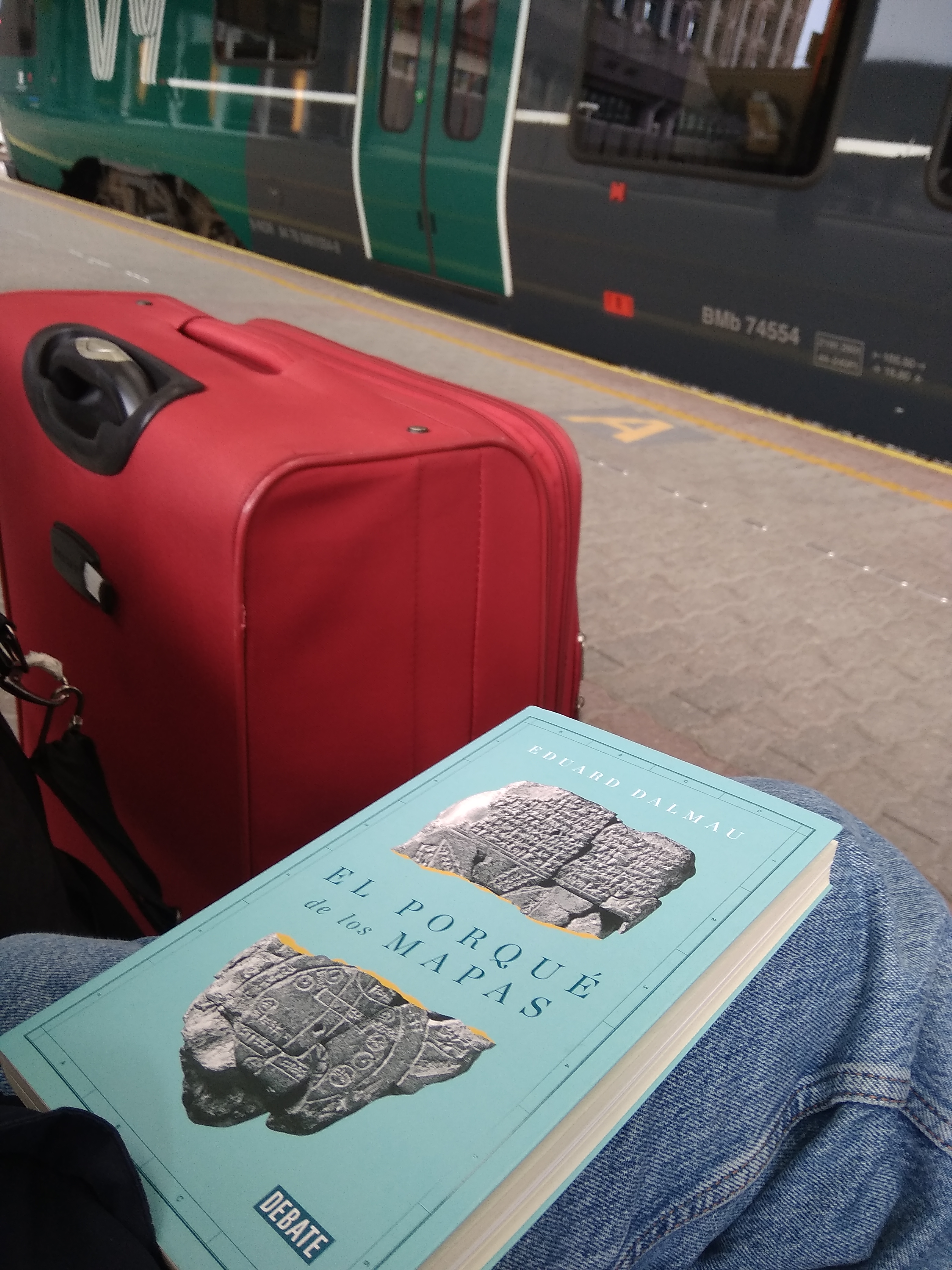
As with every year, small mini-projects of reading materialise along the way. In the autumn of 2024, I realised that I was on my way to read one book in each of the six language in which I have reasonably fluent in both speaking and writing, and so I decided to complete the set, especially as I have not managed to do so in many years. Norwegian and English were easy to tick off the list, as these are the two main languages of my reading in any given year. Spanish is likewise a language I engage with a lot, but it is far rarer that I finish an entire book. One Spanish book that I finished in 2024 was El porque de los mapas (literally The why of maps) by Eduard Dalmau, a very fascinating account of the history of cartography until c.1500. Despite its shoddy treatment of the Middle Ages, it was a pleasant companion on several of my travels last year.         


Eduard Dalmau, El porque de los mapas


In Danish, I read the novel Spionen fra Atlantis (The spy from Atlantis) by Erik Juul Clausen. This is a delightful fantasy novel which describes a mission to find and steal a secret weapon in Egypt and bring it back to Helgoland, the centre of an Atlantis populated by proto-Danish speakers. Swedish was represented by Lena Liepe’s wonderful account of the cult of relics in the Nordic Middle Ages, Reliker och relikbruk i det medeltida Norden (Relics and the use of relics in the medieval Nordics). I do, however, feel that I have cheated with regards to German, as I read Alberto Manguel’s Sehnsucht Utopie (Utopian yearning), which was a translation from French that I encountered in a Vienna bookshop.  


Alberto Manguel, Sehnsucht Utopie
(Translated by Amelie Thoma)


Lena Liepe, Reliker och relikbruk i det medeltida Norden


What made me particularly happy about this mini-project was that I was able to finish my first book in French, namely Voyages en Utopie (Travels in Utopia) by Georges Jean. Granted, this book is very well illustrated, so it did not require a lot of reading to finish it, but I nonetheless felt a delightful pride in what is my first proper step in the further exploration of untranslated Francophone literature.


Georges Jean, Voyages en Utopie


Sundry highlights    

In addition to these main themes, there have also been several other highlights, both small and large, that have comprised the reading year of 2024.


Writing the last entry in the guest book at the family shieling, and whose first entry was written in 1957.         


Dropping by the Madrid book festival.        


Purchasing a collection of medieval sources pertaining to Portugal at a metro station bookshop in Lisbon.


Contemplating my book haul after two weeks in Iberia.     


Seeing the local bookshop in my native municipality advertising a multivolume work of local history with the slogan ‘You don’t need Google when you have the hamlet book’ (a hamlet book being a historical overview of all the families and farms of each local hamlet).           


Receiving author and editor copies of a co-edited volume of articles.


Working on articles at the shieling.              


Encountering a mini library at the train station in Lier, Belgium.  


Visiting the exhibition on the Law of the realm of 1274 at the National Library in Oslo (several times).     


Spending some last sessions of reading and writing at one of my favourite haunts, namely the library café at the University of Oslo.


+++   


Related blogposts (2024) 


My quest for Austrian poetry 

Synchronicity in Madrid 

A Dutch haul 

Reading-spots, part 5