And was the holy Lamb of God,
On Englands pleasant pastures seen!
- And did those feet, William Blake
Viser innlegg med etiketten London. Vis alle innlegg

lørdag 13. august 2011

London Letters - A London Miscellany

I wander thro' each charter'd street,
Near where the charter'd Thames does flow
- London, William Blake

Saddle up, kick your feet
Ride the range of a London street
- At the chime of a city clock, Nick Drake

And I walked the streets of London town
Looking for a place to put my head down
- No Can Do, Mark Knopfler


Although my stay in London was not of such a length as is required in such a metropolis and despite having missed a vast number of sights great and small, I nonetheless have a small number of pictures I would like to share with all of my two readers. Those who have read my previous London-related blogpost will know the course of my visit in sufficient detail, so I will not elaborate on the subject.

As often is the case when the mind is too fixed upon a singular aim, it will not allow the eyes to wander too freely, nor will it move the muscles to much beyond the aim in question. This was very much the case during my pilgrimage, since I noticed very little aside from my primary targets, as has been covered in previous blogposts.

Although my initial plan - established in late December 2010 - had been to spend several days exploring Britain's capital and its various historic sites, my friends in York got the better of me and I chose to spend a few more days in their delightful company rather than meandering the streets of London, a decision I do not regret. The following array of pictures gives a good indication of my whereabouts the first three hours or so, before I went searching for my hotel and thus ended up covering areas of London I had not imagined I would visit, areas where I sacrificed photography for relatively speedy progress on sore feet.

London National Gallery

  He was the most extraordinary compound of talent, wit, buffoonery, obstinacy, and good feelings, in short, a medley of the most opposite qualities, with a great preponderance of good - that I ever saw in any character in my life.
- Arthur Wellesley, First Duke of Wellington

Wellesley's comment is quite apt. Although George IV was a great patron of the arts, his various projects were immensely costly, especially considering they were performed in the wake of the Napoleonic Wars and the Industrial Revolution which both had taken their heavy toll on Britain's treasury and its citizens. 

 Plaques depicting scenes from the Battle of Trafalgar.
Let me take you by the hand and lead you through the streets of London
I'll show you something to make you change your mind
- Streets of London, Ralph McTell

 View from Nelson's Column.


 Nelson's column.

 The Ugandan Embassy. In the hotel later that night I watched parts of The Last King of Scotland.Coincidence? You bet.

 Some posh building ostensibly commemorating the death of King Edward VII in 1910.


 London Eye.

 Big Ben and Houses of Parliament.


 There mighte men the royal egle finde,
That with his sharpe look perceth the sonne;
And other egles of a lower kinde,
Of which that clerkes wel devysen conne.
Ther was the tyraunt with his fethres done
And greye, I mene the goshauk, that doth pyne
To briddes for his outrageous ravyne.
- The Parlement of Foules, Geoffrey Chaucer

The gentil faucoun, that with his feet distreyneth
The kinges hond; the hardy sperhauk eke,
The quayles foo; the merlion that payneth
Him-self ful ofte, the larke for to seke;
Ther was the douve, with hir eyen meke;
The Ialous swan, ayens his deth that singeth;
The oule eek, that of dethe the bode bringeth
- The Parlement of Foules, Geoffrey Chaucer
 The crane the geaunt, with his trompes soune; 
The theef, the chogh; and eek the Iangling pye; 
The scorning Iay; the eles foo, heroune; 
The false lapwing, ful of trecherye; 
The stare, that the counseyl can bewrye; 
The tame ruddok; and the coward kyte; 
The cok, that orloge is of thorpes lyte 
- The Parlement of Foules, Geoffrey Chaucer
 The sparow, Venus sone; the nightingale, 
That clepeth forth the fresshe leves newe; 
The swalow, mordrer of the flyes smale 
That maken hony of floures fresshe of hewe; 
The wedded turtel, with hir herte trewe; 
The pecok, with his aungels fethres brighte; 
The fesaunt, scorner of the cok by nighte 
- The Parlement of Foules, Geoffrey Chaucer
 The waker goos; the cukkow ever unkinde; 
The popiniay, ful of delicasye; 
The drake, stroyer of his owne kinde; 
The stork, the wreker of avouterye; 
The hote cormeraunt of glotonye; 
The raven wys, the crow with vois of care; 
The throstel olde; the frosty feldefare. 
- The Parlement of Foules, Geoffrey Chaucer


 At this point I realised that I was moving in the opposite direction of where I ought to be going and there was much frustration. Distances in London are surprisingly great, at least when your muscles are stiff from too much walking and refuse to cooperate.
 The Burghers of Calais by Auguste Rodin (1840-1917). This bronze monument was made to commemorate the Siege of Calais in 1346, when Edward III of England promised to refrain from a mass slaughter of the city's inhabitants provided that the six foremost citizens would give themselves over to him. This monument is one of the 12 casts of the piece and it was purchased by the British government in 1911.


 The images commonly presented of Richard I are perpetuated by the romantic and idealised statute of him on horseback that stands just outside the Houses of Parliament. But is this a true picture? Sadly, it has to be said that Richard was one of our worst kings.
- Kings, Queens, Bones & Bastards, David Hilliam

Hilliam is not too scorching in his critique of Richard I, far from it. Often have I wondered why anyone has paid good money for a statue of Richard on this very spot, surely the persons in question must have been too dazzled by legends to pay attention to proper history. He is indeed a very strong candidate for the worst regent in the history of Britain, and off the top of my head I can't think of any worthy contenders, save George IV as seen above. The reasons for his strong candidacy to a title of such dubious honour are numerous. During his reign (1189-99) he was very rarely in England - a matter of months all put together, most likely - and left the country pretty much in charge of his very able mother, Eleanor of Aquitaine. Upon his return from the crusade, Richard was captured by the Duke of Austria and sold to Emperor Henry VI who in turn demanded a huge ransom of the English government. To pay for the king's release cost, according to Hilliam, a quarter of every man's income for an entire year, in addition to livestock and church gold. In addition, his failure to capture Jerusalem, losing an ally in king Phillipe of France after Richard had refused to marry his sister and his probable lack of mastery of the English language all strengthen Richard's claim to be the worst regent in Britain's history.


This is an image which put enemies to flight,
But under which citizens enjoy quiet leisure.
- On a portrait of Oliver Cromwell, Andrew Marvell (translated from the Latin)

This is another choice of motif that puzzles me somewhat, although to a lesser extent than in the case above. On the one hand I can understand a desire, especially among Labour politicians, to display Britain's most well-known Parlamentarian of all times as a counterweight to the romantically royalist Richard I, for despite his shortcomings and his troublesome aspects Oliver Cromwell (1599-1658) was an able man in the face of an uncooperative, spendthrift and militarily unsuccessful king Charles. On the other side, however, he was an iconoclast in the right sense of the word, a zealous Puritan who sought to banish Christmas and a ruthless commander who had as little success in mastering parliaments as had his royal predecessors. Andrew Marvell is quite right in the first sentece of his couplet, but whether the citizens of England could find much leisure under his auspices is somewhat dubious, and it is noteworthy that Marvell's Ode upon Cromwell's return from Ireland is considered to contain numerous veiled critcisms of Cromwell.

Although historians must be careful in asserting too stern a judgement on the characters of persons past, I personally would be quite happy if this affront to Irishmen, monarchists, Catholics and most likely quite a number of other groups, were to be removed. The same counts of course for Richard I. 


søndag 7. august 2011

London Letters - Silver-streaming Thames

When I whom sullein care,
Through discontent of my long fruitlesse stay
In Princes Court, and expectation vayne
Of idle hopes, which still doe fly away,
Like empty shaddowes, did aflict my brayne,
Walkt forth to ease my payne
Along the shoare of siluer streaming Themmes
- Prothalamion, Edmund Spenser

As men's faculties dwindle when the autumns of their lives approach so do the length and content of my blogposts diminish as the material hoarded during my stay in England is spent. As the title reveals this is an implement in the series called London Letters, a cycle of blogposts connected solely by a particular geographical setting, and I confess the series has not been as orderly compiled as it probably should have been. However, since it is my intent to chronicle the outlines and certain particulars of my somewhat uneventful trip to London, I would like to include one of the few pleasures I experienced during my stay, namely a quiet rest by the river Thames.

Considering this one of my few pleasures owes not to the trip being dreadful as such, but rather that despite certain unquestionable highlights, such as the National Art Gallery and, to a somewhat less extent, Westminster Abbey, my visit to London was marked by many frustrations. The main reason for this discomfort was my stiff muscles owing to some hill-climbing in Edinburgh the previous weekend, a problem that only worsened the fact that I had some considerable difficulties finding my hotel, which was situated in Sussex Place. I had thought this would be plain sailing, to quote a somewhat obscure Monty Python sketch, but I had not taken into account, and nor did the staff at the hotel seem to know, that there are two places in London called Sussex Place: one close to Paddington Station where there are several hotels, and one where you find the London Business School and little else. Naturally, since fortune sometimes spits in my face, I went all the way to the latter location and a good way back before I went to Paddington on my rather sore feet.

The following array of pictures, however, were taken after my somewhat disappointing trip to Westminster. Having paid my respects to the Prince of Poets and failed to see the tomb of Edward the Confessor, I went down to the Thames to read Spenser's Prothalamion as a part of my previously mentioned pilgrimage. Since the poem is written in a tone of disappointment and dejection it fitted rather well to my own state of mind as I went down to the river bank. 

Along the shoare of siluer streaming Themmes,
Whose rutty Bancke, the which his Riuer hemmes,
Was paynted all with variable flowers,
And all the meades adornd with daintie gemmes,
Fit to decke maydens bowres,
And crowne their Paramours,
Against the Brydale day, which is not long:
Sweete Themmes runne softly, till I end my Song.
- Prothalamion, Edmund Spenser

There when they came, whereas those bricky towres,
The which on Themmes brode aged backe doe ryde,
Where now the studious Lawyers haue their bowers
That whylome wont the Templer Knights to byde,
Till they decayd through pride:
- Prothalamion, Edmund Spenser

 Next whereunto there standes a stately place,
Where oft I gayned giftes and goodly grace
Of that great Lord, which therein wont to dwell,
Whose want too well, now feeles my friendless case:
But Ah here fits not well
Olde woes, but ioyes to tell
- Prothalamion, Edmund Spenser

 From those high Towers, this noble Lord issuing,
Like radiant
Hesper when his golden hayre
in th'
Ocean billowes he hath Bathed fayre,
Descended to the Riuers open vewing,
With a great traine ensuing.
- Prothalamion, Edmund Spenser


Prothalamion, meaning "song before the wedding", was published in 1596 and was occasioned by the double marriage of Elizabeth and Katherine Somerset, daughters of the Earl of Worcester. Spenser was at this time in London to seek out his fortune at the royal court, attempting to emulate his hero Vergilius, in the company of his friend Sir Walter Raleigh. His hopes were not fulfilled, as can be clearly read in the first stanza of the poem, and he later returned to Ireland.

The poem is a beautiful piece of craftsmanship, as most often is the case with Spenser's poetry, but it is also very quaint in certain respects. Unlike his sonnet cycle, Amoretti, or his Epithalamion, Prothalamion is more heavily loaded with references to contemporary events, and is deeply immersed in politics. Despite being a wedding song dedicated to the ladies Somerset, Spenser spends considerable time on himself and the Earl of Essex' military exploits against the Spanish. Considering the Somerset ladies were to be wedded into the House of Essex, it appears that the hapless Spenser took this opportunity to seek the patronage of Robert of Essex in a customary poetic grovel. In my view this lessens the quality of the work because it becomes so ostentatiously bound up with its contemporaneity, a feature rather unfitting a bridal song which ought to address certain matrimonial constancies not affected by the world of the court. Prothalamion is, therefore, as a hymn of hopelessness, the dejected ramblings of an aspiring courtier poorly veiled by his poetic prowess.

fredag 22. juli 2011

London Letters - Westminster Abbey

 
About midwinter King Edward came to Westminster, and had the minster there consecrated, which he had himself built to the honour of God, and St. Peter, and all God's saints. This church-hallowing was on Childermas-day. He died on the eve of twelfth-day; and he was buried on twelfth day in the same minster.
- From the entry for the year 1065 in the Anglo-Saxon Chronicle

The world-famed Abbey by the westering Thames.
- Westminster Abbey, Matthew Arnold

Here, where England's statesmen lie
- In Westminster Abbey, John Betjeman

Here Edward king,
of Angles lord,
sent his stedfast
soul to Christ.
In the kingdom of God
a holy spirit!
- From the entry for the year 1065 in the Anglo-Saxon Chronicle

For the past year and the one year ahead I have and will be working on my master's thesis, and since I'm writing about an office dedicated to St. Edward the Confessor I felt obliged to render a visit to Westminster Abbey where he lies buried and where he ordered a large stone church in the mid 1060s. When Edward instigated the construction of a stone church in 1065 he placed it where Benedictine monks had established a monastic community in 960, and not in the seventh century as Ailred of Rievaulx claims to be the case. Edward dedicated the church to St. Peter who was his particular saint, and by whom, according to the first biography of Edward, he had been elected as king of the English when already in his mother's womb.

Nave, choir and transept glorified with light
- Westminster Abbey, Matthew Arnold

The construction of the church we see today began in 1245 and was ordered by Henry III who also rests here. Henry was one of the most important devotees of St. Edward and it is therefore no wonder he decided to build this impressive structure to the shrine of his favourite saint. Westminster Abbey, in other words, has always been the main focal point of the cult of Saint Edward - a relationship masterfully outlined by Paul Binski - and the office I'm working on comes from the Westminster missal. It should therefore not come as a surprise that I felt a strong inclination to visit the church and have a look for myself.

Wherefrom now our choir in his honour
Gladly sings hymns
So his pious merits are remebered
By all forever after.
- The Office to Saint Edward (my translation)


I visited Westminster Abbey after a trip to the National Gallery and I looked forward to enter into a world so closely connected to my dissertation. Very soon, however, I was overwhelmed by how densely packed with tourist the church was, and my enthusiasm waned a little. Naturally, as a frequent visitor to York Minster I was not unaccustomed to churches crowded with tourists, but the space of York Minster is - or at least appears - much wider than the nave of Westminster Abbey, partly, I presume due to the slightly darker stone used inside the Abbey. I discovered, to my disappointment, that it is not possible to visit the shrine of St. Edward since it is closed for the public, and I didn't have the courage or wits to ask the staff for special treatment. Consequently the chief purpose for my visit was never carried out, and, as mentioned in the previous blogpost, nor did my second chief purpose come to a glorious end. I was a little let down by this and I didn't manage to enjoy the spectacular architecture and its decorations to the fullest, not even as a tourist.


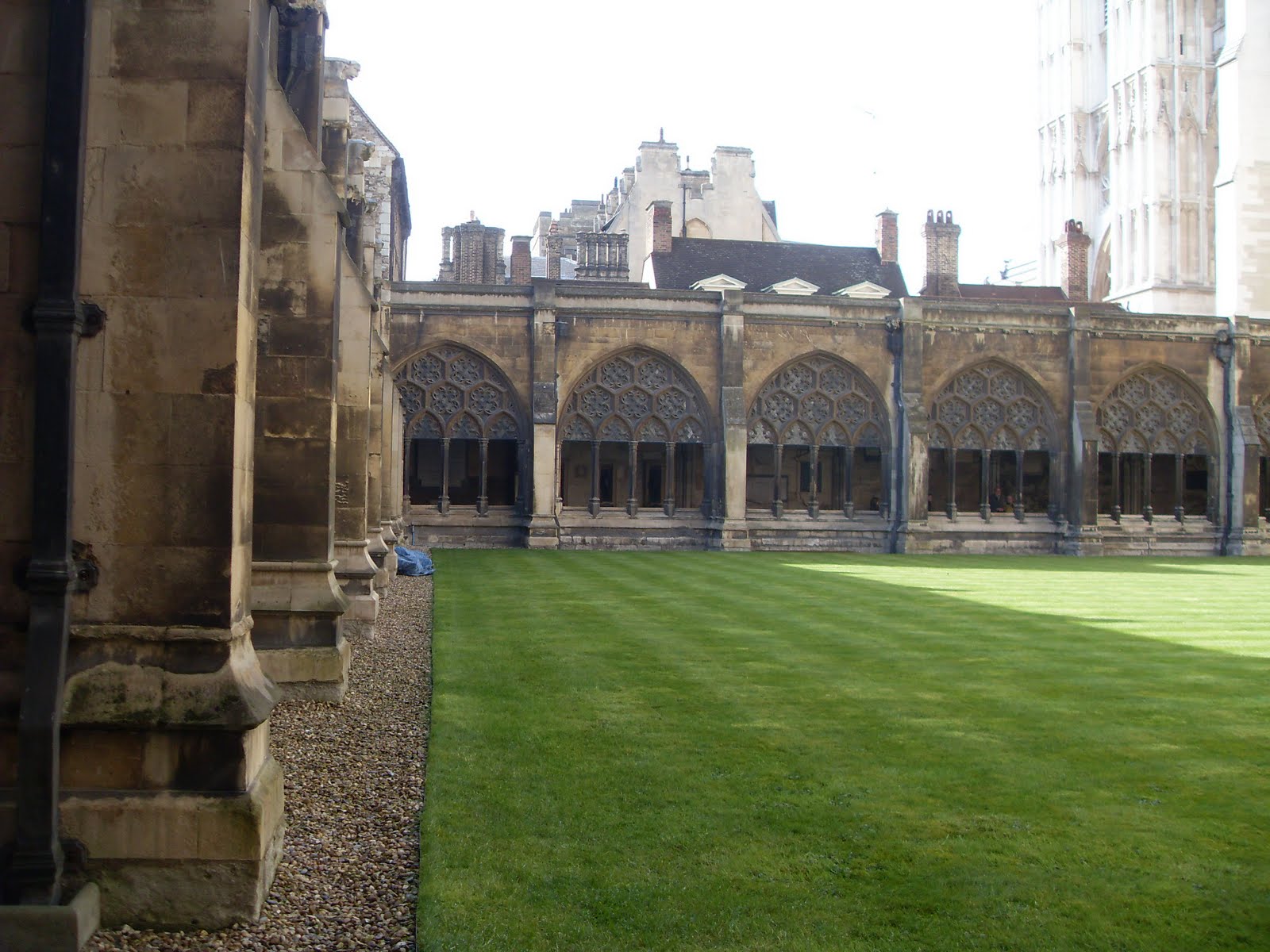
As I sauntered through the various spaces of the church room I came across many beautiful details, and I did enjoy the combined giftshop and museum very much. There also is a charming little cafeteria next to the atrium where I bought a very tasty stilton cheese pie and consumed it while gazing idly into the green space outside. However, as much as I like to spend time in my own manner and despite there being much to explore in Westminster Abbey, I nonetheless didn't go about it as meticulously or zealously as the venue deserves. This was mainly due to the disappointments I had encountered, and so I achieved satiety much sooner than I had expected. 


Here the bones of birth have cried--
'Though gods they were, as men they died.'
Here are sands, ignoble things,
Dropt from the ruin'd sides of kings;
Here 's a world of pomp and state,
Buried in dust, once dead by fate.
- On the Tombs in Westminster Abbey, Francis Beaumont


Although Westminster Abbey in many respects is an awe-inspiring church, I didn't manage to summon the same feeling of reverence as I always get when visiting York Minster. This is, of course, partly due to the tourists as explained above, but it is also in part because of the unfortunate condition of the exterior walls. As can be seen in the picture below, there are two colliding types of stone used in the structure, and this gives the venerable Abbey a semblance of having some fascinating skin disease or a leprosy in the making. 


It is evident that I have to return to Westminster Abbey at some point and spend considerably more time there, preferably in the company of friends who can alert me to the things I miss and overlook and with whom I can engage in scholarly discussions. Despite my rather sullen tone in the comments above I was on the whole quite impressed with the Abbey, or at least the distinctly Medieval aspects I encountered. If only I can bribe the staff, I may even pay some respects to the man I write my thesis on.