And was the holy Lamb of God,
On Englands pleasant pastures seen!
- And did those feet, William Blake
Viser innlegg med etiketten San Gimignano. Vis alle innlegg

onsdag 19. mars 2014

Saint Sebastian in Tuscany - two martyrdoms by Benozzo Gozzoli


The martyrdom of Saint Sebastian is a recurring theme on this blog, as can be seen here, here and here. This time I wish to introduce you to two renditions of this legend by 15th-century Italian painter Benozzo di Lese (1420-97), better known by his cognomen Gozzoli, which suggests he was fond of a feast (gozzoviglia = party). One of Gozzoli's perhaps most splendid and well-known works is his fresco work at the Chiesa di San Agostino in San Gimignano, executed in the period 1463-65. He did, however, also paint some magnificent frescoes in the Duomo di Santa Maria di Assunda, namely the decorations for the chapel of the city's patron saint Fina and a spectacular martyrdom of Saint Sebastian.


Courtesy of Wikimedia

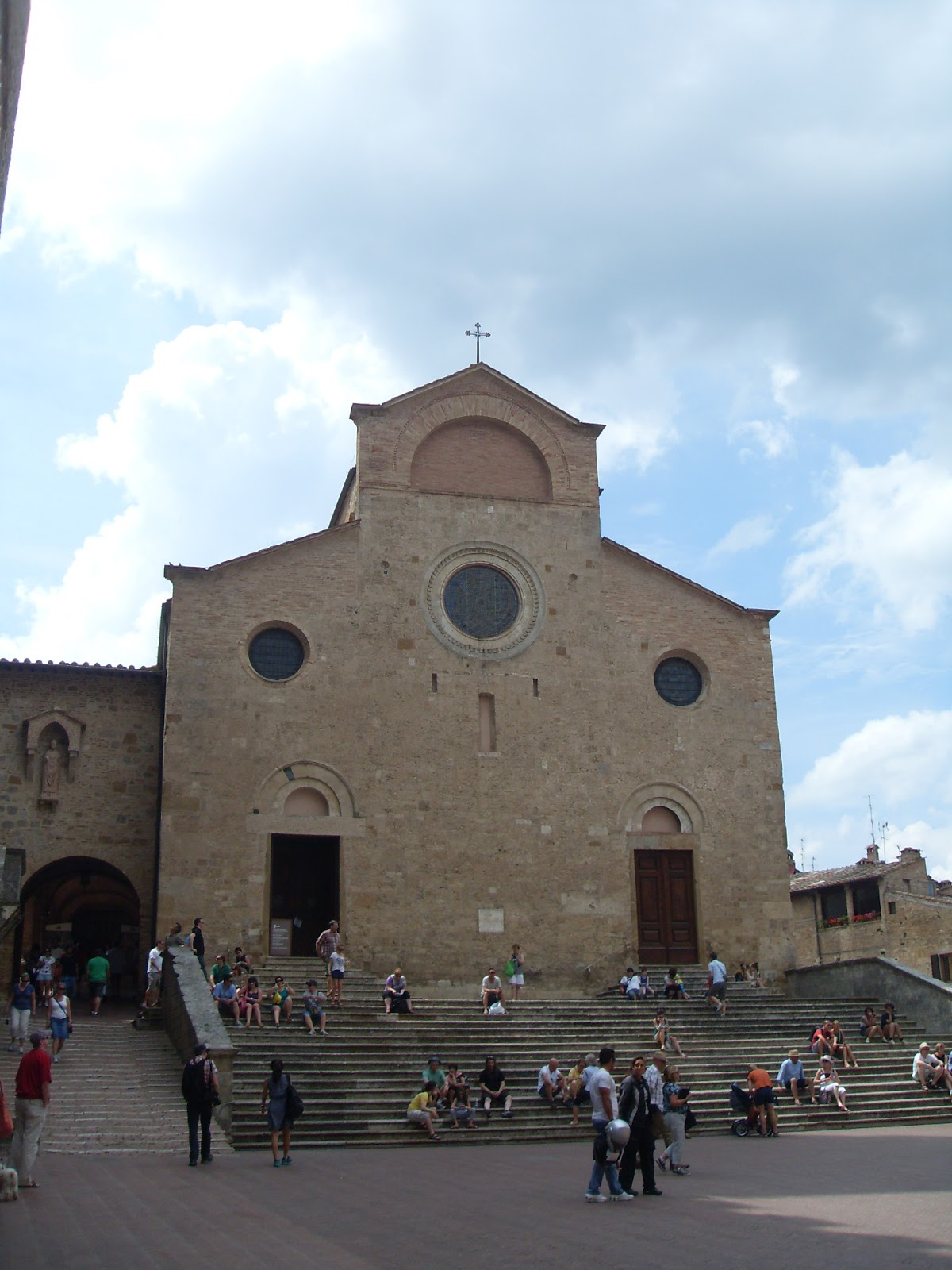
I saw this wonder myself as I explored the cathedral of San Gimignano last summer, but then I had no idea that it was a work by Gozzoli. The fresco is found on the rear wall of the nave and is executed very skilfully in that familiar theatrical composition so typical of the Quattrocento, and which becomes particularly evident in the depictions of Saint Sebastian.

San Gimignano

Duomo di Santa Maria Assunta

Sebastian was a very popular saint in 15th-century Italy because he was believed to guard his devotees against the sundry plagues that haunted the communes. In cities like San Gimignano, which had a rich mercantile estate willing to express its devotions expensively, it is therefore no wonder to find such a sumptuous and centrally located depiction as Gozzoli's.


During my stay in Tuscany I also happened upon another Gozzoli's renditions of Saint Sebastian, this time in the nearby city of Certaldo, which can be seen from the towers of San Gimignano. In one of the churches of the old city, the Chiesa di SS Tommaso e Prospero, located right next to the Pretorian palace, a beautifully painted altar can be found, where the martyrdom of Saint Sebastian can be found on the backside.

Chiesa di SS Tommaso e Prospero

As seen below, the martyrdom is splendidly depicted and surrounded by the coat-of-arms of the city (as seen by the onion, Certaldo's most famous produce) and local families. It is less grandiose than the fresco of San Gimignano, but the rigid style, the profusion of arrows and the beard of the saint are all recognisable features. It was likely executed around 1464-65, when Gozzoli was in Certaldo for the decoration of another local chapel.


What is most interesting about thes frescoes, however, is to note Sebastian's ante-apollonian beard, a detail that fell out of vogue towards the close of the 15th century, as painters like Mantegna and Botticelli turned to Classical renditions of Apollo for their models (hence ante-apollonian). This fashion is particularly evident in Mantegna's three paintings of the saint, the first of which dating as early as the 1450s. Benozzo Gozzoli, in other words, stuck to an older, pre-Quattrocento paradigm in his depictions of Saint Sebastian.

fredag 29. november 2013

Santa Verdiana of Castelfiorentino


A few weeks back I published a blogpost on the blessed Fina of San Gimignano, a virgin recluse who eventually was appointed patron saint for her native city, despite not being recognised by the Papal church. In this blogpost I will give a brief introduction to the life and legacy of another saint from the similar category, namely Verdiana of Castelfiorentino.

Verdiana shares a number of traits with the blessed Fina. She was born in 1182 into an aristocratic family, but later forsook her riches and pursued a life of spirituality inspired by the teachings of Francis of Assisi, whom she allegedly once met. This led her on a pilgrimage to Santiago da Compostela, and upon returning home she became a recluse in her native town. Immured in her cell she lived a life of poverty, asceticism, forsaking of the flesh and contemplative devotion towards God. Thus she reportedly lived in Castelfiorentino for thirty-four years until her death in 1242. Towards the end of her life, it is traditionally believed that two snakes entered her cell and began eating her flesh. Being committed to the suffering of the body she allowed them to feed and lived in intense pain for the brief remainder of her life. This episode is often represented in art, as seen above.
Verdiana feeding the snakes, Benozzo Gozzoli, 1492
Courtesy of the this website

After her death, Verdiana became the subject of local devotion, and her first vita was written towards the end of the 13th century by an unknown author. This was a time when Franciscan and Dominican monks condemned this kind of popular, unauthorised devotion, as exemplified by Salimbene da Adam, a Franciscan chronicler. A few decades later, however, the Church was in disarray and mendicant orders sought therefore to employ these local cults to bolster a religiosity in tune with their own spirituality. At the turn of the 13th century, the anonymous vita, known as the Vita Antiquor, the old life, was collected in a hagiographical anthology by a monk called Blasio. This vita was the basis for a later rendition authored by Giacomini, a Dominican bishop, in 1420, a testament to the longevity of Verdiana's cult.

Another testament to the popularity of Verdiana's cult, and that she was famous beyond the reaches of Castelfiorentino, is a reference found in Boccaccio's Decamerone, day V, story x. In this tale, Boccaccio tells of a young woman who wishes to take a lover, and in order to procure one she seeks out the advice of "an acquaintance of an old bawd who to all outward appearances was as innocent as Saint Verdiana feeding the sepents, for she made a point of attending all the religious servics clutching her rosary" (translation by G. H. McWilliam), while in reality being a hypocrite whom Boccaccio effectively makes the young woman's pimp.

The cult of Verdiana also resulted in production of art. In 1490, the painter Benozzo Gozzoli, whose talents were also commissioned by the devotees of Fina of San Gimignano, painted the above fresco of Verdiana, and this was produced on the order of Castelfiorentino's podestà Jacopo di Antonio Peri.

Verdiana and the snakes, anonymous painting from the 15th century
Courtesy of Wikimedia Commons


References


Boccaccio, Giovanni, The Decameron, translated by G. H. McWilliam, Penguin Classics, 1972

Vauchez, André, Sainthood in the Later Middle Ages, 2005

http://brunelleschi.imss.fi.it/benozzogozzoli/works/OtherWorks.html


http://www.museobenozzogozzoli.it/opere/Castelfiorentino.html


http://commons.wikimedia.org/wiki/File:S.Verdiana,_Museo_di_Santa_Verdiana.jpg


søndag 10. november 2013

November Poetry - part IV


Last year I posted a few November poems in order to keep a regular posting schedule while in the depths of ennui. This time around I've not sunken completely back into those depths, so this poem is one I would just like to share, namely one of Folgòre da San Gimignano's sonnets of the months.

Folgòre da San Gimignano (fl. 1309-1317) was born Giacomo da Michele but was given his nom de plume on account of his splendid way of life in his native San Gimignano, which is said to be reflected in his poems. He wrote on the pleasures of life, and the poem posted below is from his sonetti dei mesi, the sonnets of the months, which he, according to this website, was dedicated to a band of Siense nobles who took a rather hedonistic approach to life. The poem will be first given in the Italian, and below you will find a translation made by Dante Gabriel Rossetti. The Italian text is taken from wikisource, while Rossetti's translation comes from this website.

Scorpio, from MS. Harley 4940
Breviari d'amor, Matfres Eymengau de Beziers, French, 1st half of the 14th century
Courtesy of British Library


Novembre

E di novembre Petriuolo, il bagno,

con trenta muli carchi di moneta:
la ruga sia tutta coverta a seta;
coppe d’argento, bottacci di stagno:

e dar a tutt’ i stazzonier guadagno;
torchi doppier, che vegnan di Chiareta;
confetti con cedrata di Gaeta:
e béa ciascun e conforti ’l compagno.

E lo freddo sia grande e ’l fuoco spesso;
fagiani, starne, colombi mortiti,
lèvori, cavrioli rosto e lesso:

e sempre aver acconci gli appetiti;
la notte ’l vento e piover a ciel messo:
e siate ne le letta ben forniti.

A piazza in San Gimignano


Let baths and wine-butts be November's due,
With thirty mule-loads of broad gold-pieces;
And canopy with silk the streets that freeze;
And keep your drink-horns steadily in view.

Let every trader have his gain of you:
Clareta shall your lamps and torches send,—
Caëta, citron-candies without end;
And each shall drink, and help his neighbour to.

And let the cold be great, and the fire grand:
And still for fowls, and pastries sweetly wrought,
For hares and kids, for roast and boiled, be sure

You always have your appetites at hand;
And then let night howl and heaven fall, so nought
Be missed that makes a man's bed-furniture.

onsdag 25. september 2013

Travels in Tuscany, part 5 - The Blessed Fina of San Gimignano


Beata Fina di San Gimignano, Benozzo Gozzoli (1420-97)
Courtesy of Wikimedia

Italy can boast a wide number of saints, many of whom are local figures whose cults may be restricted to a small geography, such as one particular commune, most likely their native one, but nonetheless have resulted in a rich cultural and devotional expression. The blessed Fina of San Gimignano is one such saint whom I happened to come across during my wanderings in the city of a hundred towers.


Casa di Fina, which sadly was closed by the time I got there


Fina was born in San Gimignano in 1238 and died at the age of fifteen in 1253 on March 12. March is the season of gillyflowers in San Gimignano, and hence these became known as fiori di Santa Fina, the flowers of Santa Fina. According to local legend, they blossomed all over the city when she died. Her death had reputedly been foretold her three months in advance by St. Gregory the Great, to whom she was particularly devoted.

Gregory announcing the death of Fina, Scuola di Ghirlandaio, Capella di Fina

During her short life, Fina excelled in the ascetic religiosity that had become so extremely popular in the course of the 13th century. This was the age of mendicant friars, of Francis of Assisi and Dominic of Caleruega, and poverty and selfabnegation were keywords in the new paradigm of sainthood. Fina was struck by illness at the age of ten and became bedridden, and she was later orphaned. During her suffering she was known to proclaim to her visitors the devotion she harboured to Gregory, the Virgin and Christ until her death. This display of unwavering, patient religiosity no doubt struck a chord in the contemporary milieu, and would continue to attract attention as these virtues remained popular well into the 14th century.

Capella di Fina, duomo di Maria Assunta, scuola di Ghirlandaio
Pictures from the chapel courtesy of this website


After her death, it was reported that numerous miracles occurred at her tomb - or the plank that had been her bed according to some - and she became the centre of a local cult. In addition to the ascetic nature of her devotion, the fourteenth-century devotees may also have been attracted to her cult for her reclusion, an ideal of female sanctity that grew popular in those times. The typology of the female recluse also accorded well with the asceticism of the 13th century since the typical recluse-saint performed her imitation of Christ, the imitatio Christi, through poverty and self-mortification. This also became the century of the flagellants, which took this ideal in a somewhat different and more public direction.

It was a Dominican friar who wrote the vita of Fina di San Gimignano, Giovanni del Coppo who also was a native of that town, and it was typical for the mendicant orders to produce hagiography for local saints in the 1300s. Andre Vauchez notes that mendicant friars showed considerable interest in female lay sanctity in this period, regardless of whether the saints in question had belonged to their orders (Vauchez 2005: 210).

Another current of religiosity typical of the 14th century is also applicable to the posthumous life of Fina di San Gimignano. This is the veneration of saints who were not formally acknowledged by the Papacy, but who nonetheless attracted tremendous local popularity and who even were celebrated in the local liturgy. After the Papacy gained monopoly on canonisations in 1234 under Pope Gregory IX, such practice had never quite died out, but was very carefully executed. In the 14th century, however, this became increasingly normal, and Vauchez suggests this might have a connection to the schism and the crisis of authority prevalent in that time. It is of course also important to note that Italy, due to its fragmentary political map, had always and would continue to act rather independently of external authorities.

The casket of Blessed Fina
Courtesy of this website

The cult of Fina set its marks clearly on the city of San Gimignano. She was eventually elected to be the patron saint of the city, and a hospital in her honour was built only fifty years after her death. In 1457 the Popular Council decided to furnish a beautiful chapel dedicated to her in the collegiate church of Our Lady of the Assumption. The chapel was built in the period 1468-72 by Giuliano da Maiano, and his brother Benedetto made the altar in 1475. The walls of the chapel were decorated by Domenico Ghirlandaio and his school, as seen above.

Perhaps the most hauntingly beautiful artistic expression of Fina's cult is the portrayal of her life by Florentine artist Lorenzo di Niccolò. Here, Fina is shown here as the patron saint of the city, holding her native town in her left arm and some gillyflowers in her right hand. She is positioned next to St. Gregory, her particular saint.

Reliquary for Beata Fina by Lorenzo di Niccolò (1373-1412)
Courtesy of Wikimedia


søndag 15. september 2013

Travels in Tuscany, part 4 - The City of a Hundred Towers


e quella faccia
di là da lui più che l'altre trapunta
ebbe la Santa Chiesa in le sue braccia:

dal Torso fu, e purga per digiuno
l'anguille di Bolsena e la vernaccia
- Purgatorio (XXIV), Dante Alighieri


and that face
Beyond him, more puckered than the rest,

Is that of a man who had the Church in his arms:
He was from Tours, and now fasts to purge himself
Of the Bolsena eels and the sweet wine.
- Translated by Charles Sisson


San Gimignano, seen from Certaldo

The man to whom Dante refers in this canto is Pope Martin IV, who reigned from 1281 to 1285, and who was infamous for his gluttony and therefore set to purge his body of his favourite delicacies in the company of other gluttons on the Sixth Cornice. The eels for which he had such an appetite in his mortal days were steeped in la vernaccia, a wine native of San Gimignano, a Tuscan city Dante once visited on a diplomatic mission, and which can be seen across the river valleys from the city of Certaldo, as seen in the picture above.

Porta San Giovanni


When I visited Tuscany for the conference in Certaldo this summer, I had left one day open in my itinerary for exploring. Certaldo is situated in close proximity to several historical centres, such as Pisa, Florence and Siena, but I was first of all attracted by the small hill town of San Gimignano, known as the city of a hundred towers, some distance south of Certaldo. In the end I decided to spend my day off here rather than Florence, because I thought to myself I would certainly visit Florence some other time, while I might not have the same opportunity to see San Gimignano for the foreseeable future. However, having visited the city of a hundred towers - or twenty-one, as I've heard is the correct number - I now realise I have to return to that city for a more thorough investigation.


Facade of the Franciscan convent, later Templar mansion and, after 1308, a house of the Maltese Order

Agnus Dei

A splendid torchholder

The city of San Gimignano has an old history reaching back to Etruscan times. According to legend it was founded by two Roman brothers who ran away from Rome in the aftermath of the Catiline conspiracy and named Citadel of Selva after one of them. Later it received its current name from Bishop Geminianus, a 4th-century bishop-saint from Modena who was venerated in the city and, according to legend, was counted as its saviour, though I'm not sure on what grounds. Devotion towards Geminianus became significant in the 12th century following a translation of the bishop-saint's relic in 1106. Towards the end of that same century, San Gimignano received its municipal independence from the bishops of Volterra, to whom it had been assigned by King Hugh in 929, apparently the first document to refer to the city.


Situated on the Via Francigena, the pilgrimage route to Rome from France, San Gimignano grew to a rich and formidable hill-town throughout the 13th century thanks to pilgrims, its export of wine and its varied manufacture (including glass and cloth). Its economic prosperity attracted rich families who in their turn gave rise to the town's characteristic towers, a symbol of power and wealth, and though only 21 of them remain today, it is said that as many as 76 towers once stood in the city. In addition, there grew up convents for Franciscans, Dominicans and Augustinians, and even the Templars set their mark upon the cityscape.

Torre Rognosa

Torre del Diavolo

Piazza della Cisterna

Like so many other Italian city-states, San Gimignano had a volatile political history, siding variously with the Ghibellines and the Guelphs. It was for this reason Dante visited the city in 1300, acting as an ambassador for the union of Guelph cities in Tuscany. Whether it was during this stay that the Florentine poet learned of Pope Martin's love of vernaccia-marinated eels I don't know, but I assume Dante himself had opportunity enough to acquaint himself with the sweet wine during his stay.


The wealth of San Gimignano resulted in much beautiful architecture and wonderful artistic expressions, and even following the plague's decimation of the populace the 14th century saw many spectacular artistic projects. The walls of San Gimignano's duomo are partcularly rich in this legacy, and the Sienese painter Bartolo di Fredi (c.1330-1410) painted a series of scenes from the Old Testament, which is facing a series of scenes from the New Testament of uncertain provenance. Both these series were completely breathtaking in all their horror and delight, and I could but admire and adore the faith, the talent and the dedication that went into making these frescoes. There is also a beautiful depiction of Saint Sebastian's martyrdom executed by Benozzo Gozzoli (ca.1420-1497) who also painted a frescoe on the same theme in the chiesetta in Certaldo.


The city's medieval architecture is well-preserved and it really would feel like stepping back in time once you enter the Porta San Giovanni, were it not for the ubiquitous and occasionally boisterous tourists who swarm the streets in the summer. However, San Gimignano is so labyrinthine that it is easy to get away from the masses and explore the various arches, tunnels, alleys and walls undisturbed by the vulgar noises. There are also a number of fascinating and interesting sights, from the lowly, intimate churches to the soaring towers, and from the top of the Torre Grossa, reaching 54 meters and constructed in 1311, you have a magnificient view of the Tuscan landscape, and as you stand there and see the distant mountains, the vineyards and the green and luscious valleys it is almost as if you begin to doubt the existence of a world beyond the horizon.


Chiesa di San Bartolo, built in 1173


The Chancery Arch


Chiesa di San Agostino, consecrated in 1298


Courtyard of the late-13th-century town hall


View from Torre Grossa


Piazza del Duomo

With its richness of sights and nooks I didn't have the chance to fully explore San Gimignano the short afternoon I spent there, and I already look forward to revisit the city and see more of its fascinating history.

Piazza della Cisterna dalla Torre Grossa