And was the holy Lamb of God,
On Englands pleasant pastures seen!
- And did those feet, William Blake
Viser innlegg med etiketten Victorian. Vis alle innlegg

torsdag 25. desember 2014

Mary in the Wood of Thorns - a German folksong for Christmas


One of my favourite aspects of Christmas is the singing of carols and hymns in commemoration of the birth of Christ, and - perhaps on account of me being a historian - I usually prefer the older songs. Here in Norway, we have a rich tradition of Christmas songs in both our official variants of Norwegian (bokmål and nynorsk), and some of these are translation of songs from other languages, most notably German, Danish and Latin, with a few from English as well.

In previous blogposts I've posted links to some of my favourite English carols, such as the Herefordshire Carol or God Rest Ye Merry Gentlemen. In this blogpost I wish to present a favourite from the German tradition, Maria durch ein Dornwald ging. This was originally not a Christmas song, but a song of pilgrimage which came about in Thüringen and the bishopric of Paderborn during the 19th century. The oldest printed source can be dated to 1850, and this edition contained seven strophes. In the early 20th century, a new edition with three strophes became the standard edition and this is currently the rendition most frequently performed. The author or authors of this song are unknown to us and so are the composers of the music, and it is perhaps chiefly this trait which allows us to label this song a folksong. (Information is taken from this website.) The text is found below taken from Edition B, and an English translation follows at the end.


Thomaner Chor, Leipzig


Maria durch ein Dornwald ging

Maria durch ein'n Dornwald ging
Kyrie eleison
Maria durch ein'n Dornwald ging
der hat in sieben Jahr'n kein Laub getrag'n
Jesus und Maria

Was trug Maria unter ihrem Herzen?
Kyrie eleison
Ein kleines Kindlein ohne Schmerzen
das trug Maria unter ihrem Herzen,
Jesus und Maria

Da haben die Dornen Rosen getrag'n
Kyrie Eleison
Als das Kindlein durch den Wald getrag'n
da haben die Dornen Rosen getrag'n
Jesus und Maria


Sandro Botticelli, Madonna with child and singing angels
c.1477, currently in Gemäldegalerie, Berlin
Courtesy of Wikimedia


Mary through the thornwood walked

(My translation)

Mary through the thornwood walked
Kyrie Eleison
Mary through the thornwood walked
Which had not borne for seven years a leaf
Jesus and Maria

What bore Mary underneath her heart?
Kyrie Eleison
A little child withouten pain
that's what Mary bore underneath her heart
Jesus and Maria

Then the thorns were bearing roses
Kyrie Eleison
As the little child through the wood did walk
Then the thorns were bearing roses
Jesus and Maria

fredag 12. desember 2014

The Psalter of Quendrada - a miracle of St Kenelm


Kenelm holding a virginal lily
From the Digby Chantry, St Augustine's Church Ramsgate, John Hardman Powell, mid-19th century
Courtesy of this website


The elusively historical Kenelm of Mercia was the head of the Mercian kingdom for some time at the turn of the 8th century, at least according to his legend. Little is known about his life, and what appears in later texts is the stuff of saint-biographical legend, cultivated especially at Winchcombe Abbey, which was the centre of his cult. From documents and charters we know that a royal person by this name existed in this period, but little can be suggested beyond this. The first tokens of a liturgical cult can be found almost two centuries after his death, a time when many royal figures were the subject of new cults, such as Ethelreda, Edward Martyr and Sexburga, to mention only a few.

This flourishing of English royal saints has been treated in great detail by Susan J. Ridyard in her Royal Saints of Anglo-Saxon England, where she distinguishes between king-saints and royal women who became saints by virtue of their monastic pursuits. Ridyard's study was published in 1988, and was a counterargument against the beliefs that royal women in the convent abandoned their roles as royal patrons (hagiography shows this not to be the case), and that these saints were cultivated to protect weak royal houses. In fact, the royal houses benefitting from these cults were all very strong at this time.

Kenelm's role as a saint, therefore, fits into a larger historical canvas, and like the other royal saints boosted by the Benedictine reform movement, his cult enjoyed a perhaps surprising longevity, as can be seen by his inclusion in the 13th-century South English Legendary, and even in Chaucer's Canterbury Tales. Traditions belonging to the cult of Kenelm have endured for a long time, as suggested by a certain piece of folklore expounded by Eleanor Parker in this blogpost I have given some details about his cult and iconography in an earlier blogpost, so I will avoid undue repetition. In this blogpost, however, I will present a miracle of Kenelm which is reported by Gerald of Wales in his Journey through Wales, a work completed at the turn of the 1180s. This miracle is one among many reported by Gerald in chapter 2 of Book 1. The text quoted is taken from Lewis Thorpe's translation published in Penguin Classics (reprinted in 1984).


Kenelm's dream by H. A. Payne
From The Artistic Crafts Series of Technical Handbooks edited by W. R. Lethaby, plate 71
Courtesy of Project Gutenberg


Before presenting the miracle, however, a brief summary of Kenelm's legend might be appropriate. Kenelm was a child-king of Mercia c.800, and he had a wicked sister Cwenthryth, or Quendrada, who plotted against him. She ordered a huntsman to slay him during the child-king's hunt, and although forewarned by a vision given to his nurse, the boy accepted his death with the stoicism so typical of martyrs. After he had died, his body was discovered by the aid of a cow who began to feed at its burial-place, while the pope had been alerted of Kenelm's death by a dove. Kenelm's body was exhumed and taken back to the royal palace, and upon seeing his brother return, Quendrada's eyes fell out of her head and onto the psalter she was reading (backwards, because she was so very evil). The miracle reported by Gerald concerns this psalter:


In our days another great miracle has caused quite a stir. This had to do with the psalter of Quendrada, the sister of Saint Kenelm, at whose instigation he was murdered. In Winchcombe, on the vigil of Saint Kenelm, when, at the invitation of the monks, a great crowd of women from the neighbourhood had congregated for the celebrations, as their custom was, the assistant cellarer had intercourse with on of them inside the precincts of the monastery. The next day he had the audacity to carry this psalter in the procession of the relics of the saints. When the solemn procession was over, he made his way back to the choir. The psalter stuck to his hands and he could not put it down. He was greatly astonished and confounded by what had happened. Then he remembered the crime which he had committed the previous eveing. He confessed his sin and did penance. His repentance was sincere enough, and he was helped by the prayers of his fellow-monks. In the end, by divine intervention, he was able to free himself from the psalter and so was liberated. The book in question is held in great veneration in the monastery, for, when the dead body of Kenelm carried out and the crowd shouted: 'He is God's martyr! There is no doubt about it! He is the martyr of God!' Quendrada, who was guilty of her brother's murder and had it very much on her conscience, replied: 'He is indeed God's martyr, as truly as my eyes are resting on this psalter!' By chance she was reading the psalter at the moment. Thereupon, by divine intervention, her two eys were torn from her head and fell plop on the open book, where you can still see the marks of her blood to this day.
- Thorpe 1984: 85-86


Carving of St Kenelm at the gateway to Romsley Church
Photograph by Pollyanna Jones


There are several interesting iconographical details to pick up on in this anecdote. First, it should be mentioned that although a seemingly novel grisly detail, the loss of eyes is also found in the legend of St Alban, protomartyr of Britain together with his companion Amphibalus. Like the wicked Quendrada, Alban's murderer lost his eyes after killing him, as depicted in gory detail by Matthew Paris in the St Alban's Psalter (as seen below). On the obverse side of the coin we find a story - mentioned by Benedicta Ward in her book on medieval miracles - in the legends of St Cuthbert (if I remember correctly) where a man who had lost his eyesight and was healed by the saint, told a miraculous tale of how birds had carried his eyes away, but that they were returned after he had prayed for healing.


The prototype of British eye-losses: St Alban's beheader
Royal 2 B VI, English psalter, c.1246-c.1260

Another interesting feature is the immediate recognition by the populace of Kenelm's status as martyr. Although we have no information about the death of the historical Kenelm and how his subjects reacted, Gerald's description - perhaps drawn from William of Malmesbury's record, or the anonymous 11th-century vita - invokes a trait typical of Northern European royal cults, namely the immediate canonisation by the vox populi following the trauma of the death of a leader-figure. André Vauchez, in his study of saints' cults, has marked this as an aspect common to several English leaders in the Middle Ages, for instance Simon Montfort and Edward II.

A final aspect I want to draw your attention to in this case, is the punitive nature of Kenelm's miracle. By way of an overly adhesive psalter, Kenelm makes the assistant cellarer's guilt obvious to everyone and forces him thus to repent his crime. Punitive miracles could take many forms, either in a mundane manner or more severely through disfigurement, disablement or death. The assistant cellarer might be grateful that his punishment was not more severe than this.


Kenelm guarding his well-head
From the chapel at the Well-Head of St Kenelm's Well, by J. D. Wyatt, 1887
Courtesy of this website


Literature


Gerald of Wales, The Journey Through Wales, (trl. by Lewis Thorpe), Penguin Classics, 1984

Love, Rosalind, Three Anglo-Saxon Saints' Lives, Clarendon Press, 1996

Ridyard, Susan J., Royal Saints of Anglo-Saxon England, Cambridge University Press, 1988

Vauchez, André, Sainthood in the Later Middle Ages, (trl. by Jean Birrell), 2005

Ward, Benedicta, Miracles and the medieval mind, 1982


fredag 23. mai 2014

Goofy chivalry - A charming piece of mid-twentieth century medievalism


To be a medievalist means, in part, to be aware of how the period we call the Middle Ages has been understood, interpreted and re-enacted by later periods, and in many cases, being a medievalist entails to present a counter-narrative or a more nuanced understanding to this post-medieval view. The reception history of the Middle Ages is an interesting view into historical periods and will give a small glimpse of the history of the mentality of an age past, although not the Middle Ages themselves. Sometimes, the reception of the Middle Ages can be marked by an idealised view of the social order, as can be seen in the 19th-century depictions by Walter Scott in Ivanhoe or Alfred Lord Tennyson in Idylls of the Kings where the code of chivalry is one of the major currents. A more gloomy picture can be found in the late-18th-century Gothic literature, such as Horace Walpole's The Castle of Otranto or Matthew Lewis' The Monk, where darkness, evil monks and bloodfeuds are key elements. These elements are combined with a fundamental anti-Catholic tone of voice, which may stem more from Jacobean drama than anything else. The receptions are very interesting to a medievalist, but they can also be exasperatingly wrong.


Poster for Knight for a Day (1946), Walt Disney Productions
Courtesy of Wikimedia

Some receptions of the Middle Ages, however, are more entertaining than others, and in this blogpost I present to you a short cartoon released in 1946 by Walt Disney Productions. The cartoon, Knight for a Day, was directed by Jack Hannah and written by Bill Peet, and was one of the earliest cartoons I remember from my own childhood. This is the story of a squire-turned-knight in a tournament against the undefeated champion, set in Canterbury sometime in the 15th century


Knight for a Day
As in the case of most interpretations of the Middle Ages, anachronisms abound in this little piece, but unlike most of these cases, this is not a problem. While medievalisms often are political in tone or purpose, and often to such a degree that it becomes painfully obvious, this short cartoon is seemingly meant for pure entertainment, and the numerous anachronisms are deliberately used for comical purpose - such as a cigar and a jackhammer - while no pretension to accuracy is ever suggested. Even a grumpy historian like myself, ready to jump at the throat of anachronism whenever it rears its head, can relax and utterly enjoy a beautiful little piece of animated storytelling. It is also a pleasant reminder that the duties of a medievalist can take one into byways that can be surprising but wonderfully so. 


søndag 8. desember 2013

Mermaid and merman


These days I'm preparing for my exam in a course on Victorian medievalisms and my mind is often in the 19th century. This course has covered a wide number of aspects from Victorian culture, two of which were the Pre-Raphaelites and Alfred Lord Tennyson. Since I like to keep a regular posting of four blogposts a month, I thought it proper to share some 19th-century culture, namely two poems by Tennyson and John William Waterhouse's paintings which appear to be based on these poems. The subject is not specifically medieval, but very, very Victorian.

I was inspired to put up these works after listening to a programme on BBC Radio 3 produced by medievalist Sarah Peverley. The programme is no longer available, but the playlists can be found here.

The poems are taken from http://www.litscape.com.


The Mermaid, John William Waterhouse
Courtesy of Wikimedia Commons


The Mermaid

Alfred Lord Tennyson

I.

Who would be
A mermaid fair,
Singing alone,
Combing her hair
Under the sea,
In a golden curl
With a comb of pearl,
On a throne?

II.

I would be a mermaid fair;
I would sing to myself the whole of the day;
With a comb of pearl I would comb my hair;
And still as I comb'd I would sing and say,
Who is it loves me? who loves not me?
I would comb my hair till my ringlets would fall
Low adown, low adown,
From under my starry sea-bud crown
Low adown and around,
And I should look like a fountain of gold
Springing alone
With a shrill inner sound,
Over the throne
In the midst of the hall;
Till that great sea-snake under the sea
From his coiled sleeps in the central deeps
Would slowly trail himself sevenfold
Round the hall where I sate, and look in at the gate
With his large calm eyes for the love of me.
And all the mermen under the sea
Would feel their immortality
Die in their hearts for the love of me.

III.

But at night I would wander away, away,
I would fling on each side my low-flowing locks,
And lightly vault from the throne and play
With the mermen in and out of the rocks;
We would run to and fro, and hide and seek,
On the broad sea-wolds in the crimson shells,
Whose silvery spikes are nighest the sea.
But if any came near I would call, and shriek,
And adown the steep like a wave I would leap
From the diamond-ledges that jut from the dells;
For I would not be kiss'd by all who would list,
Of the bold merry mermen under the sea;
They would sue me, and woo me, and flatter me,
In the purple twilights under the sea;
But the king of them all would carry me,
Woo me, and win me, and marry me,
In the branching jaspers under the sea;
Then all the dry pied things that be
In the hueless mosses under the sea
Would curl round my silver feet silently,
All looking up for the love of me.
And if I should carol aloud, from aloft
All things that are forked, and horned, and soft
Would lean out from the hollow sphere of the sea,
All looking down for the love of me.


The Merman, John William Waterhouse
Courtesy of this website


The Merman

Alfred Lord Tennyson

I.

Who would be
A merman bold,
Sitting alone,
Singing alone
Under the sea,
With a crown of gold,
On a throne?

II.

I would be a merman bold,
I would sit and sing the whole of the day;
I would fill the sea-halls with a voice of power;
But at night I would roam abroad and play
With the mermaids in and out of the rocks,
Dressing their hair with the white sea-flower;
And holding them back by their flowing locks
I would kiss them often under the sea,
And kiss them again till they kiss'd me
Laughingly, laughingly;
And then we would wander away, away
To the pale-green sea-groves straight and high,
Chasing each other merrily.

III.

There would be neither moon nor star;
But the wave would make music above us afar --
Low thunder and light in the magic night --
Neither moon nor star.
We would call aloud in the dreamy dells,
Call to each other and whoop and cry
All night, merrily, merrily;
They would pelt me with starry spangles and shells,
Laughing and clapping their hands between,
All night, merrily, merrily:
But I would throw to them back in mine
Turkis and agate and almondine:
Then leaping out upon them unseen
I would kiss them often under the sea,
And kiss them again till they kiss'd me
Laughingly, laughingly.
Oh! what a happy life were mine
Under the hollow-hung ocean green!
Soft are the moss-beds under the sea;
We would live merrily, merrily.

torsdag 24. oktober 2013

He was an errant knight


Mylde answer made: he was an errant knight
- The Faerie Queene, Edmund Spenser

A few days back I was roaming the Internet for Pre-Raphaelite paintings, when I happened to come across this beautiful piece by John Everett Millais (1829-96) from 1870 titled "Painting the Knight Errant". The title is a little misleading since, at least to the modern mind, it implies a meta-dimension, but this is not the case. The painting is a lovely composition and showcases the enthusiastic and fertile medievalism embraced by the Pre-Raphaelites.

Millais has chosen has his subject the errant knight, an important figure from medieval romance and renaissance epic. The most famous examples from English literature are found in Edmund Spenser's Faerie Queene, modelled to a significant extent on the great 16th-century Italian epics like Orlando Furioso by Ariosto (1474-1533) and Gerusalemme Liberata by Torquato Tasso (1544-95). Spenser's well-wrought allegory features several of these knights errants, who were armed soldiers roaming the world for quests and challenges, but not all of them are honourable or protagonists. What defines a good errant knight appears to be the nobility of the quests he agrees to undertake, and sometimes the grand, overarching quest which leads him through the world, such as The Redcrosse Knight's quest to liberate the Faerie Queene from a monstrous dragon.

The notion that the errant knight could have a potential for evil was also picked up by Alfred Lord Tennyson in his Idylls of the King, where he notes that before Arthur gained proper control of the land, many an errant knight could be found throughout it, and Tennyson uses them as one of the symbols of anarchy and chaos preceding the golden age of Arthur. The errant knights of Idylls of the King are markedly different from Arthur's knight in that they leave Camelot first when they have a quest, rather than sauntering throughout the world on the prowl for one. It is also emblematic that Geraint, after he has fallen prey of jealousy and succumbed to the intrinsic darkness, takes his wife Enid and wanders aimlessly about just like an errant knight.

In medieval romance and in renaissance epics, the trope of the errant knight is a brilliant pretext for action and an excellent way of making the adventure move from one location to another, and this was exuberantly taken advantage of by the epic poets of the 16th cenutry.

tirsdag 22. oktober 2013

A Silent Wood - poem by Elizabeth Siddal


Elizabeth Siddal, self-portrait
From wikimedia commons

Days are currently quite busy and I've little energy left for blogging, but in order to maintain a semblance of frequency, I'll put up more poetry now and then. Since I'm currently taking a course on medievalism in Victorian England, I found it fitting to present a poem by one of the key figures of the Pre-Raphaelite Brotherhood. Elizabeth Siddal (1829-62), a woman of considerable and versatile talents. She has probably gained most fame as a model for some of the most iconic paintings by the Pre-Raphaelites, but she was also herself a painter - as witnessed above - and a poet. Below is one of her poems, A Silent Wood, dated with some uncertainty to 1855-57 by William Michael Rossetti. The text is taken from The Pre-Raphaelites From Rossetti to Ruskin, edited by Dinah Roe and issued in the Penguin Classics series in 2010.


A Silent Wood

O silent wood, I enter thee
With a heart so full of misery -
For all the voices from the trees
And the ferns that cling about my knees.

In thy darkest shadow let me sit
When the grey owls about thee flit:
There I will ask of thee a boon,
That I may not faint or die or swoon.

Gazing through the gloom like one
Whose life and hopes are also done,
Frozen like a thing of stone,
I sit in thy shadow - but not alone.

Can God bring back the day when we two stood
Beneath the clinging trees in that dark wood?


Beata Beatrix (1864-70), Dante Gabriel Rossetti
One of the most famous paintings to which Elizabeth Siddal sat model

lørdag 16. mars 2013

Three poems on longing - a selection of Matthew Arnold's poetry


Recently I've been thinking quite a lot about Oxford. I've started re-watching Lewis, one of my favourite TV-series of all time, and I've spent much time on one of my favourite blogs, written by a brilliant clerk of Oxford which contains a great variety of information pertaining to this city. One result of this preoccupation is a growing interest in the man who coined the city's much-loved and much-quoted sobriquet "city of dreaming spires". The man in question is of course Matthew Arnold (1822-88), whom I came in contact with through Derek Walcott, who used a stanza from his To Marguerite as an epigraph in his autobiographical poem Another Life. It is evident why Arnold's poem was chosen for this purpose, as both poets display a conspicuous and deep-seated fascination with wandering, absence, estrangement and longing - themes which resonate with me very well because of my nostalgic nature.


Matthew Arnold, c.1883

The poems in this blogpost were all first published in 1852, written during Arnold's poetically most productive part of life, namely his twenties. The latter two are written to the mysterious dedicatee Marguerite, whom scholars throughout the ages have striven to identify. Arnold is perhaps most known for his longer poems such as Balder Dead or Empedocles on Etna, dramatic and narrative works which are ill-suited for presentation in the blog format, so the poems here are all short and lyrical. I have come to greatly enjoy these two qualities in poetry, and I find it is easier to explore a poet by starting at his shorter work. This is perhaps especially the case with a Victorian poet such as Arnold, whose style may seem laboured to our modern eyes, although this is chiefly a result of the numerous elisions employed throughout the verse lines.


Too Late

Each on his own strict line we move,
And some find death ere they find love.
So far apart their lives are thrown
From the twin soul that halves their own.

And sometimes, by still harder fate,
The lovers meet, but meet too late.
- Thy heart is mine! - True, true! ah true!
- Then, love, thy hand! - Ah no! adieu!


To Marguerite

Yes: in the sea of life enisled,
With echoing straits between us thrown.
Dotting the shoreless watery wild,
We mortal millions live alone.
The islands feel the enclasping flow,
And then their endless bounds they know.

But when the moon their hollows lights,
And they are swept by balms of spring,
And in their glens, on starry nights,
The nightingales divinely sing;
And lovely notes, from shore to shore,
Across the sounds and channels pour;

O then a longing like despair
Is to their farthest caverns sent!
For surely once, they feel, we were
Parts of a single continent.
Now round us spreads the watery plain—
O might our marges meet again!

Who order'd that their longing's fire
Should be, as soon as kindled, cool'd?
Who renders vain their deep desire?—
A God, a God their severance ruled;
And bade betwixt their shores to be
The unplumb'd, salt, estranging sea.


Absence

In this fair stranger's eyes of grey
Thine eyes, my love, I see.
I shudder: for the passing day
Had borne me far from thee.

This is the curse of life: that not
A nobler calmer train
Of wiser thougths and feeelings blot
Our passions from our brain;

But each day brings its petty dust
Our soon-chok'd souls to fill,
And we forget because we must,
And not because we will.

I struggle towards the light; and ye,
Once-long'd-for storms of love!
If with the light ye cannot be,
I bear that ye remove.

I struggle towards the light; but oh,
While yet the night is chill,
Upon Time's barren,stormy flow,
Stay with me, Marguerite, still!


fredag 20. april 2012

Life's Little Oddities, part IV - The Rockery


You could have got off with Shepherd Book at the Bathgate Abbey. Could've been meditating on the wonders of your rock garden by now.
- Capt. Malcolm Reynolds, Firefly S01E09

This month and the next my life is dominated by my MA thesis hurrying inexorably to its allotted end. One of the many consequences thereof will be that I no longer have that much time to dedicate on this blog, and my blogposts will be shorter, briefer and - much likely - more self-absorbed than usual. The subject of the first in what will probably be a long line of such posts is a minute feature in one of York's greatest attraction, the Yorkshire Museum and Gardens.


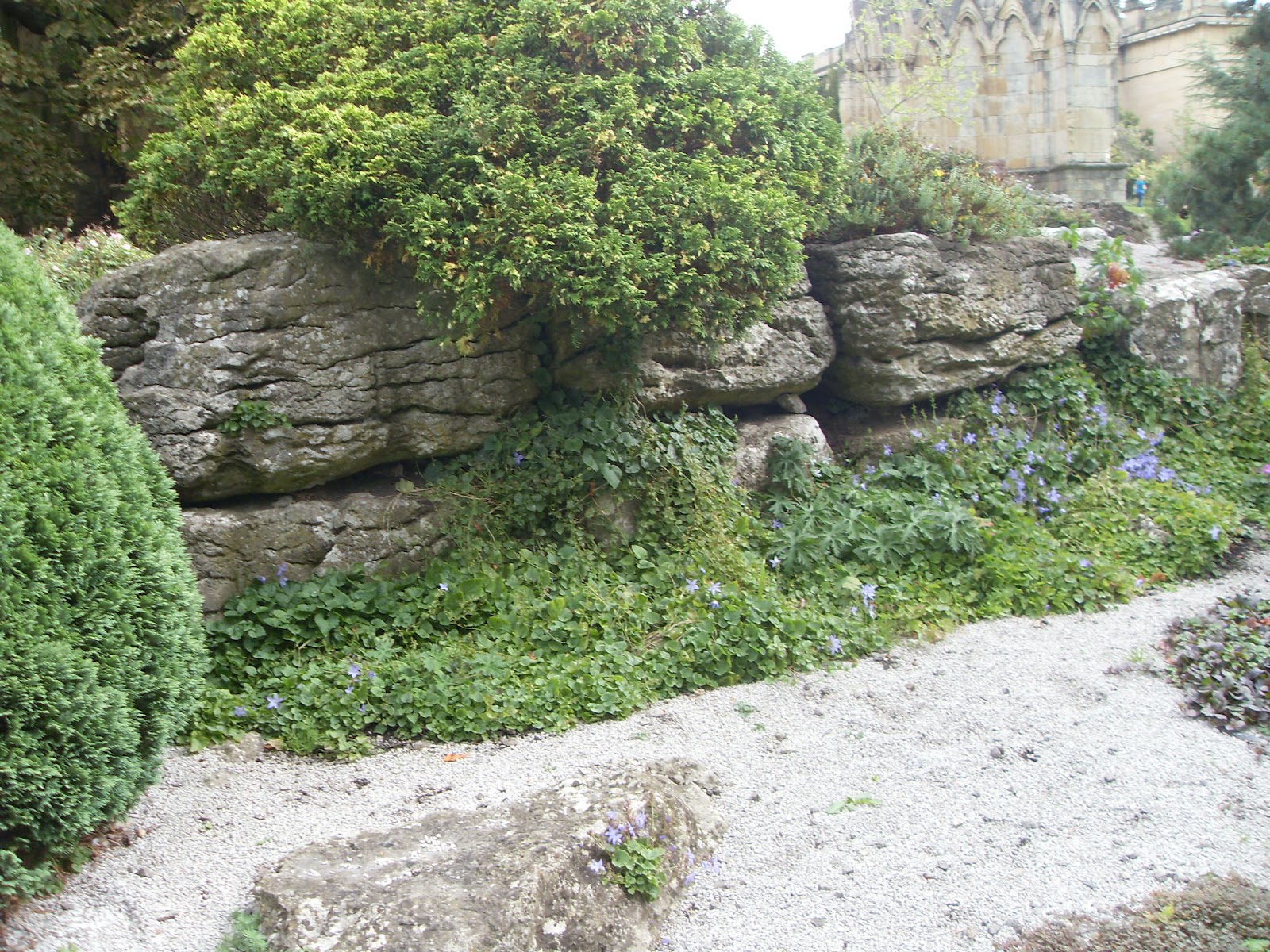
I was walking through the garden one day as I was wont to do when going between the city and Constantine House, when suddenly I noticed a sign telling me that what I had thought was rocks casually clumped together, actually was a deliberately designed rockery, a stone garden with alpine plants.


This stone garden was put together in 1980 by students of Askham Bryan College in commemoration of the Backhouse family nursery, an interesting feature of the city's commercial and scientific history that was operative between 1815 and 1955.


A nursery is a place for cultivation of plants, a business that stayed very lucrative throughout the 18th and most of the 19th century. The reason for this was that the gentry and the parvenus were putting up gardens and collecting curiosity cabinets, either for the purpose of displaying their wealth, acquiring knowledge or a blend of both, and this created a demand for plants to put there, preferably exotic and rare plants.

 
The Backhouse family nursery, first known as James Backhouse and Son of York, was established by James Backhouse III (1794-1869) and his brother Thomas (1792-1845). The brothers were of a wealthy Quaker family and this allowed them to buy the nursery of John and George Telford (or Tilford) situated on the grounds of an old Dominican friary at Tanner Row.


Since the wealthy of the north often were dependent on London nurseries to provide them with fine plants the Backhouse brothers' local supply must have made them ideally situated for competition with the southern businesses. When the railway station was built in 1841 transport became easier, faster and safer for the plants and seends. This was also a time when several new scientific societies, botanic and public gardens were founded and the upper classes, who made good money on the trade with the colonies, could afford to pursue their horticultural interests. In the decade leading up to the arrival of the railway in York, James Backhouse III had been away in Australia, engaged in mission activities, and he had collected and shipped home a number of seeds and plants. This may also have helped the business significantly.


From the 1860s and up to the 1890s the Backhouse nursery was at its summit, admired for its underground fernery (allegedly more impressive than that of Kew Gardens), its expensive rockery and its forty greenhouses. Because of the Agricultural Depression of the 1880s, the Land Tax of 1910, World War I and the establishment of competing nurserymen the business declined badly. In 1921 the nursery was forced to sell much of its land and in 1955 the firm closed down. What was left of the company's land was bought by York City Corporation and converted into a public park.

 
Today the only visible testament to this enterprise that I know of is this arrangement of rocks in the Yorkshire Museum Gardens. When I first became aware of these stones I had no idea that they would direct me to an interesting part of the city's modern history that so far was unknown to me. This is one of the beautiful things about the City of York: almost whenever you start looking for its history it will be there and it will surprise you.


Thence forward by that painfull way they pas,
Forth to an hill, that was both steepe and hy;
On top whereof a sacred chappell was,
And eke a litle Hermitage thereby
- The Faerie Queene, Edmund Spenser

torsdag 12. april 2012

The New Walk


If the strong Cane support thy walking Hand,
Chairmen no longer shall the Wall command
- Trivia, John Gay

In the beginning of the 18th century part of the public discourse of Britain was marked by a clash of estates over the use of the cityscape. While the members of the upper class desired to stroll the streets, the working class used the exact same space to conduct their business. In essence this was a debate with the mercantile interests on the one hand and the rising leisure culture of the gentry on the other, a struggle between producers and consumers, both of which were acknowledged as important parts of the proto-industrialist world of Britain.

 
The leisure culture of the early 18th century was made manifest in various ways. The book trade blossomed as a consequence of an increase in the spare time of the upper echelons, and throughout England parks were constructed for the pleasure of the rich. One of these parks - or what me might today call green lungs - was The New Walk of York, an elm-guarded avenue stretching from the Tower Gardens to the junction of the Foss and the Ouse. To access this pocket of peacefulness the walkers passed through an iron-gated stone arch - constructed in the Mayoralty of Jonas Thompson (1731-32) - that is no longer extant.


The New Walk was begun in the early 1730s at the behest of the York City Corporation and finished in 1733. Its purpose was to make York a social centre in Georgian England, providing an outlet for leisure to the gentry and parvenus. The Corporation also commissioned the Assembly Rooms, the Mansion House and the Racecourse for the same purpose, and the popularity of the project resulted in the construction of the original Blue Bridge in 1738, allowing the walk to extend even further along the riverbank.


In 1880-81 Skeldergate Bridge was constructed and the New Walk passed through a short tunnel that opened into St. George's Field where citizens in Medieval times were allowed to walk, practice with bows and arrows and to dry linen. Today the Field is occupied by a housing estate. Skeldergate Bridge was designed by Thomas Page (1803-77) who had also designed Westminster Bridge and Lendal Bridge in York.


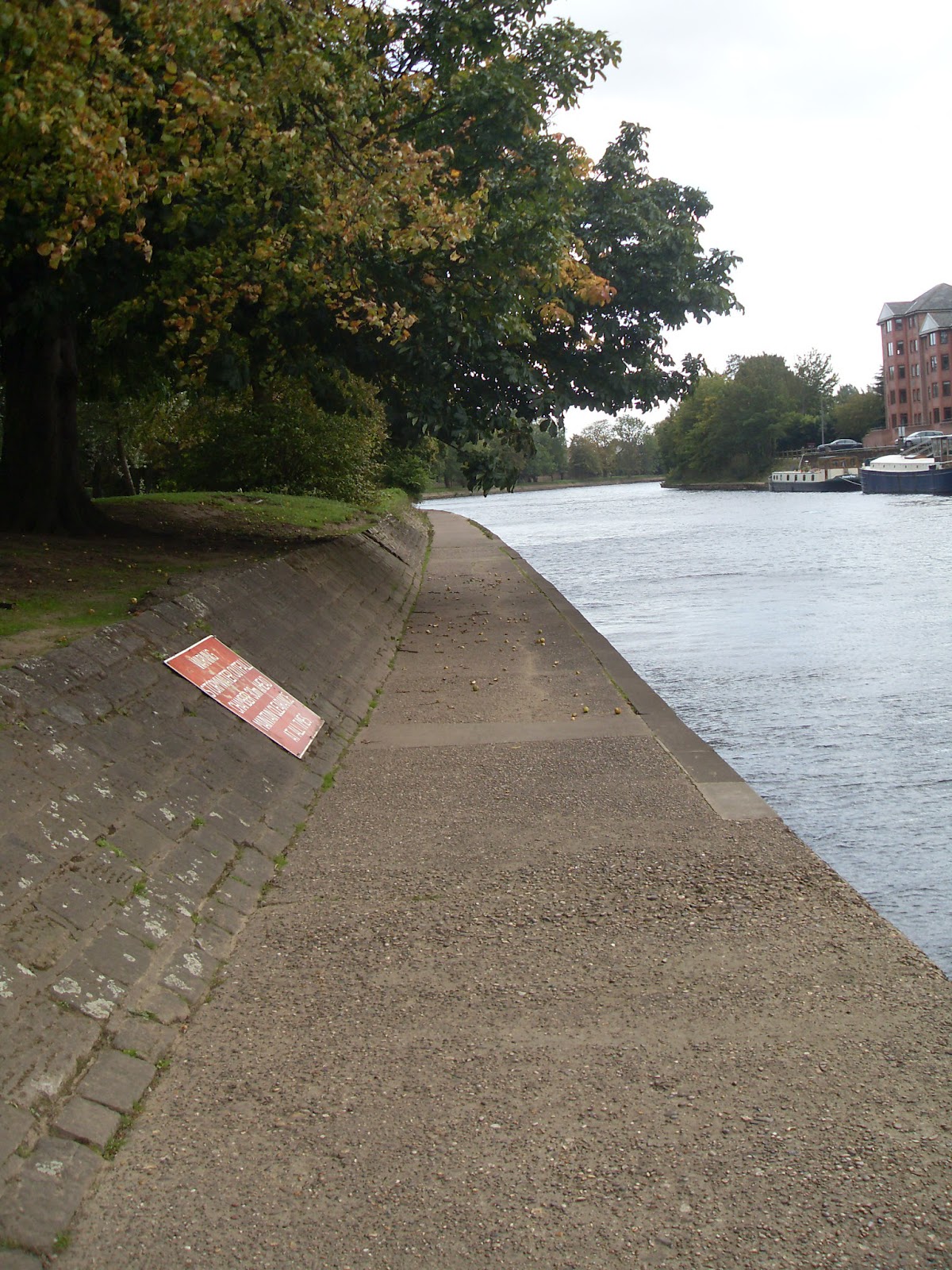
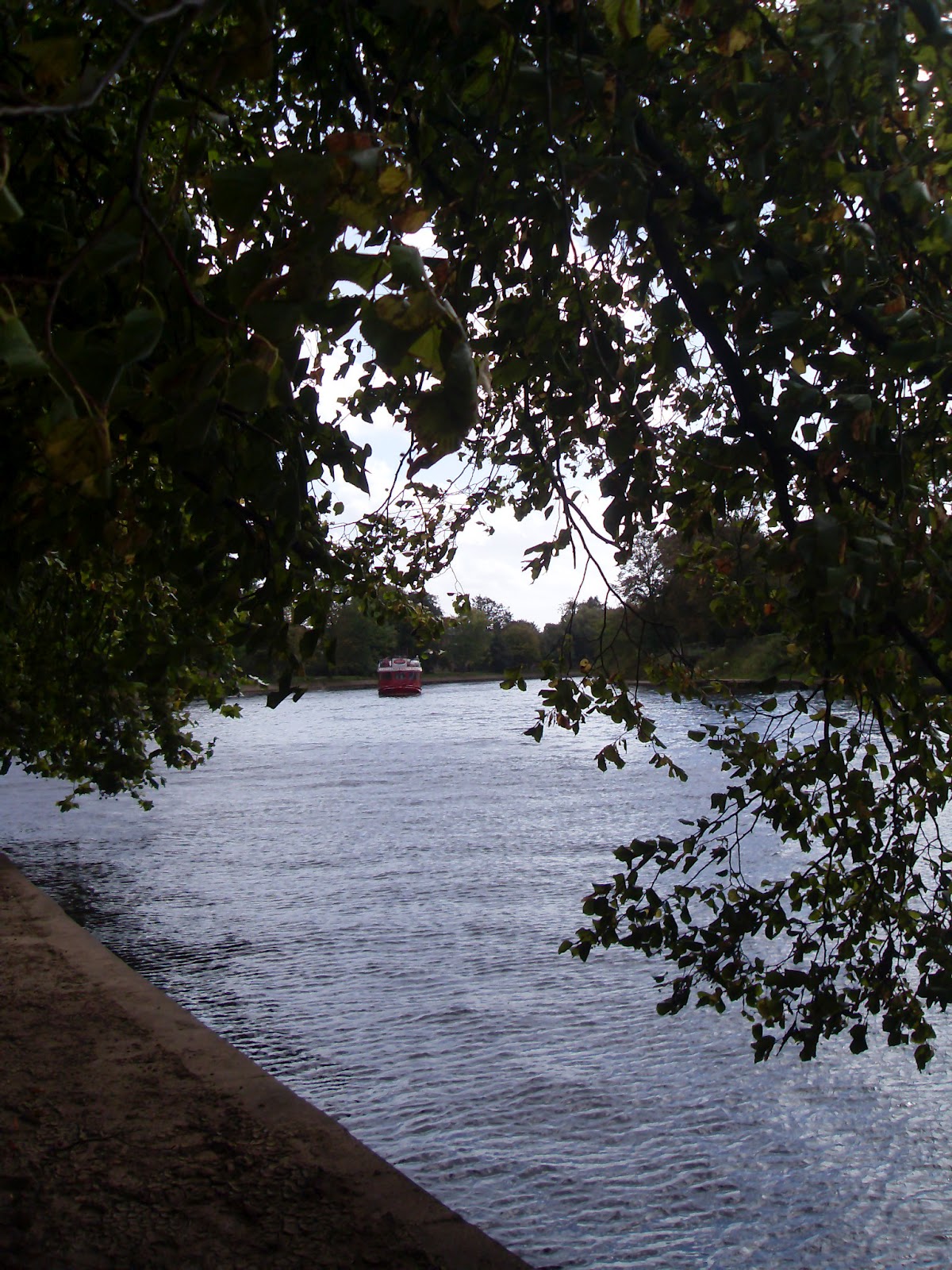
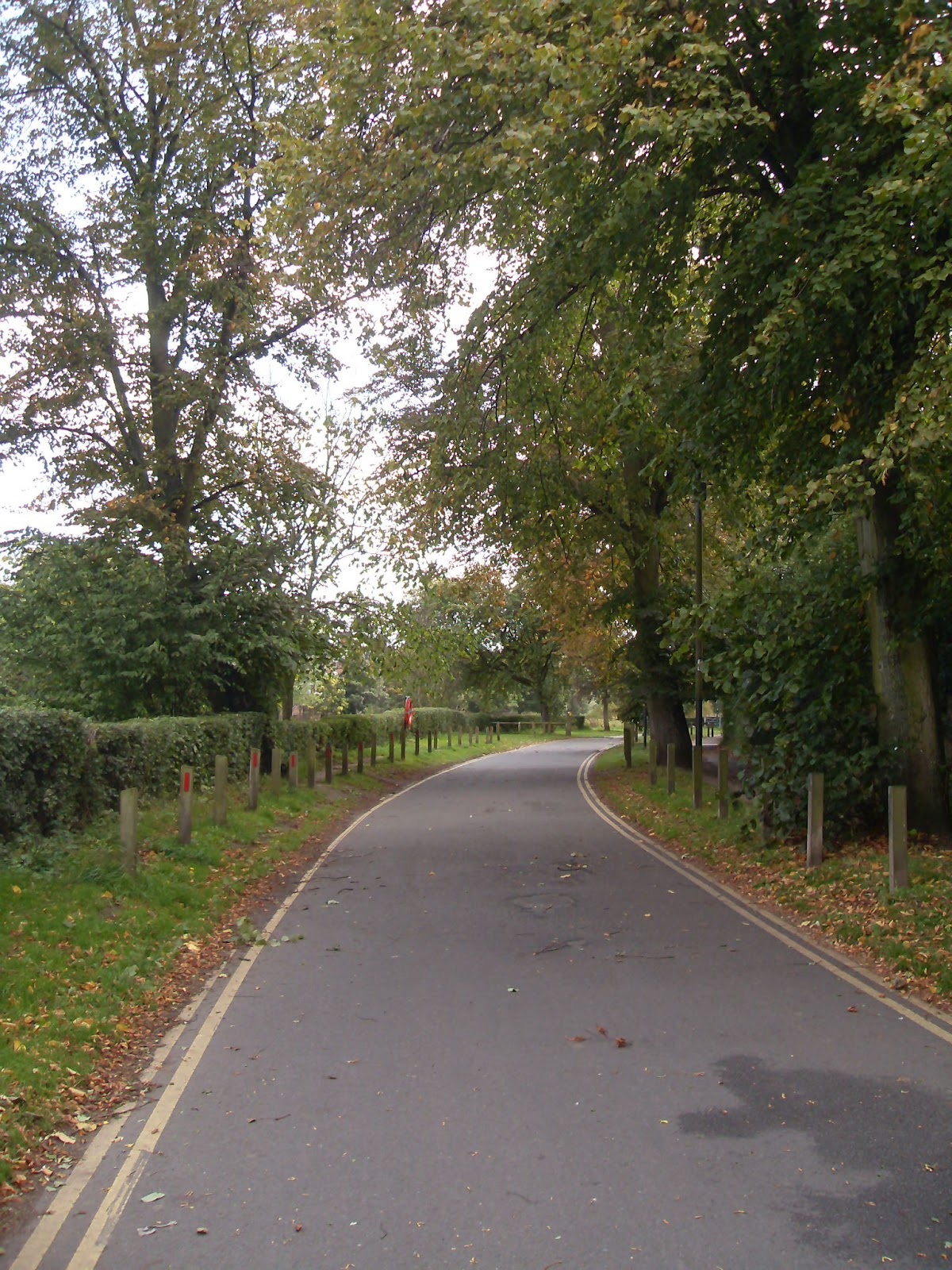
Today the New Walk offer a completely different experience to the modern walker than to the pedestrian of ages past, partly because of the changes in the surrounding geography, and partly - but perhaps most importantly - because of the changes in local society that makes the goals of its founders redundant. Today the City of York is in itself a major attraction for pedestrians. Cars are not allowed to drive certain streets within given timeframes, the majority of tourist attractions can be found within the city walls - themselves a pedestrian attraction - and numerous walks are arranged throughout the city that allow the walker to experience the city's history in a specific way. This shift has, however, restored one of the main features of the New Walk: here one can truly escape the hustle and bustle of the city, the commotion of streets packed with tourists and enjoy some peaceful solitude along the bank of the River Ouse.


When I returned to York in September 2011 I took the opportunity to take a solitary stroll up the river one beautiful summer day. The water level was sufficiently low to allow walking on the embankment between the river and the trees, but to my great delight - I have become very fascinated with this particular feature of the Ouse - the vestiges of a previous flood could still be seen in the footprints perforating the dried and cracked mud.


  One day, about noon, I was walking along the shore toward my boat, when, looking down, I saw in the sand the print of a man's naked foot.
- Robinson Crusoe, Daniel Defoe


After a short while I came upon the Blue Bridge, a curiously designed construction that has been rebuilt four times since 1738. The first bridge was made of wood, had a high-pitched roof and costed 100£, while the modern version is made of metal and was raised in 1929. In 1858 the Blue Bridge was flanked by two Russians cannons - spoil from the Crimean War - but these were melted down in World War II.


 In the background we see the Foss Barrier, a structure built after the severe floods of 1979 and 1982 to protect the city centre.


Past the Blue Bridge the scenery becomes more idyllic as the city disappears into the distance and the landscape beyond the river is dominated by a more forested landscape, allowing the walker to ignore the housing estate on his or her left-hand side. The Walk continues past Pikeing Well of which only its well-head is extant. This was commissioned by the York City Corporation in 1752 and constructed by the architect John Carr (1723-1807) at the cost of 80£. Pikeing Well was said to have curative properties and Lady Mary Wortley Montagu (d. 1762) was advised to let her son bathe here to cure his rickets.


                                                                            Pikeing Well

 
The natural end point of the New Walk is Millennium Bridge, constructed by the engineering firm Whitby Bird and Partners of London and opened to the public in 2000. From here the walker can either retrace his or her steps or cross the bridge and return to the city past Rowntree Park. I chose the latter.


Millennium Bridge is the first permanent bridge on this location. Prior to its construction the only means of traffic was a ferry operating between the New Walk and Clementhorpe. In 1955 a temporary bridge was put in place for the York Tattoo.

 
On my way back to the city I kept a lookout for the tansy beetle, a species of coleoptera located solely by the banks of the River Ouse. Its decline owes to the reduced availability of the tansy plant, its main foodsource. Unfortunately I was unable to find the beetle, but I did come across some other examples of the local wildlife.


As I was taking the above pictures I was accosted by a lady who asked me if I had been taking pictures of the push-chairs. I realised that lurching by the the fence of Rowntree Parkwith a camera and a hood pulled over my head - it was a windy day - was perhaps not the smartest thing to do. I was a bit taken aback by the question, but I appreciated her concern, knowing full well that my scruffy beard justified the assumption that I was a pervert. Fortunately she was convinced of my innocence when I showed her that none of the pictures featured push-chairs or humans for that matter.


Rowntree Park was a gift from Rowntree & Company Ltd. to the citizens of York and the City Corporation in 1921. The park was meant as a memorial to the staff of the cocoa company who fell in the Great War, while the gates were donated in 1955 as a memorial of World War II.


The New Walk is a nice change from the cityscape of York and leads you into a very different part of the local geography. As always in York history never lets go and modernity never fully retreats or stops, so the blend of old and new so integral to this wonderful city remains a salient feature even in the farthest reaches of the Walk. This probably accounts a great deal for its charm, as does the fact that tourists do not seem to seek out this locality.