And was the holy Lamb of God,
On Englands pleasant pastures seen!
- And did those feet, William Blake
Viser innlegg med etiketten Ribe. Vis alle innlegg

lørdag 19. februar 2022

The biggest book so far

 
We do not always foresee the consequences of our actions. About two weeks ago, I ordered a book through the university library, which is practically a daily pastime for me whenever I have access to an interlibrary loan system. Earlier this week the book arrived, but when I went to the library to collect it, the librarian was at first unable to find it in the shelves reserved for interlibrary loans. I then noticed that on top of the relatively low book case someone had placed a behemoth of a book, and with a slight worry that soon proved to be justified I suggested that this might be the one in question. Returning to my office turned out to be the most gruelling bout of exercise I have had since Christmas, not least because the spine of the monster contained an unrepaired tear that could easily become enlarged if handled carelessly. 


The book in question is the eighth volume of Corpus Codicum Danicorum Medii Aevi, a series of editions and facsimiles of books from the Danish Middle Ages. I needed this particular volume since it contains an edition of a collection of various letters and charters pertaining to the cathedral church of Ribe in Denmark. This collection is colloquially known as "Ribe Oldemoder", the Ribe great-grandmother, and was begun at the end of the thirteenth century. The source is both famous in Danish medievalist circles and of course very important for our understanding of medieval Denmark. I had hoped that this fame and popularity would have ensured that it had been issued in a slightly more manageable format. It turned out I was very naïve in thinking so. 

Aside from an unexpected training session, the book also provided me with a new personal record in biggest book borrowed. To better appreciate the size of this gargantuan specimen, I have placed it next to one of the two volumes of the Oxford Medieval Texts edition of Gesta Danorum by Saxo Grammaticus (fl.c.1200), mainly because this was the fattest volume I could find in my office, but also because I found it symmetrically pleasing to compare two Danish books with one another. The previous record for biggest book borrowed was held by a mid-twentieth-century reprint of an early modern edition of Vincent of Beauvais' Speculum Historiale, which I first handled a few months after the defence of my MA dissertation. While that book was indeed unwieldy, it had nothing of the back-breaking qualities that have ensured this volume of Corpus Codicum Danicorum Medii Aevi its first place in a competition inadvertently initiated in 2013.   

søndag 29. august 2021

The price of books in twelfth-century Denmark

 
In a recent blogpost, I wrote about an episode from the Danish town of Ribe which occurred in the twelfth century. The episode is recorded in the Chronicon Ripense, or the Ribe Chronicle, from c.1230. This brief chronicle is a treasure trove of information about medieval Denmark, and although a lot of its details should be accepted only with great caution, it does shed light on several interesting aspects of its time. One such aspect is the value of books. 

Chronicon Ripense is known in modern Danish as "Ribe bispekrønike", i.e., the chronicle of the bishops of Ribe. As is often the case with texts composed in the Middle Ages, we cannot be sure how they were referred to by their authors or by others in their time, and even the Latin title is a modern appellation. The Danish title is perhaps the most accurate, as the book is predominantly concerned with the reigns of the various bishops of Ribe. 

One of these bishops was Homer, who was ordained in 1186. It was customary for newly-appointed bishops to bestow gifts on their new churches, and Bishop Homer turned out to be a lavish gift-giver. The chronicler records a chalice made of gold, a censer or a thurible made of silver, various vessels or bottles made of silver, and a collection of books in six volumes. It is not specified which books these were, but it is likely that they were books of the Bible, as one-volume bibles were rare at this time and the individual biblical books were often bound together according to their connection with one another. It was common, for instance, to group the four Gospels and the Acts of the Apostles. It is possible that this book collection also contained liturgical books, such as breviaries and psalters, but it would be more probable, and more practical, for these books to be bound in single volumes since they were used more frequently during the divine services. 

The chronicler adds that the preparation of this six-volume collection required sixty marks in gold. Thanks to a number of other sums recorded throughout the chronicle, we are able to better understand just how much money this was in medieval Denmark. For instance, it is also recorded that the same Bishop Homer donated one mark in gold for the adornment of the altar of the parish church of Hellevad.

In another section, the chronicler records that after the burning of Itzehoe in Holstein, King Valdemar II (r.1202-41) donated thirty marks - it is not specified whether it was in gold or in silver - to the rebuilding of the Church of Saint Lawrence. In the same period, 700 marks in silver was the ransom demanded for Bishop Tuvo. 

A mark is a notoriously imprecise unit of currency, as it depends on the material and also the measurement, since various cities, city-states or kingdoms could have different definitions of marks. This becomes clear when the chronicler records how King Valdemar II was taken captive together with his son, and ransomed for 60 000 Lübeck marks of silver.  

Together, these instances provide some points of orientation for understanding the price of books in twelfth-century Denmark. Granted, these points are vague and imprecise, but the chronicle does offer an interesting insight into the cost of binding books, and the value of such books as gifts bestowed by a newly-ordained Danish bishop. 

tirsdag 10. august 2021

An interdict from Saint Lawrence's day - ecclesiastical conflict in twelfth-century Ribe


Today, August 10, is the feast of Saint Lawrence, an early Christian saint made famous, in part, through his inclusion in the hagiographic poem Liber Peristephanon, book of the martyrs, by Prudentius. Lawrence, or Laurentius, was one of the major universal saints of Latin Christendom, and his feast was celebrated in all calendars. The present blogpost, however, is not so much about Saint Lawrence, interesting though he is, but rather about an event in which Lawrence's feast-day figures as a temporal marker. The event unfolded in the Danish episcopal see of Ribe, and it is recorded in the anonymous Chronicon Ripense, Chronicle of Ribe, believed to have been written c.1230. The chronicle has been edited by Ellen Jørgensen, and there exists a Danish translation by Helge Søgaard.


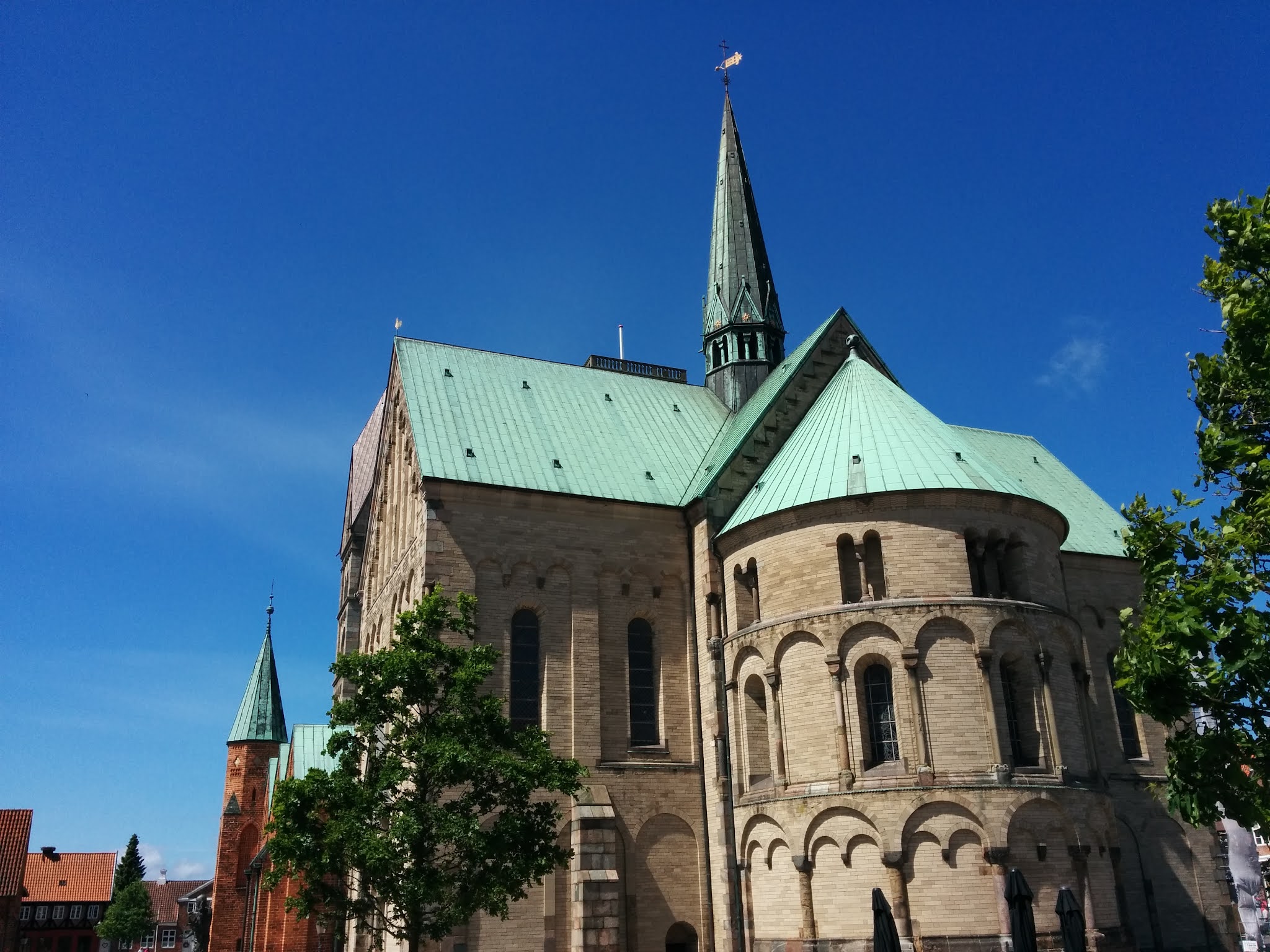
Ribe Cathedral 


The anonymous account provides an overview of the episcopacy of Radulph, an Englishman who had been the chancellor of King Valdemar I (r.1157-82) and who became bishop of Ribe around 1160. The chronicle's dating is imprecise, and Helge Søgaard suggests that Radulph began as bishop in 1162, whereas the surviving text of the chronicle has 1152 instead. Radulph was a controversial man, and his inauguration as bishop was delayed four years pending charges of murder and apostasy, but eventually he began his office as bishop of Ribe.  


The episcopacy of Radulph was a dynamic period, perhaps in part due to the ongoing rift between the Danish archbishop, Eskil of Lund, and King Valdemar I. One episode, the one that I will focus on here, provides a view of one of the rifts between the bishop and the clerics at the cathedral. According to Chronicon Ripense, Bishop Radulph sought to appoint his chaplain, a certain Vincent, as a cathedral canon. The other canons were deeply averse to this, and the reason appears to be that a canon should be elected by the other canons, and not appointed by the bishop. The hierarchical structure of the church community was clearly delineated, and the election of its members was one of the prerogatives of the chapter of canons. 

The matter of Vincent's appointment was so contentious that it came to blows, and the anonymous Ribe chronicler describes how the bishop's clothes were torn, and how the head of the cathedral school, a certain Boniface, was beaten up in the chapter house. Judging from the location, this must have been during one of the regular community meetings, that in most, if not all, ecclesiastic and monastic communities took place in chapter. The conflict led to an interdict being placed on Ribe, and this interdict - during which all church services in the diocese were null and void - began on August 10, Saint Lawrence's day, and lasted until Maundy Thursday. The right of the canons to elect their members was then confirmed. 


The story of the tumult in Ribe cathedral might at first seem odd, or perhaps amusing, but most importantly it is a window into the complex world of medieval ecclesiastic and monastic communities. These communities were comprised of people of diverse personalities, and often with diverse aims and opinions about how to achieve those aims. They were communities in which life was balanced by rights and duties, privileges and demands, and where life was guided by custom and institutional identity. For the canons at Ribe, the appointment of someone by the bishop was a breach of that balance by which the community sustained itself. Consequently, that the controversy resulted in a fist fight is not necessarily indicative of the ease with which medieval ecclesiastics resorted to violence - although that was by no means rare - but it should perhaps primarily be seen as an indicator of how serious this matrix of rights and duties were to the canons. We are reminded, in other words, that the medieval world was, as all human worlds are, infinitely complex and often surprising. 


mandag 22. mai 2017

The tooth of time - a little nugget from Ribe


As mentioned in the previous blogpost, the beginning of last week was spent in the southwestern Danish town of Ribe, an important medieval bishopric and now a quaint, lovely, old-fashioned, seemingly timelocked settlement near the Jutland coast. There are several gems to be found around the town, some of which are big and striking like the medieval cathedral, some of which are small and easy to overlook like the many beautifully and creatively painted doors.

One such little gem is a bronze sculpture situated outside Ribe Viking Museum. The sculpture was created by the Danish artist John Olesen (b. 1938) in 1995, and now welcomes visitors who seek to get closer to ages past by exploring the many treasures of the museum. The idea of "the tooth of time", which is "tidens tand" in Danish and "tidens tann/tidas tann" in Norwegian (Bokmål and Nynorsk respectively), is a Scandinavian expression to denote the passing of time left visibly on objects. We say that something has been marked by the tooth of time, an image of quiet nibbling that I find very pleasing and immensely poetic. A very fitting concept to be reminded of before stepping into a museum to behold items that have been gnawed away by the tooth of time.


fredag 19. mai 2017

Saint George in Ribe


Earler this week, my colleages and I went to Ribe for our annual gathering, the one time of the year when our two branches of the Centre for Medieval Literature meet to discuss academic matters, catch up on each others' research, and to socialise in a place with medieval connections. Ribe is a small town in the southwest of Jutland. It is colloquially known as Denmark's oldest town, as it was one of Scandinavia's most important trading sites during the pre-conversion period. After the conversion of Denmark, Ribe became a bishopric and its cathedral has still layers from the twelfth and the thirteenth century.

I hope to return to a more general description of the church itself later, but for now I present you with one of my favourite details from the church space, found at the western end of the northern side naves, namely a glorious depiction of Saint George fighting the dragon. I'm tempted to think that the female figure placed above the two combatants is princess Alexandra, the maiden saved by Saint George - and in older calendars she was also venerated as a saint - but it might also be a different figure altogether, possibly the Virgin Mary.

I have not found any information about when this set of wooden sculptures were made, but I hazard to guess early sixteenth century. It is certainly not modern, and it is a wonderful depiction of one of my favourite scenes from hagiographic art.