And was the holy Lamb of God,
On Englands pleasant pastures seen!
- And did those feet, William Blake
Viser innlegg med etiketten Dante Alighieri. Vis alle innlegg

fredag 26. oktober 2018

The hunt of the griffin - a detail from Trogir cathedral


In a previous blogpost I gave a brief introduction to the portal of the cathedral of Trogir in Croatia. The main parts of this portal were carved by the master mason Radovan in the mid-thirteenth century, and as a whole the portal displays familiarity with both Northern Italian as well as Byzantine iconography. In its complex net of images and stories, the portal of Radovan is an exceedingly beautiful example of the skill of medieval masons, and it also provides a great example of the iconographical influences that shaped the art of medieval Croatia.

One example I want to highlight here is a hunting scene in which a griffin is depicted in the moment it captures a pig. The griffin is a familiar feature in medieval iconography, and its medieval reception history is complex and long. In The Divine Comedy, for instance, Dante describes how a griffin was drawing the car of Beatrice and in this the griffin belonged to the side of good. However, griffins could also be representatives of the wild regions beyond Christendom where paganism reigned and where there were no civilisations. This can be seen in how griffins were described in Pliny, who relied on Herodotus' description which in turn relied on the now-lost work of Aristeias. According to this classical tradition, griffins were guardians of gemstone mines in the far north near the cave Geskleithron, the abode of Boreas the north wind. These mines the griffins guarded from attacks by the one-eyed nation of the Arimaspi.

The depiction of the griffin in Radovan's portal is also a demonstration of the griffin's fierce aspect. Here we see the griffin in the moment it has struck a helpless pig and begun biting its face. This scene is remarkable for its beautiful execution. Moreover, it is noteworthy for its typicality. This scene is one that can be found in various versions in medieval bestiaries, where the antagonism between the griffin and the pig is firmly established. As such, Radovan's depiction not only displays his skill but also his familiarity with an established icongoraphical canon that in consequence reminds us that medieval Croatia was not a strange periphery but part of a wide-reaching network of ideas and images that spanned the Latin West and beyond.


Griffin and pig by Master Radovan


fredag 20. desember 2013

Et in Arcadia ego


in Arcadia there were born
A shepherd
- The Faithful Shepherd, Giambattista Guarini (translated by Richard Fanshawe)


Les Bergers d'Arcadie, Nicholas Poussin (1637-38)
Courtesy of Wikimedia Commons

In my previous blogpost I gave a brief introduction to the development of the vanitas motif in art, and this blogposts examines another step in this evolution, namely the motif of death in Arcadia, collectively known as Et in Arcadia ego. This artistic genre draws on a long legacy of bucolic writing reaching back into Greek and Roman literature, with Vergilius' Bucolica and Georgica, pastoral eclogues detailing the idyllic life of shepherds, as perhaps the most important works. They retained their popularity throughout the Middle Ages, and Vergilius' position in the eyes of the medieval learned is perfectly exemplified by his role as Dante's guide through Hell and Purgatory.

In the 16th century pastoral poetry gained increased momentum with the critical debates concerning Aristotle's Poetics, which had been translated into Latin late in the preceding century. Aristotle's rules of drama gave rise to the modern theatre, and also caused a lot of controversy among literary theorists who sought to reconcile the Poetics with Horatius' Ars Poetica, and some of the key points of tension were whether the satyr play and the shepherd play were the same, and whether either could be seen as a genre of its own on par with the tragedy and the comedy. As these definitions were tried and experimented with, a significant body of pastoral literature arose. This occurred primarily in Italy, but several important works were also written in England. These pastoral works were often composed for the court, and frequently contrasted the deceits of courtly life with the simplicity of the pastoral scene, often represented by Arcadia, a region in Greece that had become synonymous with The Pastoral Idyll.

Woodcut from second eclogue of Spenser's Shepheardes Calender, 1579
Courtesy of this website

Among the most important literary works to shape the late medieval and early modern pastoral were the plays Aminta (1573) by Torquato Tasso and The Faithful Shepherd (1590) by Giambattista Guarini. These were not only texts to be performed, but statements in the ongoing debate on genre, where the views of the playwright were put to paper and then executed on stage. The Arcadian scene was already a long-standing feature in Italian literature, from Jacopo Sannazzaro's very influential poem Arcadia from 1504 and onwards. This tradition also influenced English writers of the times, and among the foremost are Edmund Spenser, who wrote his Shepheardes Calender in 1579 in imitation of Vergilius, and Sir Philip Sidney, whose The Duchess of Pembroke's Arcadia drew on Sannazzaro's poem, among others.

In the 17th century, this pastoral tradition was merged with the contemporary vanitas motif in art, and resulted in some beautiful and deeply unsettling paintings, where the pastoral idyll was disrupted by the discovery of death's presence, even in the blissful Arcadia. The first example of this sub-genre, that I know of, is a painting by Giovanni Francesco Barbieri executed in the the period 1618-22. Barbieri, also known as Guercino, or the Squinter, here depicts two shepherds discovering a human skull, the proof that death also lurks in the blessed Arcadia. This sinister composition is given extra gravity when compared with another of Guercino's paintings, Apollo and Marsyas, where the same shepherds are witness to Marsyas' penalty, as seen below.

Et in Arcadia Ego, Guercino (1618-22)
Courtesy of Wikimedia Commons

Apollon and Marsyas, Guercino (1618)
Courtesy of Wikigallery

The most famous rendition of death in Arcadia was painted by Nicholas Poussin in 1637-38 and titled Les Bergers d'Arcadie, The Shepherds of Arcadia, as seen above. This iconic painting of shepherds examining a tomb was, however, a later variation of the theme, and the first painting was finished in 1627 with a slightly different composition as seen below.

Les Bergers d'Arcadie, Nicholas Poussin (1627)

These doleful meditations on death's omnipresence are a very beautiful confluence of the vanitas motif and the literary pastoral, evoking the mythological register of Arcadia while playing on the symbolism of the vanitas in a manner worthy of the rising Baroque of the first half of the 17th century, giving a contemporary touch to elements of a rich and long-standing history.


Bibliography

Hagen, Margareth,
1500 - poetikk, intertekst og sjanger i italiensk 1500-tallslitteratur, 2013

Hayward, Malcolm, introduction to Torquato Tasso's
Aminta, 1997: http://www.english.iup.edu/mhayward/aminta.htm

Penman, Bruce, Five Italian Renaissance Comedies, Penguin Classics, 1978


fredag 18. oktober 2013

The Humility of Snails, part 2 - The snail and the knight


For all those who exalt themselves will be humbled, and those who humble themselves will be exalted.
- Luke 14: 11


In my previous blogpost I launched the suggestion that snails in medieval marginalia might be read as symbols of humility, often depicted in contrast to the prideful life of knights and warriors. Furthermore, I suggested that this symbolism was influenced by the paradigm of sanctity that emerged with the foundation of mendicant orders, in which humility was now associated with good works, self-abnegation and a reclusive lifestyle. This is a change from the 12th-century, in which humility and warfare were often twin virtues, inspired by the legends of St. Alexis of Odessa and exemplified with the emergence of the orders of warrior monks such as the Knights Templar and the Hospitallers. This is of course not to say that the mendicant orders were in opposition to the crusades. On the contrary, the Franciscan liturgy for St. Louis - composed towards the turn of the 13th century - praises him for his crusades and viewed them as an imitatio Christi. However, warfare became frequently disassociated with sanctity in the 13th century, and Louis is therefore more a deviation proving the point than anything else.

This two-part exploration was triggered by a recent blogpost from the ever-so-lovely British Library's medieval blog, and the piece in question was written by Sarah J. Biggs. In this second part, I will provide examples from several manuscripts from the time of this paradigm of sanctity and into the 15th century, looking at how well they fit with the idea that the snail is a symbol for humility. For the pictures from MS. Yates Thomspon 27 I am gratefully indebted to Robert Miller. Almost all pictures courtesy of the British Library.


The Marginal Snail


The Gorleston Psalter


The Gorleston Psalter, found in Add. MS. 49622, is an English psalter made in the timeframe 1310-24, and contains two depictions of the snail that fit very well with the idea of the snail as a symbol of humility. The first example can be seen above, where a knight has planted his sword in the ground and lifts his hands, pressed together, at the snail as if in devotion. If the slug represents humility and the peaceful life, this scene may show a warrior, a man of pride, casting aside the weapon of his trade in devotion to the virtue which stands in starkest contrast to his own way of life. We might even imagine there has been some sort of combat or debate in advance of this scene, and the knight is now defeated and yield to the humble victor. This idea is strengthened by the second example, as seen below.

Monkey business of the worst kind

Here we see combat depicted, an arrow launched by an ape is flying towards the snail. Apes (distinguished from the monkeys by their lack of tails) were frequently associated with evil and vices in medieval imagination. Bestiaries claimed that they took their name from the fact that they aped after humans, and as such came to represent a mirror-image to the human world, where apes and other simia were doing the devil's work or at least turned the ideals of the Christian world upside down. This ape is clearly at war with humility, and from the look of it he seems to be winning, reminding perhaps the viewer that the devil can overcome mankind's humility.

MS. Yates Thompson 19


Next up is MS. Yates Thompson 19, containing Li Livres dou Trésour, an encyclopedia written in 1264 by Brunetto Latini, the master of Dante Alighieri. The manuscript was made in the timeframe 1315-25 in Northern France. As an encyclopedia it was not exclusively - nor perhaps even primarily - a work of devotion, but we might presume that Christian devotion is not absent from the work.


In the manuscript, as seen above, we find another combat scene featuring a snail, here standing against a charge by an armoured knight. We don't know the outcome, but here we might imagine the haughtiness of war about to do battle with the virtue of humility. This scene is particularly interesting because of another, similar, combat scene, in which the knight's target is not a snail, but a gryllus, otherwise known as a hybrid.


The meaning of such hybrids is still a matter that remains unsolved, but the snail and the gryllus can easily be contrasted as representatives of two different worlds, the virtuous and the viceful, the good and the evil. If this is the case, the scenes above can be said to depict examples of bad and good chivalry respectively, for it was customary in medieval didactic writing to educate through good and bad examples alike, a tradition reaching all the way back to Bede's Historia Ecclesiastica and beyond.
The Luttrell Psalter

This psalter, found in MS. Add 42130, was made in the timeframe 1325-40 on the orders of Geoffrey Luttrell III (1276-1345), a Lincolnshire landowner. The work was carried out in stages and its illumination programme was left unfinished for reasons unknown. The snail found in this psalter is different from the rest here presented, in that it does not seem to interact with anyone, so that it does not invite comparison with a representative of either vices or virtues. It is simply a bas-de-page illumination, yet it might be intented to serve as a mnemonic helper for the psalm text. The text is from Psalm 89 and the snail is just below the verse "Blessed are those who have learned to acclaim you, who walk in the light of your presence". If this snail, too, represents humility or meekness, it certainly fits well with the psalm text in question.

Picture courtesy of this website


The Hours of Yolande of Flanders

This book of hours, following the Use of Paris and found in MS. Yates Thompson 27, was made in the timeframe 1353-63 for Yolande of Flanders. This wonderfully weird book contains three snails, all of which can be successfully read as symbols of humility. It is of course particularly interesting to note that as a female member of high society, Yolande was a representative of that echelon from which the Roman Catholic sanctorale drew many of its new members in the 14th century.


In the selection above we find again the motif of snails and knights. The first seems frightened and awestruck by his encounter with the gastropod, possibly in the realisation that he has erred in his ways, or something in that vein. The second might be considered a continuation of the first scene, and this knight - or the same knight - has succumbed to the mastery of the snail, yielded his pride of arms, perhaps, to the humility so emblematic of 14th-century sainthood.


There is also another fascinating example in this MS., as seen above. What this naked man represents is difficult to say, though if the snail is a symbol of humility this might very well be pride sitting astraddle the animal, chastising it with a club.


Spiegel der Weisheit

The last example in this blogpost takes us out of the 14th-century and the mendicant paradigm of sainthood, and also away from the psalters and books of hours. Like Latini's Books of Treasure, this is an anomaly, but intended as a continuation of the collection so far considered. This book is Ulrich von Pottenstein's Spiegel der Weisheit, here found in MS. Egerton 1121, an Austrian MS. from 1430. Here, as seen below, a snail is standing face to face with a black cat, which, as we know, has accrued a particularly negative reputation. If the snail here, too, is meant as a representative of humility, it is presumably mirroring the wickedness commonly ascribed to the cat. Their symbolic difference may perhaps be exacerbated by the fact that the snail is here rendered in white - though that might also owe to the fact that Southern European snails do have white shells.


Summary remarks

The array of books presented in this two-part blogpost spans a wide variety of literature, about two centuries and several countries. Each has contained some depiction of a snail or a snail-like hybrid. Reading these images as symbols of humility, in tune with the Christian virtues and the emphasis of contemporary sanctity, gives meaning and makes sense of the snails and their companions and environment on the page, both as protagonists facing a viceful foe or as mnemonic devices accompanying the page's text.

This in its turn proves nothing. We have too little information about the extent and the frequency of snail imagery in devotional books - and non-devotional for that matter - to make any broad statements. This has merely been a thought-experiment in which the snail has been interpreted in a particular manner. As I hope to have successfully shown, it is indeed a possible conjecture which fits both with the contemporary currents and the purpose of the books in which most of them are found. Much remains to be done here, and in the future it will be necessary to carefully consider each illumination together with accompanying text and the illumination programmes of their respective books. However, I hope this demonstration has established one possible way of making sense of these images, which might be considered just as plausible as the suggestions put forth by past scholarship.


søndag 15. september 2013

Travels in Tuscany, part 4 - The City of a Hundred Towers


e quella faccia
di là da lui più che l'altre trapunta
ebbe la Santa Chiesa in le sue braccia:

dal Torso fu, e purga per digiuno
l'anguille di Bolsena e la vernaccia
- Purgatorio (XXIV), Dante Alighieri


and that face
Beyond him, more puckered than the rest,

Is that of a man who had the Church in his arms:
He was from Tours, and now fasts to purge himself
Of the Bolsena eels and the sweet wine.
- Translated by Charles Sisson


San Gimignano, seen from Certaldo

The man to whom Dante refers in this canto is Pope Martin IV, who reigned from 1281 to 1285, and who was infamous for his gluttony and therefore set to purge his body of his favourite delicacies in the company of other gluttons on the Sixth Cornice. The eels for which he had such an appetite in his mortal days were steeped in la vernaccia, a wine native of San Gimignano, a Tuscan city Dante once visited on a diplomatic mission, and which can be seen across the river valleys from the city of Certaldo, as seen in the picture above.

Porta San Giovanni


When I visited Tuscany for the conference in Certaldo this summer, I had left one day open in my itinerary for exploring. Certaldo is situated in close proximity to several historical centres, such as Pisa, Florence and Siena, but I was first of all attracted by the small hill town of San Gimignano, known as the city of a hundred towers, some distance south of Certaldo. In the end I decided to spend my day off here rather than Florence, because I thought to myself I would certainly visit Florence some other time, while I might not have the same opportunity to see San Gimignano for the foreseeable future. However, having visited the city of a hundred towers - or twenty-one, as I've heard is the correct number - I now realise I have to return to that city for a more thorough investigation.


Facade of the Franciscan convent, later Templar mansion and, after 1308, a house of the Maltese Order

Agnus Dei

A splendid torchholder

The city of San Gimignano has an old history reaching back to Etruscan times. According to legend it was founded by two Roman brothers who ran away from Rome in the aftermath of the Catiline conspiracy and named Citadel of Selva after one of them. Later it received its current name from Bishop Geminianus, a 4th-century bishop-saint from Modena who was venerated in the city and, according to legend, was counted as its saviour, though I'm not sure on what grounds. Devotion towards Geminianus became significant in the 12th century following a translation of the bishop-saint's relic in 1106. Towards the end of that same century, San Gimignano received its municipal independence from the bishops of Volterra, to whom it had been assigned by King Hugh in 929, apparently the first document to refer to the city.


Situated on the Via Francigena, the pilgrimage route to Rome from France, San Gimignano grew to a rich and formidable hill-town throughout the 13th century thanks to pilgrims, its export of wine and its varied manufacture (including glass and cloth). Its economic prosperity attracted rich families who in their turn gave rise to the town's characteristic towers, a symbol of power and wealth, and though only 21 of them remain today, it is said that as many as 76 towers once stood in the city. In addition, there grew up convents for Franciscans, Dominicans and Augustinians, and even the Templars set their mark upon the cityscape.

Torre Rognosa

Torre del Diavolo

Piazza della Cisterna

Like so many other Italian city-states, San Gimignano had a volatile political history, siding variously with the Ghibellines and the Guelphs. It was for this reason Dante visited the city in 1300, acting as an ambassador for the union of Guelph cities in Tuscany. Whether it was during this stay that the Florentine poet learned of Pope Martin's love of vernaccia-marinated eels I don't know, but I assume Dante himself had opportunity enough to acquaint himself with the sweet wine during his stay.


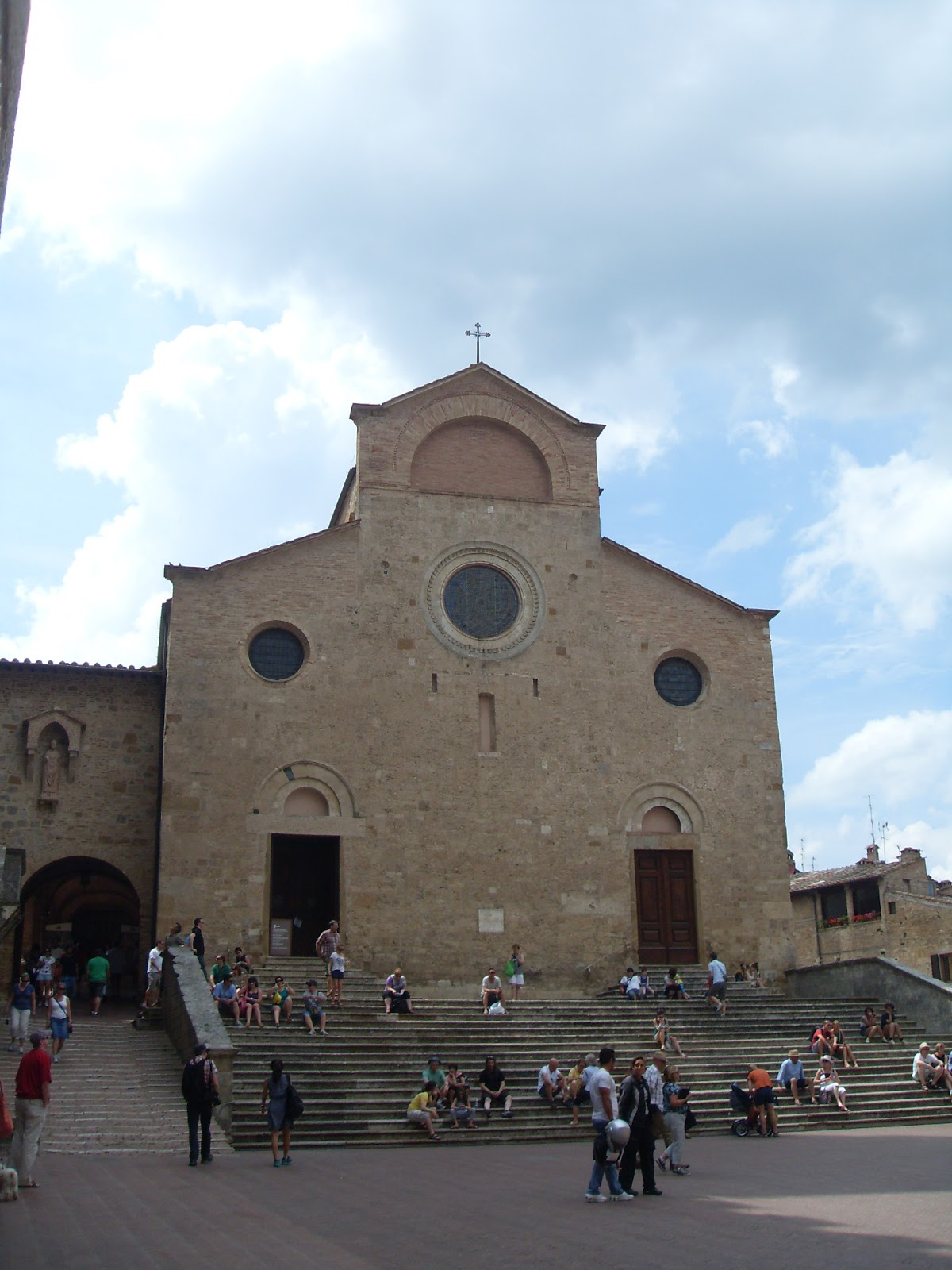
The wealth of San Gimignano resulted in much beautiful architecture and wonderful artistic expressions, and even following the plague's decimation of the populace the 14th century saw many spectacular artistic projects. The walls of San Gimignano's duomo are partcularly rich in this legacy, and the Sienese painter Bartolo di Fredi (c.1330-1410) painted a series of scenes from the Old Testament, which is facing a series of scenes from the New Testament of uncertain provenance. Both these series were completely breathtaking in all their horror and delight, and I could but admire and adore the faith, the talent and the dedication that went into making these frescoes. There is also a beautiful depiction of Saint Sebastian's martyrdom executed by Benozzo Gozzoli (ca.1420-1497) who also painted a frescoe on the same theme in the chiesetta in Certaldo.


The city's medieval architecture is well-preserved and it really would feel like stepping back in time once you enter the Porta San Giovanni, were it not for the ubiquitous and occasionally boisterous tourists who swarm the streets in the summer. However, San Gimignano is so labyrinthine that it is easy to get away from the masses and explore the various arches, tunnels, alleys and walls undisturbed by the vulgar noises. There are also a number of fascinating and interesting sights, from the lowly, intimate churches to the soaring towers, and from the top of the Torre Grossa, reaching 54 meters and constructed in 1311, you have a magnificient view of the Tuscan landscape, and as you stand there and see the distant mountains, the vineyards and the green and luscious valleys it is almost as if you begin to doubt the existence of a world beyond the horizon.


Chiesa di San Bartolo, built in 1173


The Chancery Arch


Chiesa di San Agostino, consecrated in 1298


Courtyard of the late-13th-century town hall


View from Torre Grossa


Piazza del Duomo

With its richness of sights and nooks I didn't have the chance to fully explore San Gimignano the short afternoon I spent there, and I already look forward to revisit the city and see more of its fascinating history.

Piazza della Cisterna dalla Torre Grossa