And was the holy Lamb of God,
On Englands pleasant pastures seen!
- And did those feet, William Blake
Viser innlegg med etiketten Edward the Confessor. Vis alle innlegg

lørdag 30. mai 2026

Saint Julian in a fragment - chance survivals, canonicity, and the cult of saints in medieval Scandinavia


Much of my research deals with questions pertaining to the cult of saints in medieval Scandinavia. This is a topic that labours under the double-edged problem of having both very few surviving sources - making it difficult to make strong claims about certain questions - as well as such a wide variety of source types, making it difficult to have the required expertise to use all these sources together. Concerning the cult of saints, we know that there were many more sources used and produced in medieval Scandinavia than those we have access to today. The surviving sources have, therefore, provided a skewed sense of the saints venerated by the medieval Scandinavians, as well as the stories told about those saints. Due to the source situation - combined with the nationalistic tilt embedded into the foundations of medieval studies in each Scandinavian country - we have a tendency to focus on the cult of native saints, especially the royal saints. Aside from the biblical saints and the most famous of the early Christian saints - especially Laurentius, who was patron saint of the Church of Lund, which became a metropolitan see in 1104 - there has been relatively little work done on the veneration of the saints less known in our own time. Judging from surviving materials, we have a pretty good idea of how popular and important these famous saints were. But we cannot really know whether some of the saints that we consider minor today were, in actuality, major saints throughout the Scandinavian Middle Ages, or at least within one time period or within one milieu. 


I was reminded of this issue earlier this spring, when I was at the Danish National Archives in Copenhagen to research some manuscript fragments. In one of the boxes I had ordered was the upper part of a two-columned page from a twelfth- or early-thirteenth-century manuscript, the text of which is the saint-biography of Julian Martyr, also known as Julian of Le Mans. The fragment is well known in medieval studies and I have seen it mentioned and analysed several times. It is most likely produced in Scandinavia, probably in Norway, and it is a important witness to the earliest stages of native Norwegian manuscript production. The content of the fragment, however, has received much less attention than its codicological, palaeographical and iconographical aspects. This text provides a very good starting point for reflecting on the state of our knowledge about the cult of saints in twelfth-century Norway.


Rigsarkivet, Fr. 251

Rigsarkivet, Fr. 251


Saint Julian was a third-century bishop of Le Mans. Since he was martyred during the heroic age of Christianity in what was later to become France, his cult and his figure appear to have been important elements not only of Le Mans' own identity but also the identity of France as a kingdom having received special divine attention. This kingdom-wide identity was also propped up by the cults of Saint Dionysius of Paris, of Saint Remigius and the Holy Ampulla, and eventually also the cult of Saint Louis IX. The early date of Julian's life and martyrdom also meant that he was included in several early martyrologies and calendars, and his cult was disseminated far and wide. 

In Scandinavia, there are few surviving traces of Julian in the sources. For example, the only sources from Sweden, as far as I am aware, are twelve calendars that contain his feast-day, which is celebrated either on January 26 or Janaury 27. Since most calendars used in medieval Sweden have survived only as fragments, however, the actual number of calendars containing his feast-day was significantly higher. In any case, no other sources are known - not sculptures, not altarpieces, not wall-paintings. I know of no sources from medieval Denmark, although I have not yet checked whether his feast is included in the late-medieval printed breviaries. In Breviarium Nidrosiense, the breviary printed in Paris in 1519 and aimed at the entire Norwegian church province, his feast is not included. In other words, Saint Julian of Le Mans appears to have been virtually unimportant in the cult of saints in medieval Scandinavia. 

However, Saint Julian was at least known, if only in the monastic or ecclesiastical community in which the manuscript containing his passion story was used. We do not know what community this was, but it is likely that the manuscript was a collection of saints' lives produced for - and perhaps at - one of the leading religious centres of twelfth- or early-thirteenth-century Norway. My own hunch is that the original manuscript was a typical hagiographical collection that was used during the Matins of the feast-day of the saints included in the collection. Matins was the divine service in the middle of the night, and it was during this service that the saint was venerated with a liturgical office which included both chants and readings from the saint's biography. The original manuscript, therefore, is likely to have contained the legends of several other saints aside from Julian. 

What, then, are we to make of the inclusion of Saint Julian of Le Mans in this hypothetical, now-lost hagiographical collection. Probably not much. Such collections were typically compiled from available materials, and those materials tended to contain those stories and legends that were widely accessible rather than those which were particularly important to a specific diocese or church province. Put differently, the legend of Saint Julian was sufficiently widespread that it was easy to get hold of. Its appearance in Norway reflects Julian's general canonicity as a saint in Latin Christendom by the late twelfth century rather than the importance of his cult among Norwegian Christians. 

On the other hand, the fact that Julian's legend was available in Norway and accessible at one - if not more - major religious centre should be taken seriously. What happens at such an institution when the available hagiographical material is limited? Do those stories that are available become more important than they otherwise would be? Can the cult of Saint Julian have been strengthened at this institution simply because the clerics or monastics who comprised the institution's community were familiar with his legend? Very likely, because cults tended to be shaped by the personal devotion of those who were part of the veneration of saints at religious centres. Surges in a saint's popularity could be shaped by events that were interpreted as intercession from that saint, it could be shaped by dreams of individuals, of the constant, long-term pressure from exposure to the saint's story. We see this happen in the cult of Edward the Confessor, for instance, whose main promoter before the 1160s was the figure of Osbert of Clare who believed himself to have been healed due to the saint-king's intercession. Might not a similar causality - however imagined - also not affect the cult of a well-known but otherwise not particularly important saint-bishop? 

We do not have any evidence to suggest that the knowledge of Julian's legend made an impact on his cult in medieval Norway. And personally, I do not think it did, simply because this possibility hinges on our knowledge of one sole surviving fragment. However, this reflection is not primarily about Julian or his cult, but about how our ideas about canonicity and the cult of sains is shaped by the chance survivals of sources. The fragment containing part of the prologue of Julian's saint-biography proves that he was known somewhere in medieval Norway, and for at least a period, even if that period might only be the generation of clerics or monastics that first made use of this manuscript. 

As scholars we need to be very careful in assuming that the canon of literature that we imagine today based on the survival of sources is necessarily the same as the canon of literature of the Middle Ages. Indeed, we know very well that the so-called bestsellers of medieval Latin Christendom - such as the Imago Mundi of Honorius of Autun, or the Sententiae of Peter the Lombard - receive much less attention from and are much less accessible to modern readers than works such as Beowulf, which only survives in one single manuscript. The modern medieval canon is, in other words, very different from the medieval medieval canon. Similarly, the cult of saints as we understand it today might have been configured somewhat differently in the Middle Ages, with saints now lost to us or ignored by us having much greater prominence than we will ever know. 


Rigsarkivet, Fr. 251

Rigsarkivet, Fr. 251


fredag 30. mai 2025

Saint Martin and the birds in Salamanca


From the Middle Ages, we have numerous stories about saints and animals. Some of these stories are about animal companions, such as Saint Hugh of Lincoln and his swan. Others are stories of protection (Saint Giles and the wounded hind), stories about healing and recovery  (Saint Thorlak and the lost cow), or stories about control over the animals (Saint Francis and the singing locust, or Saint Edward the Confessor and the nightingales). Regardless of the shape of these stories, they all serve to demonstrate the holiness of the saint in question because of their care for animals or their owners, or because of their miraculous communication with them. These stories also convey the hierarchy of Creation, according to Christian theology, in which humans were set above the beasts and were commanded to be custodians of the earth.  


The various topoi of animals in saint-stories provide a useful background for appreciating a symbolic convergence in the Church of Saint Martin in Salamanca. I went past this church a couple of times when I last visited Salamanca earlier this year, and I happened to note that there is an extensive avian symbolism in both the decoration and the use of the church - all of which has nothing to do with the legend of Saint Martin, but serves to highlight how such coincidences can reinforce pre-existing associations. 


One of the entrances to the church was easily accessible as I walked between my hotel and the university area, and I was entranced by the beautiful carvings on the Romanesque portal, a nice - if partial - survival of the twelfth-century stone church, which has been expanded and renovated at various times. The figure of Saint Martin seen above the portal is most likely form the renovation campaign of 1586, but the figures in the arches of the portal show the typical design of the twelfth century, and also has the wear to be expected of carvings that old. In capitals between the pillars and the arches are several winged creatures, including what appear to be sphinxes, long-necked birds (possibly storks), and harpies. These figures are stock characters in Romanesque art, possibly signifying the wild and chaotic world beyond Christian civilisation which the church visitor leaves behind when entering the hallowed space beyond the doors. 


These figures have nothing to do with Saint Martin and his legend. While there is an avian episode from the story of Martin of Tours - in which he hid among geese to avoid being elected bishop - these particular carvings are part of the portal because they were typical figures of their time. Despite not pertaining to Saint Martin's legend, however, these winged creatures do bring a certain symmetry, not so much to the legend itself, but to the Salamancan church of today. Above the church bell, a pair of storks have built a nest and were flying back and forth across the neighbouring streets. As storks are common in Salamanca, there is nothing uncommon about this sight, nor does it have any particular significance for the legend of Saint Martin. Nonetheless, there is something pleasing about the coincidental convergence of iconography and reality when storks settle on the building dedicated to a saint who hid among birds, and which building is also decorated with several avian creatures, including what might possibly be storks. These are coincidences, serendipities, happenstances - but they do converge in a wonderful way to show how life and art sometimes line up, and when you know the art you can also appreciate this convergence more strongly. And we should expect that medieval venerators of Saint Martin would do just that in case they saw birds nesting on this church in the Middle Ages. 


onsdag 13. oktober 2021

Link: The King’s Three Images: The representation of St. Edward the Confessor in historiography, hagiography and liturgy


I am writing this just past midnight of October 14, but the post itself pertains to October 13, which is the feast of the translation of the relics of Saint Edward the Confessor. 

Long-time readers of my blog might know that I wrote my MA dissertation on the development of his cult in the period 1066-1400. The dissertation was finished in the autumn of 2012, and the work that went into the dissertation is still to this day shaping a lot of my research.  

Since I was reminded of my dissertation today, I was also reminded that I never provided a clear and easy to find weblink to the document itself. The dissertation, "The King’s Three Images: The representation of St. Edward the Confessor in historiography, hagiography and liturgy", is still available on the Internet, and a Pdf file can be downloaded from my alma mater, the Norwegian University of Science and Technology in Trondheim. The link is here: https://ntnuopen.ntnu.no/ntnu-xmlui/handle/11250/243071. 


onsdag 12. oktober 2016

Edward the Confessor, according to William Wordsworth


Today is the feast of the translation of Edward the Confessor. This day celebrates the anniversary of when his dead body was placed in its shrine at Westminster Abbey in recognition of his sainthood, and this took place on October 13, 1163, only two years after his sainthood had been formally acknowledged by Pope Alexander III. A translation, or translatio, is the moving of a saint's remains to a new site, often a shrine placed in such a way that the faithful could see it when they were in the church. October 13 became, in the course of the thirteenth century during the reign of Henry III, the principal feast-day for the Confessor, although this had previously been his death-day, January 5. (For the development of the liturgical feast-days, see this blogpost.)

I have written several blogposts about Edward the Confessor, since his cult was the subject of my MA thesis, and several of these give a thorough account of the development of his cult. This time around, however, I will commemorate the translatio Edwardi by presenting to you a poem by William Wordsworth, "The Norman Conquest" which was the thirty-first of his ecclesiastical sonnets, composed in the period 1821-22. (The text is taken from this website.)

Wordsworth's sonnet only treats Edward very briefly, and rather condescendingly, and it is a clear testimony to how Edward's role in the Norman Conquest was perceived at least by the poet, if not by a wider segment of the British literati. The role of Edward in the prelude to the invasion in 1066 has been a contested issue ever since William the Conqueror laid claim to being Edward's chosen successor (for more on this controversy, see this blogpost).

For William Wordsworth, however, the verdict is clear: It is Edward who is to blame for what he sees as the "evanescence of the Saxon line", presumably meaning the line of Saxon kings which the ecclesiastical sonnets have in part followed up to this point. This testiness towards the changes brought on by the Norman Conquest is probably not that uncommon Wordsworth's own time. At the very least, it is close to the sentiment of Edward Augustus Freeman (1823-97), who wrote in his six-volume The History of the Norman Conquest of England (published between 1867 to 1879). Here, Freeman launches the conviction that the Norman Conquest eradicated English culture to such an extent that it was only the later sainthood of Edward that helped his name survive the Middle Ages.

Whatever the prevalence of Wordsworth's approach to the dramatis personae of the Conquest, the sonnet is a suitable reminder that attitudes are not constant and that Edward who was revered as a saint and patron in the Middle Ages, by the nineteenth century had found himself cast in a very different role


The sigil of Edward the Confessor, as Anglorum basilei, king of the English
Courtesy of Wikimedia


Ecclesiastical Sonnets, XXI - The Norman Conquest

The woman-hearted Confessor prepares
The evanescence of the Saxon line.
Hark! 'tis the tolling Curfew!--the stars shine;
But of the lights that cherish household cares
And festive gladness, burns not one that dares
To twinkle after that dull stroke of thine,
Emblem and instrument, from Thames to Tyne,
Of force that daunts, and cunning that ensnares!
Yet as the terrors of the lordly bell,
That quench, from hut to palace, lamps and fires,           
Touch not the tapers of the sacred quires;
Even so a thraldom, studious to expel
Old laws, and ancient customs to derange,
To Creed or Ritual brings no fatal change.


Similar blogposts

A trip to Westminster Abbey

The cult of Edward the Confessor

Edward the Confessor and Thomas Becket

A poem for Harold Godwinson

Edward the Confessor and the nightingales

tirsdag 19. juli 2016

Saints, Stained glass, and Serendipity


Created purely from glass the saint stands,
Exposing his gifted quite empty hands
- Geoffrey Hill,
In Piam Memoriam


Towards the end of June I arrived in England for an intense bout of conference activities, starting in York for a few days and then continuing to Leeds. It was a hectic period, but by a stroke of luck it all began just in time for me to catch the last performance of the 2016 York Mystery Plays. From the beginning of the performances on 26 May I had seen several favourable comments and many tantalizing pictures from people who had gone to see the plays. I became very envious, especially since I had seen a performance of the 2012 Mystery Plays, and I knew I was missing out. I was therefore very happy when I had managed to procure a ticket for the very last performance in the evening of 30 June.

This year, the Mystery Plays were performed in York Minster, with a stage arranged like the stairs of a temple, with three broader steps on which the action was performed. The top step was Heaven, while the bottom step served both as the entrance to Hell and the tomb of Christ. It was a masterful performance, and I might write more about it at some later point. In this blogpost, however, my focus is a very serendipitous detail of that evening.


Window from the south side of the cathedral

Since the stage of the mystery plays was arranged like a stair, the seating was arranged like in a stadium, and in order to get a good overview I had bought a seat very high up, which brought me level with the first row of stained glass windows. I had been inside the Minster numerous times since my first visit there in 2009, but I have never been that high up and I might never be again. I knew that this might be a once-in-a-lifetime opportunity, so before the play started I made sure to examine the glass of the south wall as well as I could. Suddenly, however, I realized that I had been more fortunate than I could ever have imagined.


Edmund to the left of me, Edward to the right

As I was standing by the railing, I saw that one of the closest windows contained stained glass depicting two saints with which I have become very familiar over the past few years, namely Edmund Martyr and Edward the Confessor. I knew that the two kings were to be found in the wilderness of stained glass in York Minster. I once wrote a blogpost about the iconography of these saints as found in York, and experts on the subject told me that they were there and provided me with details. But there I was, staring them in the face and for the first time seeing them in real life and with my own eyes. I spent a long time trying to take good pictures of the individual windows, and the best results can be seen below. Regular readers of this blog, or people who know me well enough, will know that I have something of an obsession with these two saints, and this obsession has its root in my academic career. I wrote my MA on the cult and literature of Edward the Confessor, and I'm currently working on a PhD thesis in which an examination of the cult material of Edmund Martyr is one of the three major parts.


Edward the Confessor is easily recognized in this right-hand panel. This is not the only depiction of Edward in York Minster, another stained glass window featuring the saintly king can be found in the chapter house vestibule, dated to the latter two decades of the 13th century. In both depictions, however, Edward is seen with the ring, which is perhaps his most famous attribute and the one which is most often used in representations of him in glass, sculpture, painting or illuminations. The ring is of great importance due to the miracle depicted in the stained glass window above.

The miracle of the ring appears first in Aelred of Rievaulx's Vita Sancti Edwardi, which was finished in 1163, two years after Edward's canonization and in time for his translation on October 13. According to Aelred, Edward had once met a beggar who asked for alms, and when Edward realized he had no money on him, he gave the beggar his ring instead. Later, two English knights in the Holy Land were approached by a man who said he was John the Evangelist, and gave them a ring which he asked them to bring to the king of England. This the knights did, and Edward recognized the ring understood the miracle. The miracle of the ring was so famous that it was included in the chapter on John the Evangelist in Legenda Aurea, but with Edmund Martyr in the place of Edward through some strange confusion.


Edmund Martyr is also found other places in the Minster. He is also found among the seven windows of the chapter house, and on a wooden panel once found in the chapter house ceiling (13th century), but now among the treasures of York Minster displayed in the crypt. Edmund is recognized by the arrow he holds in his hand, and this is his most common attribute. The arrow - or sometimes arrows - are the instruments of his torture. According to the first life of Edmund, Passio Eadmundi, which was written by Abbo of Fleury in the 980s, Edmund was seized by a group of Danish Vikings, tied to a tree like Christ on the cross and then pierced through with arrows like Saint Sebastian. When Edmund still refused to submit to the lordship of the Danish chieftain, he was decapitated and his head carried off, but that is another story.


Having worked this much with these two saints, it was a very pleasing serendipity to find myself on the level with these two otherwise inaccessible depictions, and that on the very last day it was possible for me to do so. Such instances of good luck can sometimes be found in the course of academic work, and they are always very welcome and very pleasing.


Similar blogposts


Edmund likened to a hedgehog

Edward the Confessor in the North of England

The miracle of the ring in Legenda Aurea

Edward the Confessor in Dringhouses, York

The cult of Edward the Confessor


søndag 20. mars 2016

Edward the Confessor in Dringhouses


Ever since writing my MA thesis on Edward the Confessor, I've had a minor obsession with all things related to his posthumous cult. Regular readers of this blog will be aware of this already, as might be attested to by the number of blogposts touching on this particular subject (a list of which will be added after the present post).

It was for this reason that I have been haunted by the idea to pay a visit to the Church of Saint Edward at Dringhouses, a village just outside York. Fortunately, while I was staying in York for two months as part of my PhD programme, I lived just about fifteen minutes away from the church and decided that it was high time I had a look around. Typical of my propensity for procrastination, I left it to the very last day I was in York, but luckily I did manage to get around it.  


The belltower. The spire was replaced in 1970


This part is most likely the vestry, which was added in 1902

The inner doorway

The church of Edward the Confessor was built between 1847 and 1849, and upon its completion it was dedicated to Saint Edward. This was in fact a re-dedication, as the new church replaced a church from 1725 which had been dedicated to Saint Helen, which in turn had replaced a chapel dedicated to the same saint. This chapel is mentioned in chantry certificates as early as in 1546 and 1548. The church was financed by the widow of the late Revd. Edward Trafford Leigh, and in memory of her husband she had it dedicated to his namesake saint. Saint Edward's became a parochial church in 1853 when Dringhouses parish was established from parts of the parishes of Holy Trinity and St Mary Bishophill Senior.

Saint Edward's church was constructed in decorated Gothic by the architects Vickers and Hugill (or Hugall) of Pontefract. This is perhaps especially evident in the windows and the doorways with their pointed arches and the leaf-work masonry on their side columns. Although there are several details of such beautiful handicraft, the exterior of the building is not remarkably opulent. The interior of the church is somewhat more so, owing in particular to the many splendid windows of stained glass.

Nave, towards the choir


The oldest stained glass windows were designed by William Wailes in 1849, and these depict figures and scenes from the Bible. The first two windows below are found on the left-hand side of the nave when facing the choir. The first window depict the prophet Elijah (here Elias) with the scene showing him being fed by ravens in the wilderness (1 Kings 17:4-6), and then Moses with the scene showing the rod with the brass serpent (Numbers 21:4-9). The second window shows Saint Simeon holding the Christ-child with a scene from the presentation of Christ in the temple below (Luke 2:25-32), and then John the Baptist with the scene showing the baptism of Christ in the River Jordan (Mark 1:1-8).


In the choir, the central window shows the crucifixion of Christ with Mary and John the Evangelist at his sides, with scenes from the Passion underneath. In the choir on the left-hand side are Matthew and Marcus, while on the right-hand side are Luke and John. Note especially how carefully John is made to be identical with the depiction in the central east window.  


On the right-hand side of the nave the windows depict scenes from the New Testament. The first shows parables of Christ, including the parable of the sower (Mark 3:4-9), the parable of the lost sheep (Matthew 18:12-17), what seems to be the parable of the talents (Matthew 25:14-30). The lower left panel might depict Christ being rejected by a pharisee. The second window shows Christ blessing the children (Matthew 19:14) with angels underneath.  


While the stained glass windows by Wailes were very beautiful, I was chiefly interested in the sundry depictions of Edward the Confessor himself, in order to see how his iconography had been represented. The first depiction of Saint Edward can be found in a niche above the doorway where a statue shows the Confessor, bearded, wearing a crown and holding a ring and a sceptre with a bird on its top.  


This iconography is typical of the tradition of Saint Edward's cult. His appearance as a bearded monarch is attested already in the first biography, written relatively shortly after Edward's death in 1066, now referred to as Vita Ædwardi Regis. His white, and virginal, beard is made into evidence of holiness in the two twelfth-century hagiographies written about him, the first by Osbert of Clare in 1138 and the second by Aelred of Rievaulx in 1163.

The ring and the bird refer to two of the most iconical legends concerning the Confessor. The story of the ring can first be found in Aelred of Rievaulx's Vita Sancti Eadwardi, where it is told that the Confessor gave his ring to a beggar. This beggar turned out to be Saint John the Evangelist in disguise (the Confessor's particular saint), and Saint John, again in the disguise of a beggar, gave the ring to two English knights in the Holy Land, with the orders to take it to the king and report how they had received it. The ring remains the key iconographical feature of Saint Edward. (More on this here.)

The bird is a later feature, but it may have entered the iconography as early as the 13th century. By the end of the fourteenth century, the coat-of-arms of Edward the Confessor was held to be a golden cross on a blue background with golden birds in the open spaces between the cross arms, and one golden bird underneath the cross. We see this from Richard II's merging of his own coat-of-arms with that of Saint Edward.

In time there emerged a legend saying that Edward had once been disturbed by nightingales during prayer, and when he prayed that they should cease their singing for a while they did so. This legend appears to have an early modern date rather than belonging to the medieval tradition. (More on this here.)


Edward the Confessor is also depicted inside the church. We see him on the right-hand side of the altar, where he is flanking Christ in majesty with Saint Peter standing on the left-hand side. The confessor is here surrounded by four angels, two of which are carrying some of the instruments of Christ's passion. Above Saint Edward's head we find his coat-of-arms.


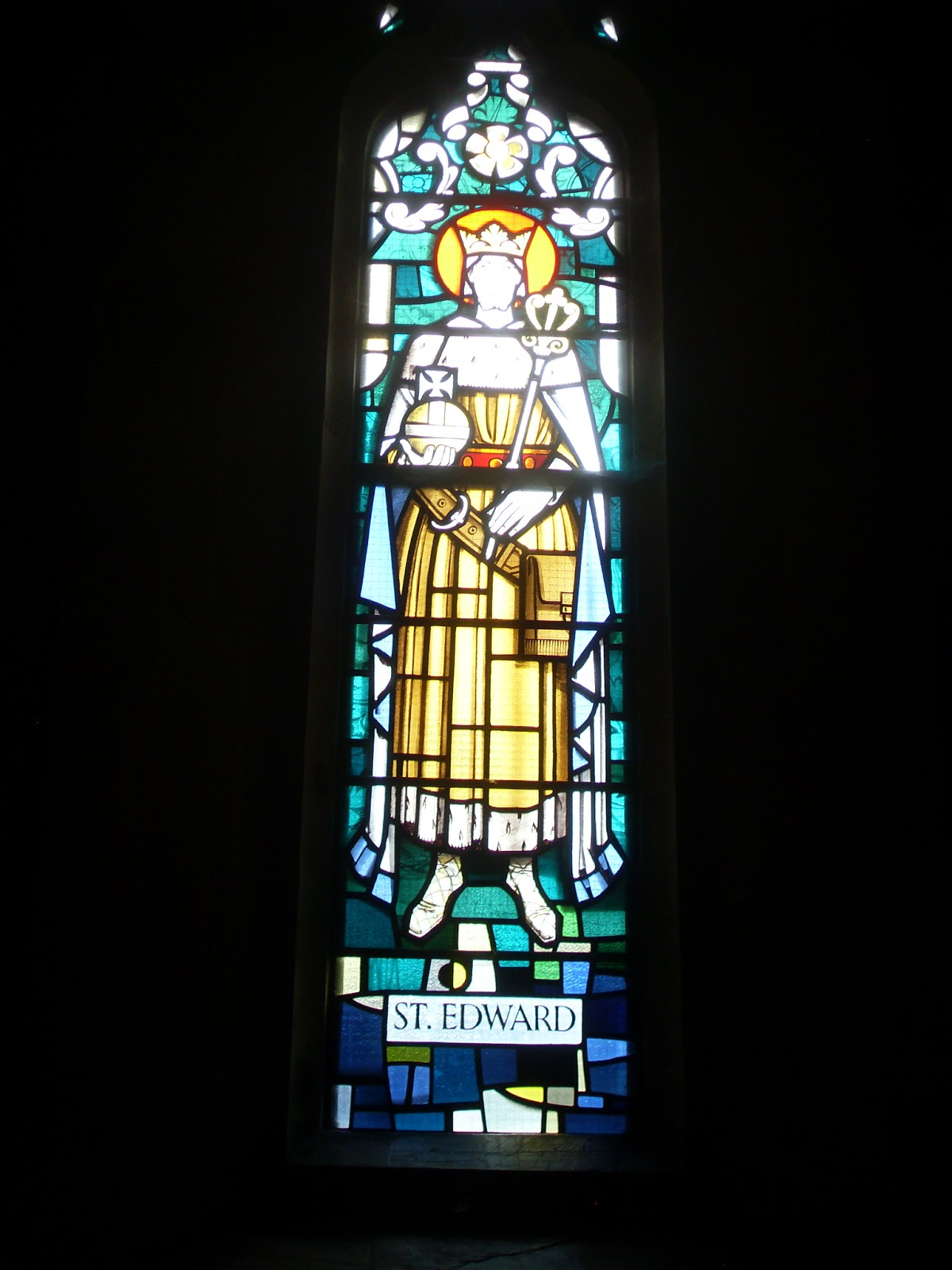
We also find Saint Edward on the left-hand side of the bottom end of the nave (when facing the altar). This is a stained glass window put up in memory of churchwarden G. Raymond Burn who died in 1993. Here the Confessor is shown wearing his regalia, but in a distinctly more royal and notably less legendary form than in the other depictions. 


The dedication of the church has also given name to at least one more place name in Dringhouses, namely St Edward's Close, as depicted below.


Websites:


fredag 26. juni 2015

The Swineherd King


In the preface to his hagiography of Edward the Confessor, Aelred of Rievaulx comments that no other royal house of Europe can look back at such a plethora of saintly kings and queens. However, according to a tradition picked up by Jacobus de Voragine in his Legenda Aurea, the genesis of the British line of monarchs was quite humble, if not downright lowly, as the first in the new line of kings was a swineherd. The story is found in the legend of Saint Germain of Auxerre (c.380-448), a remarkable figure of the early Catholic church and whose life has become saturated with exactly the kind of stories and myths that make his entry in the Legenda Aurea a very entertaining read. 

Saint Germain looking at the opening to the first lesson in an office lectionary
Paris - Bibl. Mazarine - ms. 0399, f.111v, Abbey of Saint-Magloire, Paris, early 15th century Courtesy of enluminures.culture.fr

Germain was born to a noble family. He received a very good education first at Arles and Lyons and then in Rome, and he entered into contact with the imperial court. Eventually, the emperor appointed him duke and ordered him to return to Gaul where he took up residence in his native Auxerre. In 418 he was consecrated bishop of Auxerre, and according to the legend this move from the ducal to the episcopal seat came about in a Pauline conversion, which is a story fit for another time.

After more than ten years in his office, in the early 430s, Germain travelled to Britain together with Lupus to combat the Pelagian heresy which was then thriving in Britain. According to the chronicle of Saint Prosper, this was commissioned by Pope Celestine, while Bede in his Ecclesiastical History claims that Germain was sent by a synod. Germain's journey to the British Isles has also been woven into one of the early lives of Saint Patrick, in which it is claimed that Patrick was part of Germain's retinue. The account of Germain's mission is so suffused with legend that the exact details are winnowed only with difficulty. Jacobus de Voragine covers it very briefly, saying that the two bishops were welcomed by local clergy who had been told of their arrival by demons whom the bishops had driven out of the possessed. This appears to be a garbled version of Bede's account, as Bede tells us that the demons first tried to capsize Germain's ship in the Channel, and when they were chased away they came to England and there took possession of some of the Britons. When Germain came ashore, however, he freed the possessed and chased the demons further away.

It is likely that Jacobus drew on Bede for part of his account of Saint Germain, for Jacobus had access to Bede for some of his legends, though evidently he has here been writing from memory, or has received the story from a faulty source. We know that Jacobus sometimes transmits English material rather imperfectly, and in a previous blogpost I wrote about when he confused Edmund of East Anglia and Edward the Confessor.

Saint Germain looking the other way
Chaumont - BM - ms. 0033, f.319, Breviary, Use of Langres, c.1481
Courtesy of enluminures.culture.fr

As for Germain's campaign against Pelagianism, Jacobus - unlike the far more prolix Bede - merely states that the saint "convinced the heretics of their error" and that was that. Bede then claims that the Catholics went to the shrine of Saint Alban so as to ratify the conversion with the saint's blessing. Jacobus' silence on the matter suggests again that he is not writing this legend with the Ecclesiastical History at hand.

After a while, heresy resumed its grip in Britain and Germain was sent back to deal with it, and it is here we learn of the origins of the British monarchy. Jacbous tells us:

On one occasion while he was preaching in Britain, the king of Britain refused to give shelter to him and his companions. One of the king's swineherds, after feeding his charges and receiveing his wage at the palace,was on the way home and saw Germain and his fellows in sorry straits due to hunger and the cold. He kindly took them to his cottage and had his one and only calf killed for their supper. When the meal was finished, the bishop had all the calf's bones laid upon their hide, and as he prayed over them, the calf stood up whole and entire. The next day Germain accosted the king and asked him bluntly why he had refused him hospitality. The king overcome with astonishment, could think of nothing to say in response. Germain said: "Begone then, and leave the kingdom to a better man!" Then, by God's command, he had the swineherd and his wife summoned, and, to the amazement of all, proclaimed him king. Hence the monarchs who have ruled the British people since then are descendants of that swineherd.
- Jacobus de Voragine, Legenda Aurea (translated by William Granger-Ryan)

Miniature of Saint Germain
MS Egerton 1070, Book of Hours, France, c.1410
Courtesy of British Library

There are several noteworthy things in this passage. First of all, we note the similarity between the resusciation of the calf and the story of the rams of Thor, the Norse god of thunder, which could be flayed and eaten in the evening and be alive and well in the morning. Secondly, the legend casts a Biblical shine on the early British house of kings, since the British kings originate from a swineherd, just as the kings of Israel in Judaic tradition are descendants of the shepherd Saul, anointed by God's prophet Nathan. Since Germain is here acting on God's command, he effectively takes the role of Nathan and replaces the British line of kings with another, hand-picked according to Biblical principles.

I do not know where Jacobus came across this legend, it is certainly not Bede.


Bibliography

Books

Bede, The Ecclesiastical History of the English People, translated by Bertram Colgrave, Oxford World's Classics

Jacobus de Voragine, Legenda Aurea, translated by William Granger-Ryan, Princeton University Press, 2012


Websites

http://www.newadvent.org/cathen/06472b.htm