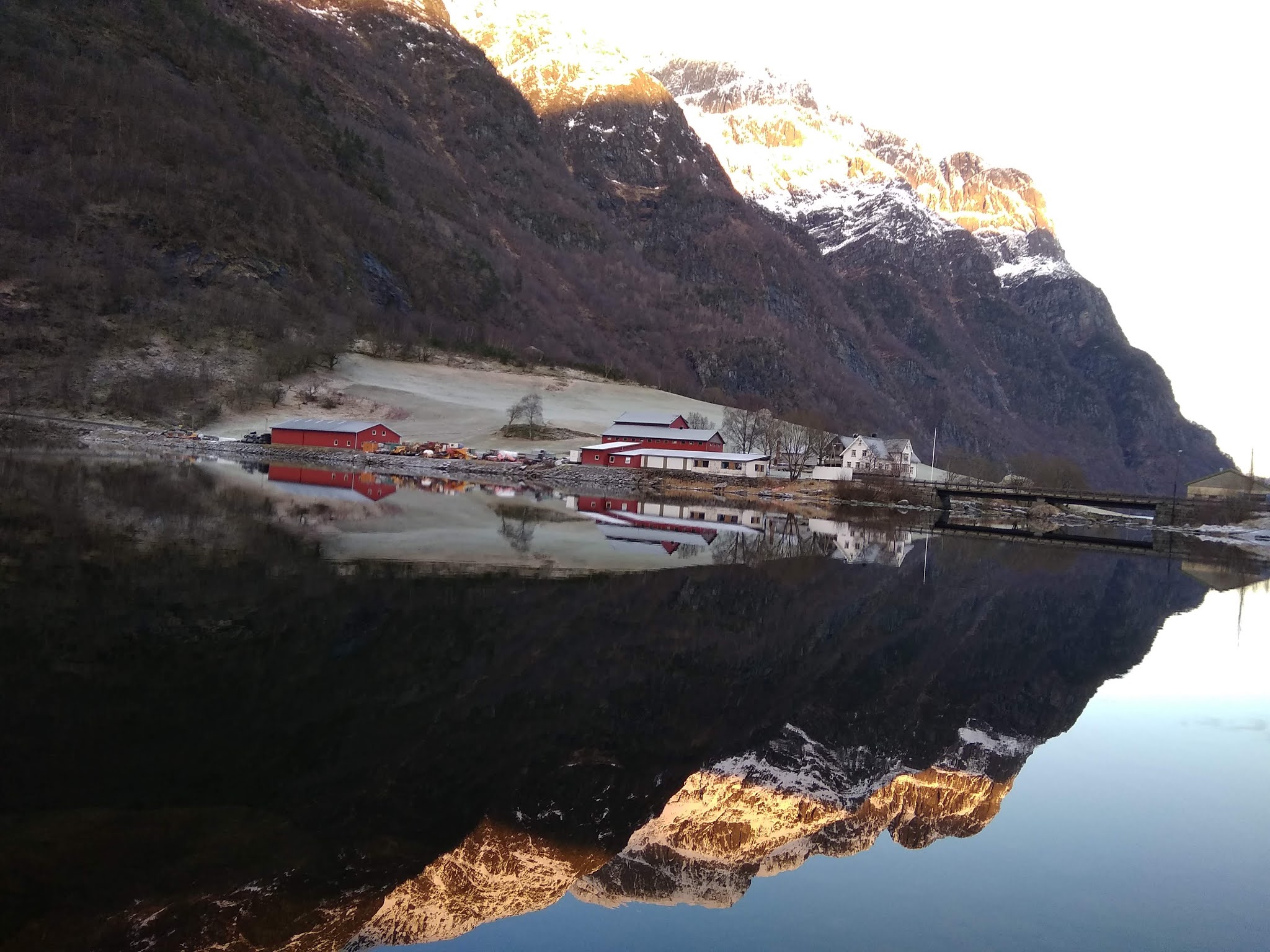
Whenever a year draws to its end, it feels appropriate to find some form of concluding statement or summary that bridges the past months with the months ahead. As this strangest of years comes to a longed-for close, however, I find it difficult to formulate anything that is not either trite or too self-serving or self-centred. Whatever my own experiences and challenges, they have been fairly mild and short-lived compared to what so many others have had to deal with. And although there are things I am likely to talk about at length at a future point out of frustration and anger, it feels pointless to rehearse these now. Instead, I leave this year with a few pictures of my home village this December, to where I was fortunate enough to return at the beginning of the month, and where I was able to quarantine safely and work while enjoying the crisp freshness of the December cold in the fjords. If nothing else, I hope to continue to immerse myself in this landscape in the months ahead.
On Englands pleasant pastures seen!
- And did those feet, William Blake
torsdag 31. desember 2020
December lights in the fjords
tirsdag 29. desember 2020
Saint Thomas of Canterbury at Lund
Today is the feast of Thomas of Canterbury, better known as Thomas Becket, archbishop, who was killed at the altar of Canterbury Cathedral in 1170, when a group of knights broke into the church. The murder must be understood against the six-year-long conflict between Thomas and King Henry II of England about the juridical borders and the power balance between church and king, which in turn was part of a power struggle that marked the political discourse of all of Latin Christendom at the time. When the English strand of this conflict culminated with the death of Thomas, he became a figurehead for the reformists of the church who championed the idea of the supremacy of the church not only in spiritual but also in worldly matters, and also the independence of the church from worldly government. Consequently, Pope Alexander III canonised Thomas in 1173, and his cult was disseminated widely throughout Latin Christendom.
The cult of Saint Thomas of Canterbury came to the Norse world very early, and while we do not know much about the concrete details of the dissemination, we know that there were several routes by which his cult could have travelled to each of the different Nordic countries, such as trade, diplomacy, ecclesiastical connections or monastic networks (in particular the Cistercians). Our earliest sources for Thomas' cult in Denmark can be seen in three stories recorded by William of Canterbury in a miracle collection, while printed breviaries from the Danish archbishopric of Lund can be seen to retain the liturgical repertoire that was imported into Denmark already in the latter quarter of the twelfth century.
While there are many things that deserve to be said about the cult of Thomas in the medieval Norse world, there are also many of those things that need to be more thoroughly researched and that are tied up with various works in progress. So for this blogpost - marking the 850th anniversary of his death and forming part of the hashtag Becket 2020 - I'll limit myself to commenting on a late source that perhaps points to a continuous, or at least long-lasting, popularity around the martyred archbishop in medieval Denmark.
The source in question is a detail I encountered in the breviary of Lund, which was printed in 1517 in Paris. By this time, Lund was part of the medieval kingdom of Denmark - it is now in Sweden - and had been its metropolitan see since 1104. Due to Archbishop Eskil's connection with the reformist movement and the Cistercian order, it is likely that Lund was one of the first religious centres in Denmark, even in the Norse world, that adopted the cult of Thomas of Canterbury. The liturgy used for the celebration of Thomas' feast-day was likely brought directly from Canterbury, and it was retained without any notable changes in the printed breviary from 1517, pointing to the durability and conservative nature of liturgical material.
Yet even though the liturgical content of the printed breviary can, in the case of Thomas of Canterbury, be traced back to the twelfth century, there is one aspect of the breviary that is distinctly contemporary with the book itself, namely the note scribbled along the top margin of the page seen in the picture above. The page, folio 98v, begins with the eighth lesson for the hour of Matins - the liturgical apex of the daily round of hours - in which Thomas' role as a good shepherd is highlighted. The good shepherd is one of the roles of Christ, and every clergyman serving as a shepherd is modelled on Christ in this aspect. When Thomas' role as a good sheperd is highlighted here, the author of the liturgical office - belived to be Benedict of Peterborough - strengthens the sainted archbishop's similarity with Christ, as Thomas not only was a martyr in imitation of Christ's sacrifice on the cross, but also was a shepherd in imitation of Christ as a protector. This lesson caught the attention of some canon or priest - perhaps the archbishop himself - in the early sixteenth century at Lund. And since the Reformation was brought to Denmark in 1536/37, the window for dating the writing of this note is pleasingly narrow.
The content of the note itself I have not yet managed to decipher, despite some frustrating attempts. The handwriting is not from my period of expertise, and I will probably ultimately have to rely on colleagues for this part. Yet even so, until such time that this is solved, it does nonetheless show that Thomas retained relevance in medieval Denmark as late as the period 1517-36/37, and that his liturgical office continued to be performed and exert an influence on at least some of its listeners centuries after it first was introduced to Denmark.
For other blogposts touching on Thomas of Canterbury, see:
A comparison of the cults of Thomas and Edward the Confessor
The chant Thomas Gemma Cantuarie
A wall-painting in the Cistercian monastery of Chiaravalle, Milan
A liturgical commemoration from the Norwegian medieval liturgical ordo
A fifteenth-century wall-painting in Skive, Denmark
Some reflections on the iconography of Saint Thomas in late medieval Europe
fredag 25. desember 2020
The Christmas story at Sanderum Church
As today is Christmas Day, I was reminded of a scene depicting the Christmas story in the vaults of a Danish parish church at Sanderum, a small village to the north of Odense. The church is from the twelfth century, and has featured in several previous blogposts, but the church space was enlarged in the fifteenth century and covered with an extensive wall-painting programme, some of which has now been heavily restored. The central vault of the church, as seen below, fixes the eye of the churchgoer as soon as they enter into the nave, and the central view is Christ in majesty. On the vault on the left-hand side is a judgement scene, showing the just entering into Heaven, and below that, on each side of the vault, is a summary of Christ's nativity.
On the right-hand side of this vault is the centre-piece of the Nativity, namely the manger with the Christ-child, the Virgin Mary standing above, and the ox and the ass in the background, who, although they do not feature in the gospels, were expected features because of the popular Gospel of Pseudo-Matthew, and because they feature in the prophecy of Isaiah. On the other side of the vault we find the sleeping or contemplative Joseph, surrounded by a coiling vine. Together, these two separate pieces convey to the onlooker the most important elements of the Nativity. In this way, those in the parish who could not read were nonetheless familiar with the Christmas story, both from the paintings and the vernacular sermon of the parish priest - the first illustrating the words of the second, and the seoncd giving context to the first in an interplay that was integral to how the medieval church conveyed biblical and historical narratives to its audiences.
mandag 14. desember 2020
New publication: Spor etter folkeleg kult
Earlier this month, I was notified of the publication of a volume to which I was able to contribute an article. Unfortunately, the publication is not in Open Access, so I cannot link to an online copy. But for anyone who can read Scandinavian languages, I recommend this volume on the cult of saints in the north. A table of content can be seen in the second image, and the book itself can be purchased here.
The volume as a whole offers new studies about the cult of saints in Scandinavia and the wider Northern European world, a subject where a lot of work still remains to be done, and a subject to which this volume provides some very interesting chapters. My own contribution - "Spor etter folkeleg kult – aspekt ved helgendyrkinga av Sankt Knud Rex i dansk mellomalder" (Traces of a popular cult - aspects of the veneration of Saint Knud Rex in the Danish Middle Ages) - is a discussion about popular veneration of Saint Knud Rex of Denmark, the king who was killed during an insurrection in Odense in 1086. As is so often the case when studying medieval Scandinavia, our few surviving sources chiefly pertain to to official cult as overseen by ecclesiastic authorities. Some sources do however allow us to piece together a somewhat general understanding of how the laity could participate in the cult of Saint Knud Rex, and what sources we have to this participation.
mandag 30. november 2020
Nada - a translation into Norwegian of a poem by Raquel Lanseros
This is another attempt at improving my Spanish by translating short, yet complex, poems into my mother tongue. As these are exercises in language proficiency rather than the result of a fluent speaker, they are of course rough and unfinished, yet they provide me with three things. First of all, the sense of accomplishment and progress. Secondly, the opportunity to share some of my favourite poetry with others, and perhaps alert some readers to a poet they might not have heard of. Thirdly, these translations provide me with an opportunity to give a public sign of gratitude and affection to the poet whose verses have come to mean very much to me, and which have served as a great relief throughout this strange millennium we call 2020.
This time around, I present you with a translation of the poem Nada by Raquel Lanseros, printed in her latest collection, Matria, from 2018. A reading by the poet herself can be found here. A rendition into English of my Norwegian translation will follow at the end.
Ingenting
Lat deg ikkje lure
av den påtekne audmjukskapen.
Bak den harmlause framtoninga
finn vi ein blodtyrstig dommar.
Ein sofistikert liturgi av mangel.
Ein bør akte seg for å misbruke namnet hans.
Der finnast ikkje eit meir hemngjerrig uttrykk.
Han tek til seg rommet.
For han er det lettare å drepe enn å dele.
Ved hans side er det ikkje plass til anna enn tomrommet.
Det nyttar ikkje å appellere til hans miskunn.
Hans einaste kjende lidenskapar
er ordet "ingen"
og ordet "aldri".
Nothing
Do not be deceived
my the feigned humility.
Behind the harmless appearance
we find a bloodthirsty judge.
A sophisticated liturgy of lacking.
One should be careful not to take his name in vain.
There does not exist a more vindictive expression.
He appropriates space.
To him, it is more easy to kill than to share.
By his side there is room for nothing more than emptiness.
It is no use appealing to his clemency.
His only known passions
are the word "nobody"
and the word "never".
fredag 27. november 2020
The order surrounding the chaos - an interpretation of figures in stone from Sotosalbos, Spain
While I am not an art historian - and while I live and work in perpetual awe of my friends and colleagues who are - I always try to broaden my understanding of medieval art, and I love using medieval art in my teaching. When it comes to the art found in an ecclesiastical context - be it the wall-paintings of the interior church space, the illuminations of manuscripts produced for an ecclesiastical institution (a category of manuscripts that can include books not aimed predominantly for liturgical use), or the stone figures populating the church exterior - one of my favourite aspects is that this art served as a mute, often wordless, language that communicated a message to a broad audience. Moreover, this language was a lingua franca of the churches across Latin Christendom, and as the various church organisations were part of the same transregional network of tastes and impulses, we find this language in stone and vellum to be used in the same way from Spain to Scandinavia, from Ireland to Illyria and beyond, and in this way it becomes possible to note patterns and and coherences that might seem absent at first glance to the modern eye, unaccustomed as it is to the logic behind this largely-lost language.
While I am not an art historian, I do not avoid the temptation of interpreting this language whenever I come across it, although I am always careful to defer to my colleagues who are experts in this field. Before getting to the grain of this blogpost, therefore, I will emphasise that the following is speculation from a non-expert, so do consult your go-to historian of medieval art - and if you don't have one, get one - before accepting my interpretation.
The subject of my interpretation is a section from the exterior programme of carvings of the Church of Saint Michael in Sotosalbos, a village near Segovia in Spain. The church is a splendid romanesque structure, and was built around 1200. The gateway and its arcade - which can be glimpsed on the left-hand side of the second photograph of this blogpost - are decorated with a sequence of carvings featuring persons, representations of the labours of the months, battle scenes, animals and geometric patterns. As was pointed out by Professor Miguel Larrañaga, who was the guide for the excursion that brought me to Sotosalbos last year, the individual carvings united in a communicative totality, one that conveyed the order and structure of the Christian cosmos, and that communicated the stratification of power in ways that would have been recognisable even to a non-ecclesiastical audience. This is the general purpose of the programme of carvings, and we find this throughout Latin Christendom. However, while we know this to be the purpose of the programme, it can often be difficult to read some of its individual component, and - at least for a non-expert such as myself - it can be a challenge to understand how one particular set of images contributes to the totality.
The other day I was talking about medieval art with a friend who is not himself academic, and I suspect this fact allowed me to speculate a bit more than I might have done if talking with one of my friends who are historians of art. One of the examples of medieval art that I presented to him was this photograph which shows a small portion of the programme at Sotosalbos. In the top row of niches, we see - from right to left - 1) a praying individual who might be an ecclesiastic, 2) a figure pruning the vines who thus represents the labour of the month for February, and 3) a figure, possibly another ecclesiastic, displaying an open scroll that might at some point have contained a short prayer that the rain has chiselled away through the centuries.
In the row below these niches, we find corbels interspersed with stones covered in geometric patterns. While the rightmost of the corbels in the photograph is effaced by time and weather, it is possible to interpret that as some sort of fighting scene when compared with the other two, one showing a man spearing a dragon and the other showing to figures in each other's choke-hold. While the individual figures are easy enough to interpret, at least with a basic knowledge of the motifs of medieval Christian art, the geometric patterns provide more of a challenge. The purpose of each individual figure seems clear enough, but what about the geometric patterns? Is there some message in these as well? Or are they just decorative, pleasing to the eye, fulfilling that dictum that nature abhors a vacuum and every void should be filled by something?
After a while, it struck me that these patterns might serve a purpose beyond mere decoration. If we consider their placings, we see that they punctuate what would otherwise be a series of violence, and this might be the clue to their collective purpose. The individual acts of violence represented by the corbels - fighting against one's fellow humans, fighting against beasts - might perhaps be understood as the chaos embedded in the world inhabited by humankind. In medieval thought there was a clear division between the order of society and the chaos of the untamed, uncivilised, lawless world of the beasts and of devils. It was this lawless world, the postlapsarian world of sin, that showed itself in acts of violence and breaches against the social order. Against this chaos, precipitated by the devil's deceit in the garden, stands the social order and the harmonious symmetry of God. The social order is here represented by the clerks whose prayers connect Heaven and earth, as well as the farmer pruning the vines, a representative of the unbroken annual cycle of labours that presides over the social life of humankind.
Then there are the patterns. If we consider this contrast between violent chaos and social order, the interpretation of these geometrical symmetries appear more accessible. The symmetry of these patterns might be understood as that divine harmony by which the entire universe is fashioned, and they might thus serve as a counterpoint to the aberrant, destructive violence of the corbels. If we understand the patterns in this way, they are not just beautiful symmetrical carvings, they are communicative statements that insist on the resilience of order, and which serve as a contrast against the chaos that exists in the world. In this way, we might understand these carvings as communicating to the onlooker that the church and the society - represented in these particular carvings by clerks and workers - provide a bulwark against the violent chaos of the world outside society. This might serve on the one hand as a message of comfort, as well as an implicit threat that if one does not conform to the law of the church and society, one is cast out in that outer darkness mentioned by Christ in the Gospel of Matthew. This is at least my interpretation.
I should emphasise, however, that this interpretation is of only one section of the pictorial programme of the porch of the church, and in order to verify or falsify the validity of my interpretation, it would be necessary to see the programme as a whole. This has perhaps been done by scholars already, and if not I hope some expert will do so. Until then, I am tempted to suggest that this interpretation might at least provide some answers, and perhaps even the correct ones.
onsdag 25. november 2020
Nørre Nærå Church in Denmark
In the spring of 2019, I had my last months in Denmark at the end of a five-year stay, and in that time I managed to do a bit of churchcrawling, something I had long wanted to do. One of the wonderful things about Denmark, especially for a medievalist, is that there are numerous churches from the Middle Ages that have survived with their medieval elements intact, at least to various degrees, and they can be found all over the country. The sheer plethora of these churches means that it is also possible to encounter them by chance when driving along, and this gives plenty of opportunity for unexpected treasures to materialise into view.
During my last months in Denmark, my parents came to visit and I had planned an itinerary that would bring us some places we had not visited before, focussing - of course - mainly on medieval churches. However, knowing full well from previous trips how rewarding it can be to also keep an eye out for lesser-known churches, we were always prepared to take an unscheduled stop along the way. One such stop was the church of Nørre Nærå on Fyn.
The name Nørre Nærå is a confusing name in several respects. First of all, it is one of two locations with "Nærå" in the name, this being the northernmost of the two, whereas the other location, also the site of a medieval church, is called Sønder Nærå, i.e. the southernmost of the two. Furthermore, the name "Nærå" initially seems to suggest a river, since the word "å" is a Norse word for river, which can be found in both modern Danish and modern Norwegian. However, according to specialist Lisbeth Eilersgaard Christensen, in a study available from the website of Odense Museum, here, the name is a muddling of the word "høj", pointing to a hill or a mound, as seen in Norwegian "haug" or English dialect "how". Finally, the element "Nær", which in modern Danish would be "near" is interpreted as a muddling of the name Njord, one of the Norse gods. So the name essentially means "The Northernmost Hill of Njord", thus possibly pointing to an old site for rituals or other religious gatherings. This is one of many names in Fyn that point to a pre-Christian religious practices, most famous of which is the main city, and episcopal centre, Odense, which is interpreted as Odin's vi, or the sacred place of Odin.
The bishopric of Odense, which covers all of Fyn, was established at the end of the tenth century, the earliest reference to which is a letter of privilege sent on behalf of the boy-king Otto III, later emperor, to the Danish bishops. At this point, the Danish church organisation was not extensive, and it is questionable whether there actually was a resident bishop in Odense at that time. In the course of the eleventh century, however, this changed, and by the end of the twelfth century the bishop of Odense was the head of a large number of churches, many of which were erected in the second half of the 1100s. It is likely that one of these churches was that of Nørre Nærå, since there are several Romanesque elements surviving, one of which is a baptismal font (imperfectly photographed by me, see below).
In written sources, the village of Nørre Nærå appears for the first time in 1282, while the church appears in 1304 - that it, if the Nærå church mentioned is the northernmost and not the southernmost of the possible candidates. Irregardless, the Romanesque elements indicate a point of origin of the church that is at least a century older than its first possible appearance in textual documents.
The church building as it stands today is mostly the result of an expansion of the original church space towards the end of the fifteenth century, and at times heavy restoration work in mid- to late 1800s. Several of the features of the church space are modern, such as the pulpit from 1848 and the altarpiece from 1937. These are both beautiful pieces, and although not medieval they are nonetheless part of that rich melange of remnants from various points in time that is is common in the Danish churchscapes.
Danish churches are historical treasure houses, and they can contain surprising gems, even in the smallest and most remote cases. The truth of this became evident when entering Nørre Nærå Church, because in the left-hand corner of the aisle just before entering the choir, there is a stone with a runic inscription unostentatiously placed on its own below a candelabra from 1934. The stone has been moved into the church during renovation work, and in earlier records it was mentioned as placed in the cemetery. This is a wonderful survival from medieval Denmark, and the most fantastic part of this artefact is not so much that it is found in a church of such chiefly local significance, but that it is dated to the ninth century, possibly close to as much as three centuries older than the oldest surviving part of the church itself.
The text itself has stumped runologists, as the inscription - which seems to be partly lost - is difficult to interpret. It reads "Thormundr Niut kumbls", which has been interpreted by Erik Moltke as being a kind of burial formula, but I for my part dare not say more on the subject here. However we understand the text, its very presence is a wonderful reminder of the wealth of the Danish medieval material, and how much of it can be encountered even in the most remote, humble places. And this is the reason why it's always a good idea to stop when a church appears in view.
The information about the various details of the church can be found in the chapter on Nørre Nærå in the monumental encyclopedia Danmarks Kirker (Churches of Denmark), available online here.