And was the holy Lamb of God,
On Englands pleasant pastures seen!
- And did those feet, William Blake

søndag 22. februar 2015

Santa Margherita da Cortona


Estasi di santa Margherita, Jacopo Alessandro Calvi (1740-1815)
(Courtesy of Wikimedia)


Today, February 22, is the feast-day of Margaret da Cortona (c.1247-97), and in this blogpost I wish to give a very brief overview of her life and posthumous reputation, which was caught up in the religious fervor of the thirteenth- and fourteenth-century vogue of sanctity, and she was at the same time a typical representative of this religiosity, and also in certain ways slightly at odds with the criteria of sainthood at that time.

Margaret’s life was shaped by her attempts to navigate between the many sorrows and misfortunes she became subject to. She was born to a family of farmers in Tuscany, and she lost her mother at a young age. Her father remarried, but Margaret was ill-treated by her stepmother, and it might have been this conflict which made her succumb to the seduction of Arsenio, a knight from Montepulciano whose mistress she was for nine years, and with whom she bore a son. The knight was in the end murdered and Margaret and her son returned to her father’s house, but since her stepmother convinced Margaret’s father not to take her back, she was forced to seek help among the Franciscans. She and her son were taken care of by two ladies apparently connected with the order, and in the next years Margaret undertook a long and harsh series of public penitence for her former life outside wedlock.


Margaret da Cortona making the devil weep
Gaspare Traversi (c.1722-70)

Typical of thirteenth-century ideals of holiness, Margaret performed several acts of mortification, but in abhorrence of her past – no doubt exacerbated by the emotional distress brought on by her family’s rejection – she even went so far as self-mutilation. She was also said to mistreat her son. After years in extreme penitence, Margaret was allowed into the Third Order of St. Francis and thus became a Franciscan tertiary, a typical feature of many of the saints of late medieval Italy. In her life as a tertiary, Margaret dedicated her time to nursing the poor, yet retained a life of austerity marked by a harsh diet, little sleep and mortification by a haircloth worn next to the skin. She founded the hospital of Santa Maria della Misericordia at Cortona, and in that city she also started preaching to call people to repentance after having had received a call to do so in one of her numerous visions. She appears to have been somewhat successful in her preaching, but despite her successes in her religious work, it appears she was the subject of much slander and opprobrium, which added to her distress.


Estasi di santa margherita da cortona, Giuseppe Maria Crespi (1665-1747)
Courtesy of Wikimedia

After her death, it was reported that cures were given at her tomb, and she is said to have “attracted visitors from other parts of Italy and even further afield” (Farmer 2004: 345). Her spiritual life was recorded in Legenda de vita et miraculis beatae Margharitae de Cortona, which was written by Giunta Bevignate, a friar minor and one of Margaret’s confessors, and this was commissioned by Giovanni da Castiglione, a friar minor who was also among her confessors and an inquisitor. In 1318 the commune of Cortona petitioned the Papal See for Margaret’s canonisation, but along with other religious women of the era – such as Angela di Foligno and Clare di Montefalco – the petitioned failed to gain approval. André Vauchez has suggested that this was because of Margaret’s connection to the Joachimite and vehement papal critic Ubertino da Casale (d.1330), who was exiled to a convent by Pope Benedict XI (Vauchez 2005: 76-77). However, it should be noted that the fact that she came from a humble origin and that she was not a virgin were also severe hindrances for her enrollment in the sanctorale, since these prerequisites were highly valued by the curia in this period.


Saint Margaret in penitence, Antonio Bresciani (1720-1817)
Courtesy of Wikimedia

Although Margaret never formally obtained an official papal confirmation of her sanctity, she seems to have been venerated in Cortona for centuries after her death. In 1515, the diocese of Cortona was allowed to celebrate her feast, but her formal canonization did not take place until 1728. Because of this, the 18th century saw a flourishing of art featuring Margaret, and she was rendered by several of Italy’s greatest artists. In much of her spiritual work Margaret fits well into the ideal of female religiosity of the thirteenth century, but in her excessive penitence and her troubled past which did not align with the ideals of life-long purity in late-medieval sainthood, she was also untypical of the many women venerated as saints in Italy at that time.

Saint Margaret of Cortona, Giovanni Battista Piazzetta (1682/83-1754)
Courtesy of Wikimedia


For other late-medieval Italian female saints, see the following blogposts:

Fina di San Gimignano

Verdiana di Castelfiorentino


Bibliography

Farmer, David, Oxford Dictionary of Saints, Oxford University Press, 2004

Vauchez, André, Sainthood in the Later Middle Ages, translated by Jean Birrell, Cambridge University Press, 2005

http://www.newadvent.org/cathen/15116a.htm

http://www.treccani.it/enciclopedia/margherita-da-cortona-santa_(Dizionario-Biografico)/

http://www.treccani.it/enciclopedia/giunta-di-bevignate_(Dizionario-Biografico)/

torsdag 12. februar 2015

Humilitas Christi - the washing of feet in medieval hagiography


Christ washing the feet of his disciples
Royal 2 B III, psalter, Netherlands, minatures from 2nd or 3rd quarter of 13th Century
Courtesy of British Library

Today I have been teaching on Sulpicius Severus’ Life of Martin, and we had a look at the ways in which Saint Martin imitated Christ. One of these ways was Martin’s performance of humility by washing the feet of his visitors, thus imitating Christ’s humility as he washed the feet of his disciples (cf. John 13:1-17). Martin performs this imitation Christi in two ways. The first episode we encounter is where he, while still an unbaptised soldier, reverses the hierarchy in the relationship between him and his slave, and Sulpicius Severus tells us that “it was usually Martin who pulled his slave’s boots off and cleaned them, and when they took their meals together it was often Martin who served at table” (II.5, translated by Carolinne White). Towards the end of the book, Sulpicius tells of his own meeting with the aged Martin, then bishop of Tours, and the link with Christ becomes clearer as we are told that Martin “himself brought water to was our hands. In the evening he washed our feet himself and we did not have the courage to resist or refuse” (XXV.3, translated by Carolinne White).
Christ washing the feet of his disciples
Egerton 1139, Psalter, Jerusalem, between 1131 and 1143
Courtesy of British Library

The washing of feet is in Christian thought seen as one of the ultimate signs of Christ’s humility. In medieval monasteries, it entered the liturgy during the Easter celebration. The liturgical calendar, strictly observed at all monasteries, is divided into the sanctorale, the celebration of saints, and the temporale, the commemoration of the life and times of Christ. These two liturgical layers run parallel, and the tempora Christi are re-enacted in the monastic liturgy. As part of this re-enactment it was customary to invite twelve beggars into church and feed them and to have the high clergy wash their feet.
Christ washing the feet of his disciples
Harley 1810, Eastern Mediterranean, last quarter of 12th century or first half of 13th Century
Courtesy of British Library

This ritual of imitation is sometimes also found in hagiography, where the washing of feet is used to illustrate the virtue of humility, a virtue expected of all Christians and all saints, but perhaps particularly from the more high-born, in keeping with the Gospel text from Luke stating that those who put themselves high shall be brought low and vice versa.

Christ washing the feet of his disciples
Lansdowne 420, psalter, England, 1st quarter of the 13th Century
Courtesy of British Library

One example of this episode in a hagiographic context can be found in Bede’s life of St Cuthbert of Lindisfarne. In chapter five Bede recounts how Cuthbert performed his office as guestmaster at the monastery of Ripon, and how Cuthbert had been tested by God in the following way:

Going out in the early morning from the inner buildings of the monastery to the guests’ chamber, he found a certain youth sitting within, and, thinking that he was of the race of men, he speedily welcomed him with accustomed kindness. He gave him water to wash his hands; he washed his feet and wiped them with a towel and placed them in his bosom so as to chafe them humbly with his hands; and asked him to wait until the third hour of the day and be refreshed with food”
- Bede, Vita Sancti Cuthberti, translated by Bertram Colgrave (Colgrave 1969: 179)

Cuthbert washing the feet of an angel
Yates Thompson 26, Prose life of Cuthbert, Durham, last quarter of 12th Century
Courtesy of British Library

The guest turns out to be an angel of the Lord, and for his kindness in his imitation Christi, Cuthbert is rewarded with loaves of heavenly bread which “excel the lily in whiteness, the rose in fragrance, and honey in taste.”

The exercise of humility was, as stated, a highly valued virtue in the saints. In the case of royal saints, the humility and the spurning of the world were emphasised with a typical monastic flair for irony. In the case of Louis IX of France (d.1270, can.1297), his humility was one of the primary virtues for which he was praised during the long canonisation proceedings. In his proper imitation of humilitas Christi, Louis washed the feet of three poor men. This episode can be found in one of the earliest hagiographies about Louis, written in the 1270s by the royal confessor Geoffrey of Beaulieu:

It was his practice on any given Saturday to wash the feet of the three of the poorer and older men who could be found, which he did on bended knee, humbly, piously, and in a most secret place. After washing, he dried their feet and humbly kissed them. In similar fashion he brought water to wash their hands, which he kissed in the same way. He then provided a certain sum of money to each, and he himself waited upon them as they ate.
- Geoffrey of Beaulieu, The Life and Saintly Comportment of Louis, Former King of the Franks, of Pious Memory, translated by Larry Field (Gaposchkin and S. Field 2014: 77


Louis serving the poor
Royal 16 G VI, Chroniques de France ou de St Denis, France, between 1332 and 1350
Courtesy of British Library

Geoffrey then adds another episode to the chapter:

[O]nce on a certain Sabbath, when he was at the Abbey of Clairvaux, he desired to take part in the washing of the feet of the monks, which they call the “mandate.” That is, according to the custom of their order, after Vespers, the monks wash each other’s feet with solemn devotion. The king himself, out of humility, many times wished to lay aside his cloak and humbly wash the feet of the servants of God with his own hands, on bended knees.
- Geoffrey of Beaulieu, The Life and Saintly Comportment of Louis, Former King of the Franks, of Pious Memory, translated by Larry Field (Gaposchkin and S. Field 2014: 78


Geoffrey here hammers home that Louis was a man of exceptional humility, and he concludes his chapter by saying “I do not know if there was another person of his station who was his equal in all the world.”

These episodes are just a few of the many examples of the importance of the foot-washing ritual in Christian hagiography, and the primacy of humility that was one of the many constants in medieval moral theology. The case of Louis IX also illustrates that to the persons of royal birth, it was necessary for them to subvert that hierarchy by which they were given the power to rule if they were to be worthy of a place in the sanctorale.


fredag 6. februar 2015

Saint Edmund the Ring-giver – SS Edmund and Edward in the later Middle Ages


I’m currently doing some reading in Legenda Aurea, the Dominican Jacobus de Voragine’s great compendium of saints’ legends and other liturgical feasts, designed to be a reference book for homilists. Jacobus compiled these stories in the 1260s and relied on a wide range of Christian authors, often citing contradicting views on certain matters as a summary of the views held by previous authors. Legenda Aurea is first and foremost a conservative compilation, since it contains only five saints from Jacobus’ own time or the preceding century. Four of these modern saints are connected with the vogue of mendicant sanctity that dominated the religious sentiments of the Latin Mediterranean in the thirteenth century. These are the mendicant founders Francis (d.1226) and Dominic (d.1221), the Dominican friar and martyr Peter of Verona (d.1252) and the Franciscan tertiary Elizabeth of Hungary (d.1231). The last of the modern saints is Thomas Becket (d.1170) whose martyrdom in Canterbury cathedral Jacobus erroneously dates to 1174, the year after his canonization by Pope Alexander III.

This incorrect date suggests that although Jacobus was extremely well-read and could draw references from a long and impressive list of sources, his knowledge of English material was quite sparse. Jacobus’ lack of familiarity with English hagiography becomes all the more apparent when you compare his original work with the adaptations from thirteenth- and fourteenth-century England such as the Gilte Legende, the South English Legendary and the Nova Legenda Anglie. Considering that Jacobus probably envisioned only a relatively local circulation of his work, his lack of English material is neither surprising nor something that merits rebuke, but it does result in the occasional misinformation, such as the year of Becket’s death.

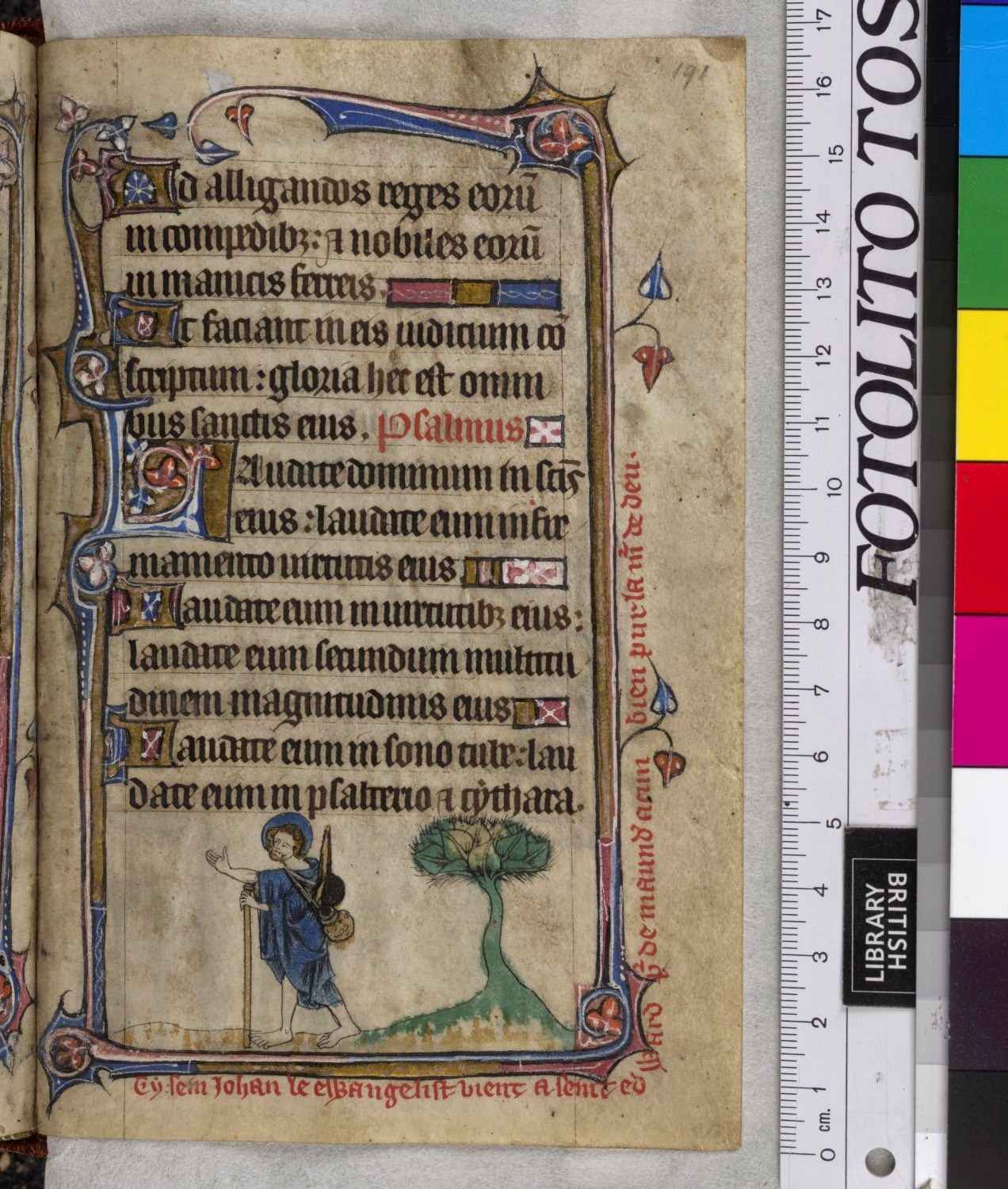
Another piece of information is an interesting anecdote appended to his chapter on St John the Apostle. Jacobus writes (in William Granger Ryan’s American translation):

Saint Edmund [of East Anglia], king of England, never refused anyone who asked a favor in the name of Saint John the Evangelist. Thus it happened one day when the royal chamberlain was absent that a pilgrim importuned the king in the saint’s name for an alms [sic]. The king, having nothing else at hand, gave him the precious ring from his finger. Some time later an English soldier on overseas duty received the ring from the same pilgrim, to be restored to the king with the following message: “He for whose love you gave this ring sends it back to you.” Hence it was obvious that Saint John had appeared to him in the guise of a pilgrim.


'Cy seynt Edward dona un anel a Iohan le ewangelist'
Yates Thompson 13, English book of hours, 2nd quarter of the 14th Century
Courtesy of British Library

'Cy sein Johan le ewangelist vient a seint edward p[ur] demaund[er] acun bien pur lam[ur] de deu'
Yates Thompson 13, English book of hours, 2nd quarter of the 14th Century
Courtesy of British Library

This anecdote is significant for several reasons. First of all because it shows an interesting confluence of two of high-medieval England’s most important saints: Edmund of East Anglia and Edward the Confessor. The story of the king giving his ring to Saint John in disguise belongs to the legend of Edward the Confessor and is perhaps one of the most famous miracles from his hagiographies. It first appears in Aelred of Rievaulx’s Vita Sancti Edwardi Regis, a work written for the translation of Edward’s body in 1163, and which was commissioned by Lawrence, abbot of Westminster. The ring became Edward’s main attribute and remained so throughout the Middle Ages, as seen below from a calendar page from the early 1400s.

Edward the Confessor holding his ring, oddly placed at March 18
Harley 2332, Almanac with astrological miscellany, England, 15th century (before 1412)
Courtesy of British Library

Jacobus’ attribution of this episode to the legend of St Edmund is also significant because it allows us a glimpse of the close relationship between those cults from the twelfth century onwards. Edmund had been venerated as a saint since the late ninth century, and his cult centre had been at Bury St Edmunds from the start. In the second half of the eleventh century and onwards, the cult of St Edmund experienced an increased literary output of hagiographical and liturgical material. A new, proper, liturgical office was composed between 1065 and 1087, and Herman the Archdeacon wrote De Miracula Sancti Edmundi c.1100. In the literature of Bury’s long twelfth century, King Edward the Confessor – universally respected in English history – was invoked as one of Edmund’s devotees, and as a just king who granted the abbey many valuable charters. The generosity of Edward was a recurring feature, appearing both in Herman’s De Miracula and Jocelin’s late-twelfth-century Chronicle of the Abbey of Bury St Edmunds.

Edward the Confessor was not canonised until 1161 and his cult was a product of Westminster Abbey and the political interests of King Henry II. Edward’s cult had a brief but intense first period of popularity which rapidly diminished at the explosive growth of the cult of Thomas Becket in the 1170s. Becket’s cult did not affect the cult of Edmund in the same way, much thanks to Bury being a thriving literary centre, and brief anecdotes in late-twelfth-century historiographies – such as Benedict of Peterborough’s Gesta Henrici II and Ralph Coggeshall’s Chronicon Anglicanum – suggests that Edmund enjoyed a much wider and more stable veneration than did Edward.

Martyrdom of St Edmund
Yates Thompson 13, English book of hours, 2nd quarter of the 14th Century
Courtesy of British Library

From the thirteenth century onwards, the two royal saints began to appear together in both art and literature. We don’t know which is the earliest example of this. Edward and Edmund – along with two others – are both listed among England’s peaceable kings in the anonymous Anglo-Norman Le Estoire de Seint Aedward le Rei from the 1240s, and in the late 1300s William Langland states in Piers Plowman that Edmund and Edward were both followed by the personification of Charity. To name some of the examples of these two appearing together in art, we have a glass cycle in Amiens from c.1280, and perhaps the most famous instance of them all, the Wilton Diptych where they appear together with John the Baptist as patron for the young Richard II.

The Wilton Diptych
Edmund and Edward both displaying their most well-known attributes
Courtesy of Wikimedia


In all these instances mentioned above the pairing of Edmund of Edward have been done deliberately, while in Jacobus’ Legenda Aurea the two saints have blended together by mistake. The interesting question is whether this mistake was owing to Jacobus’ own faulty memory, having heard the story from one of the many English pilgrims in Italy and then confused the characters, or whether the story was transmitted to Jacobus in the way he recorded it. In any case, the faulty attribution of the miracle of the ring to Edmund of East Anglia, suggests that by the latter half of the thirteenth century, the two royal patrons of England may already have begun to be paired together, not only in art and literature but also in the common imagination.


Literature

Anonymous, Le Estoire de Seint Aedward le Rei, translated by Thelma Fenster and Jocelyn Wogan-Browne, ACMRS Press, 2008

Aelred of Rievaulx, The Life of Saint Edward, King and Confessor, translated by Jane Patricia Freeland and published in Dutton, Marsha (ed.), Aelred of Rievaulx: The Historical Works, Cistercian Publications, 2005

Herman the Archdeacon, The Miracles of St Edmund, translated by Tom Licence, Clarendon Press, 2014

Jacobus de Voragine, Legenda Aurea, translated by William Granger Ryan, Princeton University Press, 2012

Jocelin of Brakelond, Chronicle of the Abbey of Bury St Edmunds, translated by Diana Greenway and Jane Sayers, Oxford World Classics, 2008

Langland, William, The Vision of Piers Plowman, translated by Schmidt, Everyman, 1995


lørdag 31. januar 2015

Two poems for Saint Brigid of Kildare by Seamus Heaney


Tomorrow (February 01) is the feast of St Brigid of Kildare, founder and abbess of the monastery of Kildare and one of Ireland's major saints. She is believed to have been baptised by St Patrick and died around 525. However, since the earliest lives date to the sixth century there is good reason to question her historicity, especially in light of the attempts of Kildare Monastery to buttress their claim to monastic supremacy in Ireland through her figure. The hagiographical material echoes her dubious place in history since it is largely comprised of miracle stories. One of the most famous of these is how she dried her clothes on a sunbeam when she could find nowhere else to hang them. This miracle is recounted in the South English Legendary, compiled in the latter half of the 13th century.

Brigid's miracles are also recounted by Gerald of Wales in his exposition of the Irish saints. In a previous blogpost I wrote more thoroughly on this, so suffice it to say that Gerald warned the Norman conquerors of Ireland not to transgress against Brigid and her places of worship, as she was - like all Irish saints according to Gerald, of a very vindictive nature.

St Brigid of Kildare
Stained glass window from 1934 in Our Lady and Saint Non's Chapel, St Davids, Wales
Courtesy of Wikimedia

Saint Brigid has also caught the fascination of Irish poet Seamus Heaney, so for Brigid's day tomorrow, I here present two poems featuring the abbess (with thanks to Trias Thaumaturga).


A Brigid's Girdle

(from The Spirit Level)

Last time I wrote I wrote from a rustic table
Under magnolias in South Carolina
As blossoms fell on me, and a white gable
As clean-lined as the prow of a white liner

Bisected sunlight in the sunlit yard.
I was glad of the early heat and the first quiet
I'd had for weeks. I heard the mocking bird
And a delicious, articulate

Flight of small plinkings from a dulcimer
Like feminine rhymes migrating to the north
Where you faced the music and the ache of summer
And earth's foreknowledge gathered in the earth.

Now it's St Brigid's Day and the first snowdrop
In County Wicklow, and this a Brigid's Girdle
I'm plaiting for you, an airy fairy hoop
(Like one of those old crinolines they'd trindle),

Twisted straw that's lifted in a circle
To handsel and to heal, a rite of spring
As strange and lightsome and traditional
As the motions you go through going through the thing.


From Crossings
On St. Brigid's Day the new life could be entered
By going through her girdle of straw rope
The proper way for men was right leg first
Then right arm and right shoulder, head, then left
Shoulder, arm and leg.
Women drew it down
Over the body and stepped out of it
The open they came into by these moves
Stood opener, hoops came off the world
They could feel the February air
Still soft above their heads and imagine
The limp rope fray and flare like wind-born gleanings
Or an unhindered goldfinch over ploughland.

mandag 26. januar 2015

For the Archbishop's Sins - a healing miracle of St Olaf concerning Archbishop Eystein Erlendsson


Today is the feast of Eystein Erlendsson, archbishop of Nidaros (modern-day Trondheim) from 1161 to 1188. Although he never achieved formal canonisation - despite petitions from the archsee - his saintly powers were acknowledged at a local church synod in 1229. Eystein was the second man to hold that office since the establishment of the Norwegian archsee in 1152/53, and his reign was a crucial era in the founding of a strong Norwegian ecclesiastical network that spanned from Northern Norway to Greenland until the Reformation. This establishment of the Norwegian church province can be seen perhaps most clearly in the cathedral which was completed and rebuilt in several phases throughout history, and which was likely meant to replace a wooden structure raised over the bones of St Olaf (d.1030), Norway's martyr-king and eventually patron saint.

Aside from the stone edifice embracing the holy bones of Olaf, Eystein was also a key figure in the establishment of a Norwegian ecclesiastical literature. He was the dedicatee of Theodoricus Monachus' Historia de Antiquitate Regum Norwagiensium, written c.1180, and he oversaw the compilation of the hagiography for St Olaf which we today refer to as Passio et Miracula Beati Olavi. In this blogpost I will present one of the most famous episode, in which Eystein himself enters the miraculous narrative and becomes the interlocutor for his scribe.
 
Eystein Erlendsson holding the cathedral
Modern statue situated in the courtyard of the archepiscopal palace, Nidaros
Courtesy of Wikimedia

Having read all those accounts which antiquity has entrusted to us concerning the life and miracles of the blessed Óláfr, we deem it fitting that we, who have personally been enlightened by his widespread miracles in our own day, should also commit to the attention of future generations, in writing, those things which have been performed by miraculous powers, to his greater glory, as we have seen for ourselves or have learnt from the testimony of truthful men. Truly, as we are enjoined by the duty of charity to suffer with those in affliction so doubtless are we obliged to rejoice with those relieved from sickness who rejoice in the newfound Health. But since no one is closer to a man than the only son of his mother, then if we are bidden for charity's sake to praise the blessings of Health conferred upon others, how much more are we bound, first and foremost, to render praise with thanksgiving for those blessings which we know to have flowed abundantly for our own needs from the powers of the martyr, through the grace of God. And thus I, Eysteinn, was at one time carrying out my episcopal duties, by God's will, in the church of the blessed martyr when I was summoned by the master-builder to the top of a wall, to settle certain matters concerning the Construction. But the walkway, over which stones were carried, broke under the weight of the crowd that followed us and collapsed. I alone, for my sins, was thrown from that height, to teach me to be more careful of my life and duty, while the others clung to the scaffolding and hoists. My side Struck against the narrow edge of a mortar-trough, and the narrowness of the surface that broke my fall made the accident all the more dangerous. my people bore me away like one lifeless, and when after a time I recovered my senses, I was brought to my own bed, where I lay anguished and anxious, aggrieved by a twofold grief. For my broken ribs gave pain, but it pained me no less that I would be unable to attend the approaching ceremonies in honour of the martyr; for in three days it would be Saint Óláfr's day, attended by an influx of people form far and wide. Distressed by these troubles of body and soul, I turned in prayer to my patron, the blessed Óláfr, although doubting my own worthiness, nevertheless with full faith; and as experience shows, not forgetful of his own, he came to the aid of the one who called upon him. For when the festal day had dawned, and the people had as usual been summoned to the celebration of the mass by the sound of bells, I discussed with my attendants whether I ought to be carried to the church, since I was too weak to walk. They urged me to it, and I welcomed their advice, for my own inclination drew me on. At first I hardly expected to take part in the ceremonies of the mass, fearing that my strength would fail me, but when I entered the church, the pain abated somewhat, and when I had taken a little time to gather my strength and resolution, I dared to hope for greater things. Therefore I asked to be robed again, quickly, that I might appear with the clergy in the procession. When we had arrived at the place where the procession customarily halted for a sermon, I did not venture to preach, but I attempted, nevertheless to expound a little upon the Lord Pope's indulgence of sins and remission of penance. But when, in answer to my prayers, my strength grew even as I spoke, I drew out the exhortation in the usual - albeit unexpected - sermon. And I carried out the rites of mass and of the Whole ceremony, in such a way that the effort did not leave me fatigued, but rather the fatigue left me thoroughly refreshed, and, although the pain had not yet fully left me, my bones were nevertheless fully knit and perfect health was gradually to follow.
- Passio Olavi, translated by Devra Kunin (printed in Phelpstead 2001: 61-63)


St Olaf enthroned, trampling the dragon
Wooden sculpture from Austevold Church, c.1400
Courtesy of Wikimedia


The passage above is widely referred to in the scholarship on St Olaf, and it led the earliest scholars - above all Eiliv Skard who translated the hagiography into Norwegian - to believe that it was Eystein who had written or at least dictated the entire book. Recent scholarship, for instance by Inger Ekrem and Lars Boje Mortensen, has shown that the archbishop's personal interjection in the narrative is an anomaly rather than indicative of his omnipresence in the writing process. Most likely - according to Mortensen - the section on Olaf's miracles have been compiled during several years and were taken from the miracle records kept at the shrine itself. Furthermore, according to Inger Ekrem and Jon Gunnar Jørgensen, Passio Olavi has been composed in at least four stages, rather than being a uniform project penned by Eystein. Regardless of this mistake, brought on perhaps by a romantic quest for a single author which is a perennial scourge in medieval studies, Eystein's importance to the Ecclesiastical literature of medieval Norway can hardly be underestimated. In addition to the compilation of the Passio and the patronage of Theodoricus' history, he also very likely oversaw the composition of an office of St Olaf, and we know that he played an important part in the establishment of a liturgy which bound the province of Nidaros to the Network of Augustinian canons, as shown by Roman Hankeln. Through these literary and liturgical endeavours Eystein helped weave the archbishopric of Norway into the wider fabric of Latin Christendom, and thus he drew his province closer to Europe. Even though he no longer stands as the sole author of Passio Olavi, his legacy is impressive enough as it is.


Literature

Ekrem, Inger, “Om Passio Olavis tilblivelse og eventuelle forbindelse med Historia Norwegie, printed in Ekrem, Inger; Mortensen, Lars Boje; Skovgaard-Petersen, Karen, Olavslegenden og den latinske historieskrivning i 1100-tallets Norge, Museum Tusculanum Forlag, 2000: 108-56

Hankeln, Roman, "St. Olav's Augustine-Responsories: Contrafactum Technique and Political Message", printed in Hankeln, Roman (ed.), Political Plainchant? Music, Text and Historical Context of Medieval Saints' Offices, The Institute of Mediaeval Music, Ottawa, 2009: 171-99

Jørgensen, Jon Gunnar, “Passio Olavi og Snorre”, printed in Ekrem, Inger; Mortensen, Lars Boje; Skovgaard-Petersen, Karen, Olavslegenden og den latinske historieskrivning i 1100-tallets Norge, Museum Tusculanum Forlag, 2000: 157-69

Mortensen, Lars Boje, “Olav den helliges mirakler i det 12.årh.: streng tekstkontrol eller fri fabuleren?”, printed in Ekrem, Inger; Mortensen, Lars Boje; Skovgaard-Petersen, Karen, Olavslegenden og den latinske historieskrivning i 1100-tallets Norge, Museum Tusculanum Forlag, 2000: 89-107
Østrem, Eyolf, The Office of Saint Olav – A Study in Chant Transmission, Studia Musicologica Upsaliensia Nova Series 18, Uppsala, 2001

fredag 23. januar 2015

The Divided Child - Two poems by Derek Walcott


Today is the birthday of Derek Walcott, my favourite contemporary poet, and for the occasion I'm posting two of his poems. Walcott was born in the city of Castries on the Caribbean island of Saint Lucia, and had from an early age a strong sense of his dual heritage of part European, part African. This duality is a very strong presence in his poetry, and it is strengthened by the tension between the heritage of Saint Lucia's colonial past, and the modernity of Saint Lucia as an independent country. Walcott has expressed a great fondness for, and a significant debt to, writers from early modern England, while also showing admiration for the modernist movement, perhaps most tangibly Ezra Pound.

This sensation of belonging and yet not belonging, of being modern and at the same time part of something very old, are two prevailing themes in Walcott's poetry. In some of his poems, Walcott unifies the old and the new in various ways, such as communicating through old poems through epigraphs, or by moving elements from the old world into the Caribbean. This latter technique is the fundamental feature in his long poem Omeros, where elements of the Homeric epics are translated into a Saint Lucian setting. Another example can be found in the cycle of poem called A Tropical Bestiary, which was published in his Collection The Castaway (1965). The title of the cycle refers to the old medieval bestiaries in which the allegorical aspect of animals were explained, and Walcott describes animals of the New World with an allegorical poetry reminiscent of the Middle Ages.


The Whale, His Bulwark

from A Tropical Bestiary

To praise the blue whale's crystal jet,
To write, 'O fountain!' honouring a spout
Provokes this curse:
                                  'The high are humbled yet'
From those who humble Godhead, beasthood, verse.

Once, the Lord raised this bulwark to our eyes,
Once, in our seas, whales threshed,
The harpooner was common. Once, I heard
Of a baleine beached up the Grenadines, fleshed
By derisive, antlike villages: a prize
Reduced from majesty to pygmy-size.
Salt-crusted, mythological,
And dead.

The boy who told me couldn't believe his eyes,
And I believed him. When I was small
God and a foundered whale were possible.
Whales are rarer, God as invisible.
Yet, through His gift, I praise the unfathomable,
Though the boy may be dead, the praise unfashionable,
The tale apocryphal.

Pieter van der Heyden, Big Fish Eat Little Fish, after a drawing by Pieter Bruegel the Elder
Flanders, 1557
Courtesy of The British Museum


Another poem from the same collection enunciates the divided nature of Walcott's heritage - a division he himself expressed through the phrase "divided child" in his autobiographical poem Another Life. The poem in question is Codicil, a poem of exile where the contrasts of belonging and yet being a prodigal can be sensed very poignantly.

Codicil

Schizophrenic, wrenched by two styles,
one a hack's hired prose, I earn
my exile. I trudge this sickle, moonlit Beach for miles,

tan, burn
to slough off
this love of ocean that's self-love.

To change your language you must change your life.

I cannot right old wrongs.
Waves tire of horizons and return.
Gulls screech with rusty tongues

Above the beached, rotting pirogues,
they were a venomous beaked cloud at Charlotteville.

Once I thought love of country was enough,
now, even if I chose, there's no room at the trough.

I Watch the best minds root like dogs
for scraps of favour.
I am nearing middle-

age, burn skin
peels from my hand like paper, onion-thin,
like Peer Gynt's riddle.

At Heart there's nothing, not the dread
of death. I know too many dead.
They're all familiar, all in character,

even how they died. On fire,
the flesh no longer fears that furnace mouth
of earth,

that kiln or ashpit of the sun,
nor this clouding, unclouding sickle moon
whitening htis Beach Again like a blank page.

All its indifference is a different rage.


These two poems not only showcase two of the major themes in Walcott's poetical oeuvre, they also emphasise his dual nature as a poet both in touch with the traditional and the modern. The first poem, drawing on medieval culture and the idea of a near-mythological past, is written in a rhyme-scheme somewhat reminiscent of the metaphysical poets of the seventeenth century, whom Walcott much admired in his early verse. The second, however, also contains the occasional rhyme, but is first of all written in free verse, yet drawing on aspects from the tradition writers - his reference to middle age is possibly a reference to Dante.

Derek Walcott has nourished his sense of being prodigal for decades, yet after he received the Nobel Prize for literature in 1992 he was duly commemorated in his home city. Columbus Square in Castries was re-named Walcott Square in his honour, and stands as a suitable reminder that in order to be a true prodigal, one has to return to one's home.

The entrance of Walcott Square, Castries
From Wikimedia

The bandstand in Walcott Square
From Wikimedia


mandag 19. januar 2015

Guthlac and the demons - the importance of liturgy in the Middle Ages


The legends about St Guthlac of Crowland and his encounters with demons are well-known to medievalists, and in a previous blogpost I drew the attention to the iconographic similarities between the struggles of Guthlac and the temptations of St Anthony, the latter being a saint whose vita by Anasthasius influenced the eighth-century life of Guthlac written by the monk Felix. In this blogpost I will return to the topic of Guthlac’s encounter with demons. However, while his most famous episode is where the demonic host brings him to the gates of Hell where he is saved by St Bartholomew, this episode takes place in Guthlac’s hermitage at Crowland.

A few prefatory words are, however, needed to put this anecdote in a wider hagiographical context. Guthlac (674-715) was born into the royal dynasty of Mercia, and showed early signs of maturity which foreshadowed his later embrace of the monastic life. As a young man he learned of the martial deeds of his forefathers and decided to emulate them, taking up arms and ravaging the lands of the enemies of his house. The chronicler Felix makes sure, however, to tell the reader that although a heathen soldier, Guthlac never showed signs of greed and always returned a third of what his men had captured. At the age of twenty-four, the young soldier reflected further on his forefathers and found that they had all come to violent ends thanks to their violent lives. He then repented his former life and left for the monastery of Repton in order to receive the tonsure. At Repton he showed such diligent abstemiousness towards alcohol that his fellow brethren began to hate him, an episode reminiscent of Benedict of Nursia as described in Gregory the Great’s Dialogi. Shortly afterwards, after having read about the desert fathers, Guthlac leaves for the fens in order to become a hermit of the desert, and on the remote island of Crowland he establishes his cell. Since he arrives at the island on the feast of St Bartholomew (then celebrated at 25th of August), Guthlac commends himself to the saint and is later aided by him as mentioned above. It should be noted that Bartholomew’s gift of the scourge does not appear in Felix’ Vita Guthlaci, but is a product of a later local tradition at Crowland Abbey. 

Guthlac receiving the scourge from St Bartholomew
MS Harley Roll Y.6, England, turn of the 12th Century
Courtesy of British Library

Even though Guthlac is brought back from the mouth of Hell, he is still troubled by demons, even in his own hermitage, and in chapter 34 we are told of a trick the demons played on him, pretending to be British marauders:


Now it happened in the days of Cænred King of the Mercians, while the Britons the implacable enemies of the Saxon race, were troubling the English with their attacks, their pillaging, and their devastations of the people, on a certain night about the time of cockcrow, when Guthlac of blessed memory was as usual engaged in vigils and prayers, that he was suddenly overcome by a dream-filled sleep, and it seemed to him that he heard the shouts of a tumultuous crowd. Then, quicker than words, he was aroused from his light sleep and went out of the cell in which he was sitting; standing, with ears alert, he recognized the words that the crowd were saying, and realized that British hosts were approaching his dwelling: for in years gone by he had been an exile among them, so that he was able to understand their sibilant speech. Straightway they strove to approach his dwelling through the marshes, and at almost the same moment he saw all his buildings burning, the flames mounting upwards: indeed they caught him too and began to lift him into the air on the sharp points of their spears. Then at length the man of God, perceiving the thousand-fold forms of this insidious foe and his thousand-fold tricks, sang the first verse of the sixty-seventh psalm as if prophetically, ‘Let God arise’, etc.: when they had heard this, at the same moment, quicker than words, all the hosts of demons vanished like smoke from his presence.
- Felix,
Life of Guthlac, translated by Bertram Colgrave (1956: 109-11)

The first two verses of  psalm 67 (68 in the modern numbering) are rendered thus in the Vulgate:

[E]xsurgat Deus et dissipentur inimici eius et fugiant qui oderunt eum a facie eius
sicut deficit fumus deficiant sicut tabescit cera a facie ignis pereant impii a facie Dei

In the English translation:

Let God arise, and let his enemies be scattered: and let them that hate him flee from before his face.
As smoke vanisheth, so let them vanish away: as wax melteth before the fire, so let the wicked perish at the presence of God.


While Felix tells us that Guthlac only sang the first verse, I have included the second verse here because Felix obviously draws on that verse for his comparison with the demons to vanishing smoke.

There are many significant things to comment on here, but my focus now is the martial aspects of the episode, and indeed in the whole text itself. Throughout the work, Felix refers to Guthlac as the soldier of Christ, a sobriquet based on St Paul’s letter to the Ephesians where his listeners are asked to put on the armour of God. This title is not merely a play on Guthlac’s military past, it is also a very apt description of how monks were seen in medieval theology: They were soldiers of God whose weapons were prayer and song, and through their asceticism and their mortification of their own flesh, they kept the devil away. In this episode, Guthlac does not physically drive away the demons as he will do in later traditions using the scourge of St Bartholomew. Nor is he here saved by the apostle’s intervention, but through his faithful incantation of the psalm. Through his arms of faith, the weapons of song and prayer, Guthlac overcomes the phantasmal spears of the demonic army and emerges victorious, a miles Christi faithfully resisting against the soldiers of Satan. When we consider this episode, therefore, we get a better understanding of why the daily performance of the office was such an important aspect of medieval religious life: Not only was it a way of strengthening the religious community through a mystic experience, it was also a feat of spiritual arms that kept the devil’s army away from the soul, and which could allow the faithful to withstand the phantasms coaxing it to fear and loss of faith in God’s protection. Guthlac's struggle with the demons, in other words, allows us to grasp the rationale of medieval liturgy as something more than mere music, and we understand that the office is not just an ornament in the church service, it is part of the arsenal which St Paul included in his letter to the Ephesians.