And was the holy Lamb of God,
On Englands pleasant pastures seen!
- And did those feet, William Blake

lørdag 27. januar 2024

My quest for Austrian poetry


Wednesday, I came back from a ten-day trip to Vienna. For the most part, it was a work-stay, where I and some colleagues spent our time preparing for a workshop in the city, and giving each other feedback on drafts of articles and applications. Luckily, however, there was still time to do some extracurricular activities, and my days were marked by a quest for books. Whenever I am in a country whose language I can read, I want to buy some reading materials, both as a souvenir and as a way to learn more about the country. Moreover, books are also excellent for establishing a stronger bond to the country in question by reading them in various locations, something which always makes me feel more connected with the surroundings, be it a city, a part of the wilderness, or the country in general. 


When I arrived in Vienna, I had not read any Austrian literature, so I sought out some bookshops to acquire a volume of poetry. In most cases, when embarking on the book-world of a new country, poetry is my first port of call, both because it is a genre of writing that I deeply love, but also because poetry sometimes catches nuances in a culture in a way that novels do not. This time, however, there was also a practical aspect to my focus on poetry, as I had packed a small suitcase and could only negotiate a few new purchases. The lack of space in my luggage further narrowed down my options, as large volumes of collected poetry were out of the question. 

The quest started well, or so I thought. At the bookshop Morawa - which I was recommended by a friend - I communicated my needs in a very poor German, which reminded me that I was out of practice, but also that when searching for specific words, my brain slides into Spanish, which makes the situation much worse. The situation was also hampered by my complete lack of knowledge about Austrian poetry. In any case, I was shown a thin book with poems by H. C. Artmann, and I left the bookshop thinking that I had now found something that could accompany me in my exploration of Viennese cafés. Unfortunately, however, I later realised that the book in question was a posthumous selection from various collections, and not an original unit. Personally, I do not like such anthologies, and I do not count them as standalone books. Consequently, my quest started again, and it led me through several bookshops without yielding any satisfactory results. Luckily, on my second-to-last full day, I happened to pass by another bookshop that I had not seen before, Franz Leo & Comp., and walked in. By this time, I had exercised my German by repeated use, and I had also understood that I needed to be as clear as I could about the parameters of my quest. Yet despite these improvements, I have only the diligence of the two shopkeepers to thank for the book that finally ended my quest, namely a volume of the collected poetry by Ingeborg Bachmann, which was sufficiently non-voluminous to fit in my luggage. I left that bookshop in a state of elation.       

My quest for Austrian poetry brought me in contact with several of Vienna's bookshops, and these visits afforded me glimpses of the number of exciting books available there, so now I know that when going back, I need to bring a larger suitcase, and set aside more time to trawling the available vendors. 


lørdag 20. januar 2024

Saint Sebastian in Vienna Cathedral


Today is the feast of Saint Sebastian, a saint with whom I am inexplicably fascinated - inexplicably because I cannot define exactly what fascinates me about him and his cult. While his historicity is widely regarded as doubtful at best, at least by modern scholars, his iconography has left a massive imprint in the history of medieval and early modern art. Part of the success of his cult - success here understood as longevity and widespread fame - can be explained by his status as a plague saint, a patronage that continued to be relevant in Europe throughout the Late Middle Ages and the Early Modern Period. Consequently, I am always happy to see a representation of Saint Sebastian on my travels, but very rarely surprised by such encounters. Today, I met him again. 

As I am writing this blogpost, I am in Vienna for a work trip, and this Saturday is the first day where I have been able to do some real sightseeing. One of the main sights that I wanted to see was the Vienna Cathedral, the Stephansdom, dedicated to Stephen Protomartyr, which was consecrated in 1147, ten years after the building work commenced. The cathedral is an overwhelming and beautiful building, with a lot of wonderful architectural and iconographical details, and one can easily get lost if one tries to see all of them. Since this is my first time in Vienna, and since most of my time has been taken up by work, I had not planned my visit very carefully, and ambled about the church space as someone coming into a different world, not really knowing what to expect. This kind of exploration by accident, as it were, has its benefits, because sometimes you see details that are not necessarily highlighted by the available literature. One such figure was that of Saint Sebastian, placed in a niche high above the floor of the nave, not difficult to notice yet also not difficult to miss. 

The beardless, contorted, perforated figure was a familiar sight. I have as yet found no information about when this figure was made, or by whom, but it looks perfectly in tune with the ideals of sixteenth-century Mannerism with its slightly exaggerated movements and bending bodies. In its iconography, the Sebastian figure in Vienna Cathedral follows the typical standard established in fifteenth-century Italy, and which continued to be followed well into the seventeenth century, and arguably into our own times. The figure was a lovely, if grotesque, reminder of the ubiquity of Sebastian's cult, and the iconographical continuity with which he is represented.     


mandag 1. januar 2024

A year in reading - 2023


I live a relatively dull life, thankfully. Most of what makes my life exciting, or that gives my life meaning, is to a large extent only exciting and meaningful for me, and there is something unintrusive about such a life which I greatly appreciate. But the one loud aspect of my life is my reading, as this is a topic that can easily be communicated to others, and that others can recognize as both exciting and meaningful. 2023 was a year of much reading, at least relative to my standard amount in the course of such a timespan, and some of it took rather surprising turns – surprising turns that grow out of my penchant for choosing such books as present themselves for the occasion, rather than sticking to a too-well-thought-out plan. And so, as we begin a new year, I bring you some of the highlights of the past year in reading. Please note that, as always, this is not a complete list, as I often feel that such complete lists will easily accrue a touch of bragging – at least when I convey them – and I seek to avoid that.


Travelling by page

One of my ongoing reading projects is to read a book, of any kind, from each country of the world. So far, I am in my 120s, and I have still more than seventy to go, and this year proved to be quite slow. To a large extent, my slowness on this particular front has been due to various other duties, that have directed my reading elsewhere. For instance, research for academic articles, supervision and teaching has forced me to spend a lot of time in Norway, rather than much further afield. However, I did find time to add three new countries, namely Honduras, Tanzania, and Indonesia. 


A volume of several poetry collections by Óscar Acosta


From Honduras, I read the poetry collection Tiempo detenido by Óscar Acosta, included in a volume containing several of his collections. This was a book I borrowed last autumn, when after a very long and tiring day, I went to the university library and sought out something new (to me) in Spanish. I came away with one sixth of the University of Oslo’s collection of Honduran literature, which is to say two books. 


Abdulrazak Gurnah, Paradise

From Tanzania, I read Abdulrazak Gurnah’s masterful novel Paradise, which tells the coming-of-age story of a merchant’s apprentice in East Africa in the period leading up to World War I. I read this novel during the first few days of my holiday in Spain. The contrast between the various East African vistas – the crowded coast, the dense jungle, the open and beautiful plains and rivers of the interior – and the dry and sometimes overpowering heat of Madrid in late April, early May, made the experience even more pleasant.


Norman Erikson Pasaribu, Sergius seeks Bacchus

The last country, at least this year, is Indonesia, from which I read the beautiful and heart-wrenching poetry collection Sergius seeks Bacchus, in which Norman Erikson Pasaribu shares some of the darkness of his experiences as a young homosexual man from a Christian family. 


New places for reading  

2023 was a year in which I did a lot of travelling, at least relative to an ordinary year. Most of this travelling was for work, but I also made sure to take the time to enjoy the places I visited, and to find some new places for reading. Some of my most memorable moments were in Spain, where I set out to buy a lot of books, and do a lot of reading. As it turned out, I bought fewer books than I had expected, but I did do a lot of reading. Much of that reading took place in a café close to the apartment I had rented, and almost every evening I would wend my way there, have a glass of beer, and read and write, and these were some of the best evenings of my entire year. 


Emilio Pascual, El gabinete mágico

One of the books I was reading during my two-week stay in Spain was El gabinete mágico by Emilio Pascual, which is a book about fictional libraries, and one which I still have not finished. Ranging from the familiar to the completely unknown, this gem of a book kept me good company, and taught me a lot about Spanish literary history. What made this book particularly special was that I bought it on my second day in Madrid at Librería Alberti, a bookshop where my friend Marina Casado was doing a poetry reading together with some of her fellow poets. El gabinete mágico also accompanied me to Salamanca, and I was reading one of its chapters as the last bus to Madrid was crossing the fields of Castilla, and I could see the sun dying splendidly in gold behind me, and the moon rising in its triumphant silver ahead of me. It was a joyous moment that I could not have planned if I had tried to. 


The poem 'Invocación' by Raquel Lanseros, included in her collected poetry, Sin ley de gravedad

As usual, I also sought out new places for reading in my home village. While I did go exploring, I was less careful to bring books along, and so I did less outdoors reading than I had hoped. But the very last day of my summer vacation, I went on a kind of pilgrimage to a mountain lake, where I had not been for the better part of fifteen years. To be able to once more see the intense beauty of the place – a place of which I have been dreaming again and again – was a joy beyond description. And to mark my return to this place of so many memories, I had brought with me a collected edition of the poems by Raquel Lanseros, one of my favourite poets, which I had bought during my time in Madrid. Raquel Lanseros is a poet whose verses mean a lot to me, so it was the perfect way to reconnect with this magical landscape. 


William Butler Yeats, The Tower

William Butler Yeats, The Tower


My last conference for the year allowed me an opportunity to visit a new country, Ireland, and a long-standing dream finally came true. The day after my presentation, I was ambling about in Dublin, and one of my priorities was to buy a book. A friend of my had recommended a bookshop, and I was pleased to find some single-volume editions of poetry collections by William Butler Yeats, another favourite of mine. I ended up buying a facsimile first edition of The Tower, and read many of its verses while drinking tea in a pub later that day, and also in the rose garden of St. Stephen’s Green while waiting for the airport bus.   


Reading by lists

As with every year, I aim to read a minimum of twelve books, divided among the same four categories, namely a) Nobel laureates, b) Norwegian books, c) academic books, and d) books from a list I put together during my first year at university. This year, I managed to meet my own minimum requirement in all categories, but not by much – except with regards to category b. Some of these books were long overdue, as I have been meaning to read them for years. The Norwegian translation of Chrétien de Troyes’ Story of the grail, for instance, have been in my collection since my first year at university, when I bought it in the campus bookshop, together with a big stack of other books from the same series, Thorleif Dahls kulturbibliotek. This series, or this ‘cultural library’, aims to make great literary works available in Norwegian, and I am still making my way through the haul from 2008. Similarly, Hippolyte Delehaye’s classic methodological reflection, The Legends of the saints, is one that I should have finished at an early point during my academic career, as so much of the last decade has revolved around the study of saints. I read these books with great anticipation, and was greatly rewarded.


Chrétien de Troyes, Gralsfortellingen (translated by Helge Nordahl)

Hippolyte Delehaye, The Legends of the Saints (translated by Donald Attwater)


Bjørnstjerne Bjørnson, Geografi og kjærlighed


Sigurd Hoel, Syndere i sommersol


Other books in this category, I came to more blindly. Kenzaburō Ōe’s The Day He Himself Shall Wipe My Tears Away, was a title I had noted down years ago, when I set out to make a list of which books by which Nobel laureates I should prioritize. I have no recollection why I chose this particular one, and I had no particular expectation of what to find on those pages. Ōe was not one of those Nobel laureates I knew outside of the Nobel canon, and his books were not among those I envisioned myself reading early in this lifetime project. However, since Ōe passed away in March, and since the university library honoured his passing with a selection of books to borrow, I decided to take the opportunity to be more relevant and trendy than usual, and so I read this very disturbing but masterfully crafted novel, which provided a very interesting insight into Japanese history. Similarly, I did not know what to expect from Annie Ernaux’s The Years, and I had heard great things about her description of everyday life. However, while she is among the more accomplished authors of auto-fiction, I was also reminded why this is a genre that I struggle to enjoy.   


Teach us to outgrown our madness, a collection of four short novels by Kenzaburō Ōe


Annie Ernaux, Årene (Les Années; translated by Henning and Margrethe Solberg)
Cultural confusion consisting of French literature, Norwegian cheese, and American non-alcoholic beer


The elder Edda

Aside from my recurring lists, every year tends to bring about new mini-projects or new strands of reading. Early in 2023, I embarked on one such mini-project when I finally gave in and bought the first of four volumes of the Elder Edda, with facing-page translations into Nynorsk by Knut Ødegård. While I am quick to buy and slow to read books, I set myself the challenge that I should finish each volume before buying the next one, and consequently I spent the next month in the disturbing, fascinating and morbid world of the gods and heroes of the pre-Christian Norse. I was delighted to finally delve into this world, as the Elder Edda remains one of the great literary treasures of the world. I was particularly fascinated by the poems about heroes, which include branches of the storyworld of Sigurd the dragonslayer, which are stories that go back – in some way, shape or form – to the great upheavals of the fifth century. Reading these results of stories travelling from Gaul, Pannonia and Italy, and then northwards into Scandinavia, in the course of a few hundred years was a powerful testament to the interconnectedness of early medieval Europe.  


First volume of Knut Ødegård's translation of the Elder Edda

All four volumes united


Utopia and Robinsonades

The main strand of reading that has woven together some of the books of the year has been utopian literature, broadly considered. I have long had a strong interest in utopian fantasies and their significance in the history of ideas, and I have been reading utopian stories for many years already. In 2023, however, I had particular impetus to delve deeper into such stories, as a friend and colleague and I have been planning an MA course on utopian thinking in the Middle Ages. Our discussions around this topic has spurred me on to thinking about Utopianism as more than just a fascinating topic, but also as a topic on which I can do some original research myself. Consequently, I have prioritized certain utopian stories with the aim of teaching about them. Some have already made their way on to the syllabus, such as Gabriel de Foigny’s La Terre Australe, connue from 1676, translated by David Fausett, or the anonymous seventeenth-century Spanish novel Sinapia. And it was this motivation that roused me to finally begin labouring my way through Plato’s Republic, which kept me company in several cafés in Warsaw this November. Other books in this strand, however, have not been included in the syllabus, although I expect that they will appear in teaching, if only by way of reference or in-class anecdotes. One such case is the novel Arqtiq, an 1899 novel by Anna Adolph, which includes elements of hollow earth fiction, space travel, Arctic exploration and Christian colonialism in a very strange and strangely entertaining blend. 


A shelfie from my office, containing a selection of Utopia-related literature for next year's teaching


Erasmus Roterodamus, Dårskapens lovtale (translated by Trygve Sparre) 
While not typically seen as utopian literature, this polemic belongs to a medieval utopian tradition


Within this strand of utopian literature, however, another strand materialized, namely the Robinsonade. Strictly speaking, Robinson Crusoe and the many stories either imitating or drawing inspiration from it also belong to the utopian genre. After all, Robinson Crusoe creates his own private kingdom on his own terms, and lays down rules of his own making. This sub-strand in the past year’s reading was more of an accident, but a very happy one. In all, however, I only read four Robinsonades, but subsumed within the broader topic of utopianism, they stood out in such degree that they created a theme which ran through much of my literary thinking in 2023. The books in question are, in order of reading, The Life and Adventures of Peter Wilkins (1751) by Robert Paltock, Håkon Håkonsen (1873), a Norwegian Robinsonade by O. V. Falck-Ytter, Robinson Crusoe (1719), and The Female American (1767), of uncertain authorship. The latter was a great surprise, because I only bought it at a book sale, not knowing anything about the content, but I was pleased to see how well it fitted my reading that year.
 

Robert Paltock, The Life and Adventures of Peter Wilkins


O. V. Falck-Ytter, Håkon Håkonsen

Map of the islands where Håkon Håkonsen was a castaway
The novel was advertised as a Norwegian Robinson


Daniel Defoe, Robinson Crusoe


Unca Eliza Winkfield (pseudonym), The Female American


Sundry highlights    

Aside from these themes and categories, there were many other book-related highlights of 2023.


Priya Hein, Riambel

Reading the excellent and heart-rending Riambel by Priya Hein the same afternoon I was gifted a signed copy by the author.  


Issue 568 of Mosaik, featuring the story 'Lelas Zorn' (Lela's wrath)

Learning about the existence of the historical comic Mosaik in Erfurt. 


Exhibition hall at the La Biblioteca Nacionál de España 
The walls are decorated with pages from the commentary by Beatus of Liébana


Visiting an exhibition on Beatus of Liébana’s commentary on the Apocalypse at the Spanish National Library in Madrid.


An issue of the regular Tex Willer series, and an issue of the Young Tex Willer series 
Both issues celebrate the 75th anniversary of the figure Tex Willer


Picking up a few issues of one of my favourite comics, Tex Willer, in the original Italian during a trip to Rome.


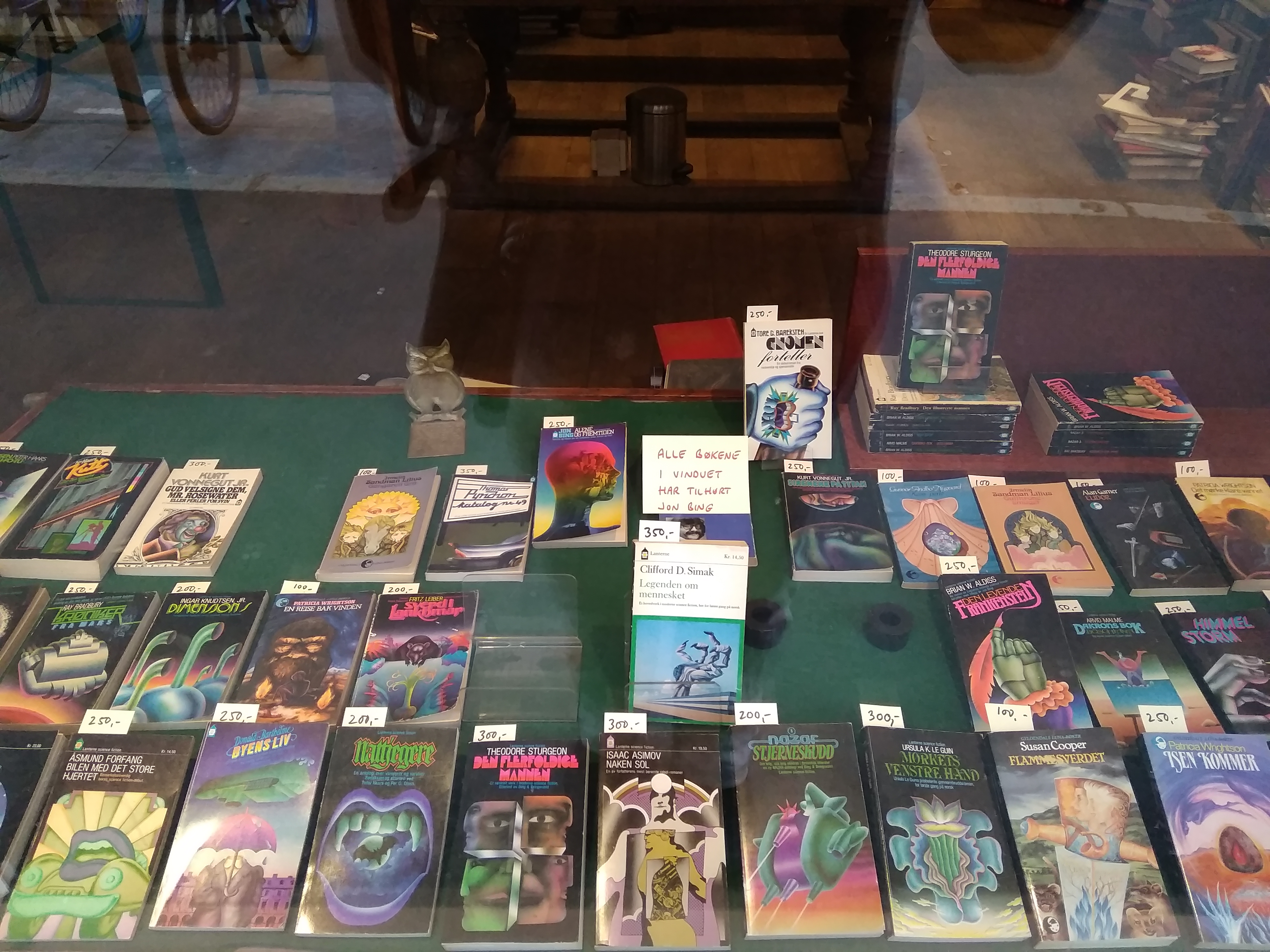
A selection of Jon Bing's library, which, after his passing, was given to a second-hand bookshop in Oslo


Buying a book for a friend, which came from the library of Jon Bing, one of Norway’s most important science fiction authors. 


A selection of Jon Fosse's books at the reception in the Oslo University Library


Rejoicing in the fact that this year’s Nobel laureate, Jon Fosse, writes in Nynorsk.


A selection of several academic books and primary sources hunted down in the campus bookshop


Desperately trying to get rid of my surplus research allowance at the very end of the term.


Similar blogposts (from 2023) 


Reading-spots, part 1 

Reading-spots, part 2 

The non-existent manuscript 

Reading-spots, part 3 

A different Oslo 

Reading-spots, part 4 

Celebrating Nynorsk 

Reading in the room 

Contrasts of reading 


fredag 29. desember 2023

Saint Thomas of Canterbury in Roskilde


Today is the feast of Thomas of Canterbury, the archbishop who was murdered by a group of knights in Canterbury Cathedral in 1170. Following his canonization in 1173, his cult spread quickly along various networks, and became a well-known reference point in Latin Christendom. The cult reached Denmark at a relatively early point. It is not known exactly when - and when it comes to religious impulses, their arrivals can rarely be reduced to a single point in time anyway - but we should expect it to have taken place already in the 1170s. The reason for this early date is that a Canterbury collection of miracles associated with Thomas, mentions a few Danish cases, one of which being associated with the Danish crusade against the Wends that began around 1180.  

The popularity of Thomas in medieval Denmark remains a contentious issue. Only a few, scattered sources have survived, and there has not yet been a research project seeking to map out the development of the cult. Consequently, we do not know whether the cult remained stable in its popularity, or whether it shifted and waned, or whether there were significant local differences. 

From time to time, I have myself delved into the sources pertaining to the cult of Thomas of Canterbury in Denmark, and I am still thinking about what to make of my scattered findings. One thing that has become clear, however, is that in several parts of Denmark, the feast of Thomas was celebrated using the liturgy composed in, and disseminated from, Canterbury, namely the office known as Studens livor. This is an unsurprising discovery, because Canterbury Cathedral was very active in its promotion of the cult of Saint Thomas, and this liturgical office became the standard in many medieval church provinces. However, unsurprising is not the same as uninteresting. That the standard liturgical office was in use in Roskilde diocese - as demonstrated by the 1517 Breviarium Roschildense - suggests that there were contacts between Canterbury and Roskilde in the twelfth century, when the office was composed, and that these contacts left an imprint that lasted throughout the medieval period - largely thanks to the conservative nature of liturgical practice.    

In Breviarium Roschildense, the feast of Saint Thomas of Canterbury begins with an antiphon, which is exactly how Studens livor usually begins. It is a summary of the story of Thomas, describing his martyrdom and its importance, serving - in effect - to inform new listeners about what they are about to hear in greater detail. Below the picture, you will find both a transcription of the Latin and a translation into English by Kay Brainerd Slocum, taken from her excellent monograph Liturgies in Honor of Thomas Becket, to date one of the best monographs on the cult of Saint Thomas.  


Breviarium Roschildense (1517), f.98v


Pastor cesus in gregis medio 
pacem emit cruoris precio. 
O letus dolor in tristi gaudio 
grex respirat pastore mortuo, 
plangens plaudit mater in filio, 
quia vincit victor sub gladio 


The shepherd, slain, in the midst of his flock, 
Purchases peace at the cost of blood; 
Joyous grief in sorrowful praise, 
The flock breathes, though its shepherd is dead; 
Lamenting, the mother rejoices in the son, 
Because he lives, as victor under the sword. 


tirsdag 26. desember 2023

Christmas in the Ål stave church ceiling


At the Museum of Cultural History in Oslo, it is possible to behold one of the most exquisite surviving works of medieval art from Norway, namely the ceiling of the ciborium of Ål stave church. The ceiling, visible to the ministrant priest and presumably intended to amplify his voice during sermons, contains a number of Biblical episodes, from Creation to the life of Christ. One of the key episodes is the Nativity, where Mary is shown reclining in a bed and looked after by a servant or a nurse, while Joseph keeps an eye on the manger, with the ox and the ass looking curiously into it. It is possible - although I have not yet read any analysis of this artwork - that the bed in which Mary lies is aimed to convey a sense of royalty. The blanket being in two colours, rather than a single colour, might be seen as foreshadowing Mary's role as queen of Heaven, a role that is made clear in the next episode. Here, we see the Virgin Mary enthroned, an angel attending to her with a thurible, and two of the three kings bringing gifts. The Christ-child sits in her lap, and Mary herself is wearing a crown. 


fredag 22. desember 2023

Ale for Christmas


In Gulatingslova, the law of the Gulathing law province in Norway, there are strict rules for the brewing of ale before Christmas. These rules are listed in chapters 6 and 7 of the so-called Christian law, namely that part of the provincial law that pertained to religious life. In these two chapters, we read that the ale should be brewed before the feast of All Saints (November 1), and it was to be consecrated to Christ and the Virgin Mary, in the hope of a good and peaceful year. Failure or refusal to brew the Christmas ale could incur penalties, at least if the means of your family were sufficient to enable you to brew the quantities prescribed by the law.   

Ale was an important part of the community-building of medieval Norway. Consequently, the rules of Gulatingslova draws up how much ale should be brewed per household, and how many people should brew together. Brewing was, in other words, something that at least three or more people did as a joint effort. However, Norway being as topographically interesting and challenging as it remains to this day, there were also exceptions for those that lived too far away, be it on remote islands or in the mountains. 

The brewing of ale for Christmas has continued to our own times, and in my family we brew our ale every year. Granted, we fail to follow the rules laid down in Gulatingslova, as we start a few days before Christmas Eve, usually the 18th or the 19th of December, and we would have incurred fines . Unlike the Norwegians in the Middle Ages, however, we aim to stop the brewing process before the alcohol sets in, so we bottle the liquid after one or two nights. This year, we let it brew in its keg for two nights.   


The common word for this kind of traditional Christmas ale nowadays is 'sukkerøl', which literally means sugar ale or sugar beer. It is brewed on a syrup of juniper and malt extract, and a lot of sugar. The process involves several steps, the first of which is to go into the woods or bogs to find some juniper twigs which are green and fresh, preferably with some berries on them. Sometimes, this step can be surprisingly challenging, such as when the juniper bushes are covered in snow, or - as happened about two decades ago - if there is an ongoing sickness which turns the juniper needles brown and dead. For this reason, I always tend to make a mental note of where to find good juniper bushes whenever I'm walking about in the village. 

The day after the the juniper twigs have been gathered, the brewing itself commences. The twigs are boiled until the needles turn blackish brown. The keg is filled with boiled water - to ensure that there are no bacteria -, sugar is boiled to a milky syrup, and, when the temperature is low enough not to kill the yeast, all the ingredients are put into the water. As our keg only takes 25 litres, we need to be careful in measuring out how much water is used for the syrups of sugar and juniper. Once mixed, the ale is left to brew at a stable temperature. After two nights, the glorious golden liquid is put on jars and bottles, and are ready to be enjoyed at every meal.  


21,5 of the 23 litres of this year's production


The brewing of ale is perhaps my favourite Christmas preparation. There are probably numerous reasons for this. Partly, it speaks to my sense of connection with the past, the joy of ensuring continuity across generation, to participate in an annual event in which my ancestors once participated, too. There is something about the passing down of knowledge and expertise that I find very pleasing, and perhaps especially because the old-fashioned aspects of the brewing stand in contrast to the many ephemeral and unnecessary elements of the contemporary, consumer-culture Christmas celebration. And, perhaps just as important, it also tastes delicious. 


tirsdag 12. desember 2023

Plains and deep dells - contrasts of reading


As I have often emphasized when writing about reading, I do enjoy those occasions when the contrast between what is being read and the place in which the reading is being done, makes both the reading and the surroundings much more memorable. Sometimes, this contrast is serendipitous, as I noted when describing my reading of Orosius a few years ago, while other times it is deliberately orchestrated in the hope that the contrast will serve to etch the experience more deeply into my memory. I November, I orchestrated such a contrast, and it was a great pleasure. 
The occasion was a research trip to Poland, where I stayed for two weeks. Having been to Poland before, I was familiar with the landscape: largely flat, and sometimes very flat. I prepared myself accordingly, and brought with me a novel whose scenes would be a far cry from the Polish fields. The novel in question was Hubroen roper, 'The eagle-owl calls', which was written in 1971 by the Norwegian author Mikkjel Fønhus (1894-1973), famous for his descriptions of the Norwegian wilderness. The novel chronicles the events of a hamlet in the interior valleys of Southern Norway through the last years of a female eagle-owl. Hubroen roper is a lament of the decline of the eagle-owl population in Norway, a decline caused in part by an aggressive policy onn the part of the Norwegian government, which paid a bounty for any raptors and predators that were shot or trapped. Since the narrative follows an eagle-owl, much of the scenery consists of deep dells, ravines and crags - in other words, exactly the kind of landscape with which I am familiar from my childhood. 

The riven topography of the novel provided a pleasant contrast with my surroundings. I read a substantial part of the short novel while sitting on a train to the village of Teresin, about an hour northwest of Warsaw. It was a late November morning, and outside the fields stretched on to some fuzzy-looking treetops on the horizon, which in turn shone black against a muted sunlight. It was a peculiar day. Quite cold, and with clouds that filtered the sunlight in such a way that the sun itself seemed to have drowned, and it felt like sunrise and sunset at the same time, despite being neither. The November fields of Mazovia had little in common with the pine-covered, ice-carved mountains of Southern Norway, and for that very reason both the mountains on the page and the fields beyond the page took a much larger place in my consciousness than they otherwise might have done. The whole affair pleased me greatly as a reader. 

The affair also pleased me as a scholar and as a medievalist. I am currently hired as a postdoctoral researcher on a project aimed at comparing the medieval past of both Norway and Poland. This is a collaboration between the University of Oslo and the University of Warsaw. For the past two years, the project has engendered a lot of discussion concerning the art of comparing one and the same phenomena in two different areas. Poland and Norway have been chosen in part because they have many similarities as medieval polities, but they also have a lot of differences. One such difference is the very landscape. Although Poland does have mountains, a lot of its most important centres of religious and political affairs in the Middle Ages are cities located on the plains. Norway, on the other hand, is the complete opposite. Throughout this project, the importance of topography has been raised time and again, and the issue has provided a very useful yardstick when analysing how a phenomenon like the foundation of nunneries or the establishment of cult centres unfolded in both Norway and Poland. Sometimes, life and scholarship converge in pleasing ways, and this was one of those times.