And was the holy Lamb of God,
On Englands pleasant pastures seen!
- And did those feet, William Blake

torsdag 24. mars 2016

Saint Wilfrid and the Easter controversy


In the Christian year, the celebration of Easter is the mystical climax and the most important feast of the annual cycle. Since Easter is a movable feast there have been many debates throughout the early Christian centuries about when the feast should be celebrated, and there have been many attempts at calculating a calendar cycle that would accurately predict the time of Easter.

One of the arguably best known examples of this ongoing Easter controversy took place in England at the Synod of Whitby in 664, where representatives of the Celtic and the Roman churches presented their arguments for their respective views. The story is perhaps most famously recorded in Bede's Ecclesiastical History, book III, chapter 25, but it is also expounded in dramatic detail in the Life of Wilfrid written by Eddius Stephanus in 720. Wilfrid (d.709) was a monk from Lindisfarne who studied in Rome and became bishop of York, and he was among the representatives from the Roman church at the Synod in 664. In the account by Eddius Stephanus' it is Wilfrid who single-handedly is responsible for the victory of the Roman party and the introduction of the Roman calculation in all of Britain.

I will not go into great detail here regarding the Synod of Whitby (an introduction can be found here). Suffice it to say that the matter was one of great importance, since there were in Britain at that time two competing Christian traditions. The Celtic church had its origin in the Roman era and had established its own missionary tradition which had founded centres on the Continent, and which had a strong influence in the north of England. The other side is referred to as the Roman side since it had been established by the missionary work from Rome as ordered by Pope Gregory the Great. At Whitby, therefore, not only correct religious observance - itself an important issue - but also ecclesiastical power struggles were at play.

As an overview of this event and as a reminder of the importance of Easter, I will here quote from J. F. Webb's translation of Eddius Stephanus' Life of Wilfrid, published in The Age of Bede, Penguin Classics, 2004: 116-17. The account is found in chapter 10. Eddius' introductory information about Bishop Colman is largely incorrect (see Webb 2004: 116). It is also worth noting that this takes place before Wilfrid ascended to the episcopacy of York.


October, with Wilfrid on the far right
BL MS Royal 17 A XVI, almanac, England, c.1420
Courtesy of British Library


On a certain occasion while Colman was bishop of York and metropolitan archbishop, during the reign of Oswiu and Alhfrith, abbots, priests, and clerics of every rank gathered at Whitby Abbey in the presence of the most holy Abbess Hilda, the two kings and Bishop Colman and Agilberht, to discuss the proper time for celebrating Easter: whether the practice of the British, Scots, and the northern province of keeping it on the Sunday between the fourteenth and twenty-ssecond day of th moon was correct or whether they ought to give way to the Roman plan for fixing it for the Sunday between the fifteenth and twenty-first days of the moon. Bishop Colman, as was proper, was given the first chance to state his case. He spoke with complete confidence, as follows: 'Our fathers and theirs before them, clearly inspired by the Holy Spirit,as was Columba, stipulated that Easter Sunday should be celebrated on the fourteenth day of the moon if that day were a Sunday, following the example of St John the Evangelist "who leaned on the Lord's breast at supper", the disciple whom Jesus loved. He celebrated Easter on the fourteenth day of the moon, as did his disciples and Polycarp and his disciples, and as we do on their authority. Out of respect to our fathers we dare not change, nor do we have the least desire to do so. I have spoken for our party. Now let us hear your side of the question.'

Agilberht, the foreign prelate, and his priest Agatho bade St Wilfrid, priest and abbot, use his winning eloquence to express in his own words the case of the Roman Church and Apostolic See. His speech was, as usual, humble. 

'This question has already been admirably treated by a gathering of our most holy and learned fathers, three hundred and eighteen strong, at Nicaea, a city in Bithynia. Among other things they decided upon a lunar cycle recurring every nineteen years. This cycle gives no room for celebrating Easter on the fourteenth day of the moon. This is the rule followed by the Apostolic See and by nearly the whole world. At the end of the decrees of the fathers of Nicaea come these words: "Let him who condemns any one of these decrees be anathema."'

These are Wilfrid's word on the subject, and the chapter continues with the king asking rhetorically the synod whose authority is the greatest, Columba or Peter the apostle. Since no one can deny the primacy of the prince of apostle, the case is settled and Colman is allowed to resign rather than having to enforce a break with his own tradition.

The Easter controversy was a matter of great contention, and we do well in treating Eddius' report with due skepticism. However, what we know for certain is that the Roman party won, and Wilfrid solidified his reputation as a learned man in these debates.  

As a final note of explanation: Bishop Colman argues that they follow the tradition established by Saint John the Evangelist, and although both this and the Roman use of Saint Peter are questionable in historical weight, this highlights the importance of longevity, tradition and Biblical roots in church ritual. What is of particular interest to a saint-scholar like me is the reference to Polycarp (d.155). He was martyred in Smyrna and was believed to have been the disciple of John the Evangelist, hence his inclusion in Colman's argument of the chain of tradition. Aside from being a valuable insight to the rhetoric of the period, Colman's speech gives us also a glimpse of the standing of Saint Polycarp in seventh-century Britain.

søndag 20. mars 2016

Edward the Confessor in Dringhouses


Ever since writing my MA thesis on Edward the Confessor, I've had a minor obsession with all things related to his posthumous cult. Regular readers of this blog will be aware of this already, as might be attested to by the number of blogposts touching on this particular subject (a list of which will be added after the present post).

It was for this reason that I have been haunted by the idea to pay a visit to the Church of Saint Edward at Dringhouses, a village just outside York. Fortunately, while I was staying in York for two months as part of my PhD programme, I lived just about fifteen minutes away from the church and decided that it was high time I had a look around. Typical of my propensity for procrastination, I left it to the very last day I was in York, but luckily I did manage to get around it.  


The belltower. The spire was replaced in 1970


This part is most likely the vestry, which was added in 1902

The inner doorway

The church of Edward the Confessor was built between 1847 and 1849, and upon its completion it was dedicated to Saint Edward. This was in fact a re-dedication, as the new church replaced a church from 1725 which had been dedicated to Saint Helen, which in turn had replaced a chapel dedicated to the same saint. This chapel is mentioned in chantry certificates as early as in 1546 and 1548. The church was financed by the widow of the late Revd. Edward Trafford Leigh, and in memory of her husband she had it dedicated to his namesake saint. Saint Edward's became a parochial church in 1853 when Dringhouses parish was established from parts of the parishes of Holy Trinity and St Mary Bishophill Senior.

Saint Edward's church was constructed in decorated Gothic by the architects Vickers and Hugill (or Hugall) of Pontefract. This is perhaps especially evident in the windows and the doorways with their pointed arches and the leaf-work masonry on their side columns. Although there are several details of such beautiful handicraft, the exterior of the building is not remarkably opulent. The interior of the church is somewhat more so, owing in particular to the many splendid windows of stained glass.

Nave, towards the choir


The oldest stained glass windows were designed by William Wailes in 1849, and these depict figures and scenes from the Bible. The first two windows below are found on the left-hand side of the nave when facing the choir. The first window depict the prophet Elijah (here Elias) with the scene showing him being fed by ravens in the wilderness (1 Kings 17:4-6), and then Moses with the scene showing the rod with the brass serpent (Numbers 21:4-9). The second window shows Saint Simeon holding the Christ-child with a scene from the presentation of Christ in the temple below (Luke 2:25-32), and then John the Baptist with the scene showing the baptism of Christ in the River Jordan (Mark 1:1-8).


In the choir, the central window shows the crucifixion of Christ with Mary and John the Evangelist at his sides, with scenes from the Passion underneath. In the choir on the left-hand side are Matthew and Marcus, while on the right-hand side are Luke and John. Note especially how carefully John is made to be identical with the depiction in the central east window.  


On the right-hand side of the nave the windows depict scenes from the New Testament. The first shows parables of Christ, including the parable of the sower (Mark 3:4-9), the parable of the lost sheep (Matthew 18:12-17), what seems to be the parable of the talents (Matthew 25:14-30). The lower left panel might depict Christ being rejected by a pharisee. The second window shows Christ blessing the children (Matthew 19:14) with angels underneath.  


While the stained glass windows by Wailes were very beautiful, I was chiefly interested in the sundry depictions of Edward the Confessor himself, in order to see how his iconography had been represented. The first depiction of Saint Edward can be found in a niche above the doorway where a statue shows the Confessor, bearded, wearing a crown and holding a ring and a sceptre with a bird on its top.  


This iconography is typical of the tradition of Saint Edward's cult. His appearance as a bearded monarch is attested already in the first biography, written relatively shortly after Edward's death in 1066, now referred to as Vita Ædwardi Regis. His white, and virginal, beard is made into evidence of holiness in the two twelfth-century hagiographies written about him, the first by Osbert of Clare in 1138 and the second by Aelred of Rievaulx in 1163.

The ring and the bird refer to two of the most iconical legends concerning the Confessor. The story of the ring can first be found in Aelred of Rievaulx's Vita Sancti Eadwardi, where it is told that the Confessor gave his ring to a beggar. This beggar turned out to be Saint John the Evangelist in disguise (the Confessor's particular saint), and Saint John, again in the disguise of a beggar, gave the ring to two English knights in the Holy Land, with the orders to take it to the king and report how they had received it. The ring remains the key iconographical feature of Saint Edward. (More on this here.)

The bird is a later feature, but it may have entered the iconography as early as the 13th century. By the end of the fourteenth century, the coat-of-arms of Edward the Confessor was held to be a golden cross on a blue background with golden birds in the open spaces between the cross arms, and one golden bird underneath the cross. We see this from Richard II's merging of his own coat-of-arms with that of Saint Edward.

In time there emerged a legend saying that Edward had once been disturbed by nightingales during prayer, and when he prayed that they should cease their singing for a while they did so. This legend appears to have an early modern date rather than belonging to the medieval tradition. (More on this here.)


Edward the Confessor is also depicted inside the church. We see him on the right-hand side of the altar, where he is flanking Christ in majesty with Saint Peter standing on the left-hand side. The confessor is here surrounded by four angels, two of which are carrying some of the instruments of Christ's passion. Above Saint Edward's head we find his coat-of-arms.


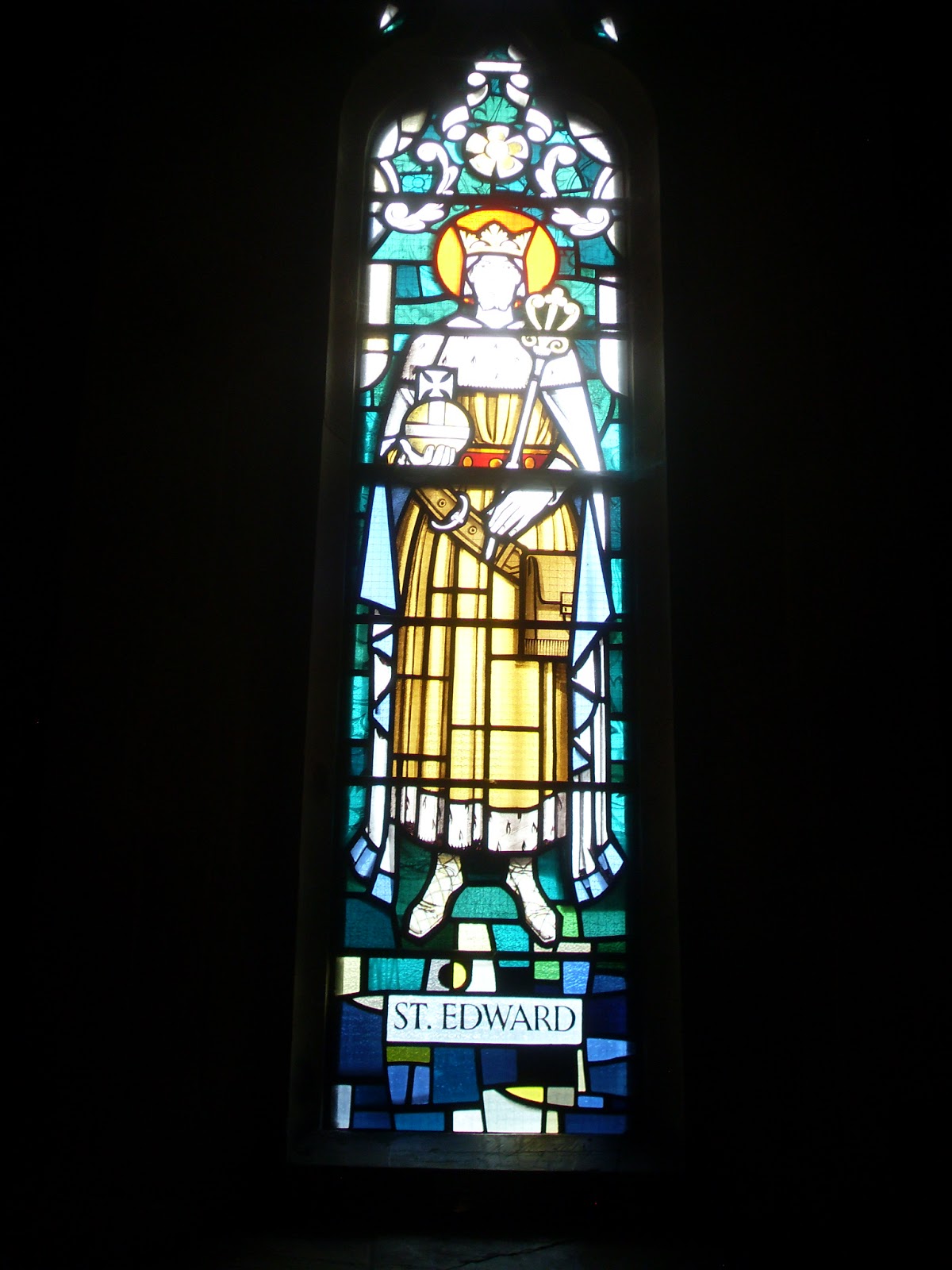
We also find Saint Edward on the left-hand side of the bottom end of the nave (when facing the altar). This is a stained glass window put up in memory of churchwarden G. Raymond Burn who died in 1993. Here the Confessor is shown wearing his regalia, but in a distinctly more royal and notably less legendary form than in the other depictions. 


The dedication of the church has also given name to at least one more place name in Dringhouses, namely St Edward's Close, as depicted below.


Websites:


tirsdag 8. mars 2016

Three meditations on mortality


I find myself very fascinated with the different ways in which mankind approaches its own mortality. Reflections on death and transience are at the core of some of the most beautiful expressions of human culture, either in art, in writing, or in music. In the present blogpost I wish to present three items that share a common engagement with death, and which have caught my attention lately.


The first item belongs to music, namely Chopin's piano sonata no. 2 in B minor, opus 35, which is most commonly known as Marcha Fúnebre, Funeral March. This is a deeply iconic piece which I myself remember to have associated with death from a very early age, since it has been used in many forms of popular culture to denote death and mortality, to such a degree that merely to hum its theme has become a non-verbal shorthand for death and funerals. 


Marcha Fúnebre, by Frédéric Chopin


The second item is from literature, and it is one I encountered for the first time only a few days ago. This is a brief poem by the Greek poet Constantine P. Cavafy (1863-1933), one of the major figures of modern Greek poetry. He lived most of his life in his native Alexandria, Egypt, with shorter residences abroad. The following poem is translated into English by Evangelos Sachperoglou and published in The Collected Poems, Oxford World Classics, 2007: 3-5.


Candles

The days to come are standing right before us,
like a row of little lighted candles -
golden, warm, and lively little candles.

The bygone days are left behind,
a dismal row of burned-out candles;
those that are nearest smoking still,
cold candles, melted and bent.

*

I don't want to see them; their sight saddens me,
and it saddens me to recall their former glow.
I look ahead at my still lighted candles.

I don't want to turn around, lest I see and shudder
how fast the darksome line grows longer,
how fast the burned-out candles multiply.


And with these last two heavy lines still echoing in the mind, I present the third and final item, this one from art, namely the death-mask of Cavafy himself, made in 1933 by an unknown artist and currently placed in the house-museum of Cavafy in Alexandria.


Courtesy of Wikimedia, Roland Unger


For similar blogposts, see:

Dance macabre

Et in Arcadia ego

Vanity of vanities


søndag 28. februar 2016

City of Books, part IV - A Temporary Library


 In my life as a student I have not been as nomadic as many of those who have followed the same path as I have. In the past eight years I have only lived in four different places during my studies, two of them have been long-term residences, others have been temporary arrangements lasting only two-three months. Currently I'm residing temporarily in a small room in a student house in York, where I'm spending about two months for the purpose of getting out of my home university to focus on some pressing tasks. I selected York as my destination because the centre where I work, the Centre for Medieval Literature, is a joint venture between the University of Southern Denmark and University of York.

I've now been here for about one and a half months, and I'm nearing the end of my time here. However, the brevity of my stay has not kept me from accumulating a library in my room. I find that this is a recurring pattern for me: Wherever I stay for a longer or shorter period of time, I always end up accumulating a library.

To me this is an inevitable development since I'm a massive bibliophile, and since I don't feel quite at home anywhere without books. In this particular case, the accumulation of the library is also helped by the fact that there are many bookshops in York, and I usually tend to drop by and leave them in turn with less money than when I came in but infinitely richer. Another factor in the current mass-accumulation is that I've taken the opportunity to buy a lot of books - especially academic books - online. As a result, my temporary library in this city of books is bigger than I first had imagined.


My current temporary library


Most of these are booty from recent bookshop explorations


Due to number of books I manage to buy in a relatively short period of time, it goes without saying that I don't manage to read the books I buy before I leave a place. But this year, however, I've happily found that I have managed to combine work and spare time in such a way that I've read at least some of the fiction I've acquired, as seen below.


One of the great surprises this time around in York was the discovery of a fairly new bookshop, The Grimoire on High Petergate, which was a welcome sight after having lost a couple of the bookshop I used to visit before. This bookshop has a lovely selection of fiction, and it was here I found a copy of Brian Jacques' novel High Rhulain, a book in the Redwall series. I was first introduced to this series five years ago when I studied in York as part of my MA, but it was not until now I got around to begin reading it. It stands as one of my best reading experiences I have ever had, and it was suitable that I should read it here in this very city. The books in this blogpost have mostly been acquired at Minstergate Books and The Grimoire.


we close our eyes to Anselm and lie calm
- Geoffrey Hill, An Apology for the Revival of Christian Architecture in England, part 10, Fidelities


The above selection is exactly that, just a selection of my temporary library, but it gives a good representations of some of the books that occupy my mind these day. I find that some books I start reading right away, and some books I need around me for some time, tempting me, before I give in and start devouring them. This is one reason why I see it as a necessity to be surrounded by more books than I manage to read, even when I know my stay will only be a short one, and my time for reading non-academic material is severely limited. Yet as a bibliophile, it is sometimes less about the reading as the inspiration to read that can be drawn from a temporal library, and this is perhaps the case this time around.


For previous blogposts in this series, see:

City of Books, part I

City of Books, part II

City of Books, part III


fredag 19. februar 2016

Epitaph for Umberto Eco - or, a personal history of reading


I do not usually indulge in public displays of grief upon the passing of renowned individuals, but I will make one of my exceptions in this case, since it concerns one of the most important authors in my life.

Umberto Eco is dead, at only 84 years, in the year after his last book, Numero Zero, was published. I was immediately grief-stricken when I heard this news, because I owe a considerable amount of my intellectual development to him.

I picked up my first book by Umberto Eco when I was 19, and I did so at an important crossroad in my life. I had just finished senior high, which in Norway covers ages 16-19, and I was about to enter into a much bigger world than I had hitherto known, a world beyond my village which is inhabited by c.400 people on a good day. I had signed up for a six-month service in the home guard starting in January 2007, as Norway still practices conscription, and I thought that that would give me time to get it over with before starting at university. Before leaving for the army, however, and while most of my friends and classmates from senior high went off to their respective adventures, I stayed home and worked with my parents on my ancestral farm, taking care of sundry duties that come with such a position.

Having been a bibliophile all my life, I was eager to spend as much time of this gap-year as I could among books. I had started to expand my literary horizon, and I began reading the books of an author whose name I had only recently become aware of through various magazines. I no longer remember which of the books I read first, whether The Name of the Rose or The Mysterious Flame of Queen Loana, but I remember reading both with great joy, and I kept reading Eco's novels, and, when I had been turned away from the army due to poor eyesight, I kept on reading until I had finished all his novels.

I was too young to get all the finer intellectual points or much of the intellectual humour of Eco's writing, and I didn't possess enough knowledge to take most of the references. But the stories, and the intertextuality and even multimodality of Eco's works whetted my intellectual appetite and expanded my ideas about prose, narrative, intertextuality and history. I had always been interested in history, and that enthusiasm encouraged me to read on despite my then relatively scant knowledge of the Middle Ages.

I began reading the works of Umberto Eco at a crucial point in my life. This was after my intellectual horizon and ambition had been amplified through senior high, and it was before I began the great intellectual challenge of university life. Eco's novels gave me an intellectual foundation and several literary reference points which allowed me to engage with university life with a sense of familiarity that I would probably not have possessed had it not been for those novels, and as such they gave me a good starting point in an environment that to many can be estranging. Moreover, the novels of Umberto Eco were also so different from what I had read before that it most likely made me realize, or at least accept, that I was beginning on something new, something bigger.

Reading Umberto Eco changed the way I thought about several things, and I owe very much of my intellectual development to his novels, to his playfulness, to his way of talking about books, to him as a person who embodies what he preaches yet who doesn't preach. My intellect matured while reading his novels, and my intellect matured at an important time in my life, as that maturity gave me the ambition to go beyond a BA degree and continue to challenge myself.

Umberto Eco is not the only author to have brought me to my present position, far from it, but his humour, his intelligence, and his storytelling laid the foundation of my intellectual life and continue to nourish me even to this day.

The passing of Umberto Eco is to me a great tragedy because I owe him so very much, and yet I never got around to telling him. Now I never will, and that adds a great deal more to the sorrow.


Narrative and Saints' Lives, part III - Drama through Dialogue, and the Legend of Saint Valentine


For this was sent on Seynt Valentyne's day
Whan every foul cometh ther to choose his mate

- Geoffrey Chaucer, Parliament of Foules

In this series of blogposts I'm looking at certain narrative aspects and techniques in the lives of the saints. Previously, I have looked at narrative technique in very short accounts, touching on how thenarrative is affected by its brevity, and also on how narratives are shaped when the legend is concernedwith a multitude of protagonists. In this blogposts, I use the legend of Saint Valentine to look how the narrative changes through the use of direct speech, as compared to a more straightforward account. As an example of the latter, I rely on the legend of Valentine as contained in the Nuremberg Chronicles and as told in the Legenda Aurea.

Saint Valentine is arguably among the most widely known saints of the world, although I think it's a fair assumption to say that the knowledge does not go very far beyond the name and his feast-day, February 14, alternately known as all hearts' day and singles awareness day. This connection between Valentine and the celebration of couples in love is attested to by the epigraph above, taken from Chaucer's Parliament of Foules, and can thus be suspected to be commonplace in the fourteenth century England. 


Almanac for February, with the bird of Valentine to the far right on the other page
BL MS Royal 17 A XVI, agricultural almanac with calendar, c.1420
Courtesy of British Library


The Nuremberg Chronicle

Another and quite pervasive story claims that the connection between Valentine and love is far older and stronger than that. According to this version, Valentine was a late Roman priest who married couples despite the prohibition against Christian marriage under imperial law. There might an old legend making such claims, and according to the Wikipedia article on Saint Valentine this story is found in the Nuremberg Chronicle, written by Hartmann Schedel and published in 1493. The Nuremberg Chronicle is a world history including many episodes from the lives of the saints. Valentine's legend is recounted on folio 122r, a folio which contains the tail end of the martyrdoms of the eighth persecutions and the beginning of the ninth persecution of the church by Roman authorities.

In the searchable online edition of Walter Schmauch's English translation of the Chronicle, this account appears to be the only one depicting the death of Valentine, and it contains no reference to marriage, only Valentine's mockery of the pagan gods. The legend goes as follows (my brackets):

[Valentine], a Roman priest, after giving evidence of exceptional learning and writing, was imprisoned by the Emperor Claudius; and being asked his opinion concerning the pagan gods, said: Jupiter, Mercury, and the other gods were miserable human beings. Afterwards he enlightened the daughter of Asterius [by healing her blindness]. He brought her and forty-nine persons of her household to the Christian faith. Finally, at the command of the emperor, he was severely beaten with clubs, and was beheaded on the 14th day of the month of February.
- Hartmann Schedel,
The Nuremberg Chronicle, translated by Walter Schmauch

The confusion regarding Saint Valentine goes very far back, as even old martyrologies contained reference to two or even three martyrs called Valentine being celebrated on February 14. One Valentine is a Roman priest, another a bishop of modern-day Terni in Italy, but both being killed during the reign of Emperor Claudius II. David Farmer in his
Oxford Encyclopedia of Saints suggests that these Valentines are one and the same.

 
Valentine interrogated
BL MS Royal 2 B VII, English psalter, c.1310-c.1320
Courtesy of British Library


Legenda Aurea

The legend of Valentine is presented in a slightly more elaborate and dramatic fashion in Jacobus de Voragine's
Legenda Aurea, written around 1260 in Italy. The elaboration consists in snippets of direct speech, but it contains no further essential details than what we find two centuries later in the Nuremberg Chronicle (although they disagree on the method of execution). The story is nonetheless markedly different, because Jacobus gives the characters of the legend their own speeches, thus making them coming alive, making them more memorable. The version by Jacobus comes after an explanation of the meaning of Valentine's name and goes as follows (my brackets):
Valentine was a venerable priest, whom the emperor Claudius [II] summoned before him. "What is this, Valentine?" he asked. "Why do you not win our friendship by adoring our gods and abandoning your vain superstitions?" Valentine answered: "If you but knew the grace of God, you would not say such things! You would turn your mind away from your idols and adore the God who is in heaven." One of the people standing by Claudius said: "Valentine, what have you to say about the holiness of our gods?" "All I have to say about them," Valentine replied, "is that they were wretched human beings full of every uncleanness!" Claudius spoke: "If Christ is true God, why do you not tell me the truth?" Valentine: "Truly Christ alone is God! If you believe in him, your soul will be saved, the empire will prosper, and you will be granted victory over all your enemies!" Claudius responded, saying to those around him: "Men of Rome, heed how wisely and rightly this man speaks!" Then the prefect said: "The emperor is being led astray! How shall we give up what we have believed from infancy?"
At this the heart of Claudius was hardened, and he turned Valentine over to the prefect to be held in custody. When Valentine came into this man's house, he said: "Lord Jesus Christ, true light, enlighten this house and let all here know you as true God!" The prefect said: "I wonder at hearing you say that Christ is light. Indeed, if he gives light to my daughter who has been blind for a long time, I will do whatever you tell me to do!" Valentine prayed over the daughter, her sight was restored, and the whole household was converted to the faith. Then the emperor ordered Valentine to be beheaded, about A.D. 280 [a date which is ten years after the death of Claudius II].
- Jacobus de Voragine,
The Golden Legend, translated by William Granger Ryan, 2012


Valentine beheaded
BL MS Royal 2 B VII, English psalter, c.1310-c.1320
Courtesy of British Library


On narrative and dramatic speech

As we see, the use of dialogue makes the story of Valentine according to Jacobus become much more captivating and dramatic than is the case in the
Nuremberg Chronicle. One important consequence is that the narrative is more memorable: Valentine is not a taciturn figure whose narrative is left solely to the narrator, he is a character in a dramatic passion play, his own passion play. Furthermore, he also becomes quotable, delivering verbal punches of Christian defiance. In addition, the legend of Valentine becomes in this way peopled by more characters with whom Valentine can perform his verbal battle, and who serve as foils for his perfect Christian truth: The emperor begins promisingly but falls because he listens to others instead of following his heart, while the prefect begins as a pagan responsible for Valentine's imprisonment but becomes the saint's Christian brother instead. These two minor personal dramas are played out within the passion story of Valentine, and we only properly access these personal dramas by way of dialogue, as the dramatic speech provide brief glimpses into the thoughts and concerns of the two antagonistic figures in the narrative.

The question then is why the legend is rendered in this way by Jacobus. One possible explanation is that he quotes directly from an existing
vita, though the lack of detail and the brevity of the narrative might suggest that he draws from his own memory rather than a specific written source. It is important to underline, that the difference between the story as presented in Legenda Aurea and the Nuremberg Chronicle does not have to do with the different genres at play, hagiography and historiography. Indeed, chronicles often contained direct dramatic speech, and the contents of these were likely to be put in the mouths of the characters by the historiographers to increase the drama or to present the complex rationale behind an action in an easily accessible way. Among the many medieval historians who practiced this kind of editorial inventiveness I want to name the tenth-century Italian bishop Liutprand of Cremona, and the twelfth-century English historian Henry Huntingdon, to suggest how widespread this phenomenon was.

Since the distinguishing feature is, in my mind, not the genre of the work, I will instead suggest that the key lies in the purpose of the work. Jacobus de Voragine wrote
Legenda Aurea as a compendium for homilists from which they could find material for their sermons on the various liturgical feasts. I therefore suggest that the dramatic dialogue serves partly as a mnemonic tool by which homilists could more easily remember the story, hence the result that the story becomes more memorable. Another point to make is that, as mentioned, Valentine becomes quotable, thus providing the homilists with material by which they can make their sermons more exciting.

A third and final point regarding the dialogue is that we might consider it as a form of
imitatio Christi. I have elsewhere written about how a debate between the saint and pagans about the nature of divinity or other subjects could be ways of imitating Christ when he was twelve and lectured the learned men in the temple. This kind of rhetorical imitatio is perhaps most famously known as performed by Catherine of Alexandria, but we can also see some of this in Valentine's dismissal of the pagan gods.

In short, I believe that Jacobus' use of dramatic speech is there to bring the story more alive to his audience who in turn had as their job to make the story more alive to their own audiences in church. It might also be that the dialogue serve to embellish a narrative about a saint of whom very little is known.

Afterthought

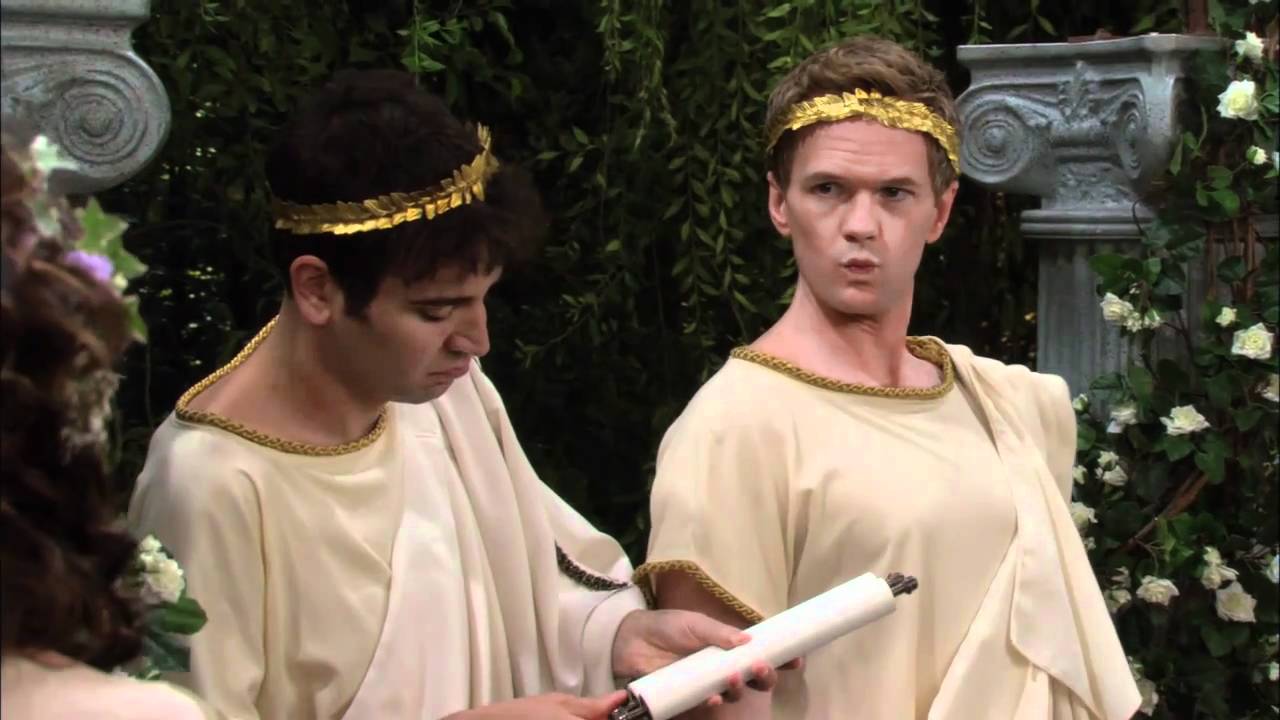
As an afterthought, Jacobus is not the only one to dramatize the story of Saint Valentine. One dramatic rendition of the legend was narrated by Barney Stinson in How I Met Your Mother, S06E16. Its veracity is dubious on many accounts, but I will let that doubt speak for itself.

Valentine and his best bro Desperatius
From HIMYM S06E16 (for the full clip, see below)

Courtesy of this website


Bibliography

Farmer, David,
The Oxford Encyclopedia of Saints, Oxford University Press, 2004

Jacobus de Voragine,
The Golden Legend, translated by William Granger Ryan, Princeton University Press, 2012

Schedel, Hermann,
The Nuremberg Chronicle, translated by Walter Schmauch, accessed at Morse Library, Beliot College, online edition: https://www.beloit.edu/nuremberg/


Websites

The Catholic Encyclopedia: http://www.newadvent.org/cathen/15254a.htm

Wikipedia: ttps://en.wikipedia.org/wiki/Saint_Valentine

søndag 7. februar 2016

Tomás Luis de Victoria in York


Ever since I began plotting my course to become a medievalist, which happened roughly in my second year at university mostly thanks to a course given by my MA-advisor-to-be, I've gained an ever-increasing appreciation of medieval and early modern music. Part of this appreciation is buttressed by the fact that I have been doing research on liturgical texts both in my MA and now during my PhD, which allows me to place the beauty of the music within a historical framework. It is not at all necessary to know anything about the development of Christian liturgy to appreciate this music, but it helps, and in my case it has been conducive to explore composers I would otherwise maybe not have heard about.  As I mentioned in a previous blogpost, I often listen to medieval or early modern music when I'm working, and I do this because it puts me in a more historically-minded state of thinking.

One of the composers I've been listening to a lot in the past year is Tomás Luis de Victoria (c.1548-1611), perhaps the best known representative of of the music of the golden age of Spanish culture, Siglo de oro, and also a great representative of the intersection of culture and religion in the wake of the Counter-Reformation, an intersection exemplified for instance by the beautiful and mystical sobriety of El Greco's paintings.

I was therefore very delighted to find that the Yorkshire Bach Choir was performing selections of Victoria's music here in York at St. Michael-le-Belfrey. The concert was held yesterday and I enjoyed two wonderful hours listening to the psalms and the excerpts from the mass as rendered by the musical sensibility of Victoria. It is music that builds cathedrals in your mind, and the melodies carried my thoughts to happy memories from my trips to Spain, and I already look forward to the next concert with Victoria's music - wherever and whenever that might be.

Unfortunately, I couldn't find videos on Youtube of the excerpts I heard yesterday, but I nonetheless take this opportunity to bring you some samples of the mastery of Tomás Luis de Victoria, whose songs I dearly love.


Officium Defunctorum


Salve regina


O Vos Omnes


Vidi Speciosam